REVIEWED BY JONATHAN LEWIS:


  THE KILLING. United Artists, 1956. Sterling Hayden, Coleen Gray, Vince Edwards, Jay C. Flippen, Ted DeCorsia, Marie Windsor, Elisha Cook, Joe Sawyer. Screenplay: Stanley Kubrick, with additional dialogue by Jim Thompson; based on the novel Clean Break by Lionel White. Director: Stanley Kubrick.

   Much has been written about The Killing, one of Stanley Kubrick’s earliest films and the template for the crime film subgenre known as the “heist film.” In many ways, the story at the heart of this crime film — a ragtag group of men planning the perfect heist of a betting track — is less important than the way in which the story is told.

   From the voiceover narration, which lends the movie a semi-documentary feel, to the reverse chronology in which certain key events in the unfolding story are depicted, Kubrick’s movie is revolutionary in the manner in which it frequently shifts the perspective from which the viewer engages with what is happening on screen.

   At first look, the movie’s protagonist/anti-hero is Sterling Hayden’s character, Johnny Clay. He’s a career criminal, once imprisoned at Alcatraz. Most significantly, he’s the brains of the whole operation to steal from a horse racetrack — an institution that is inherently suspect as it gains its money from the desperate and the downtrodden hoping to turn their money into even larger gains. (A heist film where the target was an honest, family owned restaurant, for instance, wouldn’t generate much interest, I suspect.)

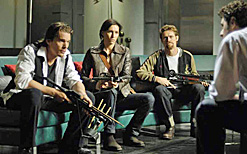
   Back to Johnny Clay, both the brawn and the brains. It was his idea to gather a group of men, including an old friend (Jay C. Flippen), a corrupt policeman (Ted De Corsia) and a chess playing wrestler (Kola Kwariani) as well as an off-kilter sharpshooter (a perfectly cast Timothy Carey) to pull off the job. He’s also got men on the inside: bartender Mike O’Reilly (Joe Sawyer) and George Peatty (Elisha Cook, Jr.), a betting room teller.

   I mentioned George Peatty last for a reason, for in many respects, it is Elisha Cook’s portrayal of a downtrodden cuckold that carries the film’s story from its desperate but oddly optimistic beginning to its violently tragic, albeit humorous, climax. It’s Johnny Clay’s story that makes The Killing a crime film. It’s George Peatty’s that makes the movie a film noir.

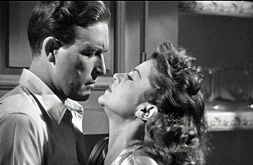
   Some five to ten minutes into the movie (I don’t remember exactly), The Killing shifts its visual focus from Hayden’s character and the preparations for the crime to the marital squabbles between George Peatty and his witty, albeit sarcastic and emotionally abusive wife Sherry (Marie Windsor). The scene in which we see the two Peattys bicker, with Sherry hurling cruel verbal jabs at her sad sack of a husband lingers longer than one might expect.

   It’s just the two of them in an apartment bedroom, with Sherry complaining that she married George thinking that one day he’d hit it rich. He’s truly in love with her, but she has next to no respect for him — a point further highlighted when it’s revealed that she’s cheating on him with a total sleaze named Val Cannon (Vince Edwards) whom she freely tells that George is part of a scheme to rob the racetrack. George may be thinking of obtaining illicit money to keep Sherry, but Sherry is thinking of taking George’s money to keep her illicit lover.

   If this all sounds like a standard double cross scenario, it’s because it is. And it’s this melodramatic aspect to the film, when combined with Johnny Clay’s quest for the perfect heist that makes The Killing not just a crime film, but also a film noir with tragic qualities.

   What makes this Kubrick film a particularly durable work is that the behavior on display here is merely instantly recognizable aspects of human behavior enhanced for dramatic effect. Johnny is a career criminal and a cynic, and while Sterling Hayden’s character is cool and full of swagger, he’s not all that interesting.

   The same cannot be said about George (Cook in a standout role, one in which his eyes reveal the depth of his soul). He’s a weak man who wants so badly to please his wife that he’s willing to commit a felony to do so and it’s his story — from his pathetic entreaties to his wife at the very beginning to his willingness (Spoiler Alert) to cut her down in cold blood — that makes The Killing a fascinating look into human greed and urban despair.

“When Things Go Wrong” appeared on the first of three albums this group released for Warner Brothers in the early 1980s. It was their best known hit.

THE BACKWARD REVIEWER
William F. Deeck


MANNING LONG – Vicious Circle. Duell Sloan & Pearce, hardcover, 1942. Croyden (#1), digest-sized paperback, 1945.

   When Liz Parrott and her husband, Gordon, are invited to spend Christmas with Gordon’s snobbish Aunt Hester and her family in Upper Cutting, New York, Liz does not want to go. There is, though, more to the invitation, for Aunt Hester apparently wants Gordon’s detecting skills more than she wants him and his wife for social purposes. Of course, once the Parrotts arrive, Aunt Hester won’t discuss whatever problem she had in mind. Even after the murder, she remains mum.

   I have read only one other Liz Patron novel, without Gordon, and it was a good one. This fairish-play book may appeal to husband-and-wife-team fanciers, if they don’t mind childish jealousy and a fair number of tantrums by all concerned, and to those who enjoy biblio mysteries (the biblio part is a best-selling study of the Soviet Union). The only sensible character here — even Gordon stupidly puts Liz in jeopardy, and Liz just as stupidly compounds his folly — is the cat I-Am, who unfortunately has no control over circumstances and has an undeservedly rough time.

— Reprinted from MYSTERY READERS JOURNAL, Vol. 7, No. 3, Fall 1991, “Holiday Murders.”


Bio-Bibliographical Notes:   Says Al Hubin of Manning Long in Crime Fiction IV: “Her husband Peter Wentworth Williams was a noted ceramist who designed the Mystery Writers of America’s Edgar Award.” Bill Deeck’s review of the other book he mentioned might be that of Short Shrift, which you can find here, and where you can find a list of all the Liz Parrott novels. In the comments, Bill Pronzini adds some additional information about both Liz and Gordon Parrott, including the fact that the latter is an investigator with the NYC District Attorney’s office

S. S. VAN DINE – The Garden Murder Case. Charles Scribner’s Sons, hardcover, 1935. Serialized in Cosmopolitan magazine, July-October, 1935. Paperback Library 52-193, paperback, February 1963.

   I left a comment on this blog a few days ago following my review of Death Stops the Bells, by Richard M. Baker, an author who it was easy to see was well-versed in the Van Dine approach to detective fiction. I didn’t care for Baker’s book very much, though, and in that comment I mentioned I was reading this one, and how much more easily Van Dine was able to keep a talky detective story moving, whereas Baker had considerable difficulty doing so.

   Sometimes, however, it is better to keep your mouth closed when talking about a book you haven’t finished yet, and this is one of those times. The first three-quarters of Garden Murder Case is very good — I haven’t changed my mind abut that — but I found the ending rushed and forced. Too much of a very complicated plot is condensed into too short a space.

   Dead is a man who had just wagered ten thousand dollars on a horse that did not even finish in the running. Suicide? Everyone but Philo Vance thinks so, and soon enough he is able to explain why. Next a nurse is attacked in a vault in the same house with a poisonous gas, then Floyd Garden’s mother is found dead from an overdose of a sleeping potion.

   All kinds of interesting questions and conflicting accusations arise, the latter between the other guests to the “betting party” at the Garden mansion, and even Vance’s lazy drawls and dropped g’s can easily be tolerated. Where the book doesn’t jell is, as I suggested earlier, is the ending. The undoing of the mystery is far too complicated, depending on chance events and events that were planned by the killer and those that didn’t happen, and Van Dine has to try too hard to make us, the reader, swallow it all.

   It is strange that I found only the one paperback reprint of this book, nor very few others reviews of it online. I suspect that I may not be the only reader who’s found this one disappointing.

From this 13-piece Canadian jazz-rock fusion band’s second album, Suite Feeling, released in 1969. The higher the volume, the better it sounds:

THE DARK CORNER. 20th Century Fox, 1946. Lucille Ball, Clifton Webb, William Bendix, Mark Stevens, Kurt Kreuger, Cathy Downs, Reed Hadley. Screenplay: Jay Dratler & Bernard Schoenfeld, based on a story by Leo Rosten. Director: Henry Hathaway.

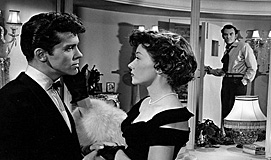
   This is one of those movies that whenever I watch it again, I see things in it that I hadn’t noticed the first time. That may be true of many good films, but for me, it’s especially true for noir films, which this most definitely is.

   Mark Stevens plays PI Brad Galt, who’s trying to pick up the pieces in New York City after having had a plague of bad luck (and a jail term) out in California. But when you’re down, sometimes it seems that the rest of the world just wants to pile on. Only his new secretary, played to perfection by Lucille Ball, seems to care, and she’s the one who tells him that he’s being followed by a thuggish man in a white suit (William Bendix), posing as a down-at-the-heels private eye.

   I say “posing,” but even if he really is a PI, it’s soon clear enough that it’s a setup. Details need not be gone into, but it may suffice to say that at the other end of Manhattan society — the world of high society and culture — is an art dealer (Clifon Webb) who is having problems with his wife, and he thinks he can get the unwitting Brad Galt to help him take care of it.

  &nbsrp;It’s a complicated plot, and it takes all of the movie’s 99 minute running time to get everything established solidly enough that events can take their natural course. Galt is being set up, he knows it, but he has no clue who’s behind it, or why.

   Only the mother hen approach of his faithful secretary can keep him focused on avoiding the frame-up he’s all but wrapped up in. There’s no nonsense about it, either. She makes that clear enough right away.

   So there are elements of Cornell Woolrich’s Phantom Lady in this story, with even stronger overtones of Laura, though I don’t believe I can persuade you that this film is better than either. Nonetheless, it is very good, and so are the players, especially the beautifully sassy but still innocent Lucille Ball, whom one wishes had had the opportunity to appear in more noir films as good as this one.

      PS: What I was able to take the time to notice during this most recent viewing was the camerawork and black-and-white photography of Joseph MacDonald (Call Northside 777, Pickup on South Street). Superb! Next time you watch this film, see if you don’t agree.
   

From this New Wave singer-songwriter’s LP Girl’s Night Out (RCA, 1981). Since 1993 she has been the lead singer for the group Blue by Nature.

REVIEWED BY JONATHAN LEWIS:

THE CYCLE SAVAGES. Trans American Films, 1969. Bruce Dern, Melody Patterson, Chris Robinson, Maray Ayres, Karen Ciral, Mike Mehas. Written and directed by Bill Brame.

   Bruce Dern is at his unhinged, psychologically disturbed best in The Cycle Savages, a mediocre biker movie with a threadbare plot. Filmed on location in the Silver Lake and Echo Park neighborhoods of Los Angeles, the movie is a rather downbeat affair. Dern’s portrayal of Keeg, the leader of a biker gang engaged in the white slavery racket, is so viscerally raw and cruel, that one forgets that one is even watching a fine actor at work.

   But it takes more than a dastardly villain to make a movie work. It also takes a hero. In Cycle Savages, we really don’t get much. The only person in the neighborhood who seems willing to stand up to Keeg is Romko (Chris Robinson), a pensive, sensitive artist originally from the Eastern Bloc. Unfortunately, Robinson’s portrayal of Romko doesn’t exactly leave one feeling inspired. At least he has a pretty girl at his side. Lea (Melody Patterson) is playing both ends against the middle. She’s working for Keeg, but also falling in love with Romko. If this doesn’t seem to entice you, then I’d suggest that you’re not going to find much in the plot to keep you interested.

   What makes this film somewhat worth a look – aside from Dern’s over the top madman portrayal – is the fact that it’s very much a slice of life from a specific place at a specific time. One imagines that the filmmakers had some sense of the sleazy biker counterculture that existed in late 1960s Los Angeles and how a biker gang could really ruin a neighborhood. There is actually a great deal of meanness on display here, including an implied gang rape scene that would be difficult to put on screen today.

   But is there a message in the movie? Or is it just sheer exploitation? If it’s the latter, the movie could have benefited from some more memorable characters and better music. One can thoroughly appreciate Dern as an actor, but a movie needs more than a vindictive, misogynistic villain to make it worth the price of admission. Caveat emptor.

DENISE SWANSON – Murder of a Sleeping Beauty. Signet, paperback original; April 2002.

   As far as the recent crop of cozy mysteries goes (since the turn of the century) this may be one of the better written ones. Since Sleeping Beauty is the third of now nineteen in the series of crime-solving adventures of school psychologist Skye Denison, it is certainly among the ones that have run the longest.

   It does not hurt that Denison has a “real” job, not an extension of a hobby turned into a something hopefully more. It also does not hurt that Swanson can write, with plenty of witty asides about the life of a school psychologist, especially in regard to superiors as well as the students themselves — she was one for seventeen years.

   Dead in this book is one of Scumble River’s most popular seniors, a girl who was a cheerleader, had the leading role in the school’s upcoming play, and was the winner of many past beauty pageants. As expected, Swanson does not think well of the latter, especially the mothers who constantly push their children too fast and too far.

   The message is more important than the mystery, or so it seemed to me, but I am not among the target audience for books such as this, nor, I suspect are most regular readers of this blog, who probably are ill-equipped to handle mysteries in which the leading sleuth has had romantic relationships, mostly ill-fated, with the chief of police, the city coroner, and the new teacher on the staff.

   Pluses and minuses, therefore. You’ll just have to figure out which apply to you.

REVIEWED BY BARRY GARDNER:


K. C. CONSTANTINE – Bottom Liner Blues. Mario Balzic #10. Mysterious Press, hardcover, 1993; paperback, 1994.

   This is the first Balzic book from Constantine in three years. He doesn’t churn them out; the first in the series appeared in 1972. He has achieved an enviable reputation not only as a mystery writer, but a writer of regional fiction.

   Mario Balzic is the 64 year-old Chief of Police in Rocksburg, Pennsylvania, a thoroughly depressed and depressing area of the state devastated by the collapse of the coal mining and steel industries. He’s feeling his age. His mother died not too long ago, and this triggered an ongoing reevaluation by his wife of their marriage and her life; he’s having minor problems with a City Father, and the area is undergoing a record drought and heat wave.

   As the book opens, he is confronted with two problems. First, he’s called to the boondocks to talk to a woman with a small child, who spins a disjointed tale of a husband who is threatening to kill the man married to his ex-wife for abusing his children. The woman won’t reveal her name or her husband’s, but does give Balzic the name of the alleged abuser.

   Second, a Russian-American writer he knows slightly is causing problems in his favorite bar, ranting and raving and running the customers off. From these two things the rest of the book flows, and the larger part from the latter.

   This may be good regional fiction; I don’t think so, but it may be. It isn’t a good crime novel. More than anything else it is a sustained diatribe, by the Russian, by Balzic’s wife Ruth, by Balzic himself. Page after page after page consists of pure dialogue or monolog deploring everything from the economy, to a woman’s role in life and marriage, to the unfair way America treats its writers, to life in general. It is a sustained cry from the hearts of several unhappy people, some of them desperately so. One wonders about Constantine himself.

   As always in Constantine’s books, the characterization is sharp and in depth, and his ear for regional dialect is superb. There is no real plot, no real sense of resolution; this is slice of life stuff. Narration is minimal — if the speeches were removed, I doubt the book would be fifty pages long. Bottom Liner Blues may be a good, even a fine, book; that, of course, is as always a matter of subjective evaluation. What it isn’t is a murder mystery, a detective story, or even a crime novel. What it is in my opinion is an exercise in self-indulgence.

— Reprinted from Ah Sweet Mysteries #6, March 1993.


Bibliographic Note:   There are 17 books in this series, appearing between 1972 and 2002.

« Previous PageNext Page »