REVIEWED BY DAVID VINEYARD:


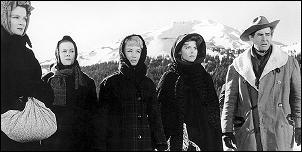
HEAVEN ONLY KNOWS. United Artists, 1947. Re-released as Montana Mike. Robert Cummings, Brian Donlevy, Marjorie Reynolds, Jorja Curtwright (debut), John Litel, Bill Goodwin, Stuart Irwin, Gerald Mohr, Edgar Kennedy, Lurlene Tuttle, Peter Miles, Glenn Strange. Screenplay: Art Arthur & Rowland Leigh. Adaptation by Ernest Haycox from a story by Aubrey Wisberg. Directed by Alfred S. Rogell.

   Heavenly fantasy dates back a while, but it took a foothold in Hollywood with Here Comes Mr. Jordan, and by the late forties was a genre unto itself with such heavenly(and diabolical) helpers as Claude Rains, Laird Cregar, Henry Travers, Cary Grant, Clifton Webb, and Cecil Kellaway taking a hand in human affairs.

   This time out the angel in question is Robert Cummings, as Michael, who discovers as the film opens that a mistake has been made in the heavenly bookkeeping: Adam “Duke” Byron (Brian Donlevy) has been born without a soul, and thus won’t fulfill his destiny. In fact, he is already two years behind time in marrying Drusilla (Jorja Curtwright), the daughter of a reverend (John Litel), and that union looks unlikely since Duke Byron runs a saloon and gambling hall and is embroiled in a deadly power struggle with his partner in the Glacier, Montana mine, Bill Plummer (Bill Goodwin).

   With that in mind, Michael is dispatched to Earth to correct the problem, and a bigger babe in the woods there never was, save for the fact he is an archangel though without his cloak of immortality and forbidden to use his powers.

   Glacier proves no paradise. The feud between Duke and Plummer means the mines have been shut down for two months and the desperate miners and townsfolk, led by Drusilla, are ready for vigilante justice. Laconic Sheriff Bodine (Stuart Irwin) talks them into waiting as he hopes to play Byron and Plummer off each other until only one of them is left, and things get quickly more complicated when Plummer makes sure Duke thinks Michael is the Kansas City Kid hired to kill him.

   Then there is Duke’s gunslinger, Treason (Gerald Mohr), who doesn’t like the look of Michael one bit, and with good reason, as there is more than a hint of sulfur and brimstone about him. Heaven isn’t the only one interested in Duke Byron (a good running joke has Treason’s match going out whenever Michael is near him).Michael saves Duke from the real Kansas City Kid, and becomes his friend, but his job is only starting.

    Heaven Only Knows is a curious mix of fantasy, religion, comedy, romance, sentimentalism, and traditional Western elements, the latter no doubt given a boost in the screen treatment by veteran Western writer Ernest Haycox (“Last Stage to Lordsburg,” Canyon Passage, The Adventurers). Brian Donlevy plays the familiar role of good bad man (we know he is good because an ill little boy, Skitch, played by Peter Miles, and drunk storytelling Judd, played by Edgar Kennedy, are loyal to him).

   Cummings angel steals the show, by turns naïve, otherworldly, strong, and scheming, finding himself a bit tempted by saloon girl Ginger (Margorie Reynolds) who begins to fall for him.

   Along the way there are ambushes, two rescues from burning buildings, a showdown “Montana” style between Duke and Plummer, a few sermons, a lynching where Duke finally finds his soul, and a three hanky ending designed to leave no eye in the house dry.

   At times a bit preachy, and sometimes corny, I don’t imagine too many of today’s audiences will care for it, but if you like this genre well done, and would like to see Cummings stretch his wings a bit (sorry) Heaven Only Knows is an odd semi-lost film well worth finding, and easily the most unusual of a genre that still pops up on big and small screens today.

JOHN CREASEY – Hang the Little Man. Charles Scribners Sons, US, hardcover, 1963. Berkley F1280, US, paperback reprint, October 1966. First published in the UK: Hodder & Stoughton, hardcover, 1963.

   Although published in the early 1960s, Hang the Little Man has a really old-fashioned feel to it. That may be in part because the crimes involved are so relatively unimportant. A series of robberies from small neighborhood grocery shops (the little men of the title) are taking place all across London. All that are taken are cigarettes and whatever cash is found in the drawers.

   Superintendent Roger “Handsome” West suspects that these thefts are not the actions of lone individuals, but rather that some mastermind is behind them. It is not until one woman alone in her shop is murdered that West’s superiors yield to his arguments and allow him to set up a task force to find out who’s responsible.

   And somehow author John Creasey manages to build into his tale enough twists and turns to fill out a novel, and I feel I must warn you that not everyone manages to get through it alive or not seriously maimed, beginning with the first victim, a wife pregnant with the couple’s first child. Make that two victims.

   It all makes for interesting but rather shallow reading, with an ending that comes with a huge explosion of action and confusion that sorts itself at the very end with some surprising … well, let’s say perhaps my suspicions were correct. Creasey had something up his sleeve all along.

A song from the self-titled debut album (1971) of the jazz-fusion group Chase. Key members included trumpeter Bill Chase and vocalist Terry Richards.

FRANCIS M. NEVINS, JR. – Corrupt and Ensnare. G. P. Putnam’s Sons, hardcover, 1978. iUniverse, softcover, 2000. Ramble House, softcover, 2013.

   Deeply involved in lawyer-detective Loren Mensing’s second mystery adventure are a contested will, a multi-million-dollar corporation with a history of working hand-in-glove with the CIA, and the not yet extinguished brand of ultra-liberalism left over from the 1960’s. It begins with a shoe-box full of money found in an old friend’s study after his death, raising a pair of unanswered questions: had the judge really once accepted a bribe influencing one of his court decisions, and if so, why?

   If you like your detective puzzles rigorously tough, the tangled plot Nevins has in store for you is intended to challenge`your little grey cells to the limit. Now and then there is a regrettable emphasis on the overdramatic and the bizarre, but there’s a lot of punch packed into these pages, and it’s a reading experience that shouldn’t be missed.

— Reprinted from The MYSTERY FANcier, Vol. 3, No. 1, Jan-Feb 1979.


   The Loren Mensing series

Publish and Perish. Putnam, 1975.
Corrupt and Ensnare. Putnam, 1978.
The 120-Hour Clock. Walker, 1986. [also with Milo Turner]
Into the Same River Twice. Carroll & Graf, 1996.
Beneficiaries’ Requiem. Five Star, 2000.

A 1001 MIDNIGHTS Review
by Kathleen L. Maio


JOSEPHINE BELL – Curtain Call for a Corpse. Macmillan, US, 1965. Perennial, US, paperback, 1988. First published in the UK by Longmans, hardcover, 1939, as Death at Half-Term.

   Josephine Bell (whose real name is Doris Bell Ball) has practiced two professions. She began her career as a physician in the 1920s, when it was an unusual field for a woman. Since 1937 she has practiced a trade more expected of British gentlewomen — the writing of mystery and suspense stories.

   In recent years, Bell has specialized in non-series suspense stories, but she started her writing career with a series of classic mysteries starring David Wintringham. Her amateur sleuth is, appropriately enough, a doctor. His police counterpart is Inspector Mitchell, who does not always appreciate Dr. Wintringham’s interference.

   Wintringham’s fifth case takes him to the Denbury (boys’ prep) School, where he is conveniently related to the headmaster and one of the students. Half-term weekend traditionally features both a father-son cricket match and a theatrical performance. This year’s performance of Twelfth Night by a third-rate touring company becomes highly memorable when an ill-tempered actor collapses with a bashed skull as the curtain falls.

   Wintringham, who attends the dying actor, becomes even more interested in the case when it is discovered that members of the school’s staff may also have had reasons for wanting the victim dead. There is plenty of detecting to go around. Mitchell, Wintringham, and an enthusiastic band of young students all have a share of collecting clues and interviewing suspects. The result is a nicely complex investigation, punctuated by a cricket match and climaxing in a classic gathering of the suspects and confrontation with the murderer.

         ———
   Reprinted with permission from 1001 Midnights, edited by Bill Pronzini & Marcia Muller and published by The Battered Silicon Dispatch Box, 2007.   Copyright © 1986, 2007 by the Pronzini-Muller Family Trust.

       The Dr. David Wintringham series —

* Death on the Borough Council. Longmans, 1937.
* Murder in Hospital. Longmans, 1937.
* Fall Over Cliff. Longmans, 1938.
* Death at Half-Term. Longmans, 1939.
From Natural Causes. Longmans, 1939.
All Is Vanity. Longmans, 1940.
Death at the Medical Board. Longmans, 1944.
* Death in Clairvoyance. Longmans, 1949.
* The Summer School Mystery. Methuen 1950.
* Bones in the Barrow. Methuen 1953.
* The China Roundabout. Hodder 1956.
* The Seeing Eye. Hodder 1958.

(*) Inspector Steven Mitchell also appears. The latter had one case to solve on his own, and three with barrister Claude Warrington-Reeve, who had no solo appearances.

From Oklahoma singer-songwriter John Fullbright’s debut studio release From the Ground Up, a 2013 Grammy nominee for Best Americana Album:

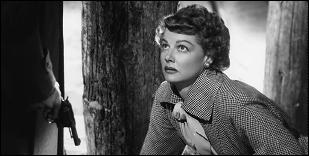
THE OCTOBER MAN. General Films, UK, 1947. Eagle Lion, US, 1948. John Mills, Joan Greenwood, Edward Chapman, Kay Walsh, Joyce Carey, Catherine Lacey, Frederick Piper. Producer-Screenwriter: Eric Ambler. Director: Roy Ward Baker.

   This modestly budgeted but sharply produced British thriller from the late 40s shows, I think, what a good directer and an excellent cast can do with a so-so story, which is to say, one that keeps the viewer watching with considerable interest, if not out-and-out edge of the seat suspense, from beginning to end.

   John Mills plays a man haunted by a bus accident in which he survived, albeit with a serious head injury, while the little girl who was accompanying him was killed. Trying to put his life as a chemist (not a British pharmacist) back together, he finds a place to live in a middle class boarding house, in which the residents essentially live together, knowing each other’s secrets, or they think the do, and when they don’t, they make up their own.

   When a young girl in the room next door whom Mills briefly befriended is murdered, the gossipers go hard to work, and the police, learning quickly of his previous head injury, even more quickly believe they have their man. Luckily Mills has found a girl friend (Joan Green wood) who still believes in him, even when it appears that all hope is lost.

   Photographed stylishly in stark shades of black and white, this is a movie that may have been made quite independently of the noir movement in the US, but all the ingredients are there. A solid piece of film-making.

AGATHA CHRISTIE – Poirot Loses a Client. Dodd Mead, US, hardcover, 1937. First published in the UK by Collins, 1937, as Dumb Witness. Reprinted many times in both hardcover and paperback, including New Avon Library #10, 1945 (shown).

   This one starts out in much the same way as the previous Hercule Poirot novel reviewed by me on this blog, Funerals Are Fatal; that is to say, by introducing in some detail a family with a wealthy matriarch (in this case) and (also in this case) a younger set, all of whom can use some money. Needless to say, for at least one of whom, sooner is far better than later.

   Begun thus in similar fashion, the two books diverge from here. In Client, Poirot’s good friend, Captain Hastings is on hand to tell the tale, in first person. And Poirot is on hand much sooner, only 35 pages in. But not soon enough: the letter he receives from Emily Arundell, wishing to avail herself of his services, is too late. She has passed away, her death having occurred over two months earlier.

   Reading between the lines of the letter, Poirot takes it upon himself to investigate. By all accounts, Miss Arundell died of natural causes, although there is the matter of the near fatal accident she had had a week or so before.

   I think it helps to have Hastings along as a companion to Poirot on one of cases. Hastings is intelligent enough to tell the story carefully and well, with witty asides about incidents as they happen and the people they meet, but he’s not quite bright enough to put the facts together as swiftly as does M. Poirot. This is not an insult. Neither am I.

   Part of Agatha Christie’s success is how easily she makes it seem to describe people and who they are in a minimum of words. This is what makes it possible for Poirot to solve the case by relying almost solely on the conversations he has with all of the people involved. Some of whom are suspects, others not, but they all have different perspectives on the facts, and all are useful in determining who the killer or killers may be.

   Who this may be is revealed, in my opinion, too early, even before the family is gathered together for a final denouement. The solution is an anticlimax this time around, which is something not at all usual for Agatha Christie in my experience, but until then, there is plenty of story for the inveterate armchair detective to puzzle over. Those readers looking for lots of action, stay away.

REVIEWED BY BARRY GARDNER:


LARRY BEINHART – Foreign Exchange. Tony Cassella #3, Harmony, hardcover, 1991. Ballantine, paperback reprint, 1992.

   Ex-PI Tony Cassella is now living in an Austrian ski village, on the run from the IRS, who have been sicced on him by powerful enemies made in earlier cases. He’s a budding entrepreneur with a string of laundromats, and a soon-to-be father with a pregnant ladyfriend.

   Asked to investigate a skiing death by avalanche, he finds the case all mixed up with international intrigue, Japanese business conglomerates, and various government agencies. Someone tries to kill him, his lady has the baby (a girl), both mothers in-law come to visit (from France and the USA), and it all just gets complicated as hell.

   The characters are the best part of the book; most of them are realistic, if not always sympathetic. The plot’s a little fanciful, though, and overall I’d give it only a fairly good plus.

— Reprinted from Fireman, Fireman, Save My Books #5, January 1993.


       The Tony Casella series

1. No One Rides for Free (1986)
2. You Get What You Pay for (1988)
3. Foreign Exchange (1991)

Note:  No One Rides for Free received the 1987 Edgar Award for Best First Novel.

  JOHN A. SAXON – Liability Limited. M. S. Mill, hardcover, 1947. Ace Double D-81, paperback reprint, 1954; published back-to-back with Too Many Sinners, by Sheldon Stark. Pulpville Press, trade paperback, 2009.

   This is the first of two recorded cases L.A.-based insurance investigator Sam Welpton happens to have been involved in. Both were published under Saxon’s name, but the second, Half-Past Mortem (Mill, also 1947), was ghost-written by famed pulp writer Robert Leslie Bellem after Saxon’s death that same year. (My guess is that they were friends, and Bellem stepped in to help fulfill a contract, but that is only a guess. I have no sources whatsoever to support this statement.)

   Whatever the circumstances, one could wish for a better book. It’s competently written, but the story is far too complicated and there’s no zip nor drive to it. What may keep you reading as it did me is the fact that there is an “impossible” crime aspect to it.

   Welpton is interviewing an interested party in a fatal accident when the fellow suddenly looks behind Welton, pulls out a gun, but before he can shoot, he dies with a bullet hole in the middle of his forehead. What the problem is, as far as Welpton is concerned, is that the door behind him is chained in such a way it can open a few inches, and the shooter would have had to have been a contortionist to shoot with such accuracy at an impossible angle.

   That’s the interesting part of the tale. Not so interesting is the local chief of police who has a solid grudge against Welpton from a previous encounter, and if there were a means of pinning the murder on him, he’d do it. Since he can’t, he beats him up anyway.

   This all happens in the first 22 or 23 pages. There must be a connection between the murder and the fatal accident, but what? Welpton encounters a long list of other characters as he tries to clear his name, none more than mildly interesting, gets shot at, finds another dead murder victim, this one female, and so on. This is all competently done, to repeat myself, but even if you like reading old paperback mysteries solved by PI’s, even of the Hollywood variety, you can definitely do better than this one.

« Previous PageNext Page »