A Review by MIKE TOONEY:
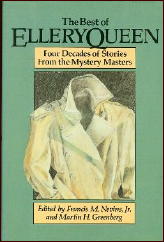
THE BEST OF ELLERY QUEEN: Four Decades of Stories from the Mystery Masters – Francis M. Nevins, Jr., and Martin Greenberg, Editors. Beaufort Books, hardcover, 1985.
Here’s a fine collection of fifteen short stories by Ellery Queen that truly are representative of the two cousins’ output from 1933 to 1967. On occasion some of these stories possess the plot complexity of most of the novels, but usually they keep it simple — simple, but not necessarily easy! (Indeed, how much ready knowledge do YOU have of Roman mythology, philately, Lewis Carroll, spoonerisms, American history, and wedding anniversary lore?)
In his introduction Francis M. Nevins, Jr. is aware of how most Golden Age of Detection fans who have read Ellery Queen are familiar with the Philo Vance clone that was the early Ellery and the later, more socially involved Ellery. However, Nevins goes on to delineate four distinct phases in the career of our master sleuth, each one greatly influenced by market considerations and personal events in the lives of the two cousins who were “Ellery Queen”:
â— Ellery I (1929-1935): The Van Dine-ian character “detached from the terrible events around him” and, in Manfred Lee’s later, rueful assessment, “the biggest prig that ever came down the pike.” But, oh, those problems! “On a smaller scale,” writes Nevins, “the best of their Period One short stories are like their early novels: richly plotted specimens of the Golden Age deduction puzzle, bursting with bizarre circumstances, conflicting testimony, enigmatic clues (including that uniquely Queenian device, the dying message), alternative solutions, fireworks displays of virtuoso reasoning, and a crackle of intellectual excitement.”
â— Ellery II (1936-1940): The Maestro “gradually loses his priggishness and becomes more human. Compared with the Period One classics, much of the cousins’ output of the late 1930s suffers from intellectual thinness, a surfeit of so-called love interest (meaning tedious boy-meets-girl byplay), and characters tailored to please story editors at the slick magazine suites and the studios. But in the longer view,” says Nevins, “they managed at least in part to open up the deductive puzzle and make room within its cerebral rigor for more of the virtues of mainstream storytelling.”
â— Ellery III (1941-1958): Fred Dannay, “the historian and bibliophile of the partnership”, founded EQMM, and he and Manny Lee “inaugurated their third and richest period as writers … which embraced twelve Queen novels and two short-story collections”; “the cousins fused complex deductive puzzles with in-depth characterization, finely detailed evocations of place and mood, occasional ventures into a topsy-turvy Alice in Wonderland other world, and explorations into history, psychiatry and religion.”
â— Ellery IV (1959-the end): “After five years of almost complete fictional inactivity, a fourth period opened with The Player on the Other Side (1963). These late Queens are marked by a zest for experiment within the strict deductive tradition and a retreat from all semblance of plausibility into what Fred liked to call ‘Fun and Games,’ i.e., a potpourri of stylized plots and characters and dozens of motifs recycled from earlier Queen material.”
Nevins’ introduction is admirably concise and informative, touching on the triumphs and tragedies the two cousins experienced in a long, productive, and illustrious career.
The Stories:
1. “The Glass-Domed Clock” (First Appearance: Mystery League, October 1933).
Where: New York City. When: March 7, 1926. Problem: Martin Orr, “the celebrated little Fifth Avenue curio dealer whose establishment was a treasure-house of authentic rarities,” has been brutally murdered. He evidently leaves behind an element that Ellery Queen often returned to, the dying clue: In one hand he is clutching a birthstone, with a broken antique clock lying beside his body. Suspects: At least seven likely ones.
Motive: Inspector Queen says, “This is a grudge kill, son”, but is it? — It was “a problem in which such components as the following figured: a pure purple amethyst, a somewhat bedraggled expatriate from Czarist Russia, a silver loving-cup, a poker game, five birthday encomiums, and of course that peculiarly ugly relic of early Americana catalogued as ‘the glass-domed clock’ — among others!”
The murderer makes several mistakes in (1) overthinking the crime, (2) assuming others know as much as s/he does, and (3) not reckoning on the formidable intellectual powers of Ellery Queen (who, by the way, needs fully one third of the story — six pages — to explain his chain of reasoning).
2. “The Bearded Lady” (First Appearance: Mystery, August 1934, as “The Sinister Beard”)
Where: Long Island, New York. When: Unspecified. Problem: A doctor, Terence Arlen, due to inherit one hundred thousand dollars from a recently changed will, is found stabbed to death with a Florentine stiletto. As an amateur artist, he could be expected to have an easel nearby — but why does his copy of a Rembrandt masterpiece feature a Dutch housewife with a beard?
Suspects: A mansion full of people, none of them with alibis. Motive: We are talking about a fortune in inheritance, right? — The murderer takes modesty to new extremes. Here is Ellery on how he perceives himself: “… he was also a detective — an appellation he cordially detested.” Ellery on his own limitations: “I don’t go about pulling murderers out of my hat.” And Ellery on life in general: “The world’s all right; the trouble is the people in it.”
3. “The Mad Tea-Party” (First Appearance: Redbook, October 1934. Filmed for TV in 1975 with Jim Hutton as Ellery, David Wayne as Inspector Queen, Tom Reese as Sergeant Velie, and an all-star cast as the victim and various suspects.)
Where: Long Island, New York. When: Unspecified. Problem: Richard Owen, Wall Street maven and peccant husband, goes missing shortly after a dress rehearsal of a play. In order to solve the mystery of his disappearance, Ellery must resort to psychological subterfuge — once he has resolved the conundrum of the disappearing wall clock.
Suspects: A white-haired old lady, the house staff, the March Hare, the Dormouse, a BIG girl named Alice, and a nine-year-old spoiled brat. Motive: About as ancient as they come. — Golden Age aficionados who have seen the TV version may remember the name changes of the characters to the surnames of Golden Age authors of the ’20s and ’30s (Doyle, Allingham, etc.). They may also recall how closely the script hewed to this story and that “The Mad Tea-Party” was the only original EQ work adapted for the Jim Hutton series.
4. “Man Bites Dog” (First Appearance: Blue Book, June 1939)
Where: New York City, the Polo Grounds. When: During the seventh game of the World Series.Problem: Big Bill Tree, one-time baseball great, collapses during the game. The doctor determines he has been poisoned orally by ingesting prussic acid — but how: in his hot dog as everyone assumes, or was there some other means?
Determining HOW, as Ellery knows, will lead straight to the WHO. Paula Paris’s problem is much more difficult: getting Ellery involved in the case, because as a rabid baseball fanatic he refuses at first to give it any attention at all.
Suspects: Fifty thousand of them, plus the Yankees’ bench players and a kid from the Bronx who’s an autograph hound. Motive: That old reliable standby, jealousy, mixed with contempt. (Note: Official records show that the only time the Giants and the Yankees played more than six World Series games was in 1921 — eight outings — when both cousins were about sixteen.)
5. “Mind Over Matter” (First Appearance: Blue Book, October 1939)
Where: New York City, the Stadium. When: Unspecified. Problem: Mike Brown, the former heavyweight boxing champion, is found murdered in the back seat of a roadster shortly after losing the title. Since he’s been stabbed ten times, Ellery’s comment seems apt: “Someone’s used him for a pin-cushion.” But there’s also that little matter of Ellery’s missing coat….
Suspects: Thirteen men, several managers, and one curvaceous ex-wife. Motive: Money, fame, respect, ego commingled. — Another case wrapped up on the spot. With today’s DNA forensics, the murderer would have been nailed eventually, but Ellery tends to work a lot faster on average.
6. “The Inner Circle” (First Appearance: EQMM, January 1947)
Where: New York City and Scarsdale. When: The week after Christmas 1946 (year inferred). Problem: The members of the Inner Circle of the Januarians Alumni Club (a tontine) are dropping like flies and one of the survivors suspects murder. Shortly after hiring Ellery to investigate, however, “he himself is found lying in a gully with four thousand pounds of used car on top of him.”
Suspects: Three. Motive: “$200,000 worth of negotiable securities.” — Eventually Ellery finds “the college denominator” that solves the case, using the POE (Process of Elimination) method.
7. “The Dauphin’s Doll” (First Appearance: EQMM, December 1948)
Where: New York City, the Queens’ apartment, and Nash’s Department Store. When: December 23-25, 1947 (year inferred). Problem: A huge collection of dolls — including one with an expensive stone set in it — are to be displayed in a bustling department store on Christmas Eve.
All well and good, but a master thief calling himself Comus vows that he will steal the valuable doll regardless of how much protection Inspector Queen, Sergeant Velie (incognito as Santa Claus, no less), the entire NYPD, Nikki Porter, and the Inspector’s brilliant son can offer. Suspects: Anyone entering Nash’s Department Store on the day before Christmas.
Motive: A blue diamond, 49 carats, worth over $100,000. — Ellery’s philosophical tidbit: “A good trick, like a good woman, is best in the dark.” As the author(s) tell us, a clue to the solution of this crime can be found on page 262b of Volume 6 of the 175th edition of the Encyclopedia Britannica.
8. “The Three Widows” (First Appearance: This Week, January 29, 1950, as “Murder Without Clues”)
Where: New York, Murray Hill. When: Unspecified. Problem: Mrs. Hood, a rich old widow, has two step-daughters who will inherit a sizeable fortune upon her demise. Two attempts on her life fail, but a third succeeds. At first, Ellery is sure it’s suicide — at first….
Suspects: Four — the two women, a doctor, and, of course, a lawyer. Motive: One million dollars to each step-daughter. — The lawyer tells Ellery that this problem is “more your sort of thing than the police’s”; to which Ellery replies, “Well, my sort of thing is always simple, provided you see it.”
9. “Snowball in July” (First Appearance: This Week, August 31, 1952, as “The Phantom Train”)
Where: Manhattan and upstate New York. When: Unspecified. Problem: A jewel robber’s moll gets jilted and takes it on the lam to the Great White North; she knows too much about him, and he knows she knows. Inspector Queen and Ellery devise a scheme to get her back into the country aboard a diversionary train. Everything is going according to plan — until the train she’s on vanishes off the face of the earth….
Suspects: Diamond Jim Grady and his merry men. Motive: The prospect of frying in the electric chair typically lacks appeal. — The problem of making hundred-ton trains disappear has entertained minds at least since A. C. Doyle.
10. “My Queer Dean!” (First Appearance: This Week, March 8, 1953)
Where: “a New York university”. When: Unspecified. Problem: The Baconian Hypothesis has generated controversy and, probably, a modicum of ill will over the years; but one wonders how often it has led to felonious assault and robbery.
One of Ellery’s old Harvard profs reveals that an Englishman has a book for sale that disproves the Hypothesis, and that he’s willing to pay for it with his life’s savings. Unfortunately, he innocently makes this revelation in public before people with itching ears….
Suspects: Three professors and a shady book dealer. Motive: A potentially priceless text and/or ten thousand dollars in cash. — For solving this one, Ellery deserves a twenty-one sun galoot.
11. “GI Story” (First Appearance: EQMM, August 1954)
Where: Wrightsville in upstate New York. When: Wintertime. Problem: Clint Fosdick, a local businessman, is found murdered in his library: poison in the gin. On a notepad he has left a dying clue: the letters “GI,” which presumably point to his killer.
Chief Dakin is absolutely certain he knows who did it, but for Ellery what seems obvious to the chief isn’t to him; and what IS obvious, the dying message, is plain for anyone to see and understand.
Suspects: Three stepsons of variable character and one housekeeper. Motive: The dead man leaves behind an unspecified fortune.
12. “Miracles Do Happen” (First Appearance: EQMM, July 1957)
Where: New York. When: The 1950s (inferred). Problem: A loan shark named Tully is found stabbed to death in his dingy office. Certainly almost no one will be weeping at his funeral; but several people are in the vicinity who not only have motives but also the opportunity to hasten his departure, among them a decent family man with his back literally to the wall.
Suspects: Four. Motive: Money — and love. Concerning Ellery’s ability to pull metaphorical rabbits out of metaphorical hats, Sergeant Velie says to no one in particular: “And the beauty of it is, he does it all with his little sleeves rolled up,” which earns him a withering glance from Inspector Queen.
13. “Last Man to Die” (First Appearance: This Week, November 3, 1963)
Where: The Queens’ apartment and the Butlers Club on Sixtieth. When: 1963. Problem: The last two surviving members of a tontine are found dead, each one in his own bed. They were known to dislike each other a lot, and it was this animosity that did them in; but did they kill each other, or was someone else involved?
And the time of death proves to be crucial, because whichever one died last will be posthumously bequeathing a fortune to his heir. Ellery’s solution is elegantly simple.
Suspects: Two octogenarian butlers, “the belle with the bell voice”, and a “playboy grandson.” Motive: “a brownstone and $3,000,000 worth of blue-chip securities besides.” — See “The Inner Circle” for another tontine story.
14. “Abraham Lincoln’s Clue” (First Appearance: MD, June 1965)
Where: Eulalia in upstate New York. When: Unspecified. Problem: Ellery must come to the aid of a damsel in (financial) distress. She and her improvident father owe a great deal; however, he claims to possess two rare — perhaps unique — items: a book with the signatures of both Abraham Lincoln and Edgar Allan Poe on the flyleaf AND a holographic letter written by Lincoln on the day he died.
Two collectors are willing to pay a considerable sum for them; but the owner expires, leaving behind an impenetrable clue as to where these collectibles might be — impenetrable to everyone but Ellery Queen, that is.
Here, by the way, is the Lincoln clue in its entirety: “The hiding-place of the book is in 30d, which”. Go ahead, you figure it out.
Suspects: Fanatical collectors aren’t always reliable, are they? Motive: The two items were bid up to sixty-five grand. — You don’t normally associate the Great Emancipator with the Raven, but Lincoln was known to be an admirer of Poe’s writing. This case calls for much cogitation and activity on Ellery’s part, prompting one character to remark: “I can’t decide whether that fellow is a genius or an escaped lunatic.” And neither can anybody else!
15. “Wedding Anniversary” (First Appearance: EQMM, September 1967)
Where: Wrightsville. When: Unspecified. Problem: Ernst Bauenfel, “the nearest thing to a civic saint that Wrightsville’s ever had,” is celebrating his first wedding anniversary with his gorgeous second wife when he collapses and dies, poison in his liqueur; but he is barely able to provide Ellery a dying clue in the form of an uncut diamond (he is a jeweler).
The diamond, of course, leads Ellery to the number thirty (isn’t it obvious?), and from there to five likely suspects, one of whom has managed to commit murder from the most disadvantageous position it’s possible to imagine….
Suspects: They include the managing editor of a newspaper, a general building contractor, a paperbox factory owner, and a voluptuous, newly-minted widow. Motive: Jealousy, although a fortune in inheritance could figure into it. As Ellery says: “I admit, motive in this case is the tough one.” — Beholding yet another murder victim at his feet, Ellery bitterly vows: “I swear I’ll never set foot in Wrightsville again.”