LUCRETIA GRINDLE – So Little to Die For.   Pocket, paperback original; 1st printing, October 1994.

LUCRETIA GRINDLE

   One might imagine that Lucretia Grindle is too good to be a mystery author’s real name, but if so, one would be wrong. And since her first two books are decidedly British (with a bit of Scottish thrown in) one might imagine that she is from England, or Scotland, but no, she was born in Massachusetts and went to Dartmouth — a native New Englander.

   And speaking of her first two books, of which this is the second, both cases are solved by the strong, diligent police work of one Chief Inspector Ross. The first was The Killing of Ellis Martin (Pocket, 1993), then this one, then nothing. Until this year, that is, or 2003, when Grindle’s most recent thriller. a book entitled The Nightspinners, came out, complete with no Inspector Ross.

   The Nightspinners is quite a total change of direction, as a matter of fact. It appears to be a semi-psychic psychodrama about two twins who can communicate with other — and then one is murdered.

   As for the Ross books — no strike that, as I’ve only read the one, but the one I have read is a straight-forward detective story. One in which two married couples are brutally murdered while vacationing in a small isolated cottage along the English-Scottish border. Ross, who is vacationing in the area, happens also to be one of the last few persons to see them alive.

   Incidentally, for whatever it might be worth, the two women who happen to be among the victims are also twins, but so far as I can tell, this small fact has little or no bearing on the story. They could be sisters, and it would make no difference.

LUCRETIA GRINDLE

   The story is strong on both setting and atmosphere. I’ll chance it and submit you to a longish sort of quote, from page 48:

    Ross stood by the headstone and listened to the silence that ran down the glen. As his ear became accustomed, he picked out the slow and steady burble of a highland stream, a burn running its way down from the hills to the loch below. From where he stood he could see the roof of the Rob Roy Hotel across the loch. … Somewhere, the lane wound down [the edge of the outcropping of rock] and ended at the farm where Rob Roy had brought his family to barricade himself into the hills and fight out his life, the place where, not seventy-two hours ago, blood had been spilled again in a frenzy of rage and terror. Here, in the chosen place of a man who had lived and died by the sword, Ross strongly felt the presence of violence. It echoed back to him over centuries and again over days.

   This is a not a cozy, in other words, nor a murder that depends strongly on the domestic lives of those involved, one in which the circle of evidence circles in, but rather one in which the path of the investigation spirals outward instead.

   Ross has the instincts of a true policeman, however. Here’s another quote, this time from page 129:

LUCRETIA GRINDLE

    As far as he was concerned, every murderer left a trail; all you had to do was find it. Sometimes you did so through dumb luck, sometimes through common sense. Other times you never found it, but not because it wasn’t there. Then there were the investigations that resembled bird-watching: you sat in the right place without moving and you looked and looked, and then suddenly you saw something. The trick might be finding the right point of observation, or simply knowing what to look for. Most often, Ross thought, it was neither. It was a matter of recognizing what it was that you were looking at, understanding what sat before your very eyes.

   The very neat, dovetailed plot gradually takes shape and comes into focus for a instant or two before being allowed to squander itself into a rather inept made-for-TV-movie showdown with the villain(s) involved.

   Grimes tries to make amends with some pleasant jiggery-pokery later, but — the word I’m looking for is “uneven” — and with this second effort, we’re likely to have seen the last of the slightly stodgy but still likable Inspector Ross.

— June 2003

[UPDATE] 01-10-10.   I don’t remember this one at all, I’m sorry to say. It sounds as though I might enjoy it! Or parts of it, at least.

   Also of note, I hope, since this review was written, Ms. Grindle has written two more books, both of which seem to be criminous in nature: The Faces of Angels (2006) and The Villa Triste (2010).

THE MAN WHO CHEATED HIMSELF. 20th Century-Fox, 1950. Lee J. Cobb, Jane Wyatt, John Dall, Lisa Howard. Co-screenwriters: Seton I. Miller & Philip MacDonald. Director: Felix E. Feist.

   Not all of ladies in film noir movies were sultry sirens who manipulated men around their fingers with their come-hither eyes. As Lois Frazer in this small gem of a movie, Jane Wyatt is as petite and innocent-looking as they come, even as much, say, as Margaret Anderson in the long-running TV series Father Knows Best, except for one thing.

THE MAN WHO CHEATED HIMSELF

   Well, make that several things. Margaret Anderson never smoked, or at least I don’t think she did. Nor did Margaret Anderson have a lover on the side – I’m sure she never did that!

   Nor did she ever kill a man – in this case, her husband – before he had the chance to kill her.

   Lee J. Cobb may be slightly miscast as Lois Frazer’s man on the side – for one thing, he’s several sizes larger – but he’s absolutely the right man to play a grizzled homicide detective who puts his career on the line to save his wealthy lover’s reputation, if not some time in the Big House, by dumping the body at the airport and covering up the crime.

   Pure noir, all the way. He has an itch for her that just can’t be scratched. And do things go well? Two guesses, or on second thought, make it one. It’s always the cover-up that goes badly, and there’s no exception here.

THE MAN WHO CHEATED HIMSELF

   Complicating matters is that Lt. Cullen’s partner is his brother Andy, a rookie cop just assigned to him, and brother Andy is nothing but persistent in following up leads and fretting over details and small things that just don’t fit.

   There are, of course, coincidences galore, as there always are in movies like these, and stupid mistakes that are made that make the viewer simply cringe inside. If I were going to pull off a scam like this, I’d sure make a better job of it – wouldn’t I?

   You may be wondering how it all comes out, and obviously for that you will have to watch the movie. I will tell you this, though. The final scene is about as perfect as they come, bar none.

THE MAN WHO CHEATED HIMSELF

[LATER.]   I have now gone to read the comments left by viewers of this movie on IMBD, and more than usual, I am amazed.

   Reaction to seeing Jane Wyatt in a noir movie was decidedly mixed, about half and half, I’d say, and I guess that’s understandable, but I thought she was perfect in the part.

   A large number of people also did not understand many of the twists and turns of the plot, and at least one wanted the ending to be explained to him. My goodness.

REVIEWED BY DAN STUMPF:         


UNNATURAL. Carlton-Film, Germany, 1952. Also released as Alraune. Hildegard Knef, Erich von Stroheim, Karlheinz Böhm, Harry Meyen, Rolf Henniger, Harry Halm. Based on the novel by Hanns Heinz Ewers. Director: Arthur Maria Rabenalt.

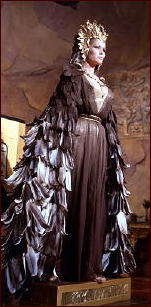
ALRAUNE Hildegard Knef

    Perhaps the best film of that recent flurry of horror movies I watched was a much-maligned, badly-dubbed little thing called Unnatural (Germany, 1952). Or maybe it’s called Alraune; it was released under both titles and generally ignored no matter what they called it.

    Hard to say just what it is about this film that draws me so irresistibly. Maybe it’s the atmosphere of romantic depravity — it’s certainly not the choppy editing or the atrocious dubbing, though they add an element of dream-like unreality to the experience, particularly when the camera cuts from a scene filmed on some elaborate set or colorful location to one obviously shot in front of a painted backdrop — or even, in one case, on an empty black soundstage.

    Scenes seem to start and stop for no discernible reason: the film may come in on the middle of an argument or cut away before it’s resolved, yet it somehow still tells its twisted story.

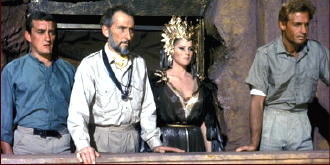
ALRAUNE Hildegard Knef

    The story. Yes, the story. Well, in 1911 when Hans Heinz Ewers wrote the source novel, Artificial Insemination was a relatively new science, practiced only on animals, and ripe for exploitation by Science Fiction.

    Ewers became a major figure in the heady days of early German silent movies, and his story prefigures the morbid fascination with science and sex found there so often. Alraune tells of a woman created by artificial insemination (purest Sci-Fi back then) who has no soul: innocent herself, but compelled to drive those who love her to recklessness, crime and self-destruction.

    Well, we’ve all known someone like that. I think I went out with her a few times in College. But Ewers gives it to us in its purest form, and this film (the fourth made from the novel) relates it with a strange, syrupy romanticism: like what you’d get if Max Ophuls directed Texas Chainsaw Massacre.

    Like I say, I’m not sure why I find this so rich and watchable. Maybe it’s the patently ersatz innocence of Hildegard Knef (sometimes looking alarmingly like Eve Arden!) as Alraune, set against the relaxed depravity of Erich Von Stroheim as her creator: complementing rather than contrasting.

ALRAUNE Hildegard Knef

    But mostly I think it’s the rich imagery. The photographer of Alraune was himself a veteran of the German Silent Cinema, having worked with Lang and Murnau, and he makes this film a delight for the eyes as he picks out unsettling details in the background, or sets up a love scene in dark, sinister lighting.

    There’s a splendid final montage, dissolving from a dead figure to a withered root, which assumes the shape of a twisted man and finally settles on the image of one ascending the gallows as Alraune’s destiny works itself out. Pure abstract cinema and a film I’ll revisit.

Editorial Comment:   There is a three-minute clip on YouTube (follow the link) that demonstrates quite successfully Hildegarde Knef’s mesmerizing effect on a smitten suitor. A recent DVD of the film is apparently out of print, but copies are available (on Amazon, for example).

AARON ELKINS – Uneasy Relations. Berkley, hardcover; First Edition, July 2008. Paperback reprint: August 2009.

   If my count is right, this is the 15th in Elkins’ series of fictional mystery cases he’s handed to forensic anthropologist Gideon Oliver to solve. The first was Fellowship of Fear, which came out in 1982, which means that both Elkins and Oliver are getting up there in longevity, in terms of series that are still going. (Elkins will be 75 this year, but to this date, he’s shown no signs of slowing down.)

AARON ELKINS Gideon Oliver

   As a quick side note before continuing, there were five episodes of a “Gideon Oliver” TV series that was on for a short while in 1989, as you may well already know.

   Starring Louis Gossett, Jr. (on the right), it may have been a program too far ahead of its time, as crime scene forensics are all the rage these days, or so I hear.

   The “uneasy relations” in the title of this fairly recent outing are those between humans and the Neanderthals, who are not known to have interbred, or to have even been able to. The book takes place in Gibraltar, where a recent discovery has shocked the world of anthropology – two bodies, that of a human woman in a Neanderthal cave, along with that of a young boy in her arms – a missing link, if you will, of a another kind altogether.

   There to delivery a paper on the subject, Gideon narrowly escapes death twice – the first as he’s pushed or he accidentally falls off the side of the Big Rock itself. (In completely non-appropriate fashion, I was immediately reminded of the “Beetle Bailey” comic strip.)

AARON ELKINS Gideon Oliver

   The second involves a defective microphone and a puddle of water Gideon would have been standing in. He scoffs at the thought that anyone with murderous intent was responsible for either incident, which simply put, means that he hasn’t been reading the previous 14 brushes with murder he’s been involved with.

   That the story takes place in Gibraltar gives the author the opportunity to describe the small section of the map that it takes up in quite some detail, and superbly done.

   There is also a lot of scientific background to be crowded into the book as well. The latter slows the book down more than the former, but obviously it’s quite necessary, as the solution to the case depends very much upon it.

   All in all, in spite of the evil intentions of someone, this is a rather easy going book, with a small bit of detection at the end to wind things up in fine fashion. Of course the solution to the case also answers a question that kept flitting in and out of my brain all the while I was reading, one that (metaphysically speaking) made the motive a lot easier for me to put my finger on that Gideon Oliver simply didn’t – and couldn’t, alas – know anything about.

A TV Review by MIKE TOONEY:


“The Name of the Game.”   An episode of Kraft Suspense Theatre. First air date: 26 December 1963 (Season 1, Episode 10). Jack Kelly, Pat Hingle, Nancy Kovack, B. G. Atwater, Steve Ihnat, Monica Lewis. Story: Fred Finklehoffe; screenplay: Frank Fenton. Director: Sydney Pollack.

   Don’t confuse this single show with the later TV series. The name of the game here isn’t fame but winning and losing at gambling, specifically casino craps.

   Jack Kelly plays an expert gambler who is down on his luck. Along comes Pat Hingle as an over-eager, impulsive Texas oil millionaire (he says he’s worth $10 million) anxious to beat the house at its own game.

   Hingle wants to win $200,000 and split it 50-50. Kelly agrees to team with Hingle as long as he does exactly what Kelly directs him to do. “I don’t tell you how to make oil wells,” Kelly informs him, “and you don’t tell me how to gamble.” Chafing at the restrictions, Hingle reluctantly assents.

   Kelly warns his partner that the odds always favor the house and that he may have to pony up at least a million to win that two hundred grand, but Hingle doesn’t seem to care. And thus begins a marathon bout of gambling, with Kelly having to rein in Hingle now and then. Director Sydney Pollack has one long-duration shot from directly over the craps table looking straight downward — a “God’s eye view” of the action.

   It’s a long, hard slog but Kelly and Hingle finally do clear two hundred thousand. Hingle, however, is hot to double his winnings. Kelly, reminding his partner of their agreement, says it’s time to quit. He’ll be expecting his hundred grand after Hingle cashes in their chips. Kelly leaves the casino to see a girl he has just met (Nancy Kovack) and hopefully extend their romantic relationship.

   But Hingle is angry, accusing Kelly of being a penny-ante gambler and not the “player” Kelly fancies himself to be. Hingle is determined not to give his partner his cut, even if it means a fight ….

   But that’s not the end of it. There is a fine little twist in the story near the end where Kelly learns a valuable life lesson in the school of hard knocks.

   Although under an hour in length, “The Name of the Game” has a movie “feel” to it. There’s some nice misdirection in the plot, and the performances are uniformly convincing.

   Trivia: Knowledgeable sci-fi TV fans will recognize several familiar faces here. Nancy Kovack starred as a temptress in one Star Trek episode. From the same series, B. G. Atwater (later commonly billed as “Barry”) played the founder of the logical Vulcan civilization, and Steve Ihnat was a psychotic starship captain who insisted on being called “Lord” or bad things would happen.

   In a minor but memorable bit part, Grace Lee Whitney plays a statuesque blonde whose luck with the dice waxes but rapidly wanes; she had a continuing role as Yeoman Rand on Star Trek. And of course Jack Kelly played the impetuous young executive officer of the deep space cruiser C-57D who is torn to bits by the Id Monster in Forbidden Planet (1956).

REVIEWED BY WALTER ALBERT:         


KATE CARLISLE – Homicide in Hardcover. Obsidian, paperback original; 1st printing, February 2009.

KATE CARLISLE Brooklyn Wainwright

    First in a projected series featuring Brooklyn (“Kate”) Wainwright, a book restorer who, invited to a reception to honor her mentor, Abraham Karastovsky, finds herself a suspect after she discovers him dying and whispering “Remember the devil.”

    Marketed as a “bibliophile mystery,” this first novel departs from the usual bookstore/collector subjects to go behind the scenes of the upscale collectors’ world to show how artisans, with loving skill, return valuable books to the condition that makes collectors proud to display them on shelves with books that have somehow, almost miraculously, escaped the myriad disasters that can befall antiquarian books.

    Any collector prizes the restorer who can return books to their original condition even though, in my experience, the process can take what seems an inordinate amount of time, causing the always anxious owner more than one night of sleep broken by fantasies of books mysteriously disappearing or being engulfed in a sudden and totally consuming fire.

    However, none of these concerns need spoil the enjoyment of this well-crafted mystery for the reader who likes the bookish references and setting, and can appreciate the enjoyable mix of humor and suspense that make this the debut of a promising series.

Note:   According to the author’s website, the second book in this series, If Books Could Kill, will be coming out next month, in February of this year.

KATE CARLISLE Brooklyn Wainwright

THE BACKWARD REVIEWER
William F. Deeck


JEREMY LANE Death to Drumbeat

JEREMY LANE – Death to Drumbeat. Phoenix Press, hardcover, 1944. Paperback reprint: Black Knight #17, no date stated [1946].

    Whitney Wheat, Lane’s series character, is a psychiatrist who also detects. In this novel his patient, a publisher and we know what they are like, hears drums, apparently portending his own death. Attempting a cure through a means that I didn’t quite understand when it was originally proposed and still don’t when all has ostensibly been cleared up, Wheat takes his patient to the estate of Humber Jacks.

    An authority on Indian Drums, Jacks is a wealthy man with an income of $25,000 a month but who rents out rooms at $1 a night to tourists and makes sure he gets the takings. He also has an ill-assorted household. After Wheat’s and the publisher’s arrival, murder occurs.

JEREMY LANE Death to Drumbeat

    Since my consciousness was recently raised, I make it a point to avoid novels in which the county attorney is gormless or corrupt, and sometimes both. But it was awhile before the county attorney appeared in Lane’s novel, and I continued reading, though I ignored the politician’s failings — alas, such are the absurdities one encounters in fiction — to find out if Lane was going to make sense of anything in the book.

    He doesn’t. Oh, he explains things; of course, that is not the same thing as making sense.

    For those who are interested in such matters, the narrator of the novel, on an intellectual level with the county attorney, has the same name as the author.

– From The MYSTERY FANcier, Vol. 13, No. 3, Summer 1992.


Bibliographic Data: The following checklist is taken from the Revised Crime Fiction IV, by Allen J. Hubin:

LANE, JEREMY. 1893-1963. Note: Dr. Whitney Wheat appears in those titles indicated with an asterisk (*).

    Like a Man (n.) Washburn 1928.
    The Left Hand of God (n.) Washburn 1929.
    * Death to Drumbeat (n.) Phoenix 1944.
    * Kill Him Tonight (n.) Phoenix 1946.

JEREMY LANE

    * Murder Menagerie (n.) Phoenix 1946.

JEREMY LANE

    * Murder Spoils Everything (n.) Phoenix 1949.

JEREMY LANE


Reviewed by DAVID L. VINEYARD:         


SHERLOCK HOLMES. Made for Cable-TV movie: HBO, 15 November 1981. Frank Langella (Holmes), Susan Clark (Madge Larrabee), Stephen Collins (Larabee), Richard Woods (Watson), George Morfogen (Moriarity), Laurie Kennedy (Alice Faulkner), Christian Slater (Billy the Page). Based on the play by William Gillette. Directed by Peter H. Hunt.

SHERLOCK HOLMES Frank Langella

    Supposedly when American actor William Gillette was writing the play which would become his most famous role (his image as iconic as the Sidney paget illustrations from The Strand) he wired Arthur Conan Doyle as to whether it was all right to marry Sherlock Holmes to the heroine at the end of the play. Doyle’s famously terse cable in return was succinct:

    “You may marry him, or murder him.”

    This filmed stage play, which aired on HBO originally, is the version that became a major hit on Broadway (Sherlock’s Last Case) when revised in 1987 with Frank Langella in the lead role (fresh from his hit in the revived John Balderston play of Dracula).

    Played with snap, flare, and a wink and a nod towards the audience, the plot involves Professor Moriarity’s convoluted plot to destroy Sherlock Holmes by drawing him into a complex plot involving the innocent Alice Faulkner, being held virtual prisoner by Moriarity’s cohorts, the Larrabees (Stephen Collins and Susan Clark).

SHERLOCK HOLMES Frank Langella

    Langella and Morfogen have real fun as Holmes and Moriarity, and the highlight of the play is their game of one-upsmanship in a recreation of the famous meeting at Baker Street between the pair from “The Final Problem.” As the table turn from one gambit to the next the two actors show real passion for the performance.

    It’s worth watching the whole production for that scene alone, but fortunately you don’t have to. The old war horse of a play may wheeze a bit here and there, but thanks to a sparkling cast it is tremendous fun as well. Collins and Clark are particularly good as the Larrabees and Woods a stalwart Watson.

    But this is a star turn for the actor playing Holmes, and Langella knows it. He take possession of the stage at every turn, filled with kinetic energy and yet sprawling across the stage in lethargy like a great cat after a big meal at other times. Both Leonard Nimoy and Charlton Heston had some success with the play in other revivals after Langella, but it is hard to imagine anyone having the energy he displays here.

    Director Peter H. Hunt directed a good deal of television and also the film 1776. Clearly he knows how to shoot a film of a stage play with style and creativity.

SHERLOCK HOLMES Frank Langella

    The Gillette play was previously filmed as a silent with John Barrymore in the role of Holmes, Roland Young as Watson, and Gustav Von Seyfertitz as Moriarity. That version is now available on DVD from Kino International.

    The play is very loosely the basis of the Rathbone and Bruce film The Adventures of Sherlock Holmes from 2Oth Century Fox with George Zucco as Moriarity. It was also loosely the basis for the Broadway musical Baker Street with Fritz Weaver and Martin Gabel as Holmes and Moriarity.

    Christian Slater, who plays the page Billy here, was in good company. In the original Gillette production in the West End of London the role was played by young Master Charles Chaplin, age thirteen.

    With Robert Downey Jr. playing a 21st Century take on the great sleuth currently on the big screen, it’s nice to return to this and see this version of the Gillette play showing such vitality.

Editorial Comment: For a delightful two-minute clip from the play on YouTube, go here. While there does not appear to be a commercial DVD of the HBO film, it is usually easily available on the Internet on a collector-to-collector basis.

REVIEWED BY DAN STUMPF:         


Horror Flicks

    I’m afraid I’ve recently watched a lot of dreck, just for the sake of completeness. Things like William Castle’s abominable remake of The Old Dark House (Columbia,1963) and The Mad Monster (PRC, 1942) a film so cheap one is amazed by the very fact of its existence.

    Then there was The She-Creature (American International, 1956), a film with an odd patina of melancholy arising from the sight of its two stars, Chester Morris and Tom Conway, both promising young actors once, now trapped in this strange, low-budget miasma. At least it boasts a good monster.

Horror Flicks

    But there were a few gems, too: I re-watched a lot of the Universal Monster movies from the 1950s (The Deadly Mantis, Monster on the Campus, The Monolith Monsters, the Creature series, and my personal favorite, The Mole People, featuring a minimalist lost-civilization conquered by flashlights) and was pleasantly surprised by the air of professionalism about them.

    There’s even, from time to time, a moment of artistry or a flash of intelligence in the fast-moving flurry of destruction. Most horror buffs and film historians concentrate on Universal in the 30s or 40s, but I think these deserve a sharper look.

    After these came the zombie movies: White Zombie (1932, United Artists) inspired by W.B. Seabrooks’ eerie travelogue The Magic Island, the former a film with atrocious acting and worse script, but infused with a visual poetry that lifts its trite story to the level of a folk tale.

Horror Flicks

    This was followed by I Walked with a Zombie (1943, RKO Radio Pictures) which is Jane Eyre set in the West Indies, with Tom Conway (remember him?) as a brooding Rochester to Frances Dee’s doughty nurse.

    The last ten minutes of this thing is played out without dialogue except for a minute of voice-over narration by a narrator who isn’t even in the movie, producing a climax of pure abstract Cinema.

    Then last, but far from least, there’s King of the Zombies (1941, Mongram) where Mantan Moreland’s deft comedy relief easily steals the film from its nominal stars and monsters.

LAIRD KOENIG – Rockabye.   St. Martin’s, hardcover, 1981. Paperback reprint: Bantam, 1983. Made-for-TV movie: CBS, 12 January 1986. Valerie Bertinelli (mother), Rachel Ticotin (tabloid reporter), Jason Alexander (NYPD lieutenant).

LAIRD KOENIG Rockabye

    Novels of the occult and the supernatural are tremendously popular today, and part of the reason has to be the excuses they give people for avoiding the real world, the one they have to live in.

    Considering the unspeakable things that can happen to a kidnapped two-year-old boy in New York City at Christmas time, here’s a book that will scare the heck out of just about everyone, and get them back to reading about witches and demons and the like.

    In part, the police are also the villains in this one, giving up too easily on what they think is just another unsolvable crime. The boy’s mother, a traveler alone in the city, nevertheless refuses to concede defeat. Her only assistance comes from a sympathetic female newspaper reporter and an aging psychic-for-hire whom she really believes to be a fraud.

    Screenwriter Laird Koenig has an unerring eye for situations easily translatable into cinematic magic. You can expect to see it on a screen near you very soon. The mayor of New York City won’t like it, nor will police departments anywhere in the country. I can’t say that I’d blame them in the slightest.

– From The MYSTERY FANcier, Vol. 6, No. 2, March/April 1982 . This review also appeared earlier in the Hartford Courant.


LAIRD KOENIG Rockabye

  UPDATE [01-06-10].   I seem to have violated my own personal rule against reading children-in-jeopardy novels with this one, but without rules, how can there be exceptions?

    I’m glad to say that I recognized the cinematic potential of this book, however. The film took a few years before it was made, and it showed up only on TV, but made it was.

    Koenig also wrote the novel and screenplay for The Little Girl Who Lives Down the Lane (1976), a Jodie Foster movie, and his paperback original The Neighbor (Avon, 1978) was the basis for a movie called Killing ’em Softly (1982).

    While Little Girl is cited in the Revised Crime Fiction IV, by Allen J. Hubin, neither of the other two are. I’ll drop him an email about them later today…

« Previous PageNext Page »