A 1001 MIDNIGHTS Review
by George Kelley:


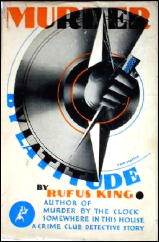
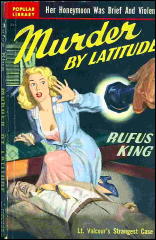
RUFUS KING – Murder by Latitude. Doubleday Crime Club, hardcover, 1930. Reprint paperback: Popular Library #246, 1950. (Cover art: Rudolph Belarski.)

RUFUS KING Murder by Latitude

    Rufus King’s sole series character was a New York police detective, Lieutenant Valcour. A proper gentleman detective, Valcour’ s only unusual characteristic is that he is a French Canadian.

    Murder by Latitude is one of Valcour’ s more exotic cases. The Eastern Bay is a cheap passenger-carrying freighter making a Bermuda-to-Halifax run. Lieutenant Valcour boards the ship with the news that one of the passengers is a murderer.

    One of the victims is dead of strangulation, the other is in a New York City hospital; police are hoping this victim will recover to give a description of the killer. The murderer sabotages radio communication so police can not send the description of the guilty party, but Valcour has clues that indicate the murderer is aboard the Eastern Bay and he starts his investigation on his own among the bizarre menage of passengers.

RUFUS KING Murder by Latitude

    As the degrees of latitude sail by, the murderer strikes again, leaving such cryptic clues as a lump of wax, a stolen thimble, and a pair of scissors. Valcour achieves some impressive feats of detection to tie the clues to the culprit in classic fashion.

    Another recommended Valcour sea mystery is the fine Murder on the Yacht (1932). Valcour made an impressive debut with Murder by the Clock (1929) and went on to detective fame in a half-dozen novels, concluding with Murder Masks Miami (1939).

    Notable among King’s nonseries novels are A Variety of Weapons (1943), The Case of the Dowager’s Etchings (1944), and Museum Piece No. 13 (1946).

         ———
   Reprinted with permission from 1001 Midnights, edited by Bill Pronzini & Marcia Muller and published by The Battered Silicon Dispatch Box, 2007.   Copyright © 1986, 2007 by the Pronzini-Muller Family Trust.

THE BACKWARD REVIEWER
William F. Deeck


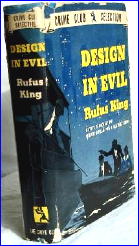
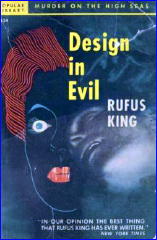
RUFUS KING Design in Evil

  RUFUS KING – Design in Evil. Doubleday Crime Club, hardcover, 1942. Reprint paperbacks: Thriller Novel Classic #21, 1943; Popular Library #124, paperback, 1948.

   Dr. Crowninshield, an authority in the psychiatric area who has reached an age and a level of experience that allows him to abandon doubt and uncertainty, has concluded, after no examination whatsoever, that Miriam Lake is really Jennifer Murcheson, wealthy and very peculiar even when normal, who mysteriously left her ranch In California and is now suffering from schizophrenia.

   Crowninshield’s assistant, Dr. Stone, is also convinced that Lake is Murcheson, but he is certain she is faking the alleged illness.

   By some dastardly plotting and a little arson, the Murcheson family — uncle, aunt, and cousin — get Lake aboard their yacht en route to the Caribbean. Ostensibly the purpose is to effect a cure. Lake, however, begins to realize that it is someone’s design to murder her at sea in order to gain the real Murcheson’s fortune.

RUFUS KING Design in Evil

   With the “scientists” aboard the vessel having their minds made up, her claims and attempts at proof are ignored. Thus her situation is both frustrating and perilous.

   The more I read of Rufus King’s novels, the more I am impressed by their general high level. His plotting is usually first class, the atmosphere of menace is almost always well done, his suspects are often few, something appreciated by this feeble-minded reader, and the clues are generally fair.

   While he has a weakness for polysyllables, so do I. Characterization sometimes is a bit weak, but King often makes up for it by his humor. In this novel, Lake’s amusing comments in the face of her obvious danger keep the novel from becoming just another damsel-in-distress type.

— From The MYSTERY FANcier, Vol. 10, No. 3, Summer 1988
         (slightly revised).


   I’ve recently annotated another grouping of authors’ entries from Part 34 of the online Addenda to the Revised Crime Fiction IV, by Allen J. Hubin.

   If the author in entry one below seems out of place at first, you’ll see why it’s here soon enough, I believe. One significant update is the disambiguation of two authors with very similar sounding names, Harlan Eugene Read and Harlan (M.) Reed.

BROTHER JAMES. Pseudonym of [Dr.] James Reynolds, – 1866, q.v.
       -The Adventures of Moses Finegan, an Irish Pervert. Duffy (Dublin), 1885. Previously published as by James Reynolds: Duffy (Dublin), 1870.

READ, CHARLES A(NDERTON). 1841-1878. Add as a new author. Born in Ireland; merchant in Rathfriland, County Down; went to London in 1863, where he became a journalist. During his writing career the author of numerous sketches, poems, short tales and nine novels, two of which are criminous in nature:
       Aileen Aroon; or, The Pride of Conmore. Henderson (London), 1870. Setting: Ireland. First appeared in The Weekly Budget. “Garratt O’Neill is falsely accused of murder.”
       Savourneen Dheeush; or, One True Heart. Henderson (London), 1869. Setting: Ireland. First appeared in The Weekly Budget. [Based on the Wildgoose Lodge Murders of 1816.]

READ, HARLAN EUGENE. 1880-1963. Add biographical information: Born in Jacksonville IL; educated at Oxford University and Brown’s Business College; editor; did syndicated newspaper work; St. Louis radio news commentator. Author of one book in the Revised Crime Fiction IV. See below:
      -Thurman Lucas. Macmillan, US, hc, 1929. Add setting: St. Louis, East St. Louis IL, and Nevada; early 1900s. [After several scrapes with the law in the Midwest, a man becomes a success in the mining fields of Nevada.]

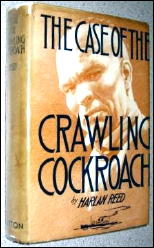
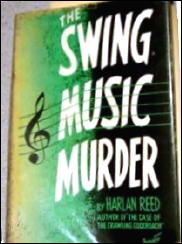
REED, HARLAN (M.) 1913-2001. Add middle initial, years of birth & death, and the following biographical information, replacing the previously incorrect data: Born in Nome, Alaska, raised in Seattle. graduate of University of Washington, where he also taught creative writing. Ran family oil business in Vancouver WA after WWII; photographer and jazz pianist. Author of two mystery novels in the Revised Crime Fiction IV. Below is the author’s complete entry. Series character in each: hard-drinking “idiosyncratic” private eye Dan Jordan.
      The Case of the Crawling Cockroach. Dutton, hc, 1937. Setting: Ship.

              HARLAND REED Crawling Cockroach

      The Swing Music Murder. Dutton, hc, 1938. Setting: Seattle WA.

           HARLAND REED Swing Music Murder

REID, LIZZIE C. Add as a new author. Short story writer who lived in Belfast, Ireland; her stories appeared in The People’s Friend and other periodicals.
      -The Doctor’s Locum Tenens. Sealy (Dublin), 1907. Setting: Ireland. “A lady doctor’s adventures in an Ulster town. […] Interwoven with a narrative of mystery and plotting there is a pleasant love story.”

REYNOLDS, [DR.] JAMES. -1866. Add as a new author. Pseudonym: Brother James, q.v. Lived in Booterstown, County Dublin. Short story writer; contributed several serials to Duffy’s Fireside Magazine under the additional pen names E. L. Berwick and “A Well-Known Novelist.”
      -The Adventures of Moses Finegan, an Irish Pervert. Duffy (Dublin), 1870. Also published as by Brother James: Duffy (Dublin), 1885. Setting: Ireland. [The protagonist, although married, goes with a benefactor’s daughter to America, where he is later sentenced to death for her murder.] Note that the word “pervert” in the title is used here in the religious sense, as the opposite of “convert.”

A REVIEW BY DAVID L. VINEYARD:         


LEO PERUTZ – Master of the Day of Judgment. First US edition: Boni & Liveright, hardcover, 1930. Translation of Der Meister des Jüngsten Tages (Munich, 1923). Reprint editions include: Charles Boni Paper Books [#7], 1930; Collier AS 528V, pb, 1963; Arcade Publishing, hc, 1994.
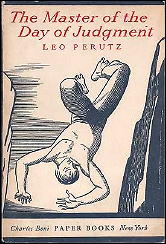
LEO PERUTZ Master of the Day of Judgment

    Thus the whole sinister and troubled business lasted five days only, from 26-30 September. The dramatic hunt for the culprit, the pursuit of the invisible enemy who was not flesh and blood, but a fantastic ghost from past centuries lasted only five days. We found a trail of blood and followed it. A gateway to the past quietly opened … step by step down a long dark passage at the end of which a monster was waiting for us with upraised cudgel.

    So opens Austrian fantasist Leo Perutz’s 1924 novel, a gothic thriller, locked room detective novel, fantasy, and example of the novel as jest of a kind we are familiar with today in the wake of Nabokov, Joyce, Pynchon, and others, but which must have come as a revelation in Austria in the period after the devastation of WW I as the Austro-Hungarian Empire reeled on it’s last desperate legs.

    To begin with, Eugen Bischoff, the actor, is dead, found in a locked room, the only clue a pipe belonging to the tales narrator Baron Von Yosch, a distinguished soldier and adventurer, and lover of the actor’s wife Dina.

    Dina’s brother sets out to convict Von Yosch, while his friends set out to clear him, and soon things get complicated, as a series of suicides strike across the city, each coming nearer to Von Yosch, and seemingly aimed at him.
LEO PERUTZ Master of the Day of Judgment

    As Dr. Gorski, the Sherlock Holmes figure points out: “Don’t you see the diabolical trap? The seat of the imagination is also the seat of fear.”

    “Fear and imagination are inseparably linked. The great phantacists (sic) have always been obsessed by fear and terror. Think of E.T.A. Hoffman, Michelangelo, Breugel, Edgar Allan Poe.”

    And it is to Poe, Hoffman, and later writers such as Borges this book with its affectionate turn on popular fiction owes much of its charm and power.

    Admittedly this is hardly a fair play mystery, and Barzun and Taylor are hard on it in Catalogue of Crime simply by their having imagined it was ever meant to be taken as one. Indeed the solution (or at least the first solution) involves one of those drugs unknown to science right out of Sax Rohmer and the doings of Dr. Fu Manchu; the Detection Club would be horrified:

    “It’s very ancient, and it’s origin is no doubt sought in the East. Fire and ecstasy. Have you ever taken an interest in the Assassins? Today you may have held in your hands the drug, or one of the drugs, by which the Old Man of the Mountain controlled men’s minds.”

    And then Perutz turns all that has gone before on its head in a moment worthy of Agatha Christie, the novel becoming a psychological mystery:

    Was it a revolt against inalterable fate? But looked at from a higher stand point — has this not always been the origin of all art? Does not every eternal masterpiece derive from the experience of disgrace, humiliation, wounded pride? … the great vision that for a moment raises the master above his tormenting guilt.

    Perutz was a master of the literary twist, the kind of gamesmanship we have grown accustomed to today, but seldom accomplished with his economy and skill as an artist.
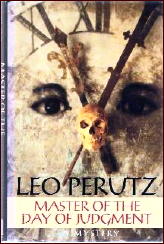
LEO PERUTZ Master of the Day of Judgment

    Among his best known books are Leonardo’s Judas, The Marquis of Bolibar, Saint Peter’s Snow, and By Night Under the Stone Bridge. These are works that belong beside Borges and Nabokov, and like them often play with the familiar tropes of popular literature, the adventure story, detective story, mystery, and the true gothic romance.

    Acclaimed by Graham Greene, Ian Fleming, Jorge Luis Borges, and Italo Calvino, Perutz is a fantasist, but his fantasy arises from realism and his works often have the qualities of 1001 Arabian Nights or The Saragosa Manuscript, stories within stories, hidden meanings. signs, and mysteries deeper than merely who-dun-it.

    Truth and even beauty found among the musty trappings of the gothic imagination and the familiar forms of the detective novel.

    Reading Perutz may alter your perception of popular fiction. For a while you may find yourself expecting twists that never come and outcomes most authors never intended, but it is worth the trouble.

    As does Borges, he finds deeper mysteries lurking in the shadows of genre fiction and like Nabokov illuminates them with a quiet but barbed humor. That his eye is also sharp as a scalpel and cuts as deeply is only one of the bonuses of discovering his work.
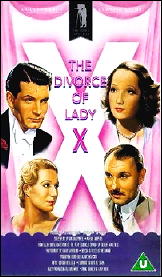
THE DIVORCE OF LADY X. United Artists (UK/US), 1938. Merle Oberon, Laurence Olivier, Ralph Richardson, Binnie Barnes, Morton Selten. Director: Tim Whelan.

THE DIVORCE OF LADY X.

   The print of this film I recently watched on TCM must be a new one, or that is to say, one that’s been remastered, cleaned up and refreshed, since the colors in this early Technicolor comedy romance are vivid and bright — they’re really quite spectacular if not dazzling — while many of the comments that have been left on IMDB are complaints about the poor quality of the color, pale and not only faded, but fading in and out.

   They all seemed to like the movie itself, however, and so did I, up to a point, and I’ll get back to that in a paragraph or so. It all begins in a London pea soup of a fog, and the crowd who’ve been attending a masquerade ball at a hotel are forced to stay there all night — without rooms for everyone, amusingly enough.

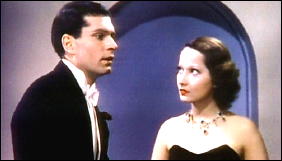
   The amusement grows even more so when a young minx of a lady (not a contradiction) inveigles her way into the suite that a barrister named Everard Logan (Laurence Olivier) had claimed for himself earlier in the evening and is unwilling to share it with any of the others who have found themselves fogged in.

   Not only that, but Leslie Steele (that’s her name), played by Merle Oberon, as you must have guessed, takes over Logan’s bed as well. Since this movie was made in 1938, you needn’t even begin to worry that something untoward happens. Logan sleeps on a mattress on the floor outside the bedroom in the suite, and one can easily imagine that the door between was locked.

THE DIVORCE OF LADY X.

   Any other imagining would be left to the viewer, but those would be thoughts of what might have been only — you can take it from me: there is no hanky-panky that goes on in this film.

   The cinema was different in 1938 than it is today, and it is all very amusing how cleverly Leslie Steele outwits her slow-witted male counterpart in this movie to take over his bed so neatly and slyly (and so innocently) as this.

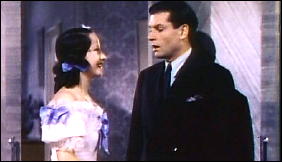
   The second half of the movie, while still amusing, is an anti-climax from here on, at least in comparison. Logan, as it so happens, is a divorce attorney … Wait, wait. I forgot to tell you this. In the morning, Logan discovers that he has fallen in love with the mischievous young lady who took over his accommodations, but she skips out without even telling him her name.

THE DIVORCE OF LADY X.

   To get back to the divorce proceedings, Logan’s very next client is a gentleman (Ralph Richardson) who wants a divorce from his wife because — you’re ready for this, aren’t you? — she stayed overnight in that same hotel the exact night before in the rooms of another man.

   Logan, of course, jumps to the immediate conclusion that the other man is none other than himself.

   A merry mixup up like this in Part Two could have as amusing as the clever shenanigans in Part One, but dragging the charade out for far too long, as it’s done here, eventually begins to feel cruel and mean-spirited.

   This is only one person’s point of view, you understand — mine, that is — and I seem to be in the minority on this, so by all means, if you’d like to see two great stars in fine action, romantic comedy style, even if it turns into a frothy mess — relatively speaking — then by all means, put this one on your list of movies to see as soon as you can.

   Be sure to watch the restored print, though. It really is an eye-catcher.

   And do you know what? I’m even willing to bet that I’ll like the entire movie more myself, the next time I watch it!

Capsule Reviews by ALLEN J. HUBIN:


   Commentary on books I’ve covered in the New York Times Book Review.   [Reprinted from The Armchair Detective, Vol. 1, No. 4, July 1968.]

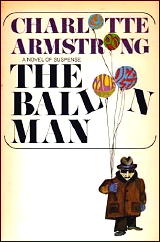
CHARLOTTE ARMSTRONG – The Balloon Man. Coward-McCann, hardcover, 1968, $4.95. (Paperback reprints: Fawcett Crest T1255, 1969; IPL, 1990. Film: Films de la Boetie, 1970, as La Rupture (The Breakup).)

   Miss Armstrong weaves impressive magic about some familiar ingredients: a young mother, her son, her weak and failure-prone husband and his unyielding and unloving father.

CHARLOTTE ARMSTRONG The Balloon Man


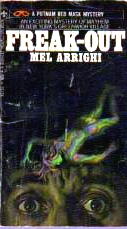
MEL ARRIGHI – Freak-Out. G. P. Putnam’s Sons, hardcover, 1968, $4.50. (Paperback reprint: Berkley X1733, 1969.)

   This fine first novel introduces an impressively original and amusing protagonist in Harrington, out-at-elbows lawyer. He thrashes unskillfully through a murder case among the psychedelic creatures of the Village scene in New York, searching for a killer who might require his talents.

MEL ARRIGHI Freak-Out


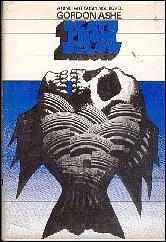
GORDON ASHE – Death From Below. Holt Rinehart & Winston, hardcover, 1968, $3.95. (UK hardcover edition: John Long, 1963. Paperback reprint: Popular Library 01492, no date.)

   This is John Creasey writing about Patrick Dawlish and his Crime Haters organization. Creasey demonstrates his very capable handling of the widespread, apparently unmotivated conspiracy of death.

GORDON ASHE Death from Below


LIONEL BLACK – Outbreak. Stein and Day, hardcover, 1968, $4.95. (UK hardcover edition, Cassell, 1968. Paperback reprint: Stein & Day, 1985.)

   This is a tightly plotted and fast moving thriller involving doctors and unpleasant characters with epidemic disease in London.

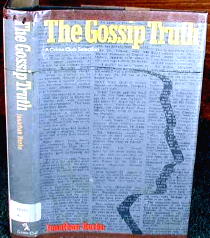
JONATHAN BURKE – The Gossip Truth. Doubleday & Co./Crime Club, hardcover, 1968, $3.95. (UK hardcover edition published as Gossip to the Grave: John Long, 1967.)

   A most entertaining little puzzle of a London gossip column invention that came to life.

JONATHAN BURKE The Gossip Truth


To be continued.

REVIEWED BY DAN STUMPF:         


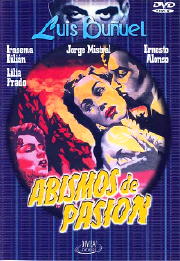
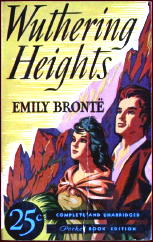
WUTHERING HEIGHTS. 1954. Originally released as Abismos de pasión. Irasema Dilián, Jorge Mistral, Lilia Prado, Ernesto Alonso, Francisco Reiguera, Hortensia Santoveña, Jaime González Quiñones, Luis Aceves Castañeda. Based on the novel by Emily Brontë. Director: Luis Buñuel.

WUTHERING HEIGHTS Luis Bunuel

   I’ve seen three films of Wuthering Heights and they all cut out the last hundred pages of the book

   Q: The last hundred pages? How big a book is it?

   A: Oh, about 250 pages.

   Q: And they cut out the last hundred?

   A: Right.

   Q: Damn!

   A: Damn indeed, as you so aptly put it.

   Luis Buñuel’s 1954 film goes them one better by also cutting out the first thirty pages. Assuming one has maybe a passing acquaintance with the classics, he kicks things off with Heathcliff’s return and his pursuit of the married Cathy — or failing that, her sister-in-law — to work his nasty love/revenge, all this set in contemporary Mexico.

   On the surface that might seem a brutal travesty of Emily Brontë’s novel, but Buñuel gives it a sensitivity and passion wholly suited to the subject. His Heathcliff bristles with Byronic angst, played effectively against a compulsively-impulsive Catherine whose fiery Latin temperament suits the character perfectly, and the Mexican landscape somehow evokes the spirit of the lonely moors… perhaps something to do with the Moorish architecture, but I may have my moors mixed.

WUTHERING HEIGHTS Emily Bronte

   Whatever the case, Buñuel conjures up Brontë’s characters and atmosphere perfectly, and when he tacks on his own original ending, it seems perfectly in keeping with the spirit of the thing … and memorably creepy in its own way.

   Anyway, watching this led me to pick up the book again for the first time since high school (I remember thinking there weren’t enough explosions in it.) and, though Emily hardly needs endorsement from the likes of me, I found it an incredibly good bit of writing.

   The main characters are all surly, short-sighted and self-absorbed, but somehow they gain our sympathy and never lose our interest. And those last hundred pages…

   I can only say that the ending of this book, while hardly cinematic, is one of the best things I’ve read this year.

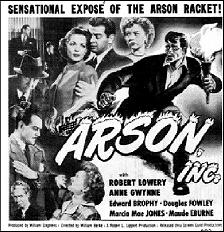
ARSON, INC. Lippert Pictures, 1949. Robert Lowery, Anne Gwynne, Edward Brophy, Marcia Mae Jones, Douglas Fowley, Maude Eburne, Byron Foulger. Director: William Berke.

ARSON, INC. 1949

   If you recognize any of the names of the members of the cast above, you ought to make a fortune on any Quiz Show that focuses on the movie entertainment industry. If you were to gather that this was a low budget production, you’d be absolutely right. If more than a thousand dollars was spent in the making of this movie, I’d be surprised.

   And of course I’m exaggerating, but not by much. This is the last movie I’ve watched in a DVD set of Forgotten Noir (Volume One), not that it’s noir, only a Bargain Basement crime movie in black-and-white made in the 1940s, and therefore…? It has to be noir.

   Arson, Inc. begins as a semi-documentary about the fire-fighting business, then segues quickly into a story of an undercover member of the arson squad (Robert Lowrey) who’s on the trail of a gang whose specialty is burning down warehouses supposedly filled with furs.

ARSON, INC. 1949

   Along the way he meets a schoolteacher (Anne Gwynne) who along with her canny old grandmother (Maude Eburne) moonlights as a babysitter. She also soon becomes his girl friend, and by “she,” I do not mean the grandmother.

   Anne Gwynne is another in a long line of good-looking Hollywood actresses whose careers never got out of low, by which I mean B-movies like this one. A sizable role in House of Frankenstein (1944) may have been the height of her career.

   Likewise goes for good-looking Robert Lowrey, whose career was longer than his co-star, including stints as Bill Gray, Indian Commissioner, in Cowboy G-Men and as a semi-regular as Buss Courtney in Pistols ‘n’ Petticoats, not that I’m telling you out of past experience, mind you. I’m only repeating what I’ve been told on IMDB.

ARSON, INC. 1949

   And speaking of IMDB, those who’ve left comments there generally liked this movie one whole quantum leap more than I did.

   Any crime movie in which the gangsters and goons at a gangsters and goons late-night party stand around and sing “Little Brown Jug” does not stand much of a chance of getting a high rating from me.

   Don’t blame the actors and actresses, though. They’re all professionals, and to a man and woman, they all know what they’re doing. I tend not to blame the directors very much in movies like this either, as they had little control over the stories they were asked to film, and even less over the money they were allowed to spend. William Berke does a good job with what he has to work with.

A 1001 MIDNIGHTS Review by Bill Crider:


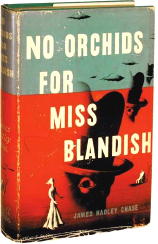
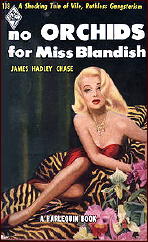
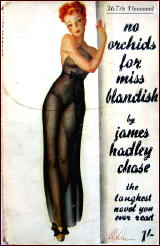
JAMES HADLEY CHASE No Orchids

  JAMES HADLEY CHASE – No Orchids for Miss Blandish. Howell Soskin, US, hardcover, 1942. UK edition: Jarrolds, hardcover, 1939. Revised edition: Panther, UK, pb, 1961; Avon, US, pb, 1961. Reprinted many times, in both hardcover and paperback. Film: Alliance, 1948. Also: Cinerama, 1971, as The Grissom Gang.

   Since the publication of No Orchids for Miss Blandish, James Hadley Chase has sold millions of copies of his more than eighty novels. A British writer who uses mostly American characters and settings in his works, Chase has a fast-paced, hard-boiled style perfectly suited to his violent, action-filled novels.

   The title character of Miss Blandish is a young socialite who is kidnapped by small-time hoods and then kidnapped from them by the members of the Grisson gang, a group based on the notorious Ma Barker and her sons.

JAMES HADLEY CHASE No Orchids

    Ma Grisson’s favorite son, Slim, a vicious, perverted killer, takes a special interest in Miss Blandish; so instead of killing her when the ransom is paid, Ma gives her to Slim—

   She is kept in a narcotic haze by Doc, another of the gang, so that she will submit to Slim’s debased desires. Eventually, Miss Blandish’s father hires Fenner, a former crime reporter turned private eye, to find his daughter.

   There is a bloody shoot-out between the gang and the police, but Slim escapes with Miss Blandish. He is finally cornered, but this is not the sort of story in which everyone can live happily ever after.

   Chase does a fine job in Miss Blandish (even in the revised edition of 1961) of understating the sex and violence, which become more effective than if they had been spelled out.

JAMES HADLEY CHASE No Orchids

   The pace never lags, and the ending is very well handled. Miss Blandish is no longer as shocking as its reputation might suggest, but it remains a powerful crime novel.

   Chase’s novels were well suited to the needs of the early paperback market, and many of them are highly sought after by collectors, as much for their colorful titles and gaudy covers as for their contents.

   Examples include Twelve Chinks and a Woman (Avon, 1952) and Kiss My Fist! (Eton,1952).

         ———
   Reprinted with permission from 1001 Midnights, edited by Bill Pronzini & Marcia Muller and published by The Battered Silicon Dispatch Box, 2007.   Copyright © 1986, 2007 by the Pronzini-Muller Family Trust.

A MOVIE REVIEW BY DAVID L. VINEYARD:         


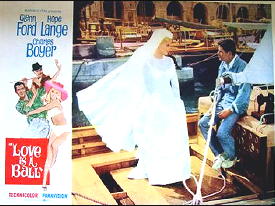
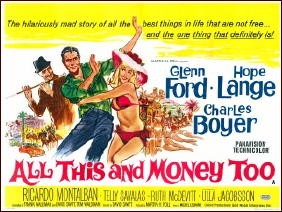
LOVE IS A BALL. United Artists, 1963. Released in the UK as All This and Money Too. Glenn Ford, Hope Lange, Charles Boyer, Ricardo Montalban, Telly Savalas, Ruth McDevitt, Ulla Jacobsson, Laurence Hardy. Based on the novel The Grand Duke and Mr. Pimm by Lindsay Hardy. Directed by David Swift.

LOVE IS A BALL

   This handsome little romantic comedy is beautifully shot on the Riviera in gorgeous color and Cinemascope, with a professional cast all elevating the slight story with good performances.

   John Lathrop Davis (Ford) is a Riviera boat bum, or he would be if he could get his boat in the water. He used to drive Formula One race cars, but now his only ambition is to raise enough money to get his boat afloat and eat regularly, which is where M. Etienne Pimm (Boyer) comes in.

   The ensuing light-hearted con game squeaks it by on Mystery*File — but only just.

   Mr. Pimm is a matchmaker. He marries minor European royalty to well-to-do Americans taking the tour and doing the Riviera for the summer.

LOVE IS A BALL

   His latest target is one Millicent (Millie) Mehaffey (Lange, and why the name in the film is changed from the books Anabell “Madcap” Mahaffey is one of those mysteries that will never be solved), very rich and very American and very much under the watchful eye of uncle Telly Savalas. The minor nobleman in question is Duke Gaspard Ducluzeau (Montalban).

   And the duke — Grand Duke no less — has almost everything but money. He’s handsome and gentle, and a complete and utter klutz.

   Ford is hired to turn the clueless duke into the suave gentleman he is supposed to be, along with a team of experts. Ford is to teach him to ride, drive, and behave as a sportsman. No easy job. The duke is an accident waiting to occur.

   And then the worst happens. Their in-man at the Mehaffeys gets hurt, and they need a man on the inside if Pimm’s plans are to work. So Davis is voted in to do the job as the new chauffeur — which throws him head long into the arms of Millie, who is as much of a write-off as the Duke, a tomboy fascinated by racing cars and engines and about as demure as a long distance trucker — something her uncle (Savalas) is trying to do something about — like marrying his very rich niece to a Grand Duke.

   If you can’t guess where this is going you have never seen a movie, much less a romantic comedy.

LOVE IS A BALL

   There is nothing special here. It looks wonderful, and if the great cast tries a bit too hard once in a while, the movie still has sparkle and wit. Montalban is fine in the comedy role, a reminder that he was always at ease and personable in this kind of froth, and Ford’s world weary frustration is perfect for the bemused Davis. No one but Cary Grant did frustration as well on screen. Boyer is his charming self, and Savalas was always at his best in comedy, where his overplaying is usually a plus and not a minus.

   Lindsay Hardy, who wrote the book, might be better known to readers here for two good thrillers he penned about Major Gregory George Athelston Keen (of the Special Service of Home Security, aka MI5), Requiem for a Redhead and The Nightshade Ring. The two books were well done, and it is a shame there aren’t more.

   But this is a charming little film, nothing major, but an easy time passer, and beautiful eye candy.

Note: I don’t know if Laurence Hardy is any relation to Lindsay Hardy. He plays the role of Priory, one of the team hired by Pimm to educate the duke.

TCM Alert: Scheduled to be shown next on Monday, September 14, at 4:15 AM. Set your timers now!

« Previous PageNext Page »