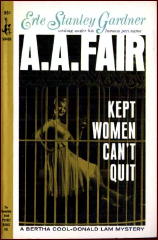
A. A. FAIR [ERLE STANLEY GARDNER] – Kept Women Can’t Quit.

Pocket 4602, paperback; 1st printing, February 1963; reprinted many times. Hardcover edition: William Morrow & Co., 1960.
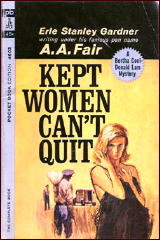
A. A. FAIR Kept Women Can't Quit

   On the other hand [speaking recently about one of Anne Perry’s books], if you happen to discover a sense of continuity between one Erle Stanley Gardner book and the next, I’d say you were one heck of a bookhound.

   In all honesty, Perry Mason and his crew did change over the years, but only gradually — from the early hard-boiled 30s books, to the 60s and 70s version that was greatly co-dependent on what Raymond Burr’s vast TV viewing audience saw. But if you were to read them in order, the books would be absolutely interchangeable, not that anyone cared, then or now.

   And as far as Gardner’s other series is concerned, the one he worte as A. A. Fair, other than occasional glimpses of the outside world, Donald Lam and Bertha Cool, partners in a detective agency, never ever changed. He the brash younger partner, taking risks that continually exasperated loud, outspoken female half of the firm; and in tandem, consistently tormenting Sergeant Frank Sellars to utter blowing-his-top distraction.
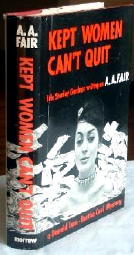
A. A. FAIR Kept Women Can't Quit

   Gardner’s forte was never dialogue — once I learned of his usual practice of dictating his books to a steady supply of secretaries, that was it for me. From that point on, all of his characters talked the same way, and if I let myself slip away from the story, I could easily hear his voice instead of theirs.

   (Something like listening to a vintage radio show and letting the curtain rise too soon, seeing the characters standing around a microphone, rather than listening to their voices as they hack their way through a jungle wilderness or travel cross-continent on on a fast-moving train full of would-be assassins.)

   No, Gardner’s strong point was plotting, and there a point in Kept Women Can’t Quit when Donald Lam suddenly turns the case so far inside out that it makes you wonder what book it was that you were reading before then. At stake is $50,000 in stolen thousand dollar bills, and of course it is a good looking cutie with lots of curves who hires him.
A. A. FAIR Kept Women Can't Quit

   And yet. A couple of points puzzled me, and when I started to search back to double-check some reference points that I thought I might have missed, I discovered that when you start exploring what’s back of the curtain behind the magician and his waving hands, perhaps (once again) you’d rather you hadn’t.

   It can be disappointing when you find out how much of Gardner’s plotting is really sleight-of-hand, that it’s all a facade. That while it’s not a fake, it’s all tied together with the flimsiest wisps of twine and plastered down with humongous amounts of duck tape.

   In other words, Gardner probably made his plots too damned complicated for his own good. But for a reader who’s willing to extend him a license to deceive (me!) he’s still, and without a doubt, a Grand Master, one of the grandest of them all.

— May 2003

FORGOTTEN MURDERS #2
by Allen J. Hubin


ANONYMOUS [WYLIE] The Smiling Corpse

ANONYMOUS – The Smiling Corpse. Farrar & Rinehart, hardcover, 1935.

   This book is not notable for its great writing but for the unusual if not unique nature of the author’s approach.

   The critic Wendel Hyat is guest of honor at a literary tea to celebrate the publication of his treatise on detective fiction, “From Poe to Plethora.” The gathering is peopled almost exclusively with famous persons, such as Tallulah Bankhead, Robert Benchley, Heywood Broun, James M. Cain, Clifton Fadiman, George Gershwin, Elsa Maxwell, Gene Tunney and dozens of others, all of whom are humorously identified in the Who’s Who at the beginning of the book.

   Incidentally, a note in the Who’s Who states: “If any character in this book bears a resemblance in name or otherwise to any living person, it is sheer coincidence. None of the persons in this book is real.”

   Hyat, who was diligently hated by everyone who knew him, is naturally discovered to be a smiling corpse. Among the guests at the tea are also G. K. Chesterton, Sax Rohmer, Dashiell Hammett and S. S. Van Dine. The author sets these men to solving the murder while behaving like their detective creations.

   Cleric G. K. Chesterton tries not to overlook the obvious, Sax Rohmer suspects a sinister Chinese influence, Dashiell Hammett gets himself shot, and S. S. Van Dine overflows with erudition and says “deah man.”

   As might be expected, none of these men is outstandingly successful in solving the crime, particularly since they operate under a certain ignorance about the actual instrument of death.

   The author appears to have enjoyed himself in contriving this spoof, and it would seem that he had more than a nodding acquaintance with the works of the four mystery writers. Their characterizations, though naturally overdrawn, seem accurate enough.

   The book made enjoyable reading, but its attraction lies in the intriguing and amusing possibilities of the contrived situations rather than any element of suspense. Here’s an interesting bibliographical puzzle: who was the anonymous author of this parody — an established author under his own name, or a timid unknown?

– From The Armchair Detective, Vol. 1, No. 1, October 1967.


Editorial Update. 08-17-09.  I’m not sure when it was discovered, but the authors of this rather desirable (and pricey) detective mystery are now known to be the co-writing tandem of Philip Wylie and Bernard A. Bergman. See, for example, this online bibliography for the first (and more well-known?) of the two authors.

   Now online, as of yesterday evening, is Part 34 of the Addenda to the Revised Crime Fiction IV, by Allen J. Hubin. While some revisions and corrections were still being made as of earlier this morning, it’s always a work in progress, and you’re certainly welcome to stop by and look around.

   This installment may or may not appear in the 2009 version coming out soon on CD, but an announcement will be made here as soon as Bill Contento finishes it up and makes it available. As a text file this installment is a hefty 40 pages long, chock full this time with lots and lots of biographical information about older authors supplied by John Herrington.

   Even though the coverage of the Revised Crime Fiction IV ends with the year 2000, it’s more and more obvious that while the flow of relevant information may slow down eventually, there’s no way it will ever stop coming in.

A 1001 MIDNIGHTS Review
by George Kelley:


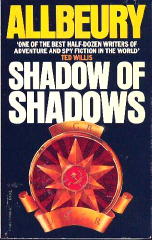
TED ALLBEURY – Shadow of Shadows. Charles Scribner’s Sons, hardcover, 1982. UK editions: Granada, hc, 1982; pb, 1982. (Shown is the cover of the paperback edition.)

TED ALLBEURY Shadow of Shadows

   Ted Allbeury started writing espionage novels in the early 1970s. He specializes in realism and the sense of desolation evident in the best contemporary British spy fiction.

   What makes Allbeury’ s novels so authentic is his background: He served with British counterintelligence during World War II. In each of the dozen espionage novels he has written so far, Allbeury creates characters and plots so convincing that the reader can’t help but be caught in his webs of suspense.

   In Allbeury’ s best book to date, Shadow of Shadows, the game is a battle of wits between Colonel Anatoli Mikhailovich Petrov, a KGB defector, and British Intelligence’s James Lawler. Petrov has been supplying valuable information — identities of double agents, locations of “safe houses,” and more — until suddenly he stops talking.

   Lawler’s mission is to find out who or what silenced Petrov and to convince him to resume supplying the vital information to British Intelligence.

   Allbeury’s novelistic skills are apparent in the relationship between the two spies — one Russian, one British — who find they have more in common with each other than they do with the spy masters who control them. The relationship grows despite Petrov’s suspicion that Lawler’s real mission may be to discover his secrets and then to liquidate him.

   With this novel and The Other Side of Silence (1981), Ted Allbeury has written espionage classics.

         ———
   Reprinted with permission from 1001 Midnights, edited by Bill Pronzini & Marcia Muller and published by The Battered Silicon Dispatch Box, 2007.   Copyright © 1986, 2007 by the Pronzini-Muller Family Trust.

Editorial Comment:   My review of The Reaper, an earlier book by Ted Allbeury about tracking down ex-Nazis in Europe, along with some biographical data about the author, can be found here.

A MOVIE SERIAL REVIEW BY DAN STUMPF:         


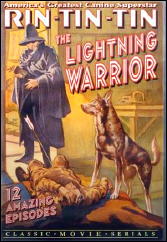
THE LIGHTNING WARRIOR. Mascot, 1931. [Twelve-episode serial.] Rin Tin Tin, Frankie Darro, George Brent, Pat O’Malley. Georgia Hale, Theodore Lorch, Yakima Canutt. Directors: Benjamin H. Kline, Armand Schaefer.

LIGHTNING WARRIOR Rin Tin Tin

   It’s hard to credit these days, but ninety-some years ago, Rin-Tin-Tin was a big star in the silent movies. Respectable critics lauded his emotional range, and even today hardened cynics like Walter Albert get all teary-eyed at the sight of him.

   But that was in the Silent Movies. With the advent of the talkies, Rinty’s popularity diminished somewhat, and by the 1930s, with a couple of divorces behind him and a rumored dog-treat habit, he ended up doing serials at Mascot.

   Not that The Lightning Warrior (1931) is all bad. I mean, sure it has an awkward script, stilted acting and meager budget … oftentimes the images seem murky, from Mascot’s policy of starting filming at first light of pre-dawn and not stopping till near-dark.

   But it’s infused with that cheap energy typical of Mascot at its best, with vigorous stunting from Yakima Canutt, earnest playing from Frankie Darro, Betsy King Ross and George Brent (long before he met Bette Davis!) plus some truly fresh location work and the usual over-ambitious straining for effects way beyond its slender budget.

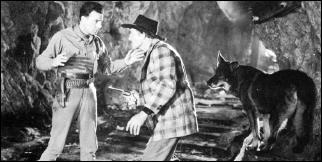
   There’s a particularly neat bit with the principals jumping between ore carts from an old mine, suspended on a cable over a vertiginous chasm; not at all convincing, but you gotta give ’em credit for trying.

LIGHTNING WARRIOR Rin Tin Tin

   The plot, if there is one, even has some poetic overtones: something about an Indian Tribe that mysteriously vanished years ago, suddenly resurrected to terrorize a remote settlement at the behest of a black-cloaked figure known only as The Wolfman, whose appearances are announced by blood-curdling howls and … well, as the chapters go by, it develops that The Wolfman must actually be one of the townspeople, but which one? The Shifty Sherriff? The Mad Trapper? The Mysterious Stranger? Marvin Hamlisch? Dick Cheney?

   Well, you needn’t look for clues, as everyone in the cast except Rinty takes turns looking guilty, and the last chapter reveals a solution that would strain the credulity of Harry Stephen Keeler, but it’s mostly fun along the way, and if Rinty gets no big emotional scenes, at least he (or his stunt-dogs) stay busy.

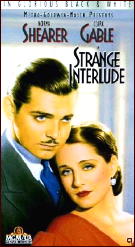
STRANGE INTERLUDE. MGM, 1932. Norma Shearer, Clark Gable, Alexander Kirkland, Ralph Morgan, Robert Young, May Robson, Maureen O’Sullivan. Based on the play by Eugene O’Neill. Directed by Robert Z. Leonard (uncredited).

STRANGE INTERLUDE Clark Gable

   On stage, Strange Interlude was a long experimental play (four and a half hours with a dinner break) that won the 1928 Pulitzer Prize for drama. While the film was cut down to a manageable 110 minutes or so, the experiment of stopping the action and allowing the actors to voice what they were really thinking was carried over to the movie.

   It didn’t work then, and it works even less (to a modern audience) now. Using voiceovers while the action stops and the actors try to match facial expressions to what the audience is hearing takes a LOT of getting used to. In these awkward moments, only Clark Gable seems able to deliver his lines in a natural and unforced manner, and that may be in part because he has fewer of them than any of the others.

   While certainly abbreviated from the stage version, and abundantly censored in the process, there still remains much in this movie that wouldn’t have passed the provisions of the Hollywood Code that came along a couple of years later. In order to maintain her husband’s sanity (Alexander Kirkland), a woman (Norma Shearer) has an affair (and a child) with another man (Clark Gable) while still in love with a man who died in combat. To complete this five-sided romantic quadrilateral, a fusty old friend of her father’s (Ralph Morgan) is also in love with her but due to his strong ties to his mother, he is unable to tell her.

   Her husband assumes the child (later to become Robert Young) to be his, but the strain of keeping the secret from him over the years wears and tears at the relationship between all of them, including the child himself, who for reasons he himself cannot easily explain, hates his “Uncle Ned.”

   Mildly fascinating, overall, and as entertaining as a slow motion disaster set in motion by characters who are too weak to prevent it, but at least I now know which play it was that Groucho Marx was parodying in Animal Crackers (1930).

A MOVIE REVIEW BY DAVID L. VINEYARD:         


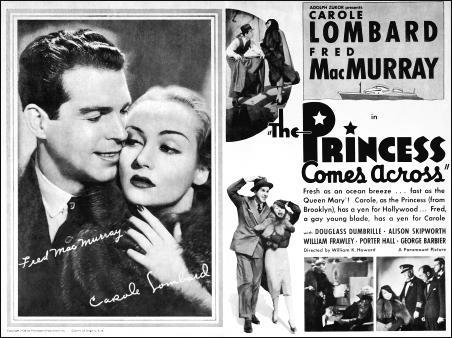
THE PRINCESS COMES ACROSS. 1936. Carol Lombard, Fred MacMurray, Douglas Dumbrille, Alison Skipworth, William Frawley, Sig Ruman, Porter Hall, Misha Auer. Screen story: Philip MacDonald, based on the novel The Duchess by Louis Lucien Rogger. (The latter may not exist in book form.) Director: William K. Howard.

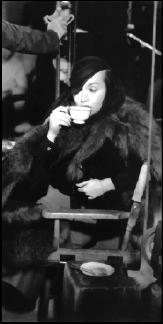
THE PRINCESS COMES ACROSS

   Why they insisted on putting Carol Lombard in dramas is one of the great unexplained mysteries of Hollywood. She was born for screwball comedy, and graces some of the highpoints of the genre from Hawks’ Twentieth Century to Wellman’s Nothing Sacred, to the divine Lubitsch’s To Be Or Not To Be.

   The Princess Comes Across isn’t quite in that illustrious company, but it’s close. The title alone is worth the price of admission.

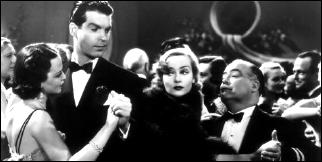
   Lombard is a would-be actress, Wanda Nash of Brooklyn, who went to Europe and got nowhere. She plans to cash in and hit New York big, though, by pretending to be a mysterious princess, Olga of Sweden, a Garbo-like figure sure to have the press in a frenzy by the time she hits New York.

   What she hadn’t counted on was a romantic bandleader in the person of Fred MacMurray as King Mantell, and murder on the ship home. The result is a delightful comedy-mystery that sometimes gets lost among the surfeit of films in that genre from the same era.

   Lombard made several films with MacMurray, and allegedly complained she wasn’t getting bigger stars as leading men, but the two are a good team, and if Fred was still a fairly minor leading man at this time, he wasn’t that far off from the films that would propel his career to major star status.

   He has an easy-to-take quality that made him ideal for these roles that could have been either dull or strident in lesser hands. MacMurray manages to hit all the right notes, and compliments Lombard as well as bigger name leads like Cary Grant, John Barrymore, or her husband Clark Gable. He was one if the stalwarts of the screwball comedy genre in his own light.

THE PRINCESS COMES ACROSS

   The voyage is a hardly a vacation for anyone. There’s a blackmailer on board targeting Wanda and others, a killer who has taken the identity of one of the other passengers, and to add insult to injury, a convention of international detectives headed for New York.

   Poor Wanda couldn’t have picked a worst boat for her trip. Then too she is falling for bandleader MacMurray, the last thing she needs in her life — a musician.

   Of course with a mix like that, it’s only a matter of time until a body shows up and sets those nosy professional sleuths to sleuthing, and when their attention turns to Princess Wanda and King Mantell, they have no choice but to turn detective themselves to unveil the real blackmailer and killer.

   Dumbrille and Ruman are among the police officers, Inspector Lorel and Steindorf. The set-up reminded me a little of C. Daly King’s novel Obelists at Sea, in which a convention of psychiatrists on a cruise all play detective while New York police Captain Michael Lord keeps his silence and tracks down the killer.

   Like all good screwball comedies, the lines flow fast and furious, and the mystery is played for laughs, but with some genuinely spooky moments at night in the inevitable fog as Lombard tries to elude the killer.

THE PRINCESS COMES ACROSS

   Everyone is at the top of their form, and despite all a list of six screenwriters (four credited, two not, including J. B. Priestley), the script holds together extremely well, thanks to Philip MacDonald’s succinct adaptation of Rogger’s novel. (If you ever wondered exactly what the screen story was in relation to the screenplay, this is a good example where a strong story holds together all the disparate contributions of an army of screenwriters.)

   We can be fairy certain it is MacDonald who keeps the mystery element in focus, while the comedy spins off of it. That said, I’d love to know what British novelist J. B. Priestley’s contribution was. He was no stranger to mystery and suspense or comedy in books or plays.

   The comedy mystery was a specialty of this era: The Thin Man, Bulldog Drummond Strikes Back, The Mad Miss Manton, Arsenic and Old Lace, Whistling in the Dark, Slightly Larcenous, Grand Central Murder to name just a few, and it mixes well with the screwball school.

   The high point was likely W. S. Van Dyke’s It’s A Wonderful World and George Marshall’s antic Murder, He Says, but Princess is no slouch, and Lombard and MacMurray are both genuinely attractive and believable.

   Somehow this one has been neglected, but it doesn’t deserve that fate. It’s one of the brightest moments of the comedy mystery film at a time when these were being made with all the skills the studio system could bring to bear. The Princess Comes Across, and delivers, a jewel of a comedy mystery.

THE PRINCESS COMES ACROSS      

IT’S ABOUT CRIME
by Marvin Lachman

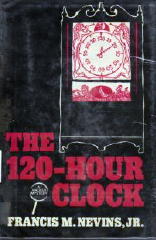
FRANCIS M. NEVINS, JR. – The 120-Hour Clock.

Walker, hardcover, 1986. Paperback reprints: Penguin, 1987; iUniverse, 2000.

MIKE NEVINS The 120 Hour Clock

   One of the last mysteries published in 1986, The 120-Hour Clock by Francis M. Nevins, Jr., turned out to be one of the most enjoyable. Nevins has abandoned (except for a cameo appearance) his previous series sleuth, Loren Mensing, in favor of an extraordinary con man, Milo Turner, whose life and happiness depend upon his solving a murder.

   The first chapter is an absolute grabber, beginning with a paragraph from Turner’s notebook in which he sounds the way Cornell Woolrich might have if he were reflecting on his career as a con man, instead of as a writer. After that we ride the Milonic roller coaster, mostly through New York and St. Louis, a world which includes Schultz’s Human Supermarket and Lafferty’s Identity Bazaar. .

   Nevins operates on two levels. First, his book is a big-caper novel and practically a treatise on the scam, though its pace is far from scholarly. Using verbs the way Nevins does (purists may blanch), I can say I page-turned compulsively. Yet Nevins evokes considerable poignancy from his character, and, incidentally, he writes excellent love scenes, several with a nicely erotic touch.

   If you’ve heard that Walker only publishes “cozy” books, disenchant yourself of that notion. The sex and the language are strong here, but they are appropriate; nothing is gratuitous.

   The mystery reader of the future, say in the twenty-second century, can learn a great deal about how we lived in the latter half of this century from The 120-Hour Clock. There are scenes in large motels that perfectly capture how it is to spend time there.

   In another scene, Turner and a woman he loves walk through Manhattan: “I linked my arm in hers as we trod the empty streets, talking in whispers so we wouldn’t wake the bag people sleeping on the steam vents.”

   I’m not sure I believe all of this book, especially the ease with which Turner establishes new identities. I’m not ever sure I was supposed to. After all, Nevins is really in the same field as Turner, who says he’s “in the business of giving apparent reality to what doesn’t exist.” Both are highly successful at their professions.

– From The MYSTERY FANcier, Vol. 9, No. 2, March/April 1987.

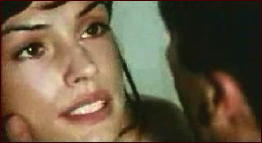
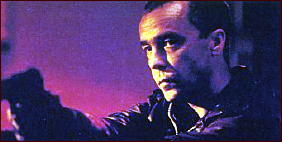
CIRCUS. Columbia, 2000. John Hannah, Famke Janssen, Brian Conley, Peter Stormare, Fred Ward, Eddie Izzard, Amanda Donohoe. Directed by Rob Walker.

   There’s plenty of split opinion to go around on this movie, but to get mine out of the way first, me, I liked it. For the most part, the dissenters fall into two camps: first, those who couldn’t follow the plot line and gave up, and secondly, those who found it inferior to a number of other similar movies of the British gangster persuasion that came out around the same time: Snatch and Lock, Stock and Two Smoking Barrels, to name two.

CIRCUS John Hannah

   Not so coincidentally, both of these were directed by Guy Ritchie, and as to the latter objection, my opinion may be biased because I’ve yet to see either one.

   But as for the complicated twists and turns of the plot: I loved them! Compared to a movie like Dead Heat on a Merry-Go-Round (reviewed here) in which the story line is straight as a string, with the mildest of zingers at the end, Circus is absolutely dynamite.

   One never knows (until the next scene) who is in cahoots with whom, and not even with a scorecard can you even tell which players are on which team.

   It would take several watchings before I’d feel totally confident that I’d have the story completely in my grasp, so that I could relay them on to you, and even then it might not even be possible. I’ll do my best, but I won’t go into detail, and of course you wouldn’t want me to anyway. (You’d hate me tomorrow if I did.)

CIRCUS Famke Janssen

   In any case, here goes: a con artist couple named Leo and Lilly (John Hannah and Famke Janssen) are planning one last final scam, but unknown to them a brutal crime lord named Bruno (Brian Conley) has plans of his own, targeting Leo with a blackmail scheme that’s built around hiring him as a hit man to kill a woman named Gloria (Amanda Donohue) who’s already on Leo’s team, or has Lilly been bending Bruno’s ear so that she’s really working for him, or did I just make that up? In the meantime Leo’s bookie Troy (Eddie Izzard) is after him for some bad bets that he made and he wants to get paid, and can Leo actually trust Lilly? Bruno’s accountant Julius (Peter Stormare) is in on the blackmail scheme, but is he working for Bruno, for Leo, for Lilly, or himself, or is he only a poor schnook who’s being taken advantage of by all three? (Is Gloria really his wife, or is she only another pawn, or does she have a mind of her own?)

   Once again, please keep in mind that some or all of the above is true. Would I lie to you? Yes, I would.

CIRCUS John Hannah

   A complicated story like this could be a huge flop easily if the actors involved weren’t involved, and believe me, they are. No phoned-in roles in this movie. John Hannah you might remember as the later Inspector Rebus in that series, and Famke Janssen is even more memorable as Jean Gray in the “X-Men” extravaganzas. They make a terrific pair, whether working together in this movie, or not, when they are even better.

A 1001 MIDNIGHTS Review
by Karol Kay Hope:


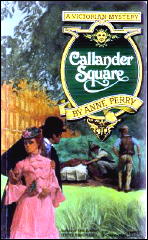
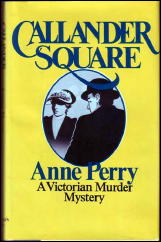
ANNE PERRY – Callander Square. St. Martin’s, hardcover, 1980. Reprint paperback: Fawcett Crest, 1981. Reprinted many times since.

ANNE PERRY

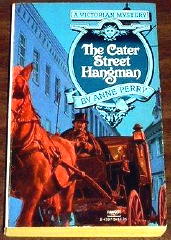
   Anne Perry’s books featuring London police inspector Thomas Pitt are called “Victorian mysteries.” One look at the covers of the paperback editions would lead the reader to believe they are just more of what has been called the “Gasp in the Grass” genre — the kind of stories that find the virginal heroine crawling at least once across the grassy slopes of a Victorian mansion in the moonlight.

   Not so. Perry has very cleverly portrayed British Victorian society with a sharp eye for its particular brand of social deceit. She is especially skilled at making the reader realize the almost unbelievable subjugation of women in those days, and if one ever wonders why women began to rebel against social constriction at the turn of the twentieth century, these books will clear up that mystery, too.

   Detective Thomas Pitt is a working-class hero in the extraordinary position of being called upon periodically to blow the cover of the English aristocracy. Being a policeman, he can exercise certain influence; if any blustering old gent attempts to order him out of the Morning Room, Pitt can threaten a search warrant.

ANNE PERRY

   He rarely needs to resort to such tactics, however, because he gets inside help from his charming wife, Charlotte, who stepped out of her upper-class world to marry him. She is an honest and enthusiastic woman whose family despairs of her insistence on following her own inchnations (although most of the women she grew up with admire her courage).

   And she is invaluable to Pitt, since most of his cases involve his exposing the passion beneath the icy breast of the upper classes. Pitt analyzes the facts with cool logic, while Charlotte uses her family connections to pick up pertinent gossip over tea and crumpets.

   In Callander Square, gardeners have inadvertently dug up the corpses of two newbom babies in the square of one of the most affluent suburbs of London. The neighborhood residents, while forced to admit the monstrosity of the deaths, simply chalk them up to the irnrnorality of some servant girl who “let herself” be molested — probably by a footman, perhaps the master of the house; gentlemen always dally with the servant girls “just for a spot of fun.”

   It is too bad, they concede, that the girl was stupid enough to get herself into such a mess — but then, what can one expect from the working class anyway?

ANNE PERRY

   Of course, those babies never belonged to a servant girl, and it is Pitt’s job to expose the enormous hypocrisy of the self-righteous elite — as well as two murderers, a blackmailer, and a gentleman drunk. This is an excellent novel that says a great deal about social pretension and the harm it can do.

   Other highly recommended books in this series are The Cater Street Hangman (1979), Paragon Walk (1981), Resurrection Row (1981), Rutland Place (1983), and Bluegate Fields (1984).

         ———
   Reprinted with permission from 1001 Midnights, edited by Bill Pronzini & Marcia Muller and published by The Battered Silicon Dispatch Box, 2007.   Copyright © 1986, 2007 by the Pronzini-Muller Family Trust.

« Previous PageNext Page »