ANNE PERRY – Southampton Row.  Ballantine; reprint paperback, Feb 2003. Hardcover edition: Ballantine, February 2002.

   I probably haven’t thought enough about this yet, so there are probably any number of exceptions I’m not thinking of right now. But it’s treacherous ground for detective stories to get into, isn’t it, when the case to be solved in one novel is nothing more than a continuation of that begun (and not finished) in another?
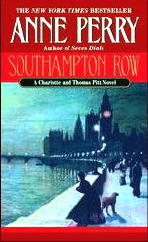
ANNE PERRY Southampton Row

   Thomas Pitt supposedly thwarted Charles Voisey, the villain in The Whitechapel Conspiracy, the book in the series before this one, and here he is, acting up again. It doesn’t feel right. Detective novels are supposed to have some sort of closure, aren’t they?

   Or perhaps I should take it back. Sherlock Holmes had his nemesis in Professor Moriarty, Bulldog Drummond had to battle Carl Peterson for several adventures, and Sax Rohmer’s Nayland Smith was constantly dueling if not outwitting Fu Manchu, and it obviously didn’t hurt the popularity of any one of those series.

   But — as far as I can recall, and you tell me if I’m wrong — each of Holmes’ cases was self-contained, and except for the escape of the villain at the end, each of the Drummond and Fu Manchu books tied up the loose ends, and this one of Anne Perry’s, at least, doesn’t. At the book’s end, we still don’t know who the other hidden adversary is, an alienated member of the Voisey’s Inner Circle? And/or is he one of Pitt’s superiors? Could the corruption reach that high?

   Epic science fiction sagas seem to come in trilogies — rightly or wrongly, blame it on Tolkien? — but it’s a little disconcerting to discover it in detective fiction. I’m relatively new to Perry’s work in general. Her stories of the Thomas and Charlotte Pitt seem to make up one long, extended Victorian drama, and you could say the same about the William Monk books as well. Which is all well and good, and Perry’s work is very popular. I understand the attraction, but when there’s no resolution to the mystery end of things, I (speaking for myself) start to feel uneasy.

   In the case at hand — to get back to the review in progress — it takes a while for an actual murder to occur for Pitt to solve, that of a medium who may also be a blackmailer. Her death may also involve Voisey, and his attempt to run for Parliament.

   Before that, and even afterward, there is a large amount of 19th century British politics to be expounded upon, and arguments about social justice and Home Rule for Ireland, either by the candidates themselves, or their wives. You may or may not find it all very interesting, but I got the strong impression that this is the story that Perry really wanted to tell, and it goes without saying (doesn’t it?) zeal and enthusiasm does matter.

   As for the mystery, I noticed small glitches in the plot here and there. And while Anne Perry’s narrative technique often consists of characters mentally asking themselves all manner of questions, the questions I wanted to ask were almost never among them.

   Charlotte has only a minor role this time. In a melodramatic finish Thomas solves the murder, but if he has the goods on Voisey on another matter — “a complicated scheme of personal revenge” — why does he let him go? I’m badly fuddled. It didn’t help to go back and read certain passages again. In fact I think it made matters worse. Befuddled, therefore, I remain, and bodaciously bemused.

— May 2003


[UPDATE] 08-14-09.   Before reprinting this review (which may not have actually appeared anywhere else until now), I confess I looked at the comments posted on Amazon, and I discovered that I was not alone in being put off balance by coming in at the middle and not having read the previous book in what’s now apparently a small “arc” in the overall Pitt series.

   It didn’t bother regular readers of the series, however, of which there are many. I’ve read (but not reviewed) only one other of Thomas and Charlotte Pitt’s adventures, the title of which I no longer recall.

   Earlier on this blog, though, you can read my comments here on Funeral in Blue, a case for William Monk, another book which, unfortunately, I also found disappointing.
REVIEWED BY WALTER ALBERT:         


SHERIDAN HAY The Secret of Lost Things.

SHERIDAN HAY – The Secret of Lost Things.

Doubleday, hardcover, March 2007. Trade paperback: Anchor, March 2008.

   After her mother dies, Rosemary Savage, with the financial help of her mother’s best friend, moves to New York City, and soon finds a job at the Arcade, a mammoth used bookstore (clearly inspired by The Strand), where she hopes, as she puts it, to “call herself into being.”

   This coming-of-age novel will delight any bibliophile, but it should capture the interest of mystery lovers as Rosemary becomes enmeshed in the intrigue that surrounds the discovery of a lost Herman Melville manuscript.

   Still, what will probably finally linger in my memory are the incisively etched portraits of the peculiar staff of the Arcade and the portrayal of the store as a mysterious entity inhabiting a space seemingly detached from the world outside its walls.

   It drew me in so completely that, given the chance to return, I would abandon the work-a-day world without a second thought.

A MOVIE REVIEW BY DAN STUMPF:         


WHO WANTS TO KILL JESSIE

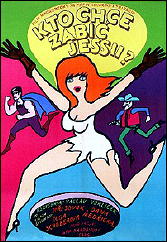
WHO WANTS TO KILL JESSIE? 1966. Originally released in Czechoslovakia as Kto chce zabíc Jessii? Director: Vaclav Vorlicek.

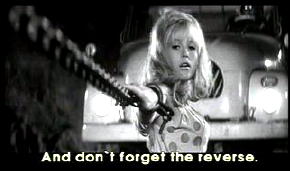
   Despite the title, Who Wants To Kill Jessie (1966) is not a murder mystery, but a Czechoslovakian pop-art sci-fi satire (you know the type) made the same year as Alphaville and sharing many of that film’s fetishes for pop culture and politics.

   An eminent (and rather dowdy) female scientist invents a serum designed to purge dreams of their unsettling elements, leading to happy, productive dreams (“No longer will people be allowed to dream anything they wish.”) and when she discovers her husband dreaming of a scantly-clad comic-strip heroine constantly menaced by a cowboy and a superhero, she purges his dream, only to have the characters materialize and begin a comic chase through their society.

WHO WANTS TO KILL JESSIE

   A basic situation that could have led to facile clowning or heavy moralizing in lesser hands is handled here with charming slapdash panache and innocent energy delightful to watch.

   Director Vaclav Vorlicek mixes sight gags and verbal humor (that survives the subtitling surprisingly well) with a deft touch and an obvious love of the comic-book culture he’s exploiting, and his players (whose names would mean nothing to you) convey a conflict of bureaucratic buffoonery and pulp-paper passion with that sincerity which is the essence of Comedy. A film that deserves a bigger reputation.

WHO WANTS TO KILL JESSIE

   By the way, I know I said the cast names would mean nothing to you, but for the sake of Academic Correctness, I should add that the actress who plays the comic-strip-heroine starred in some enjoyably gaudy English-language films (like The Vengeance of She) and eventually found her way into the December 1969 issue of Playboy.

   Just thought I’d mention it.

Editorial comment:   And on the cover of the March 1964 issue. Worth mentioning, too, perhaps?

WHO WANTS TO KILL JESSIE

A REVIEW BY DAVID L. VINEYARD:         


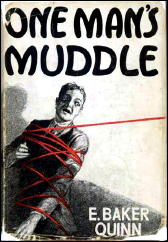
E. BAKER QUINN – One Man’s Muddle. Heinemann, UK, hardcover, 1936. Macmillan, US, hardcover, 1937.

   Two years before Raymond Chandler introduced us to Philip Marlowe in The Big Sleep (1939), E. Baker Quinn, a British writer, anticipated both his voice and his attempt to do something more serious with the detective novel with her first novel about former Scotland Yard sleuth James Strange, an accomplishment noted by critic James Sandoe in his famous list of notable hard-boiled writers.

   When we first meet her sleuth James Strange, he has fled to a “… tu’penny ha’penny inn a hundred miles from nowhere,” to escape his past. But he knows it’s hopeless. “Do a bunk to the jungles of Africa and ten to one you’ll meet your mother-in-law’s char coming around the first bush …”

E. BAKER QUINN One Man's Muddle

   And for Strange it is much worse than his mother-in-law’s charwoman. He’s runs smack into the former Mrs. Boynton, now Mrs. Geoffrey Wharton, a former London snowbird, an addict, who knows all about Scotland Yard’s former bright young thing who has just completed four years in the pen for possession of illegal drugs.

   I wondered if she would be stupid enough to lie. Burns was wrong. If we could see ourselves as others see us police blotters would be empty. For instance, she’d have made an attempt to douse the 400-watt light blazing in her eyes.

   And of course Mrs. Wharton is promptly murdered, and Strange finds himself forced to help her husband cover up her past while trying to cover up his own and keep the police from finding the .32 caliber automatic hidden in his luggage, the gun he used in a manslaughter case he was acquitted in — but would rather not bring up again — and coincidentally, the same caliber Mrs. Wharton was shot with …

   His attempts to keep his head above water push him deeper into the mess, and force him back to his ex-fiancee in London and to Ratchet, the partner who ratted on him and testified against him as King’s evidence.

   That’s the set up for a novel that anticipates the style and voice of Chandler’s novels:

   Well, I thought, the lad who wrote what a tangled web we weave certainly knew what he was talking about. From the night of Alice’s (Mrs. Wharton) death, when I made a bargain with Wharton to keep his secret if he kept mine, one thing had followed on another. Little pyramids pyramiding precariously and I was so involved now that when they crashed I’d find myself squarely on the bottom of the pile.

   Before it is over Strange will solve the case, but find himself facing another two years in prison.

    “I tank ay asked for it,” I said in a small Swedish accent, “ay been dom fool.”

   In later books Strange gets out of prison and goes to work as a private eye with his despised ex-partner Ratchet. The voice continues in the Chandler vein.

   Who Quinn was, and how she came to discover a voice and subject matter so close to Chandler is a mystery in itself. But her books are worth discovering and reading, and Strange a curious compliment to Marlowe and his world.

   Here are a few samples of Quinn and Strange:

    I gave a flawless imitation of a man looking at a packet.

    “It’s a curious thing, Mr. Strange,” he said, but I never go to the cinema.”
    “I never go to America,” I said, “but I know what Roosevelt looks like.”

    “Anything I tell that old bargepole,” I said, “you can cook three minutes and throw away.”

   If one-eighth of the publicans in England began telling all they knew, divorce and civil courts would take over the nation.

   Curious how the saving of great honour usually involves the destruction of several small honours. Like the nobleman’s son who saved the families honour by not marrying the dairymaid.

   He made me think of Luther and Savonarola and Reformations, possibly because he had what I call the Righteous Eye. Believe me I’m an authority on the Righteous Eye. The judge who sent me up had it.

   A thin chill pimpled all over me.

   She gave me a rake over then, twice the voltage of mine.

   I wondered irritably how anything as peaceful as the village could be so damn unpeaceful.

   The cows gave me the same kind of look coming home with an old lady in my arms and a dripping child on my heels as they gave me going out and I thought it must be wonderful to be beyond surprise like that.

   Tonight I’d ride the old nightmare, I’d cease to walk erect and unafraid. Four years of dreams, I thought, bitterly, and just a handful of hours to kill the dream …

   One Man’s Muddle and its sequels are an interesting look at a Marlowe that might have been, one of those curious side roads that sometime run parallel to a more successful track. And well worth reading and discovering as first rate mysteries by a writer who deserved more recognition than she got.

         Bibliographic data: [From the Revised Crime Fiction IV, by Allen J. Hubin]

QUINN, E(LEANOR) BAKER

       One Man’s Muddle (n.) Heinemann 1936. Macmillan, 1937. [James Strange]
       The Dead Harm No One (n.) Heinemann 1938.    (**)
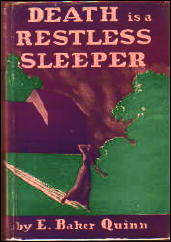
       Death Is a Restless Sleeper (n.) Heinemann 1940. Mystery House, 1941. [James Strange]

E. BAKER QUINN Death Is  Restless Sleeper

(**) While it seems likely that he is, it is not known whether James Strange is in this book or not.

    Peeking ahead at next November’s schedule, I found a bonanza of “Falcon” movies coming up on Turner Classic Movies. Synchronize your calendars!

      Friday November 20

6:00 AM Gay Falcon, The (1942)
   A society sleuth tries to break up an insurance scam. Cast: George Sanders, Wendy Barrie, Gladys Cooper. Dir: Irving Reis. BW-67 mins, TV-G, CC

7:15 AM Date With The Falcon, A (1941)
   The gentleman detective postpones his wedding to find a cache of stolen diamonds. Cast: George Sanders, Wendy Barrie, James Gleason. Dir: Irving Reis. BW-63 mins, TV-G

8:30 AM Falcon Takes Over, The (1942)
   A society sleuth and a lady reporter try to track down a murderous thug’s lost girlfriend. Cast: George Sanders, Lynn Bari, Ward Bond. Dir: Irving Reis. BW-63 mins, TV-G

9:45 AM Falcon’s Brother, The (1942)
   A gentlemanly detective calls on his brother to help him stop the Nazis from assassinating a key diplomat. Cast: George Sanders, Tom Conway, Jane Randolph. Dir: Stanley Logan. BW-63 mins, TV-G. [Screenplay by Craig Rice and Stuart Palmer.]

11:00 AM Falcon Strikes Back, The (1943)
   A society sleuth is framed for murder by criminals running a war-bond racket. Cast: Tom Conway, Harriet Hilliard, Edgar Kennedy. Dir: Edward Dmytryk. BW-66 mins, TV-G

12:15 PM Falcon In Danger, The (1943)
   A society sleuth tracks a lost plane carrying $100,000. Cast: Tom Conway, Jean Brooks, Elaine Shepard. Dir: William Clemens. BW-70 mins, TV-G

1:30 PM Falcon And The Co-Eds, The (1944)
   A society sleuth investigates murder at a girls’ school. Cast: Tom Conway, Jean Brooks, Isabel Jewell. Dir: William Clemens. BW-68 mins, TV-G

2:45 PM Falcon Out West, The (1944)
   A society sleuth turns cowboy to investigate a Texas murder. Cast: Tom Conway, Carole Gallagher, Barbara Hale. Dir: William Clemens. BW-64 mins.

4:00 PM Falcon In Mexico, The (1944)
   A society sleuth travels South of the border to investigate an art dealer’s murder. Cast: Tom Conway, Mona Maris, Martha MacVicar. Dir: William Berke. BW-70 mins, TV-G

5:15 PM Falcon In Hollywood, The (1944)
   A society sleuth tours the movie capital, where he uncovers an actor’s murder. Cast: Tom Conway, Barbara Hale, Sheldon Leonard. Dir: Gordon Douglas. BW-67 mins, TV-G, CC

6:30 PM Falcon In San Francisco, The (1945)
   A society sleuth enlists a little girl’s help in nabbing a mob of silk smugglers. Cast: Tom Conway, Rita Corday, Sharyn Moffett. Dir: Joseph H. Lewis. BW-66 mins, TV-G.

             —

   These, of course, have played many times over on TCM, but if you’ve never seen or taped them before, here’s a great chance to obtain them all at once. There are two more in which Conway appeared, followed by three starring John Calvert. You may have to hunt a while on the collector’s market for some or all of these.

THE FALCON’S ALIBI. (1946, RKO) Tom Conway, Elisha Cook, Jr.

THE FALCON’S ADVENTURE. (1946, RKO) Tom Conway.

THE DEVIL’S CARGO. (1948, Film Classics) John Calvert, Rochelle Hudson, Roscoe Karns, Lyle Talbot, Tom Kennedy, Theodore Van Eltz, Paul Regan

APPOINTMENT WITH MURDER. (1948, Film Classics) John Calvert, Catherine Craig, Lyle Talbot, Jack Reitzzen, Peter Brocco

SEARCH FOR DANGER. (1949, Film Classics) John Calvert, Albert Dekker, Myrna Dell, Douglas Fowley, Ben Welden

FORGOTTEN MURDERS #1
by Allen J. Hubin


DIPLOMAT – Murder in the State Department. Jonathan Cape & Harrison Smith, US, hardcover, 1930.

DIPLOMAT Murder in the State Department

   John Franklin Carter wrote books on a variety of subjects under several pen names, including Unofficial Observer and Jay Franklin. But when in 1930 he began a series of detective novels about a diplomat-detective, Dennis Tyler, he chose his pen name, Diplomat, with malice aforethought.

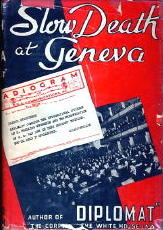
   Many of the titles of his books about Tyler suggest a political setting — for example, in addition to the above, Carter wrote Murder in the Embassy, The Corpse on the White House Lawn, Death in the Senate, and Slow Death at Geneva.

   Carter’s interest in politics and diplomacy is also apparent in his nonfiction books under the Jay Franklin pseudonym — for example, he wrote a biography of La Guardia.

   A recent reading of Murder in the State Department suggested that Carter’s detective fiction might be worthy of rediscovery. Undersecretary Harrison Howard is found with a steel filing spike in his chest, and Dennis Tyler, Chief of the Bureau of Current Political Intelligence, jauntily arrives on the scene. Tyler, who affects a Harvard accent and abundant sassy repartee (for which I must confess a weakness), puts his career on the line in his effort to solve the crime.

DIPLOMAT Slow Death at Geneva

   The case involves, among other things, an undersecretary seen flying down the nocturnal halls of the State Department with no visible means of support, the latest discovery by the Chemical Warfare Service, and finally a sinister plot by a national pacifist leader to take over the country (shades of Fu Manchu!).

   The book is weakened by an unsatisfying ending, but the author’s style is brisk and the action incessant.

   As long as credibility is not required, Murder in the State Department makes very entertaining reading and I look forward to investigating other Diplomat books in my library.

– From The Armchair Detective, Vol. 1, No. 1, October 1967.


[UPDATE] 08-12-09.   From the second issue of TAD [January 1968] is the following News Note, signed by AJH  [Al Hubin] —

    In the first issue of The Armchair Detective a novel by John Franklin Carter was reviewed, and it was suggested that Carter’s detective fiction, written in the 1930′ s under the pseudonym Diplomat, was worthy of rediscovery. Mr. Carter died November 27 at the age of 70, and thanks to Charles Shibuk I am in possession of obituary notices from the New York Times and the New York Post.

   Mr. Carter was born in 1897, one of a family of 7 children of Rev. John Franklin Carter, an Episcopal clergyman, and his wite. Weakened health due to a serious childhood infection caused him to learn to write “in self-defense against a world which is, among children at least, thoroughly contemptuous of weaklings.”

   He was occupied in various phases of newspaper work during his twenties, and then, beginning in 1928 when he moved to Washington, concerned himself with politics and government service for the rest of his lite. He held posts in the Departments of State and Agriculture, and commented on political life on radio programs and in newspaper columns for many years. Most of his more than 30 books dealt with politics, but it is interesting to note that although considerable space was devoted in the newspapers (especially the Times, on whose staff Carter served for some 5 years) and in Time Magazine to his obituary none of these publications said one word about his detective fiction.

THE BACKWARD REVIEWER
William F. Deeck

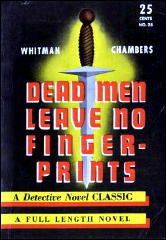
WHITMAN CHAMBERS – Dead Men Leave No Fingerprints.

Doubleday, hardcover, 1935. Hardcover reprint: Caxton House, 1939. Paperback reprint: Detective Novel Classic #28, circa 1943.

WHITMAN CHAMBERS Dead Men Leave No Fingerprints.

   Danish film star and sexpot Hilda Haan hires private detective Stanton Lake to get her out of the clutches of a man who threatens to tell her studio about her “moral turpitude” unless she marries him. Lake says he’ll get her out of the mess if he has to kill the man to do it.

   That turns out to be unnecessary. Someone else does the job for him while preparations are being made for a seance at the residence of Rufus Raybourne, a real-estate magnate now suffering hard times. The victim is killed with a poker that has on it the fingerprints of an enemy of Raybourne’s.

   Yet this enemy died more than a year earlier in prison. Or did he? Lake plays ghoul and finds an empty grave. Two more murders take place. After each one, the same fingerprints are found.

   An unusual motive, a cunning — well, he or she would have been if the killings hadn’t continued once Lake’s identity was revealed — murderer, and an interesting character in Lake.

   The writing level is the ’30s standard: Passable.

– From The MYSTERY FANcier, Vol. 10, No. 3, Summer 1988.


A 1001 MIDNIGHTS Review
by Kate Mattes:


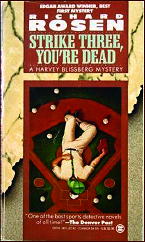
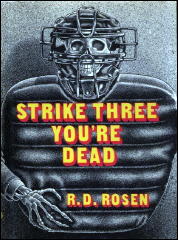
R. D. ROSEN – Strike Three, You’re Dead. Walker, 1984. Signet, pb, 1986. Walker, trade pb, 2001.

RICHARD ROSEN Strike THree You're Dead

   Harvey Blissberg, the hero of Strike Three, You’re Dead, is a baseball player recently traded from the Boston Red Sox to a new American League expansion team, the Providence Jewels.

   Called “Professor” by his younger teammates for his reading habits and off-diamond attire, Blissberg is stumped for a motive to the murder of his roommate, Rudy, and begins looking for the murderer out of a combination of curiosity and guilt.

   Discouraged by management, teammates, and police, Blissberg gets support from his girlfriend, a local TV sportscaster, and his brother, a baseball fanatic, as he tries to determine why his best friend on the team wound up drowned in the team whirlpool. His quest for the murderer takes on a new urgency when he, too, becomes a target.

   Baseball statisticians will have a very slight edge in solving the murder, but such avidity is not needed. Rosen’s clever plotting, quick wit, and subtle understatement makes this book both entertaining and easy to read.

   In the second book in this series, Fadeaway (1985), Blissberg has retired to become a professional detective and is called in to solve the murder of two NBA basketball stars.

   Strike Three, You’re Dead was named one of the seven best mysteries of the year by the New York Times, and won a Best First Novel Edgar. Rosen is also the author of two nonfiction books and numerous essays, criticisms, and articles on sports and humor.

         ———
   Reprinted with permission from 1001 Midnights, edited by Bill Pronzini & Marcia Muller and published by The Battered Silicon Dispatch Box, 2007.   Copyright © 1986, 2007 by the Pronzini-Muller Family Trust.

A REVIEW BY FRANCIS M. NEVINS, JR.         


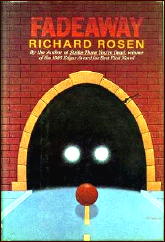
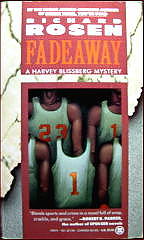
RICHARD ROSEN – Fadeaway. Harper & Row, 1986. Paperback reprint: Onyx, July 1989.

– Reprinted from The MYSTERY FANcier, Vol. 9, No. 2, March/April 1987.


RICHARD ROSEN

   Robert B. Parker may not be the best private eye writer of the eighties but surely he’s the most influential, as witness the horde of newcomers to the field who have used his pretentious, wildly overrated, consistently best-selling series about the Boston PI Spenser as their takeoff point.

   Richard Rosen, winner of the Mystery Writers of America Edgar award for the best first crime novel of 1985, deserves another prize for. using Parker most creatively.

   The main character both in Fadeaway and in Rosen’s prizewinning Strike Three You’re Dead is a sort of Jewish Spenser, at least in the sense that each man is a smart-mouthed jock from Boston with a liberated live-in lady and a snootful of angst.

   Harvey Blissberg has turned hesitantly to the PI game after the early end of his career as a major-league outfielder, but he’s not very good at his new line of work and all his cases seem to come to him from his sports world connections. In Fadeaway he’s hired simultaneously by the Boston Celtics and the Washington Bullets to find out why a basketball star from each team vanished from Logan Airport within forty-eight hours of one another.

RICHARD ROSEN

   When both players are found shot to death, Harvey follows the trail into the seamy world of college sports recruiting, and his hunch that the murders are tied in with the seven-year-old “accidental” death of a high school basketball champ in a dark bus tunnel stirs up the usual hornet’s nest of corruption.

   If Ross Macdonald had written this book, the plot would have been so convoluted you’d need a chart to sort out who did what to whom. Rosen goes to the opposite extreme, leaving out complexity and surprise almost entirely.

   If Parker had written the book, there would have been a violent confrontation in every chapter. Rosen avoids action scenes almost entirely, too. But he’s an excellent stylist, with the ability to describe an American city (in this case Providence, Rhode Island) and the inner world of desperately lonely people as well as any PI novelist now at work.

   What sets Rosen apart from everyone else in the field, however, is his gift for shifting without effort from the film noir gear into another mode entirely. Here for example is Harvey anguishing over the case with his girlfriend, Mickey:

    “I can’t figure out where their lives crossed. Christ, Mick, what am i going to do? I’m out of my element.”

    “You never had an element.”

    “Thanks. You’re joking and I’m having a crisis.”

    “Life is a series of crises.”

    “It hasn’t always felt like this.”

RICHARD ROSEN

    “Okay, I take it back. Life is a series of crises separated by brief periods of self-delusion.”

    “I need a pith helmet to protect me from your sayings.”

   Jock though he’s supposed to be, Harvey is the only PI in the literature who cries out to be played by Woody Allen.

    Fadeaway is crammed with scenes which are not only hilarious in their own right, but marvelous as parodies of the tiresome philosophic shticks in the Spenser novels. It’s light on action and complexity, but the first-rate dialogue and characterizations and the rich anti-Parker subtext make this one a joy to read.

    Bibliography — Expanded from the Revised Crime Fiction IV, by Allen J. Hubin:

ROSEN, R(ichard) D(ean), 1949- . SC: Harvey Blissberg, in all titles.

      Strike Three You’re Dead. Walker, hc, 1984. Signet, pb, 1986. Walker, trade pb, 2001.

      Fadeaway. Harper & Row, hc, 1986; Onyx, pb, 1989.

      Saturday Night Dead. Viking, hc, 1988; Onyx, pb, 1989.

RICHARD ROSEN

      World of Hurt. Walker, hc, 1994.

RICHARD ROSEN

      Dead Ball. Walker, hc, 2001.

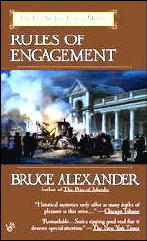
BRUCE ALEXANDER – Rules of Engagement.

Berkley, paperback; 1st printing, February 2006. Hardcover edition: G. P. Putnam’s Sons, March 2005.

   This is the first of Bruce Alexander’s “Sir John Fielding” detective novels that I’ve read, and no, I didn’t realize it until after I’d picked it out to read that this is also the last one that Alexander ever wrote. And as perhaps you already knew, Bruce Alexander was the pen name of Bruce Cook, 1932-2003, who wrote eleven mysteries under that name. Under his own name, he had five earlier ones, four of them with Antonio “Chico” Cervantes as the leading character.

WILLIAM COUGHLIN

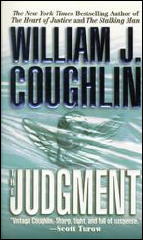
   Now it gets interesting. (I’ll get back to Antonio “Chico” Cervantes in a minute.) Cook also was at least in part responsible for writing William J. Coughlin’s last book after he (Coughlin) died, The Judgment (St. Martin’s, 1997). I’m quoting from Al Hubin in Crime Fiction IV now: “Apparently written by Bruce Cook from a beginning by Coughlin, then finished and polished by widow Ruth Coughlin.”

   The reason is that this is interesting, is that this is precisely how Rules of Engagement got written. From the back cover, and quoting again: “He (Bruce Cook) died in 2003, having completed most of Rules of Engagement, and left notes on how the rest of the story unfolded. John Shannon, author of the highly praised Jack Liffey series, most recently Dangerous Games, completed the novel with Bruce’s wife, Joan Alexander.”

   As coincidences go, it would be rather minor, but was it a coincidence? Probably not. The idea was there, and the Bruce Cook and his wife simply carried it out in the same way it had been done before. And as you can easily imagine, there are both pluses and minuses in doing so.

BRUCE COOK Mexican Standoff

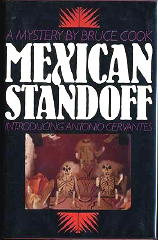
   But before getting into that, and to Sir John Fielding and what the book (and the series) is about, I promised to tell you something about Chico Cervantes. This Thrilling Detective link will tell you more, but perhaps it suffices to say that Cervantes was a Mexican-American ex-LA cop turned private eye whose stomping grounds were (as you probably already guessed) Southern California.

   His four recorded cases, published between 1988 and 1994, did not seem to turn the mystery fiction world on fire, and in fact, only one of the four, the first, Mexican Standoff, was ever published in paperback, the other three only in hardcover.

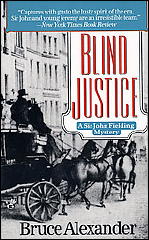
   For whatever that tells you. In any case (no pun intended) the year the last Cervantes book came out, 1994, was the same year that Blind Justice, the first Sir John Fielding novel appeared. Cook, as Alexander, at the age of 62, had hit the equivalent of pay dirt.

   I’ll append a complete list of the highly popular Fielding books at the end of this review. (I have them all. They are, unfortunately, still in the TBR (To Be Read) portion of the basement.)

BRUCE ALEXANDER

   Sir John Fielding, as I hasten now to tell you (at last), was the blind English magistrate who was the real-life founder of London’s first true police force, the Bow Street Runners, in the mid-to-late 1700s.

   What’s interesting about one of Alexander’s Fielding books, An Experiment in Treason, Benjamin Franklin makes an appearance. Unlike Robert Lee Hall’s series of books of the latter’s London adventures, though, in Treason Franklin is a suspect, not the detective, while in Hall’s books, Fielding is only a (relatively) minor character.

   In the books by Bruce Alexander, Fielding’s household and close-knit circle of friends and close acquaintances takes center stage, filled to abundance with family, servants, many of which (if not most) are fictional. Especial note should be made of the narrator of the tales, one Jeremy Proctor, Fielding’s protege with him throughout the series, an orphan taken under his wing as a dogsbody, now in Rules of Engagement all of eighteen and Sir John’s clerk at the Bow Street Court.

   The title comes in part from the fact that Jeremy is engaged to be married to Clarissa Roundtree, the other orphan taken in by the Fieldings: Clarissa as Lady Fielding’s general factotum, and as the book begins, he (Jeremy) is beginning to wonder greatly about his future. (On page 241 there is another context in which “rules of engagement” come into play.)

   The mystery is extremely slight, but of course it needs to be mentioned. It concerns the strange death of Lord Lammermoor, who has recently jumped to his death from a bridge while crossing the Thames alone.

BRUCE ALEXANDER

   Several chapters later (or to be precise, in Chapter Three) the case is all but solved when Fielding and his entourage are entertained at the theater by a practitioner of “animal magnetism” and/or “mesmerism.” The only question that remains (to the reader, that is) is who is responsible, and while I cannot reveal his/her name, you will know as soon as he/she enters the story. (Ventriloquy is also an important factor, but my telling you that will neither enlighten you further, or less.)

   One hopes for more, but more there is not, save 200 pages in which a great happens, but very little of any consequence. All in all, what the authors in combination have provided is nothing less than a worthy attempt to tie up some loose ends for the readers who followed the series and the characters from early on — but not all of them (the loose ends, that is). Life happens, and that is what is left for the reader to contemplate. This is one of the aforementioned pluses.

   For someone expecting a detective story with some solid, down-to-earth detective work going on, either Mr. Alexander did not have one in mind, or if he did, neither his wife nor John Shannon were able to build one out of the notes that he left them. This is one of the aforementioned minuses.

   For the record, the pluses outweigh the minuses, but personally, coming in at the end as I did, I left with a feeling of disappointment that I sincerely wished I hadn’t — come in at the end, that is.

   If you’d like to call my verdict “mixed,” you’d certainly be right. I wouldn’t deny it at all.

— March 2006


      The Sir John Fielding novels by Bruce Alexander:

   All were published in hardcover by Putnam and in paperback by Berkley. The dates are of the hardcover editions; the paperback generally appeared a year later.

Blind Justice. 1994.

Murder in Grub Street. 1995.

BRUCE ALEXANDER

Watery Grave. 1996.

Person or Persons Unknown. 1997.

BRUCE ALEXANDER

Jack, Knave and Fool. 1998.

Death of a Colonial. 1999.

The Color of Death. 2000.

BRUCE ALEXANDER

Smuggler’s Moon. 2001.

An Experiment in Treason. 2002.

The Price of Murder. 2003.

BRUCE ALEXANDER

Rules of Engagement. 2005.

« Previous PageNext Page »