A 1001 MIDNIGHTS Review
by Bill Pronzini:


CLYDE B. CLASON – Blind Drifts. Doubleday Crime Club, hardcover, 1937.
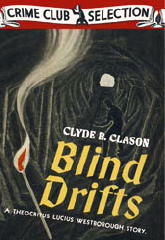
CLYDE B. CLASON

   Mild-mannered Professor Theocritus Lucius Westborough, an expert on the Roman emperor Heliogabalus, is an amateur sleuth in the classic mold of the Twenties and Thirties: He solves convoluted puzzles through the time-tested Sherlockian methods of keen observation, a storehouse of esoteric knowledge, and deductive reasoning.

   Westborough — and his creator specializes in locked-room “miracle problems.” Even the best of these offers no challenge to John Dickson Carr, but for the most part they are cleverly constructed and well-clued.

   The one in Blind Drifts offers a particularly neat and satisfying variation on the theme.

   Westborough’s home base is Chicago, but here he travels to Colorado to visit a gold mine in which he has inherited 70,000 shares. Not long after his arrival, he finds himself investigating, first, the disappearance of one of the mine’s directors, and then the murder of its owner, Mrs. Coranlue Edmonds, known far and wide as a “bearcat on wheels” — a murder by shooting that takes place in front of seven witnesses, in a “blind drift” deep inside the Virgin Queen mine, by a seemingly nonexistent gun.

   The plot is twisty and complex, the clues numerous and fairly presented, the motive for Mrs. Edmonds’s murder plausible, and the method likewise. The Colorado setting is well depicted, as are the details of the operation and physical makeup of a large gold mine.

   It is Clason’s attention to such detail, more than anything else, that lifts his work above the average puzzle story of the period; you can’t read a Westborough novel without learning something, and something interesting at that.

   The one drawback to this and the eight other entries in the series is Clason’s sometimes florid, often prolix style. Blind Drifts is the only book of his that would not benefit greatly from the excision of ten or fifteen thousand words, and at that it could stand to lose five or six thousand here and there.
CLYDE B. CLASON

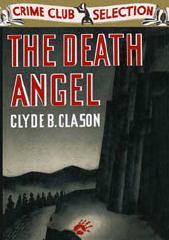
   The most appealing of Westborough’s other cases are The Death Angel (1936), set on a Wisconsin country estate called Rumpelstiltskin, where a murder happens in spite of 1542-to-l odds against it, and a murderer is twice guilty of killing the same man; The Man from Tibet (1939), which features a locked-room murder and contains some fascinating background material on the strange customs and rites of Tibet; and Green Shiver (1941), which has a Los Angeles setting and another “impossible” plot, the solution to which depends on Westborough’ s knowledge of Chinese jade.

         ———
   Reprinted with permission from 1001 Midnights, edited by Bill Pronzini & Marcia Muller and published by The Battered Silicon Dispatch Box, 2007.   Copyright © 1986, 2007 by the Pronzini-Muller Family Trust.
Reviewed by MIKE GROST:

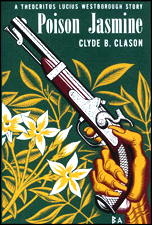
CLYDE B. CLASON – Poison Jasmine.

Doubleday Crime Club, hardcover, 1940. Trade paperback reprint: Rue Morgue Press, 2008.

CLYDE B. CLASON Poison Jasmine

   Poison Jasmine involves murder among perfume manufacturers. While other Clason mysteries are set among art collectors, Poison Jasmine has a background of science and technology, instead.

   It is a scientific detective story. The main crimes involve poisoning, and these too are scientific in nature. The science in Poison Jasmine often involves plants; Clason’s knowledge of botany will return in Green Shiver.

   Sleuth Theocritus Lucius Westborough has much information on perfumery in the ancient world. Poison Jasmine is also one of Clason’s books in which Westborough’s career as a classical historian is best integrated into the novel.

   The book’s look at a business as a background for a crime also resembles Rex Stout. As in Stout, we have a group of suspects that work as officers and consultants for a small, successful business. They are upper middle class, educated people of considerable business skill. Stout’s businesses tend to have an intellectual feel, such as a design firm, publishing or broadcasting. Clason’s perfume firm is steeped in cultural traditions of the world of scent production.

   Unlike some other Clason works, Poison Jasmine does not recreate another culture. It does offer a sympathetic, anti-racist account of the Chinese chef, which is in accord with the views expressed in Clason’s other fiction.

   Poison Jasmine has a simple, but effective impossible crime puzzle; in fact, it anticipates ideas John Dickson Carr will use in one of his later novels. The book also shows Clason’s flair for color imagery. Both the flowers, and events of the mystery plot, are described in color terms.

   Agatha Christie in The Big Four (1924) included a section called “The Yellow Jasmine Mystery” (Chapters 9-10). This deals with the same poisonous plant that gives the title to Poison Jasmine.

   Poison Jasmine seems padded. Like many mystery novels, it would have been better as a novella. Most of the meat of both the mystery plot and perfume background are in several sections totaling around seventy pages.

— Reprinted in slightly revised form from A Guide to Classic Mystery and Detection, by Michael E. Grost, with permission.


Editorial Comment:   If you’re looking for a copy of this book to read, you will need a lending library that never has discarded a mystery novel in the past 70 years. Either that, or take advantage of Rue Morgue Press’s highly laudable policy of getting hard-to-find vintage mystery fiction back into print. There was only one copy of this book on ABE just now when I looked, and in dust jacket the asking price was in the $300 range.

   For a long overview of Clyde B. Clason’s life and writing career, the Rue Morgue website is also the place to go.

   Coming up soon: Bill Pronzini’s review of Clason’s Blind Drifts (Doubleday, 1937), taken from 1001 Midnights, then my own of Murder Gone Minoan (Doubleday, 1940).

A 1001 MIDNIGHTS Review
by John Lutz:


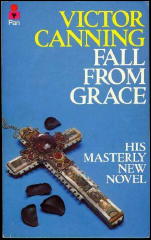
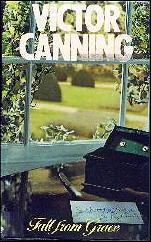
VICTOR CANNING – A Fall from Grace. Wm. Heinemann, UK, hardcover, 1980; Pan, UK, pb, 1982. William Morrow, US, hardcover, 1981; reprint hardcover: Detective Book Club, 3-in-1 edition, June 1981.

VICTOR CANNING

   Beginning with Polycarp’s Progress in 1935, Victor Canning has written over fifty novels. After World War II, he turned his efforts to espionage fiction, a genre at which he is now acknowledged to be one of the best practitioners.

   Fall from Grace, however, is anything but an international thriller. Halfway through this psychological mystery, Canning’s main character, private investigator James Helder, is asked how a calm, good-hearted man such as himself got into his somewhat unsavory line of work.

Part of Helder’ s explanation is that he feels himself to be “a sort of gray shape living a gray, humdrum life like so many people. So, to escape from all that, I mix in other and more unorthodox people’s lives to add a little crude color to my own.”

   The unorthodox person Helder is trailing here is the totally amoral John Corbin, about whom Helder observes, “The John Corbins of this world felt compelled to make the occasional obligation to the gods of chance. A little not-too-expensive kindness here, a rare good deed to assuage self-disgust, even at times an isolated self-sacrifice to bring them close to the shriving of some sin.”

VICTOR CANNING

   That really is all this novel is about, but it is enough. Canning gives us an engrossing, incisive study of the world’s Corbins, the selfish and impulsive people who charm those close to them and sometimes even themselves, predators with engaging smiles and talent for deception.

   This John Corbin lands a job writing the history of the gardens of Illaton Manor, long tended by the family of Corbin’s employer, the bishop of Testerburgh. Included in the job are a cabin, extensive research facilities, and circumstances which make it easy to seduce beautiful coworker Rachel Harrison.

   Corbin takes advantage of all these conveniences, for a while even convincing himself that he genuinely loves Rachel. But an unexpected opportunity for profitable mischief proves that Corbin’s new leaf is only ego-supported self-delusion, a strained hiatus from reality. He enthusiastically reverts to type.

VICTOR CANNING

   This is a meticulously written, revealing glimpse into the mind of a man who is the serpent in his own Garden of Eden.

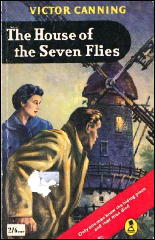
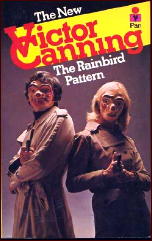
   Especially good among Canning’s early novels are The Chasm (1947) and The House of the Seven Flies (1952). Other noteworthy titles among his later works include Firecrest (1972), The Rainbird Pattern (1973), which was the basis for Alfred Hitchcock’s last film, Family Plot, and Birds of a Feather (1985). Also excellent is a collection of four suspense novelettes, Oasis Nine (1958).

         ———
   Reprinted with permission from 1001 Midnights, edited by Bill Pronzini & Marcia Muller and published by The Battered Silicon Dispatch Box, 2007.   Copyright © 1986, 2007 by the Pronzini-Muller Family Trust.
[UPDATE] 07-16-09.   Jamie Sturgeon has just pointed out the existence of a website devoted to Victor Canning, including of course a detailed bibliography. It’s at http://www.victorcanning.com/, and it is a work of art, to say the least. In terms of the bibliography, not only are covers of each edition of every book shown, but photos of places mentioned in each of the books are often included as well.

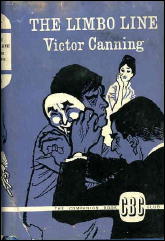
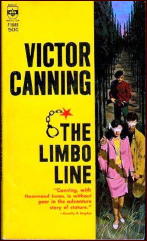
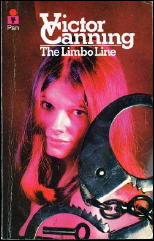
VICTOR CANNING – The Limbo Line. Wm. Heinemann, UK, hardcover, 1963. William Sloane Associates, US, hardcover, 1964. Hardcover reprint (UK): Companion Book Club. Paperback reprints (UK), Pan; several printings. Paperback reprints (US): Berkley F1085, 1965; Award 1467, 1975; Ace/Charter, 1979.

VICTOR CANNING

   Victor Canning isn’t read much today, which is a shame. He was a major figure in the period from the 1950’s to the 1980’s and one of the best of the British thriller writers, a club that included Eric Ambler, Hammond Innes, and Desmond Bagley.

   Though he began his successful writing career before the war in England, it was with The Chasm in 1950 that his real career began. His best known work is probably The Rainbird Pattern, an atypical crime novel set in the South of England and filmed by Alfred Hitchcock as The Family Plot.

   The Limbo Line is one of only three Cold War novels Canning wrote during the first half of his thriller-writing career, and something of a throwback to the thrillers of John Buchan, although the subject is up to date and contemporary to the period it was written in.

VICTOR CANNING

   Richard Manston (the similarity to the name of Buchan’s Richard Hannay is no accident) is a typical Canning hero, a retired agent turned gentleman farmer, a sportsman (golf fanatic like his creator), and a cool capable customer. As The Limbo Line opens he is drawn back into the spy game while on the links with his old boss Ronnie Sutcliffe. Manston resists at first, but his mistress visiting at his farm knows he will go back to work. He always does.

   The Soviets have been up to their usual tricks, and this time it’s a cleverer scheme than usual. AGRIP, a Soviet trade organ, is the front for the kidnapping and brainwashing of Russian defectors who are then smuggled back to the Soviet Union to much fanfare at yet another triumph of the Soviet system.

   The British Secret Service has identified the next victim, a balllerina, Irina Tovskaya, as the next victim. Manston’s job is to dangle her as bait and follow her through the “Limbo Line” the organization that handles the kidnapping, brain washing, and smuggling of the kidnapped defectors.

VICTOR CANNING

   Somewhere along the line someone would be faced with the moment not marked in the blueprint, the moment when a quick decision had to be made. And by God, it would have to be there right one of Irina Tovskaya would find herself back where she did not want to be … and after her a lot of other people. Oh, damn, damn; what was he to do with it anyway? Sutcliffe could go to hell. He was out. He put his foot down hard on the accelerator forcing himself not to think of Irina Tovskaya.

   It’s a dirty business using an innocent like Irina as bait but Manston is a pro, at least until he starts to fall for her. The trail leads to the spectacular country around Fauberg St. Honore in France and Manston sets out to track down the locals who run the Limbo Line for AGRIP.

   Along the way there are numerous crosses and double-crosses, escape and evasion, and Manston finds himself falling for Irina before he finally smashes AGRIP, shuts down the Limbo Line, and finds himself in love with Irina after nearly losing her.

   The writing is crisp and intelligent as might be expected in Canning’s hands. Manston is a tough smart agent and the Soviets running AGRIP are portrayed as believable men and women who are professionals and not monsters however monstrous their actions.

VICTOR CANNING

   The developing relationship between Manston and Irina is countered by the one between Oleg, the head of AGRIP and Ludmila his attractive and smitten secretary. When Oleg is killed at the end we last see Ludmilla:

   She moved mechanically, not allowing herself much room for thought, for thought was only misery. What happened now had no significance. It did not matter what she did., or where she went, because for her there did not seem to be anywhere to go, or anything to do, that would ever lighten the darkness that had settled over her.

   Manston later appeared as a much darker character in Canning’s novels about international private detective Rex Carver, and the cynical Birdcage sequence of novels later in his output, when he had come to take a darker view of the British security services and their actions.

VICTOR CANNING

   The Limbo Line was a mediocre film in 1968 with Craig Stevens heading an otherwise British cast.

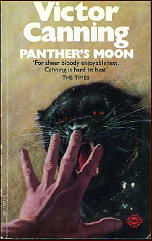
   Virtually any of Canning’s thrillers are worth reading. Just out of personal preference I would suggest Panther’s Moon (filmed as Spy Hunt, about a pair of escaped leopards loose in the Balkans with microfilm in one of their collars), Castle Minerva (filmed as Masquerade, the 1965 Basil Deardon film a slick spy spoof with Cliff Robertson and Jack Hawkins, reviewed here), The Great Affair, Queen’s Pawn, and the off beat Fingers of Saturn, as well as any of those mentioned above. He also wrote a notable series of Arthurian novels late in his career.

VICTOR CANNING

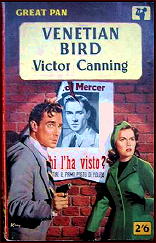
   Canning doesn’t deserve his temporary decline. He was simply one of the most intelligent and capable of the writers who marked out the territory of the British thriller in this period. His books sold well and are easy to find, and if you have never read him, or haven’t read him for a while you’ll soon find how good he can be. Many of his books were made into films including His Bones Are Coral filmed as Sam Fuller’s Shark; Venetian Bird filmed as The Assassin; The Golden Salamander; and The House of the Seven Flies filmed as The House of the Seven Hawks.

   During his heyday he ran Eric Ambler a close race for the top British thriller writer, and Hammond Innes an equally close race for the title of best adventure novelist — neither a small achievement. He deserves to be rediscovered by anyone who likes the British thriller at its most literate and intelligent.

REVIEWED BY DAN STUMPF:         


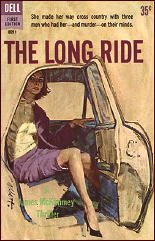
JAMES McKIMMEY – The Long Ride. Dell First Edition B211, paperback original; 1st printing, October 1961.

JAMES McKIMMEY The Long Ride

   I don’t actually seek out books by James McKimmy, but when I find one I pick it up, so I was glad to happen across The Long Ride at a local spot.

   The ending’s a bit weak, but the characters are well-realized (mostly… more on this later) and the plot is a neatly-built thing involving a sadistic bank robber, a one-armed chiseler and his abused wife, a vulnerable FBI agent, and the usual leggy temptress.

   All of them, for sundry reasons, are sharing a wild ride to the West coast with a little old lady who drives like she has some sort of death wish and her librarian spinster friend, and they all take turns bluffing about their hands in a complicated game of who’s-got-the-loot-from-the-bank-job, sounding each other out, forming temporary alliances, and trying to side-step disaster.

   There’s a lot to like here: the action is well-handled, the locations nicely-drawn, and the resolution… well, it would have been easy to wrap this up with a bit of action, but McKimmey goes for a more thoughtful approach, which I appreciated.

   My only objection to the whole thing was his portrayal of the spinster Librarian as a snoopy pedant. I’ve been married to a librarian for nigh onto thutty year now, and I know them to be lively, considerate and totally captivating creatures who deserve better treatment at the hands of a writer as good as McKimmey.

REVIEWED BY WALTER ALBERT:         


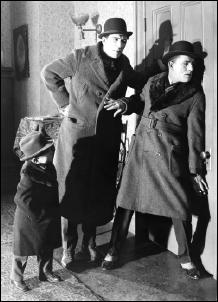
THE UNHOLY THREE. MGM, 1925. Lon Chaney, Mae Busch, Matt Moore, Victor McLaglen, Harry Earles, Matthew Betz. Based on the novel by Clarence Aaron ‘Tod’ Robbins; director: Todd Browning. Shown at Cinevent 19, Columbus OH, May 1987.

THE UNHOLY THREE (1925) Lon Chaney

   There was, perhaps, one film at the convention in which acting, script; and direction combined in an often unforgettable combination: Todd Browning’s The Unholy Three, starring Lon Chaney, Victor MacLaglen, and, memorably, the fine midget actor, Harry Earles. This is the 1925 silent version.

   Chaney plays a side-show ventriloquist (Professor Echo) who engineers a scam in which he, strongman Hercules (McLaglen), and Tweedledee (Earles) gain entry to homes of the rich who are clients of a pet store where the trio’s foil, Mae Busch, works. Chaney, disguised as Busch’s grandmother, and Earles as a year-old baby, make service calls to treat “ailing” parrots who, once they have left the store, cannot talk.

   Earles is a malevolent presence who fully justifies W.C. Fields’ wariness toward children, and McLaglen, at moments, in makeup and hulking movements bears a striking resemblance to Karloff’s Frankenstein monster.

   Eventually, a sentimental ending weakens the somber power of the best scenes, but this is still a striking film, with a vein of nastiness that gives it an acerbic edge sixty years after its production.

– Reprinted from The MYSTERY FANcier, Vol. 9, No. 3, May/June 1987.

Sometime earlier today the 200,000th visitor stopped by, and 315,000th page on this blog was viewed. I don’t know who these two people are, or they’d get prizes of some sort. They’ll have to settle for a small round of applause from me, as well as a great big thank you to all of you!

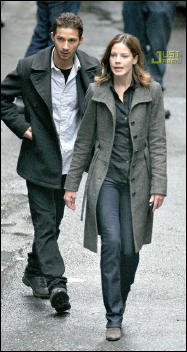
EAGLE EYE. DreamWorks, 2008. Shia LaBeouf, Michelle Monaghan, Rosario Dawson, Michael Chiklis, Billy Bob Thornton. Director: D.J. Caruso.

EAGLE EYE (2008)

   This is one of those thriller movies in which events start to happen as soon as the movie begins, almost faster than you can assimilate them, and the reason that you can’t put the pieces together is that they’re pieces of a gigantic jigsaw puzzle that takes time – be patient – until at last – finally – one key piece snaps into place, and all of sudden – but not before – do you see the big picture.

   Wonder of wonders, the people who made this movie made sure that the key piece I’m talking about is not discovered for a full three-quarters of the way through a two-hour movie.

   That’s a long time to keep people in the dark, so to speak, and I take my cap off to the director, screenwriters and players for pulling it off so successfully for so long.

   There are two main players, one male and one female, both in some sort of terrible danger and brought together to accomplish some sort of errand, plus one other whose name is not even mentioned above: a female voice on the phone whose commands must be obeyed, or else.

EAGLE EYE (2008)

   This female voice also seems to have at her command every cell phone, every on street camera, every public piece of electronic equipment in the entire country, and more, leading Jerry Shaw (Shia LaBeouf), suspected terrorist, and Rachel Holloman (Michelle Monaghan), mother of a young son on a trip with his school band to play in a concert somewhere unspecified, on a series of more and more complicated errands – to do what?

   Other reviews of this movie may tell you more than I will, or intend to. Suffice it to say that you will be sitting on the edge of your seat (figuratively, and maybe even literally) for a good solid portion of the two hours you will spend watching it.

EAGLE EYE (2008)

   I suppose there is an underlying moral involved, or maybe more than one, and one of them (which I think you can gather yourself from the paragraph above) is that there is not nearly enough privacy in this country any more. You may think you are alone, but very seldom are you alone as you think you are.

   After watching this movie, you may wish to give up your cell phones and GPS’s and maybe even your laptop computers that you take with you everywhere, but who among us is willing to do that?

EAGLE EYE (2008)

   There are some political considerations that are also involved, and lots and lots of action scenes, with cars roaring up and down streets and turning over on their sides with lots of flames bursting from them, and all kinds of heavy machinery doing the unknown female voice’s bidding. You will not be bored.

   Shia LaBeouf is young and rather light weight as an actor, but he does well in this film and the Transformer movies in which a lightweight, or a slacker, is exactly the persona that’s needed. He didn’t do so well in the Indiana Jones movie he was in, in my opinion. The gravitas of a Harrison Ford he doesn’t have, yet.

   Michelle Monaghan, who was such a successful femme fatale in Kiss Kiss Bang Bang, doesn’t have nearly the same opportunity in Eagle Eye to display her glamorous side. Frantic, though, she does very well, and overall, both actors are very determined to be a good sports about being in this movie. Both get solid A’s for Effort, and it shows. The screenwriters (all four of them) might have done it without them, but it would have been awfully difficult.

IT’S ABOUT CRIME
by Marvin Lachman

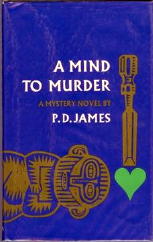
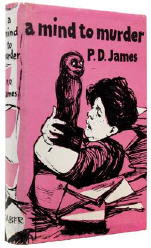
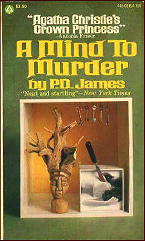
P. D. JAMES – A Mind to Murder. Faber & Faber, UK, hardcover, 1963. Charles Scribner’s Sons, US, hardcover, 1967. Reprinted many times, both hardcover and soft, including Popular Library, paperback, US, 1976. (All shown.)

P. D. JAMES A Mind to Murder

   Although mystery fiction has had more than its share of characters with psychiatric conditions, there have been few books set in psychiatric institutions.

   Coincidentally, two of these are currently available in paperback, and they are both worth seeking out. A Mind to Murder is P. D. James’s second novel and draws heavily on her own experience for its setting, a London psychiatric outpatient clinic.

   The victim is a hospital administrator, a position Miss James held in the British Civil Service System.

P. D. JAMES A Mind to Murder

   Not only does the author know the workings of such a clinic, but she also knows the heartbreak of mental illness firsthand, since her husband, a physician, was hospitalized due to that condition for most of the twenty years before his death in 1964.

   Authenticity is the strong point of this book, along with the writing,which is civilized and perceptive; its plotting adequate, but it is not as good in that regard as the 1962 James debut novel, Cover Her Face.

   James is very adept at characterization, especially as regards Adam Dalgliesh, her series ,detective, who shows depths not often found in sleuths who solve the kind of classic puzzles James presents. Her skillful writing evokes considerable poignancy in describing his personal life.

P. D. JAMES A Mind to Murder

   There is also a superbly written section about his searching the apartment of the victim, and Dalgliesh has enough empathy to realize that the necessary act is a violation of a dead person.

   If P. D. James seems to have received an inordinate amount of praise in recent years, do not begrudge it to her. She, more than most, combines the ability to plot interesting puzzles with the writing skill to observe society create real characters, and write with intelligence and sophistication.

– From The MYSTERY FANcier, Vol. 9, No. 2, March/April 1987.


Editorial Comment:  The review by Marv of the second of the two paperback mysteries he refers to will appear on this blog soon.

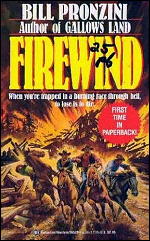
JACK FOXX – Wildfire.   Bobbs-Merrill, hardcover, 1978. Reworked and republished as Firewind, as by Bill Pronzini: M. Evans, hardcover, 1989; paperback reprint: Ballantine, 1990.

   Introduction: From the blurb on the cover of the Ballantine edition of Firewind:

    “Nothing stirred in the quiet valley of Big Tree in northern California — until a single gunshot sparked a fire that turned the logging town into sudden hell. As the flames whipped higher and smoke choked the air, Matt Kincaid knew the only way out for the terrified townspeople was the old locomotive. But would the ancient train work? Could it outdistance the hungry flames, and tear through the fiery abyss to reach the old wooden trestle before the fire? It was a midnight race through hell and insanity in a valley of death — a race that the losers would not live to talk about.”

   When I recently uncovered my review of Wildfire, by Jack Foxx, and posted it here on the blog, I was surprised to learn that the author, Bill Pronzini, had “reworked” the novel and republished it as Firewind. I don’t think I knew this before, or if I did, I’d forgotten and the fact that there was a second version had vanished from memory.

   Now here’s the really strange thing. I could not determine from my review of Wildfire (and could not remember) the time period in which it took place, but I was reasonably sure that it was an present day affair. But when I saw the cover of the paperback edition of Firewind, it was obvious that the latter was an out-and-out western novel. Could I have been wrong about Wildfire?

   Nothing on the Internet was of any assistance, nor of course could I find my copy of Wildfire (the first book, in case I’m starting to lose you, which I’d really rather not do). The only solution was to ask the man himself, Bill Pronzini, that is. If he didn’t know, who would?

   And of course he did. He’ll take over from here:


   Very nice review of Wildfire, which I missed seeing when it first appeared; I’m pleased that you found it to be a suspenseful read. Firewind is a reworking of Wildfire, but not merely a reissue under a different title.

JACK FOXX Wildfire

   Although the basic storyline and general progression are similar in both versions, Wildfire has a contemporary setting and Firewind a historical one, and the characters and their motives and interactions are different.

   I wasn’t satisfied with the way Wildfire turned out, but it wasn’t until a few years after it was published that I realized why: the story works better as a “western” and should have been written as such in the first place.

   So when Sara Ann Freed, who was editing M. Evans’ western line in the late 80s, asked me to do a second book for her (after The Last Days of Horse-Shy Halloran), it gave me an opportunity to transform Wildfire into Firewind. The latter is much the better of the two.

   As to the Jack Foxx name, which you also asked about, I chose it for two reasons. The minor is that it’s short and punchy, both surname and given name just four letters; the major is that I’ve always considered the letter “X” something of a lucky talisman.

   Long-time readers of my work might note that I often give characters names containing an “x”.

   Pronzini’s “X” file. One of my many quirks, on and off the printed page.

« Previous PageNext Page »