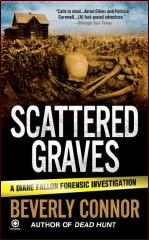
BEVERLY CONNOR – Scattered Graves.

Penguin/Obsidian, paperback original; 1st printing, February 2009.

   I’m not much interested in stories about medical examiners (not even Quincy) or forensic specialists (I’ve never read a book by Patricia Cornwell), nor do I watch Bones or any of the CSI shows on TV. It must be a failure in me, as they seem to be very popular with everyone else.

   In any case, this is the reason that this is the first book by Beverly Connor that I’ve read, it being the sixth book in her “Diana Fallon Forensic Invesigator” series, which followed five books about Linsday Chamberlain, described online as an “anthropologist who specializes in archaeology [and] an expert in forensic analysis of bones.”

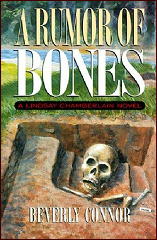
   A description of A Rumor of Bones, the first book in the Chamberlain series begins this way: “It’s the bones of missing children that disturb her…” and that tells me all I want to know. I don’t read books that have bones of missing children in them. I’m sure that this is what wiped me out of reading any others in the series, as none of the titles sound remotely familiar:

      Lindsay Chamberlain series:

   1. A Rumor of Bones. Cumberland House, hc, Oct 1996; pb, Mar 2001.

BEVERLY CONNOR

   2. Questionable Remains. Cumberland House, hc, Sept 1997; Worldwide, pb, May 2001.
   3. Dressed to Die. Cumberland House, hc, Sept 1998; pb, Oct 2001.
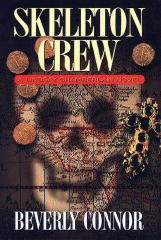
   4. Skeleton Crew. Cumberland House, hc, Oct 1999; pb, Jan 2002.

BEVERLY CONNOR

   5. Airtight Case. Cumberland House, hc, Oct 2000; pb, Oct 2002.

   But now that I’ve done the research, I take that back. Cumberland House books don’t get much circulation up here in New England, and the reason that the titles don’t look familiar, all but the one from Worldwide (Harlequin), is that I never saw them.

   Luckily enough, when her contract with Cumberland seems to have run out, Beverly Connor was able to adapt and start another series, apparently in much the same subgenre, and maybe even the same same mode. Here’s a list of her Diane Fallon books, both so far and forthcoming:

       Diane Fallon series:

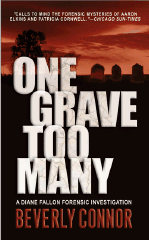
   1. One Grave Too Many. Onyx, pbo, Dec 2003.

BEVERLY CONNOR

   2. Dead Guilty. Onyx, pbo, Sept 2004.
   3. Dead Secret. Onyx, pbo, Dec 2005.
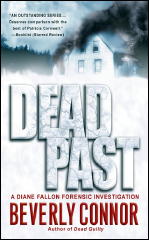
   4. Dead Past. Onyx, pbo, Feb 2007.

BEVERLY CONNOR

   5. Dead Hunt. Obsidian, pbo, Feb 2008.
   6. Scattered Graves. Obsidian, pbo, Feb 2009.
   7. Dust to Dust. Obsidian, pbo, Aug 2009.

   Six books into a series these days, when detectives have personal lives as well as solve crimes, means that there’s a lot of backstory to catch up on, but to Connor’s credit, she made it easy for me, a first time reader. What struck me the most, though, was not the small group of friends, enemies and co-workers around her – some of whom are one and the same – but how “over the top” the story line is.

   After a rather standard opening for a book about a DNA lab, with the local sheriff bringing in a young boy’s find – a stash of bone chips in a newly plowed field – I suddenly sat straight up in my chair in the middle of Chapter Four, as a local policeman with a grudge against Diane tries to push her personally off a cliff.

BEVERLY CONNOR

   She, being an experienced rock climber, manages to escape, while Harve Delamore falls to his death. Perhaps I should mention that Rosewood, where Diane works, in in Georgia, not too far from Atlanta, and you may have to accept that grudges last longer and are worked out differently in the South.

   Including, strangely enough, Diane’s nearly being charged with Delamore’s death. But wait, that’s not all. I won’t reveal anything that you wouldn’t like to know about ahead of time, but Rosewood is one of the most corrupt towns you will ever be in, and that goes all the way to the top. Until someone with a gun tries to do something about it – and that someone may or may not be one of the Good Guys.

   I’d like to say more, but let me release my breath and say Whew, just thinking about it. It’s like one bombshell going off after the other. There is one heck of a complex ending, too, one that all but stalls out in a moral morass of malicious behavior, some intended, some not, as extravagantly excessive as anything that has gone before.

   And please don’t take that as a bad thing. Is the book readable? Once you pick it up, I don’t think you’ll put it down very quickly. It took me two evenings to read its slightly over 350 pages, the best eyeball rate I’ve managed to accomplish in a good long while.

   Uploaded this morning was Part 31 of the ongoing online Addenda to the Revised Crime Fiction IV, by Allen J. Hubin. Included are the usual bits of information, including a handful of new authors and titles, but for the most part the new data consists of additional information about books and writers previously included. Series characters and story settings for the former, for example, and birth and death dates for the latter.

   Al says the printed version is 45 pages long — one of the longest installments to the Addenda so far.

   Follow the links and feel free to browse around. If you spot any errors and would like to make corrections, or if you discover you have additional facts to supply, then of course, please do!

A Review by MIKE TOONEY:


CHRISTIANNA BRAND – The Spotted Cat and Other Mysteries from Inspector Cockrill’s Casebook.  Crippen & Landru, hardcover & trade paperback, November 2002. Edited by Tony Medawar.
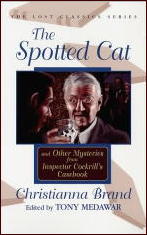
CHRISTIANNA BRAND Spotted Cat

   Christianna Brand’s Inspector Cockrill appeared in almost a score of novels, short stories, and even a play, most of which were published in her lifetime. Crippen & Landru have done us a service in preserving all of the short stories that saw publication — and more.

   From the back cover blurb:

INSPECTOR COCKRILL INVESTIGATES

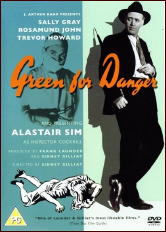
    “Christianna Brand (the pseudonym of Mary Christianna Milne Lewis, 1907-1988) was a supreme mistress of the classic detective story, with twists and turns, and all the clues fairly given to the reader. The wizened, bird-like Inspector Cockrill of the Kent police starred in Green for Danger, one of the greatest detective novels to emerge from World War II, but The Spotted Cat is the first collection of all of the short stories about him. Five of the stories have never previously appeared in a Brand volume, and one of them is published here for the first time. The book also includes a genuine find, a previously unpublished three-act detective drama featuring Cockrill.”

* * * * * * * * * * * * * * *

         CONTENTS:

Introduction (“In and Out of Darkness”) by Tony Medawar: A well researched article about Brand’s life and progress as a writer.

1. “Inspector Cockrill” (1978) by Christianna Brand: The author writes an amusing but affectionate biographical sketch of her most famous character, patterned closely after her father-in-law, a medical doctor.

    “He [Cockie] is not one for the physical details of an investigation: ‘meanwhile his henchmen pursued their ceaseless activities’ writes his creator, not too sure herself exactly what those would be; and he is content to leave fingerprint powder and magnifying glass to the experts, using their findings in a process of elimination, to get down to the nitty-gritty from there on.

    “He has acute powers of observation, certainly; a considerable understanding of human nature, a total integrity and commitment, much wisdom; and as we know a perhaps overlong experience of the criminal world …. Above all — he has patience.” True, “he will have compassion for the guilty”; nevertheless, “he can be forthright and stern …. There is no false sentiment about Chief Inspector Cockrill, none at all.”

2. “After the Event” (from Ellery Queen Mystery Magazine, January 1958 as “Rabbit out of Hat”)

   In a famous play by Shakespeare, Othello strangles his (reputedly) faithless wife; back in the 1920s, an actor playing Othello at the time apparently did the same thing in the lady’s dressing room backstage. An unnamed Great Detective reminisces about the case to a group of acquaintances, among them Inspector Cockrill, who predictably pokes holes in the speaker’s handling of the situation, much to the Great Man’s chagrin. And one should always remember, as Cockrill does, that theatrical people have been known to put on an act ….

   Note: Inspector Cockrill, cracking walnuts and irritating the Great Man, is an armchair detective in this story.
CHRISTIANNA BRAND Spotted Cat

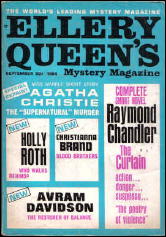
3. “Blood Brothers” (from EQMM: September 1965)

   Brotherly love, like all relationships, seems to have its limits. Two siblings, identical twins, have been with the same girl, competing for her affections; but now, it seems, she is pregnant by one of them. The situation is further complicated by several factors: The girl knows that one of the brothers has killed a small boy in a hit-and-run; she is also married to a huge brute doing time in one of HM’s prisons but due soon for release; and one of the siblings harbors enough hatred to let the other take the fall for first-degree murder.

   Inspector Cockrill — who enters in the last third of the story — simply lets things take their natural and inevitable course, as David and Jonathan rapidly degenerate into Cain and Abel … with a twist.

   Note: Instead of being told in the third person, this story is narrated by one of the brothers.
CHRISTIANNA BRAND Spotted Cat

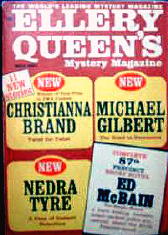
4. “The Hornet’s Nest” (from EQMM: May 1967 as “Twist for Twist”)

   When wealthy Cyrus Caxton — a nasty piece of work, that one — does a Brodie face first into his half-eaten peach, no one of his acquaintance is moved to shed a tear, save his attractive wife. Inspector Cockrill is called in and confronts a fine set of likely suspects; in the end, the Inspector, Ellery Queen-like, has proposed two plausible solutions before pouncing on a third, actual one.

   Elizabeth comments on Cockie’s method: “He’s — he’s sort of teasing us; needling us, trying to make us say something.” Presciently, the Inspector early in his investigation remarks: “There has been a plan here, doctor: no simple matter of a lick of poison scraped out of a fortuitous tin, smeared on to a fortuitous peach-in-liqueur; but a very elaborate, deep-laid, long-thought-out, absolutely sure-fire plan.”

5. “Poison in the Cup” (from EQMM: February 1969)

   CASE HISTORY: Stella Harrison is a small-town doctor’s wife more than a little bored with her lot in life; her husband Richard, a painfully honest individual, seems oblivious to her incipient disaffection — and equally unaware of her secret love for his partner, Frederick Graham. A nurse at the hospital, Ann Kelly, however, makes no secret of her undying love for Stella’s husband… Ann makes a fatal mistake, though, when she decides to stage a bogus suicide attempt in Dr. Harrison’s surgery …. DIAGNOSIS: Murder. PROGNOSIS: Life in prison for a killer who remembers every detail but one ….

   Note: The murderer’s identity is never in doubt; we see the crime committed. The interest lies in how Chief Inspector Cockrill, a la TV’s Columbo, will trip up the perp — because this killer uses the truth as a cover.

6. “The Telephone Call” (from EQMM: January 1973 as “The Last Short Story”)

   The best-laid plans do often go off the tracks, don’t they? A young man short of money conceives an intricate plot to acquire a lot of it in a hurry; his girlfriend half-jokingly suggests it: “You’ll have to murder your rich Aunt Ellen”; and he improves it: “Yes, and let Cousin Peter swing for it; if he did, I’d scoop the lot.”

   And so he carefully begins building two alibis, one for himself and a negative one for the hapless Peter… And it all works beautifully — except for one thing, and you don’t have to be Detective Inspector Cockrill to figure it out.

   Note: The bulk of this story is told in the form of a written confession.

7. “The Kissing Cousin” (from Woman: June 2, 1973)

   Cranky old Aunt Adela has millions, but true to form she is parsimonious and secretive about her wealth; her niece Franca doesn’t really care if she inherits — but there’s someone she knows who is greatly interested in the old lady’s money, someone willing to kill for it. When Aunt Adela is found dead, her house ransacked for a missing will, Chief Inspector Cockrill zeroes in on Franca: “You inherit,” he says. “And you hold the only key to the door.” But the killer already has Franca marked for murder, and knows as well the secret Keeper, the cowardly mastiff, is harboring ….

   Note: It seems Cockie doesn’t really solve this one, and takes no active part in apprehending the murderer; he is a secondary character here.
CHRISTIANNA BRAND Spotted Cat

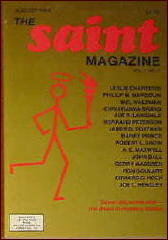
8. “The Rocking-Chair” (from The Saint Magazine: August 1984)

   Taking a break from a village fete “on a boiling hot afternoon” to have “a little booze-up”, the Duchess of St. Martha’s Island retires to her castle with Miss Maud Trumble, “rich and famous author of dozens of really quite terrible books”, and Chief Inspector Cockrill.

   Seemingly gripped by a feeling of guilt, Miss Trumble, “mildly squiffy,” relates her involvement in the unresolved Case of the Three Dead Ladies: “three women lying dead, spread out like a trefoil clover-leaf, their poor heads forming the centre point…” Cockie and the Duchess both prove able armchair detectives by “solving” this fifteen-year-old case.

    “It was like a detective story, thought the Duchess, where the clues are placed not so much squarely before the reader as slightly obliquely, so that they come out as not quite what in fact they are.” Just so.
CHRISTIANNA BRAND Spotted Cat

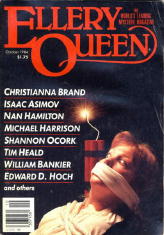
9. “The Man on the Roof” (from EQMM: October 1984)

   English village life is normally uneventful, but not today: The much-despised and suicidal Duke of Hawksmere seems at long last to have followed through with his oft-delayed promise to do himself in: “a good, straight-forward suicide,” thinks Chief Inspector Cockrill, “heralded by the gentleman himself….”

   If only it were that simple. The dearly deceased, consistent with the burdensome pattern of his life, has managed to die under most perplexing circumstances that suggest he was murdered; to wit, he seems to have expired in a classic “locked room.”

   Cockie, in frustration, says: “The locked room is the lodge, locked in, as it were in all that untrodden snow. A man dead in the lodge, very recently dead, death instantaneous, from a gun-shot wound at close range. And the mystery is very easy to state and not at all easy to answer. The mystery is — where is the gun? — because it isn’t lying there close to his right hand where it ought to be, and it isn’t anywhere else in the lodge and it isn’t anywhere outside in all the snow.”

   As in “The Hornet’s Nest,” Cockie devises two plausible scenarios — but the actual solution, one not of his devising, comes as an exasperating — and exasperatingly simple — surprise to both him and the unsuspecting reader.
CHRISTIANNA BRAND Spotted Cat

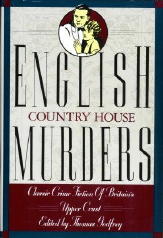
   Note: “The Man on the Roof” can also be found in Thomas Godfrey’s English Country House Murders, 1989.

10. “Alleybi” (“This story, published in this volume for the first time, was probably written in the mid-1950s.”)

   A short-short story (one and a half pages) that should serve as a warning to all investigating officers not to get tunnel vision whenever someone’s alibi is in doubt.

11. “The Spotted Cat: A Play in Three Acts” (“Previously unpublished; written in 1954-1955. Brand considered turning it into a novel but abandoned the idea.”)

   Things aren’t going particularly well for barrister Graham Frere these days: His legal prowess is failing, he’s experiencing problems with alcohol, and he is beginning to think he’s going crazy.

   At first he doesn’t realize that not all of his troubles are of his own making, that people close to him — under his very roof — are subtly pushing him towards madness, or possibly suicide; they have already murdered once, however, so even that option isn’t off the table. The conspirators themselves share a love-hate relationship, as evidenced by one telling the other:

    “We’re bound together for ever now, you and I.”

    “Nothing binds us.”

    “Fear binds us.”

    “It doesn’t bind me.”
CHRISTIANNA BRAND Spotted Cat

    and: “When I look at you — coldly and sanely — I’d as soon put my love and trust in a cobra.”

    Nice people! But the conspiracy falters when the worm turns and murder is prescribed ….

   This play is a mixture of Gaslight and Double Indemnity with just a dash of Patricia Highsmith. Brand spoofs herself in one exchange:

    “London Particular was a book — that woman who wrote Green for Danger.”

    “I know it was. I couldn’t read a word of it.”

*****

   Despite a few typos (e.g., “does” for “dose,” “desert” for “dessert”) and some problematic punctuation, this book can be highly recommended.
A 1001 MIDNIGHTS Review
by Ed Gorman:


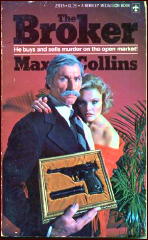
MAX COLLINS – The Broker. Berkley, paperback original, 1976. Paperback reprint: Foul Play Press, 1985, as Quarry.

   In the mid-1970s, the multi-talented Max Collins (who also writes as Max Allan Collins) produced a series of four paperback originals about a Vietnam vet turned hired killer, known only as Quarry. The Quarry series has so often been referred to as a Richard Stark pastiche that its own tone and morality are often overlooked.

MAX ALLAN COLLINS Quarry

   In The Broker, the first in the series, we meet Quarry shooting a man in an airport men’s room. Quarry’s assignment is to bring what the man is holding (heroin) back to his employer, an icy sort called the Broker. Quarry complies.

   After complaining that he does not like to deal in drug killings, he reluctantly takes another Broker assignment, this one working with a homosexual killer named Boyd. In the rest of the novel, Collins shows us an abundantly unpleasant world peopled with all sorts of characters, from cuckolded husbands to porno-crazed geezers who look like Gabby Hayes.

   What gives the Quarry books their style is the detached voice of the narrator: Quarry has no compunctions about killing people, because he feels most of them are rather foolish beings anyway. Unlike Stark’s Parker, who is human only when it serves his ends, Quarry is subject to feelings other than anger-melancholy, amusement, contempt-feelings he notes, nonetheless, with the kind of removed observation one would expect from a man in his profession.

   The Broker and the other three novels in the series — The Broker’s Wife (1976), The Dealer (1976), and The Slasher (1977) — are successful for another reason: They depict the waning hippie/flower-power days with a great deal of historical accuracy. The Quarry books are therefore an important part of the crime fiction of the Seventies — a quirky, idiosyncratic look at the Midwest during the Gerald Ford regime.

         ———
   Reprinted with permission from 1001 Midnights, edited by Bill Pronzini & Marcia Muller and published by The Battered Silicon Dispatch Box, 2007.   Copyright © 1986, 2007 by the Pronzini-Muller Family Trust.

         Bibliographic data: The Quarry series [Updated].

   The Broker. Berkley, pbo, 1976; aka Quarry, Foul Play, 1985.

   The Broker’s Wife. Berkley, pbo, 1976; aka Quarry’s List, Foul Play, 1985.

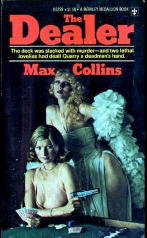
   The Dealer, Berkley, pbo, 1976; aka Quarry’s Deal, Foul Play, 1986.

MAX ALLAN COLLINS Quarry

   The Slasher, Berkley, , pbo, 1977; aka Quarry’s Cut, Foul Play, 1986.

   Primary Target. Foul Play, hardcover, 1987.

   Quarry’s Greatest Hits. Five Star, hc, 2003. Contents:
       ● Primary Target (novel)
       ● “A Matter of Principle” (short story, reprinted from Stalkers, Roc/Penguin, 1992, Ed Gorman, ed., and the basis for a short film included in the DVD boxed set Max Allan Collins Black Box Collection: Shades of Neo-Noir, 2006.)
       ● “Quarry’s Luck” (short story reprinted from Narrow Houses: Blue Motel, Volume 3, Little Brown, UK, 1994, Peter Crowther, ed.)
       ● “Guest Services” (short story reprinted from Murder Is My Business, Signet, 1994, Mickey Spillane & Max Allan Collins, eds.)

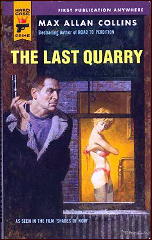
   The Last Quarry. Hard Case Crime, pbo, 2006. Expansion of “A Matter of Principle,” and the basis for the feature length film, The Last Lullaby (2008).

MAX ALLAN COLLINS Quarry

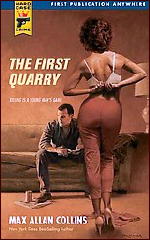
   The First Quarry. Hard Case Crime, pbo, 2008.

MAX ALLAN COLLINS Quarry

   Quarry In The Middle. Hard Case Crime, pbo, 2009. (Forthcoming, November.)

   In case you missed it, there’s been a good deal of discussion in the comments following Mike Nevins’ most recent column about the possibility that Jack Vance wrote all, most or some of Ellery Queen’s Face to Face (NAL, 1967).

   Mike Doran asked the question, but the possibility was first raised by George Kelley on his blog, which I recommend to you for all sorts of good reasons, including not only sound and solid discussion of books and music of all kinds, but for an abundance of cover art as well.

   My own opinion regarding Face to Face, though, after reading all of the arguments, pro and con? George presents a good but non-conclusive case, but the door’s hardly closed on the matter. The possibility’s still there.

WENDI LEE – Habeas Campus. Worldwide; paperback reprint, February 2003. Hardcover edition: St.Martin’s Press, 2002.

   This one was a disappointment, to put it as mildly as I can. Wendi Lee, also a writer of westerns, is the author of four other mysteries about her Boston-based private eye Angela Matelli, so this drab and unbelievable outing came as quite a surprise, if not an out-and-out shocker.

WENDI LEE

   It might be the subject matter. Here’s the first line: “If my family had known that I was going up to Vermont to fight zombies, they would have slapped me in an institution so fast it would have made my head spin.”

   There’s a lot of scientific talk in the book about Haitian poisons and antidotes to back up the premise that zombies (the walking undead) indeed do exist, but if you were to check it out on Google, you’d soon discover that the evidence is largely anecdotal and (to say the least) extremely controversial.

   In any case, Lee’s job was to convince me that people can be transformed into zombies, and that they could be put to work in sweatshops or behind the counters at McDonalds. (You’re kidding me, right?) She also wanted me to believe that a body could somehow go missing from a college town’s morgue without a huge outcry being made. Just a prank by some fraternity kids? I don’t think so.

   I also thought that the plan for Angela Matelli, an ex-Marine and nearly 30, to go undercover as a student at Hartmore College, living in an undergraduate dorm, registering just before midterm, was, well, rather uninspired (if not highly unlikely).

   The writing is hardly better. Two paragraphs on page 16 say exactly the same thing. The dialogue is bad. From page 31: “This is why I didn’t tell you everything over the phone. I knew you would jump to the conclusion that this is some sort of weird situation.” On page 40, another two paragraphs (concerning Matelli’s phoney registration as a student) repeat themselves.

   Back in her own stomping grounds, surrounded by family and friends, Angie Matelli’s basic perkiness and good nature might come off to greater advantage. They don’t here, I’m sorry to say.

— March 2003


[UPDATE] 03-30-09.   For more on Angela Matelli and some more on the other books by her creator, Wendi Lee, you might check out the former’s data page on the Thrilling Detective website. Habeas Corpus was her last appearance in print.

   Based on both the Revised Crime Fiction IV, by Allen J. Hubin, and her dossier on Kevin Burton Smith’s website (above), here’s her complete bibliography:

ANGELA MATELLI. [Wendi Lee]

    Novels:

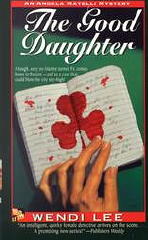
      The Good Daughter. St. Martin’s 1995.

WENDI LEE

      Missing Eden. St. Martin’s 1996.
      Deadbeat. St. Martin’s 1999.
      He Who Dies. St. Martin’s 2000.

WENDI LEE

      Habeas Campus. St. Martin’s 2002.

   Short stories:

       “Salad Days” (Noir, Winter 1994)
       “The Disappearance of Edna Guberman” (Murder For Mother, 1994)
       “Check Up” (Lethal Ladies, 1996)
       “The Other Woman” (Vengeance Is Hers, 1997)

REVIEWED BY WALTER ALBERT:         


JASPER FFORDE – The Fourth Bear. Viking, hardcover, August 2006; Penguin, trade paperback, July 2007.

JASPER FFORDE

   The second in the Nursery Crime series featuring DCI Jack Spratt and DS Mary Mary [after The Big Over Easy (2005)] finds Jack once again on the outs with his superiors and sidelined while a clueless detective investigates the escape from prison of the murderous Gingerbreadman, whose capture was one of Jack’s early successes.

   In spite of warnings not to involve himself, Jack seems to keep running into the Gingerbreadman as he looks into the disappearance and subsequent murder of “Goldy” Hatchett after she escapes from a confrontation with the three bears in their rural retreat, and a series of mysterious explosions and deaths of cucumber growers that may somehow to linked to secret experiments of interest to the mammoth and slightly sinister QuangTech industries.

   This may strike some readers as terminally cute, but I thought it was funny and a compulsive page-turner, with the important role played by the bear community further insuring my enjoyment of the goings-on.

   This isn’t a review of the book in the title of this post, Blast to Oblivion, by Chap O’Keefe, but I do want to tell you a couple of interesting things about it. You can find a much more lengthy write-up in the most recent online edition of Black Horse Extra, the March-May 2009 issue, in fact.

CHAP O'KEEFE: Blast to Oblivion

   Each issue is devoted to the westerns published in the UK by Robert Hale, Ltd., and this issue is chock full of tidbits about the current quarter’s group of authors and their pen names, but there is also a sad note at the end in which the life and death of one of Black Horse’s more prolific western writers, Walt Masterson, is covered.

   You may recognize Chap O’Keefe’s name as someone who frequently leaves comments on this blog, sometimes under that moniker and sometimes as Keith Chapman, which happens to be his real one.

   Talking about his book, however, Chap says:

    “The first words in this book, after the title pages, are written by Sir Arthur Conan Doyle: ‘The old wheel turns, and the same spoke comes up. It’s all been done before, and will be again.’

    “Black Horse Western readers who are also Sherlockians will recognize that quotation as words spoken by Sherlock Holmes in the second chapter of The Valley of Fear. The Holmes novel was serialized in Britain in The Strand magazine between September 1914 and May 1915. Along the way, the George H. Doran Company, of New York, gave it a first book publication on February 27, 1915.”

   There is much more to Chap’s essay, which goes into great detail about Sherlock Holmes, Sherlock Holmes movies, the Pinkerton Detective Agency, the Mollie Maguires, and every point you can think of in between, including his own book, Blast to Oblivion. Highly recommended!

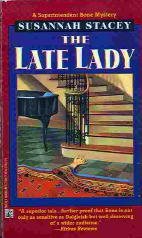
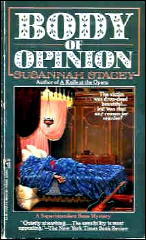
SUSANNAH STACEY – Body of Opinion.

Pocket Books; paperback reprint. First printing, March 1991. Previously published in the US by Summit Books, hardcover, February 1990. Prior UK hardcover edition: Bodley Head, 1988, as by Jill Staynes & Margaret Storey.

   There is a mystery here – and one for which I do not know the answer – and that is why the books written by this pair of British authors appeared under their own names in the UK, but as by a pen name in the US. I haven’t any idea why.

   But since both authors are now in their late 70s or early 80s, and no books by them under any byline have appeared in over ten years, I think it’s safe to assume that their entry in the Revised Crime Fiction IV, by Allen J. Hubin, is now complete:

    STACEY, SUSANNAH. Pseudonym of Jill Staynes & Margaret Storey; other pseudonym Elizabeth Eyre.
       Goodbye, Nanny Gray (n.) Summit 1988; UK: Bodley Head, 1987 as by Jill Staynes & Margaret Storey.

SUSANNAH STACEY

       A Knife at the Opera (n.) Summit 1989; UK: Bodley Head, 1988 as by Jill Staynes & Margaret Storey.
       Body of Opinion (n.) Summit 1990; UK: Bodley Head, 1988 as by Jill Staynes & Margaret Storey.
       Grave Responsibility (n.) Summit 1991; UK: Bodley Head, 1990 as by Jill Staynes & Margaret Storey.
       The Late Lady (n.) Pocket Books 1993; UK: Barrie, 1992 as by Jill Staynes & Margaret Storey.

SUSANNAH STACEY

       Bone Idle (n.) Pocket Books 1995; UK: Century, 1993 as by Jill Staynes & Margaret Storey.
       Dead Serious (n.) Pocket Books 1997; UK: Headline, 1995 as by Jill Staynes & Margaret Storey.
       Hunter’s Quarry (n.) Pocket Books 1998; UK: Quarry (Hale 1999), as by Jill Staynes & Margaret Storey.

   As long as Elizabeth Eyre has been mentioned, though, here’s a list of the books the two authors wrote under that name:

EYRE, ELIZABETH. Pseudonym of Jill Staynes & Margaret Storey
       Death of a Duchess (n.) Headline 1991; Harcourt, US, 1992.
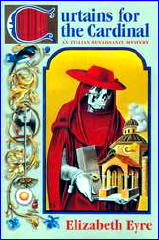
       Curtains for the Cardinal (n.) Headline 1992; Harcourt, US, 1993.

SUSANNAH STACEY

       Poison for the Prince (n.) Headline 1993; Harcourt, US, 1994.
       Bravo for the Bride (n.) Headline 1994; St. Martin’s, US, 1995.
       Axe for the Abbot (n.) Headline 1995; St. Martin’s, US, 1996.
       Dirge for a Doge (n.) Headline 1996; St. Martin’s, US, 1997.

   The Eyre books all take place during the Italian Renaissance; the leading character in each is a fellow named Sigismondo, who quoting from Publishers Weekly is a “brilliant deductionist [who] is bald like a monk but who fights like a soldier, and his slack-jawed manservant, Benno, who has an air of ‘amiable idiocy.’”

   That’s a description that makes me want to read these book right away, and if you think I’m joking around when I say that, then you don’t know me very well.

SUSANNAH STACEY

   To the book at hand, though, the third in the series. It’s not clear to me that Superintendent Bone works for Scotland Yard or if he’s only a member of the local police force, but when a murder occurs at a party at a famous rock singer’s mansion, he’s the first to be called in. (One passing reference, on page 29, suggests that this is not the first time he’s met Ken Cryer and his son Jemmy, so that makes me believe he’s local.)

   Dead is a woman with a deeply held secret, and since this time the writer who wrote the blurb for the back cover doesn’t mention it, I won’t either, except to say two things — the first being that part of this sentence is not exactly true, and the second that the secret just mentioned is NOT the list of blackmail targets that’s found later in the victim’s home.

   What that does do is increase the number of possible suspects by a factor of at least ten — theoretically. Since it’s more than likely that the killer was seen at the party, invited or not, it’s still a matter of only dogged police work before his or her identity is uncovered.

   One does hope for more, however, what with all of the clues, false leads, red herrings, misleading directions and crimes on the side that Bone and his crew must sort through. But alas, no, the ending is as straight (and flat) as a string.

   Much more interesting is Bone’s home life, recently widowed with a young precocious young daughter to bring up on his own – but with the possibility of a new love in his life, a woman who is beginning at last to break down the emotional shields he’d set up after the auto accident took his wife away.

   I think the two authors had the Golden Age of Detection in mind when they wrote this book, updated by all kinds of sexual activity that went unreported in mystery fiction of the 1930s. That’s the overall model they’re following at least, but if so, I can’t tell you that they succeeded — although it’s busy, the plot simply isn’t complicated enough.

   On the other hand, the writing is excellent more often than not, with many a nice turn of phrase to complement the events taking place. The superintendent’s incipient love affair — deliberately chaste in comparison to the mystery itself, perhaps — may have been the even greater enticement for readers to be look for the next installment when it appeared.

THE GOLDEN AGE OF BRITISH MYSTERY FICTION, PART II
Reviews by Allen J. Hubin.


   Of Lynton Blow I know absolutely nothing. The “Moth” Murder (Alexander-Ouseley, 1931; Holt, 1932) and The Bournewick Murders (Butterworth, 1935) appear to be the only traces he left in our criminous world, and they betray a fondness for plotting complexities and apparent impossibilities.

   Moth is perhaps the more interesting, and Bournewick the more baffling, though I found both quite pleasant British detection. In Bournewick Amelia Scott, an elderly though active woman living near the titular town, disappears; her strangled body turns up in due course. A suspect hoves into view, though the evidence is weakening; then he too is murdered.

   Another killing follows, and the Yard arrives in the person of Inspector Eldridge, who must tie together the multiple and seemingly unrelated murders and a mysterious mailbox fire, while the bodies continue to pile up: six die violently in this tale. Blow does break one of the cardinal rules of detective fiction here, but I found Bournewick sufficiently good that I can forgive him; the final resolution, though fanciful and not really of the fair-play variety, ties all together neatly.

   In Moth a burning plane crashes to earth near a coastguard station on Bournemouth Bay; the pilot, sole occupant, is burned to a crisp. Inquiries and an autopsy reveal that the victim is the famous airman, Charles Stafford, who took off with a female passenger (now vanished), and that the corpse died not of incineration but of a bullet in the brain.

   Inspector Hunt of the Yard also has other puzzles: a second plane, piloted by the wife of Stafford’s passenger, took off at the same time and vanished without a trace –- and a policeman was murdered on a rural road not far from the Stafford crash site on the same night. And more: Stafford’s heir turns up at the dead man’s home, stays a night, then disappears; there seems to be a curious link with a London drug gang; and then there’s that suitcase full of money…

   The U.S. dust jacket is criminally revealing, so avoid it, but not the book, which is fun 1930s reading.

***

   Frass by John Chancellor (Hutchinson, 1929) was my first exposure to the work of this author, who produced a number of novels in our genre from 1923 to 1970. Frass is a thriller, not a detective story; I can’t speak for any other of Chancellor’s fictions.

   Captain Frass left the sea, found a partner, and established a real estate business. But the captain was a bit naive: the residential plots his partner was peddling to earnest British burghers were just slightly offshore, and Frass spent a solo two years on the rockpile when the roof fell in.

   Now released, he’s approached by Roscoe Lengarde and his Prisoner’s Benevolent Society with an offer of employment. Frass resists for a while, then joins in; Lengarde has a nice smuggling scheme going, using pleasure vessels.

   Cracks rapidly develop in the operation, however: Frass discovers love, a conscience, a traitor in the ranks, and looming Excise men, in that sequence, and survival of the fittest becomes the order of the day. It will not surprise you to learn that the captain is quite fit (and survives for at least one sequel novel).

   This is competent crime-adventure, enlivened more than anything else by its subsidiary characters: the sniveling and cowardly Ginger Hoyst, the reliable follower Taunton, and the mad historian Peterson.

***

   NOTE: Go here for the previous installment of this column.

[EDITORIAL UPDATE.] 03-30-09. On the Yahoo “Golden Age of Detection” group, Juergen Lull points out that Lynton Blow’s The “Moth” Murder is available as an online etext at http://www.archive.org/details/mothmurder00blowiala.

   On the same venue, Doug Greene follows up with a comment, saying: “The Moth book seems to have been based on the famous disappearance over the channel of Alfred Loewenstein in 1928 — Darwin Teilhet used the same background in his Death Flies High (1931). The story can be followed in William Norris’s [non-fiction account of the mystery] The Man Who Fell from the Sky.”

   To this, Curt Evans adds the fact that Lynton Blow was a flight instructor, appropriately enough, verified by a search on Google and this page.

« Previous Page — Next Page »