ANTHONY ARMSTRONG and the JIMMIE REZAIRE Novels
by David L. Vineyard.


   Anthony George Armstrong Willis (1897-1972) was a Canadian novelist and playwright best remembered today for his play Ten Minute Alibi and the novels The Room at the Hotel Ambre (also a play) and The Strange Case of Mr. Pelham (adapted for Alfred Hitchcock on television, and as the 1970 film The Man Who Haunted Himself, directed by Basil Deardon).
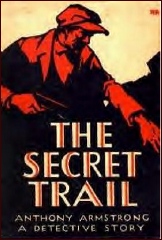
ANTHONY ARMSTRONG Jimmie Rezaire

   From 1927 to 1932, however, he penned five of the best thrillers from the heyday of the form about gentleman crook Jimmie Rezaire and his ‘secret service’ adventures in The Trail of Fear (1927), The Secret Trail (1929), The Trail of the Lotto (1930), The Trail of the Black King (1931), and The Poison Trail (1932).

   In their A Catalogue of Crime Jacques Barzun and Wendell Hertzig Taylor said of The Trail of Fear, the first Jimmie Rezaire novel:

    “Not strictly a detective story, but a good example of the chase after dope smugglers of the type popular in the late twenties … the chase goes on continuously for 275 pages, and it holds the attention surprisingly well … the hero is not a superman, and his strengths and weaknesses are well matched.” (page 37)

    What sets the Rezaire novels apart from the adventures of Bulldog Drummond, Sydney Horler’s Tiger Standish, Wyndham Martin’s Anthony Trent, and the other colorful adventurers of the era was both Armstrong’s sense of drama and literacy and Jimmie’s character.

   The slight, attractive Rezaire was no steel-thewed six-footer laying the enemy about him with a single blow, no brighter buccaneer or durable desperado, but a clever criminal who enjoyed the game of pitting his brains against the police until he allowed himself to be caught and served a term in the pen.

   In The Trail of Fear he’s still a criminal and drawn into a bit of secret service work which suits his nature. In The Secret Trail, just out of prison, he teams up with his one time girl friend Vivienne and Harry Hyslop (aka H.H.), down from Oxford after a forgery scandal, who have been running a shop lifting scam. Jimmie opens a Private Inquiry agency and almost immediately gets drawn into yet another bit of secret service trying to rout a spy ring that has stolen the Murchison bomb sight and plans to smuggle it out of the country to Russia.

   The books are primarily chase and pursuit, aided by Armstrong’s understanding of plot construction and the line of suspense. Unlike many writers of the period Armstrong doesn’t indulge in tiresome blathering and the silly ass dialogue that mars the Drummond books and others from this time frame.

   The Rezaire books are a modern read, with Jimmie a more complex hero than most. Though he loves the game and plays to win he is also attractively human and given to doubts and concerns. He’s also apt to rely on his wits too much, which is where H.H. comes in as a good man with his fists and a gun. H.H. would be the hero of any other series of the era, but Armstrong is careful to show us the limit of the brawn-over-brains type when pitted against the kind of super criminals Jimmie and company cross swords with on a regular basis.
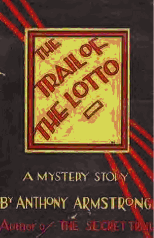
ANTHONY ARMSTRONG Jimmie Rezaire

   That said, the books are very much of the period they were written, with the usual foreign spies and drug smugglers (cocaine rings feature in many books of the era, from thrillers to classical detection like Sayers’ Murder Must Advertise), but all done with Armstrong’s superior writing and Rezaire’s more intelligent hero:

    “He settled down to his food, but his brain was busy marshalling his information about the sighter. What had he definitely learned from the dead man’s shorthand note? A certain amount at any rate. He knew that there were three if not four men concerned. He knew that the bomb sighter was somewhere in London. He knew that because it was so complicated the secret was safe, and would remain so till it left the country for Paris, where the man Siminski would arrive on the 19th to take it to Russia. He knew that therefore he presumably had six days — for today was the 13th — six days during which the spies apparently had to make some arrangements for ensuring a departure without a hitch by the Calais route. Of course they might try to smuggle it out by means of a motor-boat or airplane, but the boldest way was always the best; a passport, a suitcase, and an innocent appearance would do the trick easily.”

   That’s more reasoning and deductive work than in the entire Bulldog Drummond oeuvre. In fact, the fun is watching Jimmie as he thinks and fights his way out the various deadly traps set by the opposition and the chases in fast low slung cars, motor boats, airplanes, and on trains, across rooftops, down foggy roads, through busy London streets, and across the Channel in France.

   Armstrong’s understanding of drama keep the books moving swiftly, while the plot unfolds in snappy dialogue and exposition. Here Jimmie’s ex-partner Long Sam is back from America and out to get Jimmie:

    They stayed chatting with Viv in her sitting room for nearly an hour. Then the bell rang.

    “Sam,” whispered Viv, and the pair were hustled into hiding. They found themselves concealed by a thick curtain which hung across a corner behind the sofa. The one big window of the room was just on the left.

    “Don’t come out Jimmie, unless I call you,” pleaded Viv. “Honestly Sam won’t hurt me, but he might go for you if …”

    “What about nice little me?” put in Hyslop humorously. “Don’t nobody love me too?”

    “And you, H.H.,” added Viv, but something in her eyes told him he didn’t count beside Jimmie — that strange little man with so much ingenuity and so little physical courage.

    It should be pointed out that Jimmie is hardly a coward, but having the wit and common sense to know when he’s in danger and the imagination to see what the consequences of his actions might be he’s no steely nerved ice man either. He’s cool and leveled headed in action, but has the good grace to at least sweat the details when he’s bound up in a rug being carried to meet his maker in the trunk of the villain’s speeding salon car.

    For anyone interested in the thrillers of the era, the Armstrong books about Jimmie Rezaire offer a better than usual entry point forgoing the blather of the Drummond books, the bullying of Horler’s various heroes, and the gloating Berkeley Gray’s Norman Conquest was prone to.

   While they don’t have the sheer spirit and joy of the early Saint adventures by Leslie Charteris, they are clever and fast-paced, and cinematic in the best sense. The jingoism, snobbery, casual racism, and other drawbacks of books of the time are played down, and the writing is crisp and literate without the endless false bon homme of so many of Armstrong’s contemporaries.

   Jimmie Rezaire is a complex and interesting protagonist, and one who deserves to be better remembered. Among the armies of Blackshirts, Picaraoons, Gray Phantoms and the like, Jimmie was a breath of fresh air with well-conceived action and a fast pace that modern readers will appreciate, along with a more human and interesting set of heroes than the usual breed of supermen.

— All quotes from The Secret Trail (Macrae Smith, US, 1929).


Bibliographic data:   [Taken from the Revised Crime Fiction IV, by Allen J. Hubin.]

REZAIRE, JIMMIE    [Anthony Armstrong]
      Jimmie Rezaire (n.) Paul, 1927. US title: The Trail of Fear. Macrae-Smith, 1927.
      The Secret Trail (n.) Methuen, 1928. Macrae-Smith, 1929.
      The Trail of the Lotto (n.) Methuen, 1929. Macrae-Smith, 1930.
      The Trail of the Black King (n.) Methuen, 1931. Macrae-Smith, 1931.
      The Poison Trail (n.) Benn, 1932. No US edition.
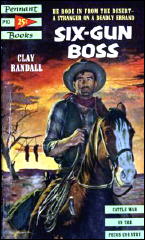
CLAY RANDALL, aka CLIFTON ADAMS (1919-1971)
A Checklist:

   Clifton Adams deserves a checklist and a page to himself, but that will have to wait for another day. One of his several pen names, however, was Clay Randall, and it was as the latter that he wrote a series of “Amos Flagg” westerns.

   The latter came up recently in the comments following my review of one of the Buchanan books, a series also published by Gold Medal.

   The Randall books are relatively scarce, but not very expensive. I’m surprised to see that I have only two of them, both in the Flagg series. Not having read any of them — a deficiency in myself that I will have to remedy soon — I’ll have to rely on James Reasoner’s comment, and I’m quoting: “The Amos Flagg novels are somewhat similar to [the TV series] Gunsmoke, as I recall, but only in the same sense that any town-set Western series with a lawman as the central character would be.”

   Note that not listed here are a dozen or so western stories that Adams wrote as Clay Randall for the pulp magazines, perhaps more. The first two novels were published in hardcover; all of the others are paperback originals. Amos Flagg is the leading character in the last six.

____

   Six-Gun Boss. Random House, hc, 1952. Pennant P10, pb, 1953. “A range detective works undercover to rid the range of rustlers.”

CLAY RANDALL

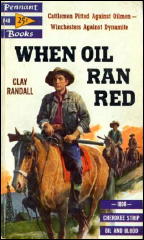
   When Oil Ran Red. Random House, 1953. Pennant P48, pb, 1954. “A range war in the Cherokee Strip sets cattlemen against oilmen.”

CLAY RANDALL

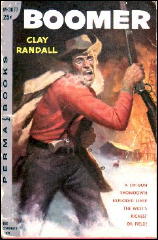
   Boomer. Permabook M3077, pbo, 1957. “An oil worker has to defend his rigs against crooks who have gunned his boss down.”

CLAY RANDALL

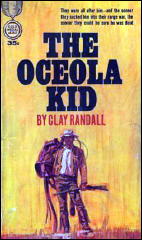
   The Oceola Kid. Gold Medal s1342, pbo, 1963. Leisure, pb, 1974. “The kid is drawn into a range war.”

CLAY RANDALL

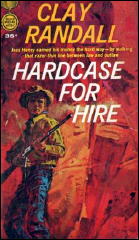
   Hardcase for Hire. Gold Medal s1357, pbo, 1963. Belmont Tower, pb, 1974. “A bounty hunter travels to Choctaw country after a man he’s never seen.”

CLAY RANDALL

   Amos Flagg — Lawman. Gold Medal k1482, pbo, 1964. Belmont Tower, pb, 1973

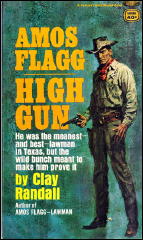
   Amos Flagg — High Gun. Gold Medal k1596, pbo, 1965. Belmont Tower, pb, 1973. “Four notorious killers drift into Sangaree County.”

CLAY RANDALL

   Amos Flagg Rides Out. Gold Medal k1677, pbo, 1967. Belmont Tower, pb, 1973.

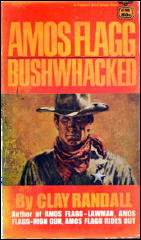
   Amos Flagg � Bushwhacked. Gold Medal d1760, pbo, 1967. Belmont Tower, pb, 1973.

CLAY RANDALL

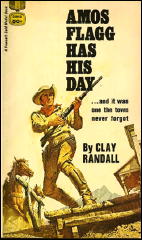
   Amos Flagg Has His Day. Gold Medal D1946, pbo, 1968. Belmont Tower, pb, 1973, as The Killing of Billy Jowett. “The town figures the sheriff is due some recognition on Amos Flagg Day.”

CLAY RANDALL

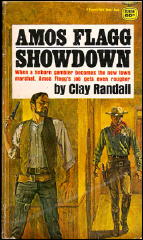
   Amos Flagg — Showdown. Gold Medal D2098, pbo, 1969. Belmont Tower, pb, 1973. “A tinhorn gambler becomes the new town marshal.”

CLAY RANDALL

A 1001 MIDNIGHTS Review
by Newell Dunlap:


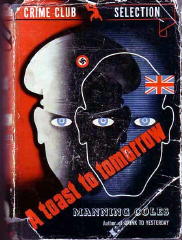
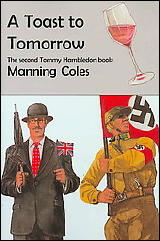
MANNING COLES – A Toast to Tomorrow.

MANNING COLES Toast to Tomorrow

Doubleday Crime Club, US, hardcover, 1941. Earlier UK edition, published as Pray Silence: Hodder, hc, 1940. Many reprint editions, both hardcover and soft. US paperback editions include: Bantam 118, 1947; Berkley F873, Jan 1964; Rue Morgue Press, 2008.

   In Germany in March 1933, a bit of a puzzle crops up concerning a radio production called “The Radio Operator.” On the surface, the show is nothing more than blatant Nazi propaganda. But to the British Foreign Office, it is much more.

   It seems the Morse code used as a background sound on the. show is actually a code used by an undercover British agent during World War I. Why, then, is it suddenly being used again after all these years-especially since the agent who used it is now dead? A puzzle indeed.

   For answers, the novel flashes back to January 1918, and we follow the life of an amnesia victim who adopts the name Klaus Lehmann. Lehmann, like most Germans, has a rough time of it in the postwar years.

   He meets Adolf Hitler, joins the Nazi party, and works his way up through the party ranks, all this before he remembers his true identity. He is really Hendrik Brandt. No, that isn’t right. He is really a British intelligence agent named Tommy Hambledon, who was posing as Brandt, and who is now posing as Lehmann. And what a position for a British agent to be in!

MANNING COLES Toast to Tomorrow

   The name Manning Coles is a pseudonym for Cyril Coles and Adelaide Manning. Under this pseudonym they produced numerous books and stories, but none of their characters was more popular than agent Hambledon. This book is the second in the Hambledon series. In the first, Drink to Yesterday (1941), Hambledon winds up his World War I experience and suffers the beginning of amnesia.

   The subsequent books — among them Operation Manhunt (1954), The Man in the Green Hat (1955), and The House at Pluck’s Gutter (1968) — came to rely more and more on formulaic plots and stock settings, and from the Fifties on,the series lost much of its appeal.

   Coles and Manning also collaborated on a series of satirical ghost stories featuring a defunct pair of cousins, James and Charles Latimer, and their equally dead pet monkey, Ulysses. Published as by Francis Gaite, these include Brief Candles (1954), The Far Traveler (1956), and Duty Free (1959).

         ———
   Reprinted with permission from 1001 Midnights, edited by Bill Pronzini & Marcia Muller and published by The Battered Silicon Dispatch Box, 2007.   Copyright © 1986, 2007 by the Pronzini-Muller Family Trust.

As a spillover from hunting and collecting books, I accumulate a good many duplicates, which I then list for sale on Amazon. Every so often, I update a complete listing of these books on my own website, and this afternoon I did just that.

Go here to take a look, if you think you might be interested. There’s a quantity discount offered of 20%, but if you mention this blog, take the full 20% off, no matter how many books you buy.

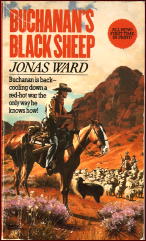
JONAS WARD – Buchanan’s Black Sheep.

Fawcett Gold Medal; paperback original. First printing, February 1985.

JONAS WARD

   I’m sure I read some of the first Buchanan books when they first came out, but since that was well over 50 years ago, I hope you’ll forgive if I don’t remember many of the details. In fact, you might as well say none of the details, and if you don’t, I will.

   So when I picked this book up in a spare moment last week, it was as if I was reading about the character for the first time, and yet (as it turns out) it was the next to the last of the series. Which must have made Gold Medal a small stack of money over the years – a small stack large enough to keep bringing the books out, even after the original author died, a fellow named William Ard, who was probably better known then as now as a mystery writer, under his own name and a few others.

   Science fiction writer Robert Silverberg completed the sixth one, Brian Garfield pinch hit for the seventh, then William R. Cox wrote all the rest. (For some more on Cox, go here to read my comments about a mystery novel he wrote, a yarn called Death on Location (Signet, 1952).)

   Thanks to Pat Hawk, whose list of the complete series he posted on the WesternPulp Yahoo group, here below is the full Buchanan bibliography. Although some were reprinted later in various large print and library hardcover edition, each of the books appeared first as a paperback original. I’ve added the Gold Medal code numbers and the full dates, whenever I could find them.

      WILLIAM ARD
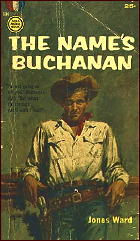
The Name’s Buchanan. Gold Medal 604, 1956. Filmed as Buchanan Rides Alone.
Buchanan Says No. Gold Medal 662, April 1957.
One-Man Massacre. Gold Medal 742, February 1958.
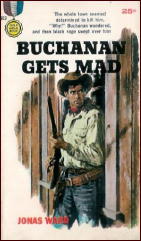
Buchanan Gets Mad. Gold Medal 803, 1958.

JONAS WARD

Buchanan’s Revenge. Gold Medal 951, January 1960.

      WILLIAM ARD & ROBERT SILVERBERG
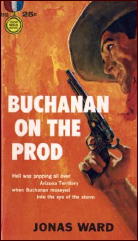
Buchanan On the Prod. Gold Medal 1026, August 1960.

JONAS WARD

      BRIAN GARFIELD
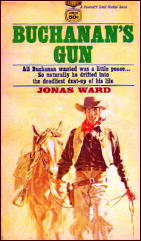
Buchanan’s Gun. Gold Medal D1926, 1968.

JONAS WARD

      WILLIAM R. COX
Buchanan’s War. Gold Medal R2396, March 1971.
Trap for Buchanan. Gold Medal T2579, 1972.
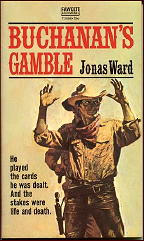
Buchanan’s Gamble. Gold Medal T2656, January 1973.

JONAS WARD

Buchanan’s Siege. Gold Medal T2773, August 1973.
Buchanan on the Run. Gold Medal M2966, May 1974.
Get Buchanan! Gold Medal M3165, December 1974.
Buchanan Takes Over. Gold Medal M3255, May 1975.
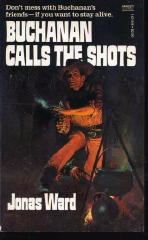
Buchanan Calls the Shots. Gold Medal M3429, December 1975.

JONAS WARD

Buchanan’s Big Showdown. Gold Medal 13553, 1976.
Buchanan’s Texas Treasure. Gold Medal 13812, 1977
Buchanan’s Stolen Railway. Gold Medal 13977, 1978.
Buchanan’s Manhunt. Gold Medal 14119, 1979.
Buchanan’s Range War. Gold Medal 14357, July 1980.
Buchanan’s Big Fight. Gold Medal 14406, May 1981.
Buchanan’s Black Sheep. Gold Medal 12412, February 1985.
Buchanan’s Stage Line. Gold Medal 12847, March 1986.

   As for Black Sheep, the one I read last week, Tom Buchanan, whose travels have taken him all over the West, takes sides in still another range war in this one, this time on the side of a sheep rancher and his family.

JONAS WARD

   On the other side, a big cattleman intent on running the little guy off the land with any means he sees fit, either fair or foul, mostly foul – in terms of hired gunmen who also think that taking Buchanan down will mean a big boost to their reputation.
   That’s the story in a nutshell, but of course there’s a lot more to it than that. Cox, which is how I’ll refer to the author, is interested in characters, and not only in the major players going head to head over the grasslands, but the women involved, of whom there quite a few, and the Indians – both those who ride renegade against both sides, but others also who for reasons of their own have taken allegiance with the sheepman and his family.

   Siding with Buchanan is his companion – over the course of several/most/all of the books? – a black man named Coco Bean and a good person to have next to you in a fight, whether in the squared circle or on the open plains.

   There is little action for most of the book, only a few small scattered (but often deadly) skirmishes. Buchanan tries his best to end the impasse without gunplay, but with cattle rancher Jake Robertson egged on by his own ego — as well as an outside factor or two — resolving the matter peacefully proves to be next to impossible.

   And in the end, gunplay is what ends (and saves) the day – fast, furious and fatal for many of the participants – but I have a feeling that it may have come too late for many readers of the day, who may have become impatient with too much palavering and the romantic subplots, which are fine as far as they go, but neither are the characters quite deep enough to make this literature as well as a pretty good old-fashioned western.

FIRST YOU READ, THEN YOU WRITE
by Francis M. Nevins


TCOT VELVET CLAWS

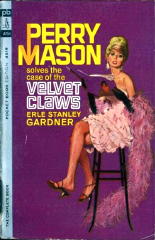
    At the thought of Graham Greene reading Perry Mason novels the mind boggles, but we now have documentary evidence that he did — and apparently so did his friend and fellow titan of 20th-century English literature, Evelyn Waugh.

    “Maybe we’ve been wrong about Perry Mason,” Greene wrote to Waugh on September 29, 1951. I’ve just been reading an early one — perhaps the first. The Case of the Velvet Claws. He kisses Della [Street] right on the lips & when his client notices the lipstick, he says ‘Let it stay.’ His client’s a girl & at one time he pushes her roughly onto a bed. He also makes her faint by third degree & slaps her with a wet towel to bring her round… [I]n the next case he drinks some red wine with a little French bread.”

    The letter can be found on pp. 191-192 of Graham Greene: A Life in Letters, ed. Richard Greene (Norton, 2007) but it’s never mentioned in the Index.

***

Greek Coffin

    The three men and the lovely Asian woman arrived a few minutes early that Saturday morning. I was reminded of the invasion of Ellery and Richard Queen’s apartment in the first pages of The King Is Dead (1952) but these invaders — Japanese director Naoto Tanaka and two camera operators and a female interpreter — were on a more prosaic mission: to shoot some footage with me for a documentary on Ellery Queen, one of a series of four that are being made for Japanese TV. (The subjects of the other three are Poe, Agatha Christie and Raymond Chandler.)

    They stayed for half a day and as far as I can tell the filming went well. At one point I was asked to name my two favorite Queen novels. This was almost impossible for me even when the director made it clear that I could exclude the four originally published as by Barnaby Ross.

cAT OF mANY tAILS

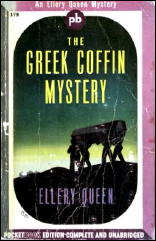
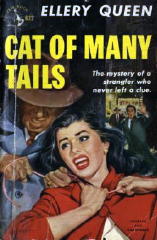
    Since the early EQ novels (1929-35) were so radically different from those of the third period (1942-58), I argued that I should be allowed to pick two from each and chose The Greek Coffin Mystery and The Egyptian Cross Mystery from Period One and Ten Days’ Wonder and Cat of Many Tails from Period Three.

    Tanaka then insisted that I opt for one from each of those periods. When I went for the Coffin and the Cat, he beamed, and said that those were his favorites too. Whatever footage from our interview winds up on the cutting-room floor, I suspect that bit will survive into the finished film. Of which I’ve been promised a DVD.

***

    Just about everyone knows about the sign on Harry Truman’s desk, but how many know of its possible connection with mystery fiction? The story is briefly told on page 481 of David McCullough’s 1992 biography Truman.

    “In the fall [of 1945, soon after FDR’s death and Truman’s unexpected rise to the presidency], Fred Canfil had given him a small sign for the desk. ‘The Buck Stops Here,’ it said. Canfil had seen one like it in the head office of a federal reformatory in El Reno, Oklahoma, and asked the warden if a copy might be made for his friend the President, and though Truman kept it on his desk only a short time, the message would stay with him permanently.”

TCOT VELVET CLAWS

    The obvious follow-up questions are: Where did that warden get the sign? Was he or the person who had it made for him aware that a sign with an almost identical message figures in a mystery novel published just a few years before FDR’s death?

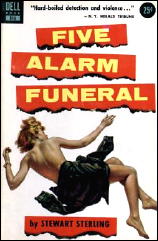
    Five Alarm Funeral (1942) was the first novel in what became a long series about New York fire marshal Ben Pedley, written by super-prolific pulp writer Prentice Winchell (1895-1976) under his most frequently used pseudonym, Stewart Sterling.

    At the beginning of Chapter Three, Pedley tells his assistant Barney that on the arson murder he’s presently investigating the Police Commissioner “has to pass the buck to somebody.” Barney: “You’d ought to have a new sign up on the door there….” Pedley: “What kind of a sign?” Barney: “‘The Buck’ — it oughta read — ‘Stops Right Here.'”

    Perhaps Truman’s next biographer will look into the connection, if any, between this passage and the most famous sign in recent presidential history.

THE GOLDEN AGE OF BRITISH MYSTERY FICTION, PART I
Reviews by Allen J. Hubin.


   When I still had my book collection (sold in 1982) I read and reviewed a number of Golden Age British mysteries, and stuck the reviews in a file. Some of the reviews were published somewhere, but here is a bunch that weren’t.

***

   Elaine Hamilton’s Murder Before Tuesday (Ward Lock, 1937) is better than average Golden Age material, presenting a number of intriguing characters with mysterious and intertwined relationship and satisfying plotting.

   Inspector Reynolds of the Yard does the detecting, what little there is, and fair play is not emphasized. Vanda Quayne well qualifies as a murderee. She’s a dancer who preys on people, sowing discord and hatred liberally in her path. She comes to London to perform despite threatening letters, hires a secretary, inflames passions, and, in due course, provides us with our corpse.

   The landscape is littered with suspects, a nosy reporter turns up who treads on all available toes, and Reynolds whisks a least likely suspect out of his hat at the end.

***

    W. W. Masters and his only work Murder in the Mirror (Longmans, 1931) are about as obscure as they come, but the story is not without merit.

   The theme is psychic or supernatural menace, with which battle must be waged; I was reminded of the later books by Jack Mann. And quite a nice surprise climaxes the story.

   We begin with a man playing cricket — but playing while in mental turmoil for he can remember nothing of who he is or where he came from or how he happens to be in the game. We later meet his friends — pals from Oxford — and learn with whom, or with what, they are now locked in deadly, unavoidable combat. Babylon, magic, mind control and murder are all effectively worked into the story.

***

   Nat Gould was, I gather, regarded as England’s (and maybe Australia’s, too) premier horse racing writer during his active years. At least some of his work was criminous, but of particularly thematic interest here is the rare volume of short stories, The Exploits of a Race-Course Detective (John Long, 1927).

   Those exploits comprise the first 6 (out of 15) tales in the collection. Crime stories they are (the other 9 are not), but of real detection they contain practically nothing. The sleuth is Valentine Martyn, the titular detective. He has a daughter, and we know that for her true love will out.

   The villain of the linked stories is a “sharper,” Luke Darton. Martyn foils his schemes each time, and we know that in the end Val will put him away. Each story has to do with racing; there is much of the jargon and milieu of the day, but no suspense and not much interest for present-day readers.

— To be continued.

REVIEWED BY WALTER ALBERT:         


JASPER FFORDE

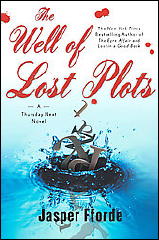
JASPER FFORDE – The Well of Lost Plots. Viking, hardcover, February 2004. Penguin, trade paperback, July 2004.

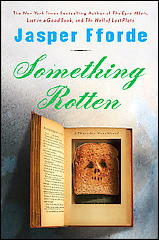
   —, Something Rotten. Viking, hardcover, August 2004. Penguin, trade paperback, July 2005.

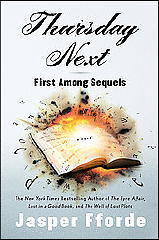
   —, Thursday Next: First Among Sequels. Viking, hardcover, July 2007. Penguin, trade paperback, July 2008.

   In the third and fourth of the Thursday Next alternate world fantasy detective series, Thursday first escapes into an inner world, a maelstrom where classic texts are in a constant flux, threatened from without and within (Lost Plots), then in Something Rotten returns to her native English town of Swinton, accompanied by her two year old son Friday, Shakespeare’s Hamlet, and Pickwick, her pet dodo, in search of her eradicated husband, Lamden.

JASPER FFORDE

   She also has to deal with the possible end of the world, a rather full plate for the resourceful Thursday.

   First Among Sequels, number five, begins fourteen years after number four. Thursday, her husband and two children, are living what appears to be something of a normal life in Swindon. Her SpecOps Division closed down in 1992 and she’s now working for Acme Carpets, or so her husband is meant to think.

JASPER FFORDE

   SpecOps has gone underground/undercover and Thursday is still traveling to the Book World, which is, as usual, in some turmoil and threatened with extinction if the nefarious plans of the Goliath Corporation are successful.

   In addition, Thursday is threatened with her most challenging enemy yet, her fictional self. And then there’s a continuing problem with her sixteen-year-old son Friday who refuses to accept his “ordained” role as a member of the time-traveling ChronoGuard.

   I found numbers three and four to be less fresh, and funny, than the first two entries, but First Among Sequels immediately captured my interest and convinced me that these are the most engaging comic novels currently being published.

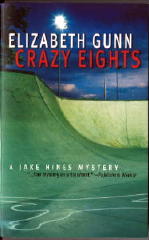
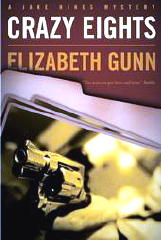
ELIZABETH GUNN – Crazy Eights.

Worldwide, paperback reprint; March 2006. Hardcover edition: Forge, February 2005.

   This isn’t the first appearance of Jake Hines, whose case this is, by any means — and I’ll get back to that in a minute — but this is the first one that he’s has been involved in that I’ve happened to read. So before starting the review itself, I’ll begin with some small bits (or bytes) of information.

ELIZABETH GUNN

   Hines, who tells the story, is the chief of detectives in Rutherford, Minnesota, and the woman who’s living with him is Trudy Hanson, a forensic scientist at the Bureau of Criminal Apprehension in St. Paul, about eighty miles away. They must have gotten together earlier in the series, since the story begins with them well-ensconced on their farm, located halfway between their two jobs.

   They get along well, and as you probably have realized without my telling you, a certain amount of shop talk takes place at home – or in other words, all the crime news in the area seemingly filters one way or another through one of them.     FOOTNOTE 1.

   Here’s a long quote to help further this introduction along, from page 10, which is about where the story itself begins, as the reader finds Jake being woken up at four in the morning:

   Coming out of the shower five minutes later, I stood by the bed, looking down at the sweet curve of her shoulder while I buttoned my shirt, thinking how it would feel to wake up and find her gone from there. I never quite get over the luck of it; I was rescued as a foundling from a Dumpster, an ugly duckling that grew into an ugly duck, with indeterminate brown skin and a mixed-race face that looks like it was made by a committee. But this smart, beautiful blonde likes me. Go figure.


   And as I promised, here are the earlier entries in the series:

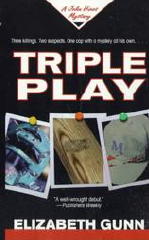
      Triple Play. Walker, hc, September 1997. Dell, pb, November 1998.

ELIZABETH GUNN

      Par Four. Walker, hc, December 1998. Dell, pb, December 2000.

      Five Card Stud. Walker, hc, May 2000. Worldwide, pb, July 2001.

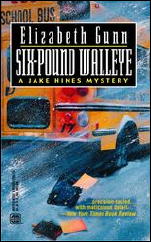
      Six-Pound Walleye. Walker, hc, June 2001. Worldwide, pb, July 2002.

ELIZABETH GUNN

      Seventh-Inning Stretch. Walker, hc, June 2002. Worldwide, pb, June 2003.

      “Too Many Santas” A short novel (or long novella) contained in How Still We See Thee Lie, no editor stated, Worldwide, November 2002.

      Crazy Eights. Forge, hc, February 2005. Worldwide, pb, March 2006.

   Some questions remain to be answered. For example, what happened to the “first two” books in the series? Will they ever be told?

   Also notice the short gap in continuity and the save by Forge Books when Walker canceled all of their genre fiction categories, I believe, including mysteries, or is there more of a story there? Gunn’s paperback publisher at the time, Worldwide, an imprint of Harlequin, must have helped the cause in the interim, publishing a non-numerical shorter entry in the series as they did.

   But in any case, there is some history behind the characters, and when you come in late, you have to get used to dealing with it really quickly. But the author does it right, and the paragraph quoted above is a good part of what does it.

ELIZABETH GUNN

   What is unusual –- I can’t think of another instance –- is that the story that follows –- the one about the case that Jake is called out on (at four in the morning) –- jumps right from Chapter One and into Chapter Two, which begins with the courtroom trial of the second of two small-time hoodlums who kidnapped and killed Shelley Gleason in Chapter One. Time elapsed: a year and a half later.

   What happened in the meantime? In a very interesting way of telling the story, Gunn lets the reader sort it all out through the ensuing testimony. This is not all that is unique. When the trial is over and the defendant is found –- well, no, I can’t tell you that, but what I can tell you that there is a confrontation between the accused Benny Niemeyer and one of the prosecuting attorneys that has never happened in a work of fiction before, ever.     FOOTNOTE 2.

   This is on page 102, and *whew* there are over 160 pages to go. Perhaps it suffices to say that medium-sized towns like Rutherford MN have a lot of secrets on both sides of the track, and on occasion there are oodles of opportunity for crossover. Most of the rest of the book plays itself out with relatively straight-forward plotting and story-telling. Unless, of course, you consider a relatively innocent skateboard as (also) being a relatively uncommon clue in the annals of detective fiction, as I do.

FOOTNOTE 1. I was curious about Rutherford, so I looked up the town on Google. No such place. The first two references to Rutherford MN were directly related to Elizabeth Gunn’s series of books, which may give Ms. Gunn her own two moments of fame right then and there (or here and now).

FOOTNOTE 2. What I said I couldn’t tell you is the first thing out of the mouth of the blurb-writer who’s responsible for describing the book on the back cover. Do I feel dumb, or what?

— March 2006


[UPDATE] 03-20-09. Since this review was written, there has been one more book in the Jake Hines series, perhaps the last?

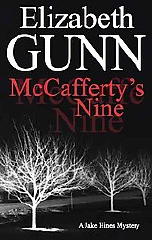
      McCafferty’s Nine. Severn House, hc, 2007; trade pb, 2008.

ELIZABETH GUNN

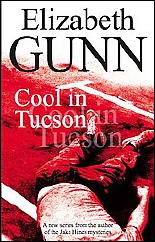
   And the author has started a new series, one with Tucson police detective Sarah Burke as the primary protagonist:

      Cool in Tucson. Severn House, hc & trade pb, 2008.

ELIZABETH GUNN

      New River Blues. Severn House, hc & trade pb, 2009.

   David first posted this as Comment #36 of a recent post he wrote called What Is Noir? – Part 2. Toward the end of the discussion, a conversation between Juri Nummelin and David took a turn toward the movie Kiss Me Deadly. The following is the latter’s most recent statement on the film.        — Steve


KISS ME DEADLY

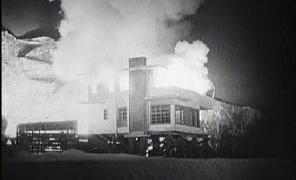
   My copy of Kiss Me Deadly (and every copy I’ve ever seen) clearly shows Hammer and Velda escaping into the surf and then the beach house being consumed in a mushroom cloud, so you can read it either way.

   The scene doesn’t show anything but the beach house consumed by the explosion, nor a mushroom cloud as big as the Trinity or Hiroshima ones we have seen on film. It seems to show a small contained explosion that only blows up the beach house. If Aldrich intended Mike and Velda to be killed, I assume they wouldn’t be shown reaching the surf, unless he intended ambiguity.

KISS ME DEADLY

   Of course, if you want to get realistic they likely both got a lethal dose of radiation when the box was opened while they were in the house, much less when the house went up. But the film seems to show the explosion only consuming the beach house, and Mike and Velda are shown before that in the surf, not the house.

   I still think the death of Mike and Velda is like the ending of 2001: A Space Odyssey where viewers wrote their own ending. The only thing supporting the death of Hammer and Velda is that Aldrich and screenwriter A.I. Bezzerides really disliked Spillane and loathed Hammer.

KISS ME DEADLY

   I have heard there is supposedly a cut where Mike and Velda do not reach the surf (and even that the scene where they do was imposed by the studio), but then again that may be fans reading their own interpretation into the film or even a bad copy edited poorly for showing on television. Again, if the intent of the film is Mike and Velda die, why show them reach the supposed safety of the surf?

   I’m reminded of taking my cousin’s five year old son to see Butch Cassidy and the Sundance Kid. At the end when Newman and Redford are surrounded by the army and decide to go out in a blaze of glory they run outside firing their weapons wildly, the frame freezes on that image. With perfect five year old logic my cousin’s son turned to me and asked: “Did they kill all those guys?”

KISS ME DEADLY

   The mind is a terrible waste — or whatever Dan Quayle said. Or maybe this is one of those glass half empty, half full things. At least Aldrich doesn’t have Mike and Velda climbing in a lead lined refrigerator like Harrison Ford in Indiana Jones and the Kingdom of the Crystal Skull.

   Or like the argument between Sam Jackson and Keven Spacey in The Negotiator — is Alan Ladd dead or alive in the last scene of Shane? In the case of Kiss Me Deadly and Shane, I think the pessimists are writing their own movie, but you never know, maybe my cousin’s five year old was right and Butch and Sundance wiped out the entire Bolivian army.

« Previous Page — Next Page »