Steve,

   Thanks for a great tribute to Desmond Cory on your blog. It’s greatly appreciated by the Cory fan club members. I contacted some of them who run the [Desmond Cory] website you mention, asking if there are any aspects of his life left out.

   Well, although not really dramatic, below are some points not mentioned that you might want to consider:

      CHILDREN’S NOVELS:

   Cory wrote a number of novels for children. I am aware of at least:

1958. Ann & Peter in Southern Spain (The Kennedys Abroad). Paperback: Frederick Muller Ltd., London, using pen-name Theo Callas.

1960. Jones On The Belgrade Express: An Adventure Story For Boys. Hardcover & jacket: Frederick Muller Ltd., London; First Edition. The adventures of Jones in Macedonia; an irrepressible schoolboy. Used Desmond Cory pen-name.

      SHORT STORIES:

   Cory wrote quite a few short stories too. Below is a sample:

1975. “The Crime of Prince Milo.” Appeared in Winter’s Crimes 7; Macmillan: London; edited by Hardinge.

1976. “Story of Stumblebum, the Wizard.” Appeared in Winter’s Crimes 8; Macmillan: London; humorous detective story featuring the inane wizard, StumbleBum.

1980. “Song of Fariq.” Appeared in The Mystery Guild Anthology, edited by John Waite; Constable: London

1992. “Switchblade.” Appeared in Midwinter Mysteries #2; Little Brown & Co: London; Short story featuring Professor Dobie.

      RADIO PLAYS:

1956. “The Secret Metal,” by Norman Edwards — freely adapted from Desmond Cory’s The Phoenix Sings (1956).

1959, Oct 31. “Shaken Leaf.” BBC Radio Play produced by R.D. Smith — adapted by Daphne Laney from the novel by Desmond Cory

1960, March 26 9.15 pm. “Pilgrim at the Gate.” BBC Radio Play adapted by Norman Edwards

Unconfirmed date. “The Phoenix Sings.” BBC Radio Play

1961. “Orbit One,” based on novel High Requiem.

      CINEMA:

1958. The Mark of the Phoenix. Directed by Maclean Rogers, 1958, written by Norman Hudis; based on Cory’s novel The Phoenix Sings.

1972. England Made Me. Screenplay of Graham Green’s novel.

      ACADEMIC BOOKS & ARTICLES:

   Probably one of Cory’s best kept secrets was that he was a university professor of English. His academic works varied a great deal. Below is an inkling of his work here:

1977. “Language and Behaviour.” Article Incorporated Linguist

1980. “Modes of Comedy.” Hardcover (no jacket); Volturna Press

1981. “Antonio Machado and the Cycle of Life.” Article Bulletin Hispanic Studies

1981. “English Literature and its Backgrounds.” Paperback (thick edition) Routledge

1983. “Eliot’s ‘mythical method’ and the poetic image.” Article Comparative Literature Studies

1983. “Hemingway and the Pardoner’s Tale.” Article American Literature

   My thanks again for the blog entry.

                     — Best wishes, Jan

   A couple of months ago I reviewed a book by Marguerite Silverman entitled The Vet It Was That Died. I didn’t include any biographical information on the author because at the time, I couldn’t find any. Nor was there anything more about her in Crime Fiction IV, by Allen J. Hubin, only the following list of the three books she wrote:

   SILVERMAN, MARGUERITE R(uth)
      * The Vet It Was That Died (n.) Nicholson 1945 [Chief Insp. Christopher Adrian; England]
      * Who Should Have Died? (n.) Nicholson 1948 [Chief Insp. Christopher Adrian; England]
      * 9 Had No Alibi (n.) Nicholson 1951 [Chief Insp. Christopher Adrian; England]

   
   For my overall opinion of the book, you can read the review. Here?s a quote, though, from somewhere early on:

   … The primary detective in each is Chief Inspector Christopher Adrian. Coming to his assistance in this one, at least, a relatively minor affair, is a newly graduated veterinarian surgeon by the name of Helena Goodwin.

   Helena’s involvement with the mystery is due only to this, her first job, however, and in fact she’s one of those immediately on the scene when her body of her veterinarian employer is found.

   
   Keep this in mind, as this will be important later. I no longer remember the reason — and this was only yesterday, mind you — but I happened to Google the author’s name, and up came up several websites I hadn’t seen before. Marguerite Silverman is not a common name, but neither is it uncommon, which makes a big difference when trying to locate an author when all you have to work with is her or her name.

   But one or two of these websites mentioned Marguerite Silverman as being — a veterinarian! And yet another site where I found her name was in relation to pets and their well-being.

   I asked British librarian-sleuth John Herrington if I was onto something, and indeed, yes he agreed, sending me this paragraph about her, found here:

   Marguerite R Silverman, MRCVS, ACIS, graduated from the Royal Veterinary College in 1935 and spent some time in companion animal practice before the Second World War. She then changed career and developed a successful business in verbatim recording (before the invention of the tape recorder). In 1958, following a holiday visit to Israel during which she had been distressed by the scale of the animal suffering she had seen, she founded the Society for Animal Welfare in Israel. […] In 1986 she approached UFAW about the possibility of SAWI being taken under its wing […] She died peacefully at a nursing home, near her home in Catcott in Somerset, on Friday 5 December 2003, aged 89.

   
   For those of us who are acronym-disabled, Google helps out in this manner also:

      MRCVS = Member of the Royal College of Veterinary Surgeon
      ACIS = Associate of the Chartered Institute of Secretaries
      UFAW = Universities Federation for Animal Welfare

   Working backward from her age at the time she died, along with the fact that she passed away so late in the year, it means that Miss Silverman, who apparently never married, was born in 1914. Unfortunately the Somerset Local Studied Library had no obituary on record for her. Then in a later email, John reported that: “According to Freebmd, her birth was registered in Southampton in June 1914. (Entry is incorrect as transcriber has read the R for Ruth as an M — magnification of the entry shows it as a poor R.)”

   I’ve still read only the one book of the three that Marguerite Silverman wrote. Knowing that she was a veterinarian herself, and learning of her lifelong love of animals, puts the book into a perspective I hadn’t had before. It also puts tracking down her other two mysteries several notches higher on my scale of things to do. Both are rather scarce, unfortunately.

      —

[UPDATE] 05-07-07. Although neither John nor I realized it, Al Hubin already had the information on Miss Silverman’s birth and death dates. See his Addenda #9 for the Revised CFIV.

HUNTER STINSON – Fingerprints

Henry Holt & Co.; First Edition, March 1925.

   After a short investigation on my part, I believe that I can safely say that this is the only edition that was published of this book, nor were there any other books that appear under this author’s name. (The asking price for the only copy found on the Internet at the time I am writing this is $50, but that is certainly explainable by the fact that that particular copy is inscribed by the author; otherwise it is in about the same condition as mine.)       FOOTNOTE.

   Long time readers of the pulp magazines may, however, suspect that they know the author by a slightly different name, and they would be correct, if they happen to be thinking of H. H. Stinson. An incomplete list of his short fiction at Bill Contento’s Fiction Mag website begins with a western story published in Top Notch in 1928 and ends with a mystery yarn in Black Mask in 1948. In the latter magazine he had a series character by the name of Kenny O’Hara.

   To discover more, I put out a call for help, first from Victor Berch, whose name has been mentioned on these pages before, then from the various members of the Pulp Mags yahoo list:

[From Victor:] I think I found your man. He’s Herbert H. Stinson. In the 1930 Census he’s listed as a police reporter. In the 1920 Census, he’s listed as a journalist. Have his birth and death dates: Born 27 Apr 1896, Died 09 Oct 1969. Mother’s maiden name was Hunter, so that would fit right in. Wrote some plays as well out in California.

Black Mask


[From John Locke:] He’s mentioned in The Black Mask Boys [edited by William F. Nolan]:

   The following year [1933] proved to be Shaw’s finest as he brought five powerful new writers into the Mask: Thomas Walsh, Roger Torrey, H. H. Stinson, W. T. Ballard, and (at the close of 1933) Raymond Chandler.

   H.H. Stinson’s series hero was quick-fisted Ken O’Hara, of the Los Angeles Tribune. Again, a very tough cookie.

   From the AFG Bulletin, July 1, 1936:

      Joseph T. Shaw, Black Mask:

   Your request to select a “model” story in the July Black Mask, or in almost any issue, for that matter, cannot be fairly done without a word of explanation. You see, we follow the principle of “no dud in any issue;” therefore it is rarely that any one story stands out markedly from any other or all of the balance, although we hope that the magazine itself, as a whole, does.

   So far as the writers permit, we select for an issue the best of as many types as are available; in consequence, readers naturally have preference for one over another in accordance with their individual tastes, and all may be equally good as to workmanship quality. There is a story in the July issue, however, which can be pointed to for a specific reason. It is “Nothing Personal,” by H. H. Stinson.

Nothing Personal

   If a new writer should ask me to suggest what might be interesting to our readers, I would probably mention anything but what Mr. Stinson has in his story, in the way of characters, by name or position – that is, a reporter, an editor, a tough police official, and so on. They have been used so many, many times.

   Yet Mr. Stinson has done something with these familiar identities, with the ordinary action, which, to many readers, will make this an outstanding, a “model” story, in any company. The one word to describe it is “treatment.” He has brought every one of his characters vitally alive. The fact that they are this, that or the other is less important than that they are “real” personages; not once do they speak, act or react out of character – with a more or less commonplace setup, his handling of story detail, of constant menace, of action, is masterly. One careful reader refers to one of his scenes as the most vivid, the best of its type since Hammett told about Ned Beaumont in The Glass Key.

   The fact that Mr. Stinson is himself a newspaper man, a police reporter on one of the big Los Angeles papers, may have contributed to the sense of reality which he has infused into the story. But it isn’t every newspaperman who can make a story live and throb like this one. If it were, editors would have an easier time.

   A “model” story. No – except for treatment. A marvelously entertaining and vital one? Yes – decidedly yes.

Dime Detective


[From Ed Hulse:] Besides O’Hara in Black Mask, Stinson in the post-WWII years wrote a series about a dick named Pete Rousseau for Dime Detective.

   He stopped writing for both Mask and Detective in 1948. He wrote for other detective pulps, too; Cook-Miller credits him with 60-odd stories altogether.

Dime Detective


[From Will Murray:] I just went through my copy of the manuscript of the Joe Shaw bio written by his son, Milton. I find no mention of HHS.

   However, Shaw did pick one Stinson story for possible inclusion in his Hard-Boiled Omnibus, “Give a Man Rope.” His editor thought it weak in comparison to other selections and it was dropped along with several others.

   So we know what Shaw thought was his best BM story.

Black Mask


    Me again. I’m back, and I’m assuming that after all of this talking, as interesting as I hope you found it, you’d like to hear about the book itself. Truth be told, it’s not very good, but for most of an evening or two, the entertainment value is still high enough that I did. Read it in an evening or two, that is.

    As the story begins, the primary protagonist has discovered that as of that very same morning, he is a pauper. The estate he believed that had been left to him by his overly generous father, he learned, had been badly (and sadly) overtaken by various notes, mortgages, liens and debts. Which therefore means, as of that very same evening, his marriage to Maryse Douglas is off.

   Not by any wishes of the young lady herself, far from it, but by Owen Kenrick, her guardian until she comes of age. Here is how the author describes the young lady, on page 5:

    …Though Maryse Douglas had only the standard equipment of eyes, mouth, hair and other features with which any member of the race goes through life, the component parts seemed to have been arranged in such wise that most young men upon seeing her went away mumbling to themselves of resolves to lead better lives and some day be worthy of her.

   The next morning Christopher is consoled by a gent by the name of Bosworth, who lives in the apartment upstairs from him. From page 13:

    “Cheerio, lad. Into every life a couple of showers have to fall, as some ass of a poet remarked. No doubt in the least that you’ll get on.” He proceeded cautiously as became a venture on delicate ground. “And if I can help, old onion, you’ll make me thoroughly irritable by not letting me come to the fore.”

   This is not the sort of dialogue that would make any kind of headway in the pages of either Black Mask or Dime Detective, nor would the mystery itself. When Kenrick is found dead, young Christopher is, of course, the obvious suspect. The only others in the running are the butler or Miss Douglas herself, and when Christopher’s fingerprints are found on the murder weapon, that just about clinches the case right then and here.

Fingerprints

    Except for one undeniable fact, and that is that Christopher did not do it, and in the remaining 200 pages, it is up to him, Maryse, and Bosworth (who has secrets of his own) to prove it.

   Also on Blake’s trail are a gang of jewel thieves (jewelry being a primary item of trade for the dead man) who kidnap Maryse as part of their nefarious doings, but she escapes and makes her way back to the city just as Blake and Bosworth discover the hideout where she had been kept a captive, and mystery upon mystery ensues. By page 209 Maryse has been captured again, by yet a third party to the drama, and rest of the book is devoted to her rescue, nothing more, and quite a lot less.

    A lot happens in this book, as you can tell, but when it comes down to it, as I’ve already implied, nothing really happens, if you know what I mean. And what about the phony fingerprints? You might ask, and rightly so. In 1925, they were still a novelty to mystery readers, and so in 1925 they must have been amazed as to what could be done with them, by both the investigators and (in this case) the villains. I checked online with Google, and guess what, what the chaps on the wrong side of the law did back then could really be done. Of course Mr. Stinson makes it sound easy, but in terms of the technology of 1925, I’m still not quite convinced it would have been as easy as he made it sound.

— September 2006


FOOTNOTE: I seem to have spoken somewhat ahead of myself. After some further investigation I have discovered that the novel was previously published as a three-part serial in the mystery fiction magazine Real Detective Tales and Mystery Stories, concluding in the February 1925 issue. Mostly, I think but am not sure, the stories that appeared in RDT&MS were either of the mansion house variety or out-and-out thrillers, and thusly not hard-boiled fare at all.

    Or am I making a judgment on a sample of size only one? Other authors who appeared in the magazine in 1925 include Seabury Quinn, Arthur J. Burks, Raoul Whitfield, Otis Adelbert Kline and Vincent Starrett. You tell me.

   I don’t know about you, but for me writing is the hardest thing in the world. I have nothing but admiration for the storytellers whose works and words we mystery readers follow so avidly. They make it look so easy – and every once in a while, I imagine that it is.

   Because maybe they’re human like you and me, and they spend their days struggling to put the words on the computer screen in the right order, and not only that, but the right words in the right place and at the right time, and if the wrong word is used, it just throws everything out of whack, like a single grain of sand in a well-tuned BMW engine.

   I’ve been writing reviews of mystery fiction since the early 1970s, when I was the “Courant Coroner” for the local Hartford paper, and every once in a while I’ve run out of words, and I’ve had to quit for a while. This latest consecutive streak of books reviewed has been going on for nearly seven years now – and do you know what?

   It’s still a struggle to put the right words down and in the right order and with the right punctuation. Case in point. I was reasonably happy with my comments on the John Whitlatch book I recently reviewed – until I read them the next morning.

   You probably haven’t noticed – and I sincerely hope not – but I’m constantly tweaking and changing little things here and there on this blog until either (a) I get it right or (b) I concede defeat – in a good sense, that is. I can only hope.

   But every once in a while, I look at something I wrote and say to myself, for example, what is really he trying to say here? Or could he possibly be more convoluted than this to get his ideas out? And look at what he says here. If changes are going to be made, they’re going to have to be big ones this time. Case in point. After considerable inner struggle and debate, I’ve revised the Whitlatch review and I’ve posted the result and I don’t think I will read it again for a week. (My fingers are crossed when I say that, though.)

   My opinion is the same, and some of the words are the same, but some of them aren’t and the punctuation is different too.

   Next up, a review of Death Turns the Tables, by John Dickson Carr. It’s turned out to be a tough book to comment on, and I’ve been putting it off for a couple of weeks now. I’d better get to it, before I forget the story altogether. (This has happened before.)

   I wonder what I’m going to say about it.

   Here’s something that caught my eye a few days ago. A book just out from mystery writer Allison Brennan is entitled Fear No Evil. As it turns out, it’s part of a one-two-three punch in a series of crime novels connected by title and characters:

Allison Brennan

      Speak No Evil (Ballantine, pbo, Jan 30 2007) Homicide detective Carina Kincaid.

      See No Evil (Ballantine, pbo, Feb 27 2007) Private eye Connor Kincaid.

      Fear No Evil (Ballantine, pbo, Mar 27, 2007) Forensic psychiatrist Dillon Kincaid.

   What caught my eye was none of above, however. Not the titles, not the characters, not the quick time frame in which the books were published.

   It was this:

Alice Brennan

   A book by Alice Brennan with the same title as the third in Allison Brennan’s series of books, Fear No Evil, was published by Lancer in 1970. As I’m sure you can tell from the cover, Alice Brennan’s book is a gothic romance. Allison Brennan’s book, to put it in a category, might be called a psychological thriller — but then again, perhaps that’s what those old gothics have somewhat evolved into — books that are called either romantic suspense or psychological thrillers.

   Here’s Allison Brennan’s reaction when I emailed her about my find:

  Hi Steve:

   I didn’t know that little bit of trivia! I’ll have to try and find the book. Brennan is my married name and my husband doesn’t recall an Alice in his family, but part of his family lives in Canada and he doesn’t know all his relatives up there. Brennan is a very, very common name in Ireland and Canada. In fact, I think Brennan is one of the top ten most common Irish surnames.

   Thanks for the info! Truly an odd coincidence . . .

                        A

   Allison Brennan           www.allisonbrennan.com


   Looking up Alice Brennan in Al Hubin’s Crime Fiction IV, here’s her complete entry. It’s easy to tell that most of her books, if not all of them, fall in the “gothic” category:

BRENNAN, ALICE (1913-1973) Born in St. Louis; has been dancer, hat-check girl, secretary; living in Avoca, Michigan, in 1960s.

* Circle of Fear (n.) Monarch 1964
* The Brooding House (n.) Lancer 1965 [Michigan]
* Litany of Evil (n.) Lancer 1969
* Candace (n.) Paperback Library 1970
* Fear No Evil (n.) Lancer 74660, 1970 [Michigan]       FOOTNOTE.
* Castle Mirage (n.) Belmont 1971 [Oregon]
* The Devil’s Dreamer (n.) Lancer 1971
* Never to Die (n.) Lancer 1971 [Michigan]
* The Haunted (n.) Lancer 1972
* To Kill a Witch (n.) Lancer 1972
* Ghost at Stagmere (n.) Paperback Library 1973
* Sleep Well, Christine (n.) Avon 1973
* Devil Take All (n.) Popular Library 1974 [Michigan]
* House of the Fiery Cauldron (n.) Berkley 1975
* A Matter of Witchcraft (n.) Berkley 1975
* Thirty Days Hath July (n.) Avon 1975 [Michigan]

   And here’s something else you can do with CFIV. You can look up titles:

      # Fear No Evil • Leigh Brackett • (n.) (Corgi, 1960, pb) See: The Tiger Among Us (Doubleday 1957).

      # Fear No Evil • Alice Brennan • (n.) (Lancer, 1967, pb)

      # Fear No Evil • John Gordon Davis • (n.) (Collins, 1982, hc)

   I’m sorry to say that I haven’t been able to come up with a cover for Leigh Brackett’s book, not even of the original US title. Here’s a short synopsis, however: “The Tiger Among Us (1957) was a story of a citizen-turned-vigilante, who seeks to revenge himself on a gang of juvenile delinquents; it was filmed as 13 West Street starring Alan Ladd.”

   A quick summary of the Davis book: “This is an epic story of the most dramatic theft of our time, of two extraordinary men, Davey and Charlie, circus hands, who try to return their animals to freedom.”

Davis

   And just for completeness, a description of Alice Brennan’s book, taken from the back cover: “When Margaret Blyeth came back to the lake country of her childhood seeking proof that she was not responsible for the death of a man who had claimed to love her, she quickly came under the spell of Mom Pet .. and just as quickly found herself enmeshed in a web of terror!”

   From Allison Brennan’s website: “In cyperspace, no one can hear you scream… Five years ago FBI agent Kate Donovan took on a sadistic killer and lost. Now running from her own government in order to prove her innocence in another girl’s gruesome murder, Kate teams with forensic psychiatrist Dillon Kincaid to find the killer’s chamber of horrors before Dillon’s sister Lucy is slaughtered live on the Internet.”

   Four books, one title, four totally different stories.

FOOTNOTE. The date stated for this book in CFIV, 1967, has been discovered to be an error. Another error exists in Graham Holroyd’s Paperback Prices and Checklist, which incorrectly lists Lancer number 74660 as Litany of Evil, which came earlier [74-580].

   Chester H. Opal was a one-shot author, at least as far as the world of crime and mystery fiction is concerned. The single entry for him in Crime Fiction IV, by Allen J. Hubin is:

LORRAINE, JOHN; pseudonym of Chester H. Opal
      * Men of Career (Crown, 1960, hc)

   According to what Al has learned, Mr. Opal was born February 9, 1918, and died on February 27, 2006. Neither date was known before. The subtitle of Men of Career is: A Novel About the Foreign Service, which makes the following Internet discovery come as no surprise:

   Deposited with Georgetown University’s Foreign Affairs Oral History Program is an interview with Chester H. Opal (USIA), or the United States Information Agency.

   Further investigation reveals that in his folder is a transcript of an interview he had with G. Lewis Schmidt, in which he discussed Poland (1946-49); Italy (1949-50); Planning Staff (1950-52); Vienna, Austria (1952-53); Mexico (1954-56); Naval War College (1956); Saigon, Vietnam (1957-60); Deputy Director of Television Service (1961-62); Schmidt Task Force on Europe (1962-63); Assistant Director for Europe (1963); Beirut, Lebanon (1964-66).

***

   Playwright Robert Lord, born in New Zealand on July 18, 1945, also has but one credit to his name in Crime Fiction IV, as follows:

LORD, ROBERT (Needham)
      * Country Cops (Broadway, 1988, pb) 2-act play.

   Based on information from Contemporary Authors, Mr. Lord lived in the US between the years 1974 to 1990, when he returned in New Zealand, where he died of cancer in January 1992.

   Further biographical information can easily be found on the Internet. A complete list of his plays can be found at http://www.playmarket.org.nz/, for example.

   Also learned from that website is that Mr Lord, “wrote numerous television programs as well as the screenplay for the New Zealand feature Pictures. At the time of his death, he was working on the screenplay The Big Ditch.”

   Described as a black comedy farce, Country Cops was first produced at the Dorset Theater Festival in Vermont. Synopsis:  “Set in a police station in small-town New Zealand. Jasper Sharp is sent from the city to solve a murder.”

    Ian Covell, from a post he made to the FictionMags Yahoo group:

   Thanks for alerting me that so much had been cleared up (though I can tell you the bibliography still has a couple of errors).

   I am “pleased” to find that the many books I thought were missing (there was a note [F&SF July 1974] that Runyon had written “over 30 published novels in 14 years of writing”) turn out to be much less (just over 20), and indeed, I have half of them.. definitely the SF, though not the Ellery Queen’s or the adult stuff.. The Black Moth is one of the finest, darkest thrillers I have ever read… and Color Him Dead is an unpredictable, excellent work. Soulmate is definitely adult horror. .

   The corrections and additions pointed out by Ian in the remainder of his post have already been incorporated into the bibliography. They include:

INCARNATE, the paperback from Manor, was published in 1977. (Previously “no date.”)

KISS THE GIRLS AND MAKE THEM DIE. Correct spelling of Runyan to Runyon.

I, WEAPON. The hardcover was published in July 1974, not 1971, which necessitated a change in the chronological order in the SF section. The paperback from Popular Library appeared in December 1977.

   Short Stories:

“In Case of Danger” F&SF, December 1975 — the actual title is longer and funnier, “In Case of Danger, Prsp the Ntxivbw”

      and add the following:

“Happiness Squad” – Fantastic, March 1967
“The Youth Addicts” – Worlds of IF, May 1967

   Charles also had a letter appear in F&SF, September 1975. [This does not appear in the bibliography, but it is certainly worth a mention here.]

   Ian also cited one British paperback reprint of one of Charles’ books, but since this means that other UK editions are omitted, I’ve decided not to include it for now, based on an “all or none” philosophy.

   Also from Ian: “I have a penned note of something called Hang Up from Gold Medal, circa 1969, but it really is just penciled in, not confirmed; may be an early title of No Place to Hide or even Power Kill.”

   And from Allen J. Hubin: “I’ve got the three Mark West titles listed in Addenda #14, each with a dash.” The dash, of course, indicating marginal crime content; the Addenda referring to the Revised Crime Fiction IV.

          —

   Thanks to Ian Covell in a followup email, and a judicious search of the Internet, I now have equal-sized cover scans for all of Charles Runyon’s novels. (One is a third printing, but other than that, it’s complete.)

   I’ve also cleaned up a couple of glitches that I created this morning. See the bibliography as it appears now on the primary Mystery*File website.

[UPDATE] 05-04-07. An email from Charles Runyon:

  Dear Ian, et al:

   Thanks for the kind words and the help in researching my past. You dug up some interesting material, not the least of which was that enigmatic Hang-Up which was supposedly published by Gold Medal in 1969. According to my wife’s Little Black Book, that was my original title for No Place to Hide.

   I sold a story entitled “The Day it All Hung Out” to Escapade Magazine in October 69. An amusing little tour de force, which I remember reading when it came out. I haven’t yet been able to find any copies of it in my files, but I’m keeping my eyes open.

   I sold a few other stories to the men’s magazines, such as Adam Yearbook, “There Must be More than This” and Knight, “The Appointment” but “The Day…” was the best according to my memory — not excluding “The Naked Bums,” which was the title Men put on their serialization of The Death Cycle. (If you’re looking for the Ultimate in Egregious Reprints, that’s gotta be IT.)

   I think the discrepancy in the number of books published arose from the fact that I counted foreign language editions at the beginning. Or maybe I was just exaggerating.

   Regards to you, Ian, and everybody else, Chas.

   Recently brought to the attention of mystery readers was the hitherto unnoted death of crime fiction author Michael Kenyon. Born in Yorkshire England in 1935, he lived in the US off and on after his university days for many years before eventually becoming an American citizen in 1997. He died in Southampton NY in 2005.

   Mr. Kenyon has a long list of credits in Crime Fiction IV, by Allen J. Hubin, most of them featuring in the starring role either Ireland’s Superintendent O’Malley or Inspector Henry Peckover of Scotland Yard. One book, The Elgar Variation (US title) seems to be somewhat of a transition point between the two series, with both characters sharing the top billing (see below).

KENYON, MICHAEL (1931-2005); occasional US pseudonym Daniel Forbes.

    * May You Die in Ireland (n.) Collins 1965; Morrow, 1965. Fawcett Crest R1211, pb, 1968. [Supt. O’Malley; Ireland]

Ireland

   * The Whole Hog (n.) Collins 1967; Morrow 1967, as The Trouble with Series Three. [Illinois; Academia]
    * Out of Season (n.) Collins 1968 [Channel Islands]. No US publication.
   * The 100,000 Welcomes (n.) Collins 1970; Coward, 1970. [Supt. O’Malley; Ireland]
    * The Shooting of Dan McGrew (n.) Collins 1972; McKay, 1975. [Supt. O’Malley; Ireland]

McGrew

   * A Sorry State (n.) Collins 1974; McKay, 1974. [Supt. O’Malley; Philippines]
    * Mr. Big (n.) Collins 1975; Coward, 1975, as by Daniel Forbes. [England]
    * The Rapist (n.) Collins 1977; Coward, 1977, as by Daniel Forbes. Dell 17294, pb, 1982. [Supt. O’Malley; Ireland]
    * Deep Pocket (n.) Collins 1978; Coward, 1978, as The Molehill File. [Insp. Henry Peckover; England]
    * Zigzag (n.) Collins 1981; Coward 1981, as The Elgar Variation. [Insp. Henry Peckover; Supt. O’Malley; England]
    * The God Squad Bod (n.) Collins 1982; Doubleday 1982, as The Man at the Wheel. Avon 70381, pb, 1988. [Insp. Henry Peckover; London]
    *A Free Range Wife (n.) Collins 1983; Doubleday, 1983. Avon 70382, pb, 1988. [Insp. Henry Peckover; France]
    *A Healthy Way to Die (n.) Hodder 1986; Doubleday, 1986. Avon 70380, pb, 1987. [Insp. Henry Peckover; England]
    * Peckover Holds the Baby (n.) Severn 1988; Doubleday, 1988. Avon 70636, pb, 1988. [Insp. Henry Peckover; Belize]
    * Kill the Butler! (n.) Macmillan 1991; St. Martin’s, 1993. [Insp. Henry Peckover; Long Island, NY]
    * Peckover Joins the Choir (n.) Macmillan 1992; St. Martin’s, 1994. [Insp. Henry Peckover; Belgium]
    * Peckover and the Bog Man (n.) Macmillan 1994; St. Martin’s, 1995. [Insp. Henry Peckover; Scotland]

   Compiled by using resources available on the Internet, the following collection of short synopses does not include all of the books above, but it does provide a fairly substantial glimpse into the kind of mystery fiction Mr. Kenyon wrote:

   May You Die in Ireland. The letter bearing the news that William Foley, easy-going math professor at a Midwestern university, had become the owner of a castle in Ireland was certainly cause for celebration. But the legacy that made him king of a castle also turned him into a human carrier pigeon, the unwitting bearer of a deadly secret, and a living time bomb.

   The Whole Hog aka The Trouble with Series Three. Arthur Appleyard experiments with pigs and their feeds.. one day he finds series three batch, including Marlon and Humphrey, have been given a magical ingredients of critical importance to the space race and the cold war!

Series Three

   Out of Season. Mystery set in Jersey as a German man returns to the island where his father was once stationed, to be met by hostility and bizarre events.

   The Shooting of Dan McGrew. In this hilarious Irish crime story, O’Malley investigates the disappearance of two prospectors working a mine site together.

   The Rapist. Dungoole in County Cork begins to unravel when a visiting American feminist is raped, and later murder occurs.

   Deep Pocket aka The Molehill File. Detective-Inspector Henry Peckover, “a passable published poet,” links the “murder of a May fair tart to a web of political, financial and sexual hanky-panky that encompasses a titled M.P., a police chief superintendent who turns drag queen by night, Middlesex pols and proles, bird hunters of all varieties and an Arab sheik bent on making the green and pheasant land an adjunct of Riyadh.” (Time Magazine, July 17, 1978)

   Zigzag aka The Elgar Variation. A simple escort-the-prisoner run goes awry when the man escapes just as Chief Inspector Peckover is about to take over.

   God Squad Bod aka The Man at the Wheel. Scotland Yard’s newly formed God Squad is following Paster J. C. Jones very closely. A Henry Peckover novel.

    A Free-Range Wife. Peckover finds himself in France at the Chateau de Mordan, where more is on the menu than escargots and chips: a modern-day Jack the Ripper.

   A Healthy Way to Die. An elite spa features beautiful bodies and murder for Inspector Henry Peckover of Scotland Yard.

Healthy

   Peckover Holds the Baby. Peckover is sent to Belize to track down a cocaine king and lands feet first in a messy brew of murder, drug running and kidnapping.

   Kill the Butler. It’s madcap mayhem when Inspector Henry Peckover goes undercover as a butler on a Long Island estate to find a millionaire’s murderer.

   Peckover Joins the Choir. Chief Inspector Henry Peckover and Detective Constable Jason Twitty go undercover as choir singers to investigate a series of continental art thefts.

   Peckover and the Bog Man. When Sir Gilbert Potter, whose blustering grows offensive at a dinner party, is murdered by a knife through his voicebox, Henry Peckover and his assistant Jason Twitty must investigate.

   While Barzun & Tayor in A Catalogue of Crime were not impressed with the two of Kenyon’s works they read – May You Die in Ireland “A bad first try,” and The Molehill File “rather turgid plotting and prose” – one suspects that humor combined with mystery were not what they were looking for. Craig Rice’s books are panned by them, for example, as being filled with “ill-advised humor.”

Molehill

   Other commentators have invariably made referenceto the humor in Kenyon’s mystery fiction and have been more favorably impressed. Reading what else they have had to say, along with the synopses above, the impression that’s gathered is that under the veneer of light-hearted gaiety in Mr. Kenyon’s work is a solid core of seriousness and — in the good old Irish tradition — a healthy dose of tragedy.

   I heard today from Charles Runyon, who’s been battling the flu. Going through his records, he’s come up with the following changes to his bibliography, posted here a couple of days ago.

    ● “Rum and Chaser” was the title put on one of my stories by Scott Meredith (or somebody working there at the time; perhaps Terry Carr) but that didn’t go down with the editor of Manhunt, who replaced it with my original title, “The Last Kill.” At least I think that was my original title; I used to have the magazine (Manhunt, April 1961) but I don’t seem able to find it now. Probably best to just leave out “Rum and Chaser” entirely.

   The book entitled Something Wicked (Lancer, pb, 1973) is included in Crime Fiction IV, by Allen J. Hubin, but tracking down a copy has proven to be a very difficult task. Both Victor Berch and I had come to the conclusion that it has never been published. The next comment from Charles confirmed my growing suspicion:

    ● Something Wicked was apparently the title put on Dorian-7 by the inheritors (if that is the right word) of the Lancer properties. At the time I was trying to switch from Scott Meredith to Richard Curtis and there was considerable confusion. Richard reported making several visits to the SM agency to winnow out all my stuff, but I do not recall getting paid for anything entitled Something Wicked. Maybe I did; my wife can’t find her financial records for that era so perhaps we could just sweep that little paradox under the carpet of the past. (Does this mean The Curse is actually working? Chills and premonitions.)

    So that it may be read more easily, I’ve moved the article entitled “The Curse of Dorian-7 to the primary Mystery*File website.

    ● A Killer is a Lonely Man was my title for To Kill a Dead Man (Major, 1976). [The former title sometimes appears as an unpublished book written by Charles.] It would be more appropriate in my case to retitle it To Revive a Dead Man because I’m about ready to make a major effort to resurrect my corpse which has been mouldering away (according to the report in SF Encyclopedia) since 1987.

    All of these changes are now in place. Thanks again to Charles Runyon and Ed Gorman for helping put together all of the pieces on this project, as they have. And to Charles, it’s great to have you back!

   Genevieve Holden, the author of seven mystery novels between 1953 and 1976, died Sunday, April 22nd, in Atlanta GA at the age of 87. As a mystery writer born and raised in Mississippi, she is one of the many authors honored by being included in the University of Mississippi’s online archive exhibit entitled Murder With Southern Hospitality: An Exhibition of Mississippi Mysteries.

   Excerpted from the page devoted to her is the following biographical summary:

    “Genevieve Holden is the penname of Genevieve Long Pou, who was born in Tupelo, Mississippi in 1919. She attended the University of Mississippi for two years before transferring to the University of Georgia. After college, Pou worked on the Birmingham Post and the Idaho Statesman before writing her first mystery in 1953.

Kate

    “Set in the South, Pou’s books epitomize the subgenre termed ‘Gothic,’ known more widely these days as ‘Romantic Suspense.’ Written primarily for a female audience, books of this nature feature heroines in dangerous situations who tend to find themselves attracted to handsome yet potentially menacing men.”

   Expanded from her entry in Crime Fiction IV, by Allen J. Hubin, here is her complete bibliography. Each of her books was published first in hardcover by Doubleday, all of them under their famed ‘Crime Club’ imprint.

HOLDEN, GENEVIEVE; pseudonym of Genevieve Long Pou, (1919-2007)

      * Killer Loose! (n.) Doubleday, hc, 1953. Detective Book Club, hc reprint, June 1953. Bestseller Mystery B172, digest pb, abridged. [Lt. Al White; U.S. South]

Loose

      * Sound an Alarm (n.) Doubleday, hc, 1954. Detective Book Club, hc reprint, May 1954. [Lt. Al White; U.S. South]

      * The Velvet Target (n.) Doubleday 1956. Ace G-554, pb, 1965. [Lt. Al White; U.S. South]

      * Something’s Happened to Kate (n.) Doubleday 1958. Ace G-558, pb, 1965. [Lt. Al White; U.S. South]

      * Deadlier Than the Male (n.) Doubleday 1961. Detective Book Club, hc reprint, August 1961. [New Orleans, LA]

      * Don’t Go in Alone (n.) Doubleday 1965 [Atlanta, GA]

      * Down a Dark Alley (n.) Doubleday 1976 [Atlanta, GA]

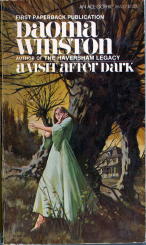
   Reiterating what was said by the librarians at U-Miss about the nature of her books, the two reprinted by Ace were published as part of their ‘gothics’ line of paperbacks. The cover shown is quite typical; no would-be reader, almost invariably female, would look at the cover and not know what to expect if it were to be picked up and read.

   Covers sometimes lie, however. Belying my own words, Barzun and Taylor include one of her books in A Catalogue of Crime, saying about Deadlier Than the Male:

Deadlier

    “Here is more evidence tending to show that it is possible for an author of detective fiction to outgrow his or her earlier deficiencies. G.H. has written at least three other tales featuring the deep South and miscellaneous private eyes, examination of which disclosed nothing palatable. The present work differs markedly. Hank Farrell, the private detective, is a plausible ex-cop; the chase of a lady who does in one rich husband after another is reasonable; and it is enlivened by the discovery that she is hot on Ferrell’s trail.”

   Using Ellen Nehr’s Doubleday Crime Club Companion 1928-1991 as a guide, here are some comments on Mrs. Pou’s other novels, based on the blurbs on the inside front dust jacket flaps:

   Killer Loose! The leading character is Janet Milton, who with her young nephew Tolly, goes on the run from a psychopathic killer, apparently dressed in the uniform of a sheriff’s deputy. Lt. Al White is not mentioned.

   Sound an Alarm. In true ‘gothic’ fashion, Linda Stanley is hired as a governess for a grandchild and young heir. The house is a mansion with “cavernous halls with a sense of portending evil.” Lt. Al White again is not mentioned in the blurb.

Sound

   The Velvet Target. Eve Halsey is suspicious of her new uncle, believing that her wealthy aunt had made a bad choice in marrying him. Lt. White agrees, and he begins a race against time to rescue Eve when the honeymooners take her along.

   Something’s Happened to Kate. Menacing danger is in store for Kate Woodley after she meets handsome Jim Garrett – and disappears. Lt. Al White not mentioned in the blurb.

   Deadlier Than the Male. It is difficult to say for sure, but contrary to Barzun & Taylor, this seems to be the first book in which a PI is involved, Hank Farrell in this case.

   Don’t Go In Alone. Police detective Captain Mark Latham has a case of three missing Atlanta women on his hands, all of whom went into vacant homes on the real estate market and disappeared.

   Down a Dark Alley. Captain Mark Lathan (sic) returns [a series character previously unknown to Al Hubin] to solve the shocking murder of member of a motorcycle gang. Dinah Prentiss’s Victorian aunt is the primary suspect.

Alley

   Without knowing more about her books than this, do you also get the impression that there was a lot more toughness to Ms. Holden’s mysteries than you might have assumed at first?

« Previous PageNext Page »