THE BACKWARD REVIEWER
William F. Deeck


JAMES CORBETT – The Lion’s Mouth. Herbert Jenkins, UK, hardcover, 1941. No US edition.

   Another in Mr. Corbett’s continuing series of poor-quality thrillers. It is apparent that he means well, but he really just can’t seem to break out of the formula, which is a rather humdrum one at that.

   In this novel, Robert Morley, archcrook, has threatened Chief-Inspector Langton of Scotland Yard with kidnapping. Morley wishes to remove Langton so that he can successfully complete his final crime and retire. He is also aware, as the novel proves, that without Langton Scotland Yard is a mere nothing.

   The kidnapping takes place. The case is placed temporarily in the hands of Detective-Inspector Denton — none of the members of the big five wanting to handle it. It is said about Denton that “the set of his chin below humorous grey eyes bespoke his ability to take care of himself in any situation that might arise”. A gross exaggeration, as his later falling over a female, getting knocked out, and kidnapped proves.

   While there is no real mystery here — it is a police procedural, very loosely described — some puzzles are present:

   â€” Is there such a thing as a “Mauser revolver”?

   â€” One of Morley’s henchmen is a Hungarian. We know this because the author keeps telling us, plus the henchman has an accent when the author remembers to provide him with one and says “he in?” and “Schweinhundt!” periodically. Why then would Denton look for him in a shop with provisions “dear to the taste of the Latin”? (Why Denton would also seek him out in “a struggling photographer’s studio” also raises questions.)

   â€” What does “the character he had so skillfully assumed seemed to synchronise with his surroundings” mean?

   â€” After a 45-minute walk, plus time for some ridiculous conversation, Denton whips out a handkerchief from his pocket and covers a woman’s face. He had prepared the handkerchief with “just a spot” of chloroform at his apartment. Where did Denton get this remarkable stuff?

   Not to be compared with Mr. Corbett’s delightfully awful novels, but amusing in its own way.

— Reprinted from CADS 7, December 1987. Email Geoff Bradley for subscription information.


Note:   James Corbett books previously reviewed by Bill on this blog —

      Murder While You Wait
      Gallows Wait
      Vampire of the Skies
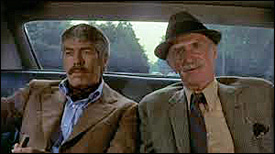
REVIEWED BY JONATHAN LEWIS:


RIDE A CROOKED TRAIL. Universal, 1958. Audie Murphy, Gia Scala, Walter Matthau, Henry Silva. Written by Borden Chase. Directed by Jesse Hibbs.

   Audie Murphy may have been the top billed star, but it’s Walter Matthau who steals the show in the 1958 Cinemascope western, Ride a Crooked Trail. The future Academy Award winner portrays Judge Kyle, a rough-around-the-edges, whiskey-drinking, and shotgun-toting small town magistrate.

   When outlaw Joe Maybe (Murphy) comes to town and falsely assumes the identity of a federal marshal, the ornery Judge Kyle takes the young man under his wing and makes him the town’s lawman. Little does he realize, at least at the beginning, that Joe Maybe, along with his “wife” Tessa (Gia Scala) have their eyes on the local bank vault.

   Leading the outlaw gang is the borderline sociopathic Sam Teeler, portrayed to the hilt by veteran character actor Henry Silva. Of course, there comes “the choice.” Does Joe Maybe decide to go straight and side with his newfound friend, Judge Kyle, or does he stay on a crooked path?

   Much of the film is typical Western fare and there’s not all that much in this one that you probably haven’t seen done better elsewhere before. Sad to say, the film’s direction and editing is really at times noticeably sub-par. Which is a shame, because it looks so good, with bright colors and distinctive hues.

   But as I mentioned before, Matthau gives a stand-out performance. It was a relatively early film for him, one made in the first several years of his long and illustrious career. If for nothing else, Ride a Crooked Trail is worth watching for him alone.


NOTE: Dan Stumpf has also reviewed Ride a Crooked Trail for this blog. See his comments here.

ANTHONY GAGLIANO – Straits of Fortune. Jack Vaughn #1. William Morrow, hardcover, June 2007. Harper, paperback, June 2008.

   Jack Vaughn is a former New York City cop (there’s a long story behind that) who’s now a personal trainer in Miami, and in Straits of Fortune he takes on a job that might qualify him for unlicensed PI status if it weren’t totally illegal, no matter how you look at it.

   The father of his former girl friend (there’s a long story behind that, also) hires him to dispose of a yacht on which the body of the man his daughter dumped Jack for (that’s the long story told briefly) is still lying. Jack hesitates for most of a day, but an offer of $100,000 (half up front) has a way of allowing a lot of qualms to be shushed up and tossed away.

   There is a catch, of course. There is a second body on the yacht. Jack scuttles it anyway, but before he gets to shore, he is… Well, gee, I’m telling you the whole story. Suffice to say that Jack is in a jam, no doubt about it, and it’s a damn good thing he’s in shape, or he wouldn’t get out of it with an entirely whole skin.

   So. There’s lots of action, but there’s also a lot of backstory to be filled in, which Jack tells us about himself. To action fans, this is the kind of thing that could make for an awful lot of down time. The overall result is therefore a bit uneven, as first novels sometimes are, but there is, I found, a certain poetic flow to Gagliano’s prose that propelled me along with a nice rhythm and beat. It doesn’t quite smooth over one medium-sized hole in the plot, but it’s one I found easy enough to ignore, and I kept on reading.

   Nor is this all I should tell you. The last chapter, after all of the shooting is done, and some certain ends are tied up, is well worth the price of admission in itself.

   Now for the bad news. Anthony Gagliano was only partway through Jack Vaughan’s second adventure when he died of a stroke in 2009, at the age of only 53. This first novel was based on his master’s thesis at Florida International University, and Les Standiford and Dan Wakefield, his instructors and mentors there, took it upon themselves to work on the manuscript and finish the book for him.

   The title of the second book is The Emperor’s Club, and was published in 2014. I’ve already ordered a copy.

FUGITIVE NIGHTS: DANGER IN THE DESERT. Made for-TV movie. NBC-TV, 19 November 1993. Sam Elliott, Teri Garr, Thomas Haden Church, Raymond J. Barry, Barbara Babcock, Geno Silva. Screenplay by Joseph Wambaugh based on his novel Fugitive Nights. Director: Gary Nelson.

   Teri Garr is good-looking enough, and about the right age to portray any one of the many female PI’s that have cropped up in recent years, and Sam Elliott has become scruffy enough to become her assistant while he’s waiting for his disability retirement to come through.

   If this is a pilot for a TV series, though, I think they’d better start hunting up some stories, since in this whole two-hour introductory affair, there’s only about 15 minutes worth of plot. Lots of byplay between the characters can fill up big chunks of time, that’s for sure, but it left me hungry for some meatier fair in nothing flat.

   Locale: Palm Springs. Villain: a bald Mexican fugitive, loose in the desert. Opinion: forget it.

— Reprinted from Nothing Accompliced #4, November 1993 (very slightly revised)


LAWRENCE BLOCK – The Burglar Who Traded Ted Williams. Bernie Rhodenbarr #6. E. P. Dutton, hardcover, 1994. Onyx, paperback; 1st printing, June 1995.

   When this book came out, there had been a gap of over ten years between this one and the previous entry in Lawrence Block’s “Burglar” series, The Burglar Who Painted like Mondrian, and as I recall at the time, fans were beginning to wonder if there ever would be a new one.

   If anyone knows more of the story than I do, you’re welcome to say more in the comments. For whatever reason Block decided to pick up the series again, I for one am glad he did. This is the funniest detective story I’ve read in a long time. And not only that, there are five more in the series that I have not read, and I’m more than ready to start catching up.

   By the end of this book, some changes in Bernie’s life have taken place. He has a new cat to help him in the bookstore, his worries about paying the rent are over, and he will have a partner of sorts in his other occupation, and there’s no secret what that is, is there?

   This one begins in Bernie’s shop. No bookseller can be up on the prices he has in stock, not unless he’s a specialist in every area under the sun, and as book opens Bernie gets snookered when he sells a First Edition copy of Sue Grafton’s B Is for Burglar for $100 when it’s worth $500. It also turns out that the buyer is Bernie’s new landlord, and he’s about to jack up the rent for $875 a month to a staggering $10,500. That’s some stagger.

   In any case, Bernie is tempted to go back into his former business again. He resists, and he almost succeeds, but he’s grown used to running the store, and he wants to keep it. Here, or soon thereafter, is where a set of 1950 Ted Williams cards comes in. And not only are the cards missing, but on his first burglaring foray he’s been on in a while, Bernie also finds a dead man totally naked in a bathroom that’s sealed up from the inside as tight as a drum.

   It’s a complicated story, with far too many details to go into here. You’re far better off reading it for yourself. Everybody and everything is connected to everything and everybody else in this story, and it takes Bernie, with some persuasion, to solve the case, with all of the suspects (and more) gathered together in one room in one of the grandest finales I’ve read all year.

   And, oh, remember Sue Grafton being mentioned a while back? This is the book in which Block has some fun with her, making up titles such as F Is for Stop, T Is for Sympathy, and G Is for Spot. Not to mention Bernie’s good lesbian pet groomer friend Carolyn wondering aloud whether Kinsey Millhone may be of the same sexual orientation, or not. I do not know what Sue Grafton’s reaction may have been.

       —

NOTE:   Based on an error on my part pointed out by David P., the current version of this review has been revised from the one you may have seen before.

THE INTERNECINE PROJECT. Allied Artists, 1974. James Coburn, Lee Grant, Harry Andrews, Ian Hendry, Michael Jayston , Christiane Krüger, Keenan Wynn. Screenplay by Barry Levinson & Jonathan Lynn, based on the novel Internecine by Mort W. Elkind. Director: Ken Hughes.

   The dictionary definition of the word “internecine” is “mutually destructive,” and as a description of what this movie is all about, it’s as an appropriate a word as I can think of. Based on the short amount of time I spent watching an interview with screenwriter Jonathan Lynn provided on the DVD of the film, the word is pronounced something like “in TERN neh seen,” and if you let it, it’s a word that will get stuck in your head all day long without being able to find a way to get out.

   Also, before going any further, I’d like to mention that the novel the movie is supposedly based on, the one by Mort Elkind that’s stated in the credits, it doesn’t seem to exist. One of those anomalies of the film-making world that pops up every now and again, I imagine, and I no longer worry about such things.

   So, where does the “mutual destruction” come in? It seems that what James Coburn, a high profile (and highly photogenic) professor of economics, wants more than anything else, is an appointment to a high government position. Rather than go through an embarrassing set of revelations in any confirmation hearings, he decides to clean up his past. That is to say, four most inconvenient former associates, unknown to each other, in some previous undesirable activities.

   How? By setting each one a final task, that of killing off another one of the four. By an overdose of insulin, by death in a shower (someone must have seen Psycho), by a high tech electronic frequency transmitter, and last but not least, a stout clunk on the head, simple but always effective.

   The timing of these four simultaneous assassinations is crucial, and so the movie plays out like a well-planned “heist” film, one in which if one step goes awry, the whole affair may fall apart quickly and immediately.

   Twists and turns are expected, therefore, but alas, even though James Coburn’s character spends a lot of time pacing as he waits for the phone to ring at appropriate intervals from each of the participants he has sent into motion, there is only one twist that really counts, and you’ll have to wait to the ending for that.

   The photography is very well done, and Lee Grant, who plays a journalist as well as a former romantic interest, is as beautiful as ever. Every once in a while there also seems to be a point at which she is important to the plot, but sadly enough, that point never quite comes. According to what I read on IMDb, a number of people have liked this film, but if you were to ask me, I’d have to tell you I found it a misfire, more often than not.

REVIEWED BY BARRY GARDNER:


NEVADA BARR – A Superior Death. Anna Pigeon #2. G. P. Putnam’s Sons, hardcover, 1994. Berkley, paperback, 1995. Avon, paperback, 2002(?). Berkley, paperback, 2003.

   I’ve heard a lot of good reports on Barr’s first novel, Track of the Cat, but for whatever reason have not read it. Barr, like her protagonist, is a Park Ranger, at the lovely Natchez Trace Park in Mississippi.

   Ranger Anna Pigeon has been transferred from the Texas high desert to Isle Royale National Park, a remote island off the coast of Michigan in Lake Superior and known for deepwater dives to wrecked sailing vessels. One of the vessels contains five well-preserved bodies that make it a prime diving attraction. Before long there’s a fresher body to contend with — a recently married diver who conducted diving tours on the lake. In addition, the young wife of an old-salt Park Ranger hasn’t been seen lately, and a New Age-ish couple are hinting to Anna of cannibalism and murder.

   Agh friend asked me when I was about two-thirds through the book how I liked it, and my answer was, “Pretty well, and if she doesn’t screw up the plot like so many of them do these days, I’ll like it a lot.”

   She did, though, bigtime. The eventual key to the plot was one of the most contrived and unlikely I’ve come across in many moons, and it comes to Anna in a blinding flash. Too, there’s the all-too-common situation of the law (including the FBI, this time) idling off-stage while the smart people catch the crooks, and the heroine plunging breathlessly into foolish danger.

   On the plus side, I think Barr writes very good prose, particularly when she’s dealing with nature and the environment, and manages to convey a strong ecological message without it getting in the way of the story. I liked Anna and thought that Barr did a good job with characterization overall. If you don’t share my distaste for reality shat upon, you might like this.

— Reprinted from Ah Sweet Mysteries #12, March 1994.

      The Anna Pigeon series —

1. Track of the Cat (1993)

2. A Superior Death (1994)
3. Ill Wind (1995)
4. Firestorm (1996)

5. Endangered Species (1997)
6. Blind Descent (1998)
7. Liberty Falling (1999)
8. Deep South (2000)
9. Blood Lure (2001)

10. Hunting Season (2002)
11. Flashback (2003)
12. High Country (2004)
13. Hard Truth (2005)
14. Winter Study (2008)

15. Borderline (2009)
16. Burn (2010)
17. The Rope (2012)
18. Destroyer Angel (2014)

19. Boar Island (2016)

REVIEWED BY JONATHAN LEWIS:


THE ZODIAC KILLER. 1971. Hal Reed, Bob Jones, Ray Lynch, Tom Pittman, Mary Darrington, Frank Sanabek, Ed Quigley, Doodles Weaver (as Doddles Weaver). Director: Tom Hanson.

   This one’s an exercise in pure exploitation. Released in 1971 at the height of the hysteria surrounding the series of unsolved murders in northern California, the eponymous The Zodiac Killer is a low budget attempt to capitalize on the public’s well-founded fears that a brutal murderer might be lurking in their midst. Poorly edited and with acting that ranges from borderline adequate to the downright campy, The Zodiac Killer is not what anyone would call a good film.

   But it is a cultural artifact, to be sure. There’s something very gonzo about late 1960s and 1970s independent filmmaking, a gung ho spirit that sadly is lacking in filmmaking today.

   The tone of the film ranges from sleazy to brutal to hysterically funny, and it takes forever to figure out what the filmmakers actually intended their final product to be. Unless, that is, what they intended is what you see on the screen: a real mishmash that somehow tells a story about who they imagined the Zodiac killer might be.

   And that persona comes in the form of a mailman by the name of Jerry (Hal Reed). Jerry’s not a particularly happy person. His father lives in an insane asylum, and he gets yelled at by old ladies on his mail route – well, one old lady in particular. His only friend seems to be a pathetic, violently erratic truck driver. Somehow – and we never really learn how and why – he snaps and becomes a devotee of a religious cult and then begins his killing spree.

   There are some truly brutal murder scenes in this one, but also some scenes that are so over the top that they’re downright comical. Almost slapstick. A truly bizarre little movie that doesn’t say too much about anything but, if it ends up being screened as a midnight movie, has the potential to be a lost cult classic.

REVIEWED BY DAN STUMPF:


ERNEST HAYCOX – Alder Gulch. Little Brown, hardcover, 1941. Paperback reprints include: Dell #317, mapback edition, 1949; Bantam A2287, 1961; Paperback Library, 1971; Pinnacle, 1992.

   A superior Western by a master of the form, Alder Gulch starts off in Jack London territory with Jeff Pierce, shanghaied by a brutal sea captain, jumping ship in Portland — or trying to. The captain pulls a gun, Pierce clubs him down and ends up wet and alone, fleeing for his life in a strange city… and wanted for murder.

   In the best pulp tradition, he’s rescued by a beautiful woman of mystery, and they end up making a difficult trek to Virginia City, Montana, then on to Alder Gulch, where Pierce intends to try his luck prospecting.

   About this time I wasn’t expecting much, but Haycox quickly abandons the Pulp traditions (most of them anyway) and sets about writing a genuine story, filled with real-seeming characters, tense situations, lots of action and even a moral dilemma or two.

   Haycox fashions a story that pits the hard-toiling miners of Alder Gulch against the well-entrenched outlaw bands of the area, led by Sheriff Henry Plummer (A real-life character of some controversy. And I should add here that although our hero is named Pierce and he’s been shanghaied, he bears no relation to the Shanghai Pierce of Texas fame.)

   A lot of this plot found its way (unaccredited) into Borden Chase’s screenplay for The Far Country (1954) from the outlaws’ habit of picking off miners trying to leave with their profits to the central character who’d rather go it alone than stand up for law and order with the community. And shame on Chase anyway for stealing so shamelessly. But Haycox blends the tale neatly with grungy details of a miner’s life and the progress-or-decline of characters who grow and change as we watch them, wrapping things up with a satisfying conclusion.

   Now I’m going to pick a fight with you. There’s a scene in Alder Gulch where the hero, having finally joined the vigilantes, finds his good friend mixed up with the outlaws and facing the wrong end of a rope. This is not a new thing in westerns; it goes back at least as far as Owen Wister’s The Virginian (1902) and there may even be ancient Icelandic sagas about former pardners turned owlhoots. It has appeared in a number of books since then (including Lonesome Dove) and it also shows up in A. B. Guthrie’s These Thosand Hills.

   Most of you read my review of Hills and said you never read Guthrie and didn’t think he was worth the trouble, but I’m here to tell you Guthrie took this meme and handled it with originality, tension, and a sure feel for the moral and emotional complexity of the thing. Haycox was good, but Guthrie was brilliant, and I’ll fight any man in the room (at a safe distance, of course) who will read the book and say different.

   And meanwhile, don’t forget Haycox’s Alder Gulch; it’s a winner.

A 1001 MIDNIGHTS Review
by Marvin Lachman


ELISABETH SANXAY HOLDING – Net of Cobwebs. Simon & Schuster, hardcover, 1945. Bantam #26, paperback, 1946 (copies with jackets exist). Detective Book Club, hardcover, 3-in-1 edition. Ace Double G-530, paperback; published back-to-back with Unfinished Crime. Stark House Press, trade paperback, 2004; published with The Death Wish.

   The psychological mystery, along with its first cousin, the film noir, became extremely popular during the mid-1940s. Elizabeth Sanxay Holding had been writing this type of book since the early 1930s, and Anthony Boucher, one of her biggest boosters, was quick to point out her preeminence in this subgenre. Raymond Chandler paid her extravagant praise indeed, saying, “For my money she’s the top suspense writer of them all.” Net of Cobwebs is one of her best books.

   Most of the Holding mysteries involve close family relationships. This is perhaps a carry-over from her early writing days, prior to 1930, when she primarily wrote romantic fiction. Critics Barzun and Taylor disliked the “family wrangling” in her books, but they are in a distinct minority; most fans and critics thought otherwise. In Net of Cobwebs it is his family that is an apparent refuge for Malcolm Drake, a merchant seaman who is recovering from the effects of having had his ship torpedoed.

   He carries the additional burden of guilt regarding the death of one -member. Plagued with nightmares and inability remember, he suffers the further trauma of being the primary murder suspect when a relative who made him her heir is murdered with his medication.

   Though women were generally her protagonists, Holding shows in this book that she has no difficulty in being equally convincing when writing from a male viewpoint, even that of a war veteran. We can accept and identify with Drake as easily as we can with the heroine of another Holding novel using World War II as its background. In The Blank Wall (1947), Lucia Holley seems to to be a typical middle-aged housewife, concerned with writing to her husband overseas and coping with wartime shortages. When a married man “takes up” with her teenage daughter and then is found murdered, Lucia’s life becomes a nightmare. The book, one of her most popular. was filmed in 1949 by Max Ophuls, with Joan Bennett and James Mason, as The Reckless Moment.

         ———
   Reprinted with permission from 1001 Midnights, edited by Bill Pronzini & Marcia Muller and published by The Battered Silicon Dispatch Box, 2007.   Copyright © 1986, 2007 by the Pronzini-Muller Family Trust.
  

« Previous PageNext Page »