NORBERT DAVIS “Walk Across My Grave.” Short story. First published in Black Mask, April 1942. Reprinted in Ellery Queen Mystery Magazine, November 1953.

GLORIA WHITE Ronnie Ventana

   I was talking about humorous private eyes after reading Loren D. Estleman’s story “State of Grace” a short while back. The PI in that tale was a chap named Ralph Poteet, a relatively recent hero of sorts based in Detroit. Going back in time, to the early 1940s, the leading character in this story is a chap named Jim Laury, who’s not a PI at all, but a matter-of-fact sort of fellow whose fictional existence was even shorter than Mr. Poteet’s. According to all the evidence I’ve been able to find, this is the only story he was ever in.

   He’s a quiet, unprepossessing ,man. Here’s the first couple of paragraphs that was used to describe him as he comes into the story, a two or three pages in:

“Jim Laury had run for sheriff of Fort County because he wanted the job. It paid pretty well, and he knew he wouldn’t have to work very hard at it. Besides that, he really enjoyed dealing with law-breakers, and he knew that the most interesting ones weren’t to be found among the regimented masses who huddle uncomfortably together in cities but in the small towns and the open country around them where individuality is still more than a myth.

   “He was tall and sleepy-looking and he talked in a slow drawl. He never moved fast unless he had to. He was wearing his long brown overcoat when he entered the funeral parlor through the side door, and he unbuttoned the collar and turned it down, wrinkling his nose distastefully at the heavy lingering odor of wilted flowers that clung to the anteroom.”

   Not too much there to stoke anyone’s sense of humor there, I suppose, but I think it’s an excellent piece of writing. No, what I found really funny comes later, speaking of myself in particular, as he listens to his deputy (a man named Waldo) wild and woolly theories about the case, bods thoughtfully as if they had any real bearing about the case, and continues on about business.

   Which begins with a figure in black being seen stumbling around in a cemetery at night banging into tombstones and all, then seguing into a murder that has to be solved. Which Mr. Laury does, calmly and in very cool pulpish fashion.

   It’s too bad that Norbert Davis never tool the time to wrote down any other of his cases. He wrote lots of other tales equally fun to read, though, in a career that was far too short. He died in 1949, at the age of only 40.

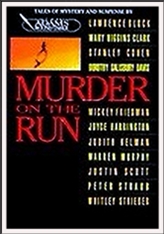
GLORIA WHITE – Murder on the Run. PI Ronnie Ventura #1. Dell, paperback original; 1st printing, July 1991.

GLORIA WHITE Ronnie Ventana

   According to page one,Ronnie Ventura is the half-Mexican daughter of a pair of jewel thieves, Somehow she is now a PI, According to the short bio at the end of the book, this is Gloria White’s first novel. Of these two statements, the first one is more than a little unusual, but it’s actually the second one that’s hard to believe. This is a good book, and if I had any say in the matter (which I don’t), I think it could easily be nominated for Best First Novel in anybody’s league.

   It begins like this. Ronnie is out running near Golden Gate Bridge one morning, when she spots two men struggling, One pushes the other into he water, and  once she has been seen, she is pursued by the one who did the pushing, Luckily she gets away,

   Two problems arise immediately: (1) the body is not discovered right away, and (2) she has recognized the person who did the dumping as Pete August, a PI who once worked for the D.A.’s office, and who also has worked for the police department – in other words, he’s a fair-headed, high profile boy with all his former connections still in intact.

   Snubbed by the police, Ronnie keeps working. More deaths follow, but she soon manages to get a homicide detective names Philly Post interested. This is a lady who doesn’t give up, and the story has both ginger and snap.

   There is even an unexpected twist ahead. The only problem is the ending, It’s too predictable. A little too obvious. I saw it coming, One good twist deserves another as the saying goes, and I didn’t get one.

   Don’t get me wrong. This book is as good as any of the other female PI novels I’ve read in recent months, and some of them were as good as those by men, (A number of them have been even better.)

— Reprinted from Mystery*File 33, September 1991.

LOREN D. ESTLEMAN “State of Grace.” PI Ralph Poteet #1. . First published in An Eye for Justice: The Third Private Eye Writers of America Anthology, edited by Robert J. Randisi (Mysterious Press, hardcover, 1988). Collected in Match Me Sidney!, (No Exit Press, 1989), and in People Who Kill, (Mystery Scene Press, 1993). Reprinted in Under the Gun, edited by Ed Gorman, Robert J. Randisi & Martin H. Greenberg, (NAL, 1990_ and in Murder Most Divine ed. Ralph McInerny & Martin H. Greenberg (Cumberland House, 2000).

   Comical PI’s are not common, fictional or otherwise, but you can add Ralph Poteet to the short list that (someone else) has been busy putting together over the years. You can tell about the funny business in it first of all by the name of the detective. Now I suppose the name Ralph Poteet is common enough is some parts of the country – Detroit, for example? – but  in sturdier country, such as New England, for example, just reading the name is bound to give us folk a serious case of the giggles.

   Not that the comedy in this tale is likely to do more thay. Mr Estlemna, as its author was wise to make the humor in it quieter and more subtle than that, but I think that he had fun writing it. It begins with the hooker who lives in the apartment above him calling him to tell him that she has a dead priest in her bed. Dead. Heart attack? Maybe. What she wants is for him to get rid of him.

   Ralph is the kind of guy who thinks well of himself, but when it comes down to it, he’s a sleazy kind of fellow, and he takes the job. The first person he calls is a bishop named Stoneman, who is ready and willing to help. When he comes back, well I won’t say exactly, but it’s a close call.

   The story goes on from there, and if you haven’t been able to tell, I recommend this one to you highly. It shouldn’t be too difficult to find, if I’ve intrigued you enough.


The Ralph Poteet series —

       Short stories:

“State of Grace” (1988, An Eye For Justice)
“A Hatful of Ralph” (2003, Flesh and Blood: Guilty as Sin)

        Novels:

Peeper. (Bantam, 1989.)

AMELIA REYNOLDS LONG – Murder to Type. Phoenix Press, hardcover, 1943.

   Blood type, that is. A blackmailer is given the wrong type of blood during an emergency transfusion in a doctor’s office. (The doctor is among those being blackmailed, and so is his female ward.)

   Lawyer Stephen Carter. brother of the D.A., does the detective work. While he has a light-hearted view of the world, Long takes the whole affair very seriously. Midst the flutter and clutter, though, who really cares?

— Reprinted from Mystery.File.3, February 1988.

LIA MATERA. “Dead Drunk.” Laura Di Palma. First published in Guilty As Charged, edited by Scott Turow ( Pocket, paperback, 1996). First collected in Counsel for the Defense and Other Stories, Five Star, hardcover, 2000). Reprinted in Year’s 25 Finest Crime and Mystery Stories: Sixth Annual Edition edited by  Joan Hess, Ed Gorman & Martin H. Greenberg (Carroll & Graf, 1997); in Shamus Winners, Volume II: 1996-2009, edited by Robert J. Randisi (Perfect Crime Books, softcover, 2010; and in A Century of Noir, edited by Mickey Spillane & Max Allan Collins, New American Library, 2002). Winner of the  PWA Shamus Award for Best Short Story, 1997.

   There is a small problem with the credentials for this story, not really a serious one, unless you would to argue more about it than I do. Laura Di Palma, the protagonist in this tale is a lawyer, not a PI, but the PWA decided that the job she does in it is close enough to qualify. (See the fact that it won a Shamus Award for that year;s Best Story.)

   She is, in fact, hired by a client who fears that he is sbout to be arrested for the deaths of a number of homeless men. There has been a sequence of four of them, all found frozen to death in the park after having been doused with water while asleep there on very cold nights.

   Since she hasn’t made enough money to pay the PI who works for her, she has to do all of the legwork on her own. It’s not a long story, and the story has all the credentials for it to be considered as a well better than average tale (see above), which it is, but I have a quibble anyway. I think her finding the killer is more a lucky accident on her part than by doing any significant amount of any real detective work — not that clues and deduction are necessary in a PI story, I have to admit.

   And Lia Matera is a good writer. I think you may gobble this story down in no time flat anyway. As I did.

ROBERT MARTIN – She, Me and Murder. Jim Bennett #12. Curtis, paperback original, 1962. Expanded version of the story that appeared in Dime Detective Magazine, November 1948.

   Jim Bennett, who may have been Cleveland’s first fictional private eye, is hired by an elderly man who has befriended a young stage actress, When her current boy friend is killed, there are only three possible suspects.

   As opposed to the prose of an Ed McBain, for example, which scorches and sings, Martin’ is – at first – plain, dowdy, and chaste. The pace picks up, however, when Bennett’s secretary/fiancee is kidnapped, and the triple-switch at the ending is a doozy.

— Reprinted from Mystery.File.3, February 1988.


A 1001 MIDNIGHTS Review
by Bill Pronzini


WILLIAM GOLDMAN – Marathon Man. Delacorte, hardcover, 1974. Dell, paperback, 1975. Other reprint editions include: Random House, softcover, 2001.

   William Goldman, the well-known novelist and screenwriter (Butch Cassidy and the Sundance Kid), achieved his first major commercial fiction success with Marathon Man. The first half of the novel is some of the finest suspense writing committed to paper during the past three decades. Goldman weaves a complex plot involving a young budding intellectual/historian/student/marathon runner named Babe Levy, a superspy named Scylla, and Nazi war criminals on the loose in New York City. The characterization is excellent, the story line taut and fast-moving, and there are a couple of unexpected twists.

   The last half of the book, however, might have been written by someone else, because the plot and everything else falls apart. The characters suddenly begin to think and act implausibly, there are several bizarre and unbelievable progressions, and the climax on the Jewish-controlled Diamond Exchange along Forty-seventh Street is unsatisfactory and filled with gratuitous and glorified violence.

   Goldman never seems able to make up his mind whether he wants to be funny or deadly serious; the fluctuation works surprisingly well in the first half and not at all in the second. (There is one nicely handled scene in the last half. a chilling interrogation by torture, simple and bloodless, that involves the use of a dental drill. This scene was likewise one of the highlights of the 1975 film of the same title, starring Dustin Hoffman.)

   All in all, a potentially classic novel in the suspense field, weakened and made distasteful through mishandling of its material.

   Goldman’s other suspense novels include No Way to Treat a Lady (1964; originally published as a paperback original under the pseudonym Harry Longbaugh) and Magic (1976).

———
   Reprinted with permission from 1001 Midnights, edited by Bill Pronzini & Marcia Muller and published by The Battered Silicon Dispatch Box, 2007.   Copyright © 1986, 2007 by the Pronzini-Muller Family Trust.

FREDERICK NEBEL “Murder à la Carte.” PI Jack Cardigan. First published in Dime Detective Magazine. 15 November 1933. Collected in The Adventures of Cardigan. (Mysterious Press, softcover, 1988), and in The Complete Casebook of Cardigan, Volume 2: 1933 (Steeger Properties, softcover, 2012).

   Cardigan’s main source of work comes from the Cosmos Agency, but he’s hired on his own by a baseball pitcher and a good friend in this one. The fellow was picked up in bar by a lady of some disrepute and after a few drinks they head off to her place in a cab. He doesn’t remember much after that, or so he tells Cardigan.

   He also doesn’t remember signing a check for the lady, a sizable one, but he thinks he might have. This presents a problem on two fronts. He’s married,for one,  and for two,  the World Series is coming up. With him pitching that’s almost a sure two wins for his team. Otherwise, they wouldn’t stand much of a chance. One more problem, and it’s a doozy: when Cardigan finds the lady’s apartment, he finds her dead.

   Nebel’s prose has a smooth, crisp flow to it, and the chase for the two guys Cardigan’s client vaguely remembers being in the girl’s room is a good one. Until, that is, there is a development in the tale that takes the case to a quick ending. Maybe, I thought, just a little too quick. It’s a weak transition point, and it’s far from a fatal one. Maybe it was just me, and maybe I should better just keep my mouth shut.

   Overall it’s a good story. Neither Nebel nor Cardigan are remembered today. Neither is up to Hammett or Chandler’s standards, but on the other hand, nobody else is, either.

DOCKS OF NEW ORLEANS. Monogram Pictures, 1948. Roland Winters (Charlie Chan), Virginia Dale, Mantan Moreland, John Gallaudet, Victor Sen Yung. Based on charcaters created by Earl Derr Biggers. Director: Derwin Abrahams.

   A chemical manufacturer hires Charlie Chan to help investigate the trouble he’s gotten into after agreeing to handle a mysterious overseas assignment, then dies under strange circumstances before their appointment the next morning.

   The is some semblance of a locked room mystery here, but I don’t think it occurred to anybody involved. Happy to say, I figured out who the killer was and how he did it, even before Charlie’s number two son starts up rousing rendition of “Chop Chop Boogie.”

— Reprinted from Movie.File.2, April 1988.

IF SCIENCE FICTION. December 1967. Cover art: Douglas Chaffee. Editor: Frederik Pohl. Overall rating: **½.

JAMES WHITE “All Judgment Fled.: Serial, part 1 of 3. See report following my review of the February 1968 issue.

JAY KAY KLEIN “On Conquered Earth.” Another story of unsuspecting aliens being outsmarted by dumb Earthlings. (2)

FRITZ LEIBER “Answering Service.” An old woman who says she is dying of a heart attack needs help. (4)

C. C. MacAPP “When Sea Is Born Again.” Novelette. Life on an alien world, well-pictured, complicated by the forces of an unknown sea and by visitors from space. (3)

TERRY CARR “City of Yesterday.” The control of humans by machines reaches its final stages, (4)

ROBERT E. MARGROFF & ANDREW OFFUTT “Swordsmen of the Stars,” Novelette. A typical story of mercenary swordsmen hired to fight each other to decide quarrels between rulers of worlds. (2)

ROGER DEELEY “The Time Travellers.” Napoleon revisited. (3)

HAL CLEMENT “Ocean on Top.” Serial, part 3 of 3. See report to be posted soon here.

— May 1969.

Next Page »