Pulp Fiction


A 1001 MIDNIGHTS Review
by Bill Pronzini


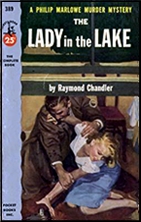
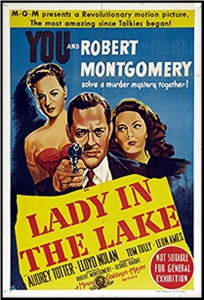
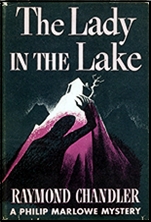
RAYMOND CHANDLER – The Lady in the Lake. Alfred A. Knopf, hardcover, 1943. Pocket #389, paperback; 1st printing, September 1946.  Film: MGM, 1946, as Lady in the Lake (with Robert Montgomery as Philip Marlowe).

   Even though The Lady in the Lake is not Chandler’s best novel. it is this reviewer’s favorite. It too was “cannibalized” from three pulp novelettes: “Bay City Blues·” (Dime Detective, November 1937), “The Lady in the Lake” (Dime Detective, January 1939), “No Crime in the Mountains” (Detective Story, September 1941), but it is not as seamless as The Big Sleep or Farewell, My Lovely, nor as wholly credible. Nevertheless. there is an intangible quality about it, a kind of terrible and perfect inevitability that combines with such tangibles as Chandler’s usual fascinating assortment of characters and some unforgettable moments to make it extra satisfying.

   The novel opens with Marlowe hired by Derace Kjngsley, a foppish perfume company executive, to find his missing wife. Crystal (who he admits he hates and who may or may not have run off with one of his “friends,” Chris Lavery). Marlowe follows a tortuous and deadly trail that leads him from L.A. to the beach community of Bay City, to Little Fawn Lake high in the San Bernardino Mountains, to the towns of Puma Point and San Bernardino, and back to to L.A. and Bay City. And it involves him with a doctor named Almore, a tough cop named Degarmo, a half-crippled mountain caretaker, Bill Chess, whose wife is also missing, Kingsley’s secretary, Miss Adrienne Fromsett and the lady in the lake, among other victims.

   As the dust jacket or the original edition puts it, it is “a most extraordinary case, because … Marlowe understands that what is important is not a clue – not the neatly stacked dishes, not the strange telegram … but rather the character of [Crystal Kingsley]. When he began to find out what she was like, he took his initial steps into a world of evil, and only then did the idea of what she might have done and what might have been done to her take shape. So it was that not one crime but several were revealed, and a whole series of doors that hid cruel things were suddenly opened.

   “Again Chandler proves that he is one of the most brilliant craftsmen in the field, and that his Marlowe is one of the great detectives in fiction.”

   Amen.

   The Lady in the Lake was filmed in 1946. with Robert Montgomery (who also directed) as Marlowe. For its time, it was a radical experiment in film-making, in that it is entirely photographed as if through the eyes of Marlowe — a sort of cinematic version of the first-person narrator, with Montgomery himself never seen except in an occasional mirror reflection. The technique doesn’t quite work – it, not the story, becomes the focus of attention – but the film is an oddity worth seeing.

         ———
   Reprinted with permission from 1001 Midnights, edited by Bill Pronzini & Marcia Muller and published by The Battered Silicon Dispatch Box, 2007.   Copyright © 1986, 2007 by the Pronzini-Muller Family Trust.


FIRST YOU READ, THEN YOU WRITE
by Francis M. Nevins


   A few weeks ago I received an email from bookseller Lynn Munroe, asking me a question about the uncollected short stories of Cornell Woolrich. The result was that I got interested in how many uncollected stories there were and how many might be worth collecting. It will take more than one column to explore these questions but let’s start here.

***
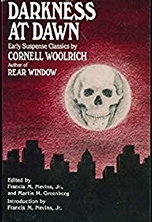
   For the first two years in which Woolrich published crime-suspense stories, the number of uncollected tales is zero. Why? Because I brought together all three of the tales that first came out in 1934 and all ten of those that appeared in ‘35 in the collection DARKNESS AT DAWN (1985). Woolrich’s output grew exponentially in 1936: a total of 26 crime stories, earning him a total of $4,300, which was a respectable annual salary back then.

   Some of them—for example “The Night Reveals” (Story, April 1936), “Johnny on the Spot” (Detective Fiction Weekly, May 2, 1936), “The Night I Died” (from the same magazine’s August 8 issue) and “You Pays Your Nickel” (Argosy, August 22, 1936), which is usually reprinted as “Subway”—rank among his most powerful short stories. Others from that year—including, I fear, most of the dozen that remain uncollected—are pretty terrible.

   The year kicked off with one of the worst tales he ever perpetrated; perhaps the worst of his career. The mild success of the Popular Publications pulp chain with weird-menace magazines like Dime Mystery inspired rival entrepreneur Ned Pines of Thrilling Publications to launch a competing monthly called Thrilling Mystery, which debuted in October 1935 under editorial director Leo Margulies (1900-1975).

   During its 50 issues the magazine offered a parade of strange cults, diabolic rituals, gruesome murders, sadistic villains, slavering beasts and (of course) beautiful young women shivering in peril. Woolrich dipped his toes into these weird waters just once. Like the 1935 classic “Dark Melody of Madness” (better known as “Papa Benjamin”) and the 1937 classic “Graves for the Living,” “Baal’s Daughter” (Thrilling Mystery, January 1936) is about hapless innocents falling into the clutches of repulsive religions.
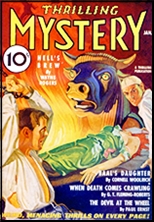
   But this version of the story is so sloppily and luridly written, so overloaded with stupid inconsistencies and grotesque twaddle, that to claw one’s way through its pages is an act of masochism. Narrator Bob Collins visits his psychiatrist friend Dr. Dessaw to ask for help in freeing his fiancée Gloria’s dotty aunt from a Westchester cult.

   As Woolrich Coincidence would have it, the head of the cult is Dessaw, who drugs Bob and spirits him to the religion’s headquarters mansion on the banks of the Hudson, where in rapid order our hero is stripped to his shorts, flogged by a tongueless black giant, menaced by a man-eating panther, tortured with boiling oil injected into his veins, forced to kneel before a woman calling herself the reincarnated goddess Ishtar, forced to help lure Gloria to the mansion for ritual sex with with the god Baal who of course is Dr. Dessaw, and so on and on long past our endurance.

   The narrative throbs with clunkers like “The fiend on the throne stood up and turned to me as I quivered there, ashen-faced” and “I was prone there, at the mercy of the he-devil and the she-devil….” How desperate must Woolrich have been to have cranked out this garbage?

***

   Of the dozen uncollected Woolrich stories from 1936, Detective Fiction Weekly was the original home of seven, including two that might well deserve collection. Not, though, the first pair we consider here. “Blood in Your Eye” from the March 21 issue is an insanely bad cop story set in an anonymous city on which Woolrich sticks the label Los Angeles.

   Mitchell, a rambunctious young homicide dick, is the only one who sees the truth when a murder victim is found in a rooming house with the image of his killer apparently imprinted on his eyes. Instead of sharing his insight, Mitchell throws down his badge in disgust at his colleagues’ willingness to believe medieval superstition and goes out to solve the crime lone-wolf style.

   The hunt takes him to two venues that Woolrich was to use over and over, a manicurist’s booth and a dance hall. For this one you have to accept that neither a roomful of cops nor the medical examiner can tell the difference between genuine and glass eyes, but the climax is violent and the central gimmick Guignol-gruesome.

   Just two weeks later, in the magazine’s April 4 issue, came “The Mystery of the Blue Spot,” which Woolrich submitted as “Death in Three-Quarter Time.” In a lifetime of reading whodunits I’ve never come across an alibi gimmick as wacko as this one. Homicide cop Dennis Small happens to be in the Curfew Club on the night when the specialty dancer Emilio is shot to death in his dressing room just a few minutes after he and his partner Lolita have finished performing a bizarre new number.
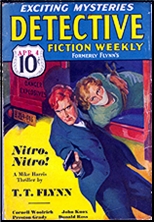
   All the evidence points to chorus line dancer Mary Jackson, for whom Emilio was about to dump Lolita. This tale too is never likely to be reprinted or collected so I might as well give away the solution: Lolita herself killed Emilio before the dance, then rigged herself in a crazy costume and went out into the spotlight and convinced a clubful of people that she was both herself and her partner! The story becomes interesting only in the final scenes when Woolrich makes us empathize with her for two crucial noir reasons: she had lost her love and she’s about to die.
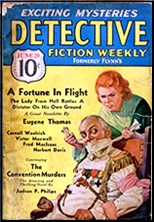
   For the next uncollected story we jump into the summer months. “Nine Lives” from the June 20 number is set in the waterfront district around New York’s South Street. Demon newshawk Wheeler stumbles onto the story of an old bum who’s been treated by three sinister strangers to booze, food, clothes, and to an insurance policy on his life. The best scene finds Wheeler bound, gagged and left for dead at the bottom of an old-fashioned bathtub filling with water, but even in this serial-like incident there’s nothing terribly urgent.

   Later that summer, in the August 15 issue, came “Murder on My Mind,” the earliest appearance in Woolrich and perhaps the earliest in crime fiction of a plotline which was a staple of film noir classics like SO DARK THE NIGHT (1946, directed by Joseph H. Lewis) but ultimately goes back to the Greek tragedy OEDIPUS TYRANNUS.
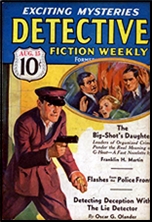
   Marquis, the detective narrator, is assigned with his partner Beecher to the brutal murder of a harmless cigar-store clerk, but as the investigation goes forward, countless tiny details push Marquis and the reader closer and closer to becoming convinced that the murderer is Marquis himself.

   This tale has never been reprinted or collected as it first appeared but a heavily revised and less crudely written version was included as “Morning After Murder” in the paperback collection BLUEBEARD’S SEVENTH WIFE (Popular Library pb #473, 1952, as by William Irish).

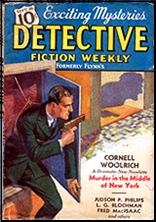
   The trademark Woolrich combination of breathless urgency and plot flubs permeates the long story which he submitted as “Right in the Middle of New York,” but it’s so packed with action and tension that one barely notices that nothing in it makes sense, not even the published title, since no murder is committed at all in “Murder in the Middle of New York” from the September 26 issue.

   Tony Shugrue, a relatively honest protégé of mobster Chuck Morgan, is set up by his mentor with phony references and gets hired by wealthy Cole Harrison as chauffeur for his beautiful and spoiled daughter Evelyn. Unaware that he’s married, Evelyn makes several passes at her driver, and for a while we’re reminded of the romance between another flighty heiress and her chauffeur in Woolrich’s 1927 pre-crime novel CHILDREN OF THE RITZ.

   Finally Tony realizes that Morgan plans to kidnap Evelyn, hold her for ransom, kill her and leave him to take the fall. From this point on the story morphs into a wild roller-coaster ride crammed with thrills, anguish and suspense as Tony fights to save himself and his wife and Evelyn from the gang. Some of the dialogue creaks—“‘Rats!” he hissed viciously through his teeth. ‘Lower than rats, even!’”—and the crucial scene requires Tony literally not to recognize his wife at close quarters.

   But the irresistible Woolrich urgency sweeps away all nitpicking into the ash heap and suggests that this one of the uncollected dozen may deserve being revived.

   I feel the same way about “Afternoon of a Phony” from the November 14 issue—so much so that it was reprinted in Alfred Hitchcock’s Mystery Magazine (June 2012) at my recommendation and with a new introduction by me.

   The story is something of a departure for Woolrich, a charming, clever and bizarre whodunit where the detective role is played by a con man. Clip Rogers steps off the train at the Jersey seaside resort of Wildmore and is instantly mistaken by the brainless local cops for Griswold, the supersleuth from Trenton, whom they’d sent for to help solve the bludgeon murder of a woman in one of the town’s vacation hotels.

   What complicates the case beyond the local yokels’ power to unravel is that the woman’s eight-year-old son, who witnessed the crime in the middle of the night but is too young to understand its meaning, has identified as the murderer a man with a perfect alibi. Rogers exposes the real killer rather neatly, but the story becomes distinctively a Woolrich tale only afterward when, as in “The Mystery of the Blue Spot,” a criminal motivated by lost love takes center stage and, for a page or two, becomes a deeply sympathetic character. His comment that the impostor Rogers is more humane than any cop he’d ever met is evidence that when Woolrich drew genuine cops as brutal thugs he wasn’t doing it inadvertently.
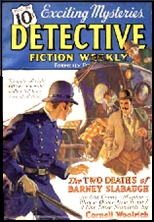
   His final 1936 appearance in Detective Fiction Weekly was one of his weakest, but for anyone with a little knowledge of law, it’s a coffee-out-the-nose classic. The year’s last issue, dated December 26, included “The Two Deaths of Barney Slabaugh,” in which Woolrich dusted off his favorite James M. Cain plot twist, backdated it forty years, and threw in so much of the tinny insult humor and gangster stereotypes from the current James Cagney movies that the illusion we’re in the New York of the 1890s isn’t sustained for a microsecond.

   Manhattan racket boss Emerald Eddie Danberry is persuaded by his shyster lawyer Horace Lipscomb that the proper way to kill rival mobster Barney Slabaugh is to take the man prisoner, frame himself for Barney’s murder beforehand, and get himself acquitted in court. Then, Lipscomb explains—foreshadowing an infamous recent comment by Donald Trump?—even if Danberry were to murder him in full view of a thousand people he could never be prosecuted for it.

   Danberry asks for the name of this marvelous rule of law. Lipscomb replies: Why, it’s the Statute of Limitations! (Cue the coffee.) Fighting DA Barry McCoy, one of the city’s few uncorrupt officials, tries to snooker the plot, and fate works another Cain trick to help him out in this super-pulpy tale, which is full of police brutality, casual racism and enough Woolrich-style wisecracks to sink an aircraft carrier.

***

   So much for eight out of the dozen, and quite enough for one column. I’ll finish the tabulation next month. With perhaps a bonus thrown in to boot.
  ARTHUR LEO ZAGAT “Crawling Madness.” Novelette. First published in Terror Tales, March 1935. Reprinted in Zombies! Zombies! Zombies!, edited by Otto Penzler (Black Lizard, softcover, 2011) and in Famous Fantastic Mysteries, Fall 2016, edited by Matt Moring (Altus Press, softcover).

   Ann and Bob Travers are newlyweds who are heading for Bob’s new job located somewhere out west. He has a new formula for extracting gold from otherwise tapped out mines, and he’s anxious to try it and find out how well it works. Driving along in their car, they are sideswiped off the road by a truck filled with crazed, terrified miners speeding madly off in the opposite direction.

   Their car is wrecked, and Bob’s ankle is broken. What is she to do? Luckily the mine is only a short distance away. It can’t be totally deserted, can it? Well, no, not exactly. Nearing the mine, she is confronted on all side by creeping emaciated men, crawling on their stomachs closer and closer…

   Thus begins “Crawling Madness,” a story that once started, just doesn’t stop. A stranger who claims to be the foreman frightens off Ann’s attackers, but there is something about his Satanic visage that she just doesn’t trust. It’s then a cat and mouse game all the way, in shelter and out, in the mine and out, then trapped in one of the furthermost caverns, always with the threat of unspeakable horror from the monstrously disfigured creatures lurking just beyond the only small sources of light she has.

   The clammy shuddersome feel of the thing upon which Ann’s hand had fallen shocked her back to reason. To reason and the flooding horror of her search. She shoved up on extended arms, arching her back; she looked dazedly about her.

   Madness pulsed in her once more as she stared at which the crawlers had left — at tattered, gnawed flesh; at a torso from whose ribs meat hung in frayed strips; at a skull that had been scraped quite clean so that the grinning bone glowed brightly in the lunar rays. And everywhere on the pitiful remains that once had been human were the marks of teeth, of human teeth!

   This is the stuff of nightmares, no doubt about it, but of course it ends happily, with an explanation that actually works (I think), and most surprisingly at the very end, the equivalent of a PSA about the need for more safety regulations in mines all across the country.


CORNELL WOOLRICH “Crime on St. Catherine Street.” Novelette. First published in Argosy 25 January 1936; reprinted as “All It Takes Is Brains” in Ellery Queen’s Mystery Magazine, December 1966. Woolrich’s original title: “Murder on St. Catherine Street.”

   Woolrich was the kind of writer that could start with the screwiest kind of idea, get his protagonist to go along with it, and make the reader swallow it down whole, enjoying the whole rest of the story without hesitation and with no holds barred.

   Case in point. On a drunken whim, a man named Hewitt, one of Manhattan’s idle rich, agrees to a wager that he can go to a strange town — Montreal, say — with only six bits in his pocket, and manage to survive for a whole week without knowing a single soul. Which he manages to do, of course, and in fact he comes out ahead by several thousand dollars, not including the money he wins on the bet.

   It all begins with him picking up a girl as he starts the first night of his stay, or rather, as it turns out, she thinks she’s picking him up. But when she quarrels with his boy friend and accomplice in crime, a man known only as Louie, she ends up dead and Hewitt ends up on run from the law, with only a salt shaker in his pocket that he can use to pretend he has a gun.

   Coincidences always played large roles in any story that Cornell Woolrich wrote, and this one is no exception. But this is no tale of gloom and doom. In spite of all the odds against him, Hewitt maintains an upbeat attitude throughout, making this a lot of fun to read.

SELECTED BY DAVID VINEYARD:


H. BEDFORD-JONES “The Case of the Kidnaped (sic) Duchess.” Novelette. John Solomon. First published in Argosy, 05 January 1935.

   â€œThe worst kind of a job sir. One that you and me might swing together and ’elp out the most beautiful woman in Europe, Mr. Carson. But it’s a werry dangerous business, sir. That ’ere Duchess o’ Furstein is in a werry bad ’ole and if we give ’er a ’and it means risking our necks.”

   That’s the voice of John Solomon, ship’s chandler, mysterious millionaire, operator of one of the best private espionage operations in the World, the short, stout (think Edmund Gwenn as Santa but minus the beard) Cockney adventurer who first appeared under the by-line Allan Hawkwood, but who, by 1935, was appearing under Bedford-Jones’ own name and commanding the cover of Argosy with the little Cockney’s adventurers.

   This one is a mystery novelette that begins in foggy London where engineer Carson, an American, and one of a long line of engineers, grocers, doctors, and the like to act as assistant to Solomon’s myriad schemes in all ports of call, has received an urgent message to join him before they sail that night for Europe to assist the Duchess o’ Furstein.

   If this sounds all very Holmesian, keep in mind Bedford-Jones also wrote a Holmes pastiche so successfully it passed for a lost Conan Doyle story among some scholars.

   But our guide here is Solomon, not Holmes, though he is just as high-handed, clever, and dangerous to know as the Baker Street sleuth, if less cerebral and more given to flashing guns.

   Carson has hardly arrived at the tobacconists where he’s been summoned when Solomon rushes by, drops a wallet, which he commands Carson to hide, and seconds later is in the hands of a constable accused of picking the pocket of a ’toff, soon to have Carson “up to his neck in emeralds, Sicilian palaces…” as the wallet belongs to Sir Basil Lohancs, who has already kidnapped the duchess, and is delivering her to London on his yacht that werry, I mean very, evening.

   Baghdad on the Thames was never more so. Heady stuff in the pulp era.

   The Duchess has been using her wealth, estates, and is threatening to use her fabulous emeralds, to continue social work in Palermo. Lohanc’s can’t have that. The result as Solomon says is that the Duchess is in “a werry bad fix, as the old gent said when ’e buried ’is third wife.” Lohanc is a bad one “Money, brains and nor scruples whatever, sir. What ’e goes after ’e gets, that’s ’is boast,”and later, “Murder don’t mean nothing to ’im.”

   Scotland Yard and the French police have been fooled, and now the Duchess’s only hope is Solomon and Carson, boarding a yacht full of kidnappers and potential murderers to make a rescue on the fog bound docks with the information her loyal Sicilian maid died getting to them. Without getting all Sax Rohmer on us, Bedford-Jones evokes Limehouse and its environs and a sense of romance built out of the reality and not vague menace and shadows. His Limehouse is that of Thomas Burke and Arthur Morrison.

   Solomon gives Carson an automatic and instructions to get on the yacht while it works its way up the Thames to London, an impossible job. “There ain’t nothing impossible, sir, if so be you ’as a ’ead,” Solomon advises and he proves right, Carson getting on board and making contact with the Countess. Now what ever happens depends on Solomon and his plans, and as always Solomon’s plans are played close to the vest, Carson is captured and drugged by Lohanc and Dr. Vecchhi the murderous doctor in his pay.

   Meanwhile the usual close calls, disasters, and last minute rescues follow until the last possible moment when Solomon plays his last card, the love of a Sicilian whose wife died to protect her mistress.

   If it strikes you that with a little bit of tweaking here and there, this might well be the outline for a thriller by John Buchan, or later Victor Canning, you aren’t far off.

   It’s no great mystery, but as action adventure goes, it’s splendidly told, replete with villains who deserve their just rewards, noble heroes and heroines, and always, the presence of John Solomon, one of the great captains of pulp fiction, part adventurer, part avenger, and always righter of wrongs, cherry cheeked and wispy haired man about adventure. There is nothing quite like him or his kin in most modern fiction today.

   For anyone interested you can download or read this at Internet Archive under their Pulp Collection. The issue also includes a dog story by Albert Peyson Terhune and serial chapters by F. Van Wyck Mason, Theodore Roscoe, and Fred MacIsaac, a pretty good issue.

J. LANE LINKLATER “Mystery of the Mexicali Murders.” PI Alan Rake. First published in 10-Story Detective, January 1941. Reprinted in The Noir Mystery Megapack (Wildside Press, Kindle edition, 2016).

   Although the author of several hundred stories for the pulp fiction magazines, J. Lane Linklater, the pen name of Alexander William Watkins (1892-1971), certainly qualifies as an unknown author today.

   He did write seven hardcover mystery novels, all with a private eye character named Silas Booth. I’ve always meant to read one, but for some fault of my own, I never have.

   One series he wrote for Detective Fiction Weekly had lawyer Hugo Oakes as the leading character, and Monte Herridge wrote about him earlier on this blog here.

   He had few other recurring characters in the stories he wrote for the pulp magazines, but as far as I know, “Mystery of the Mexicali Murders” is the only appearance of private eye Alan Drake, a fellow who reminds me a bit about a fellow who Dashiell Hammett often wrote about.

   Here is the first paragraph of the story:

   The small plane from the north circled and came down. It had one passenger, an undersized, stocky man in whose volatile, fleshy face was explosive energy. His perspiring cheeks glistened in the light from the airport office as he walked toward it. He carried one very battered handbag. Billions of stars glared down at him from the sky over the great Imperial Desert.

   This is, of course, Alan Rake. He is here in the area along the border between California and Mexico after receiving an urgent telegram from the head of a big fruit shipping outfit, but when the man is shot dead in front of him when he first meets him, he decides to stay on the case and see if there’s some way he can still get paid the $5000 that was promised him.

   The case is a complicated one, with lots of suspects and a setting that is over 100 degrees during the day and not much better at night. One girl in particular, a young spitfire with flashing eyes named Edna, catches his attention.

   But more than the characters, and who it was who killed Warnbecker, takes second place to the setting, a cantaloupe-growing area that Linklater must have known well to describe it in as much depth as he does, including its vast underbelly of criminal activity. Rake mixes in well, seeing and observing, and quite remarkably, thinking too.

   Linklater was no Hammett — I should make that totally clear — but a better editor could have helped make the ending a lot tighter, and if so, this might be the small gem of a story that it almost is.

CARROLL JOHN DALY “The Egyptian Lure.” Novelette. Race Williams #18. First published in Black Mask, March 1928. Reprinted in The Snarl of the Beast: The Collected Hard-Boiled Stories of Race Williams, Volume 2 (Altus Press, 2016).

   Race Williams doesn’t call himself a Private Eye. He’d rather be thought of as a Confidential Agent, and in fact that’s what it says in the lettering clients see on his office door. By the time this story appeared, Williams was already a long-time fixture at Black Mask magazine. Readers had been enjoying — and heartily approving — his adventures since the first June issue of 1923.

   In “The Egyptian Lane” he’s, well, lured to the dive / strip joint of the same name by an envelope stuffed with money, with no name attached to the brief note accompanying it. It’s a tawdry joint — the owner of the joint is a Greek by the name of Nick — and it takes Williams a short while to track down the beautiful dancing girl who once lived in a convent but who is now his new client.

   He takes her under his wing, but thanks to a clever ruse of the men who are after her, he loses her again. Calling himself a dunderhead, there’s no way in hell the thugs who’ve abducted her can escape his wrath. Nor do they! The hunt the follows, urged on by his anger and consuming desire for vengeance, is what readers of Black Mask were waiting for, and that’s exactly what they got.

   And so did I. Race Williams is correct is not thinking of himself as any kind of “detective.” His methods are crude but effective, and a gun is his constant companion. The story is well told, the settings (from the dirty streets of Manhattan to the barren wastes of New Jersey) are well described, and the pace? It never lets up.

VINCENT STARRETT “The Taggart Assignment.” Short story. Jimmy Lavender #6. First published in Short Stories, 10 August 1922. Reprinted in The Detective Megapack: 28 Tales by Modern and Classic Authors (Wildside Press, Kindle edition, January 2016).

   Although a number of his Jimmy Lavender stories were collected in book form during Vincent Starrett’s lifetime, this doesn’t doesn’t seem to have been one of them, and I think there may have been a reason for it. Before getting into that, however, let me say first of all that the resemblance of the Lavender tales to Conan Doyle’s stories about Sherlock Holmes is unmistakable. (Starrett was a noted Sherlockian of his day.)

   Simply move the stories from London in the late 1800s to Chicago in he 1920s, swap Watson for a narrator-assistant named “Gilly” Gilruth, and there you have it. Even the story itself, that of a young woman whose fiancé has gone missing only days before their wedding, is reminiscent of one of Holmes’s own adventures, that being “A Case of Identity.”

   The about-to-be-jilted woman — or has something more serious happened to the missing man? — wishes no publicity, and Lavender agrees. The trail leads, by sheer coincidence (Lavender thinks not) to a another missing man, this one the circulation manager of a local newspaper.

   The story is lively and fun to read, with Gilly more actively involved that Watson was, but (and I hate to have to say thus) it’s seriously marred by a final conclusive clue that unfortunately means nothing to the reader and everything to Jimmy Lavender. I was somewhat mollified by a very striking last line, however.

POUL ANDERSON “Sargasso of Lost Starships.” Novella. Technic History #1. Planet Stories, January 1952. Collected in Rise of the Terran Empire (Baen, trade paperback, 2009). Reprinted as Sargasso of Lost Starships (Armchair Sci-Fi & Horror Double Novels #92, trade paperback, 2013), with The Ice Queen by Don Wilcox.

   The story opens thusly:

   Basil Donovan was drunk again.

   He sat near the open door of the Golden Planet, boots on the table, chair tilted back, one arm resting on the broad shoulder of Wocha, who sprawled on the floor beside him, the other hand clutching a tankard of ale. The tunic was open above his stained gray shirt, the battered cap was askew on his close-cropped blond hair, and his insignia–the stars of a captain and the silver leaves of an earl on Ansa–were tarnished. There was a deepening flush over his pale gaunt cheeks, and his eyes smoldered with an old rage.

   Looking out across the cobbled street, he could see one of the tall, half-timbered houses of Lanstead. It had somehow survived the space bombardment, though its neighbors were rubble, but the tile roof was clumsily patched and there was oiled paper across the broken plastic of the windows. An anachronism, looming over the great bulldozer which was clearing the wreckage next door. The workmen there were mostly Ansans, big men in ragged clothes, but a well-dressed Terran was bossing the job. Donovan cursed wearily and lifted his tankard again.

   Donovan had been a leader of the Ansan forces in their defeat at the hands of the Terran Empire. He is naturally bitter and is surprised to e taken by force to an interview with Commander Helena Jansky from Earth:

   “Sit down, Captain Donovan,” said the woman.

   He lowered himself to a chair, raking her with deliberately insolent eyes. She was young to be wearing a commander’s twin planets–young and trim and nice looking. Tall body, sturdy but graceful, well filled out in the blue uniform and red cloak; raven-black hair falling to her shoulders; strong blunt-fingered hands, one of them resting close to her sidearm. Her face was interesting, broad and cleanly molded, high cheekbones, wide full mouth, stubborn chin, snub nose, storm-gray eyes set far apart under heavy dark brows. A superior peasant type, he decided, and felt more at ease in the armor of his inbred haughtiness. He leaned back and crossed his legs.

   “I am Helena Jansky, in command of this vessel,” she said. Her voice was low and resonant, the note of strength in it. “I need you for a certain purpose. Why did you resist the Imperial summons?”

   It seems that Donovan is only of only a handful of people who have ventured into the Black Nebula and returned. Jansky needs him to guide her forces there on a return visit:

   Space burned and blazed with a million bitter-bright suns, keen cold unwinking flames strewn across the utter dark of space, flashing and flashing over the hollow gulf of the leagues and the years. The Milky Way foamed in curdled silver around that enormous night, a shining girdle jeweled with the constellations. Far and far away wheeled the mysterious green and blue-white of the other galaxies, sparks of a guttering fire with a reeling immensity between. Looking toward the bows, one saw the great star-clusters of Sagittari, the thronging host of suns burning and thundering at the heart of the Galaxy. And what have we done? thought Basil Donovan. What is man and all his proud achievements? Our home star is a dwarf on the lonely fringe of the Galaxy, out where the stars thin away toward the great emptiness. We’ve ranged maybe two hundred light-years from it in all directions and it’s thirty thousand to the Center! Night and mystery and nameless immensities around us, our day of glory the briefest flicker on the edge of nowhere, then oblivion forever–and we won’t be forgotten, because we’ll never have been noticed. The Black Nebula is only the least and outermost of the great clouds which thicken toward the Center and hide its ultimate heart from us, it is nothing even as we, and yet it holds a power older than the human race and a terror that may whelm it.

   He felt again the old quailing funk, fear crawled along his spine and will drained out of his soul. He wanted to run, escape, huddle under the sky of Ansa to hide from the naked blaze of the universe, live out his day and forget that he had seen the scornful face of God. But there was no turning back, not now, the ship was already outpacing light on her secondary drive and he was half a prisoner aboard. He squared his shoulders and walked away from the viewplate, back toward his cabin.

   Wocha was sprawled on a heap of blankets, covering the floor with his bulk. He was turning the brightly colored pages of a child’s picture book. “Boss,” he asked, “when do we kill ’em?”

   Things do not go well on the voyage. Strange voices and apparitions begin appearing to the entire crew, including Donovan:

   Donovan had not watched the Black Nebula grow over the days, swell to a monstrous thing that blotted out half the sky, lightlessness fringed with the cold glory of the stars. Now that the ship was entering its tenuous outer fringes, the heavens on either side were blurring and dimming, and the blackness yawned before. Even the densest nebula is a hard vacuum; but tons upon incredible tons of cosmic dust and gas, reaching planetary and interstellar distances on every hand, will blot out the sky. It was like rushing into an endless, bottomless hole, the ship was falling and falling into the pit of Hell.

   Eventually Donovan comes face to face with Valduma, an old nemesis slash alien lover from his previous voyage:

   Valduma stood beside Morzach for an instant, and Donovan watched her with the old sick wildness rising and clamoring in him.

   You are the fairest thing which ever was between the stars, you are ice and flame and living fury, stronger and weaker than man, cruel and sweet as a child a thousand years old, and I love you. But you are not human, Valduma.

   She was tall, and her grace was a lithe rippling flow, wind and fire and music made flesh, a burning glory of hair rushing past her black-caped shoulders, hands slim and beautiful, the strange clean-molded face white as polished ivory, the mouth red and laughing, the eyes long and oblique and gold-flecked green. When she spoke, it was like singing in Heaven and laughter in Hell. Donovan looked at her, not moving.

   “Basil, you came back to me?”

   The Terran forces lose control of their ship:

   The engines cut off and the ship snapped into normal matter state. Helena Jansky saw blood-red sunlight through the viewport. There was no time to sound the alarm before the ship crashed.

   “A hundred men. No more than a hundred men alive.”

   She [Helena] wrapped her cloak tight about her against the wind and stood looking across the camp. The streaming firelight touched her face with red, limning it against the utter dark of the night heavens, sheening faintly in the hair that blew wildly around her strong bitter countenance. Beyond, other fires danced and flickered in the gloom, men huddled around them while the cold seeped slowly to their bones. Here and there an injured human moaned.

   Across the ragged spine of bare black hills they could still see the molten glow of the wreck. When it hit, the atomic converters had run wild and begun devouring the hull. There had barely been time for the survivors to drag themselves and some of the cripples free, and to put the rocky barrier between them and the mounting radioactivity. During the slow red sunset, they had gathered wood, hewing with knives at the distorted scrub trees reaching above the shale and snow of the valley. Now they sat waiting out the night.

   Takahashi shuddered. “God, it’s cold!”

   A battle begins, one of groundshaking ferocity:

   The others were there with her, men of Drogobych standing on the heights and howling their fury. They had chains in their hands, and suddenly the air was thick with flying links.

   One of them smashed against Donovan and curled itself snake-like around his waist. He dropped his sword and tugged at the cold iron, feeling the breath strained out of him, cursing with the pain of it. Wocha reached down a hand and peeled the chain off, snapping it in two and hurling it back at the Arzunians. It whipped in the air, lashing itself across his face, and he bellowed.

   The men of Sol were weltering in a fight with the flying chains, beating them off, stamping the writhing lengths underfoot, yelling as the things cracked against their heads. “Forward!” cried Helena. “Charge–get out of here–forward, Empire!”

   The stronghold of the dying alien race is entered:

   The Terrans slogged on down the street, filthy with dust and grease and blood, uncouth shamblers, apes in the somber ruin of the gods. Donovan thought he had a glimpse of Valduma standing on a rooftop, the clean lithe fire of her, silken flame of her hair and the green unhuman eyes which had lighted in the dark at his side. She had been a living blaze, an unending trumpet and challenge, and when she broke with him it had been quick and dean, no soddenness of age and custom and–and, damn it, all the little things which made humanness.

   All right, Valduma. We’re monkeys. We’re noisy and self-important, compromisers and trimmers and petty cheats, we huddle away from the greatness we could have, our edifices are laid brick by brick with endless futile squabbling over each one–and yet, Valduma, there is something in man which you don’t have. There’s something by which these men have fought their way through everything you could loose on them, helping each other, going forward under a ridiculous rag of colored cloth and singing as they went.

   This is a prime example of a subcategory of science fiction that might be called “swords and spaceships.” The pages of Planet Stories were filled with this kind of tale, and no one did it better than Poul Anderson.

   PS. The cover illustration is perfectly correct. It must have helped hundreds of copies of the magazine on the newsstands, if not more.

PHILIP K. DICK “The Gun.” Short story. First published in Planet Stories, September 1952. First collected in Beyond Lies the Wub (Underwood Miller, hardcover, 1987; volume one of The Collected Stories of Philip K. Dick, sold only as a five-volume set.) Also collected in The King of the Elves (Subterranean Press, hardcover, 2011), among others.

   This appears to have been Philip K. Dick’s second published SF story, not including some he had published in a college newspaper. The first also appeared in Planet Stories, that being “Beyond Lies the Wub” in the July 1952 issue. “The Gun” is a minor story, admittedly, a fact reflected by noting that all of its later reprint appearances gave been in collections of his early work and never picked up for a major anthology of any import.

   In 1952 the quality of the stories in Planet Stories was beginning to pick up. Authors like Ray Bradbury and Leigh Brackett had been appearing all through the 40s, but authors such as Poul Anderson, Gordon R. Dickson and Eric Frank Russell were beginning to be added to the mix. (Anderson, for example, had a story in this same issue; see below. Also among his early work, but still a sign of significant improvement.)

   It is not clear whether the devastated planet is Earth or the crew of the spaceship that comes to investigate is from Earth (my sense was it was the latter), but an atomic war had left the planet covered with bare earth or uninhabitable slag. And yet the investigating ship is shot down without warning, from a gun they could not see.

   A veteran SF reader will know right away that the gun is acting on it own, a remnant of two sides fighting each other to the bitter end. They manage to disable to gun so they can safely take off, but a twist in the end suggests that they have made a serious error.

   What adds a bit of poignancy to the story is the discovery of a hidden horde of material hidden away for safekeeping by one of the two warring sides about their culture. It is this single factor that makes this short take stand out, if only in a small way, hinting that the author may have had a future ahead of him. Which of course he did.


      Other stories in this issue (thanks to ISFDb) —

4 • Evil Out of Onzar • novella by Mark Ganes
30 • Zero Data • novelette by Charles Saphro
46 • The Gun • short story by Philip K. Dick
54 • The Star Plunderer • [Technic History] • novelette by Poul Anderson
70 • Thompson’s Cat • short story by Robert Moore Williams
78 • Big Pill • short story by Raymond Z. Gallun
90 • The Slaves of Venus • novelette by James E. Gunn [as by Edwin James]

« Previous PageNext Page »