ERIC TAYLOR “Kali.” Short story. First published in All Star Detective Stories, November 1929. No cover image available. Reprinted in The First Mystery Megapack (Wildside Press, ebook, April 2011).
As a detective pulp, All Star Detective was not in top tier of those being published at the same time, but it did last for some 26 issues between October 1929 and June 1932. Most of the authors they published were unknowns even then, but the list does contain a few whose names are still recognizable today, such as Leslie Charteris, Erle Stanley Gardner, T. T. Flynn, and Johnston McCulley.
You can let me know if you disagree, but Eric Taylor, is not likely to be one of them. He did write several dozen stories for the detective pulps between 1927 and 1937. Even before that, he began his career with a handful of stories in 1926 for Droll Stories and others in that particular category. Starting in 1937 or so, he switched gears and began writing for Hollywood, churning out scripts for many of the Ellery Queen movies, plus the Crime Doctor and The Whistler films, Universal’s monster movies and so on. He died in 1952.
Margaret will not receive her inheritance if she marries without her aunt’s permission before she is 23, and the Bengali’s influence over the aunt means that that will never happen. Worse, strange things are going on the house, and Roy’s attempts to break in and learn what they might be always end in fierce battles — and sudden deaths — with a small cadde of loyal servants.
The writing is crude, true, but it also has a lot of momentum. Back in 1929, the secret that lives behind the barred door of the house would have been not only plausible but also something fearfully terrible. Not quite so much today — the title of the tale may give you a bit of a clue — but I have admit that the drive behind the tale is still there.
HUGH B. CAVE “The Late Mr. Smythe.” Short story. Peter Kane #1. First published in Dime Detective Magazine, August 1, 1934. Collected in Bottled in Blonde (Fedogan & Bremer, hardcover, 2000) and The Complete Cases of Peter Kane (Altus Press, 2018; introduction by Bob Byrne).
Private eyes in detective fiction are as often as not hard drinkers, and some of them are awfully good at it. But few of them are as good at it as was Peter Kane. There isn’t a single minute in “The Late Mr. Smythe” in which he isn’t totally sozzled. I can’t believe that anyone could go through life the same way he does, in three stages: drunk, drunker, and completely plastered.
A former member of the Boston police department, Kane nominally now works for the Beacon Detective Agency, but in “The Late Mr. Smythe,” he takes the death of a friend of his still on the force personally, and he works full time on this one on his own to bring the killer(s) to justice.
The first death is that of a blackmailer named Smiley Smythe, and when a cop named Hoban tries to bring his suspected killer in, a hoodlum named Joe DiVina, both men are killed by a torrent of machine gun fire from a car that comes speeding by.
Besides Kane, who spends a lot of time at a bar run by a fellow named Limpy, the other recurring characters are Moe Finch, the hapless chief of police, who continually begs for Kane’s assistance; and Kane’s nemesis still on the force, Lt. Moroni. It is always Kane’s pleasure to not only solve the case at hand, but to show up Moroni as well, and in the most dramatic way he can.
Hugh B. Cave is best known for his tales of horror and weird menace, but in this, the first of Peter Kane’s cases on record, he shows he could write very very good detective stories too. Surprisingly good, given Peter Kane’s way with either a glass or the bottle.
The Peter Kane series —
The Late Mr. Smythe. Dime Detective Magazine Aug 1 1934
Hell on Hume Street. Dime Detective Magazine Nov 1 1934
Bottled in Blonde. Dime Detective Magazine Jan 1 1935
The Man Who Looked Sick. Dime Detective Magazine Apr 1 1935
The Screaming Phantom . Dime Detective Magazine May 1 1935
The Brand of Kane. Dime Detective Magazine Jun 15 1935
Ding Dong Belle. Dime Detective Magazine Aug 1941
The Dead Don’t Swim. Dime Detective Magazine Nov 1941
No Place to Hide. Dime Detective Magazine Feb 1942
THE AVENGER IN RADIO: RICHARD BENSON vs. JIM BRANDON
by Michael Shonk
THE AVENGER. WHN transcribed services. July 18, 1941 – November 3, 1942. Cast: Unknown except for Humphrey Davis as Mac. Written, directed and produced by Maurice Joachim. Other writers, directors and producers unknown. Some episodes based on stories in THE AVENGER pulp magazine by Kenneth Robeson (Paul Ernst); plots by Henry Ralston.
THE AVENGER. Syndicated, Charles Michelson syndication. October 25, 1945. Cast: James Monks as Jim Brandon (Dick Janiver may have also performed the role) and Helen Adamson as Fern Collier. Writers: Gil and Ruth Braun. Produced by Charles Michelson- Walter B. Gibson involvement uncertain.
As with much of entertainment history, there are conflicting alleged facts when one examines old-time radio and The Avenger is no exception. Let’s start with a couple of important sources of confusion. The WHN version is based on the Street & Smith’s pulp hero and the 1945 version has a different character and premise, created by Gil and Ruth Braun. Walter B. Gibson (THE SHADOW) was involved in the creation of the Street & Smith pulp character and while he was involved in some way with the 1945 AVENGER, there is some doubt he wrote any of the episodes.
If you have any questions about S&S THE AVENGER, the place to start looking is Howard Hopkins’ GRAY NEMESIS (2008).
In 1939 Street & Smith was searching for a new hero to follow the success of The Shadow and Doc Savage. Business Manger Henry W. Ralston, editor John L. Nanovic with writers Walter B. Gibson (THE SHADOW) and Lester Dent (DOC SAVAGE) created The Avenger. Paul Ernst was asked to write the series. He turned it down.
Howard Hopkins (GRAY NEMESIS) wrote Ernst took the job after “Nanovic gave him the cash, the idea, and the plots.†The cash was $750 a book. Ralston, Nanovic, Gibson and Dent supplied the idea, but who did the plots for the pulp?
In ON THE AIR – ENCYCLOPEDIA OF OLD-TIME RADIO John Denning claimed Henry Ralston supplied plots for the radio series. Could Ralston have done it for the pulp version too?
Using the house name of Kenneth Robeson, Paul Ernst would write the first twenty-four pulp magazine adventures.
The S&S The Avenger was millionaire adventurer Richard Henry Benson. After he lost his wife and daughter to criminals, Benson became The Avenger and devoted his life to fighting evildoers everywhere.
The Avenger led a group of crime fighters called Justice Inc.: Algernon Heathcote “Smitty†Smith electronic genius, Fergus “Mac†MacMurdie chemist, Nellie Gray young blonde martial arts expert, married black couple and college graduates Josh and Rosabel Newton and later on Cole Wilson engineer and sort of a Benson copy. Reportedly Josh, Rosabel and Cole never appeared in the radio series.
THE AVENGER magazine lasted from September 1939 until September 1942. There were five short stories in CLUES DETECTIVE (1942-43) and a novelette in THE SHADOW (August 1, 1944); all six written by Emile Tepperman.
According to “Billboard†magazine (June 19, 1943) publisher Street & Smith was looking for a way to keep its titles alive as print sales fell and radio listener numbers rose. Street & Smith would provide scripts to a radio station for free. The station would produce the show paying royalties only if the series was sponsored. Various S & S titles turned to radio including Doc Savage (WMCA – New York) and The Avenger (WHN – New York). The 1943 article stated, “…deals currently working are airing of DOC SAVAGE, weekly half-hour on WMCA; THE AVENGER, being showcased on WHN…â€
According to the “NY Times†radio logs (source: J.J. Newspaper Radio logs) the series aired on Tuesday at 9:30 pm or Tuesday at 9 pm beginning July 18 1941 and the last episode I can find in the logs was November 3, 1942
According to “Broadcasting†(September 22, 1941) WHN had chosen THE AVENGER as their first series to syndicate. The WHN version of THE AVENGER was a transcribed series airing live on Tuesday (it aired at 9:30-10 and moved to 9-9:30pm December 9 1941).
One of the chapters in GRAY NEMESIS deals with the radio series. “Broadcasting Benson†by Doug Ellis (1988) helps answer many of the questions about the radio series, but needs some updating. Among his sources were the “New York Times†radio logs and the few remaining scripts.
Ellis noted the series was syndicated and appeared on other stations but makes no mention of what stations. After reading the “New York Times†radio logs, Ellis noted the series lasted sixty-two weeks but there were only twenty-six stories produced, and reruns and station pre-emptions filled the rest of the run.
However the series may have lasted longer. The twenty-sixth episode aired January 6. 1942, Yet In “Billboard’ (May 16 1942) columnist Jerry Lesser wrote he was replacing Wendell Holmes on THE AVENGER, but he offered no clue what part he would play. “Variety†(September 16, 1942) reported Bill Zucker joined the cast of THE AVENGER. Both were hired after the twenty-sixth and alleged last original episode reportedly aired.
Little is known about the cast. John Dunning’s ON AIR claimed an unknown New York actor played The Avenger and the only known cast member was Humphrey Davis who played Mac. Maurice Joachim who wrote, directed and produced at least four of the episodes was also a successful radio actor and could have been part of the cast.
From the surviving scripts we know some of the episodes adapted Paul Ernst’s stories but the series also had original stories. The titles of the seven surviving scripts are TEAR DROP TANK (an original story for radio), THE HATE MASTER, RIVER OF ICE, THREE GOLD CROWNS, BLOOD RING, THE DEVIL’S HORNS, and THE AVENGER (YELLOW HOARD). The scripts are reprinted in Doug Ellis’ PULP VAULT issues 1-5.
October 2001 at the Friends of Old-Time Radio Convention a group of fans called Radio Active Players recreated the lost radio show’s episode based on Paul Ernst’s YELLOW HOARD from the script called THE AVENGER. The Players were Tom Powers, Richard McConville, Carol Smith, Marc Yelverton and Rich Harvey. The production can be heard on YouTube and is better than one would expect and recommended.
YELLOW HOARD was the pulp series’ second story. It would introduce Nellie Gray to Justice Inc. The team in the pulp at that time included Benson The Avenger, Smitty and Mac. The radio version had Nellie as an established member of Justice Inc with Benson, Smitty and Mac.
THE AVENGER (September 9, 1941)
Nellie Gray’s father Professor Gray had led a group of men in an archaeological dig in Mexico where they had discovered a group of clay bricks with mysterious writing. The men divide up the bricks and return to United States with hopes of solving the mystery of the writing on the bricks.
Someone using strange peanut shaped explosives began to kill for the Mexican bricks. Justice Inc would solve the mystery of the bricks and bring the bad guys to justice.
YELLOW HOARD is a pulp thriller at its best. Pages filled with non-stop action, violence, danger, death, and endless twists and too much to fit in a half hour weekly radio series.
Changes were made from minor points such as the pulp’s Aztec treasure was turned into a Mayan treasure in the radio versions to Nellie being arrested for her father’s murder being dropped from the radio story. Maurice Joachim’s script may have lost much of the pulp’s atmosphere but it got close enough to make the radio version entertaining.
However I wonder if the stories would have worked better as a radio serial such as CAPTAIN MIDNIGHT, FLASH GORDON, SUPERMAN and TARZAN.
Today many questions remain unanswered or the answer doubted. How many episodes were there? Who was in the cast? Who wrote the series? Did S&S ever publish the radio’s original stories? If there were more than twenty-six episodes could any of those episodes had featured Josh, Rosabel, or Cole? If it was syndicated could a copy still survive?
In 1945 Street & Smith’s AVENGER was gone except for maybe an appearance in THE SHADOW comic book. A new syndicated radio series aired featuring a new and different character that would steal THE AVENGER name and THE SHADOW premise.
“Broadcasting†(October 25, 1945) reported Charles Michelson Inc NYC who distributed THE SHADOW planned to add a new series called THE AVENGER. According to “Broadcasting†there were fifty-two episodes of the thirty-minute open-end transcribed series available to stations for local sponsors. (Today many believe only 26 were made and all survive.)
“Billboard†(October 12, 1946) mentioned Gil and Ruth Braun had sold the idea for the radio series THE AVENGER after Gil had gotten out of the Army. No mention of The Shadow’s pulp writer Walter B. Gibson.
According to RADIO DRAMA AND COMEDY WRITERS 1928-1962 by Ryan Ellett (McFarland & Co.) Gil and Ruth Braun wrote all the episodes. Today it is commonly believed Walter B. Gibson also wrote for the series. According to Ellett, Gibson did not write for the series, but he was involved in some unknown way.
My guess is Gibson may have provided some of the plots. Some of the plots were worthy of THE SHADOW, but the stories and writing lacked Gibson’s style. Magician Gibson was too fond of magic to write scripts that explained magic away with science.
The Avenger was biochemist Jim Brandon. Brandon had invented a telepathic indicator that allowed him to catch flashes of other people’s thoughts and a secret diffusion capsule that when broken allowed him to be invisible with the power of black light. Aided by his version of Margot Lane the beautiful assistant Fern Collier, the two fought crime, and annoyed whatever police detective was in charge (usually the hot-tempered and stupid Inspector White).
The plots ranged from standard murder mysteries to weird science fiction. The series is almost a direct copy of THE SHADOW but changed the one thing that made THE SHADOW a success. Instead of a mysterious hero with magic powers learned in the mystical Orient like The Shadow, Jim Brandon was a dull scientist who explained it all with science, sucking all the fun and atmosphere from the stories.
HIGH TIDE MURDER (October 25, 1945)
The premiere episode starts out slow with Jim and Fern burdened with too much exposition. Inspector White can’t solve the murders of jewelry salesmen until Jim and Fern join in and THE AVENGER goes to work.
The music by Doc Whipple at beginning and end was a placeholder available for stations to add local commercials.
The production was average with decent acting. The writing was its weakness. The series often talked down to the audience with the characters often over-explaining what happened and why.
THE MYSTERY OF THE GIANT BRAIN. (November 1, 1945)
https://www.youtube.com/watch?v=kcS6LjYDYhU&t
An over-the-top evil mad scientist is searching for human brains to build his army of robots. Fern has fallen into the villain’s clutches and only The Avenger can save her.
Golly gee whiz even the kids in the audience laughed at how bad this episode was.
THE CRYPT OF THOTH. (December 13, 1945)
https://www.youtube.com/watch?v=w_x3SZM42xE
A great example of what could have been a spooky mystical mystery turned into a dull procedural. A scientist is killed inside the Crypt of Thoth. Is he a victim of the Ancient Egyptian God of Death? Maybe if this was an episode of THE SHADOW but we are stuck with THE AVENGER who explains in boring detail how it was done.
Today there are twenty-six surviving episodes of Jim Brandon The Avenger. Few except OTR fans remember him and many of them mix him up with the pulp hero.
Meanwhile Richard Henry Benson remains alive today. Much of his survival is due to the 1973-74 Warner Brothers Paperback Library reprints of Ernst’s twenty-four THE AVENGER stories. With the series success in paperback the publisher turned to Ron Goulart to write twelve more adventures.
The character has appeared in comic books, from THE SHADOW comic in the 1940s to DC comics off and on since the late 1980s.
Today publisher Moonstone has kept the character alive in comic books, short story collections and novels. More are on their way.
Paul Ernst’s version of THE AVENGER remains my favorite of all pulp series. Few pulps share modern day approved social views while maintaining the pulp’s sense of adventure and justice.
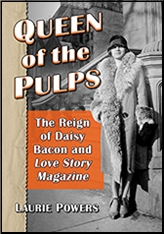
LAURIE POWERS – Queen of the Pulps: The Reign of Daisy Bacon and Love Story Magazine. McFarland, paperback, September 2019.
Have you ever received a book in the mail and immediately stopped what you were reading, stopped whatever you were doing and sat down and read the book? This is what happened when I received Queen of the Pulps. I had seen Laurie Powers work and do research on it for several years and finally here it is! She must of gotten sick and tired of me nagging her about the book and asking for progress reports.
This book breaks new ground and stresses original research on the love and romance magazines. Recently there have been some excellent books about the pulps such as John Campbell and Astounding Science Fiction, Joseph Shaw and Black Mask (forthcoming from Altus Press/Steeger Books this November), and in a few months, Michelle Nolan’s book on the sport pulps. Many collectors have been saying that we live in the Golden Age of Pulp Reprints, well it looks like there is a Golden Age of Pulp Studies also.
It’s exciting to realize that these books are not just run of the mill academic studies. They cover three of the greatest pulp editors: John Campbell, the greatest of the SF editors in the forties, Joseph Shaw, the greatest of the hard boiled detective pulp editors, and Daisy Bacon, the greatest of the love and romance pulp editors. Now all we need are books on Arthur Sullivant Hoffman, the greatest of the adventure pulp editors and Farnsworth Wright, the greatest editor of the fantastic and supernatural pulps.
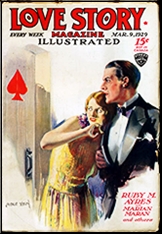
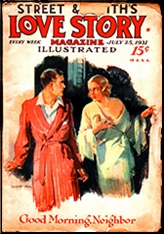
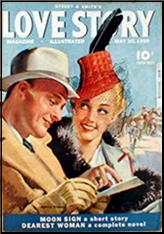
The book is a real beauty and very impressive looking. Laurie spared no expense and gathered over 80 photographs which are reproduced on high quality book paper and thus show up very well. She also has five color photos of Love Story covers. I like the way the photos are spread throughout the book and not just squeezed in a few pages. In the back of the book are around 300 chapter notes and footnotes documenting the facts, also an extensive bibliography and index. It is very obvious that this is a labor of love for Laurie and the excellent final results make all her hard work worth it.
But in addition to the above, there is another reason why I love this book. Starting in 1972 I attended the yearly Pulpcon conventions where just about all the conversations centered around the hero pulps. Titles like The Shadow,Doc Savage, G-8 and His Battle Aces, Operator 5, etc. There also was some interest in science fiction and many of the old timers(all these great old pals now gone), loved Max Brand and Edgar Rice Burroughs.
You might think this must have been a great time but for me, it was not. Though I ended up collecting just about all the hero pulps, I hated them with a passion. I know many of my collector friends will gasp in horror at such sacrilege, but I couldn’t stand the heroes and every attempt to read them defeated me because of the childish plots and dialog. At least with a love pulp you are dealing with a subject that makes the world go round. Love! But I positively disliked the silly Monk and Ham characters in Doc Savage and Bull and Nippy in G-8.
So, in the early days of pulp fandom there was very little interest in other genres like detective, western, adventure, and sport fiction. And certainly there was absolutely no interest in collecting the love and romance pulps. Sure there were a couple lost souls like me, Digges La Touche, and even Steve Lewis. We picked up issues here and there over the years and now I guess I have a couple hundred Love Story issues without even trying.
However, as the years and decades marched on, things began to change and collectors started to collect the other genres, the pulps that adults read and not just the hero pulps which were aimed at the teen-age boy market. I even did an informal survey in the seventies and eighties where I asked many non-collectors if they remembered the pulps. Many of the women remembered the love and general interest pulps and many of the men remembered and read Black Mask, Argosy, Adventure, Western Story, etc. When I directly asked them about the hero titles, the usual response was did I mean the “kid pulps”, or as one of my old time friends said “the magazines with the unreadable crap” (Harry–Damn it you said you would get back to me about the afterlife!).
Now finally we have a book that back in the 1970’s I never thought would be published. It is not about the hero pulps, rehashing old tired comments but about one of the most successful editors, Daisy Bacon. For 20 years, 1928–1947, she edited Love Story which had the highest circulation of all the pulps, estimated to reach 600,000 per issue.
Queen of the Pulps is not only about Daisy Bacon and Love Story, but also about editing in general at Street & Smith. Daisy edited seven other titles in addition to Love Story and though the main thrust of this book is about that magazine, Laurie Powers also discusses Daisy’s time editing Detective Story for most of the decade in the forties. She also covers her time as editor of the final issues of The Shadow and Doc Savage.
It sounds like she enjoyed the change of pace from love to murder. For 25 years Detective Story had published a sort of bland and sedate detective story, just about ignoring the hard boiled style sweeping through the other quality detective titles like Black Mask, Dime Detective, and Detective Fiction Weekly. During this period, 1915–1940, the magazine avoided the tough, hard boiled fiction except for an occasional story from Carroll John Daly, Erle Stanley Gardner, and Cornell Woolrich, etc.
But when Daisy Bacon took over as editor in 1941, Detective Story took on new life and she encouraged many of the writers from Black Mask and Dime Detectiveto write for Detective Story. Raymond Chandler, Dale Clark, T.T. Flynn, G.T. Fleming-Roberts, Julius Long, D.L. Champion, Norbert Davis, John K. Butler, Day Keene, John D. MacDonald, and others all appeared once or twice.
It’s obvious she wanted to make the stories tougher, and she got Carroll John Daly to write six novelets, Fred Brown to write nine shorts, William Campbell Gault to appear 14 times, and her best author during the forties, Roger Torrey. Torrey had 13 novelets, all starring Irish private eyes, and these stories are worth looking up because they represent his very best work. Torrey unfortunate had a severe drinking problem and drank himself to death around 1945. I read about his death in one of his short story collections and it’s a real sad story.
Daisy Bacon’s reward for all this? She was fired in 1949 during the bloodiest day in pulp history as Street & Smith killed off all its pulp titles (the one exception for some reason being Astounding). Western Story, over 1250 issues—Gone! Detective Story, over a thousand issues–Gone! It seems that the president of Street & Smith hated the pulps and saw the future as slick women’s magazines. These slicks are so dated and worthless that just about no one collects them nowadays. But the Breakers love them because they cut out the slick ads and sell them to housewives and men to frame them in their basement bars or kitchens.
What is this guy’s name? Allen Grammer, who was hired by the family to run Street & Smith, the first such outsider in almost a hundred years of publishing. When he came on board in 1938, he had no interest in the pulps and almost from the very beginning worked to get them out of circulation. Needless to say, he and Daisy did not get along and he got rid of her along with the pulp titles.
On a more personal note, I became involved with the Grammer family. What’s the odds of a non-collector having two pulp cover paintings and moving right next door to a collector with a house full of pulp art? A billion to one? Will it happened to me. In the mid-1990’s an elderly retired music teacher moved next door and had an open house for the neighbors to get acquainted. As my wife and I walked through his house we were stunned to see two original cover paintings from Western Story hanging on the wall of the den.
They both were from 1938 and painted by Walter Haskell Hinton. I immediately cornered my host and discovered that his name was Paul Grammer and he was the nephew of Allen Grammer. It seemed his uncle was the head executive at Street & Smith back decades ago and Paul Grammer’s father also had a high position. Eventually when Allen Grammer died, Paul inherited the pulp cover paintings. Several years later Paul gave in to my pleas and sold me the two paintings. Every time I look at the one I still have, I think of Paul and wish he still lived next door.
Over the years I had several conversations with Paul about his infamous uncle and I sure wish Paul was still alive because I have even more questions now that this Daisy Bacon book is out. Paul once showed me a photograph of Allen Grammer sitting behind his desk at the Street & Smith offices. Behind him was a large pulp painting by N.C. Wyeth. I commented that the painting was now worth a million dollars and Paul said one day his uncle went into the office and the painting was gone. Someone had walked out with it. I wish I had talked Paul Grammer into letting me have the photo because I see that Laurie does not have one of Allen Grammer in the book. I suspect Laurie sympathized with Daisy and also dislikes him. Thus no photo! (Or maybe she could not get the rights to publish a photo.)
So, for several years I watched Laurie got deeper and deeper into the life of Daisy Bacon. More than once Laurie traveled from California to New York and New Jersey. She discovered the old records, photographs, diaries, and various papers that Daisy had kept all her long life. On one trip she even discovered the love nest built by Daisy’s long time lover in the woods of New Jersey. Laurie even came across and now owns, the one painting that Daisy kept by Modest Stein. By the way, love pulp cover paintings are rare. I’ve only found two: one for Love Book and one for All Story Love.
The book is full of fascinating details and stories about Daisy, her half sister, Esther Ford, her mother, and her lover. Laurie has told a suspenseful story worthy of being published in Love Story magazine. Of course the part about the secret lover would have to edited out of the story. It has all the pulp story ingredients: love, attempted suicide, secret lives, success, depression, and failure.
If you read the pulps, buy the pulp reprints, or collect the old magazines, this book is a must buy. Price is $40 but it’s worth the cost. This gets my highest recommendation and can be bought on amazon.com or the McFarland Books website. If you attend Pulpadventurecon in Bordentown, NJ on November 2, 2019 Laurie will have copies for sale.
RAYMOND CHANDLER – The Big Sleep. Philip Marlowe #1. Alfred A. Knopf, hardcover, 1939. Avon Murder Mystery Monthly #7, digest paperback, 1942; New Avon Library [#38], paperback, 1943. Movie photoplay edition: World, hardcover, 1946. Reprinted many times since. Film: Warner Bros., 1946 (screenwriters William Faulkner, Leigh Brackett, Jules Furthman; director Howard Hawks; Humphrey Bogart as Marlowe). Also: United Artists, 1978 (screenwriter-director: Michael Winner; Robert Mitchum as Marlowe).
It is difficult to imagine what the modern private eye story would be like if a forty-five-old ex-oil company executive named Raymond Chandler had not begun writing fiction for Black Mask in 1933. In his short stories and definitely in his novels, Chandler took the hardboiled prototype established by Dashiell Hammett, reshaped it to fit his own particular vision and the exigencies of life in southern California, smoothed off its rough edges, and made of it something more than a tale of realism and violence; he broadened it into a vehicle for social commentary, refined it with prose at once cynical and poetic, and elevated the character of the private eye to a mythical status — “down these mean streets a man must go who is not himself mean, who is neither tarnished nor afraid.”
Chandler’s lean, tough, wisecracking style set the tone for all subsequent private-eye fiction, good and bad. He is certainly the most imitated writer in the genre, and next to Hemingway, perhaps the most imitated writer in the English language. (Howard Browne, the creator of PI Paul Pine, once made Chandler laugh at a New York publishing party by introducing himself and saying, “It’s an honor to meet you, Mr. Chandler. I’ve been making a living off your work for years.”
Even Ross Macdonald, for all his literary intentions, was at the core a Chandler imitator: Lew Archer would not be Lew Archer, indeed might not have been born at all, if Chandler had not created Philip Marlowe.
The Big Sleep, Chandler’s first novel, is a blending and expansion of two of his Black Mask novelettes, “Killer in the Rain” (January 1935) and “The Curtain” (September 1936) — a process Chandler used twice more, in creating Farewell, My Lovely andThe Lady in the Lake, and which he candidly referred to as “cannibalizing.”
It is Philip Marlowe’s first bow. Marlowe does not appear in any of Chandler’s pulp stories, at least not by name: the first person narrators of “Killer in the Rain” (unnamed) and “The Curtain” (Carmody) are embryonic Marlowes, with many of his attributes. The Big Sleep is also Chandler’s best-known title, by virtue of the well-made 1944 film version directed by Howard Hawks and starring Humphrey Bogart, Lauren Bacall, and Elisha Cook, Jr.
On one level, this is a complex murder mystery with its fair share of clues and corpses. On another level, it is a serious novel concerned (as is much of Chandler’s work) with the corrupting influences of money and power. Marlowe is hired by General Sternwood, an old paralyzed ex-soldier who made a fortune in oil, to find out why a rare-book dealer named Arthur Gwynn Giger is holding his IOU signed by Sternwood’s youngest daughter, the wild and immoral Carmen, and where a blackmailing abler named Joe Brody fits into the picture.
Marlowe’s investigation embroils him with Sternwood’s other daughter, Vivian, and her strangely missing husband, Rusty, a former bootlegger; a thriving pornography racket; a gaggle of gangsters, not the least of which is a nasty piece of work named Eddie Mars; hidden vices and family scandals; and several murders. The novel’s climax is more ambiguous and satisfying than the film’s rather pat one.
The Big Sleep is not Chandler’s best work; its plot is convoluted and tends to be confusing, and there are loose ends that are never explained or tied off. Nevertheless, it is still a powerful and riveting novel, packed with fascinating characters and evocatively told. Just one small sample of Chandler’s marvelous prose:
The air was thick, wet, steamy and larded with the cloying smell of tropical orchids in bloom. The glass walls and roof were heavily misted and big drops of moisture splashed down on the plants. The light had a unreal greenish color, like light filtered through an aquarium. The plants filled the place, a forest of them, with nasty meaty leaves and stalks like the newly washed fingers of dead men. They smelled as overpowering as boiling alcohol under a blanket.
That passage is quintessential Chandler; if it doesn’t stir your blood and make you crave more, as it always does for this reviewer, he probably isn’t your cup of bourbon.
JOHN LAWRENCE “Broadway Malady.” Short story. Lt. Martin Marquis #1. First publisheded in Dime Detective Magazine, February 1937. Collected in The Complete Cases of the Marquis of Broadway, Volume 1. (Altus Press, 2014); introduction by Ed Hulse.
This is the first in a series of 26 tales written by veteran pulp writer John Lawrence about the redoubtable Lt. Martin Marquis, the so-called “Marquis of Broadway,” and the gang of men he used to keep law and order in Manhattan’s famed strip of brightly lit theatres and night clubs in the 1930s and (mostly) pre-war 40s. All of them appeared in Dime Detective. The last would have been appeared in 1942, butr one last one was finally published in 1948.
Always flashily dressed, the dapper Marquis was actually little more than a criminal himself, if not an out-and-out gangster, nor were the policemen in his squad any better, and maybe even worse. . Their methods were crude but effective. In “Broadway Malady,” however, one particular overly ambitious night club owner makes the mistake of crossing him, to his lasting regret only a few pages later.
It seems as though the latter has taken a liking to a beautiful young singer who is in love instead with a bandleader whom the Marquis has taken under his wing. When the former is found beaten up rather considerably, the Marquis takes it personally.
What’s most striking about this story, even more than its setting — what major thoroughfare of its era was more famous than Broadway? — the rather standard plot, is the terse, understated way in which it’s told. I think “Broadway Malad” comes as close to matching the subtext of Dasheill Hammett’s tales than almost any of the latter’s would-be imitators. Other writers may steal Hammett’s plots, but very few of them seem ever to master the essence of how he told his terse, hard-bitten tales.
Or in other words, there is almost as much to be read between the lines in “Broadway Malady” as there is story itself. Lawrence makes no concession to the reader. I can’t imagine many getting to the end of this tale without having to go back to see what they missed. When the pieces finally fit together, and they will, the light goes on.
Chandler is easy to imitate. Hammett less so. It’s a pleasure to read a story that’s so solidly told in the latter’s manner. There are now only 25 more stories of the Marquis left for me to read. Luckily two thick volumes of his “Complete Cases” have recently been published by Altus Press, making up just over half the run. More, I hope, are on the way.
JOHN JAY CHICHESTER – The Bigamist. Jimmy “Wiggly†Price #2. Serialized in seven parts in Detective Story Magazine between February 7 and March 14, 1925. Published in hardcover by Chelsea House, 1925. Reprinted by A. L. Burt, hardcover, 1927.
You shouldn’t expect a detective story published in 1925 to be a modern day mystery, especially one published in Detective Story Magazine, a pulp that didn’t realize that hardboiled detective fiction was coming into play until the very late 1930s, some fifteen years after the fact.
And yet … and yet … the opening of The Bigamist reminded me of a noirish novel I recently read by Day Keene, I believe, in which the protagonist was mixed up with two women, one in the city and the other, much more innocent, living on a farm (figuratively speaking, if not literally). The bigamist in The Bigamist, is no amoral character however, just a weak one who forsakes the women who loves him (and has waited over ten years for him) and marries a rich women he quickly finds he really doesn’t love.
Learning that his first love is dying, he hurries home, and so that she can die in peace, still loving him, he goes through a phony marriage ceremony with her — only to have her miraculously recover. Enter a blackmailer, then a killer.
The detective on the case is not the clown of a cop in the village where Dora lives, but a newspaper reporter from the city by the name of Jimmy “Wiggly†Price, first met in The Porcelain Mask (Chelsea House, 1924). His nickname comes from the fact that when he gets excited, his ears begin to wiggle uncontrollably. (No, I’m not joking. It can be done, but it takes practice.)
Any hint of this being a noir novel has quickly disappeared by this time, obviously, and the dialogue between the participants is often antiquated at best. Since the number of these participants is strictly limited, if the killer isn’t the obvious one, there’s only one other person it could be. And yet .. and yet … the book is surprisingly readable, and only because the author, I submit, was a natural storyteller, fact that outweighs any other deficiencies he may have had. I have no other explanation.
—
Bibliographic Notes: John Jay Chichester was a pen name of Christopher B. Booth, noted in some circles as the author of the Mt. Clackworthy stories, discussed at length on this blog here and here. The third and final Jimmy Price novel was The House of the Moving Room (Chelsea House, 1926).
L. M. MONTGOMERY “The House Party at Smoky Island.” Short story. First published in Weird Tales, August 1935. Reprinted in Startling Mystery Stories, Fall 1968, andVisions from the Edge: An Anthology of Atlantic Canadian Science Fiction and Fantasy (Pottersfield Press, trade paperback, 1981). First collected in Among the Shadows (Bantam Starfire, paperback, 1991).
Whenever I read a ghost story — which isn’t often, but on occasion I do — I want a story that gives me shivers and goosebumps. No gross out gruesome stuff for me. There’s an obvious difference between chills and shock and disgust. You know where the line is as well as I do, and “The House Party at Smoky Island” stays completely on the right side of it.
It helps, though, when a tale takes place on an island somewhere in the isolated wilderness– of central Ontario, for example, and Lake Muskoka in particular. The manor house in full of people, but it has rained all week, and by Saturday night the guests have been on each other’s nerves for far too long.
One of the married couples is especially on edge. She has become more and more obsessed with the thought that he killed his first wife. She does not know this for a fact. She only suspects it. As Saturday night arrives, with the wind howling and the rain pouring down, there is a call for each of the members of the house party to tell the rest of the company a ghost story, which only builds up to what happens next.
And that’s all I can tell you without telling you the whole story, but if ever a ghost story can give you a brief shiver or shill at exactly the right moment, this one will.
You may have recognized the author’s name, or you think you may have, and if so, you are correct. This is the same L. M. Montgomery who wrote Anne of Green Gables and all of its sequels, plus many other stories meant for children. She is one of Canada’s most well-known and beloved authors, and this is a rarity: the only story she wrote for the pulp magazines.
Alas, I’ve been jammed up with too many things to do to be able to post Walker’s annual PulpFest report here on this blog in any timely fashion. We’ve asked Sai Shankar whether he’d be willing to post it on his Pulp Flakes blog, and he’s most graciously agreed. More than that, he’s done a masterful job.
FREDERICK NEBEL “Wolves of the Wild.” Novelette. First published in Ace-High Novels, April 1932, Collected in Forbidden River (Black Dog Books, trade paperback, 2014).
In this tale of the frozen North an old prospector named Shorty finagles the son of a good friend, wasting his life away as gambler in a Yukon saloon, into hitting the trail with him on his next expedition. He needs toughening up, Shorty thinks.
There’s only one problem. Shorty has come into town with a pouch full of gold, and when others see gold as rich as this, they start thinking that there will be more of it at the other end of Shorty’s trail. They is a girl, too, and even though this is all the story there is, Nebel fills over 40 pages to tell it. Luckily he’s a good enough story teller that you don’t really notice how thin the tale is until 20 minutes later, when you’ve finished it.
The second story in this same collection, which I’ll stick with for a little while longer, is “A Gambler Passes,” which first appeared in the January 1930 issue of Five Novels Monthly. The latter was an all-purpose magazine, usually with one mystery story, a western, a sports story, and a couple of adventure tales or maybe a romance. Since “A Gambler Passes” is less than 50 pages long in book form, you can easily realize that calling the stories “novels” is really only a case of exaggerated salesmanship.
That the leading character in “Gambler” is, guess what, s gambler, should come as no surprise. That his name is Jack Cardigan is a bit startling, but only if you know that Jack Cardigan was also the name of his long-running private eye character later on in Dime Detective. In his long, informative introduction to this collection, publisher and editor Tom Roberts seems to suggest that the two are one and the same. They certainly could be, and it’s fun to think so, but without more evidence, I’m inclined to write it off as an author doubling up the use of a name that caught his fancy.
I could be very wrong about that, and the more I think about it, the more likely I think I may be.
In this story, the gambler Jack Cardigan is accused of killing the son of the man who has the small mining town of Lodestar. That it was an accident that occurred while the dead man was foisting his attentions too fiercely on the girl Cardigan loves makes no difference to the kangaroo court that is convened, and once convicted, Cardigan has to flee.
And thus follows a lot of traipsing around in the snow-covered wilderness. One gets the feeling of how bitterly cold the weather that far north can be, but after a while one also begins to wonder how easily the main protagonists run across each other while fighting off blizzards and general fatigue. Still, a good story with a satisfying ending.
Nebel takes a different approach in “Forbidden River,” reprinted from the June 1930 issue of Five-Novels Monthly. The primary protagonist is a lawyer from Chicago who is making a trip to the North country as part of a hunting vacation with a friend who has a lodge there.
The trip is by train, and on the train the one other passenger is a young girl who appears to be of French heritage. When his back is turned she pulls the emergency cord, the train stops, and she jumps off. Going to the end of the train, he falls off as the train starts up to look for her, and he’s off and running in an adventure he never in his life dreamed of.
I’ll not venture further into the plot, but all kinds of factions come into play, including murder and two Mounties, making it a detective story of sorts as well as a tale that once started is difficult to put down.
There are two more stories in this collection: “The Roaring Horde” (Five-Novels Monthly, April 1932) and “Gold” (North•West Stories, May 1931). I confess that I’ve not read either, I’m sorry to say, but I’m sure I will sometime soon. Nebel was a good writer, and these frostbitten yarns make for perfect reading in these hot and muggy days of mid-August.