Pulp Fiction


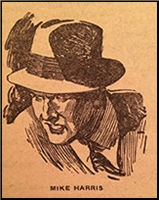
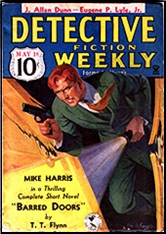
T. T. FLYNN “Barred Doors.” Short novel. Mike Harris & Trixie Meehan #7. First appeared in Detective Fiction Weekly, May 18, 1935. Probably never reprinted.

   I may be wrong, but whenever female private eyes have come up for discussion on this blog, especially those who primarily appeared in the pulp magazines, the name Trixie Meehan has never been mentioned. It’s true that she always played second fiddle to Mike Harris, her fellow operative for the Blaine Agency, but she’s her own woman with her own cases, and the fact that every so often she’s able to give Harris a helping hand is no reflection on her ability.

   In “Barred Doors” Harris is given the job of tracking down the secretary who seems to have disappeared with a half million dollars worth of unregistered Liberty bonds taken from the safe of the agency’s client, Sir Douglas Carter MacClain.

   Naturally there is a gangster involved and the gangster’s ex girl friend, who has lately been seen gong out on the town with the missing secretary. There is a kidnapping involved, and a strange form of blackmail, or so it is revealed, but with both Mike Harris and Trixie Meehan on the case, everything eventually works out justice finally prevails.

   The story is suitably complicated and well told, but to me, there’s just not enough zip to it to make it more than just a step above average, but above average it most certainly is. There doesn’t seem to be anything of a romantic nature between Mike and Trixie, just a lot of light bickering and back-and-forth banter, nothing more serious than that.

   Having sold off a large number of my DFW collection, I may not get a chance to read another of their adventures, but I’d like to. There were sixteen of them between 1933 and 1951, all but the last published in Detective Fiction Weekly. That final one appeared in Detective Tales, some ten years after the previous one. (It is possible that this last one is a reprint of an earlier story under a new title.)

FRANK GRUBER “The Sad Serbian.” Short story. Sam Cragg #1. First published in Black Mask, March 1939. Reprinted as “1000-to-1 for Your Money,” Ellery Queen’s Mystery Magazine, March 1950. Also reprinted in The Black Lizard Big Book of Pulps, edited by Otto Penzler (Vintage Crime, softcover, November 2007).

   I’d say that a skip-tracer definitely falls into the same category as a private eye, wouldn’t you? This was Sam Cragg’s only solo adventure. The very next year found him teamed up with Johnny Fletcher in The French Key (Farrar, hardcover, 1940) in the first of 14 novels they appeared in together.

   To tell to you the truth, though, I’m not at all sure the Sam Cragg in this story is the same Sam Cragg who teamed up with Johnny Fletcher in all those books. In this one he tells the story himself, and he’s both observant and articulate, while the Sam Cragg in the Fletcher books is little more than a second banana or even a musclebound stooge, if you will. Fletcher is the brains of the pair, Cragg is the brawn.

   And here’s another “to tell you the truth.” While always having an old pupwriter’s gift for words, Frank Gruber’s choice of stories to tell and I are often not entirely on the same wavelength, and “The Sad Serbian” is no exception. It has something to to with a Serbian prince and a scam of some kind he’s pulling on Chicago’s Serbian community, somehow in conjunction (or competition) with a giant 300-pound Amazon of a woman.

   The story’s both too complicated and worse, uninteresting, to me at least, a deadly combination in a story if ever there was one. One saving grace, though, is the interplay between Cragg and Betty, the secretary of the outfit he works for. There should have been more of it. Maybe in a followup story of Sam on his own there would have been.


[ADDED LATER.]   My review of The Limping Goose (Rinehart, hardcover,1954), including a list of all 14 Johnny Fletcher and Sam Cragg books can be found here.

  LOU SAHADI, Editor – An Argosy Special: Science Fiction. One-shot reprint magazine. Popular Publications, 1977.

#4. JOHN W. JAKES “Half Past Fear.” Short story. First appeared in Super Science Stories, August 1951. Otherwise never reprinted.

   Before John Jakes hit it rich with his Kent Family Chronicles, he was generally regarded as an all-around hack, and rightly so. He wrote a couple dozen sci-fi novels, maybe a dozen more mystery and spy novels, of which his PI Johnny Havoc books may be the best remembered today, and even a half dozen “Man from UNCLE” stories for the magazine of the same name in the mid-60s.

   Of his fantasy and science fiction, his Brak the Barbarian pastiches of Robert E. Howard’s Conan tales are collectable now; the rest are safely forgotten. And the same can be said of “Half Past Fear,” his third to be published short story. In it a family of three takes in a strange traveler as a boarder, only to discover that he came from the past and that he is being pursued.

   Time travel tales are almost always fun to read — they make up one of my favorite subgenres in all SF — but this one is clunky and confusing, with one of the lead characters, unable to explain how things turn out, simply shrugs and calls upon the unexplainable “paradoxes of time travel” to bail out both the author and the story, and not at all succeding.

   One might be forgiven in thinking that this story was chosen for Jakes’ name only, to help sell the magazine, but if you take a look at the image at the upper left, you’ll see that none of the authors are mentioned, only the titles of the stories. A strange marketing device, indeed.

       —

Previously from this Lou Sahadi anthology: LEIGH BRACKETT “Child of the Green Light.”

REVIEWED BY DAVID VINEYARD:


ALBERT DORRINGTON – The Radium Terrors. Eveleigh Nash, UK, hardcover, 1912. Doubleday Pagr, US, hardcover, 1912. W. R. Caldwell & Co., US, Hardcover, ca. 1912. Serialized in The Pall Mall Magazine, UK, January-June 1911, and in The Scrap Book, January-August 1911.

   Beatrice Messonier sat near the window dazed and mystified by her benefactor’s dazzling prophecies. Something in his manner suggested an approaching crisis in his own life and hers. What did his talk of princes and statesmen mean? She would have regarded such an outburst in another as the result of alcoholic excesses. But Teroni Tsarka was not given to the use of stimulants. He abhorred intemperance of mind and body. What he had spoken was the result of his structural philosophy, she felt certain. A tremendous crisis in medical research was at hand. And Teroni Tsarka was the man to sound the trumpet of science to an apathetic civilization.

   Beatrice Messonier is a brilliant oculist whose research was backed by the mysterious Dr. Tsarka, who has helped her learn the secrets of the Z Ray, the powerful result of radium research, and has set her up in a clinic, which has no patients thanks to his insistence on exorbitant fees.

   Just that night she broken her own heart having had to turn down the young detective Clifford Renwick, who was blinded with radium by Tsarka’s own assistant Horubi when Renwick tried to force an interview with Tsarka about the recently stolen Moritz Radium, Renwick being a youthful private investigator eager to make a name for himself.

   And of course we are off in the land of the Yellow Peril novel, serialized in Pall Mall, a popular British magazine on the lines of The Strand, and handsomely illustrated as well.

   Ironically Sax Rohmer had much the same idea in about the same year, with Dr. Fu Manchu making his debut, but even with Rohmer’s rather crude Edwardian style, his work is a far cry from the maudlin at times (the blinded Renwick has a touching moment with his old gray mother after escaping Tsarka — something you can hardly imagine Dr. Petrie or Nayland Smith bothering with) and painfully arch Dorrington.

   The formula here is much the same of the early Fu Manchu books, parry and thrust, chase, escape, and traps to capture Tsarka sharing about equal time with not particularly imaginative deadly traps for young Renwick.

   But the devil in these details is how dated Dorrington’s novel reads compared to Rohmer, who for all his melodrama and atmosphere is practically a minimalist in comparison.

   What with Beatrice Messonier (another difference is that in Rohmer, a Eurasian beauty wins Dr. Petrie’s heart, but in Dorrington, Renwick can’t be involved with a woman much more exotic than a Frenchwoman) unconvincingly posing as a much older woman and forced to seem heartless and cruel to young Renwick, and Tsarka being more interested in profit than world conquest, it is, for all its thrills, pretty pale stuff compared to Rohmer’s unknown poisons, Fu Manchu’s army of dacoit assassins, seductive Eurasian beauties under his spell, snakes, rats, weird poisonous bugs and the like.

   Tsarka, like Fu Manchu, has a daughter, but she is a far cry from Fu Manchu’s child. Rather she is a pale flower whose Japanese artist lover lives with she and her father (Tsarka uses an exhibition of the young man’s work to blind several prominent people who must then seek Madame Messonier’s clinic, the extent of his evil masterplan, a cheap cruel con game to make a few bucks). I suppose the attractive lovers are a step up from Fu Manchu’s evil daughter, but frankly they don’t bring much to the proceedings rather than a bit of humanization to the cruel and crafty Japanese scientist despite his penchant for experimenting on unwilling victims.

   “The scoundrel!” burst from Coleman. “He and his associates appear to have discovered a destroyer of human energy in radium. Personally, I fear that we shall find ourselves unable to cope with this new school of Asiatic criminals who regard the blinding of men and women as a pleasant pastime.”

   Reading this, it doesn’t take much imagination to see Rohmer’s entry in the Yellow Peril stakes for the startlingly new and modern work it must have seemed what with a thin patina of sex, relatively clipped dialogue, and straight forward telling wrapped in the opium fog laden atmosphere of Limehouse out of Thomas Burke and pure imagination. Rohmer’s “The Zayat Kiss” reads as if it might have been written in the early twenties, where Dorrington’s Radium Terrors reads as if it might have been written in the early eighteen nineties.

   The book has its thrills, and while dated, it isn’t badly written, but reading it you can understand what readers noted in better writers of the era, a voice, that beginning with Conan Doyle, was more modern and less given to maudlin sentiment and long winded prose. Reading Rohmer after Dorrington, or around the same time, must have been as refreshing as discovering Dashiell Hammett after a steady diet of Carolyn Wells.

   Reading this can give you a new appreciation for the relative modernity of the more vulgar, and certainly more gifted Sax Rohmer. Tsarka is a mean and constipated villain, vicious, petty, and ultimately ridiculous for all the Victorian language. Rohmer’s Fu Manchu is a Miltonian angel fallen to earth — some recent Asian literary scholars have suggested rehabilitating Fu Manchu for just that reason — because the character has, both in Rohmer’s work and the public imagination, transcended his racist origins becoming an archetype as much as a stereotype.

   Whether there proves to be anything to that view or not the inescapable fact of reading The Radium Terrors is that Rohmer and Fu Manchu ran literary rings around Dorrington and his Dr. Tsarka, and it may just be the difference, aside from Rohmer’s superior storytelling skills, is that Dorrington doesn’t believe in his Japanese pretender for a moment, and Rohmer embraces the his creation with full blooded zeal.

   Fu Manchu lived and breathed. Tsarka lingers like a bad taste.
  WYNDHAM MARTYN “The Shadow’s Shadow.” Novelette. Bentley Mayne & Captain Dashwood #1. First appeared in Flynn’s Weekly, 14 May 1927. Probably never reprinted.

   Wyndham Martyn was the pen name that author William Henry Martin Hosken (1874-1963) seems to have used more often than several others. While he produced dozens of short stories for the pulps and other fiction magazines in the teens and 20s, Martyn may be more well known, if at all, for his long series of hardcover thrillers published in the UK featuring a master criminal named Anthony Trent, whose specialty was solving mysteries the police are having trouble with.

   Other than three serialized novels for Flynn’s, Trent appeared in only one pulp magazine story. The private eye in “The Shadow’s Shadow” is a young fellow named Bentley Mayne, who has obtained a fine reputation for cleverness and success for the cases he’s worked on.

   Enter steel magnate John Dawbarn, who has been trying to convince someone in Washington that his new method of processing steel is something our country’s government ought to have. Fearing that the secret may fall instead into enemy hands, Dawbarn calls on Mayne, who is happy to take the case.

   But instead of working on it himself, he assigns an associate named Captain Dashwood to act as Dawbarn’s bodyguard. Dashwood is (um) a dashing Englishman in dapper dress and a monocle, and fits in well with Dawbarn’s society-minded wife’s life style.

   After the secret plans is a master criminal known only as The Shadow (no relation to the fellow who came along later). The problem is, no one knows what he looks like. He could be anyone. Now Dashwood is competent enough, but his eye is as much on Dawbarn’s daughter Betty as on ferreting out who The Shadow might be or where he may strike next, but happily to say, both halves of the story work out well.

   [PLOT ALERT] There is a strange twist in the tale that I ordinarily wouldn’t bring up, but since it may not be easy for yous to obtain the copy of Flynn’s the story is in, I have decided to tell you about it anyway. It seems that Mayne and Dashwood are one and the same. I haven’t decided what purpose the hoax is for — he doesn’t even tell Dawbarn what’s going on — but personally I think Dawbarn is something of a dolt to not to have recognized Mayne’s alter ego almost immediately.

   But now that the impersonation has been revealed, it might explain why this was Bentley Mayne’s first and last appearance. That and the fact that at story’s end, he and Betty seem to be on their way to settling down in fine matrimonial fashion.

  LOU SAHADI, Editor – An Argosy Special: Science Fiction. One-shot reprint magazine. Popular Publications, 1977.

#3. LEIGH BRACKETT “Child of the Green Light.” Short story. First published in Super Science Stories<, February 1942; reprinted in the April 1951 issue. Reprinted in Classic Science Fiction: The First Golden Age, edited by Terry Carr (Harper & Row, hardcover, 1978). First collected in Martian Quest: The Early Brackett (Haffner Press, hardcover, 2002).

   There are science fiction stories so vast in scale it is next to impossible for the human mind to comprehend them, and even though this tale takes place within the orbit of Mercury in our own solar system, this is one of them.

   Son is a living creature — a mutation, perhaps — capable of existing in space without protection, the only living being in a junkyard of wrecked ships that his own space craft is part of. Nearby and at the center of this story is the Light, burning green in color, and the Veil, on the other side of which is Aona, a creature such as himself but obviously female.

   Coming to investigate the Light is, for the first time in a place where time and aging have no meaning, is a ship of seven humans and other intelligent aliens. It seems that a Cloud has passed through the solar system, changing the metabolism of all the creatures it touched. Destroying the Light is the only means of survival for billions of people.

   What has happened to Son to make him the being that he is? Is there any way for him to cross through the Veil to become part of the parallel universe where Aona is? And what about the one of the seven who sees Son as someone with powers that, if had them and the Light were destroyed, could rule the solar system?

   Whew! One thing you can say about this story is that has a cosmic Sense of Wonder, the secret ingredient of stories such as this one, and is the absolute epitome of Super Science.

       —

Previously from this Lou Sahadi anthology: CHAD OLIVER “The Land of Lost Content.”

CLIFF FARRELL “Sign of the White Feather.” Short novel. First published in Fighting Western, March 1946. Collected in The White Feather as “The White Feather.” (Five Star, hardcover, 2004; Leisure, paperback, March 2005).

   Fighting Western is generally considered one of the second- or even third-rank western pulps, but this particular issue is filled with a bunch of better western writers. Besides this long tale by Farrell, there are four shorter ones by gents such as Giles A. Lutz, William J. Glynn, Thomas Thompson, and Joseph Chadwick, of whom only Glynn is completely unknown to me.

   As you can probably guess from the title, “Sign of the White Feather” is the story of a man considered a coward but who in the end redeems himself. It seems that in order to make a hurried trip to Salt Lake City to raise money to save his estranged father from bankruptcy, he had to forego a fight with one of the men working for his father’s ruthless competitor in finishing a coast-to-cast telegraph line.

   A contract is a contract, and a deadline is a deadline, but it’s even harder when thugs, gunmen and outlaws are working for the other side. Even Kelly’s fiancée is starting to wonder how much courage the man she is engaged to marry actually has. It does not help in that regard when she learns that the only person who has agreed to give Kelly the loan he needs is a woman, and what’s more, she’s coming back with him.

   The story is non-stop action, starting with a rough and bumpy stage ride back to Salt Lake City, then up in the mountains cutting down logs to be used as poles — just as the winter season is ready to settle in. The enemy is suitably vicious, the romance suitably up in the air, and while the characters are not deeply developed, I found myself rooting for them all the way. Is Kelly Brackett a coward? Far from it!

 MARTIN H. GREENBERG, Editor – Deadly Doings. Ivy, paperback original; 1st printing, 1989.

#5. WILLIAM CAMPBELL GAULT “Never Marry Murder.” Short story. First published in Dime Mystery Magazine, December 1949, as by Roney Scott. Not collected or reprinted elsewhere.

   Most readers of this blog will recognize William Campbell Gault as the author of two long-running series of private eye novels, eight with a fellow named Joe Puma and fourteen with Brock “The Rock” Callahan, both working cases all over the southern California landscape.

   Less known is the fact that Gault also had a long career writing detective and crime stories for the pulp magazines, well over a hundred of them, starting with “Crime Collection” in the January 1940 issue of 10-Story Detective Magazine.

   Some of them featured PI’s or wanna-be PI’s, but “Never Marry Murder” is not one of them. (That the byline on the story is Roney Scott is due to the fact that Gault had another story in the same issue under his own name, “Slay You in My Freams,” a common practice in those days.)

   No, this one’s a straightforward domestic crime tale, one that would not be out of place in, say, Alfred Hitchcock’s Magazine, back when it started after the success of the TV show; that is t= say, a story that depends on a surprise ending, a unexpected twist, if you will.

   A man who’s made his fortune by killing his first two wives has decided to settle down with the woman of his dreams, until, that is, he finds out that she’s been seeing another man. He doesn’t hesitate a minute. She has to go, victim number three.

   Unfortunately I knew exactly what was coming well before the ending, long before the protagonist did, and you may, too, with only the information I’ve given you. The story’s well told — you could say the same thing about everything Gault ever wrote — but when the story’s as predictable as this one is, I think editor Martin H. Greenberg might have found a better one. He certainly had plenty to choose from.

         —

Previously in this Martin Greenberg anthology: SUE GRAFTON “The Parker Shotgun.”

  LOU SAHADI, Editor – An Argosy Special: Science Fiction. One-shot reprint magazine. Popular Publications, 1977.

#2. CHAD OLIVER “The Land of Lost Content.” Short story. First published in Super Science Stories, November 1950. Collected in A Star Above It and Other Stories (NESFA Press, hardcover, 2003).

   Of the many SF writers of his day, Chad Oliver certainly had the credentials for the job. He had a PhD in anthropology from UCLA and was a fixture in that department at the University of Texas for nearly 50 years, including twice being chairman. He didn’t write a lot of science fiction, but as they say, what he did write was choice.

   My favorite of the nine novels he wrote, some of which were westerns, was The Winds of Time (1956), in which a race of aliens who came to Earth thousands of years in past decide to go into suspended animation to wait for a civilized mankind to evolve.

   “The Land of Lost Content” was Oliver’s first published story, and frankly, while certainly quite readable even today, it doesn’t show him at his best. The story line is unfortunately a very familiar one, that of a group of underground survivors of a nuclear and/or germ-based catastrophe on the surface of the Earth deciding generations later to break all of their dying society’s laws and see if they can make it to the land above.

   The last few lines sum it up: “Could they succeed where gods had faltered? He shook his head. Probably, almost certainly they would fail. But they would try. For that was what it meant to be a man.”

       —

Previously from this Lou Sahadi anthology: ROGER DEE “First Life.”

REVIEWED BY DAVID VINEYARD:


H. BEDFORD-JONES “The King Makers.” Novelette. Vincent Connor #6. First published in Short Stories April 25, 1932. Collected as the title story in The King Makers: The Adventures of Vincent Connor (Altus Press, The H. Bedford-Jones Library, trade paperback March 2015).

   Any attempt to cover H. Bedford-Jones’ career in the pulps is virtually doomed by the sheer volume of it. Writing in virtually every major pulp available (including Weird Tales), and with stories covering every historical era imaginable, he was the acknowledged King of the Pulps for much of his career, one of the highest paid writers in the field, and one whose work regularly was reprinted in hardcovers, whether it was his popular John Solomon stories written as by Allan Hawkwood, his Westerns, Mystery novels, historical novels, adventure fiction …

   He somehow even found time for a bit of poetry and non-fiction.

   Among his many series, one of the most popular featured Vincent Connor, a ne’er do well playboy American in China who would seem to be a jovial fool, but who in reality is one of the quickest minds and best fighters in Asia, “…an energetic young man who mixed largely in political affairs—not for his own interest, but for the good of China.”

   Not PC by any definition, in fact, another white man saving the natives, but these were the pulp magazines, and that was unfortunately the standard. Thankfully Bedford-Jones is too good to just settle for that.

   From the native city, bandits and alleged patriots had flooded into the Japanese quarter of Tientsin to kill and rob. Native mobs were being shot down, and all Tientsin was in alarm and uproar.

   Connor is in Tientsin waiting for his friend Earl Stanley when the rioting and violence break out in the Japanese quarter. A phone call from Stanley quickly summons him to an obscure restaurant in the French quarter where Connor finds the source of all the commotion “…This young native in the sweater and spectacles was Henry Chang-yin. He was the last of the line of the great Nurhachu, founder of the Manchu empire, and the throne of the Yellow Dragon was his by rights.”

   Henry is a quiet studious type who has been living in the Japanese quarter in a sort of separate peace with them, happy to let them use his status to their own needs so long as there is no violence, but now he has escaped, and in short order Connor and Stanley convince him to make a run for Manchuria where he can claim his throne and lead the advance to run the Japanese incursion out of China.

   1932, when this was written, was early in the Japanese imperial adventure in China that would become one of the bloodiest and deadliest in history, and Bedford-Jones can be forgiven in using it for a background for high adventure and political skull-duggery as it would be in countless stories, books, and films of the period. It’s only been in the last thirty years or so that the whole story of the Japanese war crimes in China has been fully exposed.

   In 1932 it was still possible to use the tragedy as a background for exotic adventure.

   The battle is bloody and hard fought with Colonel Honzai, the tough but honorable Japanese officer pursuing them. Bedford-Jones was an expert at orchestrating this kind of tale and pulls out no stops here.

   Despite the lack of political correctness, Bedford-Jones is far to good a writer to deal in the usual stereotypes. There are no evil Asian masterminds here (even when he did that trope he managed it with finesse), and both the would-be emperor, Connor’s driver, Wang, and their Japanese nemesis are written as intelligent and capable men, which doesn’t hurt the sense of adventure and action one bit, and even adds to it.

   The story ends with a nice ironic twist, with Connor’s dream of playing king-maker in China is lost, but not before undergoing a solid adventure tale in the old style by one of the masters of the genre.


       The Vincent Connor series

A Prince for Sale (ss) Argosy Jun 13 1931


House of Missing Men (ss) Argosy Jul 4 1931
The Tomb-Robber (ss) Argosy Aug 1 1931
Diplomacy by Air (ss) Argosy Sep 19 1931
Connor Takes Charge (nv) Argosy Dec 19 1931
The King Makers (nv) Short Stories Apr 25 1932

   All six are included in the Altus Press collection.

« Previous PageNext Page »