Pulp Fiction


RICHARD WORMSER – The Body Looks Familiar. Dell First Edition A156; paperback original; 1st printing, March 1958. A shorter version previously appeared in the September 1957 issue of Cosmopolitan magazine as “The Frame.” Also: Stark House Press, trade paperback, 2017, combined with The Late Mrs. Five, also by Wormser; introduction by Bill Crider.

   After reading I don’t know how many thousands of mystery novels in my lifetime, it seems strange to say this, but all of them have been different in some way from the others. Sometimes in very minor ways, sometimes more. Sometimes a lot more. Like this one.

   In fact, I’m inclined to say that the story line in this one is unique. Absolutely. You can tell me if I’m wrong or not by keeping on reading.

   The problem is, if I tell you what the story line is, it may tell you more than you want to know. For once, the blurbs inside the front cover and on the back cover are rather vague about it. On the other hand, the factor that makes it unique takes place in Chapter One, so if you were to start reading the book yourself, you’d find out soon enough anyway.

   But maybe you’d like to learn what it is that I’m talking about on your own. Hence the following

          SPOILER ALERT

   Reading any further will reveal essential plot elements that you may not wish to know about in advance.

   What happens in Chapter One? Well, now I’ll tell you. The assistant D.A. for an unnamed city kills the mistress girl friend of the city’s chief of police in the apartment he keeps for her and frames the murder on him. He shoots her right in front of him, taking the chief’s gun away from him by surprise and using it for the deed.

   What’s his motive? Revenge. James Latson, fast on his feet both in the political arena as well as in the bedroom, had taken Dave Corday’s wife away from him. She later committed suicide when she was dumped by Latson, and Corday could not bear the shame of taking her back.

   Whew! With an opening like that, you (the reader) have no way of knowing which way the story is going from there. Of course you’ve got to believe that Corday’s plan has any chance at all of working, and Richard Wormser as the author has his job cut out for him.

   For the most part he’s up to the task, but I have to admit that reading this particular work of crime fiction was like reading a science fiction novel, one for which the “willing suspension of disbelief” is a required element of what the reader has to bring along to the task.

   It’s not a classic, far from it, but it’s not as though reading this book really was a task. It only took a very enjoyable couple of hours, mostly spent in guessing which way the story was going to go next — and usually being wrong about it.

   Richard Wormser, by the way, was born in 1908 and wrote a couple of hardcover detective novels in the mid-1930s before switching to writing for the pulps and slick magazines through the 1940s. Westerns, adventure, mysteries, the whole gamut.

   Mostly he’s remembered, if at all, for the paperback originals, including movie tie-in’s, he did from the late 1950s on to early 1970s. He died in 1977.

[FOOTNOTE] Also shown are the covers for:

The Communist’s Corpse. Smith & Haas, hc, 1935. Series character: Sgt. Jocelyn “Joe” Dixon.

Argosy. April 6, 1940. Includes the story “Detour, Mr. Darwin,” by Richard Wormser. (His name should be discernible in the upper right corner.)

[UPDATE.]   This review was first posted on this blog on November 18, 2008. I’ve reposted it without any changes except for the information about the recent Stark House reprint. I started reading it today, and I said to myself, “This sounds familiar.” It was.

REVIEWED BY DAVID VINEYARD:


C. C. WADDELL & CARROLL JOHN DALY – Two-Gun Gerta. Chelsea House, hardcover, 1926. Serialized in four parts in People’s Magazine, October 1 through November 15, 1923. Available as a PDF download from Vintage Library, a possibly censored version.

    THERE isn’t much to say about Yavisa except that it is hot and dirty. But then all the towns in Mexico are hot and dirty; so I’ll put it that Yavisa is a shade hotter and dirtier than anything else along the border.

   That is the authentic voice of Roger Francis ‘Red’ Connors, ex-Hollywood stunt man and cowboy star (“You want to remember that I’d had two years’ experience dare-deviling for the films under Milt Leffingwell. As a matter of fact, I’d worked almost the same stunt in one of my ‘Reckless Rudolph’ pictures, as you’ll recall if you’ve ever saw ‘The Pit of Perdition.’), and all around tough guy come South for adventure and about to be up to his neck in it when he encounters the beautiful and fiery green eyed hellion, ranch owner Gerta O’Bierne: “She had a couple of heavy Colts strapped about her waist; and for all her sweet-sixteen look and her quiet manner, I figured that they weren’t just a bluff. Give her half a chance, and she’d use ’em.“

   He has hardly ridden into Yavisa when he spies beautiful Gerta pinned by local bandit and mustache twirler Colonel Manuel Esteban, old Crooked Mouth: “Half Mexican and half something else, I took him to be, but all murder. He looked like the bad man in the movies, only more real. A yellow, splotchy face under his broad-brimmed sombrero, with eyes as cold and deadly as a rattlesnake’s, and a cruel, crooked mouth that ran halfway up his cheek on one side as the result of an old knife scar.”

   In short order Red has saved Gerta and is hired as foreman on her ranch, but it is hardly smooth sailing from there, as soon Gerta is kidnapped, and even once he rescues her Red has to face her jealousy over saloon girl Rosita.

    But with the help of his horse, “El Flivver!…EL Hennery Ford! The devil caballo!” and his Colt .45 automatic, Red is a match for just about anything the Old West or Old Mexico can throw at him save perhaps Gerta.

    Cannon to right of me; cannon to left of me. I couldn’t go back, and I couldn’t go forward. Looked like I was ketched, eh, what?

   But it takes more than a squeeze of that sort to decompose Red Connors:

    “Hold fast!” I barked like a Amsterdam Avenue conductor to this pillowsham I was loaded with.

   Then I flings myself with her over the balcony railing, and hangs by one hand. Henry Ford is just underneath me, his back about two inches from my dangling toes.

    “Whoa, Henry!” I says, and he stands like a rock.

   Then I let go, and lands pretty as you please square in the saddle, with the lady jolted but unhurt still in the hollow of my arm. Another second, and we was streaking it for the archway and the great, open spaces.

    Bang! A red-hot stripe flicks along the side of my neck, and I hears another bullet go zipping past my ear.

   Red, of course, gets the girl and the horse, and at one point has a two way conversation with Henry Ford the likes of which you never encountered in Zane Grey, and it is all insane and mad fun written in the indomitable style of the much maligned Carroll John Daly, who for my money is one of the most sheerly entertaining bad writers to ever hunt and peck deathless prose onto the written page.

   Exactly what C. C. Waddell contributes is hard to guess, because Two-Gun Gerta reads like pure Daly, and Red Connors, like Three Gun Terry Mack, is just a rehearsal for the urban gunfighter/private eye Race Williams soon to emerge from Daly’s white hot imagination.

   It is pure pulp, and Red, Henry Ford, and Gerta are all well worth meeting: ”She’d been heaven and hell. But through it all, she’d been Gerta. And there wasn’t nobody like her.”

   There “wasn’t nobody” like Daly either, or this B Western of a two fisted adventure novel out of Tom Mix by way of Mickey Spillane.

Note: This book is important to the development of the hard-boiled genre for three reasons. Most obviously it is an early work of Carroll John Daly, who, whatever your feelings about his work, is the onlie beggetor (to borrow a Kiplingesque term from O. F. Snelling), of the modern hard-boiled private eye.

   Next, historically this book is further evidence of the ties between the Western and the hard-boiled school of writing where the former genre’s penchant for colorful language, fast action, and smart independent noble heroes with guns was transplanted to the Urban canyons of the Big City, while the quieter pleasures of the detective novel were supplanted by gangsters, floozies, femme fatales, gunmen, gamblers, crooked politicians, and corrupt cops.

   Hammett and Chandler both touch on distinctly Western settings at least once each in their work, and Gardner actually wrote mysteries with Western settings, while Black Mask as often as not included one Western in many issues..

   Finally, Red Connors is only a breath away from Daly’s first two private eyes, Three Gun Terry Mack and Race Williams. Hard going as this book may be for some readers, it is historically important to the genre.

COLLECTING PULPS: A Memoir
Part 20: Pulp Art, Part Two
by Walker Martin

   
   This is a continuation of the pulp art subject which commenced in my last column numbered Part 19. When I started this column in 2010, I never planned for it to last and continue for long. I thought I’d just discuss my collecting of The Big Three in the detective genre(BLACK MASK, DIME DETECTIVE, DETECTIVE FICTION WEEKLY). But I’ve received such great support for the series that it has continued now to Part 20 and beyond.

   And the Collecting Pulps subject led to me writing the series about ADVENTURES IN COLLECTING, and also book reviews and the pulp convention reports. I firmly believe we should be discussing these shows and collecting in general. I can remember the time when there was very little discussion of the importance and fun of collecting pulp magazines and original pulp art.

   We all know about how much fun it is to read and collect these old magazines, but it also is of great importance. It will be difficult for future generations to be aware that once there was a golden period of excellent fiction magazines and illustration art. It’s hard now to even find a newsstand, but once there were thousands of such outlets in drugstores, deli grocery stores, and on street corners. The newsstands groaned under the weight of scores of fiction magazines both pulp and slick. And they all used illustrations from talented artists that numbered in the hundreds.

   I collect this great art and the columns titled Part 19, Part 20, and Part 21 (upcoming) contain the story about how I managed to track down and find many unique cover paintings and interior illustrations. Every now and then the accusation is made that you have to be rich in order to collect paintings and sets of long running magazines. No, you don’t, and I’m living proof of how it can be done on a middle class income.

   True, you have to be a committed and enthusiastic collector, but I built up this collection while working on a salary and bringing up a family with the usual mortgages, car payments, and other bills. I often went through periods where I had very little money in the bank account, or I had to borrow money from the credit union at work. For many years I skipped lunch in order to save money to buy books. Sounds familiar right? I’m sure many collectors have scrimped and saved in order to feed their collections. And yet they still had all the usual things that we take for granted such as family, children, homes, cars, education.

   One of my favorite book conventions is Pulp Adventurecon, otherwise known as the Bordentown show, or Harveycon, after Rich Harvey the organizer of the show. He’s been putting it on for almost 20 years now, and it is an annual event held every November. Officially it’s a one day show, but for the last several years, I and some of my best friends have turned it into a four day convention lasting Wednesday, Thursday, Friday, and Saturday. Not only do we discuss books, pulps, and art, but we eat and drink everything in sight. It’s like a gigantic bookish picnic and party.

   This photo shows several of us at my kitchen table: left to right is me in a SHORT STORIES T-shirt, Matt Moring, Digges La Touche, Scott Hartshorn, and Ed Hulse. Also present but not in the photo are Sai Shanker, who is responsible for these great photos, Nick Certo, Paul Herman, and Laurie Powers. These are all committed and serious collectors that I have known for many years.

   
   And fitting in with the collecting art theme, they all collect art except for Ed. Even Ed has a big interest in the art and though Digges and Laurie only have a piece or two, they represent what I think every book and pulp collector should strive for, and that is to have at least one representative piece of art to go with your collection of books. Anthony Powell once titled a novel, BOOKS DO FURNISH A ROOM, and so does original art.

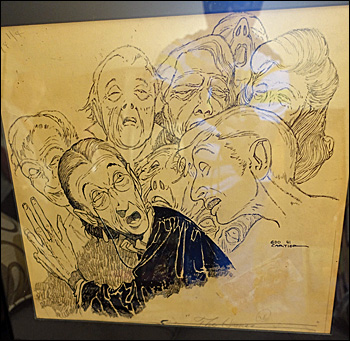
   Two weeks prior to the show, Doug Ellis and Deb Fulton visited me and I finally managed to obtain an Edd Cartier illustration from one of my favorite magazines, UNKNOWN WORLDS. In a prior convention report I had bemoaned the fact that I had missed out on a previous Edd Cartier drawing from UNKNOWN. I think this 1941 drawing showing a scene from a Jane Rice story is even better that the one I missed out on.

   
   Before I move on to more art, I would like to mention that this year’s Pulp Adventurecon was one of the best yet. 50 tables and well over a hundred attendees. No guests, no panels, no movies. Just hard core pulp collecting and book buying! Two important items made their debut at the convention: ART OF THE PULPS, an excellent book on the pulps and the artwork, by Doug Ellis, Ed Hulse, and Bob Weinberg and the third issue of the new and revived BLACK MASK.

   Matt Moring and I shared a table, and many collectors were wearing the Altus Press pulp T-shirts. These look great, and Matt has over a dozen titles available. The selection can be seen on the Altus Press website and so can the hundreds of pulp reprints that Altus Press has published.

   Though this is only a one day show, there are many unusual and rare items for sale. A couple years ago I completed my set of ALL STORY at this convention, and you can’t get rarer that that. This year John Gunnison of Adventure House, had many bound volumes of FLYNN’S and DETECTIVE FICTION WEEKLY from the 1920’s and early 1930’s. Also available from Altus Press was a complete run of ASTOUNDING, 1937-1943 which are the great John Campbell years, otherwise known as The Golden Age of SF.

   I had a couple stacks of the rare British mystery digest magazine, LONDON MYSTERY MAGAZINE. So there were some rare and collectible items. Speaking of rare items, I also saw and spoke with Bob Lesser, another pulp art collector. He says he is 94 years old! That give us all hope for the future and a reason to keep collecting even when we get old.

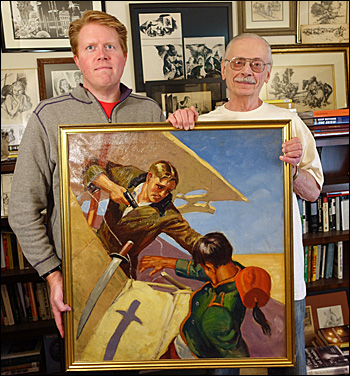
   Matt Moring and I completed a pulp cover painting trade. Here Matt is holding a cover from SKY RIDERS, 1929, that he has just traded to me. Many pulp cover paintings and interior illustrations change hands through trades.

   
   Another painting Matt traded to me: PEOPLES from 1922 and the artist is Franklin Wittmack.

   
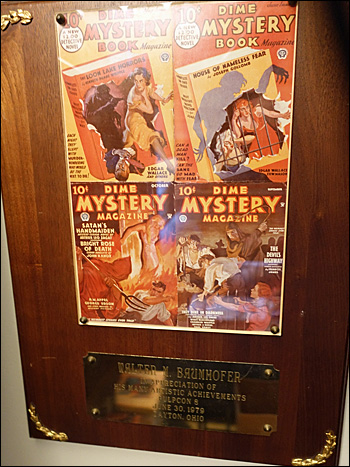
   This item is absolutely unique, and something I never thought I’d find. For decades, ever since Pulpcon started to give the Guests of Honor a plaque in honor of their work in the pulp field, I have wanted to find one of the plaques for my collection. It was the one thing that Pulpcon got absolutely right because these plaques are beautiful. I have seen many of the guests get emotional after receiving these great plaques. They always show four pulp covers and bear the guest’s name while praising them for their contributions to the pulps. This one I found out about when I read an article by David Saunders. Dan Zimmer, the publisher of ILLUSTRATION MAGAZINE, had it hanging in his office and I managed to buy it. It’s the one given to Walter Baumhofer during Pulpcon 8, 1979 in Dayton, Ohio.
   
   This is from ADVENTURE in the 1940’s. During a visit to Gerry De Ree’s house in 1989, I saw two beautiful paintings by Earle Bergey from STARTLING STORIES. Gerry had a terminal illness and was selling his collection, but the price was more than I could pay for the two Bergey paintings. He saw how disappointed I was and sold me this painting at a special bargain price. Gerry was a great collector and dealer and has never been replaced.

   
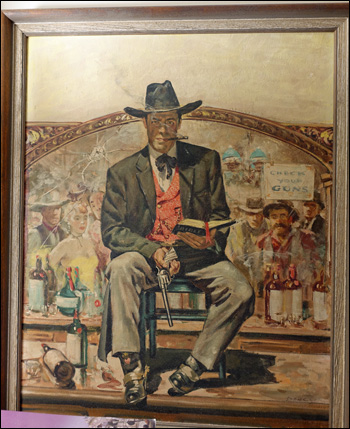
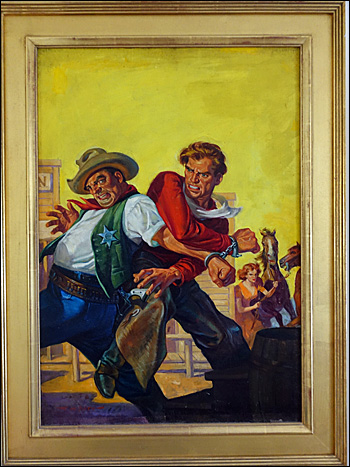
   This is a favorite of mine because of the unusual scene depicted. A sixgun preacher in a saloon forcing the boozers to listen to his sermon. I got it at an early Pulpcon for only a couple hundred dollars.

   
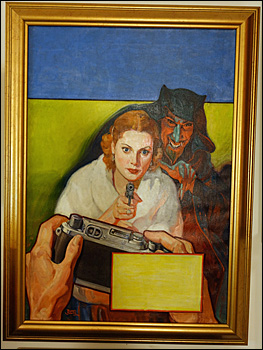
   1930’s DETECTIVE FICTION WEEKLY by Rudolph Belarski. Author Richard Sale had two popular series characters, Daffy Dill and Candid Jones. This cover illustrated the story where they meet. Artists often had to leave space for writing on the the cover. This square was for the blurb “Daffy Dill and Candid Jones, Together Again!” Many collectors would not buy this art because of the empty yellow square but I love it. Plus it made it affordable for me to buy it!

   
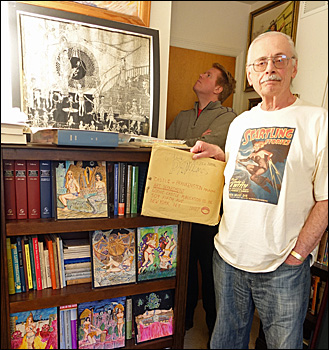
   The reason for this photo is sort of weird. If you look carefully you can see 6 small risque paintings by J. Brandt. They all are signed and were submitted in the paper envelope I’m holding to CASTLE OF FRANKENSTEIN magazine. But the publisher and editor, Calvin Beck, never used them as far as I know and never returned them to the artist.

   Now J. Brandt paints fine art and would be amazed to see his teenage paintings have survived. I consider these paintings to be sort of outsider art and of great interest as examples of unique and strange pieces of art. Most collectors would bypass these as just unpublished amateur work, but I think they are beautiful.

   
   DIME MYSTERY in the 1940’s. Many collectors have a fetish for guys or women in hoods! I love it!

   
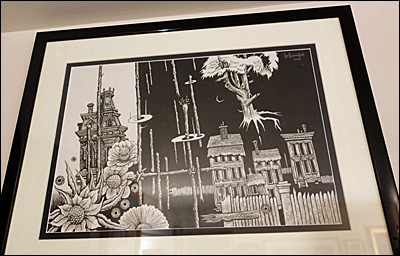
   Lee Brown Coye, one of my favorite artists, but many collectors are blind to his great bizarre talent. There have been three recent books discussing his work. This lacks the Coye weird figures but has the bizarre house and the sticks that became his trademark in later life.

   
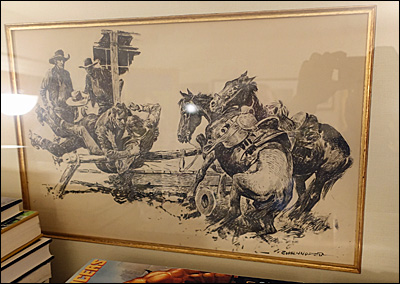
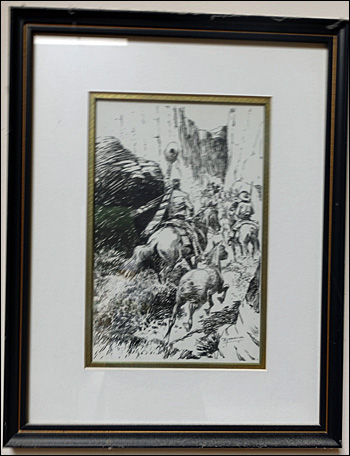
   Nick Eggenhofer is one of the greatest of the pulp artists and he did hundreds of illustrations for WESTERN STORY and the Popular Publication pulps. For many years I couldn’t find one of his illustrations that I could afford but finally in the 1980’s I found one and the floodgates have opened. I now have 9 or 10. One of the great books on the pulps is one titled EGGENHOFER: THE PULP YEARS.

   
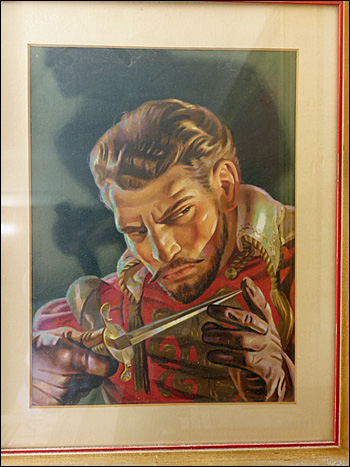
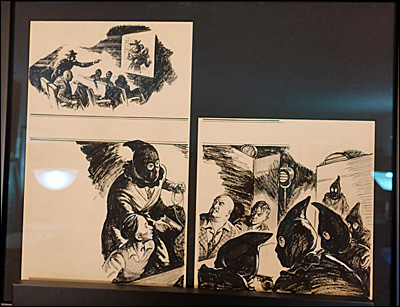
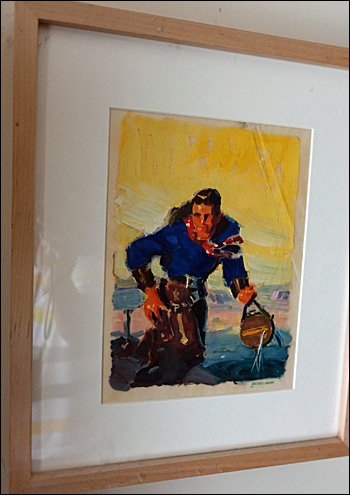
   I have over 30 of these smaller preliminary paintings and drawings like the one below, all framed by art dealer Steve Kennedy in the same type of frame. The artists were often requested to submit a preliminary sketch or painting before receiving the ok to do the finished cover painting. Many of these prelims are well done and some are mere sketches, very rough indeed. I have them in all styles, some painted like these but some drawn in pencil or ink. Most collectors do not seem to want to bother with these preliminary sketches but I like them a lot.
   
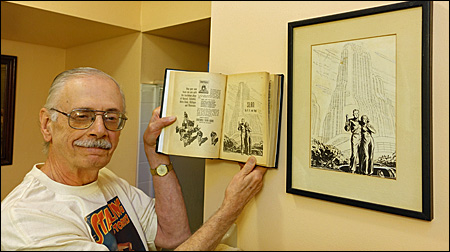
   Here I am holding up the issue of ASTOUNDING which started the serial, SLAN by Van Vogt. I obtained the drawing back in the 1970’s at the Toronto world science fiction convention. I have a total of six Charles Schneenman drawings, all from ASTOUNDING in the 1940’s. I got them for the minimum bid at the big auction. No one else was interested in bidding! A puzzle that I cannot understand. One thing about collecting art is that you eventually run out of wall space. These six drawings are hung in the master bathroom. Not a good idea but I don’t want to add them to the ones I have stacked against the wall, unable to hang them for lack of space.
   
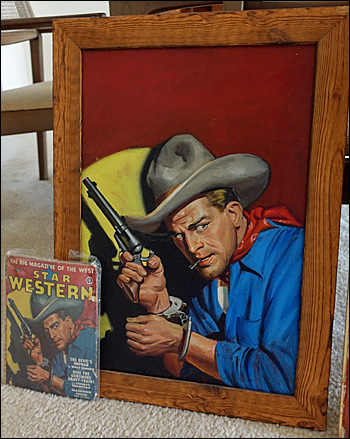
   This is a painting that I just traded to Matt Moring. Richard Lillis is the artist for this cowboy portrait from STAR WESTERN. The Lillis is the last one I bought from Steve Kennedy before his early and sudden death two years ago. He had met Lillis at an art class and they became friends even though Steve was in his 30’s and Lillis in his 80’s. They became friends and when Lillis died in his 90’s, Steve was the executor of the estate. Prior to meeting Lillis Steve was mainly a fine art dealer and knew nothing about the pulps. This friendship changed Steve’s life because he started to specialize in pulp art.
   
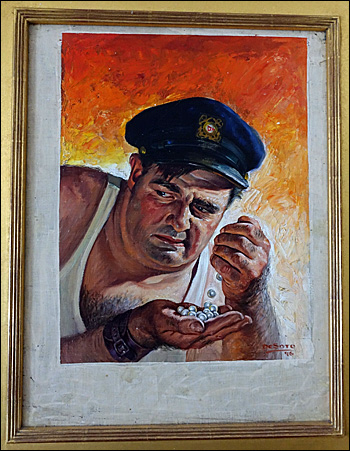
   De Soto didn’t sign many of his pulp paintings but this ADVENTURE cover is signed. Sometimes we forget that non-collectors just do not understand the collector. This is an example. I had this painting hanging in a good spot in the powder room but one year after returning from Pulpcon, my wife had moved it and replaced with a $20 Walmart decoration. I just don’t understand how non-collectors think.

   
   Charles Dye cover for ADVENTURE. Bargains are still out there. I got this from Heritage Auctions and didn’t have to pay much at all.

   
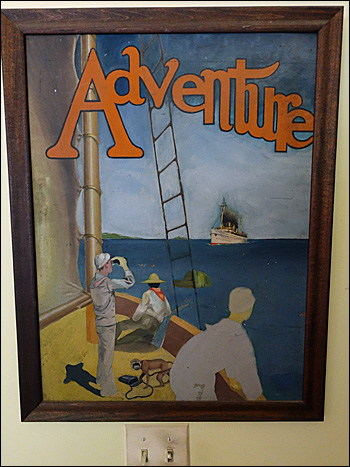
   This is an unfinished ADVENTURE cover and I guess we will never know the story behind it. It looks like it was painted in the teens which means it is a hundred years old. But why did the artist stop painting? Perhaps the editor did not like it? We will never know. And how on earth did it survive all these years. Even finished excellent paintings were often destroyed or lost.

   
   STAR WESTERN by DeSoto and I’ve owned it twice, which is not an uncommon occurrence with me. I first had it many years ago and the previous owner got it back in a trade. Then a couple years ago I got it back again. Unusual scene.

   
   This drawing by Lorence Bjorklund is representative of the ones I just bought from Paul Herman. One good side effort of the pulp brunches is that I often get art, pulps, books. These are quite interesting and were published as interiors in WILD WEST WEEKLY and WESTERN STORY.

   
   This is the room where I write these columns, surrounded by art and books.

   
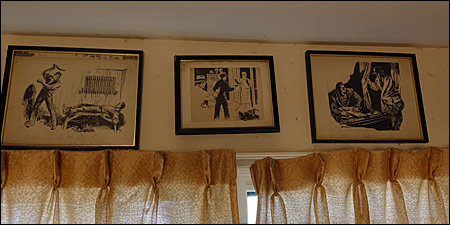
   Close up of the three Lyman Anderson drawings from UNDERWORLD. These were among the first pieces of art that I bought back in the early 1970’s. Nils Hardin had a stack of them and I picked only three. Why only three? Maybe I was broke?

   
      TO BE CONTINUED IN PART 21

REVIEWED BY DAVID VINEYARD:


CORNELL WOOLRICH
“I’m Dangerous Tonight.” All American Fiction, November 1937 (Volume 1, Number 1). Collected in (among others): The Fantastic Stories of Cornell Woolrich Southern Illinois University Press, hardcover, 1981; Vampire’s Honeymoon, Carroll & Graf, paperback, 1985. Available as a free download (various options) from www.archives.org.

    — “Señor Flatfoot.” Argosy Weekly, February 03, 1940. Collected as “One Night in Zacamoras” in Six Nights of Mystery, Popular Library #258, paperback 1950, as by William Irish. Readable online at www.unz.org.


   THE thing, whatever it was — and no one was ever sure afterwards whether it was a dream or a fit or what — happened at that peculiar hour before dawn when human vitality is at its lowest ebb. The Blue Hour they sometimes call it, l’heure bleue — the ribbon of darkness between the false dawn and the true, always blacker than all the rest of the night has been before it.

   â€œI’m Dangerous Tonight” is one of those stories that edge the fringe of the supernatural, hint, snap, and pull back from going too far, but only just. It’s almost a Janus Solution story (term coined by Frank McSherry) save the supernatural has a bit more weight than the natural.

   Like many of Woolrich’s plots, it doesn’t bear too much thinking about. The setting is Paris, where a disgraced FBI agent, Frank Fisher, is out to find Fed killer Belden, head of a dope-smuggling ring. Swirling around those events is a cursed dress that seems to make women go mad with evil, and acts as a catalyst to the events that end Fisher’s quest. Fate looms heavy, and every woman who wears the gown feels its siren’s call, “I’m dangerous tonight…”

   Fisher is bitter, guilt-ridden, and -driven. Belden is a back-shooting murderer and dope pusher, and the dress itself is simply evil. It is Gothic noir out of the Weird Menace pulps with just a hint of madness.

   There is always a rational explanation for everything in this world — whether it’s the true one or not. Maybe it is better so.

   If not in the front rank of the master’s work, this is nonetheless a fine example of the kind of power and control Woolrich could exert, grabbing the reader by the lapels and whispering of unkind and uncaring blind fate, here stalking from the fine shops of Paris to the smoky Apache haunted nightclubs, with doomed people briefly finding love and even bad men finding something worse than them moving just beyond the lights.

   No one ever wrote more convincingly of what lurked just beyond the light than Woolrich.

   I chose these two stories, not only because I read them recently, but because they could not be less alike, save the voice for both is distinctly that of Woolrich.

   Where “I’m Dangerous Tonight” suggests something ancient and evil, “Señor Flatfoot” is a straight forward action tale that was well suited to Argosy, and an example of something of the variety of Woolrich’s work, which encompassed, not only suspense and the weird, but also adventure, a hint of science fiction (“Jane Brown’s Body”),international intrigue (“Tokyo 1941”), and romance, as might be expected of anyone successful in a pulp career.

   O’ROURKE was enjoying a gin-and-lime under the arcade fronting the Plaza when the government changed on him. Or around him, whichever way you care to put it.

   â€œFlatfoot,” which incidentally was the cover story for that issue of the famous pulp, opens with the New York cop of the title in Latin America on a matter or extradition (waiting for his prisoner to get over typhoid in the local hospital), but before he can accomplish that job, he’ll find himself in the middle of a revolution amid beautiful dark eyed and passionate young women, ambitious generals with an eye for wristwatches, and up to his neck in murder.

   While fully in the Woolrich vein, the hero of “Flatfoot” could as easily have come out of Black Mask or one of those Warner Brothers movies about tough New York types in exotic locales. It’s hard not to wonder reading it if maybe you didn’t see Pat O’Brien in the film somewhere and have it stored in your memory palace as half a dozen other films.

   At times you can nearly hear O’Brien narrating.

   Things get more complicated when O’Rourke is recruited to display his skills as a detective to solve a murder that arises, not that you would think it would matter much with all the dead piling up around him.

   Of course O’Rourke ties it up all neatly:

   â€œI don’t want thanks,” remonstrated O’Rourke, wrinkling his forehead at her. “You don’t thank a duck for swimming or a bird for flying, do you? I just don’t know any different, that’s all. That’s my job; that’s why they call me flatfoot.”

   Neither story is a lost masterpiece by Woolrich (neither is reprinted much either, especially “Señor Flatfoot.”). Both are solid and entertaining pulp tales though, and each in its way shows just how much in control of the material he was as a professional. O’Rourke’s little coda could almost be Woolrich speaking. Writing was his job, and even in a lesser mode he did it well, and with an economy and skill that was admirable.

CHRISTOPHER B. BOOTH – Mr. Clackworthy. Chelsea House, hardcover, 1926.

   What I know about Booth is that he was a prolific writer for the pulp magazines in the 1920s and 30s, with just under three and a half pages of entries in Cook and Miller’s Mystery, Detective, and Espionage Fiction. These are only the detective stories. On Bill Contento’s FictionMags site, I also see a smattering of western stories for him, and these are only the tip of the iceberg, as relatively few of the western magazines have been indexed yet.

   According to Al Hubin’s Crime Fiction IV, Booth wrote ten novels under his own name, all from Chelsea House, and eight more as by John Jay Chichester, also all from Chelsea House. Also to his credit is one book on which he shared the writing duties, and that was with Isabel Ostrander, another long-time writer for the pulps.

   To point out that you can not always trust the Internet for factual information, some sites suggest that Christopher B. Booth was a pseudonym for Isabel Ostrander. Not so, even though Ostrander (who died in 1924) really was the lady behind ‘Robert Orr Chipperfield,’ ‘David Fox,’ and ‘Douglas Grant.’

   Chelsea House was the hardcover publishing arm of Street & Smith Publications, which also produced Detective Story Magazine, where most (all?) of the novels were serialized first.

   Or cobbled together out of short stories, as was the book at hand, Mr. Clackworthy. There are nine of them in this volume. Of the book which was the sequel to this one, Mr. Clackworthy, Con Man, I do not know if the same is true. Hubin in CFIV does not say yes, which may very well mean no. (I suspect the answer is yes, however.)

   Enough of the general background, I suppose. To get down to business, you should know first of all (or based on the second title, you may have already deduced) that Mr. Clackworthy was one of those protagonists so often on the wrong side of the law in the 1920s, a con man. I imagine someone could write a thesis if not a dissertation on such individuals in the world of crime fiction.

   Here is an off-the-wall question. What character in what novel(s) would qualify as the last in the line of such con men, preying mostly on the rich and unscrupulous, but not necessarily giving to the poor, of which Mr. Clackworthy does not make a general practice?

   I am not an expert, so nor will I even attempt to list any of the other characters who would fall into the category. If you can help, please do, otherwise we shall leave the matter to someone who needs a thesis if not a dissertation on their academic record. (Of course such a someone then would be also obliged to put into perspective WHY con men who preyed mostly on the rich and unscrupulous were so prevalent in the 1920s. One can guess, though.)

   As a start to such a project, it belatedly occurs to me, if you will allow such an interjection such as this, may be Yesterday’s Faces #3 : From the Dark Side, by Robert Sampson (Bowling Green Press, 1987), a rollicking account of all sorts of bad guys who inhabited the pages of the pulp magazines.

   And by the way, before it slips my mind and we head off into the review itself, I would like to point out that in the pages of Detective Story Magazine Mr. Clackworthy met another of that magazine’s regular characters, Johnston McCulley’s lisping pickpocket, Thubway Tham, on at least one occasion: “Mr. Clackworthy and Thubway Tham” (Detective Story Magazine, March 4, 1922). Even though Cook-Miller suggests that only Booth was the author, this may be the first team-up on record between two characters created first by two separate authors. (Does one count, however, Arsene Lupin Versus Holmlock Shears, by Maurice LeBlanc, Richards, 1909? One must posit some ground rules, one supposes.)

   Further investigation into the subject reveals another story of interest: “Thubway Tham and Mr. Clackworthy,” by Johnston McCulley (Detective Story Magazine, February 18, 1922, or two issues earlier). You can read this story in the recent edition of Tham thtories from Wildside Press, Tales of Thubway Tham, although in that edition the story is called “Thubway Tham Meets Mr. Clackworthy.”

   One source does suggest that the team-up was a three-part serial. This may be so, but if indeed it is, I have not yet uncovered a third tale in the triptych, and to this date, the matter rests, for now.

   Let’s get on with the review. The best way to do that, I decided the moment I started reading it, is to quote the opening paragraphs, right from the beginning:

   â€œThe greed of the human heart!” Mr. Amos Clackworthy, confidence man deluxe, sighed as he laid down his newspaper, which was folded to the want ad pages. He had been for some time engrossed in an analytical perusal of the “Business Chances” column.

   James Early, whose record at police headquarters credited him with the alias of “The Early Bird,” was standing at the window of Mr. Clackworthy’s [Chicago] Sheridan Road apartment, gazing glumly at the stream of traffic that flowed past in its usual Sunday afternoon flood. The Early Bird was a lost soul during those times when there was none of Mr. Clackworthy’s nefarious schemes under way to occupy his mind and to keep his wits sharpened.>P>

   All con men naturally work on the concept of greed, as many a Nigerian knows full well today. Booth’s prose style is not all that dissimilar to that of his contemporary (at the time), Erle Stanley Gardner, whose Lester Leith stories for Detective Fiction Weekly started out in very much the same fashion.

   Most of Mr. Clackworthy’s victims well deserve it — greedy bankers, swindlers, unscrupulous investors, and so on – getting their comeuppance in a rough and tumble sort of justice, in a naive, twinkle-in-the-eye sort of way, but even innocent banks sometimes fell afoul of his various and sundry plots and plans. (But were banks truly innocent of wrongdoing in the 1920s? Perhaps Booth’s readers did not really think so.)

   In any case, these stories were written, read and enjoyed in a different time and place. If you’re read this far into the review and other commentary, however, I see no reason why you shouldn’t read and enjoy them, too, even if no one is writing them like this any more.

— November 2005


UPDATE #1: Thanks to the eagle-eyed Monte Herridge, one of the nine stories has been identified so far. It is “Mr. Clackworthy Tells the Truth,” from the October 19, 1920, issue of Detective Story Magazine, the cover of which is shown here to the right. If and when others are identified, you will read about it here first.

   This particular story, amazingly enough, can be read online. (Follow the link.) What is interesting is that some editing was done when the story appeared in book form. Small descriptive sentences and paragraphs were removed. If you want to read the complete text, in other words, you have to go back to the primary source.


UPDATE #2. Very early on this blog, some 10 years ago now, I posted the results of my continued research into the stories in the three collections of Clackworthy stories, identifying as many as possible of the stories contained in each. (The third collection was published by Wildside Press in 2006.) You can read the post here.

DASHIELL HAMMETT – The Big Book of the Continental Op. RICHARD LAYMAN & JULIE RIVETT, Editors. Vintage Crime/Black Lizard, softcover, 28 November 2017. 752 pages.

    “Now for the first time ever in one volume, all twenty-eight stories and two serialized novels starring the Continental Op — one of the greatest characters in storied history of detective fiction.”

    What else do you need to know? I’ve been waiting for this book for almost 60 years. And now here it is, at last, all but three stories appearing first in Black Mask magazine, and all reprinted as they first appeared.


TICKET TO A CRIME. Beacon Productions, 1934. Ralph Graves (PI Clay Holt), Lola Lane, Lois Wilson, James Burke, Charles Ray, Edward Earle, Hy Hoover, John Elliott. Based on the story of the same title by Carroll John Daly (Dime Detective Magazine, Oct 1 1934). Director: Lewis D. Collins.

   According to IMDb, this is the only movie based on the work of one of the most popular pulp fiction writers of his day, Carroll John Daly. He was a pioneer in the rough and tough PI genre, but his crude writing style has relegated him to an all-but-unknown status except to fans of the field.

   Daly’s most famous character was probably a gun-slinging private eye named Race Williams. Equally violent was a hardboiled police cop by the name of Satan Hall, who in his many adventures racked up nearly as many bodies as Williams. PI Clay Holt, the featured protagonist of this movie as well as the story it was based on, had only six recorded cases, four of them for Dime Detective.

   I’ve not read any of his adventures, but I can tell you this. The movie is not very good. Not if you want anything resembling an actual detective or mystery story. The plot has something to do with some diamonds that are worth $50,000, but beyond that, I cannot tell you more.

   Most of the just over 60 minutes worth of running time are taken up by (1) Holt suddenly coming to realize that his secretary (Lola Lane), who he hasn’t paid in six weeks, is actually beautiful once she takes her glasses off and dresses up for a gala party he invites her to by default (all of the other entries in his little black book turn him down).

   And (2) the humorously antagonistic byplay between Holt and his former buddy on the police force, Detective Lt. John Aloysius McGinnis (James Burke). Without either (1) or (2), there’d be absolutely nothing to see here. Even so, the movie seems to be far far longer than its actual running time.

ROBERT BLOCH “The Cloak.” First published in Unknown, May 1939. First collected in The Opener of the Way (Arkham House, hardcover, 1945). Reprinted many times, including: Dracula’s Guest and Other Stories, edited by Victor Ghidalia (Xerox, paperback, 1972); Magic for Sale, edited by Avram Davidson (Ace, paperback, 1983); Vamps: An Anthology of Female Vampire Stories, edited by Martin H. Greenberg (Daw, paperback, 1987); American Fantastic Tales: Terror and the Uncanny from Poe to the Pulps, edited by Peter Straub (Library of America, hardcover, 2008). Film: Adapted as Part Four of The House That Dripped Blood (Amicus, 1971; reviewed here ).

   The list of places above where this small but obviously effective short story has appeared only scratches the surface, but what’s especially rewarding is seeing it progress from the pages of a 20 cent pulp magazine to a $35 hardcover from the prestigious Library of America.

   It’s one of those stories that begins, more or less, in one of those strange out-of-the-way shops that dot the side streets of the poorer sections of large cities, open for a while and perhaps only to pre-selected customers, only to disappear as mysteriously as they appeared, or to go up in flames, the owners vanished or even destroyed along with it.

   It is Halloween and a man named Henderson is looking for a costume. The shop owner in this case offers him the cloak — not a cloak, but the cloak — and once Henderson puts it one, he is a new man — or is he?

   What he definitely is is the center of attention at the party he attends that night. He is attracted to the neck of his fat host. Most positively attracted to him is a girl dressed as an angel — or is she?

   Told in Robert Bloch’s invariably easy to read writing style, the reader is always one step ahead of the main protagonist, until, that is, he meets the girl above, named Sheila, and once she is met, you are not exactly sure which way the rest of the tale is going to go. You think you do, but you’re not quite sure. Exactly where you should be at this stage of a story well told.

   I’ve asked Dick Etulain, the author of the following book to tell us more about it. He’s most graciously agreed:

RICHARD W. ETULAIN – Ernest Haycox and the Western. University of Oklahoma Press, hardcover, illustrated, 2017.

   This book attempts to resurrect writer Ernest Haycox as a major figure in the development of the fictional Western. It is not a biography; Haycox’s son, Ernest Haycox, Jr., does that in his smoothly written book On a Silver Desert: The Life of Ernest Haycox (2003). Nor is it primarily a work of literary criticism. That book is available in Stephen L. Tanner, Ernest Haycox (1996).

   Rather, my book is a work of literary history, tracing Haycox’s literary career from its origins in the early 1920s to his death in 1950.

   Born in 1899 and reared in Oregon, Haycox contributed to high school publications and then to college outlets at Reed College (1919-20) and the University of Oregon (1920-23). By graduation, Haycox had published several stories in pulp magazines. Hoping to establish strong links to fictional outlets in the East, Haycox traveled to New York City, where he met editors important to his career in the 1920s. Meeting Jill Marie Chord (also from Oregon) on the train east, they married in New York City but soon returned west to Portland, which would be the Haycox home for the remainder of his life.

   By the end of the 1920s, Haycox was a steady contributor to many pulp magazines, including such stalwarts as Adventure, Short Stories, and Western Story Magazine. In 1928, he published his first full-length serial, which appeared the next year as Free Grass, his first novel. In the opening 1930s, Haycox made his first appearance in Collier’s and remained a steady contributor for almost twenty years.

   Hoping to move to the top of writers of Westerns, Haycox experimented with several new wrinkles to chosen genre. He created reflective protagonists (“Hamlet heroes”) and dark and light heroines (passionate and reserved women).

   Even more important, he began to turn out historical Westerns, infusing his lively fiction with historical backgrounds such as building the transcontinental railroad, fighting Indians in the Southwest, and settling Oregon. His most notable historical Western was Bugles in the Afternoon (1944), a fictional recreation of Gen. George Custer and the Battle of the Little Bighorn.

   Immensely successful, Haycox was nonetheless dissatisfied with the restrictions of the Western and entered a period of revolt in the last half-dozen years (1944-50) of his career. Abandoning lucrative serial markets, he set out to write first-rate historical fiction. His best historical novel, The Earthbreakers (1952), appeared two years after his death.

   Talented, ambitious, and driven, Ernest Haycox became a major figure in popular fiction written about the American West. Haycox’s continuing growth, gradual but steady, amply demonstrates an author determined enough to defy popular demands and honest enough to write novels consistent with his changing literary beliefs.

LESLIE T. WHITE “Tough Guy.” Reprinted in Alfred Hitchcock Mystery Magazine, September-October 2017. This issue’s Mystery Classic, selected and introduced by Jim Doherty. First published in Liberty, 21 June 1941. Reprinted in Liberty Quarterly: 19 Tales of Intrigue, Mystery & Adventure (Vol. 1, No. 1, ca. 1950).

    In his introduction to this story, Jim Doherty makes a solid case for Leslie White as one of the very first practitioners of the police procedural novel. Up for discussion in particular are Me, Detective (1936), a biographical account of White’s own career, Harness Bull (1937), and Homicide (1937).

    Most of White’s work was done for the pulp magazines, producing as he did well over 100 short stories for that market, beginning with “Phoney Evidence” in The Dragnet Magazine, January 1930. To substantiate his case, Doherty describes some of White’s career in police work, and how he used it to give all of his crime fiction a solid, believable setting.

    “Tough Guy” was written toward the end of his pulp fiction days, and that’s even a stretch, as Liberty magazine was not really a pulp. It’s the story of a tough cop named Gahagan who lives for nothing other than his job, a primary part of which is nailing a notorious killer and crime boss by the name of Danny Trumbull.

    Things go awry in his life when the trail leads him to Trumbull’s eight-year-old daughter Penny, who lives alone with her father but who has no idea how totally bad he is. This one starts out in full tilt pulp mode, but by the end, it’s become, as you might have expected, a long way from being a hard-boiled tale of a tough guy cop. Quite the opposite.

    Which does not make it a bad story, by any means. In fact, I enjoyed this one more than any of the other twelve stories in this latest issue of AHMM, many of them (to my mind) rather weak efforts and/or not interesting to me. It’s starting to get difficult to justify spending $7.99 an issue for a magazine that I can’t get excited about any more.

« Previous PageNext Page »