Pulp Fiction


STEVE FISHER “You’ll Always Remember Me.” Short story. First published in Black Mask, March 1938. Reprinted in Best American Noir of the Century, edited by James Ellroy & Otto Penzler (Houghton Mifflin Harcourt, 2010).

   When you think of “juvenile delinquents,” what probably comes to your mind first (well, it does mine) are the gangs of young hoodlums who obsessed the country everywhere in the 1950s, largely in big cities but small towns in the middle of nowhere as well.

   Well, what this this story does is to remind you that kids could be bad in earlier time periods as well, but maybe only without the accompanying gangs. The young 14-year-old narrator of “You’ll Always Remember Me” is, for example,  as bad as they come.

   It seems that the older brother of the girl that Martin Thorpe is seeing is about to be hanged for the killing of their father, and he’s run out of appeals. It won’t matter if I tell you that it won’t long for you to decide who really did it. The only question is, is he going to get away with it?

   You’d think that another mysterious, unexplained death would be enough for one story that’s only 18 pages long (in the hardcover reprint anthology), but what I found really chilling was the death of a very sick kitten. I guess it’s all in perspective. One thing’s for sure. The title is absolutely right on.

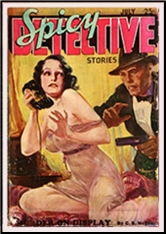
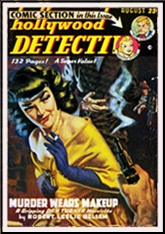
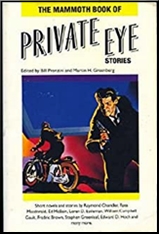
ROBERT LESLIE BELLEM “Diamonds of Death.” Dan Turner #2. Published in Spicy Detective Stories, July 1934. Reprinted in Hollywood Detective, August 1950, and in The Mammoth Book of Private Eye Stories, edited by Bill Pronzini and Martin H. Greenberg (Carrol & Graf, 1988).

   I think that the best way to review a Dan Turner story may also be the easiest. It could even reflect the only reason for anyone to read a Dan Turner story. Simply quote passages from the story, taken here and there at random. Like this:

   Mitzi was a gorgeous taffy-haired morsel, dainty as a Dresden doll in a combed wool ensemble. It was about ten-thirty at night when she ankled into my apartment, making with the moans regarding an alleged fortune in sparklers which she said had been glommed from her dressing bungalow on the Supertone lot. Now, as I slipped her the brush-off, her blue glims puddled with brine.

         […]

   I fastened the speculative focus on her; wondering if she was leveling or feeding me a line of waffle batter.

         […]

   The defunct ginzo lay sprawled behind a big wheel-of-fortune on the far side of the set, where you wouldn’t notice him unless he was pointed out to you. … [He’d] been handsome until some sharp disciple carved in his cranium with a blunt instrument. Now his scalp was messy with shattered bones and coagulated gravy, and he was deader than canceled postage.

         […]

   Max took a wild swing at the wren’s rod. Maybe she actually hadn’t meant to discharge it, but the impact of Murphy’s mitt made her trigger finger jerk. Ka-Chow! and a tongue of flame licked at the prop man, a bright orange flash of fire that streaked across the set and stabbed him in the thigh. He staggered and went down in a writhing heap.

         […]

   Maybe he wasn’t planning to paste a haymaker on my dimple; I couldn’t tell. But I remembered the last dose of knuckle tonic he’d doled me; my bridgework still ached from it, all the way to the shoestrings. On a lug like Max you couldn’t afford to take chances.

   Me again. I submit to you that prose like this is the work of genius.


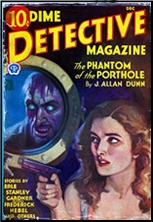
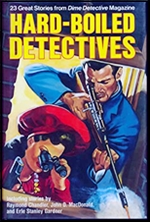
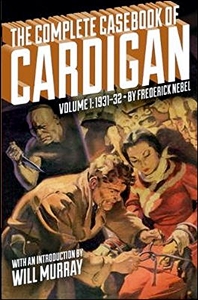
FREDERICK NEBEL “Hell’s Pay Check.” Cardigan. Novelette. Published in Dime Detective Magazine, December 1931. Reprinted in Hard-Boiled Detectives, edited by Robert Weinberg, Stefan R. Dziemianowicz and Martin H. Greenberg (Gramercy, 1992). Collected in The Complete Casebook of Cardigan. Volume 1: 1931-1932. Altus Press, February 2012).

   From the second paragraph in this story, we learn that Cardigan is “a big, shaggy-headed man with a burry outdoor look,” getting off a train wearing “a wrinkled topcoat” and “a faded fedora that had seen better days.” He’s in Indianapolis on a case, but his home office, that of the Cosmos Detective Agency, is in New York. He comes with a reputation that the local cops are aware of, but it also helps to be working with an agency that has some clout. Local cops are not at all leery about pushing around independent operators.

   His job in “Hell’s Pay Check” is to help the mayor retrieve a check that he paid to a “notorious woman” on behalf of his son, a check that she didn’t cash at a bank; she seems to have gotten paid by another party who has kept the check. If it gets into the wrong hands, the mayor’s career is over.

   The story begins with a bang, and never stops moving. He’s picked up at the railroad station, but when he gets into the mayor’s car, he quickly realizes that the chauffeur is a phoney. A subsequent car chase through the back streets of the city leaves the driver dead, shot to death by his fellow gang members, who think he has turned on them.

   If you’re looking for a hard-boiled detective at work, you need not go much farther than any of Cardigan’s cases, and this is a prime example. He has a nose for trouble, and likewise trouble is never very far behind him. Nebel’s prose has a ferocity and drive to it that simply can’t be matched. Luckily for us,  all of his cases have now been published in total by Altus Press (now Steeger Books) in four thick handsome volumes.


FREDERICK NEBEL Cardigan

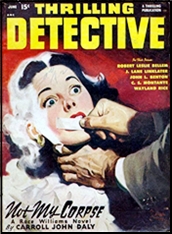
CARROLL JOHN DALY “Not My Corpse.” Race Williams. Novella. First published in Thrilling Detective, June 1948. (Cover by Rudolph Belarski.) Reprinted in The Mammoth Book of Private Eye Stories, edited by Bill Pronzini and Martin H. Greenberg (Carrol & Graf, 1988).

   Race Williams had a long career in the pulp magazines, ranging in time from 1923 to 1955, and he showed up in a few book-length adventures as well. He was a tough guy with both his fists and his guns, and he wasn’t afraid to show it. If Mickey Spillane didn’t read Race Williams’ adventures before coming up with the idea for Mike Hammer, I’d be awfully surprised.

   In his heyday, all through the 1920s and early 1930s, Carroll John Daly was one of the hottest PI writers around. By the time “Not My Corpse” appeared, in June 1948 issue of one of the lesser detective pulp magazines, his luster had faded considerably, and Race Williams’ antics had tamed down considerably – but not completely, and it’s still a cracking good yarn.

   After a series of young girls have been tortured and killed, Race decides that the common factor connecting them is that they inadvertently saw something they shouldn’t, and that the killer is tracking them down, one by one, going from one to the next. A solid tip suggests that one more girl is going to be the next victim, and Race is determined to stop him.

   There are flashes of good writing in this tale, with memorable turns of phrasing, and Race is his usual cocky, confidant self, which is all to the good. The plot is a little rickety, though, and there’s too much that’s never hinted at as to the killer’s actual motive; it takes a flood of details on his dying bed before the whole story is told.

   A mixed bag, in other words, but while Carroll John Daly is often given a bad rap today as a lousy writer, he wasn’t.

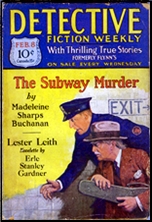
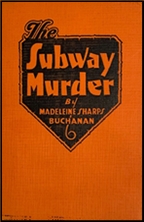
MADELEINE SHARPS BUCHANAN – The Subway Murder. NYPD Homicide Lt. Ransom #1. Serialized in five parts in Detective Fiction Weekly, February 8 through March 8, 1930. Hardcover editions: A. C. McClurg & Co., 1930; Grosset & Dunlap, no date stated.

   If Lieutenant Ransom was given a first name in this better than average detective novel, first serialized in the pulp magazine Detective Fiction Weekly, I seem to have missed it. It’s also quite possible that this was not his first and only appearance in print, but I can’t find a reference to a later case he was involved in, or even an earlier one.

   I’ve not been able to research this, but The Subway Murder may actually be the first defective mystery in which the victim is killed in a subway, as Ransom briefly wonders to himself early on. Given that the Manhattan subway system opened in 1904, though, there’s a good chance that another author came up with the same idea before Mrs. Buchanan did.

   The dead girl is a young woman of no great beauty, and it takes Ransom and Jim Pensbury, his chief aide, some time to identify the body. What they discover astounds them. The woman had led two lives, married, in fact, to two different men. One is a lowly salesman for a hosiery firm; the other is a rich millionaire, who does not at first recognize the woman, she is so poorly dressed.

   It is quite a puzzle, then, that faces Ransom and Pensbury. It takes a lot of legwork on their part, and any number of interviews with people with whom they come in contact, all somehow connected with the case, which is a deliciously complicated one.

   There is also a matter of $70,000 worth of radium that has gone missing, so there’s plenty to plot to keep the reader interested all the way through, with only an ending that feels a little flat. No big twist at the end, in other words, just a matter of good police work that slowly but surely eliminates all of the possible solutions, one by one, until there is only one left.

   Madeleine Sharps Buchanan, the author, had only seven novels published in hardcover, but she wrote several dozen others that were serialized in pulp magazines such as DFW, Clues, and Detective Story Magazine. There’s probably little hope of putting together a set of consecutive issues of any of them to put a full novel together. On the other hand, you could hunt down the novels in book form, but for example, there are only two copies of the hardcover edition of this one now offered for sale online, the lowest asking price (on eBay) being just under $100. I’d like sample her work a little more, but it looks like it may be a bit of a challenge.

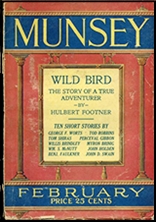
TOD ROBBINS “Spurs.” First published in Munsey’s Magazine, February 1923. Collected in Who Wears a Green Bottle? And Other Uneasy Tales (Philip Allan, UK, 1926). Reprinted in Best American Noir of the Century, edited by James Ellroy & Otto Penzler (Houghton Mifflin Harcourt, 2010), as well as several other anthologies. Film: Freaks (1932; produced and directed by Tod Browning).

   There is no doubt that the Tod Browning’s notorious cult film Freaks is far more known than the short story it’s based on. The film takes the basic story and expands on it by a magnitude of three or four, if not more, but the story itself still manages to hold its own as a small gem of comeuppance and pure edginess.

   To wit: When a dwarf in a traveling sideshow inherits a small fortune from an uncle, he decides it is full time he declared his love for the star of the circus’s high wire act, a veritable Amazon of a woman. To perhaps the reader’s surprise, if not Jacque Corbeé’s, who in spite of his size, is superbly confidant that she will say yes, she does indeed. Say yes, that is.

   Of course it is his money she is after, but fate being what it is, things do not progress anywhere near what she envisions. The other members of the circus — freaks, if you will – play only a secondary role in the story, mostly during the dinner after the wedding, in which a small melee breaks out – each of the participants convinced that the success of the show depends largely to their presence in it.

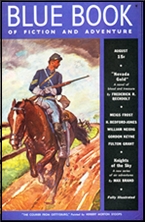
MAX BRAND “The Flaming Finish.” Short story. First published in Blue Book, August 1938. Not known if ever reprinted.

   Even though I’d have to say that Max Brand is my favorite western writer, I haven’t read anything by him in quite a while. That’s why when I was going through some old pulp magazines last week, it really caught my eye when I saw that he had the lead story in the August 1938 issue of Blue Book.

   It turns out that “The Flaming Finish” is of note because while Max Brand under his many pen names had already written hundreds of thousands of words for the pulp magazines, this was the first story he wrote for Blue Book. And while he was most noted for his western stories (see above), this is the first I’ve come across that’s been an aviation story.

   It takes place during the Spanish Civil War (1936-39), but it’s really a nostalgic tribute to those air pilots who fought during World War I, when aviators (true or false) had a certain camaraderie, if not outright chivalry or a code of honor used as the basis for their battles in the air against each other. When one such pilot in this story crashes to the ground and is captured, his opposite partner in the air returns him to his home base instead of killing him on sight, as he had every reason to.

   I don’t know enough about the aviation pulps to know how long in time that stories celebrating this code of honor lasted, but I’d like to think this one was one of the final ones, and Brand made its length of only seven pages fly by. Pun intended.

PostScript: A blurb on the cover of the magazine announces this as the first of a “new series of air adventures” under the overall title of “Knights of the Sky.” I don’t know if the following all fall into that category, but here’s a list of the next few followup stories Max Brand did for the magazine:

      Last Flight, The Blue Book Magazine September 1938.
      The Return of the Man Who Was Killed,  The Blue Book Magazine October 1938.
      True Steel,  The Blue Book Magazine February 1939.
      Half a Partner, The Blue Book Magazine March 1939.

CON REPORT:
Pulp AdventureCon, November 6, 2021
by Walker Martin

   I’ve attended all these annual Pulp Adventurecons, over 20 of them, most of them in Bordentown, NJ (there also is a Florida show which I’ve never been able to attend). The first one was in the woods somewhere at a firehouse. Several of us got lost trying to find it. I remember there being maybe ten tables and about 50 attendees, maybe less.
Left to right: Nick Certo, Paul Herman, Richard Meli, Digges La Touche.

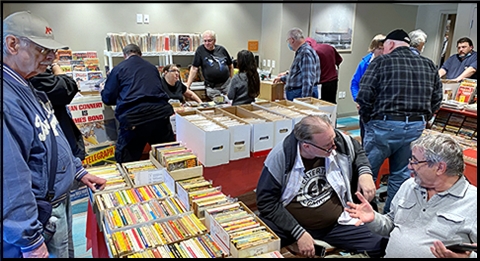
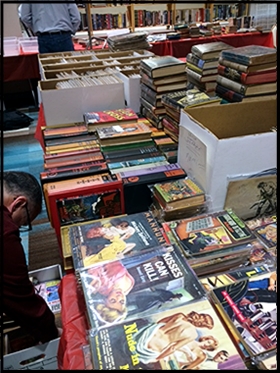
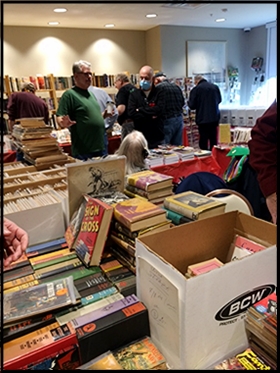
   But it certainly has grown! This year the show was held in a new hotel in Bordentown, and I liked the new venue though I wish the dealers were all in one big room instead of two smaller rooms. There were over 40 tables and what looked like well over 100 attendees. I was happy to see the hotel had free coffee and egg sandwiches available in the morning.

   A year ago I reported on the show held in November 2020 (Book Hunting during the Pandemic) and I received some negative criticism on one of the online discussion groups. But my entire life has been consumed by my desire to collect books and pulps, not to mention original cover and interior art.

Left to right: Ed Hulse, Steve Lewis.

   I’ve been a bibliomaniac now for over 65 years ever since I discovered Edgar Rice Burroughs, Erskine Caldwell’s Signet paperbacks with the sexy James Avati covers, and the SF digest magazines. I’m not going to go into hiding because of the virus. In fact what better death for a book collector than to die hunting for collectible books, vintage paperbacks, pulps, and artwork? With that attitude, I guess that’s why I have a large collection.

   Last year the hotels were requiring masks and social distancing, but this year masks were optional and we all happily squeezed into the two rooms and bought and sold books, magazines, and DVDs.

   Though this convention is a one day show, it feels a lot longer. Each year it seems to last several days. To give you an idea I will briefly list each day’s events at my house:

      Wednesday, November 3

   Matt Moring of Steeger Books has for several years arrived on Wednesday before the Saturday convention. He does some research for upcoming books, and we meet for dinner. There are plans for a special Thanksgiving sale, and he soon will announce the upcoming publication of around 40 new volumes in the Steeger Books reprint series.

Left to right: Scott Hartshorn, Nick Certo.

   That’s right, 40 new books! This has to mean that Matt has published over 500 books in the last few years. If not 500, then very close to it. There will be new books in the Dime Detective Library, the Argosy Library, and important releases reprinting Talbot Mundy, The Spider and others including perhaps H. Bedford Jones. There will be a great release coming soon dealing with The Campfire letter column in Adventure.

      Thursday, November 4

   Richard Meli and Scott Hartshorn arrive from Florida. I’ve been friends with Scott since 1976 when he was a teenager and thought I was an old man even then at age 34. He must think I’m really old now. Scott is a long time art and book collector with a love for film noir movies, a passion I share.

   Richard Meli is the man behind Heartwood Books and Art and also happens to be a physician. I mention this because every book convention should have a doctor on call in case an elderly collector collapses or faints from the terrific stress of trying to buy every damn book and pulp magazine in sight.

   Actually I thought Rich Meli might keel over since he bought so much and was so excited. Maybe we need two doctor/collectors, in case one collapses, the other could care for him. There were now five of us and we had lunch and dinner together.

      Friday, November 5

   This is the day of my annual brunch that I host every year just prior to the Bordentown convention. I can’t handle a big crowd of insane book collectors, so I try to keep attendance at around ten. I used to have hoagies, potato salad, chips and beer and soda but I couldn’t depend on the delis to have the food ready for Friday at 1:00 pm, so the last couple years I’ve ordered pizzas for everyone except for one collector who hates pizza. So I ordered a steak sandwich and fries for him.
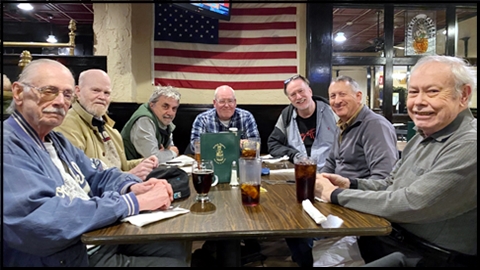
Left to right: Walker Martin, Digges La Touche, Nick Certo, Ed Hulse, Scott Hartshorn, Paul Herman, Steve Lewis

   During this brunch, a lot of selling and buying goes on. To give you an idea, this year a nice condition set of Thrilling Wonder changed hands. Also nice sets of the Ziff Davis Amazing and Fantastic Adventures, two sets of Planet Stories, a nice stack of All Western and many individual issues of detective and western pulps.

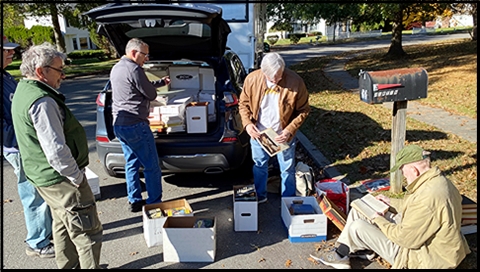
   In fact the weather was so nice and sunny that we were buying books and pulps outside at the curb in front of my house and out of the back of cars and pickup trucks. Two of my neighbors were walking by and commented on the mass of books and magazines on the grass and sidewalk. I’ve known them 25 years and little did they know I also had a house full of books! Non-collectors just don’t know the true insanity of collectors.

   Then after 5 pm we all met at Firkin’s Tavern for dinner. Matt Moring has sent some photos showing us in the Irish pub. In addition to myself, also in attendance were Matt Moring, Nick Certo of Certo Books, Scott Hartshorn, Ed Hulse of Murania Press, Digges La Touche, Paul Herman, book seller, Steve Lewis of Mystery*File, Richard Meli of Heartwood Books and Art. My wife, being a non-collector was absent because so many collectors in the house at one time freaks her out.

      Saturday, November 6

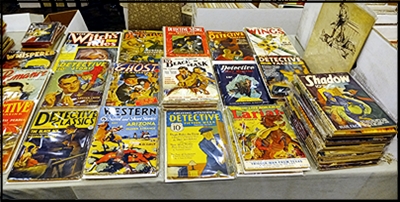
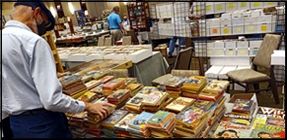
   The day of the convention! Matt Moring picks me up at 8 am and we arrive at 8:30. Matt quickly sets up five long boxes of pulps, all priced at only $5.00 each, easily the bargain of the convention. John Gunnison and his wife were already set up with what looked like five tables of pulps or an entire wall of the room. Cowboy Tony was there with three tables of all sorts of paper products: pulps, fiction digest magazines, slicks, comic strips, men’s adventure magazines and risque magazines.

   
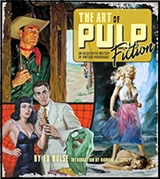
   Ed Hulse was selling his brand new book on vintage paperbacks: The Art of Pulp Fiction. Martin Grams had his usual tables of DVDs, Paul Herman had hundreds of vintage paperbacks. Gary Lovisi and his wife were selling his excellent magazine Paperback Parade. Nick Certo had books and paperbacks. This is just a sample of the books available. There were many more dealers. After the convention closed at 5 pm, many of us ate dinner at Mastoris Diner, another long time tradition.

   The people behind this long running show are Rich Harvey, Audrey Parente, and Rich’s father was taking care of admissions. Thank you for your efforts and usual fine job!

      Sunday, November 7

   Matt and I went out for breakfast and we talked about a possible art trade but we couldn’t reach agreement. Maybe next year.

      Monday, November 8

   Scott Hartshorn and Digges La Touche met me for breakfast and afterward we took Scott to the airport.

   So ends another Pulp Adventurecon. See you at Windy City and Pulpfest!
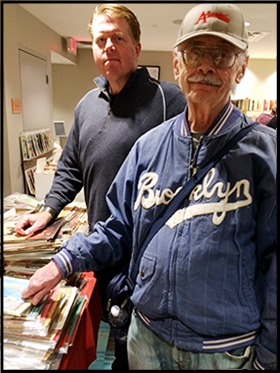


From left to right: Matt Moring, Walker Martin.
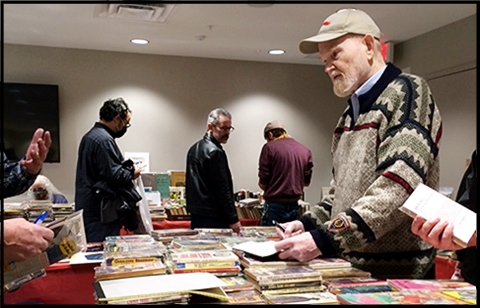
   

Digges La Touche.
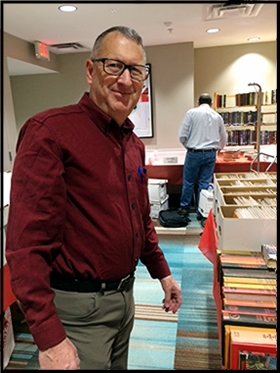
   

Paul Herman



Andy Jaysnovich
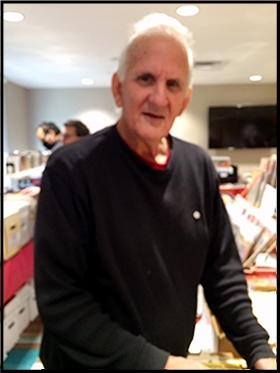
   

Gary Lovisi
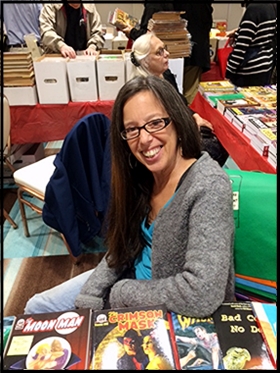
   

Gary’s wife Lucille

WINDY CITY PULP CONVENTION 2021 REPORT
by Walker Martin


   A group of about five collectors have been making this trip out to Chicago for over 10 years but this year only three of us made the two day drive out to the convention. One of our group could not make it due to pandemic restrictions and one hurt his back moving bookcases just prior to the show. This injury was especially sad since he always looks forward to the pulp shows and has been attending them since the second Pulpcon in 1973.

   We had nice weather driving to and from the show and enjoyed several meals together, especially the ones at the Outback and Longhorn Steak House. The three of us discussed several topics during the drive, including memories of past Pulpcons and my adventures at the first one in 1972, a mere 50 years ago. Somehow it feels like only the other day that I drove out to St Louis and discovered so many great friends and great pulps.

   In fact we often hear about people entering their second childhood if they live long enough, and the same rule applies to pulp and book collectors. For instance back in the 1980’s I got rid of my almost complete set of G-8 and His Battle Aces and here I am 40 years later buying a complete set of the 110 issues again. I imagine I will dislike Nippy and Bull just as much as I did decades ago, but I also love the great insane covers just like I did so long ago. Thanks Doug. Just what I needed, another set of G-8 to complain about.

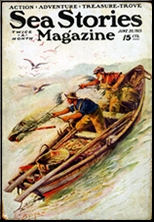
   What else did I buy? I have an almost complete set of Sea Stories, over 112 issues and I’ve always wanted an original cover painting. Thanks to Doug (again!) I bought the painting for the cover of the June 20, 1923 issue. True, this is not a great one like the ones Anton Otto Fischer painted, but then again I probably cannot afford such great art anyway.

   I’ve been buying paperback cover art by Larry Schwinger for over 30 years, starting in 1989 with two Cornell Woolrich covers. This convention I bought another one, a real bargain at only $100. But my old pal Scott Hartshorn beat me to another bargain by Schwinger, the cover to Hombre by Elmore Leonard. I tried to immediately buy it from Scott, but he’s so greedy that he refused my offer.

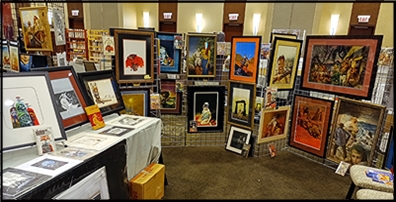
   I also bought some books including 3 volumes of the R.A. Lafferty collections presently being published by Centipede Press. They plan to publish 12 volumes but the print runs are only 300 each, so they go out of print fast and are expensive to find. Speaking of books, Ed Hulse had an advance copy of his new history of vintage paperbacks. Go to the Murania Press website to order. The book has over 450 paperback covers in color and will be shipping starting September 28. The title is The Art of Pulp Fiction: An Illustrated History of Vintage Paperbacks.

   There were some paintings I wanted to buy but I talked myself out of buying them because I have no space and I don’t want to add to the stacks of art leaning against the walls and bookcases, a common problem that collectors face as they accumulate art. Fred Taraba had a great Frontier Stories cover painting from 1925 and Craig Poole had a McCauley from Amazing Stories but I manage to escape the show without adding to the stacks of art.

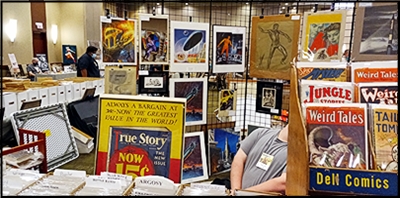
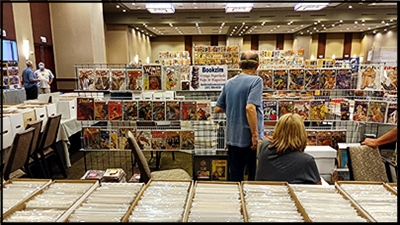
   During the old days of Pulpcon in the 1970’s, 1980’s and 1990’s, there were often what we called “feeding frenzies”, where the entire dealer’s room seems to swarm around certain tables with rare and desirable pulps. This no longer happens that often but it did at this Windy City show. Andrew Zimmerli had several tables crammed with hundreds of rare old pulps.

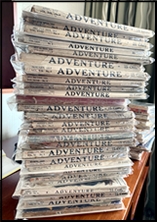
   To give you an example of what happened, Matt Moring missed the first day of the feeding frenzy but still managed to find around 50 old Adventure’s that he needs, mainly from the hard to get teens. He now only needs 40 or 50 issues to complete the set of 753 pulp issues, 1910-1953. Non-collectors may not understand this but believe me it is a major achievement.

   Doug Ellis mentioned to me that attendance was 500 and there were 168 tables. Despite the pandemic, these are excellent numbers. Masks were required, maid service limited and restaurant hours limited. The auction was the main event for Friday and Saturday evening. In the old days’, Rusty Hevelin believed the comic book dealers should by banned from Pulpcon, but we live in The Brave New World today and so the comic book influence was evident. For instance the so called “bat girl” cover of Weird Tales sold for $11,000 and there were conversations about “slabbing” pulps.

   This is the future where we will see rare and expensive pulps slabbed like many comics in plastic. Readers Beware!! I guess we will have to change the old saying, “So many books, so little time” to “So many books, but since they are enclosed in plastic, we have plenty of time”. The “slabbers” say only the expensive books will be slabbed and there will be reprints to read but to me slabbing books is still sacrilege. I get it about slabbing baseball cards but pulps and books?

   The auction also included over 300 lots of other Weird Tales, rare pulps, Robert Howard items, and correspondence, including some great letters from Farnsworth Wright, the editor of Weird Tales. Most of the items were from the estates of Robert Weinberg and Glenn Lord.

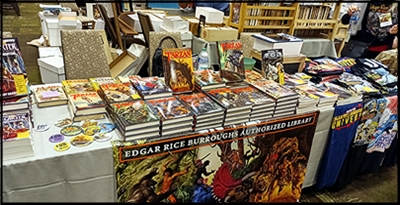
   There were two panels. The Friday night panel discussed upcoming books by Edgar Rice Burroughs and the Saturday night panel discussed the magazine, Black Mask. I talked about how I managed to complete a set of the 340 issues back in the 1970’s and fellow panelists also discussed the Joseph Shaw era and the Ken White years of 1940-1948. The other three collectors on the panel were long time collectors John Wooley, Will Murray, and Matt Moring. We had to be tough and hard boiled to talk about such a subject in only 45 minutes!

   There was the usual art show and films. This year Ed Hulse ran the films only during the day and not at night or after the auction. As usual Sunday was New Pulp Sunday with panels discussing the subject. The 20th edition of Windy City Pulp Stories was excellent and all 158 pages dealt with Black Mask and Dashiell Hammett. This is a must buy if you have any interest in pulps or Hammett.

   The next Windy City Pulp show will be May 6, 2022 through May 8, 2022. Same hotel and hosted as usual by Doug Ellis and John Gunnison. Thank you for your efforts. I know a lot of work went into this convention. Thanks too to Paul Herman and Matt Moring for allowing me the use of the photos they took for this report. I hope everyone survives the plague and that we all meet again next year!

« Previous PageNext Page »