Pulp Fiction


REVIEWED BY RAY O’LEARY:


MAXIM JAKUBOWSKI, Editor – The Mammoth Book of Pulp Action. Carroll & Graf, trade paperback, December 2001.

   There was only one story, Fredric Brown’s classic “Don’t Look Behind You,” that I’d read before in this solid anthology of what the editor calls Pulp Fiction though not all the stories were published in the pulps. Since there are too many to go through one by one, I will just comment on some of them.

   The volume opens with Erle Stanley Gardner’s “The Kid Clips a Coupon,” which features The Patent Leather Kid (a sort of Simon Templar/Raffles type character), who manages to steal $70,000 while clearing an innocent man of murder. Though Gardner wasn’t much of a prose stylist, I find his stories featuring minor series characters like the Kid or Lester Leith compulsively readable.

   “Motel” by Evan Hunter seems to be added for the author’s name value since the only action in it is the pounding on the motel room’s walls by the guy in the next room. It’s three chapters depicting the beginning, middle and end of an adulterous relationship, and should be in The Mammoth Book of Adultery if/when that’s published (or maybe Carroll & Graf already has in the five years since this one came out). Judging by the long list of other Mammoth Books listed in the beginning, it’s only a matter of time.

   “Burn, Corpse, Burn” by Bruno Fischer, despite its lurid title, is a sad, sentimental supernatural tale about a lonely man who sees the body of a young woman floating in the water while ice fishing. “The Pulp Connection” by Bill Pronzini has his Nameless sleuth solve the murder of a man killed in the locked room containing his pulps. Not only is this a homage to John Dickson Carr but also to Ellery Queen since the victim leaves a “dying message” clue.

   “Caravan to Tarim'” by David Goodis is a pretty good Arabian adventure story rather than a crime tale per se. “The First Five in Line” is the opening twenty pages of an unfinished novel by Charles Willeford. Intriguing is the word. “Where There’s a Will, There’s a Slay” by Frederick C. Davis has a man returning to his home town to open a factory, trying to solve the murder of a lawyer friend and. confronting a nest of vipers.

   “Dog Life” by Mark Timlin is the only story written for volume. A man avenges the murder of a petty crook/informant though his motive and identity isn’t revealed. Finally, “The Pit” by Joe R. Lansdale is about a small town of redneck types who kidnap any strange men of a certain age who pass through, hold them prisoner while training them and pit them against each other in an unarmed fight to the death.

   There are quite a few more stories that are well worth reading in the 630 pages of this fat paperback.
— Reprinted from The Hound of Dr. Johnson #44, March 2006.

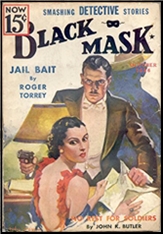
JOHN K. BUTLER “No Rest for Soldiers.” Novelette. Published in Black Mask, October 1936. Not known to have been collected or reprinted.

   It was one of John K. Butler’s Steve Midnight stories in Ron Goulart’s Hard Boiled Dicks (1965/67) that was one of the first pulp detective tales that I ever read. Midnight was a Los Angeles-based cab driver who kept running into dead bodies, and the name of the story was “The Saint in Silver.” I don’t know why, but while the rest of the stories in Goulart’s groundbreaking anthology have faded into memory, on an individual basis, the Steve Midnight story has stayed with me ever since.

   Even though Butler’s name has been long forgotten by everybody else, he wrote well over a hundred stories for the pulps before going on to the movies and TV, with (according to IMDb) 69 credits. What this tells me, more than anything else, is that he could produce vivid, well-constructed storylines meant to keep his audiences reading or watching, and “No Rest for Soldiers” is a prime example.

   I don’t know the full history behind it, but the basis for the story is that in 1936  or thereabouts, disabled US soldiers in World War I were given a bonus in cash to help them get along now that they’re back home. Ernie Chappell is once such, now living in a National Military Home. Across the street, though, is a strip of cheap cafés, shady beer joints and honkytonks, all there to take money from the pockets of the vets living in the home, legally or otherwise, with a wink and a nod on the part of the law.

   Ernie, it seems, has been accused of killing of the silent owners of one such establishment. What’s worse is that he woke up in the same room as the dead man, not knowing whether he did it or not. Luckily for him, he has a good friend from the war, now a used car salesman, who decides to investigate on Ernie’s behalf.

   It’s a good hard-driving tale that as the old cliché says, keeps the pages turning – and of course, there’s a woman involved – as well as a head of detectives who decides that going along with City Hall is something he’d rather not do any longer.

   If I were doing an anthology of old detective stories, I’d do my best to include this one.

SELECTED BY DAVID VINEYARD:


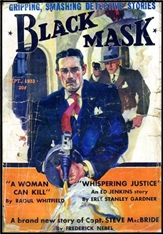
RAOUL WHITFIELD “A Woman Can Kill.” Novelette. Dion Davies #1. Published in Black Mask, September 1933. Reprinted in Ellery Queen’s Mystery Magazine, June 1953.

   â€œWhat a set-up! The Old Lady is tricked by Joey Tay. Then she puts one over on him. Then he tries to put one over on us, in order to get her to be good. Then you tell her the truth and she tells you that she thinks her granddaughter is trying to murder her. The same granddaughter Tay hired you to frame, and you thought you were protecting!”

   
   That is one heck of a tricky plot, but there is more, because this story has more people not quite who or what you think they are than you can imagine.

   First there is our hero Dion Davies, a successful private detective, part of Davies and Dancer Ltd., a private detective agency. Davies is the face of the operation and his partner Stephen Dancer, a lawyer who financed the partnership and went into business with him and his attractive secretary Julie Ryan.

   Seems simple enough, but this one veers off into Remington Steele country pretty fast. There is no Stephen Dancer, and there is no Julie Ryan, instead there is Julie Hazard, who is the senior partner and created the mysterious Dancer to attract customers and posed as Julie Ryan Davies secretary to keep close. She put up the front money and is the silent partner as handy with a gun or her wits as Dion.

   Tay is a crooked club owner who tricked nice old philanthropic Mrs. Greenaway into selling her non-profit theater and then set about turning it into a swank beer joint. Mrs. Greenaway has always been dead set against beer so she feels doubly upset that Tay tricked her.

   Her revenge is to buy up the property across the street and open up an even bigger joint, put Tay out of business and then close down both places, so Tay sends his man McQuirter to hire Davies and Dancer to get something on Mrs. Greenaway’s wild society granddaughter Nancy Gale who is engaged to a no good society type.

   When Tay tries to set Davies up with a phony Gale he quits and gets a warning from Tay not to hire on with Mrs. Greenaway if she shows up — and a speeding sedan opens up on him from the street with a machine gun to emphasize the fact.

   Then Mrs. Greenaway shows up at his office to hire him — not to protect her from Tay, but from her granddaughter.

   Still with me?

   On top of everything else the Old Lady is lying about why she fears her granddaughter. It’s not the girl doesn’t have a motive, but killing Mrs. Greenaway would do her no good, the Old Lady fixed it so she would never inherit, so why is the Old Lady afraid of Nancy Gale?

   Then they find Nancy Gale murdered, and the police think her grandmother tricked her, trapped her, and murdered her out of fear.

   And the twists keep coming until the final shootout when everything gets more or less sorted out.

   This isn’t prime Whitfield. The set-up is too cute, the plot too complex for its length, and there isn’t much character development. Davies and Dancer/Hazard/Ryan are interesting and the byplay between them good, but we never get enough insight into why she does what she does and why he bought into it in the first place.

   Everyone else is strictly from hard-boiled Central Casting.

   Of course this is Whitfield, and even minor Whitfield is well written, observed, snappy, and written with that famous word savagery the Black Mask school of writers were famed for.

   Whitfield was only just below Hammett and Chandler, and light as this fare is, it also shows why. It is fast, clever, and I read it at a sitting compelled to keep going.

   Reading this, it is hard not to imagine it as a slick B movie full of snappy lines and moving at a decided clip for the fade to black, and that’s a compliment and not a knock.


Bibliographic Note: There was to be only one more Dion Davies story, that being “Money Talk,” Black Mask, October 1933.

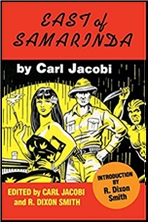
CARL JACOBI “Crocodile.” Short story. First published in Complete Stories, 30 April 1934. Collected in East of Samarinda, edited by Carl Jacobi & R. Dixon Smith (Bowling Green University Popular Press, softcover, 1989).

   If Carl Jacobi (1908-1997) is remembered as a writer today, it is by collectors of such long ago pulp magazines such as Weird Tales, Thrilling Mystery, Marvel Tales, Planet Stories and the like. He was, however, an equal hand with adventure stories that appeared in titles such as Top Notch, Short Stories, and Complete Stories, which is where this lead-off story in the collection East of Samarinda first appeared.

   I haven’t read all of the stories in that modest compendium yet, more than twenty of them, but the ones I’ve read or browsed though take place in Dutch Borneo, which in the 1930s was as much an out of the world place for adventurers tohave adventures as there ever could be. The jungles teeming with snakes, the native Dyaks, not all friendly, the rivers filled with crocodiles, all grist for Jacobi’s mill.

   But was he ever there? In a word, no. He may have never taken a step outside his native Minnesota. So how did he get the details to sound so right? In another word, research. Libraries existed before Google came along, and as a matter of fact they still do.

   In “Crocodile,” a collector of animals for zoos and the like, comes staggering into the camp of a surveyor for the Dutch named McNair, and once fortified with enough whiskey, the former tells the latter of how he killed his partner who’d come across a priceless emerald by tricking him into falling into a river swarming with crocodiles.

   Sometimes fate needs a helping hand, and that’s exactly what happens here.

SELECTED BY DAVID VINEYARD:


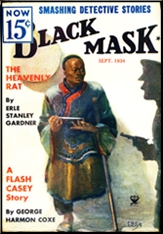
ERLE STANLEY GARDNER “The Heavenly Rat.” Novella. Ed Jenkins (a/k/a the Phantom Crook). First published in Black Mask, September 1934. Not known to have been collected or reprinted.

   I felt certain that the police, for all they wanted me, would never recognize me as the shabby figure that prowled around Chinatown — the figure of a white hanger-onner who had been crowded out of the society of his own kind and into the dark poverty that fringes Chinatown.

   After Perry Mason and Donald Lam and Bertha Cool, the most popular of his creations, and certainly of his many pulp characters, was criminal Ed Jenkins, the Phantom Crook who haunted the pages of the legendary Black Mask.

   Jenkins is a professional crook always in the shadows, often in disguise, and often hiding among his friends, allies, and sometimes rivals in the shadows of Chinatown. Gardner, who had begun his career as a young lawyer in Chinatown representing clients there, had a genuine interest and respect for the people, and if there is the faintest taint of condescension and prejudice still found in stories like this one they were, for their time, fairly rare in their representation in the pulps of the Chinese as human beings and not the Yellow Peril, as allies and not implacable cruelty personified.

   In “The Heavenly Rat” Jenkins, in disguise as a down-on-his-luck bum looking for work, is stopped by a man who flashes a badge and tell him if he wants work to meet him that night at the “Yellow Lotus.” Once the man is gone, Jenkins really has no reason to show up, but there is something about the fellow, he’s no ordinary cop for one thing, that leads Ed to follow through.

   Granted that might seem a pretty odd thing for a wanted man to do, but then Jenkins is a somewhat more grounded and less romantic version of the Saint in many stories. He just can’t not show up especially when he is tipped to “a twist in a blue coupe” tagging him after the man with the gold badge approached him.

   The girl is Beatrice Harris, the daughter of miner George Harris, accused of murdering his ex partner Frank Trasker after a strike. Also partners in the game were an ex pug named Sam Reece, and a Chinese cook. The big shot behind them, the man who flashed a badge and hired Jenkins, is Oscar Milen, and he knows who killed Trasker, that’s why Harris daughter is following Ed hoping if she does Milen’s bidding he will clear her father.

   The game ups considerably when Jenkins witnesses Sam Reece killed by a big one legged Chinese on a crutch with a throwing knife in the fog. As Reece dies he lets two words escape his lips, T’sien Sheuh, “the Rat of Heaven” aka “the Bat.”

   The story has pretty much everything, a good girl in with bad men trying to clear her Father, if indeed he is innocent, a smart dangerous criminal the police can’t or won’t touch, a hero with no one to call on for help caught between protecting his neck and helping a girl he can’t trust, and a mysterious Chinese exacting revenge in the San Francisco fog.

   And Gardner rings every change out of those old familiar bells, never letting his hero or his readers pause, spinning expertly from one moment to the next, the writing not as artful as Hammett, Chandler, or Whitfield, but never less than perfectly expressed.

I slid the car with its gruesome burden into the dark shadows of a particular alley, and thanked my lucky stars that the night was so foggy. Thick fog had settled down like a gray blanket, enveloping the streets in white mystery, muffling the sounds of night life on the pavement.

   Hammett would have said it cleaner and sharper, Chandler more eloquently, but Gardner nails it without fuss or bother. There is something to be said for cool professionalism.

   Tongs, revenge, a big dope deal, a beautiful girl, Jenkins framed for Sam Reece death, it all piles on in a novella that moves in a clip down to a satisfying conclusion of that favorite Gardner plot, the Cinderella story, with Jenkins on his own again as he always is.

   No more of the city underworld for her. She was going back to windswept silences, the clean dry air of Nevada.

   As for me, I had cast my lot in life. I was headed back toward the only life that I could live — the foggy, mysterious streets of San Francisco’s Chinatown — the underworld …

   Maybe the music is a little tinny, the tune a bit too familiar. Like the ever present fog a familiar slightly musty air lays over it all, but it is still music, still sweet, still beautiful in it’s oft repeated rhythms if you know how to listen, and are inclined to its song.

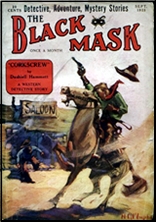
DASHIELL HAMMETT “Corkscrew.” The Continental Op #20. Short novel. First published in The Black Mask, September 1925. Reprinted in Ellery Queen’s Mystery Magazine, September 1947 (severely edited by Fred Dannay). Collected in The Big Knockover, edited by Lillian Hellman (Random House, hardcover, 1966) which includes all of Dannay’s changes and adds one. Also collected in The Big Book of the Continental Op (Vintage Crime/Black Lizard, softcover, 2017), which goes back to the original text and reverses all the changes.

   In many ways “Corkscrew” is one of my favorites of Hammett’s shorter works. In it the Op travels to an isolated small town in Arizona (circa 1925, I presume) and tries his best to fit in as an obvious city slicker in one of the last pockets of the Old West, complete with all of the lawless elements you can think of, standard cliches all, including some of the newer ones, such as opium users and human trafficking of would-be immigrants across the border.

   Nor did the Old West have automobiles (flivvers) or telephones, although while I’m sure they are mentioned, I don’t think anyone in Corkscrew had one. The Op’s mission is supposed to be a secret: he’s undercover as the new deputy sheriff in town, but he’s recognized as that eve before he arrives. He’s been sent by the head office to clean up all of the bad element so that their clients can come safely in and bring commercial enterprise to the area.

   The scene that I like best – and it’s stuck with me ever since I read this story the first time – is the one in which the Op is joshed along by some ranchhands who persuade him that the horse they’re offering to sell him is as gentle a horse as there ever could be. Ha! Three times on, and three times off. The Op is no horseman, but it is a way to get the locals’ respect.

   What I also noticed this time around is how much of precursor to Red Harvest this tale is. The Op comes in and when the opportunity arises, he sets one faction of the non-savory aspect of Corkscrew against the other. What I also noticed is this is more than just a crime story. It’s a detective tale as well, and well-clued at that. And I didn’t even notice!

   Here’s a link to the long list of changes Fred Dannay made when he published the story in EQMM, as carefully delineated by Terry Zobeck on Don Herron’s website.

   Some are relatively minor, some consist of huge chunks of expository text. And some are explainable, sort of. A character referred to as the “the Jew” in the original version becomes “The Toad” in EQMM. It’s not a choice I would have made, but as I said, it sort of makes sense.

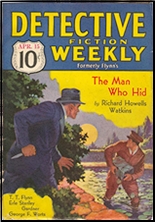
T. T. FLYNN “The Deadly Orchid.” Trixie Meehan & Mike Harris #1. First published in Detective Fiction Weekly, April 15, 1933. Reprinted in The Pulps, edited by Tony Goldstone (Chelsea House, hardcover, 1970) and Hard-Boiled Dames, edited by Bernard Drew (St. Martin’s Press, hardcover, 1986).

   I have written about the bickering pair of PI’s by the name of Trixie Meehan and Mike Harris before. You can find my review of “Barred Doors,” the seventh in the series, here. To recap quickly, though, they both work for the Blaine Agency and are always casting barbs at each other – in a friendly way, you know —  or at least I think so.

   In this, their first appearance, they go undercover in a plush hotel disguised as husband and wife (but in a suite of adjoining rooms, with a lock on the door between them). With the benefit of an unlimited expense account, they also are pretending to be a fabulously wealthy pair of Texans (oil money), and living it up greatly.

   Their target: a incredulously beautiful wisp of a girl, nicknamed the Orchid, who is also a notorious blackmailer who has also been known to kill her victims when things don’t work out perfectly with one of her schemes.

   Mike is the one who tells the story and the one who works up the plan to discover where the love letters she is holding over her latest victim are located, but Trixie is no slouch either when she is needed to take part in the action.

   There’s not a lot of depth to the tale, but it’s smoothly told, in something of a screwball story sort of way. Somebody really ought to put together a complete collection of their adventures together.
   

      The Mike Harris & Trixie Meehan stories –

The Deadly Orchid (ss) Detective Fiction Weekly Apr 15 1933
Falling Death (nv) Detective Fiction Weekly Oct 28 1933
Murder’s Masquerade (nv) Detective Fiction Weekly Mar 31 1934
The Yin Shee Dragon (na) Detective Fiction Weekly Sep 29 1934
Murder Harbor (nv) Detective Fiction Weekly Dec 1 1934
The City Hall Murders (na) Detective Fiction Weekly Mar 23 1935
Barred Doors (na) Detective Fiction Weekly May 18 1935
Nitro! Nitro! (na) Detective Fiction Weekly Apr 4 1936
The Letters and the Law (na) Detective Fiction Weekly Jun 27 1936
Abbey of the Damned (na) Detective Fiction Weekly Oct 30 1937
Murder Circus (na) Detective Fiction Weekly May 21 1938
The Secret of the Swamp (na) Detective Fiction Weekly Feb 25 1939
Brother Murder (na) Detective Fiction Weekly Dec 2 1939
Mike Finds Trouble (sl) Detective Fiction Weekly Aug 17 1940, etc.
Build Up for Murder (nv) Detective Fiction Aug 20 1941
Killer in the Clouds (ss) Detective Tales Mar 1951


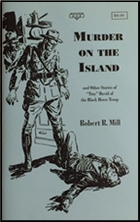
  ROBERT R. MILL “Murder on the Island.” Short story. “Tiny” David #1. [Corrected to #2. See Comment #1.] First published in Blue Book, May 1933. Collected in Murder on the Island and Other Stories of “Tiny” David and the Black Horse Troop (Black Dog Books, paperback, 2004).

   We don’t get to see any of the Black Horse Troop in this, the first story of 47 in all, all appearing in Blue Book magazine between 1933 and 1942. The Black Dog collection contains only four of them. The rest I imagine I’ll never get a chance to read, never having collected the magazine, and the ones I did own for a while are long gone.

   In this one, we meet only Trooper Edward David and his immediate superior, Sergeant James Crosby. The setting is somewhere in the Adirondacks in New York State, as Tiny and the sergeant are rowing to an isolated island where a wealthy man and his daughter are living, along with several servants. Disliking publicity, visitors are generally not welcome, but an urgent telephone call from Joseph Bahn has them heading that way in rowboat, and in a hurry.

   Once there they find the body of the Bahns’ butler, dead, having been shot in the head. Although six foot two and weighing 220 pounds, “Tiny” David may appear lazy and slow-witted, but he’s one observant fellow, a lot sharper than his sergeant, and when he senses that something is wrong with the scenario they’ve been presented with, you can count on his sense been exactly right.

   What this story turns out to be is a perfectly ordinary detective mystery, a rather light-hearted approach that even without a challenge to the reader, an equally observant reader can see and interpret the same clues that Tiny does.

   For more on the author and the series, here’s a link to Sai Shankar’s Pulpflakes blog and his essay on both:

https://pulpflakes.blogspot.com/2017/01/robert-r-mill.html

JAMES A. LAWSON “Hard Guy.” Short story. “Hard Guy” Dallas Duane #1. First published in Spicy Western Stories, March 1937. Collected in Dying Comes Hard (Black Dog Books, softcover, 2015) under the author’s real name, James P. Olsen. Introduction by James Reasoner.

   â€œHard Guy” Dallas Duane was an oil range troubleshooter in the 1930s, a fact that fully qualifies him as a PI. His adventures took him all over Oklahoma and Texas, often working undercover. And under the covers, too, which you will have already recognized for yourself if you saw that this first one was published in Spicy Western, a pulp magazine which took its title very very seriously.

   This first of 20 adventures has Hard Guy tracking down the killer of the local county attorney, all the while beating himself up for being tricked into being in the arms of very friendly saloon singer by the name of Nancy. Then follows ten pages of non-stop action, punctuated by the stops to wonder over the pulchritudinous delights of both Nancy and another girl named Kate, both of whom look very good, even with their clothes off, and even while less frequently with them on.

   Great literature this is not, as a wise man once told me, but if that wise man never read this story, I’m one up on him. I just did! And note this: the Black Dog collection collects all twenty of Hard Guy’s recorded adventures.


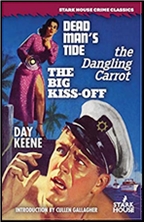
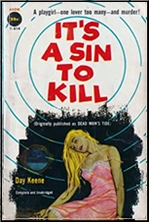
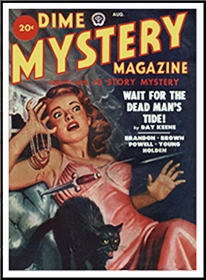
DAY KEENE – Dead Man’s Tide. Stark House Crime Classic, softcover, January 2021. Three-in-one volume with The Dangling Carrot and The Big Kiss-Off. First published as by Williams Richards (Graphic #60, paperback original, 1953). Expanded and revised from “Wait for the Dead Man’s Tide,” by Day Keene, published in the August 1949 issue of Dime Mystery Magazine. Also published as It’s a Sin to Kill, as by Day Keene (Avon T-814, paperback, 1958).

   After a short prologue consisting of following a woman’s nude body as it floats along with the tide in the Gulf of Mexico off the Florida coast, Dead Man’s Tide starts with a bang and never lets up until 120 pages later (in the soon-to-be-released Stark House edition). It opens for real with Charlie Ames, a fishing excursion boat captain waking up alone in a strange bed, on another boat with a woman’s clothing scattered about, a liquor bottle rolling back and forth on the floor, and $5000 in his pants pocket.

   Whose boat, whose clothes, and most importantly, whose $5000? And where is she? No one knows, including the police, who most definitely do not believe Charlie’s story of having a cup of coffee with a prospective client on his own boat, but everything going black and he not knowing what happened until he woke up the following morning.

   What’s worse is that he doesn’t think that his wife Mary Lou, a singer and hostess at a local night club, believes his story, either. That’s what pains him the worst. But when the woman’s nude body is finally found (see above), it’s the local police force who he finally realizes really is his greater concern.

   Fellow blogger Cullen Gallagher, who wrote the introduction to the Stark House Press edition, calls this a “man on the run” novel, a trademark theme of author Day Keene, and it’s a good one. There are lots of twists and turns in store for Charlie Ames in this one. Every time he thinks he’s reached a point of safety, fate extends him another finger. Eventually, in a final move of sheer desperation, he decides to take his destiny into his own hands, until at last comes the biggest twist of them all.

   Highly recommended.

« Previous PageNext Page »