Pulp Fiction


J. ALLAN DUNN “In the Grip of the Griffin.” Novelette. Gordon Manning vs. the Griffin #30. First published in Detective Fiction Weekly, May 18, 1935. Reprinted in In the Grip of the Griffin: The Complete Battles of Gordon Manning & The Griffin, Volume 3 (Altus Press, 2015).

   The first of this long saga of 31 stories was, I believe, “The Crime Master,” which appeared in the November 30, 1929, issue of Detective Fiction Weekly. IN this and stories yet to come, Gordon Manning remained continually on the trail of the notorious madman and supervillain known only as the Griffin, his real identity unknown.

   Readers of “In the Grip of the Griffin” were treated to more of same — capture, escape, capture again, rescue, and so on — but what they didn’t realize it at the time, but there was but one more to go: “The Seventh Griffin” (DFW, Oct 5, 1935). I haven’t read that one, but I have been told that the series did have a finale, and I kind of hope it was a good one.

   The Griffin was the key reason why the series lasted as long as it did. It is the evil villain who attracts readers, not the mild-mannered adventurer (in this case Gordon Manning) whose sworn duty is to bring the mad killere to well-deserved justice. (Who remembers the fellow who chased Fu Manchu all around the globe, back in the day? Almost nobody.)

   In this case the Griffin sends one of his henchmen to break into Manning’s home — object: eliminate him — not knowing that Manning is ready and waiting for such a contingency. Once the tables are turned, however — and I hope I’m not revealing too much — the tables are turned again, with Manning bands in the hands of the Griffin. And in what better place to be held captive than a mausoleum located below an abandoned cemetery.

   All ends well for Manning, though, have no doubts about that. Narrow escapes in these kinds of stories are only to be expected. On the other hand, the Griffin is shot and wounded as he makes his own escape one more time. You shouldn’t expect a lot of characterization in stories such as this one, and in fact, there isn’t any at all. But they are in fact a lot of fun to read. Not too many at once, though!

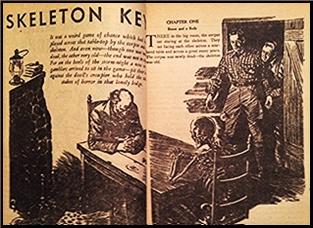
  WILLIAM E. BARRETT “Skeleton Key.” Novelette. First published in Ace-High Detective, August 1936. Probably never reprinted.

   To pulp readers of long standing, William E. Barrett is best known for his fifteen stories in Dime Detective Magazine about a chap nicknamed Needle Mike. As described in relation to all fifteen being reprinted in two volumes by Altus Press, Needle Mike was “[A] millionaire playboy with a yen for excitement, young Ken McNally disguises himself as the gray-haired, gold-toothed, jaundiced-looking proprietor of a seedy tattoo parlor in the ‘tenderloin’ district of St. Louis. His unusual occupation frequently brings him into contact with underworld denizens who, willingly or accidentally, embroil him in criminal activities.”

   Totally outrageous and totally unforgettable. William E. Barrett, the author, however, were no mere pulp writer. He later became a well-known bestselling novelist, with [according to Wikipedia] three of his books made into films:

      The Left Hand of God, starring Humphrey Bogart.

      Lilies of the Field based on his novel The Lilies of the Field, featuring Sidney Poitier.

      Pieces of Dreams, based on The Wine and the Music.

   “Skeleton Key” was never made into a film, but perhaps it could have been. It begins on a dark and stormy night (not Barrett’s words, but is true) as a young fellow named Jeff Madison is forced to stop at an isolated cabin for shelter and finds himself confronted with a very strange scene: a dead man with three knives in his chest sitting at a table across from a skeleton. On the table are a pair of dice.

   One man is there before him, and two more in separate automobiles soon stop, also forced to stop in the storm, or so they say. With no way to contact the authorities, all five go to bed for the night. Which of course is when the action begins.

   That’s the setup, and it’s a good one. The explanation is much more complicated, and after all the resulting gunfire ended, Jeff Madison finally learns what was behind it all. Did I forget to tell you that Madison has a secret of his own? On his way to the cabin he found a suitcase filled with $50,000 in cash. I’m afraid I did. How do you like that? Not surprisingly, it is the key to everything.

        —

Previously reviewed from this first issue of Ace-High Detective: FRED MacISAAC “The Corpse Goes East.’

FRITZ LEIBER “Lean Times in Lankhmar.” Published in Fritz Leiber’s Fafhrd and the Grey Mouser, Book Four. Epic (Marvel) Comics, 1991. Adaptation & script: Howard Chaykin. Pencils & inks: Mike Mignola & Al Williamson. Also in this same issue: “When the Sea King’s Away.” Note: “Lean Times in Lankhmar” was first published in Fantastic SF, November 1959. Reprinted many times.

   Fafhrd and the Grey Mouser are a pair of adventurous rogues living day by day if not moment by moment in the swords and sorcery setting of the city of Lankhmar on the world of Nehwon, just west of the Great Salt Marsh and east of the River Hlal. Fafhrd is a tall powerful barbarian, while the Gray Mouser is a small hotheaded thief extraordinarily good at swordsmanship.

   Their first story, “Two Sought Adventure”, appeared in the pulp magazine Unknown in August 1939, but the story of how they first met was “Ill Met in Lankhmar,” did not appear until the April 1970 issue of The Magazine of Fantasy & Science Fiction.

   They usually team up well, but at the beginning of this story they have split up, perhaps arguing over the spelling of Fafhrd’s name. (I have trouble, too.) Fafhrd becomes an acolyte of Bwadres, the sole priest of Issek of the Jug, while the Gray Mouser goes to work for a local racketeer named Pulg, who offers protection to “priests of all godlets seeking to become gods — on pain of unpleasant, disturbing, and revolting things happening at future services of the defaulting godlet.”

   And of course in the course of their new occupations, the two heroes’ paths are about to cross. Many consider this story to be one of the funniest sword and sorcery stories ever, and you can count me as being one of them.

   I enjoyed the comic book version, and I do recommend it to you. The structure and setting of the stories, as well as the flashing charisma of the heroes themselves, are perfect for adaptation to graphic novel format, but I kept wondering whether I’d have enjoyed it as much if I didn’t already know the story itself ahead of time.

   The art is fine, but there was a day, back into the 1960s, where to get the story told, the captions and word balloons took almost all the space in the pages of the comic books of the day. No more. The art is now supposed to tell a lot more of the story, but it takes a lot of coordination between writer and artist to make it so. It may very well be the best that could have been done, but I don’t think it happened here. There were several times when if I hadn’t know what was supposed to be happening, I’d have had no clue.

   Or maybe I’m an old dog struggling with new tricks.


FIRST YOU READ, THEN YOU WRITE
by Francis M. Nevins


   Dashiell Hammett is universally acclaimed as the founding father of hard-boiled or what is now called noir crime fiction. I know that Carroll John Daly (1889-1958) entered the field shortly before Hammett, and that his earliest novels predated Hammett’s by a few years. But almost a century after both men began, Daly’s output does not hold up well by comparison, and I don’t have enough years left to explore it in detail. How about the first significant writer who followed in Hammett’s footsteps?

   Raoul Whitfield (1896-1945) was born in New York City, distantly related to Andrew Carnegie through the great industrialist’s wife. His father, a federal civil servant, was assigned to Manila as an accountant shortly after the Spanish-American War, so that Raoul grew up in the Philippines. As a young man he moved to Hollywood and is reported to have appeared in uncredited bit parts in silent movies. Upon the U.S. entry into World War I he enlisted and was trained as an aviator. Apparently his main overseas jobs were shuttling cargo to the front lines in France and towing targets for aerial gun practice, although he claimed heavy air combat experience.

   After the war he settled in Pennsylvania and worked as a laborer in a steel mill, as a bond salesman, and (maybe) as a reporter for the Pittsburgh Post. He married his first and longest-lived wife, the former Prudence Ann Smith (1895-1990), in April 1923.

   Apparently his first short story was “The Pin” (The Cauldron, December 1922), which was reprinted in Ellery Queen’s Mystery Magazine for April 1985, a few years after Fred Dannay’s death, but it wasn’t until 1924 that he started turning them out like bratwursts in a sausage factory, mainly for pulps like Breezy Stories, Droll Stories and Street & Smith’s Sport Story.

   He made his first sale to Black Mask in 1926, with most of his early tales in that iconic magazine being air combat adventures, a genre he claimed to have invented, but within a few years his interests turned to combat between tough guys on terra firma. Once having gotten his feet wet in this new body of water, he became a staunch admirer of Hammett, who’d been swimming in it for about four years before him. They corresponded for a while before finally meeting in Hammett’s San Francisco stamping grounds, and thereafter they met periodically, downing oceans of bootleg liquor on every occasion.

   Hammett’s RED HARVEST had already appeared both in Black Mask (November 1927-February 1928) and as a novel (Knopf, 1929), and THE MALTESE FALCON in serial form (Black Mask, September 1929-January 1930), when Whitfield made his hardcover debut with GREEN ICE (Knopf, 1930), based on five Black Mask stories (December 1929-April 1930) and issued by Hammett’s own publisher at Hammett’s suggestion.

   There’s no private eye in the book, no one comparable to the Continental Op or Sam Spade. Released from Sing Sing after serving a two-year stretch for a vehicular homicide committed by his girlfriend, Mal Ourney (who to my mind would best have been played onscreen by Richard Dix, the star of several early-talkie crime movies) resolves to devote his life and inherited bankroll to wiping out the “crime-breeders,” the big-shot criminals who ensnare, frame and ruin the lives of little crooks.

   His girlfriend comes up to Ossining to reunite with him — or perhaps for a more sinister reason –– and is promptly shot to death, the first of a huge assortment of violent ends that stud Whitfield’s pages, at least a dozen in all and seven of them before the end of Chapter Five. The impossible-to-keep-straight plot involves a host of ruthless characters in pursuit of a fortune in emeralds which turns out to be — well, remember what Hammett’s black bird turned out to be?

   Events begin in Ossining just outside of Sing Sing but soon move to Manhattan and then to Pittsburgh (the dirty burg, Whitfield calls it) and its suburb Duquesne. The steel mill stench is everywhere. “Red flames streaked up into the sky from the plant stacks. Red smoke hung low. The air was heavy, thick with steel grime.” Ourney gets beaten up and blackjacked at least once too often and grins a lot more than a noir protagonist should. And I do get tired of his using human as a synonym for man or person.

   Dot Ellis got more space than most of the other humans. But there was one human that grabbed the headlines.

   â€œ[W]hoever did—that human knew her well enough to know she was left-handed.”

   â€œ….I got the idea that just a few humans were using a lot of other humans as they wanted, then framing them, smashing them—rubbing them out….”

   Until the middle of Chapter VIII Ourney takes it for granted that the black bird of this book is in the form of cash. Then he makes what he himself calls “a blind guess” and says: “Somebody’s after something, but it isn’t a hundred grand. It isn’t fifty grand. Maybe it’s stones.” As indeed it is. Surely Hammett would have found a more elegant way of putting his protagonist on the right track.

   But the book is still readable almost 90 years after its first publication, although clearly not in the same league with Hammett’s classics. Considering the Black Mask serialization dates of all three novels, any similarity with RED HARVEST and THE MALTESE FALCON that one may find in GREEN ICE can hardly be coincidental.

***

   Whitfield’s second novel, DEATH IN A BOWL (Black Mask, Sept-Nov 1930; Knopf, 1931), is a genuine PI exploit set in Hollywood, with a convincing background of the movie industry at the dawn of talkies and a relatively small cast of characters compared with the hordes that populated GREEN ICE. After screenwriter Howard Frey knocks out German émigré director Ernst Reiner while a tense scene is being shot, both men approach Hollywood PI Ben Jardinn, with Reiner claiming Frey is out to kill him and Frey insisting that the director wants to frame his scenario man in case he’s killed by someone else.

   The actual murder takes place the following evening at a Hollywood Bowl concert attended by some 12,000 people — including Reiner, Frey and the tempestuous star of Reiner’s movie — and conducted by Reiner’s illustrious brother. In the middle of a thunderous tone poem the Bowl lights suddenly go out, a tri-motored plane buzzes the field with its engines roaring, and the conductor is shot in the back four times, although later Whitfield changes his mind and tells us there were only two bullets in the body.

   Except for a plane-crash death and a second murder, not all that much happens in the remainder of the book beyond a constant stream of characters lying to and double-crossing one another, bringing home to us the quintessential noir insight that you can’t know or trust anyone, not even yourself.

   The climax is a somewhat creative variant of THE MALTESE FALCON’s you’re-taking-the-fall-baby denouement — although not in the same class with the twist Erle Stanley Gardner pulled off in the first Perry Mason novel, THE CASE OF THE VELVET CLAWS (1933) — and the style is ersatz Hammett all the way. In both narrative and dialogue “human” is used as a substitute for “person” so often it becomes silly.

       ….[A]ll humans were difficult to work with….

       Humans were still pouring into the Bowl.

       The roar of the plane’s engines filled the bowl of humans.

       Humans were surging from the grass before the shell….

       The police are yelling that I caused an important human to get himself quieted….”

       â€œ….The bushes are tall enough to hide a human.”

   Whitfield didn’t have anywhere near Hammett’s success in Hollywood. Movies were made out of none of his novels and only one short story (“Man Killer” from the April 1932 Black Mask, which was filmed as PRIVATE DETECTIVE 62, Warner Bros., 1933, starring William Powell) but, judging from DEATH IN A BOWL, he seems to have absorbed quite a bit of the early-talkie Hollywood atmosphere, with the director filming a scene required to stay in a sound booth looking down on the stage below.

   The autocratic director character Ernst Reiner was clearly modeled on the great German film-maker Fritz Lang (1895-1975), who in fact was still working in Germany in the early 1930s and didn’t move to the U.S. until a few years later, after Hitler came to power.

   Anyone who wants proof that Lang was on Whitfield’s mind need only look at what Ben Jardinn has to say about Reiner’s movies. “They show a good deal of imagination. Cities of the future, and that sort of thing….” (8) What is this but an unmistakable allusion to Lang’s 1926 masterpiece METROPOLIS? Long before anyone ever heard of the auteur theory, Whitfield has no doubt who holds the power in the film world. “Most directors are more important than writers.” (7)

   Whatever its weaknesses as a detective novel, DEATH IN A BOWL is redeemed by moments like these.


   TO BE CONTINUED NEXT MONTH…

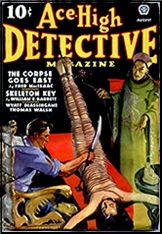
FRED MacISAAC “The Corpse Goes East.” Novelette. First published in Ace-High Detective, August 1936. Probably never reprinted.

   Designed by Popular Publications as a companion to Dime Detective Magazine, their mainstay detective pulp, the August 1936 issue of Ace-High Detective was the first of only seven before it was discontinued. One can only guess, but poor distribution and low sales were both probably to blame. The authors appear to be the same as were used in Dime Detective, but I have the feeling that their better material ended up in the latter, and not this new kid on the block.

   Truth in blogging. The cover image you see there to the right is not mine. My copy of this first issue is has no covers, and I had to borrow the image you see from the Internet. My copy is still readable, of course, and over the next few weeks, I will doing so and reporting on the results here. Other authors whose stories are to come are William E. Barrett, Norbert Davis, Thomas Walsh and a handful of others.

   Up first, though, is “The Corpse Goes East,” by author Fred MacIsaac, who wrote hundreds of stories for the pulps, both detective fiction and some very early science fiction. Although he is noted for his many serialized novels in such magazines as Argosy and Detective Fiction Weekly, relatively few of them were published later in hardcover form, and he’s all but forgotten today.

   The leading protagonist in “The Corpse Goes East” is neither a PI nor a policeman in any shape or form, but almost assuredly your next best guess, a young attorney by the name of Tom Franklin. While still struggling financially, he has a girl friend — or he would, if he ever has enough money to ask her out on a date.

   Things pick up between them, though, when the girl comes by his office as a client. Her aunt, it seems, has disappeared, and the niece thinks foul play is involved, most probably at the hands of her much younger gigolo husband. That the aunt is also wealthy has a good deal to to with the motive, if indeed she is no longer among the living.

   What Franklin soon discovers, besides a lack of a trail at all, is that she left her apartment on her own, it was without a stitch of clothing, as her wardrobe is completely present and accounted for. But neither is she (or her body) in the building. It has been searched thoroughly.

   This begins as a detective story, a rather stiff and formally told one, but toward the end the action picks up considerably. Tom Franklin gets by by impersonating a policeman far too often, as far as I was concerned, but maybe that’s only fair, since the police do not deserve any awards for their work on the case. This is a routine story, if ever there was one, and middling enjoyable. On the other hand, though, it would have been considerably less than that if in 1936 you were reading Ellery Queen or John Dickson Carr, two authors with whom Fred MacIsaac was never in the same league.

 MARTIN H. GREENBERG, Editor – Deadly Doings. Ivy, paperback original; 1st printing, 1989.

#10. RAY BRADBURY “The Small Assassin.” Short story. First published in Dime Mystery Magazine, November 1946. First collected in Dark Carnival (Arkham House, hardcover, 1947); also collected in The October Country (Ballantine, hardcover/paperback, 1954) and A Memory of Murder (Dell paperback original, 1984) among many others. Reprinted many times, including Children of Wonder, edited by William Tenn (Simon & Schuster, hardcover, 1953). TV adaptation: “The Small Assassin” The Ray Bradbury Theater (Season 2, Episode 6). Comic book adaptation: Story in Shock SuspenStories #7 (EC Comics, February/March, 1953) by Al Feldstein and George Evans.

   “The Small Assassin” is without a doubt the most well known story in this Greenberg anthology. Given that all of the others are detective or straightforward crime stories, it is also by far the creepiest. It’s the story of a new mother who is convinced from day one that her new child hates her.

   And why not? Forced from the luxurious living space of the womb into a cold, cold world, why doesn’t every newborn child hate his or her mother? For the sake of the world’s population, it’s lucky that there’s only a one in a billion chances that any one of these infants is able to do anything about it. But a one in a billion chance does not mean none.

   The idea has been the basis of more than one story or movie over the years, I’m sure, but my thought is that Ray Bradbury is the one who came up with it first, and his unique style of writing is all it takes to make the story convincing, all the way to an ending that once read will never be forgotten.

       —

Previously in this Martin Greenberg anthology: EDWARD D. HOCH “The Unicorn’s Daughter.”

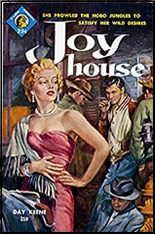
DAY KEENE – Joy House. Lion #210, paperback original, 1954. First published in much shorter form as “She Shall Make Murder,” Detective Tales, November 1949. Expanded manuscript, circa 1952. Revised/edited version published by Lion in 1954. Lancer 72-628, reprint paperback, 1962, published in a 2-in-1 edition with City of Sin by Milton K. Ozaki. Reprinted by Stark House Press, softcover, 2017, in a newly revised edition based on the 1952 manuscript by David Laurence Wilson. This is a 3-in-1 edition with Sleep with the Devil (Lion, 1954; reviewed here) and Wake Up to Murder (Avon, 1952; reviewed here). Film: MGM, 1964; also released as The Love Cage.

   If you ever have the urge to read a real down to earth noir novel, as solid as solid can be, and this one’s handy, look no further. You aren’t gong to find many books, nor authors, better than this one. If you have to go looking, though, you’ll probably need to pass on coming up with the Lion edition. I’ll get back to this, but I just looked, and there’s only one copy offered on abebooks.com right now, and that one has an asking price of $250.

   The book opens with our protagonist — not hero — awakening in a Chicago flophouse following a weeks-long drunken binge. How he made it to Chicago from California Mark Harris does not know. At one time a top notch criminal lawyer, all he remembers now is killing his wife, faking an accident to put the authorities off the trail, and going on the run.

   And here’s what every bum on skid row dreams of. A rich “crazy” lady whose support the mission depends on, sees him and he’s cleaned himself up, asks him if he’d like to be her chauffeur. A widow, Mrs. Hill is blonde, beautiful and still young. Would you say no? Mark Harris doesn’t either.

   He also knows, or strongly senses, that she has an ulterior motive in mind. Alone in a boarded up relic of a house for ten years, with only a black maid for company, indeed she does. The maid knows full well what is going on, and she is quite correct.

   All is well for a while. Mrs. Hill has a past, though, and when a man from that past makes his way into the house, he ends up dead, and it is up to Mark Harris (now Phil Thomas, an “accountant” from Atlanta) to dispose of the body. Even though it is May Hill’s plan for them to get married and escape to Rio, it is downhill all the way from here.

   And if you can stop reading once you’ve gotten to this point, you’re a better person than I am. Keene’s prose may have been pulpish and not always polished, true. It is gritty and fatalistic but never quite salacious — you can use your imagination for that.

   Every word pulls you on to the next, and not always gently. Entire pages will be swallowed up in a gulp, until you’ve reached the last one, when at last you can come up for air and let yourself savor the ending just a while longer.

   If I’ve intrigued you at all, and I hope I have, my suggestion is to obtain a copy of the recent Stark House edition. With two other novels included, all three by Day Keene, it’s quite a bargain.

T. T. FLYNN “Barred Doors.” Short novel. Mike Harris & Trixie Meehan #7. First appeared in Detective Fiction Weekly, May 18, 1935. Probably never reprinted.

   I may be wrong, but whenever female private eyes have come up for discussion on this blog, especially those who primarily appeared in the pulp magazines, the name Trixie Meehan has never been mentioned. It’s true that she always played second fiddle to Mike Harris, her fellow operative for the Blaine Agency, but she’s her own woman with her own cases, and the fact that every so often she’s able to give Harris a helping hand is no reflection on her ability.

   In “Barred Doors” Harris is given the job of tracking down the secretary who seems to have disappeared with a half million dollars worth of unregistered Liberty bonds taken from the safe of the agency’s client, Sir Douglas Carter MacClain.

   Naturally there is a gangster involved and the gangster’s ex girl friend, who has lately been seen gong out on the town with the missing secretary. There is a kidnapping involved, and a strange form of blackmail, or so it is revealed, but with both Mike Harris and Trixie Meehan on the case, everything eventually works out justice finally prevails.

   The story is suitably complicated and well told, but to me, there’s just not enough zip to it to make it more than just a step above average, but above average it most certainly is. There doesn’t seem to be anything of a romantic nature between Mike and Trixie, just a lot of light bickering and back-and-forth banter, nothing more serious than that.

   Having sold off a large number of my DFW collection, I may not get a chance to read another of their adventures, but I’d like to. There were sixteen of them between 1933 and 1951, all but the last published in Detective Fiction Weekly. That final one appeared in Detective Tales, some ten years after the previous one. (It is possible that this last one is a reprint of an earlier story under a new title.)

FRANK GRUBER “The Sad Serbian.” Short story. Sam Cragg #1. First published in Black Mask, March 1939. Reprinted as “1000-to-1 for Your Money,” Ellery Queen’s Mystery Magazine, March 1950. Also reprinted in The Black Lizard Big Book of Pulps, edited by Otto Penzler (Vintage Crime, softcover, November 2007).

   I’d say that a skip-tracer definitely falls into the same category as a private eye, wouldn’t you? This was Sam Cragg’s only solo adventure. The very next year found him teamed up with Johnny Fletcher in The French Key (Farrar, hardcover, 1940) in the first of 14 novels they appeared in together.

   To tell to you the truth, though, I’m not at all sure the Sam Cragg in this story is the same Sam Cragg who teamed up with Johnny Fletcher in all those books. In this one he tells the story himself, and he’s both observant and articulate, while the Sam Cragg in the Fletcher books is little more than a second banana or even a musclebound stooge, if you will. Fletcher is the brains of the pair, Cragg is the brawn.

   And here’s another “to tell you the truth.” While always having an old pupwriter’s gift for words, Frank Gruber’s choice of stories to tell and I are often not entirely on the same wavelength, and “The Sad Serbian” is no exception. It has something to to with a Serbian prince and a scam of some kind he’s pulling on Chicago’s Serbian community, somehow in conjunction (or competition) with a giant 300-pound Amazon of a woman.

   The story’s both too complicated and worse, uninteresting, to me at least, a deadly combination in a story if ever there was one. One saving grace, though, is the interplay between Cragg and Betty, the secretary of the outfit he works for. There should have been more of it. Maybe in a followup story of Sam on his own there would have been.


[ADDED LATER.]   My review of The Limping Goose (Rinehart, hardcover,1954), including a list of all 14 Johnny Fletcher and Sam Cragg books can be found here.

  LOU SAHADI, Editor – An Argosy Special: Science Fiction. One-shot reprint magazine. Popular Publications, 1977.

#4. JOHN W. JAKES “Half Past Fear.” Short story. First appeared in Super Science Stories, August 1951. Otherwise never reprinted.

   Before John Jakes hit it rich with his Kent Family Chronicles, he was generally regarded as an all-around hack, and rightly so. He wrote a couple dozen sci-fi novels, maybe a dozen more mystery and spy novels, of which his PI Johnny Havoc books may be the best remembered today, and even a half dozen “Man from UNCLE” stories for the magazine of the same name in the mid-60s.

   Of his fantasy and science fiction, his Brak the Barbarian pastiches of Robert E. Howard’s Conan tales are collectable now; the rest are safely forgotten. And the same can be said of “Half Past Fear,” his third to be published short story. In it a family of three takes in a strange traveler as a boarder, only to discover that he came from the past and that he is being pursued.

   Time travel tales are almost always fun to read — they make up one of my favorite subgenres in all SF — but this one is clunky and confusing, with one of the lead characters, unable to explain how things turn out, simply shrugs and calls upon the unexplainable “paradoxes of time travel” to bail out both the author and the story, and not at all succeding.

   One might be forgiven in thinking that this story was chosen for Jakes’ name only, to help sell the magazine, but if you take a look at the image at the upper left, you’ll see that none of the authors are mentioned, only the titles of the stories. A strange marketing device, indeed.

       —

Previously from this Lou Sahadi anthology: LEIGH BRACKETT “Child of the Green Light.”

« Previous PageNext Page »