Pulp Fiction


REVIEWED BY WALKER MARTIN:


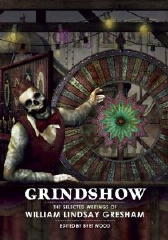
GRINDSHOW: The Selected Writings of William Lindsay Gresham. Edited and with a biographical essay by Bret Wood. Centipede Press hardcover. June 2013.

WILLIAM LINDSAY GRESHAM gRINDSHOW

   There are some authors that are known by only one book. Perhaps it really is the only book that they wrote, or the book just stands out above everything else that they did. In other words it is so excellent and powerful that when you think of the author, you just think of the one book.

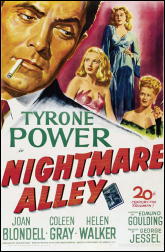
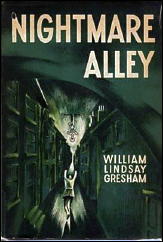
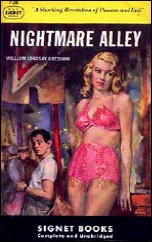
   Well known examples are TO KILL A MOCKINGBIRD by Harper Lee and GONE WITH THE WIND by Margaret Mitchell. In the crime novel field NIGHTMARE ALLEY by William Lindsay Gresham would be a good example. Usually when we discuss Gresham, the topic is NIGHTMARE ALLEY, a very powerful and nourish crime novel told from the viewpoint of the criminal. Carnival life plays a big role in the story which is a fascinating tale of the rise and fall of a con man.

   I’ve always been fascinated by carnivals and NIGHTMARE ALLEY is one of the best known novels about carny life. Other examples are MADBALL by Fred Brown, THE DREAMING JEWELS by Theodore Sturgeon, SOMETHING WICKED THIS WAY COMES by Ray Bradbury, and CARNY KILL by Robert Edmond Alter.

   Like many readers and lovers of carnivals, I first became aware of them as a child when the carnival would come to town. During my teenage years the schools would let us out early to attend the New Jersey State Fair. The Fair would last a couple weeks during the summer and in the Trenton area was an enormous undertaking. I would get off the bus and it would take me an hour to stroll from one end to the other. It had something for everyone: car races, 4H livestock shows, all sorts of food stands, varied items for sale, clothes for sale, rides for the kids, etc.

WILLIAM LINDSAY GRESHAM gRINDSHOW

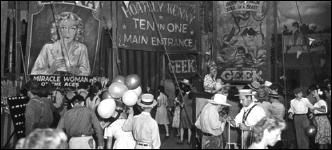
   But the main draw for me was the long row of tents and stands that made up the carnival and freak show exhibit. I have a confession to make. As many times as I tried to win a prize, not once was I successful. I attended the girly shows, always hoping to see something sexy. Nope, just a bunch of tired, worn out, jaded, and surly carny girls, many who had seen their best days a long time ago. The freak shows were always a ripoff and I never did see an impressive freak. Sure there were plenty of fat and bearded ladies, tallest man in the world, strongest this and that, and pickled things in jars. But nothing really of note.

WILLIAM LINDSAY GRESHAM gRINDSHOW

   But this didn’t stop me from coming back year after year until I finally grew up and realized the carny life was not for me. The workers seem to be living lives of quiet desperation and often looked like they were drunk or stoned. Everything was a con to separate cash from the townies, and I always had the strong feeling that the carnies felt nothing but scorn and disgust for us. Easy marks indeed.

   But all the above didn’t stop me from thinking that NIGHTMARE ALLEY was one hell of a read and a fine tough, hardboiled crime novel. One of the best and the same applies to the film starring Tyrone Power. Despite the cop out ending, the movie is in the running for top ten film noirs.

   So for over 50 years, that is all I really knew about William Lindsay Gresham. The novel was so impressive that it overshadowed everything else the man ever did. In 1949 he published his second and last novel, LIMBO TOWER, about life in a city hospital. It was not a success and I will soon read it to see why.

   Then in the early 1950’s he wrote a non fiction book called MONSTER MIDWAY. The title says it all and it never appeared in paperback. His fourth book was a biography of Houdini and finally a last book just before his death in 1962. It was about body building and weight lifting.

WILLIAM LINDSAY GRESHAM gRINDSHOW

   So there we have it, five books with one great one standing above all the rest. That is until now. Evidently Gresham had an extensive career writing short fiction and articles during 1945-1962. There are over 80 that we know about and this is how he mainly earned his living during the last years of his life.

   He died at age 53 in 1962, a suicide in a hotel room. He had been diagnosed with cancer and was supposed to see a specialist but instead took his own life with an overdose. Gresham had lived a life straight out of a film noir movie. For awhile he was a drunk but he finally stopped drinking. Though he tried for another success on the level of NIGHTMARE ALLEY, it was not to be. His second wife even left him for another man. Talk about cold blooded plans, she developed a liking for the books of C.S. Lewis, so she planned to go to England and seduce him. Which she did, meanwhile divorcing Gresham and marrying Lewis. Then the final straw was the cancer.

   All the above and more is discussed in a new book published by Centipede Press. GRINDSHOW reprints 24 pieces that Gresham did for various magazines, mostly fiction. The collection shows there was more to Gresham than just NIGHTMARE ALLEY. The first few stories are about carny life and the rest are a mixture of SF, crime and detective fiction. There are a few factual articles (“King of the Spook Workers”) and even a piece from a true crime magazine (Master Detective).

WILLIAM LINDSAY GRESHAM gRINDSHOW

   As a magazine collector, I was impressed by the range of the markets that Gresham wrote for. At first, because of the success of NIGHTMARE ALLEY, it looks like he was writing for the high paying slick magazine markets. Magazines like THE SATURDAY EVENING POST, ESQUIRE, ATLANTIC MONTHLY, and REDBOOK.

   However he also wrote for the pulps (Doc Savage and Bluebook), the SF digests (Fantastic, F&SF, Satellite), the crime digests (Ellery Queen Mystery Magazine, Mike Shayne Mystery Magazine and Manhunt), the true crime magazines like Master Detective, the men’s adventure magazines like Saga and Argosy, and the girly magazines like Dude and Rogue.

   All the above markets are represented within the 397 pages of this collection. The biographical essay is a valuable piece of research and 30 pages in length. The dust jacket is by David Ho and quite impressive, showing a skeleton carny barker.

   The stories vary in quality, but overall I’m very glad I bought the collection. My favorites are the first seven stories about carny life and the detective stories “Don’t Believe a Word She Says” and “The Corpse From Nowhere”. If you don’t buy this collection, check out “Don’t Believe a Word She Says” in the August 1956 issue of EQMM. It is an excellent hardboiled, private eye story.

WILLIAM LINDSAY GRESHAM gRINDSHOW

   You might note that I say above, “If you don’t buy this collection…” I say this because Centipede Press only publishes small print run books that immediately become collector’s items. When I say small print run, I mean like 200 or 300 copies. The books are well made with interesting essays and often reprint fiction that is not available except in hard to find back issues. The artwork is outstanding also. The series “Masters of the Weird Tales” reprints authors in editions of hundreds of pages (900) and cost hundreds of dollars.

   However GRINDSHOW costs $75 and like the Paul Cain collection, THE COMPLETE SLAYERS, which I reviewed here, once it goes out of print the price will start rising.

   This book has a companion volume, also priced at $75. It is of course the Centipede Press edition of NIGHTMARE ALLEY. It has another nice introduction by Bret Wood, the novel, and five interesting essays about carnival life. If you have the money, I recommend both books.

   And if you want to watch some films about carny life, in addition to NIGHTMARE ALLEY, I recommend FREAKS (1932), CARNY (1980), and the HBO series CARNIVALE, which ran for 24 episodes and is available as a box set DVD.

Reviewed by DAVID L. VINEYARD:         

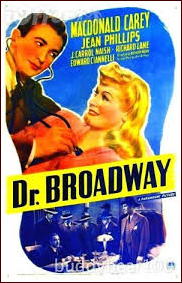
DR. BROADWAY

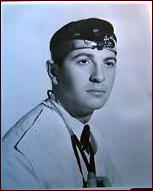
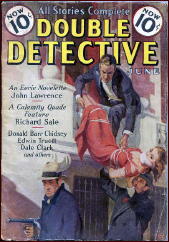
DR. BROADWAY. Paramount, 1942. Macdonald Carey, Jean Phillips, J. Carroll Naish, Richard Lane, Eduardo Ciannelli. Joan Woodbury, Gerald Mohr, Warren Hymer, Olin Howard, Frank Bruno, Sidney Melton, Mary Gordon, Jay Novello. Screenplay: Art Arthur, based on the short story “Dr. Broadway” by Borden Chase in Double Detective Magazine (June 1939). Directed by Anthony Mann.

   Dr. Broadway … Specialist in Heart Trouble … and Lead Poisoning

   The lights of old Broadway are flashing over Times Square, neon and traffic, crowds and honking horns, and a pretty girl on a ledge.

   So what’s new?

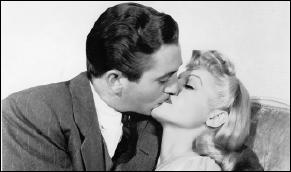
   Not much for Dr. Timothy Kane, Dr. Broadway (Macdonald Carey), a smooth taking GP who was raised and sent to college by the people of the Broadway streets when his much loved newspaper man father died. On this night there is a pretty blonde girl on a ledge (Jean Phillips — Ginger Rogers stand-in — and really nice legs I might add) and his old pal Detective Sergeant Pat Doyle (Richard Lane) bets him a ten spot he can’t talk her down.

DR. BROADWAY

   Of course she has no intention of jumping. It’s a publicity stunt — but she didn’t know it could send her to jail, so Kane has to keep her out of jail — which is how he ends up with a leggy blonde receptionist.

   Meanwhile Vic Telli (Eduardo Ciannelli) is fresh out of jail, a haunted gunman sent up by the Doc’s testimony. Everyone assumes Vic wants Doc dead — but what he really wants is a favor. Vic is dying: “I’m up to my neck in my own grave …” and wants Doc to see his innocent daughter gets the $100,000 dollars he has put back for her legally.

   How much trouble could that be?

   Pat: Doc, will you tell me why you hang around Times Square getting mixed up with these broken down Cinderella’s, Broadway screwballs, stale actors … I’m afraid they’re gonna jam you up …

   Doc: I don’t know Pat. Maybe it’s because they need me more.

   But jammed up he is. Telli is murdered in his office (fried by a heat lamp) and Doc promptly knocked out and framed. Someone wants Telli’s hundred grand for themselves.

   Pretty soon Doc is on the run from the cops and the crooks. And then his new receptionist gets kidnapped.

DR. BROADWAY

   All they want is the money. But Doc is in a cell and his only hope is to run a con on the kidnapers and rely on his army off the Broadway streets — grifters, hoods, news vendors, and the like.

   In the meantime Doc is, as crooked haberdasher J. Carroll Naish puts it, “… half way between the hot foot and the hot seat.”

   And you just know Doc and the girl are going to end up back on a ledge over the streets of New York before it’s over.

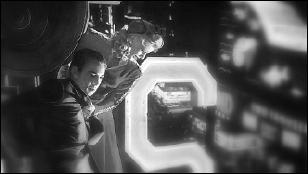
   This handsomely shot B-programmer was Anthony Mann’s debut film. It is mostly shot at night in the reflected shadow of flashing neon and with the constant chatter and blare of Times Square in the background. It is peopled with a colorful cast out of central casting by way of Damon Runyonville and moves at a rapid pace full of fast talking and faster thinking.

   Dr. Broadway is based on a series of stories written by Borden Chase for the pulps and was the pilot for a possible series that didn’t develop sadly. Chase may be more familiar to you for his books that became films (sometimes with his screenplays) like Red River and Lone Star.

DR. BROADWAY

   Macdonald Carey had a long career as a mid-level leading man, and was always reliable. He brings an earnest and easy going charm to the central character as Dr. Timothy Kane, and Jean Phillips is good as the slightly dizzy blonde receptionist/girl friend caught up in his world.

   Richard Lane could play good but frustrated cops in his sleep (he was most often the brunt of Boston Blackie’s adventures), while Ciannelli had at least one really good scene as the haunted gunman (reminding us how seldom he was used as effectively as he might have been) and J. Carroll Naish has some fun as the crooked haberdasher behind it all. Gerald Mohr appears briefly as a hood not long before he would be the voice of Philip Marlowe on radio.

   There is no real mystery here, mostly just a fast paced crime drama.

   Familiar faces like Warren Hymer, Sid(ney) Melton, Olin Howard, Mary Gordon, and Jay Novello round out the cast as various Broadway types.

DR. BROADWAY

   Now, before someone starts, this is a slick fast paced, exciting B-programmer, but despite the direction of Anthony Mann, it is not noir or even proto noir. There are a few touches that will eventually become noir, but they were nothing new to this kind of film in 1942, and good as it is, entertaining as it is, it’s not a precursor of film noir.

   You only have to look at a film like I Wake Up Screaming to see the difference. It’s far above average, but in many ways, it could have been made at any time from the start of the talkies as a slick mix of crime, humor, and characters. At most its a cousin of noir-like Mann’s Two O’Clock Courage.

   There is an almost indefinable quality that makes a film noir, and this one doesn’t have it, even though it touches on some of the themes and styles.

   On a personal note, it took me over twenty years to catch up with this one, ever since I read about in William Everson’s The Detective In Film. Usually when you wait that long it is a disappointment — this one is not. It is everything advertised, and the copy I have from the collector’s market is only a little soft, but otherwise extremely good.

   This is a superior B-programmer from a time when they were often the best thing on the bill. Heat up the popcorn and enjoy it. If you look real close you will even see some of the promise of Anthony Mann to come. But either way it is a rapidly paced sixty eight minutes making the most of its low budget and an army of New York types.

   You will probably enjoy it far more than its modest origins might suggest.

FIRST YOU READ, THEN YOU WRITE
by Francis M. Nevins


   Hello again! I won’t attempt to describe the health problems that forced me to abandon this column and just about everything else these past few months, but they seem to be behind me now and I’m ready to take up where I left off. Care to join me?

***

   Not long before I put the column on hiatus, I learned from Fred Dannay’s son Richard that I’d made a mistake in Ellery Queen: The Art of Detection, and I can’t think of a better place to correct it than here.

   On page 241 of the book I state that the 1968 Queen novel The House of Brass was written by Avram Davidson from an outline by Fred. It’s true that Davidson was commissioned to and did expand Fred’s outline to book length, but that’s only a small part of the story, which is told in full in the Dannay papers, archived at Columbia University.

MIKE NEVINS

   Among the House of Brass documents are: (1) two different drafts of Fred’s synopsis, one running 74 pages, the other 61; (2) Davidson’s expansion of the synopsis, which runs 181 pages; (3) two copies of the 266-page version of the novel written by Manny Lee after the Davidson version was rejected; (4) two copies of the final draft of the novel, which runs 275 typed pages. These facts are indisputable, and I thank Richard Dannay for sharing them with me.

   As I documented in my February column, we know from Manny’s letter to Fred dated November 3, 1958 that he was at work turning a Dannay synopsis into a new novel but had been put behind schedule by health problems. (Whether these included the onset of writer’s block remains unknown.)

   We also know that the book in question was not The Finishing Stroke, which had been published much earlier in 1958 and was the last novel in what I’ve called Queen’s third period. So what happened to the book Manny was working on near the end of the year?

   I can envision three possibilities. (1) Fred gave up on it completely. (2) He gave up on it as a novel and he or another writer turned it into the novelet “The Death of Don Juan” (Argosy, May 1962; collected in Queens Full, 1965). (3) Manny went back to the project after recovering from writer’s block and it was published as Face to Face (1967).

   My own guess, which is speculative but (I hope!) informed, is the third possibility. With that as my premise, I offer the following timeline.

   Late 1958 or early 1959 — Manny develops writer’s block and is unable to continue expanding the latest Dannay synopsis into a novel.

   1961 or 1962 — A decision is made to bring in other writers to perform Manny’s traditional function.

   1963 — Publication of The Player on the Other Side, written by Theodore Sturgeon from Fred’s synopsis.

   1964 — Publication of And on the Eighth Day, written by Avram Davidson from Fred’s synopsis.

   1965 — Publication of The Fourth Side of the Triangle, written by Davidson from Fred’s synopsis.

   1966? — Davidson expands Fred’s synopsis into The House of Brass, but Fred and Manny reject his version and the project is shelved.

   1966 or 1967 — Manny recovers from writer’s block and finishes his work on the project that was left incomplete back in the late Fifties. This book is published as Face to Face (1967).

   1967 or 1968 — Manny completely rewrites the rejected Davidson version of The House of Brass, which is published under that title in 1968.

   The final Queen hardcover novels — Cop Out (1969), The Last Woman in His Life (1970), and A Fine and Private Place (1971), whose publication Manny did not live to see — were written by the cousins without input from outsiders, Fred preparing the plot synopses as usual and Manny expanding them to book length.

***

   As editor of Ellery Queen’s Mystery Magazine, Fred had reprinted dozens of the pulp stories of Dashiell Hammett but just one tale by Raymond Chandler and that only after his death. Of course the vast majority of Chandler’s short fiction was too long for EQMM’s requirements, but from Fred’s point of view the most serious problem with the creator of Philip Marlowe was that, unlike Hammett, he had a pervasive tendency to get lost in his own plot labyrinths. In fact he once said that plot didn’t matter to him, only the individual scenes did.

MIKE NEVINS

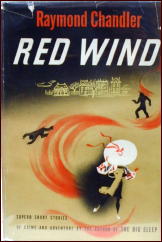
   This tendency can be seen as far back as his first published story, “Blackmailers Don’t Shoot” (Black Mask, December 1933; collected in Red Wind, World 1946, and in Stories and Early Novels, Library of America 1995).

   Trying to make sense of this story is like trying to nail jelly to a wall. One of the main characters is Landrey, a gambler and racketeer who earlier in his life had tried to launch a Hollywood career. In those days he had had an affair with Rhonda Farr, a young beauty who had become a major star. Apparently wanting to rekindle the romance, Landrey pretends that Rhonda’s love letters to him had been stolen and has his underworld buddies demand blackmail money from her. Then he hires the story’s protagonist, a PI named Mallory, to thwart the blackmailers and recover the letters.

   All these events have taken place before the story begins. Chandler opens with a nightclub scene where Mallory pretends to have the letters himself and, hoping to force the blackmailers to go after him, demands $5,000 from Rhonda. (What would he have done if she had said “Show me you have them”?) Chandler never makes up his mind whether Rhonda had asked Landrey to help get her letters back.

   At pages 71 and 106 of the Red Wind collection and pages 7 and 37 of the Library of America volume it seems she did, at pages 111 and 42 respectively it seems she didn’t. If she didn’t, how could Landrey have known she was being blackmailed unless he was behind it himself?

   At no point does Chandler provide any details about how the letters were stolen. In fact at pages 104-105 and 36-37 respectively it’s hinted that Landrey had returned the letters long ago and that they’d been stolen not from him but from her. To make matters even more chaotic, he for no earthly reason is carrying the letters in his own pocket on the night of the action!

   Simultaneously with the fake blackmail plot, Landrey has arranged for Rhonda to be kidnaped and held for ransom so that he can rescue her and earn her eternal gratitude. Apparently none of his underlings are ever privy to his overall plan, but a remark of Mallory’s — “When the decoy worked I knew it was fixed” (pp. 112 and 43 respectively) — suggests that in some mystic manner our sleuth knew the truth almost from the get-go.

   Somehow, although again Chandler spares us any details, Landrey’s partner Mardonne is involved in the master scheme, and Mallory miraculously discovers this aspect of the plot too (pp. 115 and 46 respectively). Small wonder that Mardonne (on pp. 112 and 43 respectively) remarks “A bit loose in places.”

   Parsing other Chandler stories will have to be done by someone else. Life’s too short.

***

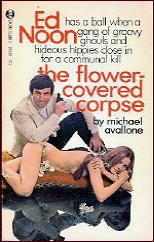
   How better to celebrate one’s recovery from serious illness than with one of the immortal works of Michael Avallone? The Flower-Covered Corpse (1969) is rife with the scrambled sentences that are his unique claim to fame but I’ll limit myself to a handful. The “I” in these quotations is New York PI Ed Moon, who is to detectives what Ed Wood was to directors.

MIKE NEVINS

   I had never heard of Louis La Rosa. Didn’t know him from Robert J. Kennedy.

   Blood played tag in my little grey cells.

   â€œ….Hep you may be but you are unitiate….”

   The mad evening had come to its final, inexorable totem pole of weird unreality.

   More marbles scattered across the floor of what was left of my brain.

   Right after War Two, he had plunged into the Police Academy bag and come up with an apple pie in each hand.

   I didn’t have a client except myself and my own neck.

   He tried to smile, still huddling his lovely fortune cookie.

   Femininity and Melissa Mercer are blood sisters.

   The .22 spit like a sneeze.

   I said a handful and a hand has five fingers so I guess I should have stopped halfway through my list. But there’s something about Avalloneisms that almost forces me to say — again and again and again — “Just one more.” I hope you didn’t mind too much.

COLLECTING PULPS: A MEMOIR, PART NINE —
WESTERN STORY MAGAZINE
by Walker Martin

WESTERN STORY MAGAZINE

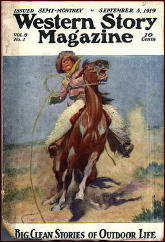
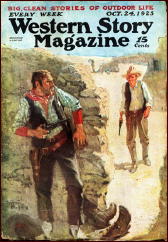
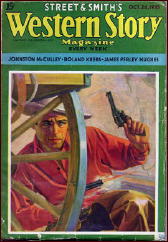
   Recently, a collector of hardboiled fiction was visiting me and he noticed that my dining room was filled with stacks of WESTERN STORY MAGAZINE, hundreds of issues. In fact there were two extensive runs of the magazine, each one over a thousand issues. His first question was what on earth was I doing? A question I might add that my wife asks me each day in louder and more exasperated tones. Taking over the dining room was a major victory in the constant and bloody pulp wars between the collector and the non-collector.

   I of course thought it was perfectly obvious what I was doing. I was going through the painstaking process of carefully comparing each issue in order to keep the better condition copy for my own collection. This process of having to decide which copy is the better one, has been known to drive collectors crazy.

   He then wondered why I was bothering with a western magazine when he knew me as a collector of mainly SF and hardboiled fiction. After he left I started to think how did I get involved in such an enormous project as collecting western pulps. Why enormous? Because, after the love pulps, the western pulps were the most popular and best selling fiction in the 1920’s and 1930’s.

   To start collecting the many titles is a major commitment in time and money. Not to mention the necessity of having the space to store them. Plus, I only collect books and magazines that I can actually read, so I have to devote some time to reading the stories. But I’ve never seen that as a big problem because I’m reading all the time: in bed, outside in the shade, while eating. The only time I’m not reading is while I’m asleep or at a book convention hunting for books. But even while sleeping I often dream about reading and what I’ve read.
WESTERN STORY MAGAZINE

   When I was working and people would ask me about my job, I often responded that I was a reader and collector. Only later would I realize that they were referring to my occupation which I considered as only a means to pay the bills. We all have jobs and careers but if you are a serious collector, then your main function, your main purpose in life is often your collection. Hunting for rare items, adding to your collection, and thinking of new areas to expand your collecting interests.

   And the above sentence just about explains why I expanded into the western pulp and paperback areas. I have this theory about collecting, mainly that the collector must keep expanding into other interesting areas because once you complete a collection of a certain author or magazine, then there is a danger of boredom setting in and you end up selling your collection. But if you keep collecting and getting interested in new areas, then you do not get jaded and cease collecting.

   In my own case, I started out reading and collecting SF at age 13, then ten years later I started reading and collecting detective and mystery fiction, and then in a few years adventure fiction. Meanwhile I always kept an interest in mainstream and literary fiction.

   I still remember the day in 1980, when I realized that I was close to realizing my pulp magazine goals. I had extensive runs of all the major SF, detective, and adventure magazines. I was mainly involved in filling in some gaps and titles. However, except for a few issues, I did not have many western pulps.
WESTERN STORY MAGAZINE

   I was fortunate to be friends with a major western pulp collector, Harry Noble. Harry was quite a bit older than me and had actually bought the pulps off the newsstands. The only pulp I ever bought off a newsstand was SCIENCE FICTION QUARTERLY in 1956, just as the pulps died. So naturally Harry was the man to talk to about the western pulps.

   While driving to Pulpcon in the early 1980’s, Harry regaled me with many stories of his early pulp collecting days. He started off in the early 1930’s as a boy reading WILD WEST WEEKLY. But this magazine was slanted toward the teenage boy market and he soon graduated to the more adult WESTERN STORY. This was probably his favorite magazine because of all the Max Brand stories.

   By the time we returned from Pulpcon, I was desperate to collect WESTERN STORY. I asked Harry what he wanted for his set which was not complete but numbered over a thousand of the over 1250 issues. Yes, you read right, *over 1250* issues! For most of its life WESTERN STORY was a weekly, which meant 52 issues each year or 520 issues during a decade. A major title indeed.

   He said $5,000 which came to around $5.00 each. Not a bad price but $5,000 was like impossible for me to pay. Like all of us, I had the usual bills to pay, car payments, mortgage, children to raise and educate, and a non-collecting spouse to care for and feed. In the early 1980’s I was earning maybe $10,000 a year which provided for a middle class lifestyle but not for a major expense like a set of WESTERN STORY.
WESTERN STORY MAGAZINE

   But as some of you know, I’ve never let lack of money stand in my way when it comes to collecting my favorite addiction, my drug of choice: books and pulps. I mean this was my purpose in life, right? Since Harry and I were good friends, he trusted me to pay him $100 every pay check until the amount was paid off. So every pay check I paid Harry before any other bills. I saw the pulps as more important than such routine things as car payments, food, electric bills.

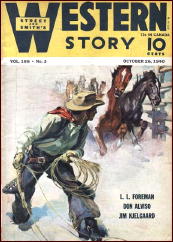
   As I looked through the collection, I realized that I had made a the right decision. WESTERN STORY was one of the major pulp titles and one of the greatest success stories. In 1919, Street & Smith decided to follow up the success of DETECTIVE STORY, which had become a big seller since the first issue appeared in 1915. Just about immediately WESTERN STORY was a big success and during the 1920’s I’ve read some accounts that put sales at 400,000 and even 500,000 an issue. And this was for a weekly magazine.

   The title lasted for 30 years, 1919-1949. However after the big selling 1920’s, the depression caused a decrease in the weekly circulation. The word rates were cut and Max Brand for instance, went from a nickel a word to 4 and even 3 cents. By 1934 he was no longer the main attraction and he developed other markets such as movies and other magazines.

   I believe the next blow was in 1938 when Allen Grammer became president of Street & Smith. Before 1938, the firm had been mainly family run since the 1850’s, so Grammer was the first outsider to head the company. If a member of the family had been president, they probably would have had some sentimental attachment to the old dime novel and pulp days, but Grammer was strictly business. In fact, he saw the future as not the pulps but women’s slick magazines.
WESTERN STORY MAGAZINE

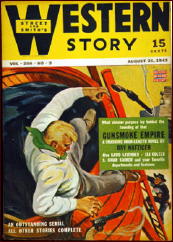
   In 1943 came another blow when Grammer decided all the pulps would be published in digest size. All the other publishers elected to decrease pages because of the war time paper restrictions but Street & Smith started to appear in the smaller size format. It’s true that the digest size was the future but they really looked sorry compared to the larger 7 by 10 pulp size.

   But he didn’t just decrease the size, he also killed several of the major Street & Smith titles such as WILD WEST WEEKLY (1927-1943, over 800 issues), SPORT STORY (1923-1943, over 400 issues), and the most missed of all, one of the greatest fiction magazines ever, UNKNOWN WORLDS (1939-1943, 39 issues).

   Since Allen Grammer had no sentimental attachment to the pulps, he saw after WW II that their days were indeed numbered. He gave the order in 1949, he pulled the trigger that caused the bloodiest day in pulp publishing history, the killing of the entire Street & Smith line of pulps. The only exception was ASTOUNDING.

   There have been many theories as to why this magazine survived the blood bath. I’ve heard that Grammer or one of the big shots in the organization liked SF. I’ve also heard that ASTOUNDING was on firmer financial ground and making money compared to the other pulp titles which were not that profitable.

   The entire Street & Smith pulp line was dismantled and it must have been a sad and shocking day as the realization set in and the editors, staff and writers had to accept the fact that a major pulp market was indeed dead.

   Daisy Bacon, one of the most senior editors with over 20 years experience editing LOVE STORY, DETECTIVE STORY and other titles was terminated. It’s reported she hated Grammer and never forgave him. In WESTERN STORY there was no advance notice, the magazine just ended with no obituary after over 1250 issues. A couple years later, Popular Publications tried to revive the title but the experiment lasted only a few issues. The pulp era was over except for a couple titles that limped on for a few years.
WESTERN STORY MAGAZINE

   Now there is an amazing footnote to the above horror story (well, a horror story to a pulp collector like me!). In the mid-1990’s an elderly man moved into the house right next door to me. He was in his late 70’s and a retired music teacher. He held an open house to introduce himself to the neighbors and my wife and I attended. While walking through the house, we were stunned to see two original cover paintings from WESTERN STORY hanging on the wall of the den.

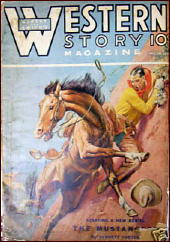
   In a daze, I slowly approached the paintings and saw they were both by Walter Haskell Hinton who did several covers for WESTERN STORY in the late 1930’s (the dates of the covers are September 24, and October 29, 1938; shown to the left, and to the right below). I collect original pulp art and couldn’t believe my eyes. What are the odds of a neighbor moving next door with two pulp paintings? A billion to one?

   I foolishly said, like an idiot, “Hey, do you know you have two pulp paintings hanging in here, huh?” It’s a wonder he didn’t escort us out of the place. But yes, he realized it and his name was Paul Grammer and his uncle was Allen Grammer, the infamous president of Street & Smith!
WESTERN STORY MAGAZINE

   He said his father also worked for the firm in some capacity and when the two brothers died, he inherited the two paintings. Paul is no longer with us but before he died he did sell me the two paintings, one of which I still have hanging in my family room as a reminder of the craziest coincidence in my life.

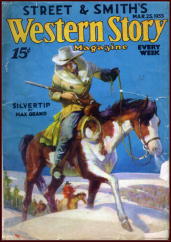
   In addition to the fiction, the art of WESTERN STORY is reason enough to collect the magazine. They used several first rate artists which reminds me of another strange story. I once was in an art gallery in NYC back in the early 1980’s looking at fine art and abstract art. Then again, I was stunned to see a cover painting from WESTERN STORY. It was by Charles Lasalle and was the cover for the first Silvertip story by Max Brand.

   The date is March 25, 1933 and shows a man on a horse looking at a trace of blood in the snow (shown to the left below). Again, while speaking to the gallery owner, I asked what do you want for the Charles Lasalle pulp painting. He gave me a look like I had asked him about pornography and said “We do not sell pulp art” and the way he said *pulp art* made it an obscene word.
WESTERN STORY MAGAZINE

   After he quoted a high price that I couldn’t afford, I slunk out of the gallery and went home. The first thing I did was go to my WESTERN STORY collection and make sure it was a pulp cover. Then the next day I returned to the gallery with the pulp and showed the owner that the Lasalle painting was indeed pulp. He was so distressed that he sold it to me for a bargain price just to get rid of it.

   Western cover art is known for the shoot ’em up images, usually a bunch of cowboys blazing away at each other. But WESTERN STORY, especially in the 1920’s, often showed scenes from a cowboy’s life. Anything from playing poker to rounding up steers at night or even chuck wagon scenes. Some favorites of mine are several covers that show cowboys reading WESTERN STORY.

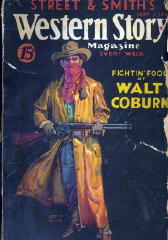
   Perhaps my favorite of them all is the first cover Walter Baumhofer did for WESTERN STORY. It so impressed the editors that they hired Baumhofer to do 50 more covers including some great ones for DOC SAVAGE. It’s the cover for September 3, 1932 and simply shows a road agent with a rifle standing in the rain (shown to the right below).
WESTERN STORY MAGAZINE

   Another very interesting series of covers was done by Gayle Hoskins in the early 1930’s. A couple dozen cover paintings showing scenes from “A Day in the Life of a Cowboy”. These were so popular with the readers that Street & Smith packaged them as prints and gave them away to subscribers. The vast majority of course were tacked up on walls and lost over the years. But I did manage to find a complete package with the envelope and prints that somehow survived.

   I’ve saved the best artist for last. Nick Eggenhofer’s main market was WESTERN STORY for over 20 years during 1920-1943. He did many cover paintings which sell for more than I can afford but he also did thousands of interior illustrations. I have several in my collection and even these can cost a few hundred or a few thousand. There is a great book about his pulp work and working for Street & Smith. It’s called EGGENHOFER: THE PULP YEARS and copies can be found on the second hand book market.

   But of course most collectors are interested in the authors. During 1920-1934 you can almost say that Frederick Faust, who wrote under the name of Max Brand and many other names, was WESTERN STORY. Some issues contain three of his stories, including the three longest such as two serial installments and the complete novel.

   Though there used to be many collectors and lovers of Max Brand, we are now down to only a few. I remember in the 1960’s and 1970’s, these collectors were all over the place: binding copies of WESTERN STORY, making little homemade books out of stories excerpted from the magazine and even publishing a few fanzines.

   I started reading Max Brand in 1955 but SF soon took over as my main reading addiction. I’ve always had a problem with his work and in 50 years of reading Brand I would have to say that he wrote too much and did it too fast. For many years he did over a million words a year and was one of the highest paid pulp writers. He was making over a hundred thousand a year when such money was like a million dollars. He owned a villa in Italy and wrote poetry. Unfortunately just about everybody agrees that his poetry is dated and of little interest. He was killed while serving as a correspondent in WW II.
WESTERN STORY MAGAZINE

   I divide Max Brand’s work into three parts: one third is good, one third is OK but nothing special, and one third is below average or poor. I never know what I’m going to find when I read him. I might read a couple novels and think, that he is really good and that the fault has been with me for not being able to appreciate him. Then I’ll read a couple bland, sort of mediocre serials, followed by one so poor I have to give reading and I start thinking that he just wrote too fast, etc.

   But Max Brand was not the only writer of interest in WESTERN STORY. I can recommend Luke Short who did some fine work for the magazine and went on become one of the best. Also Ernest Haycox and such excellent pulp writers like W.C. Tuttle, H. Bedford Jones, S. Omar Barker, T.T. Flynn, L.L Foreman, Robert Ormand Case, and many others.

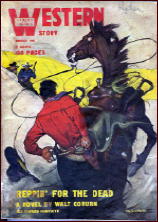
   But one of best that I’d like to specially mention was Walt Coburn. Like Max Brand, he wrote too much and too fast but he knew the west and cowboy life. In fact he was called “the cowboy author” because he actually lived the life. His western dialog and action rings true and is not false like some of Max Brand’s work. But he certainly was capable of poor work every now and then. He had a drinking problem but somehow managed to live to age 79 before hanging himself, probably due to poor health.

   After buying the Harry Noble set and reading it for 20 years, I made a mistake and traded it away for some art. I figured I had read all the best fiction and could move on to something else, some other magazine that I might want to collect.

   Well I figured wrong. As usual I missed the set and started to regret my decision. But fate is a funny thing and in 2006 Harry Noble told me he had a terminal illness and was expected to live only for a few months. He invited me and several other long time pulp collectors to visit him and buy magazines.
WESTERN STORY MAGAZINE

   Since selling me the WESTERN STORY’s in 1980, Harry had built up his set and now in 2006, again had over a thousand issues. He agreed to sell me the set again and again for only $5,000! This time I had the money to pay him and I drove back home with a carload of WESTERN STORY. My wife was not pleased to see the magazine return home, to say the least. We all managed to say goodbye to Harry and so ended the life at age 88, of one of the greatest book and magazine collectors that I have ever known.

   I could write a book about my experiences in collecting this magazine but I better bring it to an end. Wait a minute, here is another crazy collecting story. I once found out a bookstore in New Mexico had 800 issues of WESTERN STORY in nice shape from the late 1920’s to the digest years in the 1940’s. Though I had the issues already, how could I turn down their price of only 50 cents a issue if I took them all.

   I frantically sent off $400 and in a couple weeks 16 large boxes of WESTERN STORY hit the Trenton post office. They evidently didn’t want to deliver them and the manager called me to come and pick them up. This actually was OK with me because then I could figure out a way to smuggle them past my wife, otherwise known as The Non-Collector.

   I waited until she left for work and then I called my job and told them I’d be late due to a family emergency. I quickly picked them up from the post office, in the process almost throwing my back out due to my haste. I hid them in the basement so mission accomplished. I then went to work but I’d forgotten that I had to attend a staff meeting with some big shots. So not only was I late but my suit and tie had pulp shreds and dirt plastered all over. To make matters worse I apologized by mentioning my joy of receiving 800 WESTERN STORY pulps.

   Now, one thing you cannot do as a collector and that is to try and really explain the joy you get out of collecting books or pulps. You might get away with it talking to other collectors, but not to people who collect absolutely nothing and in fact, don’t even read. For years after, my bosses would sometimes bring up the subject of my so called “western collection” in dismissive terms. It probably even cost me a promotion. The funny thing is they had no idea that the “western collection” was really just a small part of my overall collection. If they had ever known the true extent of my addiction and vice, they would have figured out some way to get rid of me.

   At this point, after collecting WESTERN STORY for so many years, I’m down to needing only 11 issues but they are the hard to get 1919 and early 1920 issues, so I may never find them. But it’s been a hell of a ride and I’d do it all over again!
REVIEWED BY MICHAEL SHONK:


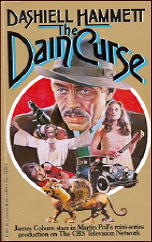
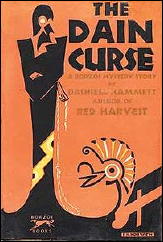
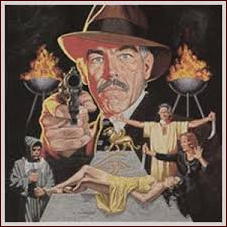
THE DAIN CURSE. CBS – Martin Poll Productions. Based upon the novel by Dashiell Hammett; developed for television by Robert W. Lenski. Producer: Martin Poll. Director: E.W. Swackhamer. Cast: James Coburn as Hamilton Nash, Nancy Addison as Gabrielle Leggett, Bernice Straight as Alice, Jean Simmons as Aaronia, Jason Miller as Owen, Hector Elizondo as Sheriff Feeney and Brent Spiner as Tom Fink.

THE DAIN CURSE

PART ONE – MAY 22, 1978 – MONDAY AT 9-11 PM (Eastern)

PART TWO – MAY 23, 1978 – TUESDAY AT 9-11 PM

PART THREE – MAY 24, 1978 – WEDNESDAY AT 9-11 PM

   THE DAIN CURSE features three stories – a simple diamond robbery that reveals a complex mystery involving drugs, child abuse, blackmail and various murders; a con using a religious cult that ends with death; and a middle aged PI who must overcome his attraction to a young innocent girl and save her from the evil around her.

   THE DAIN CURSE originally appeared as four separate Continental Op stories in Black Mask magazine. Hammett would rework the four stories (“Black Lives” November 1928, “The Hollow Temple” December 1928, “Black Honeymoon” January 1929 and “Black Riddle” February 1929) into a three-part novel (Knopf, 1929). While it was a critical and commercial success when first published, time has not been kind to one of Hammett’s weakest work. The book suffers from its clumsy structure, its padded overly complicated story and a weak ending.

THE DAIN CURSE

   The TV adaptation by Robert W. Lenski would win him an Edgar award and an Emmy nomination (losing to HOLOCAUST writer Gerald Green). Surprisingly, there was no writer credit on screen, instead Lenski received a developed for television credit. Perhaps this was because he stayed loyal to the book and its structure. But changes were made, some were wise, others not.

   Characters such as Minnie the maid’s boyfriend and many red herrings were wisely dropped. The end of each part was changed. Hammett ended each part with the dramatic closure of that part’s case. Lenski knew each TV episode would need a cliffhanger ending to bring back the viewer for the next night. For example, he followed the book closely, but ended Part One with something that happened in Part Two – The Temple, drugged Gabrielle confessing to murder.

   Many of the changes were minor such as changing the Continental Detective Agency to Dickerson National Detective agency and moving the action from the California coast to the East coast and “The City” (New York).

   Lenski should have used even more of Hammett’s original dialogue than he did. His original dialogue tended toward pulp clichés, such as a place smelling of death or things being too quiet.

   The most notable change was replacing Hammett’s Continental Op with PI Hamilton Nash played by James Coburn. The well-dressed Ham owed more to the crime-fighting image of Dashiell Hammett than to the Continental Op. While Coburn would have been a terrible choice to play the Op, he was perfect as the thin, handsome, more energetic PI Hamilton Nash.

   Hammett’s Continental Op appeared in 36 short stories (four would make up Hammett’s first novel RED HARVEST, and four became THE DAIN CURSE). The Op was the visual opposite of TV PI Hamilton Nash. He was a short, overweight (180 lbs), ugly, middle-aged man. He had no life outside of his work. Hammett never even gave him a name. It was this image that made the relationship between the Op and the young victim Gabrielle so important to the tone of the book. It added to the creepiness of the all ready odd mystery as the Op got deeper into Gabrielle’s life, resisting and denying his growing attraction to her and her growing dependence on him, a favorite older Uncle who was fighting inside his desires for the young innocent girl.

   Hamilton Nash had a past he hid from others. To keep his noisy boss satisfied (you would think the boss of a detective agency would know the past of his employees) Ham claimed he had an ex-wife who had run off with the milkman because he was never at home. Coburn with his leading man looks and thin athletic body did not seem as wrong for young but adult looking Nancy Addison as the Continental Op did for the virginal Gabrielle.

   But Coburn’s Hamilton Nash did share the cynical soul of the Op, as well as the Op’s obsessive personality, his deductive talents, and his fatalistic acceptance of injustice. According to Nash, criminals had invented justice. Nash had no problem leaving a case the client thought solved, even when he knew better.

THE DAIN CURSE

   Nancy Addison had the difficult role of the freaky Gabrielle. Her scenes with Coburn brought to life Hammett’s Gabrielle’s feelings for the older PI who was always there to save her. To her Nash was a protector not a potential lover.

   The rest of the cast, especially Jason Miller and Jean Simmons, captured Hammett’s characters well in their performances. Early in the book, Mrs. Alice Leggett was described as being serene and the only sane soul in the Leggett’s household. This played a role in the story. Bernice Straight performance failed to capture that aspect of Alice, but her performance did get her an Emmy nomination for single performance by a supporting actress in a comedy or drama series (she lost to HOLOCAUST Blanche Baker).

   E.W. Swackhamer’s direction was worthy of the Emmy nomination he received (he lost to HOLOCAUST director Marvin J. Chomsky). He kept the characters moving to give a sense of energy and tension to the slow paced twisty story. In Part One’s denouement scene, several people filled the lab of the dead man. Nash refused to believe the letter left by the man was a suicide note. Swackhamer had Nash restlessly moving around the room while the rest stay still. As Nash declares the man was murdered, he moves out of the shot (but not out of the room) leaving the camera focused on the reactions of the rest of the people there.

THE DAIN CURSE

   Production values for THE DAIN CURSE were average at best, but never let down the story. Music by Charles Gross reminded us the time was 1928, and added a nice noir sound when needed.

   Following the success of the mini-series ROOTS, CBS had high expectations for THE DAIN CURSE. The ratings for the first night were a moderate success with a 37 share. But the ratings for the second and third night fell with each episode receiving a 30 share, OK but not the blockbuster numbers hoped for by CBS.

   THE DAIN CURSE aired during the May sweeps, an important ratings period for the networks and its local stations. ABC, CBS, and NBC were going all out to attract viewers. Viewers not hooked by Part One of THE DAIN CURSE had other options, including one in syndication.

   THE BASTARD (aka THE KENT FAMILY CHRONICLES) from Operation Prime Time (OPT) scrambled the regularly scheduled programs for that week. OPT was a group of independent TV stations who had united to finance programs from major studios. Produced by MCA/Universal, THE BASTARD was a four-hour mini-series scheduled to air over two nights. It proved a major challenge to THE DAIN CURSE when the two series aired against each other in many markets. Another problem for CBS and the other networks was THE BASTARD aired not only on 25 independent TV stations but also on network stations preempting network programs. THE BASTARD appeared on 14 ABC, 27 CBS and 25 NBC stations.

   I would like to read THE DAIN CURSE in its original Black Mask format, but the original four stories reportedly have never been republished. The book was a disappointment. It was padded and told three weak stories instead of one strong one. The TV mini-series was never able to overcome the problems of the novel and added some of its own, most notably the effect casting played on the romantic spine of the story.

      Sources:

Broadcasting Magazine – May 15, 1978, May 29, 1978, and June 5, 1978.

The Dashiell Hammett website by Mike Humbert:

http://www.mikehumbert.com/Dashiell_Hammett_05_The_Dain_Curse.html

Editorial Comment:   The first two videos consist only of clips from the show. I do not know if the bottom one is the complete mini-series or not, as I have not watched it to the end. I am suspicious about it, as it is only three hours long.

Also Note:   Curt Evans reviewed the novel version of The Dain Curse earlier on this blog. Follow this link.

CONVENTION REPORT: PulpFest 2013
by Walker Martin

   During the dates of July 25-July 28, 2013 an event happened in Columbus, Ohio, that may have been not important to non-pulp and non-book collectors, but if you collect and read these great artifacts then you know that something very special occurred. I attended almost 40 pulp conventions when the old Pulpcon was the big summer event during 1972-2008. And as much as I loved that pulp convention, it never reached the heights of the present show which we call PulpFest. The most attendees that Pulpcon ever had was around 300 and many of the events had around 100 or so. But all five of the recent PulpFests have had higher attendance than Pulpcon ever had. Once again the attendance reached 400 with 100 dealer’s tables.

pulpfest 2013

   Yes, it is hard to believe but this was the fifth convention of the new pulp convention. And as a special reward to the attendees, it was one of the very best shows. If you read or collect pulps, pulp reprints, books, vintage paperbacks, slicks then this was the place to be. If you like old movies or collect original art from books and magazines, then you were in luck because there were plenty of dvds and art for sale.

   As usual, I had been thinking of this convention ever since the Windy City Pulp Convention ended in April. I’m severely addicted to reading, collecting, and buying all sorts of books and magazines and I needed another fix. I also collect dvds of old movies and original artwork, so non-collectors simply do not understand me at all. They tend to call me everything from hoarder to that crazy guy who likes to read. Actually it is impossible for the non-collector and non-reader to ever understand the collector, so the best policy is to ignore the poor ignorant fools.

   If you do not read or collect anything then you better stop reading this report because it will freak you out. Most of the 400 attendees were addicts like me and they were out to collect and buy books and magazines come hell or high water. One collector actually took an Edd Cartier artwork out of my hands while I was looking at it and yelled “I’ll buy it!”

   Another time a collector beat me again to a pulp cover painting and I was consumed with feelings of jealousy and hatred. The only thing that stopped me from trying to yank it out of his hands was the fact that he was a lot younger than me and could pound me into the floor before I made my getaway.

   It’s a pulp jungle out there as Frank Gruber once said, and every man for himself. Since I couldn’t sleep the night before, I got up at 4:00 am and waited for the van to arrive. For the last several years, a group of us have been renting a van and driving out from NJ. We have to rent a van because a normal car will not hold all our acquisitions.

   Only veteran, long time collectors are allowed in this van and you have to have a thick skin because we are prone to joke and laugh at each other. We even use insults in order to try and get an advantage over each other. Once again to pass the time we talked about bizarre and crazy pulp collectors that we have known.

   I recounted the story of a friend who wanted to steal art from the art display and another friend who picked up girls by leering and saying “the mole men want your eyes”. It seemed to work, but I never tried it because all I’m interested in at the pulp conventions are books, pulps, and original art. Everybody can have sex, but to hell with it during the pulp convention!
   After nine hours of driving we arrived in Columbus at 3:30 pm. We quickly checked in and once again I marveled at the size of the hotel and convention center area. I got lost more than once. Maybe that’s a result from all the years that I’ve spent alone in a room happily reading. That’s my ideal of a good time: reading a good book.

   Since Ed Hulse, our driver, was giving a lecture at Ohio State’s Thompson Library, we went with him to listen to him talk about the ancestors of Batman. For an hour and a half he discussed the various pulp crime-fighters. Eric Johnson, a professor at Ohio State, drove us over to the Library. He has organized these annual lectures each year during PulpFest and this one was especially enjoyable.

   We then registered for the convention and set up our tables. The panels discussed the influence of Fu Manchu and Hollywood and the Hero Pulps. Following the panels, we watched the first five chapters of THE SPIDER’S WEB. Starring Warren Hull and Iris Meredith, this has never been commercially released but is available on the bootleg market.

   In my opinion, this is one of the very best serials ever made. It faithfully follows the spirit of the Spider novels and is non-stop action. We saw five chapters each night for three evenings. My favorite scene involves a little old lady in a dress fighting the Spider. I know it’s a henchman but the scene is funny as hell seeing a woman in a dress and white wig fighting the Spider. I guess the Spider didn’t think it was funny because when the little old lady tried to run away from him, he calmly shoots her in the back. I almost had an accident laughing. One of the great scenes in movie history. I guess the movie code censors didn’t preview THE SPIDER’S WEB because they would have demanded the scene be cut. The poor little old lady. I loved it!
   I mentioned the competition between collectors above. Sometimes it can misfire. For instance when the collector took the Cartier drawing away from me, I was very jealous. He paid more than it was worth at $450 but I was still unhappy. But the next day I found si more Cartier drawings, each priced at only $160 each plus they were signed!

   Needless to say, I took great enjoyment in showing my friend that he had overpaid about $300. I was happy to see that he was crushed and I took advantage of his sadness to eagerly push ahead of him and buy some pulps. It’s true that we have been friends for 40 years but we are talking about our collections here! It’s dog eat dog!

   Next to the dealers room I noticed hundreds of women shrieking and yelling at another convention. It seem to involve baskets and shopping. In fact one lady on the elevator asked me if I had found any good shopping bargains. I quickly told her, with a superior air, that I was a member of the PulpFest convention. She asked with great puzzlement “What’s Pulpfest?”

   Since I only had something like 15 seconds on the elevator to explain, I simply muttered it was a convention of book collectors. She repeated in a tone of wonderment “book collectors?” As I said, the non-collector will never understand the collector.

WALKER MARTIN - PULPFEST 2013

   Now, you might wonder what I brought to sell and what I bought for my own collection. Recently I was lucky enough (or perhaps a non-collector would say *unlucky enough*), to obtain over 1,000 issues of WESTERN STORY MAGAZINE, 1919-1949. I already had almost all the issues but I wanted a few wants plus I’m always looking for upgrades. So I passed many of the Max Brand issues on to a friend, but that left me with many duplicates. So I boxed up a couple hundred issues, mainly 1936-1939 and priced them at only $5 each. The 1920’s I wanted $15 each but it was amusing to watch the many collectors walk by perhaps the biggest bargain in the dealer’s room, sneering at WESTERN STORY issues priced at only $5.

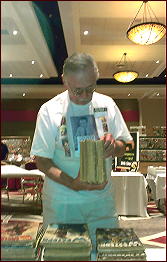
   However, there were a few who realized that I may have taken leave of my senses and bought all the issues I had before I was committed to the local insane asylum. I’m talking about fellow out of control collectors like Matt Moring, David Saunders, and Randy Vanderbeek. These guys know a bargain when they see it! By the way, I’ll try and remember to forward a photo of me looking at the WESTERN STORY’s on my table.

   I also sold several cancelled checks from the files of Popular Publications and Munsey. Again, there are a few collectors that know these are extremely rare and unusual.

   What did I buy? The best and rarest item was a bound volume of a magazine called ROMANCE. Despite its name it was not a love pulp and during its short life of only 12 issues in 1919-1920, was the companion magazine to the great ADVENTURE MAGAZINE. I’ve been hunting for decades for this title and have only found three or four issues. This volume contained six of the 12 issues and made me very happy. Next to it was the crazy magazine THE SCRAP BOOK, so I bought the those volumes also.

   I also bought 24 issues of various crime digests, the ones that tried to imitate MANHUNT in the 1950’s. I used to have these issues but since they are quite unreadable, I sold them years ago. If a collector lives long enough, he often will start collecting items that he previously sold. The covers are nice, showing all sorts of violence against women. Sorry ladies, but digest and pulp collectors seem to like these covers and they bring high prices. I’m talking about such crime digests as TWO-FISTED TALES, OFFBEAT, GUILTY, KEYHOLE, and WEB TERROR.

   I also bought several issues of GHOST STORIES. Despite the claim that these are true stories, they really are fiction. Since I’ve been at the collecting game so long, I’ve filled in most of my wants but I did manage to find a DIME DETECTIVE I still needed. Also an FBI DETECTIVE and a DETECTIVE STORY from 1922.

   I bought several pieces of pulp art in addition to the six Edd Cartier drawings, such a Kelly Freas paperback cover painting and other things too numerous to name. But I do want to mention the Walter Baumhofer art that David Saunders had at his table. He had something like a hundred pieces of art that may have been used as interior illustrations in various pulp magazines. They all eventually sold and I managed to buy many of them. David threw in a great photo of Baumhofer.

   Speaking of David Saunders, I would like to like to discuss the various panels and discussions, but there were too many for me to cover here. Pulpfest.com has a complete listing but I would like to mention two that I found to be of great interest. They all are interesting and that is another thing that Pulpfest is known for. The excellent quality of the evening programming. But my two favorites were the presentation that David Saunders gave on Walter Baumhofer and the talk that Chris Kalb gave on hero pulp premiums and promotions.

   David Saunders, as the son of artist Norman Saunders, knew Walter Baumhofer. There is no one better qualified to talk about Baumhofer. What a great discussion, and I hope PulpFest has David Saunders talk about pulp artists at every convention. David has one of the best websites on the internet where he discusses pulp artists. The site is pulpartists.com. The committee already have invited Chris Kalb back to give us additional information about the pulp premiums.

   The auction was mainly from the collection of Al Tonik and this time concentrated on the research books that Al had accumulated over the years. I also buy reference books as they are published so I had almost all of these items.

   Several pulp reprints and books about the pulps made their debut. WORDSLINGERS by Will Murray, THE BLOOD n THUNDER GUIDE TO PULP FICTION by Ed Hulse, HIDDEN GHOSTS by Paul Powers, a collection edited by Laurie Powers, PAPERBACK CONFIDENTIAL: Crime Writers of the Paperback Era by Brian Ritt, and from Altus Press, THE COMPLETE ADVENTURES OF HAZARD AND PARTRIDGE by Robert Pearsall with an excellent and long introduction by pulp scholar, Nathan Madison. We really do live in the golden age of pulp reprints and reference books.

   Tony Davis retired as the editor of THE PULPSTER last year but this year the new editor, William Lampkin, carries on the tradition by editing a fine collection of articles. My favorite is the piece on Daisy Bacon by Laurie Powers.

   The Munsey Award was given to pulp scholar and anthologist, Garyn G. Roberts. Congratualtions Garyn, you really deserve this recognition.

   OK, there must be something I can complain about, right? Nope, no drunks giving me a sour look, no complaints about the lighting in the dealers room, no bitching about the hospitality room. I just went to the bar on the second floor and acted like a collector. All the non-collectors gave me plenty of space!

   So, I would like to thank the PulpFest committee for all their hard work. Mike Chomko, Jack Cullers, Ed Hulse, and Barry Traylor. Thank you, thank you!

   And to all you collectors and readers out there. Make plans for PulpFest next year. Do it now and no excuses accepted! Even if we die, we can haunt the place.

ADVENTURES IN COLLECTING:
PULPFEST 2013
by Walker Martin


pulpfest 2013

   Readers and Collectors! We are down to the final minutes now. It’s time to separate the non-collectors from the collectors. Yes, it’s that time of year again. Pulpfest begins this Thursday, July 25 and continues through Sunday, July 28 in Columbus, Ohio. The complete details are at pulpfest.com.

   Will you be one of the millions of poor souls that do NOT attend PulpFest? Or will you be among the elite of old magazine collectors, those that DO attend? I’m talking about the 400 or so pulp, digest, paperback, book and original art collectors who will be swarming to the pulp collecting center of the universe. In April it was Chicago for Windy City and now in July, it is Columbus, Ohio.

   I’ve heard all the reasons for not attending this pulp convention and there is no acceptable excuse! Illness? Hell, I knew a collector who attended knowing he had a terminal illness and would be dead in a few months. I once attended with a busted back, wrapped up like a mummy, not able to sit down for the entire convention. Every 40 minutes I had to stop the car and get out to stretch and walk around. For awhile I was almost positive that I wasn’t going to make it and I started stopping near hotels in case I had to give up and just lay in a bed for a couple weeks.

   But the thought of my collection kept me going. The visions of more SF magazines, more detective and adventure pulps, more westerns. The artwork, the original cover paintings, the interior illustrations. The stacks of digest magazines, the vintage paperbacks. The friends and old pals that I enjoyed talking to and seeing once again. Some of the best friendships in my life are now stretching beyond the 40 year mark. I just had lunch with a collector that I’ve know since 1970 and we talked about books for 3 hours straight. How could I not attend the pulp convention? When I returned home, I took 4 weeks off from work to recuperate from my back problems. Let’s face it, our collections are more important than some job that just pays the bills.

   Speaking of money, I’ve heard the excuse about not having the cash to attend the convention. I never let this stop me. Sometimes I borrowed the money from the bank or the credit union. I even borrowed money from my wife. You know you have to be desperate to ask for help from a non-collector! I’ve used my credit cards, pension money, money set aside for bills. I mean we are talking about a serious addiction here!

   To be a serious book or old magazine collector, is a calling of the highest order. You are not just some wage slave like the other millions of non-collectors. No, you are a Collector with a capital C. You don’t just eat, work, watch TV, and sleep. And then repeat it day after day like most poor bastards. YOU READ! You Collect valuable and rare artifacts.

   In this era of electronic gadgets, you actually collect non-electronic books and pulps. I mean how cool is that? No computer geek can stand up to that. E-books look pitiful next to a beautiful real, hard copy book. You can’t collect E-books like pulps. A stack of pulps is a thing of beauty. The smell, the look, the feel. And they are worth money!

   I’ve tried many addictions and they can’t compare to collecting books and pulps. Drugs, alcohol, gambling, all can destroy your health and finances. I won’t even get into sex. Sexual habits can ruin you just like any addiction or at the very least, you will find yourself married to a non-collector!

   So there is still time to say to hell with your job and personal responsibilities. Your family can do without you for a few days. Your book addiction needs to be fed. Your Collection must be extended and made larger. You need more books!

   PulpFest awaits…

REVIEWED BY DAN STUMPF:


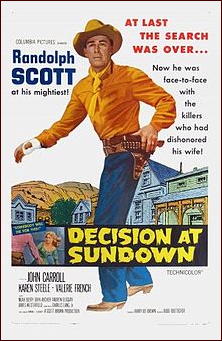
DECISION AT SUNDOWN

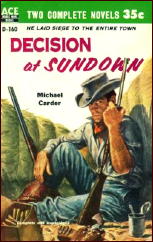
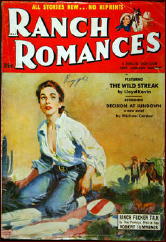
MICHAEL CARDER – Decision at Sundown. Macrae Smith, hardcover, 1955. Ace Double D-160, paperback, no date [1956]. Bound dos-à-dos with Action Along the Humboldt, by Karl Kramer. First serialized in Ranch Romances magazine, January 1955. (Part Three can be found online here.)

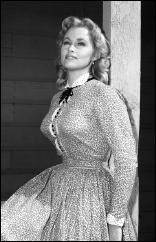
DECISION AT SUNDOWN. Columbia, 1957. Randolph Scott, John Carroll, Karen Steele, Valerie French, Noah Beery Jr., John Archer, Andrew Duggan. Based on the novel by Michael Carder (screen credit given to Vernon L. Fluharty). Director: Budd Boetticher.

   My mention a while back of Jim O’Mara’s Wall of Guns elicited a comment from James Reasoner (a worthy western pen-slinger in his own right) revealing that O’Mara was actually one Vernon Fluharty, who also wrote westerns under the name Michael Carder, among them Decision at Sundown (Macrae Smith, 1955; originally serialized in Ranch Romances, January 1955) which two years later at Columbia studios was turned into one of Budd Boetticher’s most complex and least satisfying westerns.

DECISION AT SUNDOWN

   The book Decision at Sundown bears some interesting similarities to Wall of Guns; in both a bitter loner rides into town seeking revenge, and in both he runs into a range fraught with intrigue: crooked locals grabbing for power, ranchers nursing long-simmering grudges, neighborhood bad guys, loyal friends and a woman who should hate him but finds herself strangely attracted to the handsome stranger (yawn).

   The difference is that Wall of Guns was enlivened by some deeper-than-usual supporting players whose actions — whether short-sighted, passionate or surprisingly thoughtful — sent the book places where lesser tales don’t go.

   In Decision at Sundown however, the ensemble remains depressingly stale: Tate Kimbrough, the town tyrant, is just a double-dyed rat; Lucy, his intended bride comes off like Daisy Mae on the printed page, too purely wholesome and impulsive to believe; Swede and Spanish, the hired guns are nothing but thug-uglies, and — and so it goes: the blowsy ex-mistress, the gruff doctor, grizzled rancher, doughty pardner … they all remain firmly in the cookie-cutter.

DECISION AT SUNDOWN

   There’s a trace of depth as the plot develops and our hero suddenly finds his revenge turned laughable, but it’s quickly drowned in the shallow characters charged with putting it across.

   When the novel reached Hollywood two years later, director Budd Boetticher and writer Charles Lang (story credit goes to Vernon Fluharty) picked up on that particle of originality and ran with it, adding some depth to the characters along the way and coming up with a B-western that if not completely satisfying, is at least original enough to remember.

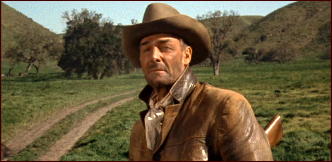
   The hero here is Randolph Scott, and when he rides into town it’s with the easy assurance of two decades of westerns behind him, abetted here by Boetticher’s graceful camerawork and feel for action. Unfortunately, he and the viewer get quickly mired in the story’s rather static complications, and the drama plays out in a few rather cramped and confining sets.

   When one thinks of Budd Boetticher’s films, it’s with appreciation of his feel for characters framed against an open, rugged landscape, dealing warily with their issues and each other as they traverse hostile terrain that reflects some inner conflict. (Or as Andrew Sarris put it, part allegorical odysseys and part floating poker games.) But in this movie, we’re just stuck in a stable.

DECISION AT SUNDOWN

   Stylist that he was, Boetticher managed a few fine moments, notably a couple of deliberately theatrical showdowns in the middle of Main Street, first with Andrew Duggan metaphorically stripping himself down for the performance, and later with John Carroll trying to hide his fears and live up to the Bad Guy’s Code of Conduct, murky as that may be.

   In fact, Boetticher’s attention to this stock character almost brings the film to life. We first see Tate Kimbrough in standard attire for dress heavies in shoot-em-ups: fancy vest, dark coat, and the snide moustache worn by thousands of B-western baddies before him.

DECISION AT SUNDOWN

   Then he starts to show some depth; he’s thoughtful and loving to his trampy ex-girlfriend, frank about himself and his past with his bride-to-be, and toward the end, when he has to go out and face Randolph Scott alone (a pre-doomed enterprise in films of this sort) there’s a rather touching moment when he confesses his fears to his ex-gal (a fine performance from Valerie French, who specialized in this sort of thing) but goes out there anyway.

   I said this was a complex film and I meant it. I also said it was unsatisfying and I meant that too. In Westerns, action is traditionally cathartic, but in this one it simply becomes irrelevant, leading to an ending that Boetticher seems unprepared to handle.

   There’s a lot of stage business between the dramatic climax and the actual ending of the film, and it dilutes the impact of what could have been a uniquely powerful Western. And that’s kind of a shame.

DECISION AT SUNDOWN


Note: To read Mike Grost’s extensive comments on this same film, check out his website here.

TWELVE ANTHOLOGIES OF
HARD-BOILED & NOIR STORIES:
A List by Josef Hoffmann


   The selected anthologies contain mostly short stories from Black Mask and similar pulp magazines. Several stories are newer. The books are especially recommended to readers who want to get a representative overview of this kind of crime fiction without investing the time, money and labour to obtain the original magazines.

   These books are also of interest for collectors who want to take care of their gems and prefer to read the old texts in new books. But my list is not complete. More such anthologies have been published than I have selected.

HARD BOILED ANTHOLOGIES

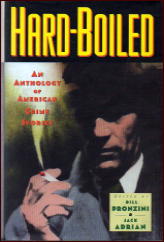
Adrian, Jack & Pronzini, Bill – Hard-Boiled: An Anthology of American Crime Stories, Oxford University Press, 1995.

   This is a de luxe edition of an anthology, not only concerning the contents but also the quality of the paper and the book cover. The long and brilliant introduction tries to define hard-boiled crime fiction. Then follow 36 stories from the 1920s to the 1990s. There are the big stars like Hammett, Chandler, W. R. Burnett, James M. Cain, Chester Himes, Mickey Spillane, Jim Thompson etc., but also forgotten writers like William Cole, Benjamin Appel, Jonathan Craig, Helen Nielsen and others.

   Among the contemporary authors you find Elmore Leonard, Margaret Maron, James Ellroy, Andrew Vachss, Faye Kellerman. One of the finest stories is contributed by James M. Reasoner, a story in a slightly depressive mood. Every story is introduced by an informative note, so the book is also a reference work. As far as I can remember it was nominated for an Edgar award, which is no surprise for any reader of this anthology.

HARD BOILED ANTHOLOGIES

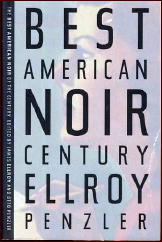
Ellroy, James & Penzler, Otto – The Best American Noir of the Century, Houghton Mifflin Harcourt, 2010.

   This book of 731 pages contains more stories of contemporary writers than of old ones. There is no text of Hammett, Chandler, Horace McCoy and Paul Cain. But there are stories by MacKinlay Kantor (“Gun Crazy”), Dorothy B. Hughes, David Goodis, Charles Beaumont (“The Hunger”), Jim Thompson, Patricia Highsmith and others.

   Among contemporary writers you find James Ellroy, James Lee Burke, James Crumley, Jeffery Deaver, Joyce Carol Oates, Lawrence Block, Dennis Lehane, Andrew Klavan, Elmore Leonard, Ed Gorman and other writers which are not so well-known. The most recent story was published in 2007: “Missing the Morning Bus,” by Lorenzo Carcaterra. The book starts with a short foreword by Penzler and an even shorter introduction by Ellroy. Informative notes on the authors are added to each story. It is good value for your money.

HARD BOILED ANTHOLOGIES

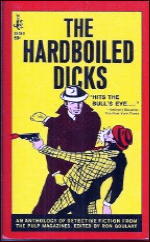
Goulart, Ron – The Hardboiled Dicks. An Anthology of Detective Fiction from the American Pulp Magazines, T. V. Boardman 1967.

   Goulart’s book contains stories by Norbert Davis, John K. Butler, Frederick Nebel, Raoul Whitfield, Frank Gruber, Richard Sale, Lester Dent and Erle Stanley Gardner. Four were published in Black Mask, the rest in other pulp magazines.

   Goulart’s introduction and his introducing notes for each story are rather short, also the informal reading list at the end of the book. As a hardcover edition of the Boardman’s “American Bloodhound” series with a jacket design by the legendary Denis McLoughlin, this book is a much-sought collector’s item.

HARD BOILED ANTHOLOGIES

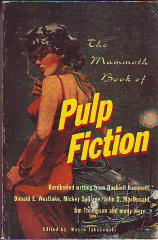
Jakubowski, Maxim – The Mammoth Book of Pulp Fiction, Robinson 1996.

   Jakubowski is not only an editor of crime fiction but also a writer of erotic crime novels and the owner of the London bookshop Murder One, which unfortunately does not exist anymore. Jakubowski’s anthology is different from other pulp collections on my list because he presents above all short fiction of Gold Medal Book authors like Charles Williams, John D. MacDonald, Gil Brewer, Jim Thompson, David Goodis, Day Keene, Bruno Fischer etc. and also more recent stories by Charles Willeford, Lawrence Block, Max Allan Collins, Bill Pronzini, John Lutz, Joe Gores, Harlan Ellison, Donald E. Westlake etc. You see this book’s understanding of pulp fiction is rather broad.

   After the success of the this anthology Jakubowski edited a volume with a similar receipt. There are some stories of the old pulp magazines of the Black Mask days by Gardner, Whitfield, Gruber, Steve Fisher, Norbert Davis etc. mixed with newer material by Michael Guinzburg, Mark Timlin, Marcia Muller, Joe R. Lansdale, Ed Gorman etc. This second anthology is The Mammoth Book of Pulp Action, Carroll & Graf Publishers, 2001, in the US.

HARD BOILED ANTHOLOGIES

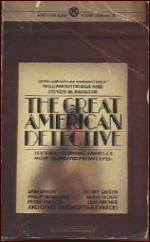
Kittredge, William & Krauzer, Steven M. – The Great American Detective: 15 Stories Starring America’s Most Celebrated Private Eyes, New American Library, 1978.

   This is the only anthology on my list which does not contain exclusive hard-boiled and noir stories. One of the two Black Mask stories is a detective tale about Race Williams by Carroll John Daly. Other hard-boiled stories feature Sam Spade (Hammett), Philip Marlowe (Chandler), Dan Turner (Rober Leslie Bellem), Michael Shayne (Brett Halliday), Lew Archer (Ross Macdonald) and Mack Bolan, the Executioner (Don Pendleton).

   The second Black Mask story is contributed by Cornell Woolrich: “Angel Face.” But you find also tales of famous detectives like Nick Carter, The Shadow, Ellery Queen, Nero Wolfe, Perry Mason and others which are not hard-boiled. The book has a very interesting introduction of 24 pages by the editors, contains short notes before each story and some suggestions for further reading in the final chapter.

HARD BOILED ANTHOLOGIES

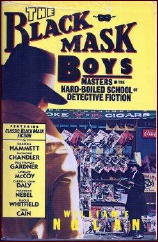
Nolan, William F. – The Black Mask Boys: Masters in the Hard-Boiled School of Detective Fiction, The Mysterious Press, 1987.

   The book begins with a short history of Black Mask magazine. Then comes the first hard-boiled detective tale ever printed: “Three Gun Terry,” by Carroll John Daily. It is followed by the most bloodthirsty story which Hammett has ever written: “Bodies Piled Up.”

   The other stories are also written by big names: Erle Stanley Gardner, Raoul Whitfield, Frederick Nebel, Horace McCoy, Paul Cain and Raymond Chandler. Each story is combined with a lot of information about the author and his writing for Black Mask. At the end is a checklist of mystery-detective-crime pulp magazines.

HARD BOILED ANTHOLOGIES

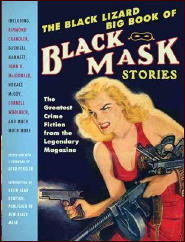
Penzler, Otto – The Black Lizard Big Book of Black Mask Stories. Vintage Books, 2010.

   This voluminous book has 1116 pages. Containing 53 stories this anthology “is the biggest and most comprehensive collection of pulp crime fiction ever published,” writes Penzler in his foreword. The introduction is by Keith Alan Deutsch, copyright owner of Black Mask Magazine.

   The collection includes the original version of Hammett’s The Maltese Falcon. Lester Dent’s story “Luck” is in print for the first time. Besides the “usual suspects” there is a lot of reading material you would not expect: stories by Stewart Sterling, Talmadge Powell, Charles G. Booth, Richard Sale, Katherine Brocklebank, Thomas Walsh, Dwight V. Babcock, Cleve F. Adams, Day Keene, W. T. Ballard, Hugh B. Cave, C. M. Kornbluth, Cornell Woolrich and many others. There are also several names I have never heard of. All in all very good value for the price of $25.00.

HARD BOILED ANTHOLOGIES

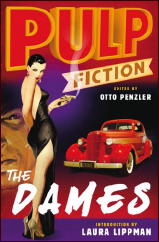
Penzler, Otto – Pulp Fiction: The Dames, Quercus 2008.

   This is one of three anthologies of pulp fiction edited by Penzler in 2008. The other two books concern “Villains” and “Crimefighters.” The “Dames” anthology is for me the most interesting book. It is introduced by crime writer Laura Lippman.

   Besides the star authors Hammett, Chandler, Woolrich one can read fine pulp stories by writers like Eric Taylor, Randolph Barr, Robert Reeves, Roger Torrey, Eugene Thomas, T. T. Flynn and some really unknown pulp fiction writers, altogether 23 stories. At the beginning of every story is a short note about the author and his text. So you get a lot of information about pulp fiction. There is also a comic strip “Sally The Sleuth” by Adolphe Barreaux.

HARD BOILED ANTHOLOGIES

Pronzini, Bill – The Arbor House Treasury of Detective and Mystery Stories from the Great Pulps, Arbor House, 1983.

   The anthology contains 15 stories and an informative introduction about the history of the pulps. Besides the big names like Hammett, Horace McCoy, Fredric Brown, Cornell Woolrich, John D. MacDonald (twice) etc. there are stories by rather unknown writers like Dane Gregory, D. L. Champion.

   A highlight is “Holocaust House,” by Norbert Davis, the first story about private eye Doan and his dog Carstairs. Each story is combined with an informative note. So the reader can learn a lot about pulps.

HARD BOILED ANTHOLOGIES

Ruhm, Herbert – The Hard-Boiled Detective. Stories from Black Mask Magazine 1920-1951, Vintage Books, 1977.

   The book contains 14 stories and a lucid introduction of 28 pages. Besides the big names there are tales by not so well-known or meanwhile forgotten writers as Norbert Davis, Lester Dent, George Harmon Coxe, Merle Constiner, Curt Hamlin, Paul W. Fairman, Bruno Fischer and the humorous William Brandon.


HARD BOILED ANTHOLOGIES

Shaw, Joseph T. – The Hard-Boiled Omnibus: Early Stories from Black Mask, Simon & Schuster, 1946; Pocket Books, 1952.

   The book is introduced by the legendary Black Mask editor Shaw himself, the man who shaped the magazine’s hard-boiled style more than any other editor. Especially he promoted Hammett and encouraged other writers to follow his literary model.

   The hardcover edition contains 15 stories, the paperback only 12. Besides well-known stories by Hammett, Chandler, Cain, Dent and Norbert Davis’s “Red Goose,” there are rather unknown tales by Reuben Jennings Shay, Ed Lybeck, Roger Torrey, Theodore Tinsley and others. A historical milestone.

HARD BOILED ANTHOLOGIES

Weinberg, Robert E., Dziemianowicz, Stefan & Greenberg, Martin H. – Tough Guys & Dangerous Dames, Barnes & Noble Books, 1993.

   The 24 pulp stories comprehend well-known authors like Chandler, Whitfield, Dent, Gardner, Paul Cain, John D. MacDonald as well as forgotten or unknown writers like Fred MacIsaac, Paul Chadwick, Donald Wandrei and others. The story by Norbert Davis, “Murder in the Red,” is not often reprinted.

   Unusual for an anthology of this kind are also names like Fritz Leiber, Leigh Brackett and Robert Bloch. The reader gets some useful information about the contributors from the introduction by Dziemianowicz.

MAX BRAND – The Phantom Spy. Pocket, reprint paperback, December 1975. Dodd Mean, hardcover, 1973. First serialized in Argosy magazine, as “War for Sale,” April 24 to May 15, 1937.

MAX BRAND The Phantom Spy

   They don’t write spy novels like this any more, and even when they did, I have a feeling that it was only Max Brand who wrote them. He had a highly romanticized view of the world, one in which friends were friends, lovers were lovers, and enemies were enemies, and even on occasion when there was some well-constructed confusion as to which was which, the reader always knew.

   Lady Cecil de Winter is the early star of this one, a delightful young lady with a real feel for the game of espionage. Recruited by the British government in those days immediately prior to World War II to retrieve missing plans for the Maginot Line – a grand line of defense designed to protect France and Western Europe on the chance that war should break out — she recruits in turn a fellow named Willie Gloster, a cheerful, happy-go-lucky American who provides the help she needs, only to have her lose them again (the plans, that is) to the hands of a suave but evil mastermind by the name of von Emsdorf.

MAX BRAND The Phantom Spy

   And the game is on. Not since reading the adventures of the early Saint have I read a tale of down to earth swashbuckling, without a single swash or buckle in sight. There is, of course, a phantom spy, a chap named Jacquelin, whom Lady Cecil believes to be another fellow named Cailland. We know better, and we groan in despair when she leaves the love of her life, Willie Gloster, who comes to her aid again anyway.

   There is blood, there is danger, and there is one hell of a grand impersonation, and there is more. This is the real stuff, but written well before we know how far Hitler would go and how the war would really be waged. Max Brand, who of course is much better known for his westerns, was well aware of what causes countries to wage war with one another, but only close to the end of this book does he let the details intrude, and truth be told, I’d’ve rather he hadn’t.

   This is very much of a period piece, if you haven’t gathered that already, but as I suggested at the beginning, perhaps it was even at the time it was written.

« Previous PageNext Page »