Pulp Fiction


COLLECTING PULPS: A MEMOIR, PART EIGHT —
THE NIGHT PULPCON ALMOST ENDED WITH A DRUNKEN BRAWL
by Walker Martin


   I guess if you live long enough and hang out in the appropriate dives, you will eventually see fistfights and guys swinging beer bottles at each other. Normally you will not see book or pulp collectors try to strike and harm another collector. I’ve always said my favorite type of people are book collectors and since there are so few pulp collectors left, I don’t want to get into any arguments with the few that are still around.

WALKER MARTIN Windy City Pulp Show 2013

   Today, a friend sent me an email about a British first edition by H. Bedford Jones. He mentioned that he might consult the resident H. Bedford Jones expert, Digges La Touche (see above). Upon reading this, I almost fell out of my chair laughing and yelling “So you’re the expert on H. Bedford Jones!” I was thinking back more than thirty years ago when the Pulpcon convention almost ended in a drunken brawl.

   Rusty Hevelin, the head honcho and boss of the convention, never scheduled the evening panels ahead of time. He just about always would give you an hour or even a few minutes notice that he would like you to talk about a pulp author or be part of a panel discussing some aspect of pulpish literature.

H Bedford Jones

   I remember once he approached me about ten minutes before the start of the evening programming and wanted me to interview Robert Bloch. Sometimes I turned him down due to not being prepared on short notice but other times I accepted.

   Evidently, at the last minute, Rusty decided to have a panel discuss H. Bedford Jones. He found three collectors who agreed and up to the stage stepped veteran pulp collectors Darrell Richardson, Harry Noble, and Digges La Touche. All were fans of the author and the discussion kept everyone’s attention.

   Everyone behaved themselves and there was no problem. Until the banquet that night. Harry Noble and I were sitting at one of the dinner tables waiting for our food and drinking beer. Another long time pulp collector, Andy Biegel, also sat down. Without any preface or explanation, Andy blurted out, “So you’re the expert on H. Bedford Jones.” At first Harry and I thought that he was kidding and we just laughed. Andy didn’t laugh however and he repeated in a louder voice, “So you’re the expert on H. Bedford Jones.”

   We now realized that Andy Biegel was drunker that we were and was in fact insanely jealous because he had not been chosen to be on the Bedford Jones panel. Harry tried to explain that he was not an expert but just a fan of the writer and loved to talk about his books. Andy was having none of it and repeated for the third time, at the top of his voice, “SO YOU’RE THE EXPERT ON H. BEDFORD JONES!”

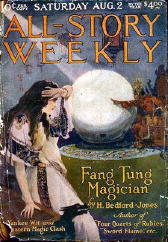
BEDFORD JONES - Fang Tung

   At this point it was obvious that in another minute Biegel was going to fling himself across the table and try to strangle Harry Noble. Though Harry was older than Biegel, such an action would not be a good idea since Harry was a fitness buff and body builder. Since I considered Harry my best pal, I certainly would have joined in the fight and probably we all three would have been rolling over on the floor punching and flailing.

   To make things worse, Andy had a disability involving one leg being shorter than the other. I’m sure Harry and I would have been banned from Pulpcon for life for the drunken beating of a person with a physical handicap. So fortunately we stood up and without saying a word to Andy, we left the room. The next day Andy Biegel evidently didn’t remember anything about the incident and talked to us just as though nothing had happened.

   Harry Noble and Andy Biegel are no longer with us but I still remember the Pulpcon brawl that almost happened over 30 years ago. Everytime I hear that someone is an expert on H. Bedford Jones, I start to scream, “So you’re the expert on H. Bedford Jones!”

WINDY CITY PULP CONVENTION 2013 REPORT
by Walker Martin


   Once again the usual gang of veteran collectors rented a 12-seat van for the long trip to Chicago. I’m talking about our annual pilgrimage to the Windy City Pulp Convention which was held over the weekend of April 12-14, 2013. But three days were not enough for us so we left the morning of April 10 and arrived 14 hours later.

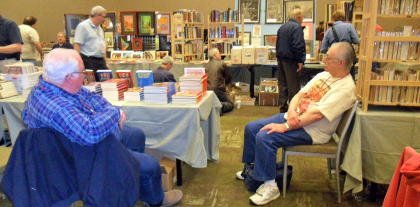
   We were to stay a total of five days eating meals together, some of us rooming together, competing against each other for books, magazines, artwork, and generally bumping heads, fighting, and insulting each other. You might wonder how five collectors could survive such an intense trip. I wonder about this also but somehow we managed to get through the ordeal of roaming through a gigantic room of 150 tables, most of them piled high with stacks of books, pulps, digests, slicks, pulp reprints, and artwork.

WALKER MARTIN Cover paintings

   I always sleep poorly at the pulp conventions and I guess I averaged 4 or 5 hours sleep each night. The rooms at the Westin Hotel are nice and the convention rate is really low each night, only $109 plus taxes. I would have stayed longer but everyone else had packed up their books and pulps and left. The first day we arose early and continued our practice of eating breakfast each morning at the Egg Harbor Cafe. We devour everything in sight and thus do not have to leave the dealer’s room for lunch and waste valuable time when we could be buying and selling books.

   Thursday we again visited The Doug Ellis and Deb Fulton Pulp Art Exhibit. They also happen to live in this art museum. We have visited the museum for three years in a row and this year we saw the new expansion. However, we got lost driving back to the hotel and spent a couple hours blaming each other for such stupidity, so this may be the end of the visits to the Art Exhibit.

   Friday was the official beginning of the festivities. Dealers were allowed in at 8:30 but since I had an “early bird” badge, I started to harass and bother the dealers at 9:30, thus beating the poor souls who had to wait until 11:00. Since I no longer need many pulps, I’m mainly interested in pulp art and cover paintings. I made my first buy at Bob Weinberg’s table. I’ve known Bob since the late 1960’s when we both lived in NJ and used to meet at the NYC SF conventions. Despite the news that he was having some health problems, he was at this table each day and walked around the dealer’s room.

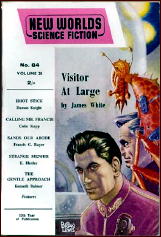
   While I was talking to Bob, I noticed a cover painting by Brian Lewis for NEW WORLDS #84 (June 1959). I quickly snapped it up because I’ve recently been reading through my sets of NEW WORLDS and SCIENCE FANTASY because of the recent publication of three excellent books on these two British magazines edited by John Carnell. Written by John Boston and Damien Broderick the books are titled BUILDING NEW WORLDS and STRANGE HIGHWAYS. Both deal issue by issue with the stories, authors, and artwork.

WALKER MARTIN Cover paintings

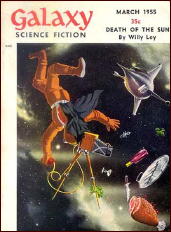
   I then spent the rest of the convention buying original art. I’ve always wanted a GALAXY cover painting from the period when I started to read the magazine. I bought the cover for March 1955 by Mel Hunter. I also found a nice preliminary cover by Kelly Freas for ANALOG. Moving to other tables I manage to buy two Norman Saunders illustrations for the men’s adventure magazines. Unfortunately they do not depict such crazy scenes as Nazis partying with girls but then again I would not be able to afford such great art.

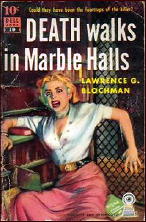
   Art dealer Fred Taraba had many interesting paintings but I managed to control my greed and addiction and limited myself to a nice painting showing a woman screaming in a library. Sort of reminds me of the typical reaction from the non-collecting spouse when they realize they have married a Book Collector! This painting is by Maurice Thomas and was used as the cover on a 10 cent Dell paperback, DEATH WALKS THE MARBLE HALLS by Lawrence Blochman. It also was reprinted in the NEW YORKER for August 19, 1996.

WALKER MARTIN Cover paintings

   I also found a nice illustration by Edd Cartier titled “Framed For Murder.” Somehow I’ve managed to accumulate five of these Cartier drawings over the years. One of biggest finds was a set of 20 illustrations by Lynd Ward, who was an early graphic novelist. My first greedy thought was to buy all 20 but since they were priced at $500 each, I started to hesitate and before I knew it paperback collector, Tom Lesser had clutched two of them. Then I decided to buy only five of them at a discounted price of $450 each. All 20 are from one of the greatest ghost story collections ever, THE HAUNTED OMNIBUS edited by Alexander Laing.

   But my biggest discovery was a large piece of art by Howard Wandrei. The brother of Donald Wandrei, Howard is known in pulp circles for his short stories written for such magazines as DETECTIVE FICTION WEEKLY, SPICY DETECTIVE, WEIRD TALES, UNKNOWN, etc. However his real claim to fame may very well turn out to be his strange, unusual, and bizarre outsider art. I’ve been thinking about buying this piece, which is impossible to describe, for two years, ever since I first saw it at the 2011 Windy City.

   In addition to the fabulous dealer’s room, there also was a large art exhibit, mainly taken from the collections of Doug Ellis, Deb Fulton, and Bob Weinberg. There were a couple of panels discussing Sax Rohmer and Fu Manchu and Science Fiction and Bookselling. Unfortunately I was so busy partying, drinking and having a fine old time with my collector pals, that I missed the panels. As I’ve said before, one of the great things about Windy City and PulpFest are the friends and contacts that lead to long friendships and future deals.

WALKER MARTIN Cover paintings

   The film programming was handled by film expert, Ed Hulse and was of great interest. The serial DRUMS OF FU MANCHU was shown as well as several episodes from the great Boris Karloff THRILLER TV show. Ed also had the new issue of BLOOD N THUNDER magazine, which is a must buy for all magazine and film collectors. Check out his Murania Press website for news of upcoming publications.

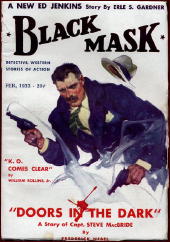
   Actually I did find a major pulp want now that I think of it. I recently obtained the February 1933 BLACK MASK cover painting and was pleased to find the magazine in the dealer’s room. The auction this year was one of the best ever held by Windy City. Friday night saw over 200 lots sold from the estate of Jerry Weist. I just added up the amounts paid for the lots and the total was over $43,000 for Friday. The Saturday auction also was of interest. A complete set of PLANET STORIES in very nice shape was auctioned off in several lots. But the main magazine title was the many issues of ALL STORY(1905-1920). These issues brought the highest prices and many had Edgar Rice Burroughs stories.

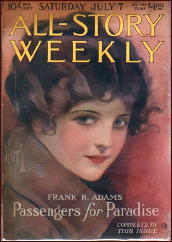
   I’m closing in on a complete set of ALL STORY and need only 4 issues. Since many issues of this magazine are now over 100 years old, it is getting hard to find copies. But the auction had one of the four I needed, the July 7, 1917 issue. But I had to drop out when the bidding hit $950. Artwork is more interesting at that price and it’s difficult to justify paying hundreds for magazines. A friend of mine paid $900 for a pulp at the Frank Robinson auction and read it in about an hour. $900 for an hour’s reading? And I firmly believe these magazines should be read. I simply do not understand collectors who do not read but pay such high prices for issues.

WALKER MARTIN Cover paintings

   Jack Cullers provided me with some nostalgia. He found Rusty Hevelin’s copy of the June 12, 1972 St. Louis Globe-Democrat. In an article about the first Pulpcon, titled “Pulp magazine may fade, but never the memories” there is a photo of Edward Kessell, Rusy Hevelin, and Mrs Walker Martin, all looking at a Graves Gladney painting for THE SHADOW magazine. 41 years ago and I’m still at it!

   Doug Ellis told me Sunday afternoon that the attendance had reached a new high level of 488. Almost 500 attendees and a new record that the old Pulpcon never came near. In this day of electronic gadgets and e-books, that is quite an achievement. So there is hope for the collectors of books and magazines afterall.

   Monday morning the 5 of us, now known as The Publisher, The Collector, The Dealer, The Reader, and The Loser, piled into the van with hundreds of books, magazines, and artwork. Somehow we made it back to NJ despite one of us almost being arrested by a state trooper. It’s too strange a tale to tell.

   Next up? PulpFest in three months! Details at pulpfest.com. See you there…

[UPDATE] 04-19-13.   Thanks to pulp collector/dealer Dave Kurzman, some photos of the proceedings:

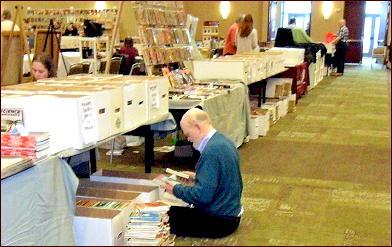
1. Long time pulp collector Digges La Touche sifting for nuggets while sitting on the floor.

WALKER MARTIN Windy City Pulp Show 2013

2. Ed Hulse and Walker Martin keeping a close eye on the traffic across the way:

WALKER MARTIN Windy City Pulp Show 2013

   For Ed’s own comprehensive commentary on the weekend’s activities, go here.

[UPDATE] 06-20-13. Here is a link that shows two pages of photos from Windy City. Mainly about the art but interesting just the same:

http://www.comicartfans.com/galleryroom.asp?gsub=144236

THREE CRIME NOVELS BY C. M. KORNBLUTH
by Josef Hoffmann


   C. (Cyril) M. Kornbluth (1923–1958) is a well-known science fiction author. What is less well known, however, is that he was also a successful crime writer. In the second half of the 1940s he wrote detective stories for pulp magazines. Later, he published crime novels under the pseudonyms Jordan Park and Simon Eisner. According to Hubin’s bibliography, these were:

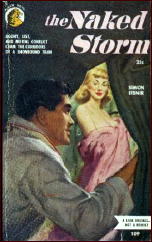
— Simon Eisner: The Naked Storm, Lion Books #109, 1952; cover art: Robert Skemp.

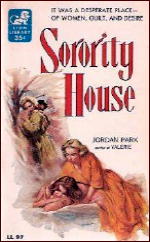
— Jordan Park: Sorority House, Lion Library LL97, 1956 (together with Frederik Pohl); cover art: Clark Hulings.

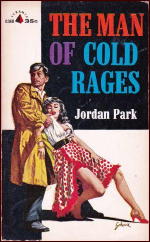
— Jordan Park: The Man of Cold Rages, Pyramid Books G368, 1958; cover art: Harry Schaare.

   A further novel, written jointly by Pohl and Kornbluth, can be found in Hubin: Gladiator-at-Law (Ballantine, 1955). In addition, there were Kornbluth’s novels Takeoff (Doubleday, 1952) and The Syndic (Doubleday, 1953). These novels have elements of a criminal plot, but because the action is set in the future and these novels are generally considered to be science fiction, I omit them here.

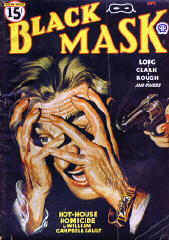
   Kornbluth’s earliest crime stories include the two detective stories in Black Mask: “Beer-Bottle Polka” (September 1946; Vol 29 #1; pp 35-43) and “The Brooklyn Eye”, 29, No. 2 (Nov 1946; Vol 29 #2; pp 79-94). The hero and narrator in each case is Tim Skeat, a private detective in New York City. Some action elements from earlier Pulp stories are reused in the crime novels.

C. M. KORNBLUTH

   The Naked Storm tells of a train journey through a snowstorm from Chicago to San Francisco. The locomotive eventually gets stuck in the snow on a pass in the Rocky Mountains, and the people on the train are cut off from civilization for three days. Using numerous observations and experiences, the novel describes how individual persons prepare for the train journey while the snowstorm is approaching, as well as the journey itself and the catastrophe.

   The novel has no underlying continuous narrative thread, but is instead constructed from larger and smaller illustrations of impressions and actions on the part of the persons involved. The combined narrative particles generate an overall impression that constantly changes, like the pictures in a kaleidoscope. While the reader is at first somewhat clueless, due to the diversity of the impressions and experiences, events intensify during the train journey around four persons:

— Hal Foreman, a news agency boss; he is being coerced by a gangster syndicate into establishing a news agency in San Francisco.

— Mona Greer, a lesbian bestselling author, who uses her glamorous status to seduce inexperienced young women, who she then proceeds to discard, once she has enjoyed her sexual conquest.

— Joan Lundberg, a pretty young woman, who is traveling to a political conference in San Francisco.

— Boyce, a businessman in the floor coverings industry, who is unhappily married.

   Both Boyce and Greer have their eye on Joan Lundberg. Foreman supports Boyce, as he hates lesbians like Mona Greer.

   The novel describes how environmental conditions influence people’s behavior, in particular how they compulsively abandon their moral standards in the face of snow and freezing ice. The bar is plundered, drugs are stolen from the doctor’s bag, insults and fistfights abound. And Foreman decides to murder Greer.

   The novel is more of a mainstream novel than a crime novel. Some of Kornbluth’s own experiences are worked into the depiction of Hal Foreman. This makes it all the more dubious that the reader is expected, through the manner in which the novel is written and concludes, to identify with Foreman’s prejudice against and hatred of homosexuality. This diminishes the quality of the novel considerably.

C. M. KORNBLUTH

    Sorority House is to an even greater extent more of a mainstream novel than a crime novel. Life in the Eleusis Academy for Women, a college in a small provincial town in Pennsylvania, is presented in a socially critical manner. The head of the college is Dr. Mildred Matthewson, an old maid and historian, who tyrannizes and spies on both students and teaching staff. She is malicious, extortionate and scheming.

   Four female students and three teachers form the centre of events. The four young women are accepted into to the sorority of the Lambs and enjoy the privilege of living in their house. They are Ann Riker, an aspiring writer, who is keen to suppress her lesbian inclinations, Kathryn Jackson, a stipendiary from the lower classes, who wishes to become a Latin teacher, Joy Squires, a beauty who embarks on a relationship with a young lecturer, and Clara Gwynn, a rather chubby student who develops a talent for mathematics. The three lecturers are the young English teacher Jim Henschel, the journalism teacher James McGivern, a drinker, and the new, unapproachable mathematics teacher Dr. Crouch.

   The entanglements that befall the students and lecturers are told in an exciting manner. But the action only takes a turn towards becoming a crime novel from page 166. During a dance party, arranged elaborately by the Lambs, Dr. Matthewson is found dead in the night, away from events, in the Mall. The police investigation, which commences immediately, establishes that the death was violent: it is murder. As the head of the college was not short of enemies, there are numerous suspects. Some detection and dramatic action takes place on the last 25 pages. The solution is no surprise.

   From our current perspective the prejudices against lesbian love and against women who aspire to social mobility by means of an academic education are reactionary. These prejudices become apparent above all at the end of the novel, which is not revealed. There is also an alarming empathy for a kind of self-justice. Finally, the different blurbs on both Lion Books falsify the content of the narrative by means of exaggeration, which I find annoying, and which does not do justice to the authors.

C. M. KORNBLUTH

   The hero of the third novel, The Man of Cold Rages, is Leslie Greene. His wife Peg and son Val are run over and killed by a car in Chicago. The car is driven by contract killers who shot Dr. Emilio Hernandez, who was sitting on a bench, and then killed the two likely witnesses to the crime, Peg and Val, with their car. Hernandez had been granted political exile. He came from the (fictional) Republic of La Paz, a small South American country ruled by the fascist dictator General Serrano. Hernandez was obviously murdered because of his oppositional political activities.

   Life no longer has any meaning for Leslie Greene. The only thing that still interests him is the punishment of the murderers. However, the police investigation is unsuccessful. Greene decides to travel to La Paz in order to kill the person who ordered the murders, General Serrano. For an indeterminate period he moves into a hotel in the republic’s capital city, which is decorated by countless portraits and statues of the dictator.

   Because Greene is an artist who can paint excellent portraits, he tries to attract attention by painting the portrait of the hotelier’s cousin, Senorita Isabel Rocas. He achieves this quite quickly, leading to the intended invitation to see General Serrano. It is arranged that he will paint a portrait of the dictator, who will model for the painting regularly.

   At the same time, Greene makes contact with the opposition, which operates underground. The opposition is planning a non-violent upheaval and a general strike. Greene’s plan to murder the dictator is rejected by the members of the opposition. But Greene sticks to his decision. Events take their course and are complicated further by the fact that Isabel falls in love with Greene.

   The Man of Cold Rages is a mixture of political thriller and suspense novel and resembles at times the novels of Eric Ambler. The typical Ambler protagonist lands in terrible danger and political adventure, without knowing what is happening to him; in contrast, Kornbluth’s hero seeks out the challenge cold-bloodedly.

C. M. KORNBLUTH

   This novel is not for readers who prefer their books to be as realistic as possible. For example, it is very unlikely that a visitor to a severely guarded dictatorship can transport a loaded pistol in his luggage on an airplane without any prior precautions, so that the weapon is only discovered by an overly enthusiastic chambermaid in the hotel. Otherwise the thriller is well written, with a number of very impressive scenes. It is exciting to read, albeit not without a certain amount of clichés.

   While Kornbluth’s first Black Mask story is roughly hewn and bursting with violence and cruelty, he refined his narrative technique in the crime novels, using violent scenes in a more differentiated manner. Kornbluth sometimes found himself to be cruel. This was contradicted by acquaintances, who considered his behavior to be friendly.

   The truth is that he was cruel in his fantasy world, as demonstrated in his first Black Mask story and – in diluted form – still in his first thriller. However, his literary attitude towards violence and self-justice obviously changed over the years, as can be seen in his final crime novel.

   It is a pity that the author died so young; we have been deprived of some probably very entertaining thrillers as a result. To those who wish to learn more about Kornbluth I recommend the detailed biography by Mark Rich: C. M. Kornbluth: The Life and Works of a Science Fiction Visionary.

— Translated by Carolyn Kelly.

J. ALLAN DUNN The Girl of Ghost Mountain

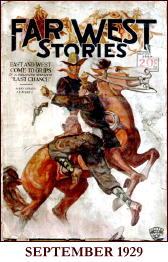
J. ALLAN DUNN – The Girl of Ghost Mountain. Small Maynard Co., hardcover, 1921. Serialized in Western Story Magazine in four parts, beginning with the 16 September 1920 issue; reprinted (I believe) as “The Ghost Mountain Girl” in Far West Stories, beginning with the July 1929 issue. Also currently available in various POD and ebook/online versions.

   Although I’ve billed this as a western novel in the heading for this review, The Girl of Ghost Mountain is much more a romance novel that takes place in the West. The date is never quite specified, but at the time it was written, it had to be the contemporaneous West.

   Prohibition is mentioned, for example, and the occasional automobile shows up or is made reference to. But there are plenty of cattle and horses too, so don’t be at all concerned in that regard. It’s still the West, although perhaps not the Frontier West.

J. ALLAN DUNN The Girl of Ghost Mountain

   Pete Sheridan is the new owner of the Circle S ranch, fresh from the east but acclimating to the west in fine fashion, while “Red” Jackson is his right hand man. They make a good team together, facing down bad guys with precision and aplomb, but they’re no match at all to the charms of the two ladies (one slimsy, the other near Amazonian) who settle in a hidden valley behind a waterfall up in the foothills of Ghost Mountain.

   The first two thirds of the book is the more interesting, as Red and Sherdian settle the hash of the main villain, a fellow named Hollister, an evil one through and through. Once he’s been vanquished and for good, with another 90 pages still to go, a stoic and enigmatic Chinese gentleman who’s been serving as their cook leads the pair to a cache of hidden gold.

   The path is not without its perils, but they are all easily overcome, as we (the reader) know at once will happen, including the prospects in the end (without giving anything at all away, I’m sure) of a double wedding soon in the offing.

   All things considered, while I enjoyed reading this one, something that kept niggling my mind is that a story entitled “The Ghost of Girl Mountain” might have had even greater possibilities, even though it’s obviously not the one Dunn intended. Sit back and think about it.

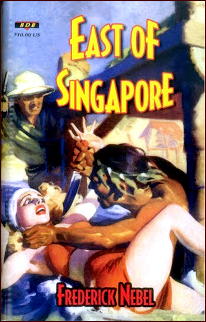
FREDERICK NEBEL – East of Singapore. Black Dog Books, chapbook, 2004. First published in Action Stories, July 1926, under the title “Somewhere East of Singapore.”

FREDERICK NEBEL East of Singapore

   Back before Tom Roberts and his associates at Black Dog Books were publishing their current array of perfect-bound paperbacks – all of which if you are a pulp fiction fan of all forms and varieties, I highly recommend to you – they produced a short series of tall saddle-stapled chapbooks, of which this is one.

   I don’t know what the print run might have been for these early examples of their production art, but I imagine it was small. The number of pulp collectors who might have purchased this particular one, to pick a prime example, is not very large, and I suspect that those who did buy one have kept them. At any rate, when I checked yesterday, there was not a single copy being offered for sale on the Internet.

   The original price was $10, and perhaps back in 2004, that was relatively steep for a 68 page paperback. Still, considering how long it would take you to find a copy of Action Stories from any month in 1926, and how much you’d probably have to fork over for it, the ten bucks outlay might seem OK after all.

   And if you were to get your hands on one, what then? You may ask. A mixed bag, if you were to ask me. Nebel’s prose is clear and descriptive and often a joy too read. Picking the book open and choosing a passage (from page 5, taking place in the streets of Singapore):

   Berk chuckled. He left the sailor quarter behind and soon found himself on the wide street of the bazaars – squat, solid buildings with the upper stories extending over the walk and forming a continuous shed. And red lanterns, and grotesque Chinese inscriptions in black on flaming red paper. Spicy odors of food from a restaurant reminded Berk that he was hungry. But he was broke, and so…

   And from page 28, as Jack Berk and his companion Marty Young, white men both, and young and daring, make their way through the Borneo jungle, searching for a treasure lode of buried jewels, on behalf of a beautiful girl:

   Yes, the outlaw Kyan band was slinking through the undergrowth in search of human heads. Ten in all, led by a ferocious fellow who wore pheasant feathers in his hair, a breech clout of bark-cloth and a sleeveless, vest-like garment of leopard’s skin. He was grotesquely tattooed and wore a string of boar’s teeth around his neck. His oblong shield was trimmed with tufts of human hair. He carried a spear with a beaten metal point and also a sampitan, or blow-pipe.

   That I mentioned that Berk and Young are white is important. The natives are “heathen rascals” (page 9) and from page 12: “A reckless disregard of odds has ever been the bright badge of those white men who have ventured among strange peoples and lifted the white man head and shoulders above his duskier brothers.”

   Please don’t forget that this was written in 1926. Fiction can often tell us more about ourselves than any history book ever could. The real flaw in this story is that it is all action, the outcome is foreordained from the beginning, and the final few chapters can be skimmed through with no fear of missing anything important. But if fast and furious jungle action is your wish, along with immersing yourself in the allure of the mysterious Far East, then this adventure caper has both, and in depth.

ADVENTURES IN COLLECTING

THE ALL-STORY October 1912: The First Tarzan Novel
by Walker Martin


   When I was 9 years old, the first books that I read on my own were the Tarzan and Mars novels by Edgar Rice Burroughs. I knew what I would try and save if the house ever caught on fire. I loved the novels and eventually got hooked on science fiction and adventure fiction. So much so, that I now have complete or extensive runs of just about every major adventure and general fiction pulp, not to mention collecting the majority of SF magazines.

TARZAN OF THE APES

   Yet I’ve never considered myself a Burroughs collector. I don’t collect the first edition hardcovers, and I’ve never attended the annual Dum Dum Burroughs convention. However since I collect All Story, Argosy, and Bluebook, I’m constantly running into the problem that many collectors have to face; and that is the fact that if you want to collect these magazines, then you are going to have to pay a premium in order to get the Burroughs issues. He appeared quite often in all three titles and these issues can command high prices simply because Burroughs is in them.

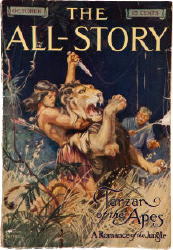
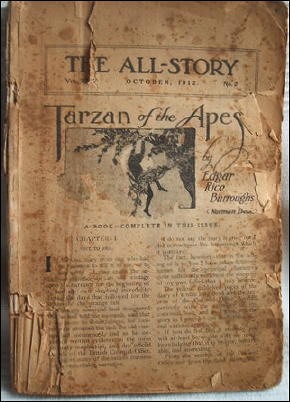
   In fact, one of the issues is considered The Holy Grail of pulp collectors. Yes, I’m talking about ALL STORY, October 1912, containing the complete novel, Tarzan of the Apes. If ever a title of a novel deserved to be in capital letters, then that certainly applies to the first Tarzan novel. Tarzan, even a hundred years later, is still one of the most popular and iconic characters ever created.

   Many years ago, it used to be possible to play the game that all collectors love. What is the most valuable first edition SF novel, detective novel, etc. Magazine collectors of course would wonder about the most valuable pulp. I can remember old time collectors discussing and voting for the first issue of Weird Tales (I actually found the second issue to be rarer), the first Dashiell Hammett issue of Black Mask, Thrill Book, etc. Some collectors would even pick an issue of some obscure, one shot magazine like Strange Suicides or Zeppelin Stories.

   But now I would have to say that it is no longer possible to play the game of “The Most Valuable Pulp Is…” Why? Because there is only one possible answer: All Story October 1912. I have seen a beat up copy go for over $25,000, a nicer copy at auction sell for over $50,000. It is evidently a very rare and hard to find magazine in addition to being the most valuable.

   I collect All Story, which during 1905-1920 printed many early SF stories. It was mainly a weekly during this period published by Munsey and lasted over 400 issues until being finally absorbed by Argosy in 1920. I lack only 4 or 5 issues of having a complete set. Needless to say, the October 1912 issue is one of the missing dates. This then is the story of my quest for that issue, an adventure that has been an obsession for many decades.

   Several times I have had the opportunity of acquiring the issue and each time I failed. My failures I see as a combination of stupidity, bad luck, and not being rich. The first time I was offered the October 1912 issue was over 30 years ago when a fellow Trenton collector casually mentioned that he knew someone that had the issue and was willing to sell. Trying my best to appear casual and bored, I said “Yeah, what’s he want for it. Huh?” All serious collectors know that you must appear like obtaining the book or magazine is the last thing in the world that you want to do.

   He wanted $1,500 which back in the early days of pulp collecting was a lot of money. I could just about come up with the sum despite having the usual roadblocks such as mortgage, wife, and children. The only problem was that the owner was elderly and evidently on his last legs. My friend would not tell me his name and address but would broker the deal. All I had to do was pay him the cash and he would send it off to pay for the issue. However, he warned me that if the owner croaked, then I would be out of luck.

   This turned out to be a deal breaker. All collectors worry about sending off large sums of money and then hearing that death has cancelled the deal. It’s kind of hard saying to a widow, “Hey I’m sorry so and so died. By the way he owes me $1,500”.

   The second time was in the 1980’s at several Pulpcons. Each year I used to see Winston Dawson, an elderly collector who always showed up with his wife (a practice I’m violently against by the way). At one point I would have to say Winston was the oldest Pulpcon attendee, definitely in his mid-80’s. We often had discussions about All Story and it became apparent that he had The Holy Grail. As he grew older, he became more and more willing to sell the issue to me. I guess he wanted to find it a nice home with a younger collector.

   However, once again the subject of death came up. Just when we were about to conclude the deal, Winston up and died. The next couple years Pulpcon held auctions of the Winston Dawson Collection. I must of looked at every pulp he ever owned. One year hundreds of pulps were stacked on the floor waiting to be auctioned and I actually groveled and crawled along the floor, hoping to find the October 1912 issue. Someone must of got it before me because it was not there.

   A few years later, up for auction at Pulpcon, came the issue! Maybe it was even the missing Winston Dawson copy! The only problem was that it was lacking the Tarzan novel. Now, many people may not be aware that at one time there existed quite a number of old time collectors who enjoyed excerpting their favorite authors and stories and making little homemade books. Some of these guys did not have any idea of what they were doing and ruined quite a few magazines.

   They would cut or rip out the pages or maybe take out the staples, etc. Then make up a cover and staple the stories together so that they had sort of a book. Some collectors even had the pages professionally bound and some, like Harry Noble, learned how to bind books so he could make a decent looking book.

   Then you could have a book of H. Bedford Jones or Max Brand stories. This was all before The Golden Age of Pulp Reprints. This is the age we live in now with excellent reprints from Altus Press, Black Dog Books, Murania Press, John Locke, Girosal Press, and others. Now you don’t need to break up pulps and make your own book. So all these old time collectors are gone now, except for one misguided soul who continues to excerpt pulps, and this is evidently what happened with the Tarzan issue up at auction at Pulpcon.

   Someone had excerpted the Tarzan novel and the covers. What was left was the rest of the magazine in quite nice condition but without the important pages. Now you might think that this item would be laughed at and forgotten. Not so. Because the Tarzan issue is so rare and expensive, even a poor, cut up copy will be of interest to collectors in the know. The bidding was hot and furious starting off at $10. I won it at $400 and figured this was as close as I’d ever come to having the issue I’d been searching for so long.

   Fast forward into the 1990’s and I’m at my senseless office job supervising non-collectors, when one day I get a phone call from pulp collector and author Frank Robinson. Due to my habit of talking about the October 1912 issue so often, he knew I was still in the hunt for it. He explained he was at an auction on the East Coast and the Tarzan issue was coming up for bids. What did I want to bid for it? For some reason I only said $5,000 and of course it went higher than that figure. Again, I was out of luck. Maybe if I’d been at the auction, I would have been successful.

   Now here we are in December 2012 and I still don’t have the Tarzan novel. I have the October 1912 issue but the novel is missing. As usual I’m complaining about my situation in a pulp discussion group online, when another collector tells the story of how he was at the Dum Dum Burroughs convention and saw a coverless issue sell for only $25. Not only that but he noticed a coverless issue is up on eBay.

   At this point in my life, I know I’m not going to pay $50,000 or so for one of my wants. It just is not going to happen. But I will be glad to get a coverless issue at a far lower price. The eBay copy is owned by a seller in the UK and he wants a minimum bid of 600 pounds, which is almost a thousand dollars. I figure that price is ok and finally I can stop being obsessed by October 1912! Toward the end of the auction another collector enters a bid and now I have to think about just how high do I want to go? I finally decide on $1,500. This I am willing to pay to get the issue and get some peace of mind.

   The seller tells me that he obtained it in England 15 or 20 years ago and recognized that it was something special. He had no idea how it got to England from America. My bid of $1500 is successful and I finally get the issue that I’ve been hunting for so long. And get this. It arrives on Christmas Eve! This is a tale to bring tears to the eyes of any pulp collector during the Christmas Holidays. Talk about the spirit of Christmas! It’s another bloody Christmas Story, A Christmas Carol!

   So now, here I sit with not one issue of the October 1912 All Story but two issues. True, one lacks the Tarzan novel and one lack the covers but beggars can’t be choosers and neither can collectors. Is it possible that in all the entire world, I am the only person with two copies of the October 1912 issue? Ah Bliss!

TARZAN OF THE APES

REVIEWED BY DAN STUMPF:


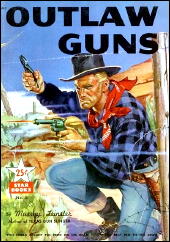
MURRAY LEINSTER – Outlaw Guns. Star Books #3, digest paperback, abridged, 1950. Previously published as Wanted–Dead or Alive!, Quarter Books #25, digest paperback original, 1949. First serialized under the latter title in Triple-X Magazine, February-May 1929.

MURRAY LEINSTER Outlaw Guns

   Outlaw Guns is a popular rallying cry in some circles these days, but it’s also the title of a rather odd western by that prolific and very talented hack Murray Leinster (Will F. Jenkins.) Leinster is probably best remembered for his enjoyable sci-fi, but he also did a number of westerns, generally as much fun to read as his other stuff. Outlaw Guns is a solid western, but I was struck by the motifs it shares with the sci-fi.

   The story starts ordinarily enough, with rancher Buck Galway getting shot out of his saddle by owlhoot or owlhoots unknown, and his brother Slim leaving the Wild West Show and coming home to square things. But on the train into his home town, Slim comes close to getting killed by a man hired for that purpose, and when he hits town he discovers another man posing as him while he is suddenly known as outlaw Snatch Gillian, wanted for murder, robbery, cattle rustlin’, hoss thievin’ and who knows what all.

   This theme of lost identity recurs in Leinster’s sci-fi, as does the notion of a community cut off from the rest of civilization (it quickly develops that the bad guys have bottled up the roads into town and are controlling the telegraph) and the portents of something big and bad taking place in secret — we soon get glimpses of some kind of secret lab set up in a hidden valley, populated by odd-looking denizens who have terrified the good folks in those parts into ominous silence — that’s yet another vibe from his tales of Space Aliens and creepy invasions.

   This ain’t sci-fi though, it’s Western, and a crackling good thing, filled with chases, shoot-outs, fist-fights and a surprising sense of humor, as when Slim is nearly run down by a posse and finds himself rescued by a bunch of squatters who have decided to turn outlaw, and since they don’t know anything about the business, they figure to learn the trade from the notorious Snatch Gillian. The passages where Slim pretends to be the ornery varmint they think he is — and they follow his orders with a devotion bordering on hero-worship — have an understated hilarity to have to read to appreciate. And I recommend you do.

ADVENTURES IN COLLECTING:
Thoughts on a December Evening
by Walker Martin


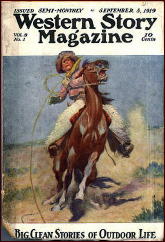
WESTERN STORY MAGAZINE

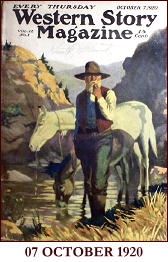
   While looking through the Western Story duplicates that I obtained recently, I’ve been involved in that occupation that has driven collectors crazy for generations. Yes, I’m talking about the heartbreaking job of comparing issues to see which copy is the better one. The better condition copy you keep for your own collection and the lesser condition copy eventually finds a new home.

   Why did I use the words “crazy” and “heartbreaking” above? Because sometimes the copies have different flaws that make it almost impossible to choose one issue as the “better” one. For instance, many times I’ve compared the two copies of the same issue and seen a small piece out of the cover of one issue; but the other copy has some spine problems or perhaps the pages look white compared to almost white, meanwhile someone has scribbled on the contents page “VG” and maybe the back cover has been bent or maybe, etc, etc, etc.

   I’m like the horse caught between two bales of hay; I can’t make a decision and so I starve to death. Or in the case of the collector, you keep both issues!

   A while back we were discussing items that we sometimes find inside pulp magazines or comments that a prior owner has written. I’m looking at the June 5, 1920, issue of Western Story and it has a great N.C. Wyeth cover showing a cowboy riding a bucking bronco while two pals cheer him on.

   Unfortunately, a prior owner by the name of Frederick Gutzwiller has chosen to scribble on the cover. He has written his full name plus the date of Sunday June 13, 1920. He has even added the time: 1 PM. In addition, he must have reread the issue more than 10 years later, because he has written June 1931 and June 1932. There also is a stamped date of January 1935.

   Inside, on the contents page he has written beside some of the stories these dates again. In addition he has rated some of the tales with the comments “poor” and “No Good”. One story he particularly hated because on page 49 where the story “Duty” by S.S. Gordon begins, he has written “29th of June 1932” and slammed it with both “Poor” and “No Good”. But wait, he’s not finished. He then puts on the top of every other page the initials “N.G.”, standing for no good.

   Between pages 90 and 91, Mr Gutzwiller, I presume, has tucked a 16 page pamphlet titled, “Cultural Directions for Will’s Pioneer Brand Nursery Stock”. I see the booklet was published in Bismark, North Dakota. At first I had no idea what this booklet was about but upon reading further I found out it all about planting fruits, vegetables, plants, and trees.

   I also have pulps where Mr Gutzwiller has listed on the covers the various prices realized for eggs, vegetables, and livestock. What I find so interesting about all this, is that he made these notations more than 80 or 90 years ago and probably is long dead. Yet he lives on with his name prominently displayed on some old magazines for collectors to puzzle over and wonder about. I guess that is a sort of immortality, more than some of us will ever receive.

   In fact, as soon as I sign off this computer, I’m going to start writing my name, address, and date on the covers of my pulps. I have a lot, so this might take me quite awhile. I can hardly wait to scribble “Walker Martin” on the set of fine condition Planet Stories that I won at the Frank Robinson auction held by Adventure House.

POSTSCRIPT: Today I’ve spent the whole day continuing to compare issues, which I find to be a lot of fun. There is nothing that make me happier than to look at a fine condition Western Story that I just obtained recently and then see that it is about a dozen times better than my old copy which is sort of brittle and faded, just like me!

   Replacing the old, battered copy with the nice condition copy is like being reborn. I feel like a new collector instead of an old one. If I can find hundreds of nice Western Story magazines at this late stage, then what new worlds are waiting to be conquered? Or collected!

THE SERIES CHARACTERS FROM
DETECTIVE FICTION WEEKLY
by Monte Herridge


        #16. Detective X. Crook, by J. Jefferson Farjeon.

   Detective X. Crook is another of the many series characters in Flynn’s/Detective Fiction Weekly. He appeared in 57 stories from 1925-29, all written by the English detective story novelist J(oseph) Jefferson Farjeon (June 4, 1883-June 6, 1955).

X. CROOK J. Jefferson Farjeon

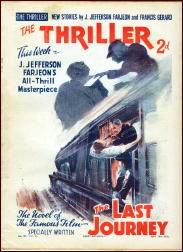
   Farjeon was a descendant of Thomas Jefferson, and was named after his maternal grandfather, Joseph Jefferson, a well-known actor of the time. One of his works, “Number 17”, was originally a stage played that was filmed twice: once in 1928 and the second time in 1932 by Hitchcock. Three other films were also based upon some of his approximately eighty books. He also wrote a novelisation of the thriller movie The Last Journey. This was published in No. 398, July 18, 1936 issue of The Thriller, a weekly fiction magazine published in the UK.

   His sister was Eleanor Farjeon, author of works for children. One brother was Herbert Farjeon, a playwright. Another brother was Harry Farjeon, a musician. Their father was novelist Benjamin Farjeon (1838-1903). It is clear that this was a literary family, and to get an idea of the author’s first twenty years see the book written by sister Eleanor: Portrait of a Family (1936) in the US, A Nursery in the Nineties (1935) in the UK. It gives a good insight into their younger years up to about the age of twenty. As teenagers, Jefferson and his brother Herbert edited and wrote a very small circulation magazine, undoubtedly giving them some experience they would use in later years.

   The X. Crook stories that appeared in Flynn’s/DFW is an average series that seems to have been popular enough to have run into quite a few tales. The mysteries in the stories are often simple and tame, and their solution by X. Crook is mostly a bit too plodding. However, there are some stories that stand out for their exceptions to the above, and many of these are later in the series.

   From what I can determine from very little information, most or all of the stories had previously appeared in the magazines Pictorial Magazine and Pictorial Weekly in Britain. “The Fourth Attempt” appeared in the British magazine Pictorial Magazine, August 28, 1926 issue. It then appeared in the July 9, 1927 issue of Flynn’s.

   The main character is something of a two dimensional personality, and really very little is made known about him throughout the series. In fact, his blandness and personality are such that he tends to blend into the background. From his name, it is clear that he is not using his real name. Crook is a reformed criminal who, upon release from prison for some unnamed offense, changes his name and takes up the profession of private detective. He means to start a new life and cut off ties from the old law-breaking ways.

   In a number of stories he meets up with former acquaintances, but his real name is not mentioned. He has good relations with the police, after proving his true reformation. His viewpoint in his new life is pointed out in one of the stories: “My second duty is to my clients, my first to justice and humanity.” And “Theoretically they are the same,” he answered, “but as we practice them they sometimes differ…” (Elsie Cuts Both Ways).

   Later in the story he tells a criminal he is trying to reform: “. . . and my life’s work is to try and help those who, like myself, are trying to wipe out their old mistakes.” He tends to make optimistic sayings to criminals, trying to convert them. When speaking of time in prison, he states: “There is always hope, when one comes out,” said Crook. “Always.” (The Hotel Hold-Up)

X. CROOK J. Jefferson Farjeon

   This new life means new ways of thinking and behaving. In one story (Darkness), Crook became involved in trying to prevent a murder, and found himself becoming angry: “Blackguards!” he muttered, and, for a moment, almost saw red. But he stamped out his emotion, for that interfered with clear thought and intelligent action.

   In another informative paragraph there is a bit more about his new attitude in this new life of fighting crime:

   Detective Crook did not often allow himself relaxation. In his endeavors to wipe out a regretted past, he found it difficult to justify the gift of leisure when it came within his grasp, and he drove himself with a relentless conscience. (Death’s Grim Symbol)

   The first story in the series appeared in the June 20, 1925 issue: “Red Eye”. One of the regulars in the early stories was Edgar Jones, Scotland Yard detective. He worked in Crook’s household as a butler under the name William Thomas. He was certain that Crook was still a criminal, and determined to get the evidence.

   It is very similar situation to the one in the Lester Leith series written by Erle Stanley Gardner, which also appeared in this same magazine later. And like that series, the employer (Crook) knows that the servant is a detective but does not let him know that.

   In the first group of stories from 1925, X. Crook is still developing his reputation and proving to the police that he is really a reformed person. This came to a climax with the story “Thomas Doubts No Longer”. In this story some criminals and former associates of Crook give him an ultimatum, demanding that he give up trying to be honest and come back to their gang. He refuses, causing the criminals to try to frame him. He resolves that to the satisfaction of the police, who doubt him no longer. The fake butler becomes Crook’s assistant, but soon disappears from the series.

   In the story “Elsie Cuts Both Ways”, Crook finds himself the victim of a plot by criminals to revenge themselves upon him. However, Crook is not easily fooled and the criminals wind up captured by the police and himself. Not a totally satisfying story, and it does not bother to explain on what grounds the criminals are arrested because they actually did nothing criminal.

   Farjeon presents small puzzles in many of the stories, and Crook usually solves these fairly easily, though occasionally one presents a harder solution. These puzzles are not where the clues are given to the reader in the Golden Age of Detection style. Crook takes on cases of many kinds, from searching for missing persons to catching thieves and murderers. He occasionally becomes involved in crimes by accident, such as in “The Hotel Hold-up”. This is a very short story which shows Crook at his best, outwitting a criminal with ease. Though he is now a great believer in honesty, Crook does admire cleverness in his opponents and notes this here.

X. CROOK J. Jefferson Farjeon

   Unlike many other crime solvers of this period, Crook does not work on cases for only the well off and higher classes (for example, see the Dr. Eustace Hailey series). He will take cases from lower class shopkeepers and ordinary workers. A good example of this kind of case is “The Absconding Treasurer” (July 23, 1927), where the Christmas fund of a number of people is missing. The amount involved is less than one hundred pounds, so this shows Crook does not let this low amount influence his decision to take the case. He doesn’t mention a fee in this case, so he might have done it for a nominal or no fee at all.

   He mentions in one story that he “never ate heavily when engaged on a case” (The New Baronet). There is little or no violence in most of the cases he works on, like many other stories in Flynn’s at this time. That degree of violence in the magazine gradually changed over a period of time, until by the early 1930s there was plenty of violence, like many other detective pulps.

    However, to show that the Crook stories didn’t need to be violent to be effective, see the September 3, 1927 story, “The Man Who Forgot”. While in Dulverley on a case, Crook is sitting on a seashore bench. Another man also on the bench strikes up a conversation with Crook, revealing that he is an amnesiac. The conversation between the two, steered by Crook’s questions, gradually reveals information about the man. The two leave the bench and backtrack the amnesiac’s trail in an effort to learn the truth about him. They uncover the truth and discover a crime, but Crook’s optimism about people gives the story a kind of upbeat ending.

   Some of the stories are excellent, without any of the faults noted. “The Stolen Hand Bag” in the March 19, 1927 issue, is an example. Crook overhears a restaurant conversation about a woman’s handbag theft, and shortly afterwards comes the news of the suicide of a baronet nearby. He sees a connection between the two events, and his investigation proves it.

   This investigation involves Crook working with the police investigator on the case. In a number of cases, showing his standing and reputation with the police, Crook was called in or called himself in to work on a police case. Crook also worked with the police on a case of apparent suicide in “No Motive Apparent”, another of the better stories. In this story, it was noted:

   There were police officials who, jealous of Detective Crook’s successes, declared that he was apt to be slow; but behind all his leisurely questions his brain was always acting fast, and when he had made up his mind no man could be quicker.

X. CROOK J. Jefferson Farjeon

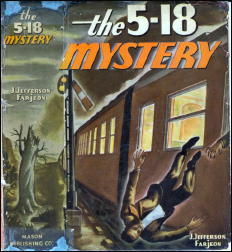
   The characters and stories are nothing like Farjeon’s novels. Having read Greenmask and The 5:18 Mystery, the difference is clearly seen. The lead characters in both novels are young men who accidentally happen into mysteries, and also into romantic entanglements. They are caught up in mysterious affairs out of their control, similar to the plots of a number of Alfred Hitchcock’s movies.

   Farjeon is noted in one source as “one of the first detective writers to mingle romance with crime.” This may be true of his novels, but not in the Detective X. Crook series. No romance ever creeps into Crook’s life. He seems to have come to terms with the way the world is and has devoted his life to criminology. Sounds like some of the other manhunters of the pulp era.

   Other novels were not as the two described above. One of his later novels was Aunt Sunday Takes Command (1940), involving three elderly women taking a trip to visit their niece and inadvertently becoming involved in crime. A rather low-key story, unlike the other two described.

   The mystery writer Dorothy Sayers considered Farjeon one of her favorite writers (Crime Time, “Reviewing The Reviewer: Dorothy L Sayers as crime critic 1933 – 1935”, by Mike Ripley). However, nowadays he seems to be a forgotten writer, and the Crook stories seem rather dated in comparison to some of his novels. Not having access to all of his books, it is not known as to whether the stories were ever gathered in collection form, though it would take more than one book to do so. However, Farjeon has quite a long list of published books so one of them may contain some of these stories.

       The Detective X. Crook series by J. Jefferson Farjeon:

Red Eye June 20, 1925
The Bilton Safe June 27, 1925
The Way to Death July 4, 1925
Thomas Doubts No Longer July 11, 1925
Fisherman’s Luck July 18, 1925
Where the Treasure Is August 1, 1925
The Hidden Death August 8, 1925
Nine Hours to Live August 22, 1925
Elsie Cuts Both Ways August 29, 1925
Crook’s Code December 19, 1925
Percy the Pickpocket December 26, 1925
A Race for Life January 2, 1926
Seeing’s Believing January 9, 1926
The Deserted Inn January 23, 1926
Death’s Grim Symbol February 6, 1926
Crook Goes Back to Prison April 10, 1926
Who Killed James Fyne April 17, 1926
Caleb Comes Back April 24, 1926
The Vanished Gift May 1, 1926
The Death That Beckoned May 15, 1926
Footprints in the Snow July 17, 1926
The Shadow July 24, 1926
Cats Are Evil August 14, 1926
The Silent House August 28, 1926
The Kleptomaniac September 18, 1926
The Knife October 23, 1926
The Hotel Hold-up November 20, 1926
The Silent Client November 27, 1926
Darkness December 11, 1926
It Pays To Be Honest December 18, 1926
Kidnaped December 25, 1926
Whose Hand? January 8, 1927
The Datchett Diamond January 29, 1927
Vanishing Gems February 5, 1927
The Murder Club February 26, 1927
LQ585 March 5, 1927
The Stolen Hand Bag March 19, 1927
Prescription 93b March 26, 1927
The Thing in the Room May 7, 1927
In the Diamond Line May 28, 1927
The New Baronet June 4, 1927
The Fourth Attempt July 9, 1927
The Absconding Treasurer July 23, 1927
The Man Who Forgot September 3, 1927
No Motive Apparent September 24, 1927
The Cleverness of Crockett October 29, 1927
August 13th September 8, 1928
The Photograph September 15, 1928
Between Calais and Dover September 22, 1928
The Bloodstained Handkerchief October 6, 1928
Wanted October 13, 1928
The Third Act December 29, 1928
The Secret of the Snow February 9, 1929
Open Warfare February 16, 1929
The Photographic Touch March 9, 1929
The “Times” Advertisement March 30, 1929
The Golden Idol April 13, 1929

    Previously in this series:

1. SHAMUS MAGUIRE, by Stanley Day.
2. HAPPY McGONIGLE, by Paul Allenby.
3. ARTY BEELE, by Ruth & Alexander Wilson.
4. COLIN HAIG, by H. Bedford-Jones.
5. SECRET AGENT GEORGE DEVRITE, by Tom Curry.
6. BATTLE McKIM, by Edward Parrish Ware.
7. TUG NORTON by Edward Parrish Ware.
8. CANDID JONES by Richard Sale.
9. THE PATENT LEATHER KID, by Erle Stanley Gardner.
10. OSCAR VAN DUYVEN & PIERRE LEMASSE, by Robert Brennan.
11. INSPECTOR FRAYNE, by Harold de Polo.
12. INDIAN JOHN SEATTLE, by Charles Alexander.
13. HUGO OAKES, LAWYER-DETECTIVE, by J. Lane Linklater.
14. HANIGAN & IRVING, by Roger Torrey.
15. SENOR ARNAZ DE LOBO, by Erle Stanley Gardner.

THE SERIES CHARACTERS FROM
DETECTIVE FICTION WEEKLY
by Monte Herridge


        #15. Senor Arnaz de Lobo, Soldier of Fortune, by Erle Stanley Gardner.
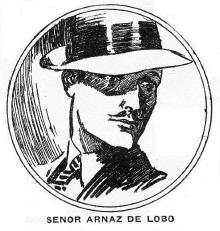
SENOR ARNAZ DE LOBO

    Senor Arnaz de Lobo … announces himself bored with life… But Senor Lobo makes no secret of his dissatisfaction. The world, he claims, has become too civilized to offer adventure. (The Choice of Weapons)

   Erle Stanley Gardner (1889-1970) is probably best known for his long-running series about the always victorious lawyer, Perry Mason, but he also had hundreds of exciting stories in the pulps. Many of these appeared in Detective Fiction Weekly, where he had multiple series running: Senor Arnaz de Lobo, Sidney Zoom, Lester Leith, the Patent Leather Kid, The Man in the Silver Mask, and other standalone stories that could have been turned into series. The Lester Leith series seems to have been the most popular in the magazine, but the other series were popular as well.

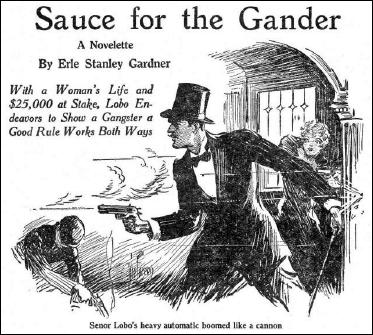
   The Senor Lobo stories are fun, action-packed stories that were nothing like the other detective and mystery stories in the magazine. Senor Lobo and his friend, El Mono Viejo, are basically soldiers of fortune thrown into the midst of a city where they continually find adventure and danger.

   Lobo is like a knight errant, always ready to jump to the defense of a lady in danger or to right a wrong. Of course, the adventurers don’t turn down any money that comes their way, and many a criminal finds himself divested of his cash after running into them. Here is a paragraph from the beginning of one their adventures that describes Lobo:
SENOR ARNAZ DE LOBO

   To appreciate the character of Senor Arnaz de Lobo, revolutionist, soldier of fortune, and gang buster, it must be remembered that he was hard. Governments are not overthrown, even in South and Central America, save by courage, valor, and a certain ability to capitalize circumstances. (A Matter of Impulse)

   His physical description is given early in the series:

   Standing in the doorway was six feet of lean, whip-corded strength, bronzed by tropic suns. Dark eyes surveyed them in scornful appraisal. He was attired in a natty spring suit. In his right hand he carried a light cane. The left hand held the hat… (Gangsters’ Gold)

   He reveals that he is only part Spanish — his mother was Spanish and his father American, and he himself is an American citizen. This brings the question as to whether his name had been changed or was originally Lobo. He can speak not only English and Spanish but also French and Chinese. He fought in Central and South America and also in China and Africa.

   Events from the past are often alluded to in the course of their American adventures. El Mono Viejo’s real name is not given in the series, just his nickname and description: “which means ‘The Boss Ape,’ short, abnormally broad of shoulder and long of arm, his eyes round and brown.” (Costs of Collection)

   Although Senor Lobo often uses guns in the course of his adventures, his favorite weapon is his sword cane. It has a retractable blade, and Lobo often uses it in confrontations with criminals. Lobo kept weapons of various kinds in his car that would be of use in close quarter fighting, including hand grenades.

   One story describes an outing against gangsters thusly: “And now as they swept into this gangster hide-out, each man carried two hand grenades, two guns, extra clips of shells, and a tear gas bomb.” (The Sirens of War)

   So they were well prepared for any fighting to be done, which is more than most of the criminals up against them could claim. Senor Lobo also had a special car for his adventures – a roadster “specially constructed for power, acceleration, and an ability to take right angle turns at high speed.” (Broken Eggs)

   Unfortunately, Lobo’s adventures were rough on equipment, and the car was shot to pieces by a machine gun in “Broken Eggs.” However, doubtless he had it repaired or acquired another because cars were indispensable in his work.

   Another requirement for his work was a safe place to live. He had to constantly change his apartments whenever their location was revealed, often abandoning his belongings at the same time. “To maintain safety it was necessary that he keep himself well under cover. The place where he had his apartment was known to but two people, El Mono Viejo and himself.” (Carved in Jade)

   Lobo also tried to keep his whereabouts secret from the police. As El Mono Viejo stated about the police viewpoint: “They are angry now at our methods. They say we are as much of a menace to law enforcement as are the gangsters upon whom we war.” (Carved in Jade)

   In virtually every story the soldierly professionalism of Lobo and his lieutenant are stressed, and the lack of such qualities in their gangster opponents is also stressed. In fact, the gangsters’ lack of ability to handle the tactics of the two soldiers of fortune is shown to best effect in the story “Barking Dogs.” Here the two soldiers raid a gangster headquarters in order to rescue a woman, and defeat a gangster mob many times their size. Afterwards, the gangsters claimed to the police and newspapers that twenty rival gangsters had raided their stronghold, and asked for a police investigation. Clearly, they never knew what hit them.

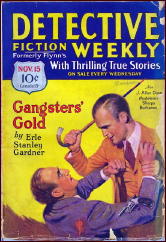
   The series, which ran for 23 stories, starts out with basically a two-part beginning, though each can be read separately and were published four months apart. In “The Choice of Weapons” and “Gangsters’ Gold”, the two parts of the opening story, Lobo is up against a hard fight with Butch Pender and his gang. These early stories are full of action, with Lobo out-maneuvering the gangsters twice in their attempt to rob gold from a bank. Lobo originally came to the U. S. in response to a strange situation. It seems that a dying American gangster named High Test Barker, wanting revenge on his enemies, makes a will leaving $70,000 in gold to Senor Lobo.

   The will makes the condition that Lobo can have the money only if he avenges Barker’s death. So Lobo comes up to take care of the situation and steps into what might be termed a hornet’s nest of trouble. The first stories are based upon this plot. After it runs its course, Lobo becomes involved in one adventure after another in the city.

SENOR ARNAZ DE LOBO

   The series seems to have quite a lot of the influence of Leslie Charteris’ series about The Saint (who appeared in DFW itself in 1938-39 and 1943). However, there was nothing like it in the magazine during the series run from 1930-34.

   Detective Fiction Weekly boasted many series, and none of them were remotely similar to Senor Lobo. Plenty of professional detectives, both private and government, ran through the pages. Also plenty of amateur detectives of all kinds appeared in stories. Senor Lobo fell into none of these categories. He was a professional who enjoyed what he did as a mercenary and revolutionary, as well as his new work as a gangbuster.

   Lobo was at his happiest when engaged in a conflict. He states to a woman: “sometimes I feel the lust for adventure in my blood… Perhaps I’ll pull out one of these days and start another revolution.” (Gangsters’ Gold)

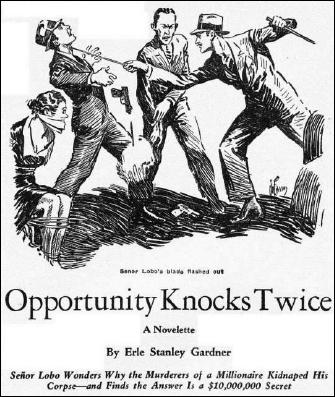
   He does eventually leave for another revolution — in the last story, “Opportunity Knocks Twice”, he and his assistant leave the city for Latin America for this purpose.

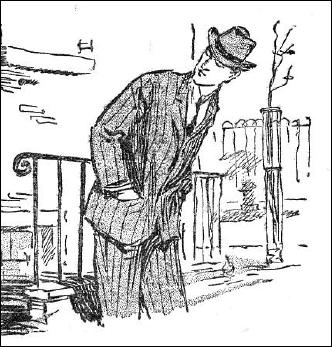
   In an example of Lobo’s predilection for getting into trouble, see the story “The Sirens of War”. In this story, Lobo is bored with inaction and soft living. He is pacing the late night sidewalks of the city looking for action. As his assistant, El Mono Viejo, says, “it has been a week, and we have had no action.”

   So they wander the streets until, finally they find some trouble to get involved in. Trouble in the form of a kidnapping of a wealthy woman. Lobo involves himself in the matter to the extent that he goes after the kidnappers and in a couple of violent shootouts wipes them out. He returns the ransom money, minus what he takes for expenses.

   The expenses are what Lobo refers to in other stories as “the costs of collection”, and usually run ten per cent of the money returned. (Costs of Collection)

   Lobo gets involved in more conflicts with criminals by investigating any strange occurrence that strikes his interest. After things quieted down too much, he got the idea of paying taxicab drivers to report unusual occurrences to him. This helped keep Lobo busier, even if only part of the drivers’ reports led to action against criminals.

   Another example of Lobo’s penchant for getting into trouble occurs in “Carved in Jade”, an early story. This one starts in Chinatown, a popular setting for Gardner. Lobo wants to eat Chinese food, but his visit to a Chinese restaurant involves him with a group of gangsters who try to kill him in a trap. Lobo is up against both American and Chinese criminals in this story.

   One of the funnier stories is “Costs of Collection”, where Lobo and his friend are almost broke, thanks to their bank going under with all of their money in it. Far from finding it to be a bad situation, the two adventurers laugh about the situation and decide they have to make more money.

   â€œCaramba!” said El Mono Viejo, “but we need guardians, we two. We put money in a bank, and presto! We cannot take it out!” So Senor Lobo needs to find some gangsters to fight and money to appropriate. He uses almost the last of his money to pay for information from a cabdriver, and as a result finds some crooks to fight and a young woman to rescue. Coincidentally, Senor Lobo takes $10,000 in cash from some crooks as what he calls the “spoils of warfare”. So he is back in the money again.

   By the time of the story “A Hundred to One”, many of the local gangsters were fed up with Lobo’s interference in their affairs and made attempts to eliminate him by setting traps. In the words of one newspaper that Lobo saw, they intended “to rid the city of a “disturbing influence” in the shape of an independent adventurer, who seemed to enjoy interfering with gang activities for the sheer pleasure of the ensuing conflict.”(A Hundred to One)

   Lobo smiled at the article; all he wanted was some excitement and conflicts with the gangsters were one way to do this. In fact, he tells El Mono Viejo: “We can ask but three things of life, beautiful women, hard fighting—and a clean getaway.” (A Clean Getaway)

   So we can assume this is the philosophy of Senor Lobo. But he has another philosophical comment in another story: “Senor Arnaz de Lobo snapped out his philosophy of life in a single sentence: “I am not afraid to die,” he said, “nor do I want to be afraid to live.” (The Spoils of War)

   El Mono Viejo is constantly warning Senor Lobo to beware of beautiful women, because their enemies may use them as bait for traps for him. Nevertheless, Lobo continues to enter the traps. As he says: “Trap or no trap, I like the bait. There is beauty and adventure, a woman and danger, a mystery and a threat. I know of no better combination.” (A Clean Getaway)

   El Mono Viejo is much more serious-minded than Lobo, and more cautious. Lobo occasionally calls him “Sobersides” to poke fun at his serious attitude. El Mono Viejo enjoys the action and adventure, but he sees matters differently: “life is a stern reality.” (Leaden Honeymoon)

   The Senor Lobo series was undoubtedly more fantasy than reality based, but it was the kind of crime-fighting stories that appealed to readers, as shown by the fact that it lasted for 23 stories and probably could have run longer.

   Each story features Senor Lobo and El Mono Viejo becoming involved in gangster activities, and usually culminates in a violent gun battle (sometimes with explosives used).

   Naturally, Senor Lobo always comes out on top and wins the girl when one is part of the conflict. El Mono Viejo told Senor Lobo “it was a wonderful idea of yours — this business of coming to the city and antagonizing organized crime.” (Opportunity Knocks Twice). He only complained when there was insufficient action.

SENOR ARNAZ DE LOBO

   The last story, “Opportunity Knocks Twice,” is a fast-moving tale of action, started when a taxicab driver’s report of a very unusual occurrence puts Lobo on the trail of a $10 million secret and murder.

   At the same time, Lobo and El Mono Viejo are getting ready to offer their services to a revolutionary, who is in the city buying arms for a revolution in Latin America. If he doesn’t want their services, then they will offer them to the opposing side.

   By this time, El Mono Viejo is tired of the “guerilla warfare” with the city’s gangsters, and wants nothing more than to leave so they can get involved in a war or revolution. So the story is of the two mercenaries running around trying to resolve the murder and at the same time keep an eye out for when the time is ripe to leave for Latin America.

   The title refers to the two opportunities that Senor Lobo has in the story: firstly the murder and secondly the revolution. As Senor Lobo says at the end of the story: “In our profession,” he said, “one does not overlook opportunity’s second knock.”

   So the series has a conclusion of a sort, as the two prepare to leave the city they have lived in for over four years. It is certain that the criminals will not miss them.

   This is an excellent series that deserves reprinting. As this series was finishing its run in 1934, another series was beginning that seems to show some influence of Senor Lobo: the Park Avenue Hunt Club series of Judson P. Philips. This was a small group of men who were devoted to fighting gangsters, and enjoyed their work. Though it is doubted if they ever enjoyed it to the extent that Senor Lobo did.

        The Senor Arnaz de Lobo series by Erle Stanley Gardner:

The Choice of Weapons     July 12, 1930
Gangsters’ Gold     November 15, 1930
Red Hands     December 6, 1930
A Matter of Impulse     February 7, 1931
Killed and Cured     February 21, 1931
Carved in Jade     May 9, 1931
Coffins for Killers     July 25, 1931
No Rough Stuff     December 5, 1931
Sauce for the Gander     December 12, 1931
Barking Dogs     March 26, 1932
A Hundred to One     April 30, 1932
A Private Affair     June 25, 1932
Trumps     November 12, 1932
A Clean Getaway     December 3, 1932
Tickets for Two     December 31, 1932
The Spoils of War     January 14, 1933
Leaden Honeymoon     March 11, 1933
Results     May 6, 1933
The Sirens of War     September 16, 1933
Costs of Collection     November 18, 1933
The Code of a Fighter     January 27, 1934
Broken Eggs     May 5, 1934
Opportunity Knocks Twice     October 27, 1934

Note:   An earlier version of this article appeared in Blood ‘n’ Thunder magazine (#16, Fall 2006).

    Previously in this series:

1. SHAMUS MAGUIRE, by Stanley Day.
2. HAPPY McGONIGLE, by Paul Allenby.
3. ARTY BEELE, by Ruth & Alexander Wilson.
4. COLIN HAIG, by H. Bedford-Jones.
5. SECRET AGENT GEORGE DEVRITE, by Tom Curry.
6. BATTLE McKIM, by Edward Parrish Ware.
7. TUG NORTON by Edward Parrish Ware.
8. CANDID JONES by Richard Sale.
9. THE PATENT LEATHER KID, by Erle Stanley Gardner.
10. OSCAR VAN DUYVEN & PIERRE LEMASSE, by Robert Brennan.
11. INSPECTOR FRAYNE, by Harold de Polo.
12. INDIAN JOHN SEATTLE, by Charles Alexander.
13. HUGO OAKES, LAWYER-DETECTIVE, by J. Lane Linklater.
14. HANIGAN & IRVING, by Roger Torrey.
« Previous PageNext Page »