Pulp Fiction


TOM W. BLACKBURN Short Grass

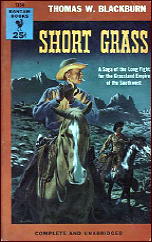
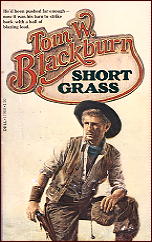
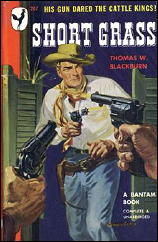
TOM W. BLACKBURN – Short Grass. Simon & Schuster, hardcover, 1947. Paperback reprints include: Bantam 207, November 1948; Bantam 1164, September 1953, Dell 7980, April 1973; Dell 17980, June 1979.

   For no good reason I can think of, Tom Blackburn (1913–1992) is not included in the second edition of 20th Century Western Writers, and he should be. I am surprised that he is not. He was a prolific writer of westerns for the pulps, hardcovers, paperbacks, movies and a number of 50s and 60s TV series. His career began perhaps with “Wagontongue’s Last Town-Tamer” which appears in Star Western, February 1940, his earliest entry in the online FictionMags Index.

   His wikipedia entry appears here, where you will learn that he may be best remembered as the person who wrote the lyrics to “The Ballad of Davy Crockett.” Among several other TV series he wrote for are Maverick, Bronco, and Daniel Boone. It’s quite a résumé.

TOM W. BLACKBURN Short Grass

   And as a western, Short Grass is quite a novel, impressive in both its exposition and impact, with (in my opinion) as much emphasis on “novel” as “western,” and perhaps more. It starts out in flurry of action, and it barely ever lets up – perhaps only in the middle, with an ending that if properly filmed, would be a humdinger of a movie. (I’ll get back to this shortly.)

   Steve Llewellyn is the primary protagonist, a wandering cowpoke – if not gunman, a drifter whose past we never learn much about – and an innocent bystander, if you will, who gets caught up in a shooting incident in a saloon between two other fellows. He’s wounded and – we’ve read this before – is soon found by a woman who takes him home to recover.

TOM W. BLACKBURN Short Grass

   Things happen fast in this book. Other westerns may draw the next step out for any number of chapters, but Steve doesn’t wait nearly that long. He kisses Sharon Lynch on page 36, and in the Dell paperback I read, there still are almost 200 pages yet to come. The course of romance does not come easily, though. Steve believes in the use of his gun. Sharon does not. She does believe violence is the solution to anything. Not a good combination, and once she sees what Steve is capable of, she rejects him, and they part.

   As a synopsis, this is too short and far too easy. The two are adults, and their behavior, their thoughts, their actions, their problems, are those of adults. When they meet later, in Kansas, not Texas, five years have passed, Steve has become a homesteader, Sharon has remarried (to a man too weak for her) and the local marshal (Ord Keown) has an eye on her.

TOM W. BLACKBURN Short Grass

   Besides the complications a love triangle (well, yes, a quadrangle) can bring, the past that both Steve and Sharon have fled comes back to haunt them again in the form of rancher Hal Fenton. The latter is someone would not mind gaining some revenge as well as some open range for his cattle he and his men have brought up for market from Texas.

   This is a tale with several twists and turns in it, surprisingly so, but it is the people involved that make the story so memorable. These are real people with real problems, and this being a western, only violence, sudden death and a fast and bloody shootout at the end can salvage any hope for them – the ones who survive, that is.

   I suggested earlier that this movie would make a humdinger of a movie. I have not seen it yet, but I have it on order. The film that was made of this book is entitled Short Grass (Allied Artists, 1950), and the screenplay was written by none other than Mr. Blackburn himself. The names of the characters are the same, and the plot summary on IMDB suggests that very few changes were made. Rod Cameron stars as Llewellyn, Cathy Downs as Sharon Lynch, Johnny Mack Brown as Sheriff Ord Keown, with Morris Ankrum as Hal Fenton. I’ll report on my findings later. With stars like these, I’m hoping for the best.

FIRST YOU READ, THEN YOU WRITE
by Francis M. Nevins


   I happened to be in New Jersey during the week in the middle of last month when an event took place in Manhattan which, had I known about it, would have led me to cross the Hudson and attend, and maybe get asked questions I couldn’t have answered on the spot.

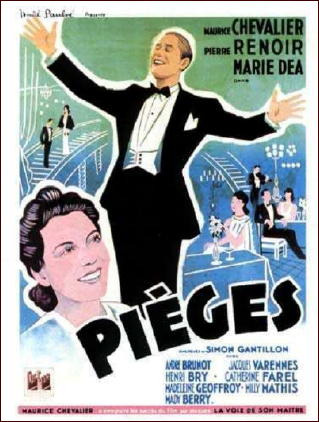
   On Thursday, August 16, as part of its ongoing series of French crime thrillers, the Museum of Modern Art ran the little-known 1939 film Pièges (Traps), starring Maurice Chevalier and directed by Robert Siodmak (1900-1973). Born in Dresden to Jewish parents, Siodmak wisely left Germany for France soon after Hitler came to power and, after completing Pièges, left France for a new life in Hollywood as a specialist in what became known as film noir.

   Our interest here is in the skein of connections between Pièges, its director, and the most powerful of all noir authors, Cornell Woolrich.

   First, the film’s springboard situation. After several young Parisian women mysteriously disappear, the police suspect that their adversary is a serial killer who finds his prey by placing newspaper ads seeking single young women. The cop in charge of the cases enlists the lovely taxi-dancer who roomed with the latest victim to go undercover, answer some of those ads, and serve as bait for a trap.

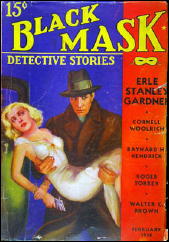
   Sound familiar? To my ears the echoes of Woolrich’s pulp classic “Dime a Dance” (Black Mask, February 1938; first collected in The Dancing Detective, 1946, as by William Irish) are as loud as the roar of the sea, although to the best of my knowledge no one has commented upon the resemblance in print or on the Web.

PIEGES

   Introducing Pièges to the MoMA audience, curator Laurence Kardish mentioned that the print, with new English subtitles, had arrived from France just two hours earlier. If the film had ever been shown in the U.S. before, it came and went in a blink.

   Among the huge audience listening to Kardish was noir connoisseur Kurt Brokaw, who in an email (not to me) described “the first meandering hour” of the film as “more florid melodrama than noir… Chevalier sings and mugs and mopes around and is such a pain. The femme Marie Dea is good, but the picture seems to run forever.”

   Eventually, Brokaw pointed out, the film assumes a noir look and feel — and takes on a strong resemblance to Woolrich’s classic suspense novel Phantom Lady.

   The problem here, as most Woolrich lovers know, is that that novel first appeared in hardcover in 1942, three years after Pièges. As they say in the cafés of Montmartre, was ist hier los? Could Woolrich have lifted Phantom Lady’s plot from a French film that had lifted its springboard situation from a Woolrich story?

   When Brokaw’s correspondent invited me to weigh in on the issue, I replied that the original version of Phantom Lady was Woolrich’s short novel “Those Who Kill” (Detective Fiction Weekly, March 4, 1939).

PIEGES

   The pub date would make it seem more likely that Pièges borrowed from Woolrich than the opposite. And when you factor into the equation that “Those Who Kill” takes place in France–!

   At this point our conversation was joined by West Coast noir maven Eddie Muller, who told us that the Pièges/Phantom Lady connection was not a new discovery but had been discussed by Deborah Alpi in her 1998 book on Siodmak.

   According to Alpi, the French film was based on the trial and conviction of a young German intellectual named Eugen Weidmann, who had murdered several women traveling in France.

   Time out for a sidebar. Weidmann was the last criminal in France to be publicly guillotined. The execution took place in 1939, the same year Siodmak made Pièges, the same year Woolrich wrote his classic “Men Must Die” (Black Mask, August 1939; usually reprinted as “Guillotine”), which is about a French criminal desperately trying to avoid his date with the headsman. Coincidence, or had Woolrich been reading about the beheading of Weidmann?

   As if our skein weren’t tangled enough already, there is one final knot. When Phantom Lady was itself filmed, in 1944, would anyone care to guess who got the job directing the picture? Yes, it was Robert Siodmak.

   However we interpret this sequence of events, we seem to be stuck with some coincidences worthy of Woolrich himself, and maybe even of Harry Stephen Keeler. Someday I’ll track down Alpi’s book, and also a DVD of Pièges if there is one.

PIEGES


   Anyone who sampled Boston Blackie on YouTube after reading my last column doesn’t need to be told that it was hardly a detective program at all but much more like an action-packed Western series set in the present, i.e. the early 1950s.

   Also accessible on YouTube is another series of the same vintage which is closer to the detective genre and even features reasoning of sorts, but I didn’t care for it 60 years ago and still don’t today.

   The 39-episode Front Page Detective was produced by small-screen pioneer Jerry Fairbanks (1904-1995), first broadcast on the short-lived Dumont network in 1951 and rerun times without number on local stations throughout the rest of the Fifties.

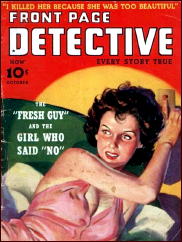
FRONT PAGE DETECTIVE

   The title came from a pulp true-crime magazine but its protagonist, café-society columnist and amateur detective David Chase — described as a sleuth with “an eye for the ladies, a nose for news, and a sixth sense for danger” — was created especially for TV.

   â€œPresenting an unusual story of love and mystery!” the unseen announcer would purr in dulcet tones at the start of each episode. His introduction concluded with: “And now for another thrilling adventure as we accompany David Chase and watch him match wits with those who would take the law into their own hands.”

   Starring as Chase was one-time matinee idol Edmund Lowe (1892-1971), a name familiar to moviegoers for a third of a century before his entry into television. During the 1920s he specialized in suave romantic roles complete with waxed mustache, but the biggest boost in his film career came when director Raoul Walsh cast him opposite Victor McLaglen in What Price Glory? (Fox, 1926), first of the Captain Flagg-Sergeant Quirt military comedies.

   Lowe’s foremost contribution to the detective film came ten years later when he portrayed Philo Vance in The Garden Murder Case (MGM, 1936), but he also played a New York plainclothesman of the 1890s opposite Mae West in Every Day’s a Holiday (Paramount, 1938).

   By the early 1950s Lowe had begun to show his age, and in Front Page Detective he looked all too convincingly like a man of almost sixty who’s determined to pass himself off as 25 years younger.

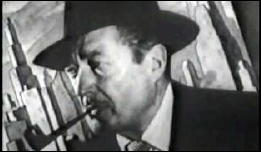
FRONT PAGE DETECTIVE

   In many an episode he’d romance the woman in the case, rattle off a few deductions — once he reasoned that a letter supposedly from an Englishwoman was a forgery because the writer used the U.S. spelling “check” rather than the British “cheque” — and then collar the villain personally after a pistol battle or fistfight underscored by Lee Zahler’s background music for Mascot and early Republic serials.

   Supporting Lowe were Paula Drew as Chase’s fashion-designer girlfriend and crusty George Pembroke as the inevitable stupid cop. Appearing in individual episodes were such stalwarts of TV’s pioneer days as Joe Besser, Rand Brooks, Maurice Cass, Jorja Curtright, Jonathan Hale, Frank Jenks and Lyle Talbot.

   Filming was 99% indoors, on some of the cheapest sets ever seen by the televiewer’s eye. The director of every episode I’ve seen recently was Arnold Wester, whose name crops up almost nowhere else in TV history, hinting that it may have been an alias for producer Jerry Fairbanks.

   Whoever he was, his idea of directing was to point the camera at the actors and leave the room. Many scripts were by veterans of pulp detective magazines and radio like Robert Leslie Bellem and Irvin Ashkenazy, with an occasional contribution by Curt Siodmak, the younger brother of director Robert Siodmak — do I connect the items in this column or what? — and author of the classic horror novel Donovan’s Brain.

   Three episodes of the series — “Murder Rides the Night Train,” “Seven Seas to Danger” and “Alibi for Suicide” — are accessible on YouTube, and a few others can be found on various DVD sets in the bins of dollar stores.

https://www.youtube.com/watch?v=RYPaS6qp3-A

   Most seem to have vanished but their gimmicks can often be deduced from the brief descriptions in crumbling issues of TV Guide. In “The Case of the Perfect Secretary” Chase tries to find out why Dr. Owens, the inventor of a synthetic cortisone, didn’t show up for a scheduled lecture. He finds Owens’ laboratory deserted and later discovers that the doctor has been murdered, the letter M imprinted on his forehead. It takes no Charlie Chan to figure out that the M is most likely a W.

   â€œHoney for Your Tea” finds Chase looking into the claim of a young actress that her fiancé was brutally murdered by her dramatic coach (Maurice Cass), a gnarled and crippled old man whose hobby is beekeeping. Anyone want to bet that this isn’t the old bee-venom poisoning shtick?

   In “The Other Face” Chase investigates the death of a handsome actor who “accidentally” fell from his penthouse terrace shortly after telling his psychiatrist of his desire to fall through space. If the murder victim didn’t turn out to be not the actor but his look-alike understudy, toads fly.

   Other episodes seem to have more intriguing story lines. In “Napoleon’s Obituary” a man named for Bonaparte dies the day after asking Chase to write his obituary, and the trail leads our sleuth to a house all of whose inhabitants sport the names of historic figures.

   In “Ringside Seat for Murder” Chase witnesses a bizarre murder during a wrestling match where one of the athletes (using the term loosely) is stabbed in the back with a poisoned dart while pinned to the mat by his opponent.

   Front Page Detective never pretended to be a classic, but for all its cliches and Grade ZZZ production values it was a pioneering effort in tele-detection that deserves perhaps a wee bit more than to be totally forgotten.

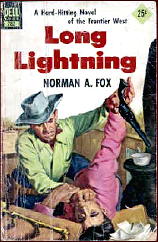
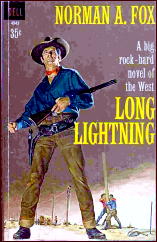
NORMAN A. FOX – Long Lightning. Dodd Mead, hardcover, 1953. Dell 783, paperback, 1954; several later printings. First published as the short novel “Wire to Warlock,” Zane Grey’s Western Magazine, December 1952.

NORMAN A. FOX Long Lightning

   For those of you always on the lookout for hard-boiled fiction to read, and you have no a priori objections to reading a western, here’s one you might want to hunt down. There are some solid “tough guy” aspects to this 50-year-old novel that may be worth your attention, largely due to the highly individualistic nature of its main protagonist, Holt Brandon, construction chief for the Mountain Telegraph Company. In this book, not only must he get the job done on time, but he has to fight for his life all the while he’s doing so.

   There are two obstacles, the first being Mountain’s main competitor, Consolidated, and they do not hesitate in hiring local gunmen to make sure Holt’s crew do not make their deadline. Second, and not insignificantly, is Colonel Templeton, the owner of the Montana land they must cross, an elderly gentleman from the South who imagines that the War Between the States is still going on, and still fighting imaginary battles in his mind.

NORMAN A. FOX Long Lightning

   Holt Brandon plays his cards strictly by the book, and his loyalty to his boss, Sam Whitcomb is never in question. The world of financial matters is beyond him, but what he’s fully aware of is this: If they do not get the wires strung to Warlock from Salish on time, all is lost for Mountain Telegraph.

   Here’s a quote that demonstrates that Fox knew exactly what he was writing about, from page 113:

   String wire, and you lose yourself in the endless race, not knowing one day from another but realizing that each day is a leaf fallen from the calendar, each days brings the deadline nearer; and always the poles set between the suns seem not enough. The ground is stubborn and repels the pick and the shovel, a batch of insulators proves inferior and has to be returned to Salish, and three of your crew slip away to see the lights of town and buck the tiger and fill a painted woman’s shoe with silver.

NORMAN A. FOX Long Lightning

   Poles are late in arriving, and the crew sent to fetch them reports a brush with hidden marksmen who keep them busy with guns when they should have been using axes. The wire stringers stand idle that day. The long lightning is flung from camp to town, shouting always for more supplies, more men, and you hammer the key constantly and wish that Sam Whitcomb were up and about and doing the job at the other end.

   To add some variety to the plot, Holt is not shy around women, but he is caught by surprise when he finds himself the focus of attention of two of them: Gail, the daughter of his boss, and Ellen Templeton, the colonel’s daughter. It is clear which of them he will end up with, if either is to be the case, but that he will lose both of them is a definite possibility, and what Fox does is make sure the reader does not lose sight of that.

   So — here’s a western that’s a trifle clumsy when it comes to affairs of the heart, perhaps, but not– ever — when it comes to matters of loyalty and pride, and other qualities that men have, or they’re supposed to.

— Reprinted from Durn Tootin’ #5,
   July 2004 (slightly revised).


NORMAN A. FOX Long Lightning

[UPDATE] 09-07-12.   I’ve made no attempt to obtain an exact count of the western novels written by Norman Fox (1910-1960), but if he’d been able to live longer, I’m sure he’d have written a lot more than the roughly 30 or so I’ve quickly come up with.

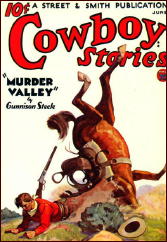
   He was a pulpster as well, with nearly a full page of entries already listed for him in the online FictionMags index, a list still under construction. The first of these, by the way, is “The Strange Quest” (Cowboy Stories, June 1934).

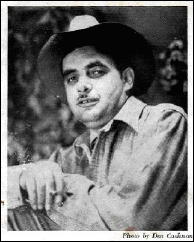
   The photo of him comes from the back cover of one the hardcovers I own by him. What’s unusual about it is that it was taken by fellow western and adventure writer, Dan Cushman. I’d love to know more about when, where and why.

The surgery of week before last went well, but I had a step backward yesterday. Not a big deal, according to my doctor, but I’ll have to slow down for a few days. I’ve been thinking about this. I’m going to take his advice — that goes without saying — and go a step further and stop posting here until after Labor Day.

I’ve taken an End of Summer break before. It’s always good to take some time off to deal with things that haven’t managed to get done over the summer — nothing too physical this time! — and that’s what I’ll be doing over the next few days.

Best wishes to those of you in the path of Hurricane Isaac. I’ll be watching news reports and thinking about you. Stay safe!

[UPDATE] 08-30-12. Thanks for all the get well notes, especially Randy’s, which gave me a much needed smile yesterday.

I’m on the mend at last, but I still have to take it easy for a few more days.

There is a post on the EQMM site that I’d like to call your attention to, especially if you’re a pulp fan and Black Mask magazine in particular. It’s written by Keith Alan Deutsch and it’s entitled “Black Mask Magazine, Steve Fisher, and The Noir Revolution.” In it he gives a small salute to Fanny Ellsworth, the editor of the magazine who took over from much more well known Joseph Shaw in 1936.

The changes she made to the magazine have never been given much attention before, and the article is well worth your reading:

http://somethingisgoingtohappen.net/2012/08/29/black-mask-magazine-steve-fisher-and-the-noir-revolution-by-keith-alan-deutsch/

KENNETH FOWLER Western Writer

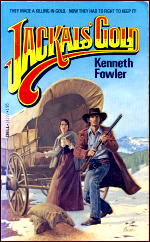
  KENNETH FOWLER – Jackals’ Gold. Doubleday, hardcover, 1980. Dell, reprint paperback, June 1981.

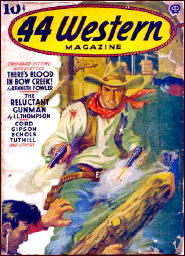
   I have a few of Fowler’s westerns in paperback, but until I started to do some research about him before writing this review, I did not realize how even more prolific he was writing short stories for the pulps in the 1940s, mostly for titles such as Dime Western, Star Western, New Western, .44 Western, and so on. Of special note in that regard, he was the editor for the first two of these magazines between 1944 and 1946.

   He seems to have written only ten western novels, though, two under the pen name Clark Brooker. The first was Outcast of Murder Mesa, a Gold Medal paperback original under his own name in 1954. Jackals’ Gold was his final novel, published when he was 80, though perhaps it was written earlier, as there is no sign of age at the helm of the rough and tumble western adventure it is.

KENNETH FOWLER Western Writer

   It begins as the story of Rachel Carr, who poses as the widow of Brad Gamble, a prospector who hit it rich then died, leaving his wife a small fortune in gold. Unknown to her, however, is that the dead man had two partners, two men whom he pulled a fast one on, and two men who want the gold back.

   Gold, according to the author — and who am I to disagree? — does strange things to people. Added to the mix are several other mysterious riders who follow Rachel and her two “guardians” as they head back to Salt Lake City in a small wagon, or who sniff out their hidden cache along the way.

   It’s a tough trip, and Fowler tells it well, even as the major point of view changes to that of Caine Joritt, one of the dead man’s two former partners — see above — who finds himself keeping a much closer eye on Rachel than he expected. Fist fights, gun shots in the night, crashing rivers and sudden violent death are the order of the day, with little to no dialogue to slow things down even an inch in most of the book’s final eighty pages. Good stuff, and interesting characters, too.

IT’S ABOUT CRIME, by Marvin Lachman

SHELDON JAFFREY Tales of Grim and Grue Horror Pulps

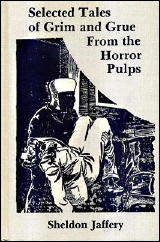
SHELDON JAFFERY, Editor – Selected Tales of Grim and Grue from the Horror Pulps. Bowling Green University Popular Press, hardcover/softcover, 1987.

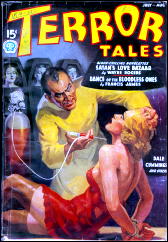
   A [recent] collection of stories, Selected Tales of Grim and Grue from the Horror Pulps, edited by Sheldon Jaffery, is wonderfully nostalgia-producing. Jaffery has collected eight novelets from magazines of the thirties like Terror Tales and Horror Stories. Some of the big names in the mystery field wrote for weird-menace pulps, including Cornell Woolrich, Frank Gruber, Bruno Fischer, and Steve Fisher.

SHELDON JAFFREY Tales of Grim and Grue Horror Pulps

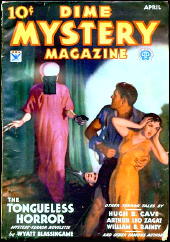
   Jaffery apparently couldn’t get them, but the writers he does include are probably more representative of the genre. Typical is Wyatt Blassingame’s “The Tongueless Horror” from Dime Mystery for April 1934. Don’t expect a great deal of subtlety, but they’re all readable, and the authors don’t rely on cop-outs. The seemingly impossible is explained rationally, even if the reader’s credulity is stretched a bit.

SHELDON JAFFREY Tales of Grim and Grue Horror Pulps

   The book is loaded with wonderful cliches like the one in G. T. Fleming-Roberts’ “Moulder of Monsters” (Terror Tales, July-August 1937): “Then he turned into the room where horror dwelt.” From Wayne Rogers’ “Sleep with Me — and Death” (Horror Stories, April-May 1938) we read, “Then the shaggy-haired head lifted and I caught a glimpse of a scarred and battered face, hardly recognizable as human — a face in which the eyes of a madman gleamed triumphantly.”

   All stories are reproduced from the original magazines, which means they include the wonderful pulp ads plus the interior illustrations of monsters slavering over scantily clad women. A bonus is a fine introduction and lengthy index by the late Robert Kenneth Jones, one of the real scholars in this aspect of the pulps.

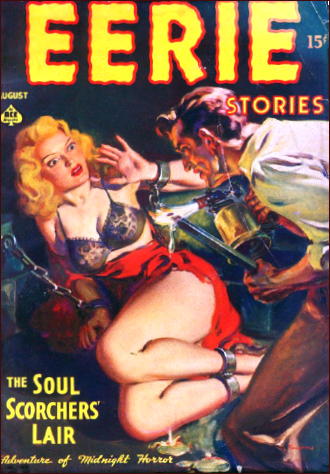
   Who can resist lists of the complete contents of the single issue, in 1937, of Eerie Stories and the five issues of Uncanny Tales published in 1939 and 1940? Certainly not I.

— Reprinted from The MYSTERY FANcier,
Vol. 11, No. 1, Winter 1989.


SHELDON JAFFREY Tales of Grim and Grue Horror Pulps

CONVENTION REPORT: PulpFest 2012
by Walker Martin

   As I think back on the many pulp conventions that I have attended, I am reminded of the many friends that I have made and the bookish traditions that we started over the years. For instance, when I was a newly wed collector, my wife and I attended the first four Pulpcons, 1972-1975.

   But then children were born and she had to stay home plus let’s face it, non-collectors eventually get tired of the dealers room and the constant discussion about books and pulps.

   Then I started driving out and sharing a room and expenses with the greatest book and pulp collector that I ever encountered: Harry F. Noble. He was so modest that most collectors really never knew anything about him. But we both lived in NJ and visited each other hundreds of times during our almost 40 year friendship. Since Harry’s death, I’ve been driving out with NYC art dealer, Steve Kennedy.

   That is how this convention started with Steve arriving at my house on Wednesday in order to sleep over so we could leave early on Thursday morning. Another tradition of a few years standing. We started off the festivities with a dinner at the Metro Grill in Trenton and five days later we ended it with another visit to the Grill and I had the same salad, pizza, and beer both times. Guess I’m set in my ways.

   But the greatest tradition in my life is Pulpcon, now known as PulpFest. I do not see a difference in the two conventions. PulpFest is not a different, separate event. It is the natural continuation of Pulpcon. The present committee had the foresight to see that Pulpcon was dying and they broke away and formed a stronger and better convention with a new name and a more enthusiastic approach to collecting. But I still see it as the natural evolvement of the Pulpcon started all those years ago in 1972 by Ed Kessel and continued by Rusty Hevelin.

   We left early Thursday morning at 7:15. We rented a van as usual because a car won’t hold all the pulps and books that will be bought. Ed Hulse was the driver; I was riding shotgun; Steve Kennedy was the official talker, and Digges La Touche, otherwise know as The Major, was laying down in the back row reading. He is not called The Reading Machine for nothing.

   Our attitude was drive hell for leather, PulpFest or Bust, and get to Columbus, Ohio in record time. Ed was willing to do this but the State Trooper on the Pennsy Turnpike took a dim view of our policy.

   Two hundred dollars poorer, we continued our mad rush to financial doom. But my attitude has always been that book collecting is the very best addiction. It won’t ruin your health like smoking, drinking or drugs. It won’t break you like fooling around with women or gambling. In fact, you might even make some money when you sell some of your collection. So I always say to hell with bills and family responsibilities; collect books and pulps instead.

   To give you an example of my madness, just a few days before the convention, my central air conditioner bit the dust after 23 years of loyal service. The repairman said not only did I need a new unit but I needed a new furnace also. I went for top of the line, high efficiency, which cost $12,000.

   Many collectors would say at this point, forget PulpFest, I don’t have the money. But serious collectors who are truly addicted will say full steam ahead, I’m not going to miss PulpFest! To top it off, I had to move dozens of boxes and hundreds of books to make room for the workers to install the furnace.

   Since I am no longer the young collector that I once was, needless to say I injured my shoulder and suffered all through the convention with a twisted and wrenched arm. This didn’t stop me either though it was not fun to try and sleep through the pain. Book collectors must have the attitude that the show must go on.

   I have a theory that collecting books and old magazines keeps you young and interested in life. I wake up each day, eager to read books or pulps from my collection. I’ve been retired many years since quitting my job at age 57 and these years have been the happiest of my life.

   Believe me work is a waste of time if you are a book collector. If you can swing it, sell some of your collection and retire, you won’t regret it.

   Let me give you another example of how book collecting keeps you young. The Major, is 70 years old, yet he had no problem with the cramped quarters in the back of the van. If fact, every time we stopped for gas or food, he leaped out of the van, hopping like the energizer bunny.

   Nine hours later, we arrived at the hotel which looked quite new and not at all like the dump we were in last year. There was an enormous complex of meeting rooms in the Convention Center, along with many stores and a big food court. Many restaurants were in walking distance. The Hyatt was worth the extra money and I gleefully paid the con rate of only $109 per night.

   At first I was stunned to discover that there was no hospitality room. Another tradition I have is after a long, hard day of buying books and pulps, I like to unwind with a nice dinner and have a couple drinks talking to other collectors in the con suite.

   I heard that the hotel wanted too high a price for the room plus they wanted to supply a bartender and the liquor. Whether or not this is all true, I found that the big bar on the second floor was a good substitute. The only problem was the annoying presence of many non-collectors boozing and talking at the top of their voices. I thought about telling them to shut up so we could talk about books, but they were quite younger than me and might injure my other shoulder.

   Speaking of drunks, several people asked me the question, “What is Pulpfest?” I not only wore my con ID badge but I also had my usual pulp t-shirt on. I noticed the Thrilling Mystery cover showing cretins menacing a young girl was especially objectionable to many non-collectors.

   Why, I have no idea. I always responded the same way, that PulpFest was a convention of people who collecting old books and magazines. This always resulted in a puzzled stare at my shirt or plain disbelief. I mean what can you expect from non-collectors.

   But I realized I may have made a serious mistake when I got on the elevator and two drunks who were younger and bigger than me stared at my shirt with angry expressions. Holding the elevator door open to prevent the elevator from moving they asked me in a very confrontational manner, “What the hell is PulpFest?” Only they used a stronger word than “hell.”

   I gave my usual answer about old books, etc. They both cursed at the same time and I figured I better take the stairs. They let me go but were not happy about it. This reminded me once again of that old saying, “the non-collector will never be able to understand the collector.” Most non-collectors may look at your collection with a straight face but they really think you are crazy or a hoarder.

   To avoid mean drunks and non-collectors, I hung out in the dealer’s room just about all the time. Attendance was similar to last year and the room was enormous with 115 dealers. The tables were full of pulps, digests, vintage paperbacks, books, dvds, pulp reprints, and artwork. For a collector, it was as if you had died and gone to heaven. It did appear to be too dark in the room, so hopefully this can be corrected next year.

   One collector I was very glad to see was Gordon Huber. He has been to every single pulp convention either under the name Pulpcon or PulpFest. Since Gordon is in his 80’s, I am always glad to see him walking around. It give me hope that I may survive so long.

   Jim and Walter Albert were there as usual and if you had told me that they would be bringing two long comic boxes filled with Adventure pulps, I would have said no way. But they did, and their table may have been the best one with the hundred issues going back to the teens.

   Also of note were the several tables of SF digests, all priced very low. Forty years ago I did not buy many issues of Fantastic and Amazing but I filled up two large boxes with back issues of these two titles.

   Also present were long runs of the digest Analog, F&SF, Galaxy, etc. And then Art Hackathorn had a 50% off sale on several tables of pulps. These bargains all proved once again that it is worth attending PulpFest even with the extra expense of traveling and room rates.

   The auction consisted of over 300 lots. It began at 9:30 pm and lasted past 1:00 am. In the beginning hours there were many bidders but as the night went on less and less collectors were present.

   I managed to last until about the half way point and then Scott Hartshorn and I went to the Big Bar on 2 for beer. I understand by the end of the auction items were going for very low prices.

   However there were some big items in the early lots. For instance there were four gigantic boxes of PEAPS mailings spread throughout the auction. Each big box contained 25 mailings. PEAPS 1-25 went for around $600; PEAPS 26-50 went for $500. I believe the two later boxes also received high bids. Lot 50 of Leonard Robbins Pulp Magazine Index (6 volumes), went for $600.

   The rest of the auction was mainly items from Al Tonik’s collection, a few pulps and many reference books. His DeSoto cover painting recreation of a Phantom cover went for $900.

   The Guest of Honor was SF author Mike Resnick and following his speech were panels such as “Barsoom and Beyond,” “J. Allen St. John,” and “Tarzan on Mars.” Saturday night we had panels on Robert Howard and “The Illustrated Conan.” Artists Jim and Ruth Keegan and Mark Schultz discussed this last topic.

   There was so much going on that I couldn’t take it all in. One discussion I had to miss was the talk that John Locke gave on pulp magazines. Even Thursday night had interesting panels such as Ed Hulse and Garyn Roberts discussing John Campbell and Astounding, Rick Lai on how French literature may have influenced writers, Henry Franke on “Tarzan: A Hero for the Ages,” and Ed Hulse again, on Burroughs as a movie producer.

   Like last year FARMERCON and the New Pulp movement were present. FarmerCon of course refers to Philip Jose’ Farmer and the New Pulp movement is about new stories and novels dealing with pulp series, etc.

   I mentioned that I bought a couple hundred digests above. But I also obtained many pulp reprints, especially those from Altus Press. I found a few pulps I needed and bought some pulp artwork from Beyond Fantasy Fiction.

   I had my usual dealer’s table and sold some dvds and a near complete set of The MYSTERY FANcier. But my biggest sales continued to be the cancelled checks showing the payment to pulp writers and artists. Talbot Mundy and Walt Colburn checks sold as well as an interesting $2.00 check to an unknown woman for “A Black Mask idea”.

   By the way, after 21 issues Tony Davis will be leaving as editor of The Pulpster. We will all miss him. I do want to correct one thing. Don Ramlow wrote some notes about the final years of Pulpcon, titled “Pulpcon’s Final Chapter.” The subtitle is “The End of the Little Convention That Could.” Pulpcon is not dead; it did not die. It lives on in PulpFest and continues to this day.

   PulpFest gives a nice award each year and this time there were two winners. Matt Moring of Altus Press received the Munsey Award for his line of pulp reprint books. Jack and Sally Cullers received the Rusty Hevelin Service Award for their many years of hard work at the conventions.

   And finally to close out this report I would like to thank the PulpFest Committee for another great convention. Without Mike Chomko, Jack Cullers, Barry Traylor, and Ed Hulse, there would be no pulp convention in the summer.

   I’ve been going almost each summer for 40 years, so I need my fix for my book addiction. These four collectors have put on another excellent event. I hope to attend again next year and hopefully so will everyone reading this report.
THE SERIES CHARACTERS FROM
DETECTIVE FICTION WEEKLY
by Monte Herridge


        #14. HANIGAN & IRVING, by Roger Torrey.

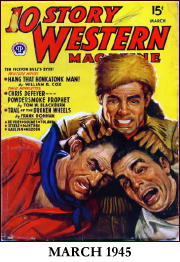
   The Hanigan & Irving stories by Roger Torrey were a short series of eleven stories published in Detective Fiction Weekly from 1937 to 1941. There are two main characters in the series and a number of supporting ones. The main characters are private detective Michael “Mickey” Hanigan and his assistant – Irving Koslowski the taxi driver.

   Hanigan is a former cop, probably a detective, before he opened up his agency. “Hanigan had ethics, though of a peculiar sort and often discounted by the police department.” (Suicide Story) Irving usually drives a decrepit old taxi and takes Hanigan wherever he needs to go and also assists when needed. Irving’s last name was Borowski in “The Meter Says Murder” but changes to Koslowski later in the series. (see “Murder Tips the Scales” from 1940)

   Supporting characters include Nancy Evans, Hanigan’s girl friend, always ready to try to convince Hanigan to take the day off and relax. But Hanigan usually resists the temptation, insisting that he needs to be in his office in case someone needs him. She tried to help him in the first story in the series, but wound up making a mess of matters, so she refrains from helping him after that unless he asks her.

ROGERT TORREY Hanigan & Irving

   Various police detectives are also supporting characters in the stories, but they are different in each story.

   Irving is introduced in the first story in the series, “Case for a Killer” (DFW, September 17, 1937), and is of assistance to Hanigan in the story. Hanigan just picks his taxi at random, and does not identify Irving by name in his first scene. In a later scene, after Hanigan repeatedly calls him Jack, Irving corrects him and tells him his name.

   He also tells Hanigan: “You’re the kind of a guy I like; one that makes up his mind.” Before the two go to a Greek bar, Hanigan tells Irving: “To this Greek spot, and you’re to go in with me. If there’s any dough in this, I’ll see you’re taken care of. If not, you got a steady customer at least.” So it was by sheer accident that the two met up and Irving became hired by Hanigan for future jobs.

   In another story (The Meter Says Murder) Hanigan defends his hiring of Irving: “Now about Irving. The guy ain’t making any money hacking and all I’ve got to pay him is enough for him to get along. And the cab’s handy and he’s a handy boy.” Later Hanigan seems to regret his hiring of Irving, for it was said about him: “Irving Kowalski, who drove a taxi part time and who drove Hanigan to desperation practically the remainder of the time. . .” (Suicide Story)

   Irving’s description was given in “Suicide Story”: “Irving wasn’t tall but he was built like a Shetland pony. Stocky. There’d been several times when he hadn’t ducked in the right direction and these errors in judgment had given him a slightly lumpy appearance. One ear had been torn and this hung at a slight angle, and the gold teeth he’d chosen to replace originals knocked out by knuckles, shone at Hanigan out of the murk.”

   In the first story in the series, “Case for a Killer”, the story is longer than later stories. It is described as a short novel, and the other stories in the series are novelettes. Hanigan is hired to bodyguard Nick Poulas and his young daughter for four days until they sail on a ship for overseas.

   Unfortunately, an assassin breaks into the hotel room while Poulas is giving his story to Hanigan and shoots Poulas with a shotgun. Hanigan takes this hard, and promptly shots the assassin while he is trying to escape. He hides the daughter from the police and goes out on an investigation. Poulas had a valuable briefcase that is missing, so Hanigan searches for that too.

   There is a big conflict between the police and Hanigan and Irving on one side, and two group of crooks on the other. Irving did a good job helping, and the police captain said about him: “Well, he’s a bearcat.” Hanigan replied: “He’s my boy. He’s going to work for me.” So that incident tied up the connection between Hanigan and Irving.

   In the second story, “The Meter Says Murder”, Hanigan is in trouble over a murder. He had had an argument with a newspaper journalist, whom he threatened. The journalist shows up dead the next day in Irving’s taxicab, and both Hanigan and Irving wind up down at the police station trying to explain the situation to one of the Homicide detectives. Hanigan then sets out to investigate the case and clear his name.

   â€œYou Only Hang Once” starts off with Hanigan being called upon to bail Irving out of jail. Irving has a number of charges against him, which he says he is not guilty of committing. The person putting the charges against Irving winds up murdered the next day, and Hanigan gets involved when an heir to a hefty sum is accused of the crime.

   Irving is attacked and both stabbed and slugged, and Hanigan is also attacked when he finds a seriously injured Irving in his taxi. It doesn’t take long for Hanigan to clear up the cases, which are all connected, once he gets a bit of cooperation from friends in the police department.

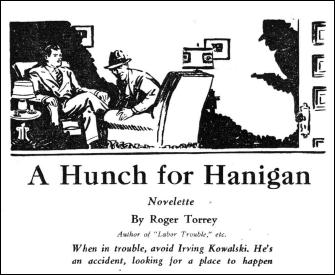
   â€œA Hunch for Hanigan” finds Hanigan searching for and finding a missing heiress. The case becomes complicated when the heiress is mysteriously killed in an automobile accident with a train. Both the police (in the person of Detective-Lieutenant Simpson) and Hanigan find the accident suspicious.

ROGERT TORREY Hanigan & Irving

   The woman’s husband, who happens to be the number one suspect in the death, asks Hanigan to investigate the crime and find the murderer. In this story, Hanigan works well with Detective-Lieutenant Simpson.

   â€œSuicide Story” starts off quickly, with a woman entering Hanigan’s detective agency office and attempting to shoot him. He disarms her and has her tell him why she shot at him. Her boyfriend committed suicide, she said, because Hanigan was investigating his firm.

   Hanigan promises to look into the matter and goes to the seedy hotel where the man had been staying. What he finds convinces him that it is murder, not suicide, and he decides to check further into the case.

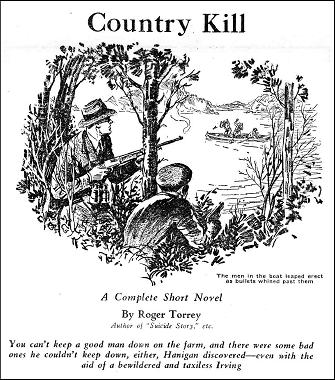
   In “Country Kill” Hanigan is called to the country for a case by a landowner who is being sniped by an unseen rifleman. The shooter doesn’t seem to want to hit anyone, just cause a nuisance. His client is an unpopular person in the neighborhood, making matters more difficult.

ROGERT TORREY Hanigan & Irving

   The case becomes more complicated when not only is a murder committed, but also three city gunmen decide to come to the area supposedly for fishing on the local lake. Hanigan calls Irving to come down to help him, and leave his taxi behind. Irving doesn’t like being separated from his taxi.

   â€œA Bodyguard for Beano” starts off with Hanigan being hired to bodyguard the rich owner’s prize pedigreed English bulldog, and then moves on the real motive for the hiring. Joseph T. Collins, the dog owner, has really hired Hanigan to bodyguard him. He is in fear of his life from his other three partners in his business firm.

   One attempt on his life took place on the first day Hanigan arrived at Collins’ house and before Collins told him why he was there.

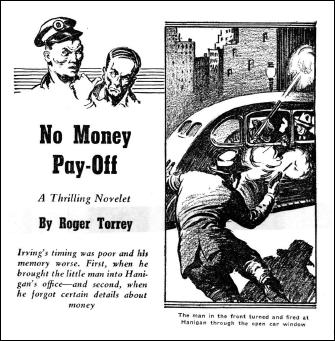
   â€œNo Money Payoff” starts with Irving bringing in a tipster to Hanigan’s office. The tipster claims he knows about a jewelry theft worth ninety thousand dollars that the insurance company would pay to know about. Hanigan, with a hangover from the night before, doesn’t believe him and throws the guy out.

ROGERT TORREY Hanigan & Irving

   Irving is convinced the guy is telling the truth, and follows him, only to run into the middle of the kidnapping of the tipster by two crooks. Irving is shot, and winds up in the hospital. He tells Hanigan the story, and Hanigan finds out there actually was a jewelry heist that the tipster could know about. Then he is interested in tracking down the tipster and finding the jewels in order to get the insurance company fee.

   This is probably the most violent of the stories in the series. Five men are killed (one a policeman) and two are seriously hurt. Only Hanigan’s good detective instincts and experience keep him safe from harm.

   In “Murder Tips the Scales” Hanigan and Irving become involved in a plot to kill some ex-politicians. The first politician asks for Hanigan’s help but is killed before Hanigan can do anything or find out any more information than a threatening note stating that three will be killed.

   As usual, Irving convoys Hanigan around in his taxi, but he does get in on some of the action. Irving chases a suspect in a scene, but somewhat ineptly. He buys another taxi, but it keeps breaking down and stranding Hanigan and Irving. The murderer turns out to be the least likely suspect.

   Police Detective-Lieutenant George Woods was ready to give Hanigan a hard time about virtually anything to do with his current cases. Woods often thought that Hanigan knew some facts about his current criminal case. And Woods was right; Hanigan just didn’t want to tell Woods anything because he was working on the case. Hanigan was in it for the money.

   â€œFrame for a Killer” opens with Hanigan and Irving unknowingly being framed for a jewelry robbery and murder in the same building that Hanigan’s new was located in. Most of the story consists of Hanigan and Irving trying to get out of the frame and get the right criminals.

   First Hanigan has to escape from two policemen who have arrested both him and Irving for the crimes. A shootout with the criminals finalizes the case. Then Hanigan has to explain matters to the police, who don’t look too kindly on Hanigan for assaulting their detectives.

   This is an above average series, with some good stories. There is an element of humor in the stories, often contributed by Irving’s actions. Irving is actually of some assistance in Hanigan’s cases, even with the humorous situations.

   This series deserves to be reprinted. The stories are fairly long, so eleven stories might fill a book.

       The Hanigan & Irving series, by Roger Torrey:

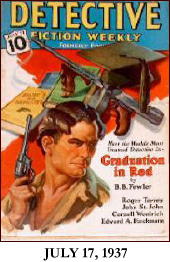
Case for a Killer     July 17, 1937
The Meter Says Murder     December 11, 1937
You Only Hang Once     April 23, 1938
Labor Trouble     September 17, 1938
A Hunch for Hanigan     November 12, 1938
Suicide Story     April 15, 1939
Country Kill     May 27, 1939
A Bodyguard for Beano     August 26, 1939
No Money Payoff     December 16, 1939
Murder Tips the Scales     February 24, 1940
Frame for a Killer     November 1, 1941

    Previously in this series:

1. SHAMUS MAGUIRE, by Stanley Day.
2. HAPPY McGONIGLE, by Paul Allenby.
3. ARTY BEELE, by Ruth & Alexander Wilson.
4. COLIN HAIG, by H. Bedford-Jones.
5. SECRET AGENT GEORGE DEVRITE, by Tom Curry.
6. BATTLE McKIM, by Edward Parrish Ware.
7. TUG NORTON by Edward Parrish Ware.
8. CANDID JONES by Richard Sale.
9. THE PATENT LEATHER KID, by Erle Stanley Gardner.
10. OSCAR VAN DUYVEN & PIERRE LEMASSE, by Robert Brennan.
11. INSPECTOR FRAYNE, by Harold de Polo.
12. INDIAN JOHN SEATTLE, by Charles Alexander.
13. HUGO OAKES, LAWYER-DETECTIVE, by J. Lane Linklater.

FIRST YOU READ, THEN YOU WRITE
by Francis M. Nevins


   It’s official, gang. I’ve just signed a contract with Perfect Crime Books for the publication of — how shall I describe it? It may not be quite as hefty as my book on Cornell Woolrich, whose title I adapted for the titles of these columns, but it will certainly qualify as a literary doorstop.

ELLERY QUEEN Royal Bloodline

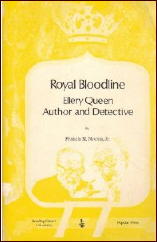
   Back in the 1980s I wanted my Woolrich book to answer almost any imaginable question about the haunted recluse I’ve called the Hitchcock of the written word. Now as I slipslide into senility I want my new book to be just as comprehensive about the two first cousins from Brooklyn who wrote some of the most complex and involuted detective novels of the genre’s golden age.

   Are you familiar with everything bagels? This tome will be, I hope, the Everything Book on Frederic Dannay and Manfred B. Lee. Its tentative title is Ellery Queen: The Art of Detection.

   I think I heard a question from cyberspace. “Hey, didn’t you do that book already, back in the Watergate era?” Well, sort of. But as I got older I became convinced that I hadn’t done all that good a job.

   Fred Dannay was the public face of Ellery Queen, and in the years after we met he became the closest to a grandfather I’ve ever known, but I never really got to know the much more private Manny Lee. He and I had exchanged a few letters, and we met briefly at the Edgars dinner in 1970, but he died before we could meet again.

   Because of his untimely death Royal Bloodline inadvertently gave the impression that “Ellery Queen” meant 90% Fred Dannay. One of the most important items on my personal bucket list was to do justice to Manny.

   Thanks largely to the memoirs published by his son Rand Lee, and to the Dannay-Lee correspondence (in Blood Relations, published early this year by the same Perfect Crime Books that will issue The Art of Detection), and to the correspondence between Manny and Anthony Boucher, which is archived at Indiana University’s Lilly Library, I’ve come to a much clearer understanding of Manny, of who he was and how he lived and worked and thought.

   The Art of Detection improves on Royal Bloodline in all sorts of ways but for me this one is the most important. In addition it provides much more detail on subjects like the EQ radio series (1939-48) and the decades-long interaction between the cousins and Boucher.

   And of course it covers all sorts of subjects that postdate the early 1970s, like the EQ TV series with Jim Hutton, and Fred’s third marriage and last years and death. And there will be a number of photographs never seen before.

   When I first discovered the Ellery Queen novels, that byline was a household name. It still was when I first met Fred Dannay. I can’t believe that in my lifetime the Queen name has (except in Japan) been so completely forgotten. Maybe, just maybe, with the publication of Blood Relations this year, and of my book next year, and of Jeffrey Marks’ biography-in-progress two or three years from now, I’ll live to see the return of Ellery Queen to the public eye.

***

   On June 5, at age 91, Ray Bradbury died. In his own field he was and will remain a giant. As far as I can determine, among the hundreds of authors whose work Anthony Boucher reviewed in the San Francisco Chronicle during and for a while after World War II, he was the last one standing.

RAY BRADBURY Mystery pulps

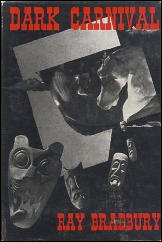
   Reviewing Bradbury’s Dark Carnival collection in his Chronicle column for June 22, 1947, Boucher called the author “the most fascinating and individual talent to appear in the fantasy field for a long time….[T]here’s no telling what may come of this still very young man.”

   During his early and middle twenties Bradbury also wrote stories for crime pulps like New Detective, Dime Mystery and Detective Tales. Was Boucher familiar with them?

   â€œFor years,” he wrote in his Dark Carnival review, “I have been prowling newsstands and buying any magazine with a Ray Bradbury story.” Observe that that sentence isn’t limited to fantasy-horror magazines.

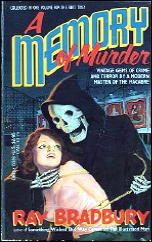
   In any event Boucher was long dead by the time Bradbury’s earliest crime tales were collected in the paperback original A Memory of Murder (Dell, 1984). We know that Bradbury was a great admirer of Cornell Woolrich, and he may well have been the first writer for whose short crime fiction Woolrich was the model and polestar.

   Woolrich never once used a series character. After two tales about a character called the Douser — for my money the weakest of the fifteen in the collection — Bradbury followed that lead. He never approached Woolrich’s mastery of pure edge-of-the-chair suspense but, for a kid in his middle twenties, did a noble job creating noir atmosphere Woolrich style.

   The more you’re at home in Woolrich, the more you feel a sense of deja vu when you read Bradbury’s stories. “Yesterday I Lived!” (Flynn’s Detective Fiction, August 1944) echoes Woolrich’s “Preview of Death” (Dime Detective, November 15, 1934; collected in Darkness at Dawn, 1985) in the sense that both are about a Hollywood plainclothesman of low rank investigating the death of a lovely actress while she’s filming a scene:

RAY BRADBURY

   â€œHe went out into the rain. It beat cold on him… Cleve clenched his jaw and looked straight up at the sky and let the night cry on him, all over him, soaking him through and through; in perfect harmony, the night and he and the crying dark.”

   In that paragraph and countless others in these stories, it’s obvious whom Bradbury is channeling.

   Sometimes Bradbury offers his own take on a Woolrich springboard situation, for example in “It Burns Me Up!” (Dime Mystery, November 1944), which tracks Woolrich’s “If the Dead Could Talk” (Black Mask, February 1943; collected in Dead Man’s Blues, 1947) in that each is narrated in first person by a corpse.

   Sometimes there’s an echo even in the titles, for example “Wake for the Living” (Dime Mystery, September 1947), which evokes Woolrich’s classic “Graves for the Living” (Dime Mystery, June 1937; collected in Nightwebs, 1971).

   Bradbury’s prose tends to be more shrill and lurid than Woolrich’s, and pockmarked with exclamation points — even in the titles! — as Woolrich’s never was, but the influence is crystal clear.

   In his introduction to A Memory of Murder, Bradbury was quite modest about his contribution to our genre:

   â€œI floundered, I thrashed, sometimes I lost, sometimes I won. But I was trying … I hope you will judge kindly, and let me off easy.”

   This old jurist has done just that, and urges others who reread these stories to bang their gavels softly.

***

   â€œSweet, dear, impossible man. I wonder who he’s making love to now. I wish it were me. I have the education and breeding to appreciate a gentleman like he is.”

   No one seems to have guessed who wrote those ludicrous lines, supposedly from the viewpoint of an educated woman, that I quoted in my last column.

   Maybe that’s because in a sense I was trying to mislead. The malapropisms from Keeler, Avallone, John Ball, William Ard and myself were false clues in the Carr-Christie-Queen manner, playing completely fair with the reader but designed to give the impression that the sixth quotation was by a sixth person.

   In fact it wasn’t. The perp, as at least one reader should have figured out, was the ineffable Avallone. Here’s another from the same inexhaustible cornucopia:

   â€œWolfman Dakota, born of an Apache mother and a Texan rancher, with bronze skin and hot blood in his veins … killed with a weapon unique in crime-land circles. A blowgun filled with poison-tipped darts. A leftover from his Apache heritage….”

   Ah yes, who can forget the climax of Stagecoach, with those damn red savages chasing the coach across the salt flats, blowing their poison darts at the Duke and Claire Trevor and all the other passengers?

IT’S ABOUT CRIME, by Marvin Lachman

FREDRIC BROWN Dennis McMillan

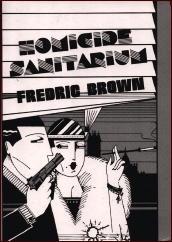
   In a very imaginative job of publishing, Dennis McMillan Publications has collected many of the early pulp mysteries of Fredric Brown and published five paperback collections, at $5.95 each: Before She Kills, The Freak Show Murders, Homicide Sanitarium, Pardon My Ghoulish Laughter, and 30 Corpses Every Thursday, which contain introductions by William F. Nolan, Richard Lupoff, Bill Pronzini, Donald Westlake, and William Campbell Gault, respectively.

   Each introduction limns a different aspect of Brown’s life and work. No, these stories aren’t quite as well written as Brown’s later novels. After all, he was a more experienced writer when he penned The Fabulous Clipjoint and The Lenient Beast.

   Still, they’re just as readable, and what a joy to be able to read material from forgotten pulps of the early 1940’s like Thrilling Detective, G-Man Detective, Clues, Popular Detective, Ten Detective Aces, Strange Detective Mysteries, and Phantom Detective.

   Homicide Sanitarium even contains Brown’s very first story, “The Moon for a Nickel,” from the March 1938 Detective Story Magazine.

— Reprinted from The MYSTERY FANcier,
Vol. 11, No. 1, Winter 1989.


Editorial Comments:   In all Dennis McMillan did something like 18 collections of Fredric Brown’s shorter work, including poetry and some non-fiction, most of them appearing after this review was published.

   This is the first of several reviews of anthologies and short story collections that Marv Lachman wrote for this same issue of The MYSTERY FANcier. Look for most of them to be posted here over the next few weeks.

« Previous PageNext Page »