Pulp Fiction


THE SERIES CHARACTERS FROM
DETECTIVE FICTION WEEKLY
by Monte Herridge


        #13. HUGO OAKES, LAWYER-DETECTIVE, by J. Lane Linklater.

   One of the precursors of Erle Stanley Gardner’s series character Perry Mason the attorney, the Hugo Oakes series is fairly entertaining. J. Lane Linklater created this series about a criminal defense attorney who solved crimes. He appeared in twenty stories in Detective Fiction Weekly from 1929-1934, a respectable run.

   J. Lane Linklater was the pseudonym of Alex Watkins (1893?-1983?). He had two other series that also ran in the magazine: Sad Sam Salter (1937), and Paul C. Pitt, a kind of conman (1936-1941).

   One of the stories describes Oakes the person: “Hugo Oakes, lawyer, investigator, gruff friend of the penniless in trouble, had four great interests in life. Those interests were law, detection, people—and horses.” (Finishing Touches)

   A physical description of Oakes is noted in another story: “He was a wizard with flowery eloquence, too, but outside of the courtroom it didn’t seem to go with his age-colored, shapeless clothes, his casual manner, his pudgy person.” (You Think of Everything)

   He wears a slouch hat, and rolls his own cigarettes. Very little information is given about Oakes’ background and upbringing. There is a mention by Oakes himself on one occasion that he liked horses because he grew up on a farm (Not One Clew).

HUGO OATES J. Lane Linklater

   He prefers to use ungrammatical, common speech that belies his education. However, when he wishes he can use much better language. Inspector Mallory prefers Oakes to use common language; he “liked Oakes much less when the lawyer used four-syllable words.” (Arsenic in the Cocktail)

   Oakes is not one of the high-priced lawyers with a fancy office and furniture. He has a shabby office that costs him twenty dollars a month, and often doesn’t have enough in his business accounts to pay that. His only employee is Mamie, who is his combination stenographer-bookkeeper-secretary.

   The reason he has very little money is that people rarely paid him for the legal work he did for them. Oakes has a thriving practice helping people with little money out of trouble. He did his own detective work rather than hire a detective agency to do it for him. However, we must remember that these stories take place during the Depression, when many people either lacked jobs or had poorly paying ones.

   Oakes is an egalitarian, preferring regular people and the poor to the better off and wealthy classes. A person’s lack of money never affected Oakes’ decision to take them on as a client.

HUGO OATES J. Lane Linklater

   The only other regular in the series is police Inspector Mallory, who is usually glad to have Oakes help on his cases, but “he would never admit it. They might gibe and grouch at each other on occasion, but Mallory had intelligence enough to recognize the value of Oakes’s assistance, and Oakes was always willing to let the credit go to Mallory.” (Finishing Touches)

   Each story usually involves Oaks being called in by a client and then having to solve a murder, usually to save the client. Once his client was a murder victim before Oakes could reach the scene. Inspector Mallory was always on hand at the scene of the crime. Mallory either does not understand what is going on, or seeks the simplest explanation (always wrong, of course).

   Very rarely did Mallory actively ask for Oakes’ help on a case. One special case was in the story “A Pair of Shoes”, where Mallory asked for assistance. A rich businessman had disappeared, and three weeks of work had led Mallory to be desperate enough to ask for unofficial help. Oakes gets to work and very quickly solves the case in a logical manner.

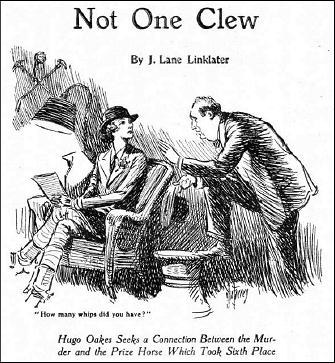
   Another request for help from Mallory led to a murder investigation by Oakes at a high society horse show in “Not One Clew”. Oakes said he did not care for society, but he did like the horses. Part of the deal with Mallory was a free ticket to the horse show.

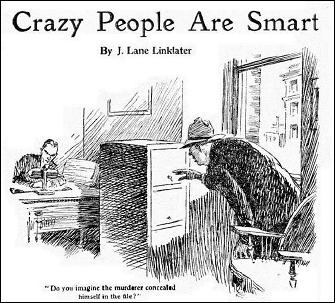
   Another off-beat story for the series is “Crazy People Are Smart,” where Oakes accepts the challenge of a prison chaplain and investigates an old murder. Bill Tubby had just twenty-four hours before his scheduled electric chair execution for a crime he claimed he did not commit. Inspector Mallory had solved the case to his satisfaction, and he is afraid Oakes will do something to change the outcome. Oakes goes to the scene of the crime and investigates, coming up with an unusual solution that saves Tubby.

HUGO OATES J. Lane Linklater

   Hugo Oakes has a system for locating the murderer in crime situations: “Always look for the type of mind capable of conceiving and executing the particular crime under scrutiny.” (The Wild Man From Borneo)

   Inspector Mallory knows about this system, and in this story attempts to use it himself. Unfortunately he chooses the wrong person as the murderer, and Oakes has to straighten him out. This is one case where Oakes becomes involved because the victim was a friend of his. Oakes is uncharacteristically not in his usual cheerful mood; in fact he is angry and unsmiling.

   Another story gives a bit more of Oakes’ insight into crime detecting: “But a man always leaves the imprint of his personality on his crime. What a man does is the expression of what he is. He may not leave fingerprints, but he always leaves mind prints.” (Crazy People Are Smart)

   So Hugo Oakes is a believer in the application of psychology to crime-solving. The stories contain little violence, though one exception is in the story “Finishing Touches.” Here Oakes confronts the guilty party and has Inspector Mallory secretly back him up, which is needed when the murderer attempts to kill Oakes. Mallory wounds the murderer and saves Oakes’ life.

   The series is interesting to read, although there are not any great criminal masterminds, fancy destructive gadgets, or gangs of criminals running around. It took all kinds of stories in the pulp era, and this series is better than many other series in DFW.

      The Hugo Oakes series, by J. Lane Linklayer:

Hello, Jim!     September 7, 1929
Court Costs Saved     October 5, 1929
The Wild Man From Borneo     February 22, 1930
The Watchful Woman     May 10, 1930
Not One Clew     May 24, 1930
Crazy People Are Smart     May 31, 1930
The Seventh Green Murder     July 26, 1930
The Lady Confesses     August 23, 1930
Three Old Crows     October 18, 1930
A Pair of Shoes     November 15, 1930
Finishing Touches     January 3, 1931
You Think of Things February 7, 1931
Women Always Mean Trouble     March 28, 1931
Arsenic in the Cocktail     April 4, 1931
He Died Laughing     July 4, 1931
Murder Next Door     September 5, 1931
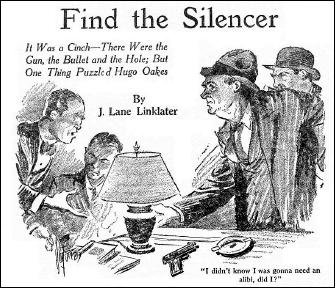
Find the Silencer     October 10, 1931
The Second Floor Murder     November 19, 1932
The Dead Client     December 2, 1933
On the Brink     June 2, 1934

    Biographical sketch of Linklater from the March 16, 1929 issue of Detective Fiction Weekly:

HUGO OATES J. Lane Linklater

   HERE is a personal greeting from J. Lane Linklater, author of “One O’Clock in the Morning,” in this issue. We asked him to stand up and say a few words to you:

   You can’t mean me, cap’n?

   Oh, well—

   We’ll avoid the statistical as far as possible and get down to the vital.

   I have lived more or less decidedly and existed more or less uncertainly, in Washington, Oregon, California, Arizona, New Mexico, Texas, and Louisiana; that is, down the Pacific Coast from British Columbia to the Mexican border, and across the south to Louisiana. Thus it will be seen that I have never set foot on any but a coast or border State.

   I have held down — sometimes for a very brief period — forty-three jobs, in offices, restaurants, hotels, boarding houses, and again in offices; in large cities, small towns, construction and logging camps, in green valleys and desert plains. If I was working in a town, it was never far away from a restaurant; if in a camp, it was never very far away from the cookhouse.

   Incidentally, the transition from job to job was at times sudden and drastic. On one occasion, for instance, I was night porter in a “coffee and” dump, and a week later I was head bookkeeper for a chain store system some two thousand miles away. Honestly — or perhaps I should say, actually — I am a very fair bookkeeper.

   While I’m on the question of jobs — and what is more important? — I might add that the last regular job I had, and the one I was on longer than any of the others, was as editor of a farm paper. I was never better fitted for any job than for this one inasmuch as I had never in my life touched my hand to a plow and couldn’t tell the difference between a Jersey heifer and a Shorthorn bull. Now I know what a Shorthorn bull is, having met one in a dissatisfied mood.

   Among the people I have met and become friendly with — and this is vital, from the point of view of both life and letters — were bankers, labor agitators, gamblers, ministers, politicians, hoboes, Chinese cooks, mining-stock promoters, hard-working bohunks, and waitresses. Of these I should say that the bohunks were the most useful, the hoboes the happiest, the Chinese cooks the most successful, and the waitresses the most interesting — to me.

   Perhaps the most accurate indication of the kind of life a man has led is where he has slept. Well, I have slept in very expensive hotels — when I was working there — in middle-class hotels, in cheap hotels, and in fifteen-cent flophouses; also in bunk houses, ditches, city parks, fields, woods and swamps. Of these I should say that the woods were the most comfortable and the flophouses the most interesting.

   I have never been arrested. This I now regret exceedingly. I have had several opportunities, although I never offended society very seriously, except by going broke. I have been accosted on the street around three o’clock in the morning in San Francisco, Los Angeles and New Orleans and other minor municipalities which suspected that my financial status warranted my arrest as a vagrant. Their suspicions were correct, but I was always able to convince them otherwise. As I say, I now regret it. I may yet overcome this disadvantage.

   In these emergencies my tongue was assisted by my face, a deceptively mild arrangement that never seemed to fit the role of roving mendicant. I have been mistaken for a well-known Methodist minister in Portland, Oregon, and for a Chatauqua lecturer in Sweetwater, Texas.

   My formal education, unfortunately, was not very extensive. However, I have read rather incessantly, if not systematically. Meditating upon what I had seen and what I had read I decided, about a year and a half ago, to forsake the discussion of ton litters and live stock diseases for the production of fiction. I inquired about it. I read the writers’ journals. I asked advice of people who know about these things — I was always keen for advice.

   They all told me to hang on to my job for five or perhaps ten years, the while I tried to write fiction. I thereupon quit my job cold. Advice is fine, but I have always thought that if you’re going to do a thing, the thing to do is to go ahead and do it, sink or swim. I’m not rich yet, but the wife and I are going back down to California for the winter.

   I have never been well enough to undertake anything violent, and never sick enough to take to my bed. It is a condition that presages a long life. Under the head of more good luck, I have a wife — acquired about eight years ago — who is a good scout and a smart woman; a father and mother, both alive and well, who are intelligent and good natured—they had to be to put up with me—and a number of friends who stick through the years.

   All of these things count. Not that it matters, but I am now thirty-six years old.


    Previously in this series:

1. SHAMUS MAGUIRE, by Stanley Day.
2. HAPPY McGONIGLE, by Paul Allenby.
3. ARTY BEELE, by Ruth & Alexander Wilson.
4. COLIN HAIG, by H. Bedford-Jones.
5. SECRET AGENT GEORGE DEVRITE, by Tom Curry.
6. BATTLE McKIM, by Edward Parrish Ware.
7. TUG NORTON by Edward Parrish Ware.
8. CANDID JONES by Richard Sale.
9. THE PATENT LEATHER KID, by Erle Stanley Gardner.
10. OSCAR VAN DUYVEN & PIERRE LEMASSE, by Robert Brennan.
11. INSPECTOR FRAYNE, by Harold de Polo.
12. INDIAN JOHN SEATTLE, by Charles Alexander.

PULP AUTHOR CHARLES W. TYLER,
by Victor A. Berch

   
   Charles W. Tyler was perhaps the most prolific pulp writer you never heard of. He was the author of 100s of novelettes and short stories, in all genres, many of which are listed below. He wrote detective stories, adventure stories, railroad stories and westerns, but except to a small handful of enthusiasts, his name is no longer known today.

   He is the author of two titles included in Crime Fiction IV, by Allen J. Hubin:

            Blue Jean Billy (Chelsea, 1926, hc)
            Quality Bill’s Girl (Chelsea, 1925, hc)

   The second of these is described as being “three novelets presented as a novel.” Since Tyler wrote six “Blue Jean Billy” stories that appeared in Detective Story Magazine (see below), a strong conjecture would be that Quality Bill’s Girl contains the first three, and Blue Jean Billy contains the final three.

   Tyler’s two most prominent series characters in the detective pulps were Big-Nose Charley and Blue Jean Billy Race. Here are descriptions of both, as excerpted from the online website The Pulp Heroes, by Jess Nevins. (Follow the link for more.)

    Big-Nose Charley was created by Charles W. Tyler […] appeared in a number of stories, starting with “Big-Nose Charley’s Get Away,” in the 5 April 1917 issue of Detective Story Magazine. […] Charley is a thief who, though occasionally relying on the more artistic forms of crime such as mail fraud, customarily uses strong-arm tactics to get his swag. […] [W]hat kept Big-Nose Charley going for so many years, and what makes his stories remembered fondly today, is the humor within them. The Big-Nose Charley stories are humorous, and meant to be, poking fun of themselves as well as at the genre.

   and

    Blue Jean Billy Race, the “highway woman of the sea,” was the creation of Charles W. Tyler, a fireman, magazine writer, and draftsman [..] Billy appeared in Detective Story Magazine beginning in “Raggedy Ann” on March 26, 1918 […] [Her father] raised Billy to hate society and its hypocrites and hypocrisies […] Billy is a thief and a pirate, stealing aboard ships to rob the owners and passengers at gunpoint and then slipping over the side and disappearing into the night. She’s not just a thief, though; she’s a thief taking revenge on the evil rich, those liars and cheats who rob from and swindle the poor.

   
   Tyler’s entry in the Crime, Mystery & Gangster Fiction Magazine Index, 1915-2010, compiled by Phil Stephenson-Payne, William G. Contento & Stephen T. Miller (2010), mentions only that he flourished from 1917-1935.

   He is also found in the online FictionMags Index, where no dates are given for birth and death, but it is noted that he was born in North Hinsdale, MA and that he should not be confused with Charles Waller Tyler nor Charles Willis Tyler.

   In Allen J. Hubin’s massive bibliography Crime Fiction Bibliography, 1700-2000, it is stated he was born in Massachusetts, was a fireman, magazine writer and draftsman.

   Armed with these bits of information, I set out to see what I could unearth through my subscription to the databases held by the New England Historic Genealogical Society to determine what information it might have on a Charles W. Tyler, born in Massachusetts prior to 1915 and born in Hinsdale (or North Hinsdale) Massachusetts.

   It was only a matter of seconds to learn that no Charles W. Tyler showed up in the Society’s databases.

   What was my next step to be?

   Having a world-wide subscription to Ancestry.com’s databases, I knew that that was to be my next avenue of research to see what that might produce.

   There were loads of Charles W. Tylers, but one that caught my attention was a Charles W. Tyler who lived in Quincy, MA and was described as a novelist in the city directories for 1918 and 1920.

   Poking his name into the US Census records from 1900 on up, I was taken by surprise at the entry of a Charles W. Tyler, born 1887 in Hinsdale, New Hampshire. Could it be that there were two Hinsdales? One in Massachusetts and one in New Hampshire and somehow the compilers of the Fictionmags Index and Allen J Hubin’s CFIV had mistakenly assigned the birthplace of Charles W. Tyler to Massachusetts.

   To verify this supposition, I turned to Wikipedia and sure enough, it verified that there was a Hinsdale, Massachusetts and a Hinsdale, New Hampshire,

   Hinsdale, Massachusetts is in Berkshire County, Massachusetts and is part of the Pittsfield, Massachusetts, statistical area. While Hinsdale, New Hampshire is in Cheshire County, New Hampshire, south of Brattleboro VT near the Pisgah State Park at the border of New Hampshire and Massachusetts.

   So, once again I turned to my Ancestry subscription. From previous searches on Ancestry, I knew that someone born in the 1880s had to register for the draft of World War I and I began to explore what might be in that particular database. I entered the name Charles W. Tyler and birthplace New Hampshire and up came Charles Warren Tyler, born 1887 in Hinsdale, New Hampshire and living in Quincy, Massachusetts.

   The clinching piece of data was that he described himself as a writer for the Frank Munsey Company in New York. However, his birth date was given as September 1, 1888. Why Mr. Tyler chose to make himself a year younger is anyone’s guess. But it was not an unusual practice, especially with women and oft times men in the public’s eye.

   Now, one of the great features of the Ancestry database is that it will suggest other of its databases to examine that relate to this person.

   So, in the 1900 US Census, it showed Charles W. Tyler, age 12, born 1887, living in Hinsdale, New Hampshire, living with his mother, Clara, a widow.

   In the 1910 Census, Charles W. Tyler, age 22, is shown living at No. 18 George St., Boston, MA as a boarder. His occupation, an artist with a general practice. (This seems to concur with Hubin’s description of him being a draftsman.)

   For some reason, he does not show up in the 1920 Census. But in the 1930 Census, Charles W. Tyler, age 42, born in New Hampshire, is living in Glendale, California with his wife, Alice. His occupation is listed as a fiction writer.

   And finally, the California Death Index shows that Charles Warren Tyler was born September 1, 1887 in New Hampshire and died April 3, 1952 in Los Angeles County, of which Glendale was a part. His mother’s maiden name was listed as Smith.

   In the book A History of the Doggett/Daggett Family, it states that his mother, Clara Smith, was born in Boston Jan. 17, 1850 and had married Olcott B. Tyler of Hinsdale, NH. Their offspring was Charles Warren Tyler.

   As an added bit of information, his story “Raggedy Ann,” which had appeared as a short story in Detective Story Magazine, March 26, 1918 was the basis for the silent film The Exquisite Thief, scenario by Harvey Gates and directed by Todd Browning. 6 reels and copyrighted April 4, 1919.

       Short fiction [crime and detective stories only]

TYLER, CHARLES W. BNC = Big-Nose Charley; BJB = Blue Jean Billy.

* At Milepost 92, (na) Detective Story Magazine Apr 13 1920
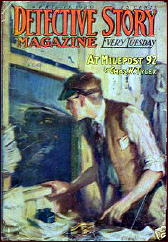
CHARLES W. TYLER

* Big-Nose Charley and Any Old Port [BNC], (ss) Detective Story Magazine Nov 18 1919
* Big-Nose Charley and Deuces Low [BNC], (ss) Detective Story Magazine Apr 6 1920
* Big-Nose Charley and His Jenny [BNC], (ss) Detective Story Magazine Apr 17 1926
* Big-Nose Charley and Human Clay [BNC], (ss) Detective Story Magazine Sep 2 1919
* Big-Nose Charley and Madeyline [BNC], (ss) Detective Story Magazine Aug 15 1925
* Big-Nose Charley and the Double Cross [BNC], (ss) Detective Story Magazine Aug 17 1920
* Big-Nose Charley and the Merry Widow [BNC], (ss) Detective Story Magazine Jun 11 1927
* Big-Nose Charley and the Promised Land [BNC], (ss) Detective Story Magazine Feb 24 1920
* Big-Nose Charley and the Simple Life [BNC], (ss) Detective Story Magazine Oct 2 1917
* Big-Nose Charley and the Tout [BNC], (ss) Detective Story Magazine Oct 14 1922
* Big-Nose Charley at Home [BNC], (ss) Detective Story Magazine Dec 16 1919
* Big-Nose Charley at the Auto Show [BNC], (ss) Detective Story Magazine Jun 4 1921
* Big-Nose Charley at the Opera [BNC], (ss) Detective Story Magazine Feb 13 1926
* Big-Nose Charley at the Policemen’s Ball [BNC], (ss) Detective Story Magazine Apr 16 1921
* Big-Nose Charley at the Races [BNC], (ss) Street & Smith’s Detective Story Magazine Nov 21 1931
* Big-Nose Charley Enters the City of Angels [BNC], (ss) Detective Story Magazine Mar 8 1924
* Big-Nose Charley Finds a Brother [BNC], (ss) Detective Story Magazine Sep 5 1925
* Big-Nose Charley Gets an Interview [BNC], (ss) Detective Story Magazine Dec 10 1921
* Big-Nose Charley Gets His Match [BNC], (ss) Detective Story Magazine Feb 24 1923
* Big-Nose Charley Hops Off [BNC], (ss) Detective Story Magazine Mar 28 1925
* Big-Nose Charley in New Orleans [BNC], (ss) Detective Story Magazine Jul 20 1929
* Big-Nose Charley in the City of Culture [BNC], (ss) Detective Story Magazine Jan 22 1921
* Big-Nose Charley in the Magic City [BNC], (ss) Detective Story Magazine Jun 9 1928
* Big-Nose Charley Leaves His Card [BNC], (ss) Detective Story Magazine Oct 24 1925
* Big-Nose Charley Lends a Hand [BNC], (ss) Street & Smith’s Detective Story Magazine Mar 25 1935
* Big-Nose Charley Meets Some Home Folks [BNC], (ss) Detective Story Magazine Jun 21 1924
* Big-Nose Charley on the Barbary Coast [BNC], (ss) Detective Story Magazine Apr 1 1922
* Big-Nose Charley on the Mt. Division [BNC], (ss) Detective Story Magazine Dec 25 1917
* Big-Nose Charley on the Painted Plain [BNC], (ss) Detective Story Magazine Oct 25 1924
* Big-Nose Charley Rolls His Own [BNC], (ss) Detective Story Magazine Mar 25 1919
* Big-Nose Charley Sits in the World [BNC], (ss) Detective Story Magazine May 5 1923
* Big-Nose Charley Works Alone [BNC], (ss) Detective Story Magazine Sep 11 1917
* Big-Nose Charley, Alias Santa Claus [BNC], (ss) Detective Story Magazine Dec 20 1924
* Big-Nose Charley, Bad Man [BNC], (ss) Detective Story Magazine Jan 29 1918
* Big-Nose Charley, Gentlemun [BNC], (ss) Street & Smith’s Detective Story Magazine Apr 18 1931
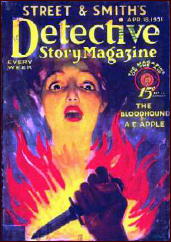
CHARLES W. TYLER

* Big-Nose Charley, Goober Grabber [BNC], (ss) Detective Story Magazine Jan 7 1928
* Big-Nose Charley, Hijacker [BNC], (ss) Detective Story Magazine Oct 11 1924
* Big-Nose Charley, On the Cross [BNC], (ss) Detective Story Magazine Apr 16 1918
* Big-Nose Charley, Racketeer [BNC], (ss) Street & Smith’s Detective Story Magazine Aug 15 1931
* Big-Nose Charley’s Color Blind [BNC], (ss) Detective Story Magazine Jan 21 1928
* Big-Nose Charley’s Derby Hat [BNC], (ss) Street & Smith’s Detective Story Magazine Jul 10 1934
* Big-Nose Charley’s Dog Helps Out [BNC], (ss) Detective Story Magazine Aug 27 1921
* Big-Nose Charley’s Florida Front [BNC], (ss) Detective Story Magazine Mar 24 1928
* Big-Nose Charley’s Get-Away [BNC], (ss) Detective Story Magazine Apr 5 1917
* Big-Nose Charley’s Ha-Ha [BNC], (ss) Detective Story Magazine Jan 10 1931
* Big-Nose Charley’s Safe [BNC], (ss) Street & Smith’s Detective Story Magazine Feb 13 1932
* Big-Nose Charley’s Trick Umbrella [BNC], (ss) Street & Smith’s Detective Story Magazine Jul 25 1935
* Blue Jean Billy and the Lone Survivor [BJB], (ss) Detective Story Magazine Aug 22 1925
* Blue Jean Billy at Fiddler’s Reach [BJB], (nv) Detective Story Magazine Jun 25 1921
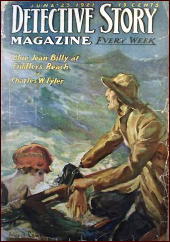
CHARLES W. TYLER

* Blue Jean Billy Plays Fair [BJB], (ss) Detective Story Magazine Jan 18 1930
* Blue Jean Billy, Sky Pirate [BJB], (nv) Detective Story Magazine Apr 4 1925; Best Detective Magazine Mar 1937
* Blue Jean Billy, Waif of the Sea [BJB], (ss) Detective Story Magazine Nov 6 1926
* Cold-Hands Kate, (ss) Detective Story Magazine Apr 15 1919
* Dim Trails [Railroad Detective], (na) Detective Story Magazine Feb 19 1921
* The Dub at Eagle Bridge, (ss) Detective Story Magazine Oct 12 1920
* Echo Bowl, (ss) Detective Story Magazine Nov 6 1917
* Expensive Cigarettes, (nv) Detective Story Magazine Oct 26 1920
* Fair Pickin’s, (ss) Detective Story Magazine Nov 3 1928
* Fate Snaps the Shutter, (ss) Detective Story Magazine Jul 15 1922
Best Detective Magazine Feb 1931
* The Foothill Tiger, (ss) Detective Story Magazine Oct 31 1925
* The Green Mask, (nv) Detective Story Magazine Jun 19 1926
* The Haunt of Raggedy Arm, (ss) Detective Story Magazine Oct 7 1919
* The Haunted House on Dungeon Road, (na) Detective Story Magazine Jul 6 1920
* Highway Woman of the Sea [BJB], (na) Detective Story Magazine Aug 19 1922
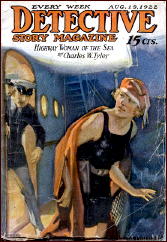
CHARLES W. TYLER

* Hounded by Habit, (ss) Detective Story Magazine Jul 30 1921
Best Detective Magazine Oct 1933
* In Hungry Man’s Canon, (ss) Detective Story Magazine Sep 17 1918
* It Was Signed “Bill”, (ss) Detective Story Magazine Jun 8 1920
Best Detective Magazine Apr 1933
* Jimmy the Quilt, (ss) Detective Story Magazine Apr 30 1921
Best Detective Magazine Aug 1934
* Judy’s Touch, (ss) Street & Smith’s Detective Story Magazine Oct 17 1931
* A Kiss for Big-Nose Charley [BNC], (ss) Street & Smith’s Detective Story Magazine Oct 25 1934
* Landlubbers, (ss) Detective Story Magazine Apr 8 1922
* Lon Durgin’s Honor System, (ss) Detective Story Magazine Oct 19 1920
* Look Out!, (ss) Detective Story Magazine Apr 7 1928
* Loose Ends, (ss) Detective Story Magazine Apr 9 1918
* The Loot of the Overland, (ss) Detective Story Magazine Apr 20 1917
* The Lying Signal, (ss) Detective Story Magazine Apr 30 1927
* Mountain Misery, (ss) Detective Story Magazine Aug 16 1924
* A Muddy Bird, (nv) Detective Story Magazine Sep 20 1924
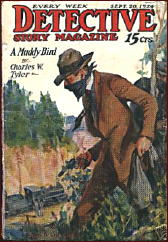
CHARLES W. TYLER

* Nix’s Mate [BJB], (ss) Detective Story Magazine Mar 11 1919
* On the Right Side of the Wrong Street, (ss) Detective Story Magazine May 14 1921
* The Pal in the Pullman, (nv) Detective Story Magazine Nov 29 1924
* Pat Brady — Flatfoot, (ss) Street & Smith’s Detective Story Magazine May 10 1933
* Phantoms of Wolf River, (ss) Detective Story Magazine Oct 29 1918
* Raggedy Ann, (ss) Detective Story Magazine Mar 26 1918
* Raiders from Raggedy Ann, (ss) Detective Story Magazine Jul 16 1918
* Raw Silk, (ss) Detective Story Magazine Dec 2 1919
* Sea Law and Blue Jean Billy [BJB], (nv) Street & Smith’s Detective Story Magazine Nov 14 1931
* Second No. 12, (na) Detective Story Magazine Aug 31 1920
* 77 and a Wink, (ss) Detective Story Magazine Feb 26 1921; Best Detective Magazine Jul 1934
* Shattered Evidence [Railroad Detective], (ss) Detective Story Magazine May 27 1919
* Sidetracked Loot on the Mountain Division, (na) Detective Story Magazine Aug 20 1921
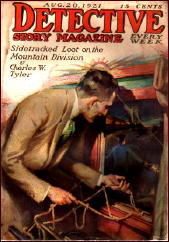
CHARLES W. TYLER

* The Slicker Bandit, (ss) Detective Story Magazine Jan 23 1926
* Stormy Petrel, (ss) Detective Story Magazine Jan 10 1925
* There Were No Clews, (ss) Detective Story Magazine Mar 23 1920; Best Detective Magazine Aug 1932
* The Third Thirteen, (ss) Detective Story Magazine Apr 27 1920
* Too Soft, (ss) Detective Story Magazine Feb 18 1928
* Tramps—Hoboes—Bums, (ss) Detective Story Magazine Apr 25 1925
* Unlucky Luke McCloskey, Gun, (ss) Detective Story Magazine Jun 25 1918
* The Wrong Sucker, (ss) Street & Smith’s Detective Story Magazine Sep 10 1934

ss = short story; nv = novelette; na = novella.

      Short fiction [everything else; likely incomplete]

TYLER, CHARLES W. Born in North Hinsdale, Massachusetts; not to be confused with Charles Waller Tyler (1841-1920) or with Charles Willis Tyler (1857-1922)

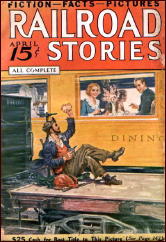
* The Angel of Canyon Pass, (ss) Railroad Stories Apr 1936; Railroad Magazine Feb 1973
CHARLES W. TYLER

* At Five Paces, (ss) Western Story Magazine Apr 29 1922; Far West Stories Aug 1930
* Back on the Main, (ss) Railroad Man’s Magazine Dec 1931; Railroad Magazine Oct 1964
* Bad Men of Old Hat, (ss) Western Story Magazine Jun 21 1924
* Baldy Sours [Baldy Sours], (ss) Quick Trigger Stories of the West Apr 1930
* Baldy Sours and a Cock-Eyed Cupid [Baldy Sours], (ss) West Jan 8 1930
* Baldy Sours and Burning Brands [Baldy Sours], (ss) West Oct 1 1930
* Baldy Sours and Skates Ajar [Baldy Sours], (ss) Short Stories Oct 10 1937
* Baldy Sours and the Chariot Race [Baldy Sours], (ss) Ace-High Magazine Oct #1 1927
* Baldy Sours and the Day of Judgment [Baldy Sours], (ss) West Nov 13 1929
* Baldy Sours and the Firing Squad [Baldy Sours], (ss) Western Trails Jan 1930
* Baldy Sours and the Fountain of Youth [Baldy Sours], (ss) Ace-High Magazine Jul #1 1928
* Baldy Sours and the Golden Fleece [Baldy Sours], (ss) Ace-High Magazine Jan #1 1927
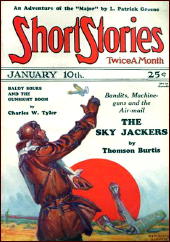
* Baldy Sours and the Gunsight Boom [Baldy Sours], (ss) Short Stories Jan 10 1929
CHARLES W. TYLER

* Baldy Sours and the Human Race [Baldy Sours], (ss) Adventure Mar 1937
* Baldy Sours and the Mexican War [Baldy Sours], (ss) Western Trails Sep-Oct 1929
* Baldy Sours and the Pig Skin Game [Baldy Sours], (ss) Short Stories Apr 25 1929
* Baldy Sours and the Polo Game [Baldy Sours], (ss) Short Stories Jun 25 1935
* Baldy Sours and the Spark of Life [Baldy Sours], (ss) Western Aces Nov 1937
* Baldy Sours and the Tin Horse [Baldy Sours], (ss) Short Stories Dec 25 1934
* Baldy Sours and the Woolly West [Baldy Sours], (ss) Short Stories Apr 25 1937
* Baldy Sours at a Gold Strike [Baldy Sours], (ss) Ace-High Magazine Sep #1 1927
* Baldy Sours Takes the Count [Baldy Sours], (ss) Ace-High Magazine Mar #2 1928; Thrilling Western Magazine Spr 1970
* Baldy Sours, Arabian Knight [Baldy Sours], (ss) Short Stories Nov 25 1928
* Baldy Sours, Bad Man from the West [Baldy Sours], (ss) Quick Trigger Stories of the West Aug/Sep 1930
* Baldy Sours, Badman [Baldy Sours], (ss) Ace-High Magazine Dec #1 1927
* Baldy Sours, Errant Knight [Baldy Sours], (ss) Ace-High Magazine Jun #2 1927
* Baldy Sours, King [Baldy Sours], (ss) Western Adventures May 1931
* Baldy Sours, Promoter [Baldy Sours], (ss) Western Adventures Nov 1931
* Baldy Sours, Rain Maker [Baldy Sours], (ss) Ace-High Magazine May #2 1927
* Baldy Sours, The Late Lamented [Baldy Sours], (ss) Ace-High Magazine Oct #2 1928
* Battle-Call for Johnny Bates, (nv) Star Western Oct 1939
* The Bird That Knew, (ss) Western Story Magazine Feb 3 1923
* The Blue-Dome Mustang, (ss) Ace-High Magazine Jun #2 1923
* The Bo Who Rode No. Two, (ss) Short Stories Sep 25 1929
* The Boothill Parson of Babylon Bend, (nv) Star Western Jan 1944
* Boothill’s Buryin’ Man, (ss) New Western Magazine Dec 1950
* Brand Pirates of the Big Muddy, (nv) Star Western Oct 1941
* The Brand-Blotters Want War!, (nv) Star Western Aug 1942
* Buzzards at Bay, (na) Far West Illustrated Oct 1927
* C-Bar, Grab Your Guns!, (ss) Star Western Jun 1947
* Calico’s “Booty” Contest, (ss) Ace-High Magazine Aug #2 1925
* Cassidy’s Kid, (ss) Short Stories Oct 25 1937
* Clear Iron, (ss) Railroad Stories Feb 1934
* Clear the Iron, (ss) Short Stories Aug 10 1936; Short Stories Apr 1952
* Code of the Morse Man, (ss) Short Stories Nov 10 1947
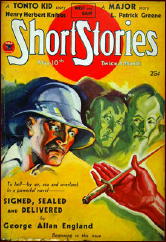
* The Cop on the Beat, (ss) Short Stories May 10 1934
CHARLES W. TYLER

* The Coronation of Baldy Sours [Baldy Sours], (ss) Ace-High Magazine Aug #2 1926
* The Courtship of Baldy Sours [Baldy Sours], (ss) Ace-High Magazine Sep 18 1926
* Cow-Pirates of the Smoky Trail, (ss) Star Western Sep 1939
* Cowboy Sleuths [Baldy Sours], (ss) Ace-High Magazine Aug #1 1927
* Cowboys Amuck, (ss) Ace-High Magazine May #1 1926
* Cowboys at Stove Pipe, (ss) Ace-High Magazine Mar #2 1926
* Crazy Well [Baldy Sours], (ss) Ace-High Magazine Mar #1 1927
* Crossed Wires at Poverty Bend, (ss) Western Story Magazine Mar 19 1921
* Cut Two Notches, (ss) All Western Magazine Nov 1936
* Dead Man’s Bend, (ss) Short Stories May 10 1936
* Dead Man’s Key, (nv) Short Stories Jul 10 1929
CHARLES W. TYLER

* Derelict Cowman’s Last Stand, (nv) Ace-High Magazine Feb 1938
* The Devil Deals Three Tough Jokers, (ss) Star Western Jul 1947
* Devil Makes a Cowman, (ss) [??] 1939; Fifteen Western Tales Sep 1952
* Diamond Jack of Wyoming, (nv) Western Story Magazine Mar 11 1922
* Double-Breasted Mike, (ss) Railroad Man’s Magazine Dec 7 1918
* Down Sunset Trail, (ss) People’s Magazine Feb 1917
* Down the Smoky Road, (ss) Short Stories Aug 25 1935
* Fast Bullet Man, (na) Fifteen Western Tales Feb 1949
* The Fastest Gun, (nv) Far West Illustrated Apr 1927
* Feud Herd Coming Through!, (nv) Ace-High Magazine Jul 1938
CHARLES W. TYLER

* Fighting Men of the Union Pacific, (nv) Star Western Mar 1942
* A Firin’ Fool, (ss) Short Stories Jul 25 1933
* For the Little Lady, (ss) People’s Magazine May 1917
* Fresh in the West, (ss) Far West Illustrated Nov 1928
* From the Primer of Hate, (ss) Far West Illustrated Magazine Sep 1926
* God of the High Iron, (ss) Railroad Man’s Magazine Mar 1930
* Gun Lord of Poverty Empire, (nv) Star Western Oct 1940
* Gun Rider for the Overland, (ss) 10 Story Western Magazine Nov 1942
* The Gun River Pilgrims, (nv) Star Western Apr 1940
* Gunmen of the Rails, (na) Short Stories Sep 10 1929
* Gunmen of the Rails, (ss) Short Stories Sep 10 1929
* Gunmen’s Trails, (nv) West Mar 2 1932
* Guns of the Graveyard Trick, (na) Short Stories Jul 10 1935
* Gunsmoke Funeral at Yellow Cat, (nv) Star Western Jul 1940
* Hard As Nails, (ss) People’s Favorite Magazine Aug 10 1917
* He Forgot to Pay, (ss) Western Story Magazine Nov 5 1921
* He Knew It All, (ss) Western Story Magazine Jul 18 1925
* Hell in Their War-Sacks! [Dewlap, Wattles and the Hairpin Kid], (nv) Star Western Jul 1945
* Highballing the Moonbeam Trail, (ss) Railroad Man’s Magazine May 1930
* Hiram at a Rodeo [Hiram Pertwee], (ss) Western Story Magazine Oct 8 1921
* Hiram in a Hold-Up, (ss) Railroad Man’s Magazine Apr 1916
* Hiram in No Man’s Land, (ss) Railroad Man’s Magazine Nov 9 1918
* Hiram on a Down-Hill Road, (ss) Railroad Man’s Magazine Feb 1915
* Hiram on the High Seas, (ss) Railroad Man’s Magazine Nov 1918
* Hiram on the Yellowstone Trail [Hiram Pertwee], (ss) Western Story Magazine Dec 31 1921
* Hiram Rides “Parson Pickax”, (ss) Western Story Magazine Mar 5 1921
* Hiram Ropes a Kitty Cat [Hiram Pertwee], (ss) Western Story Magazine May 7 1921
* The Horned Toad Detour, (ss) Railroad Man’s Magazine Nov 1930
* Hot Shot (with Griff Crawford, E. S. Dellinger, James W. Earp, William Edward Hayes, John Patrick Johns, Gilbert A. Lathrop, A. Leslie, John A. Thompson & Don Waters), (ss) Railroad Stories Apr 1934
* Igo, the Killer, (ss) Western Story Magazine Sep 24 1921; Far West Stories Mar 1930; Western Winners May 1935
* The Iron Warpath, (nv) Short Stories Oct 10 1943
* Johnny Bates Adopts a War!, (ss) Star Western Dec 1939
* Johnny Bates’ Running-Iron Rebellion, (nv) Star Western Dec 1944
* Johnny Gosh, Top Rope, (ss) Western Story Magazine Sep 10 1921
* The K.K.K., (sl) National Magazine Jul 1906
* The Kid from Gunhammer Vreek, (na) Dime Western Magazine Jul 1946
* Killer Country, (nv) Street & Smith’s Western Story Magazine Oct 15 1932
* The Killer of Canyon Diablo, (nv) Wide World Adventures Oct 1929
* The Killer of Canyon Diabolo, (nv) Ace-High Magazine Apr #2 1923
* The Last Witness, (nv) Short Stories Feb 25 1937; Short Stories Aug 1951
* Little Joe, (ss) Short Stories Jan 25 1938
* Make Way for the Eastbound, (ss) Railroad Magazine Oct 1954; Railroad Magazine Feb 1974
* The Male of the Species, (ss) Breezy Stories Sep 1916
* A Message from Mescal, (ss) Western Aces Jan 1938
* Mohave Buckaroo, (nv) Short Stories Mar 10 1939
* A Mountain Division Man, (ss) New Story Magazine Jul 1914
* The Murder Syndicate, (nv) Argosy All-Story Weekly May 12 1923
* Night Operator, (ss) Railroad Magazine Jan 1971
* Night Trick, (ss) Railroad Magazine Jan 1953
* No Cattle Sold in Hell, (nv) Ace-High Magazine Jun 1938
* No Law on the Tonto Rim, (na) 10 Story Western Magazine Dec 1941
* Old “Harqua Hala” Bill, (ss) Ace-High Magazine Sep #2 1923
* On First 303, (ss) The Railroad and Current Mechanics Oct 1913
* On Time!, (ss) Railroad Man’s Magazine Mar 1931
* The Ora Hanna Stampede, (ss) Ace-High Magazine Jan #1 1926
* Out Where the Worst Begins, (ss) Ace-High Magazine May #1 1928
CHARLES W. TYLER

* Outlaw Frontier, (na) Short Stories Jun 10 1932
* Outlaws of Milestone Mesa, (na) Western Story Magazine Apr 30 1921
* Over the Big Divide, (ss) Western Story Magazine Jun 3 1922
* Owlhoot Roundup at the Horned Moon, (nv) 10 Story Western Magazine Dec 1940
* The Parson Buries His Dead, (ss)
* The Parson of Owlhoot Junction, (nv) Star Western Nov 1943
* Parson Pickax in the Pictures, (ss) Ace-High Magazine Mar #2 1924
* Peelers in Peril, (na) Western Story Magazine Jan 21 1928
* Petticoat Doolittle’s Emancipation, (ss) Ace-High Magazine Jun 1 1926
* Pirates’ Trail, (na) Western Story Magazine Mar 9 1929
* Pistoleers West of the Pecos, (ss) Dime Western Magazine Jul 1950
* Ragtown Shall Rise Again!, (nv) Star Western Oct 1945
* Railroad Drummer, (na) Railroad Stories Dec 1934
CHARLES W. TYLER

* Railroad Engineer, (ss) Railroad Stories Oct 1933
* Railroad Romeo, (ss) Short Stories Mar 25 1937
* Rails West, (ss) Short Stories Sep 10 1944
* Range of Missing Men, (na) Dime Western Magazine Feb 1951
* Ranger Wanted—in Hell!, (nv) Star Western Mar 1944
* The Rattler Racket, (ss) Railroad Man’s Magazine Aug 1931
* The Reign of Baldy Sours [Baldy Sours], (ss) Ace-High Magazine Feb #1 1927
* Reply to Johnson’s letter, (ms) Big-Book Western Magazine Jun 1949
* Ribbons of Iron, (ss) Top-Notch Oct 15 1921
* The Road to Yesterday, (ss) Railroad Stories Feb 1936
* The Rustlers’ Union Votes for War!, (nv) Star Western Mar 1941
* Shoddy Mike’s Last Stand, (ss) Western Story Magazine May 14 1921
* Shoot ’Em Quick—Plant ’Em Fast!, (nv) Star Western Nov 1947
* The Shuffle Trick, (ss) All-Story Weekly May 22 1920
* The Sky Hoss, (ss) Ace-High Magazine Mar #1 1926
* Smiling Smith Sits In, (ss) Railroad Man’s Magazine Aug 1930
* Smoke Blue Ranch, (na) Western Story Magazine Aug 27 1921
* Smoky Smith—Sheriff, (nv) West Apr 15 1931
* Star and Six-Gun, (sl) West Dec 10, Dec 24 1930, Jan 7 1931
* The Star on Outlaw Trail, (ss) All Western Magazine Jan 1937
* Strange Guns Invade the Rim Rock, (ss) Star Western Oct 1937
* “Sunset” Jones, (nv) Western Story Magazine Feb 10 1923
* Telegraph Joe, (ss) Western Story Magazine Jul 16 1921
* The Tenderfoot of Buzzard Flat, (nv) Western Story Magazine Oct 7 1920
* The Terrible Trail to Dodge, (nv) Zane Grey’s Western Magazine Jun 1953
* Texas Sends ’Em Tough!, (na) Big-Book Western Magazine Mar 1949
* There’s Hell in Johnson Country, (na) 10 Story Western Magazine Apr 1942
* They’re Shipping Hell from Texas!, (na) Star Western Jan 1947
* Those Grave-Digging Brand-Hawks!, (nv) Star Western Jul 1943
* Those Three Texas Hellions, (nv) Star Western Jun 1943
* Three from Texas, (nv) Dime Western Magazine Jan 1952
* The 3-Cross Button Rides Gun, (ss) Ace-High Magazine Nov 1938
* “To Hell with the Rangers!”, (nv) Star Western Jan 1943
* Too Many Guns, (na) Western Story Magazine Jul 21 1923
* Track Clear at Algodones, (ss) Argosy Sep 1945
* Track Clear!, (ss) Argosy Nov 1943
* Trouble at Cottonwood Station, (ss) Argosy Jan 1944
* Trouble in the Canyon, (ss) Railroad Magazine Oct 1952
* Trouble Rides from Texas!, (ss) 10 Story Western Magazine Dec 1949
* Two-Gun Justice (with W. D. Liberty), (nv) Lariat Story Magazine Sep 1926; Cowboy Story Magazine Apr 1927
* The Walking Fool, (ss) Western Story Magazine Apr 2 1922
* War Call of the Singing Wire, (na) Ace-High Western Stories Jan 1942
* War of the Branding Iron, (na) Short Stories Nov 25 1935; Boston Sunday Globe Magazine Dec 10 1939
* Welcome to Bullfrog, (ss) Western Story Magazine Mar 28 1925
* The Western Union Kid, (ss) Railroad Stories May 1934
* When Hoboes Rode, (ss) Railroad Stories Jun 1935
* When Rangers Ride the Death-Watch, (nv) Star Western Jun 1944
* When the Chips Were Down, (ss) Railroad Magazine Jul 1945; also as “When the Chips Are Down,” Railroad Magazine Dec 1968
* When the Lights Are Green, (ss) Short Stories Aug 25 1936
* Wolves of the Iron Trail, (sl) West Sep 2, Sep 16, Sep 30 1931

          SOURCES:

The Crime Fiction Index, by Phil Stephensen-Payne, William G. Contento and Stephen T. Miller (CD-ROM, Locus Press).

Crime Fiction IV, by Allen J. Hubin (CD-Rom, Locus Press).

The FictionMags Index.

The Pulp Heroes, by Jess Nevins.

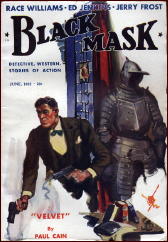
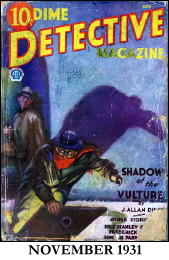
   With a special note of gratitude to Phil Stephensen-Payne for not only generously allowing such extensive usage of the bibliographic material above, but also for letting us use his wonderful Galactic Central website as a source for the cover images you see here. Thanks, Phil!

© 2012 by Victor A Berch
REVIEWED BY WALKER MARTIN:


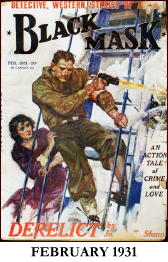
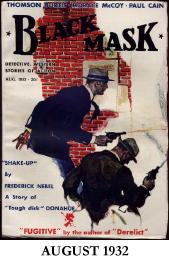
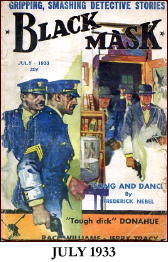
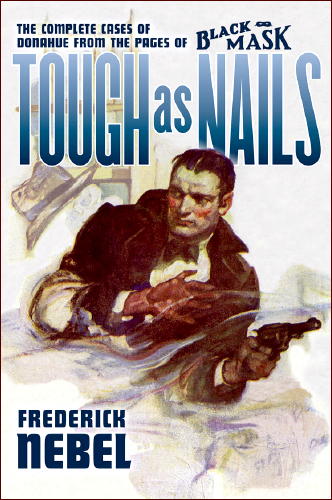
FREDERICK NEBEL – Tough As Nails: The Complete Cases of Donahue from the Pages of Black Mask. Altus Press, softcover, May 2012. [A limited edition hardcover may still be available.]

FREDERICK NEBEL bLACK mASK

   This is rapidly turning out to be the year that Frederick Nebel was rediscovered. First we had The Complete Casebook of Cardigan, Volume One, which I reviewed here. Then just recently Black Dog Books published Empire of the Devil, a collection of Nebel’s adventure tales.

   Coming up later in the year will be additional volumes in the Cardigan series from Altus Press plus the complete stories from the Black Mask series starring Kennedy and MacBride. And now just published we have this latest book from Altus Press collecting all the Donahue stories from Black Mask.

   Like The Complete Casebook of Cardigan, this book is a must buy for any lover of hardboiled fiction. The Donahue stories are also historically significant because in 1930 it was very obvious to Joe Shaw, the editor of Black Mask, that he was about to lose his best writer. Dashiell Hammett would be following the money to Hollywood, and no pulp magazine could compete with the enormous paychecks available from the movie industry.

   Shaw asked his second best writer (Chandler did not appear until 1933) to develop a series similar to the Continental Op made famous by Hammett. I stress the word “similar” because in 1930 no one could compare to the quality of Hammett. The result was Donahue of the Interstate Detective Agency. There were 15 novelettes published between November 1930 and March 1935.
FREDERICK NEBEL bLACK mASK

   The first question readers will be asking is how do these stories stand in comparison to the Cardigan stories? The answer is simple: if you liked Cardigan, then you will like Donahue. I really do not see much of a difference between the two characters.
   Like Cardigan, Donahue is tough, hardboiled, no nonsense, and a private operative working for a detective agency. We learn very little about the private lives of either character and the stories are fast moving examples of crime fiction which stand up very well even though 80 years have passed since the Cardigan and Donahue stories appeared.

   The Donahue stories were written according to the above standards set by Shaw during his time as editor for Black Mask, 1926-1936. Frankly, I consider this collection another bargain from Altus Press. The quality paperback, which is almost 600 pages is available for $29.95 from Altus Press, Mike Chomko Books, and Amazon.com.

   The limited edition hardcover, which I had to have because of the importance of this collection, is priced at $39.95 and can be ordered through the Altus Press website. These books are print on demand and hold up to the usual high qualities of Matt Moring, the publisher.

FREDERICK NEBEL bLACK mASK

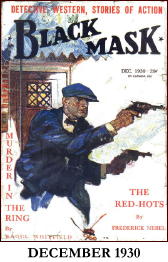
   In addition to the 15 long novelettes, all 30 some pages long except for the last one which clocks in at 56 pages, the stories all have the original illustrations by the Black Mask artist Arthur Rodman Bowker. Bowker had a very distinctive style and I’ve always liked his work. He seems to fit in with the no nonsense, hard as diamonds Black Mask style. The cover is a stunner from Black Mask also, and I believe it shows Donahue(or a character very much like him), in action, gun in hand.

   The introduction is by pulp historian, Will Murray, and the book is edited and compiled by Rob Preston. Rob has also compiled a bibliography of the works of Frederick Lewis Nebel. This is an important feature of the collection and runs 14 pages grouped by magazine title chronologically.

   It shows that Nebel had around a hundred or so stories in the slick magazines and in addition to the fiction in Black Mask and Dime Detective, he also had over a hundred stories in other pulp magazines such as Northwest Stories, Action Stories, Air Stories, Wings, and so on. The bibliography also lists the books written by Nebel as well as the anthologies he appeared in. The screenplays based on his work are also listed.

   Earlier, I mentioned that we don’t learn much of Donahue’s private life. But here are a few items of note. Donahue’s philosophy can be summed up in the passage from the first story in the series, “Rough Justice.” On page 18 Donahue says:

    “I know I’m in a rotten game… I’m not defending it. I don’t know why I’m in — but I’m in it. It keeps me in butts and I see the country and I don’t have to slave over a desk. I get places. It’s not a pretty game, and no guy ever wrote a poem about it. But it’s the only hole I fit in.”

FREDERICK NEBEL bLACK mASK

   Donahue lives in a hotel apartment, made up of a small living room and bedroom. It has a bath and a small pantry. He smokes a pipe, cigarettes and cigars. He’s in his thirties, tall, lean and good looking. He eats well, attends boxing and hockey sports and says that he never gambles. He drinks brandy, scotch, martinis, wine, and beer.

   Through the first 14 stories he has no girl friends, in fact he seems to mistrust the women he meets and this is understandable since they mostly turn out to be nothing but trouble. However in the last story he does meet a girl that he likes and trusts and the story ends with Donahue making a date.

   Speaking of drinking, when this series commenced prohibition was still in effect across the country. I have read books about the widespread popularity of speakeasies and this series certainly shows the speakeasy as a very popular illegal hangout. They may have been illegal but everyone in NYC seemed to be drinking in these establishments including the local police.

   This series shows just how impossible it was to make the general public stop drinking. It was an impossible task and prohibition just encouraged crime and corruption. None of this ever bothered Donahue and his police contacts.

   I’ll repeat what I said again. This book is a must buy for all readers of the hardboiled and quality pulp fiction. Altus Press is doing excellent work reprinting such fiction and I urge everyone to support their efforts. They have some excellent books scheduled for future publication.

FREDERICK NEBEL bLACK mASK

      Contents:

“Rough Justice” (November, 1930)
“The Red-Hots” (December, 1930)
“Gun Thunder” (January, 1931)
“Get A Load of This” (February, 1931)
“Spare the Rod” (August, 1931)
“Pearls Are Tears” (September, 1931)
“Death’s Not Enough” (October, 1931)
“Shake-Up” (August, 1932)
“He Could Take It” (September, 1932)
“The Red Web” (October, 1932)
“Red Pavement” (December, 1932)
“Save Your Tears” (June, 1933)
“Song and Dance” (July, 1933)
“Champions Also Die” (August, 1933)
“Ghost of a Chance” (March, 1935)


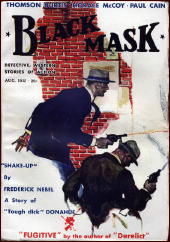
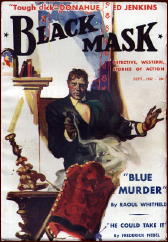
Acknowledgment:   The magazine covers you see above were obtained from the Galactic Central website, thanks to Phil Stephensen-Payne.

REVIEWED BY WALKER MARTIN:


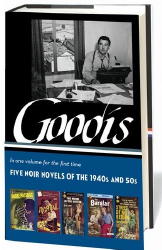
DAVID GOODIS – Five Noir Novels of the 1940’s and 1950’s. Library of America, hardcover, March 2012.

DAVID GOODIS Five Noir Novels

   I’ve been reading and collecting books from The Library of America ever since they first started coming out. At first it looked like they would just be publishing the works of the established literary figures, great authors like Henry James, Eugene O’Neill, Mark Twain, Herman Melville, and so on.

   But lately they have crossed over into more popular areas and genres by publishing two volumes of crime novels (including Down There by David Goodis), Dashiell Hammett, Raymond Chandler, H.P. Lovecraft, Philip K. Dick, Edgar Rice Burroughs, Kurt Vonnegut, two volumes titled American Fantastic Tales, and now David Goodis.

   I see this as a very good sign for popular culture and the mystery and SF genres. I guess it is too much to hope for volumes dealing with great western fiction but seeing this volume on Goodis makes me hope that we will see collections by Jim Thompson, Peter Rabe, Charles Williams, John D. Macdonald, Ross Macdonald, Gil Brewer, and others.

   We should not be surprised to see Goodis singled out for such attention because the French have long thought he was exceptional and in fact the only full length biography is in French. He was the poet of the bleak, doomed, and lost. It’s been said that Goodis did not write novels; he wrote suicide notes.

DAVID GOODIS Five Noir Novels

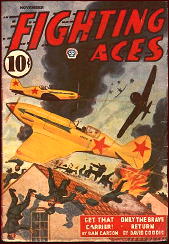
   I first became aware of David Goodis back in the 1960’s when I started to collect the pulp magazines. His pulp career lasted from 1939 to about 1947. He has been quoted as saying that he produced millions of words for the sport, detective, and western pulps. But most of his work was published in what I call the air-war pulps. I eventually accumulated extensive runs of such titles as Fighting Aces, Battle Birds, RAF Wings, Dare-Devil Aces, and Sky Raiders. Goodis appeared in all these pulps with dozens of stories, perhaps over a hundred.

   I would have to admit that I found his pulp work to be less than interesting. I’ve always had a problem with the air pulps with seemed to concentrate too much on airplanes and flying, while ignoring characterization and believable plots. I eventually sold, traded, and disposed of all my air-war magazines.

   There is an excellent DVD dealing with Goodis’ life, marriage, and career called David Goodis … to a Pulp It’s a must for anyone interested in his writing and one of the extras points out that Goodis’ wife evidently felt the same way as I did concerning his pulp stories.

   His wife told her second husband that the reason she left Goodis and divorced him was because she couldn’t stand his pulp writing that he was doing for the air-war magazines.

DAVID GOODIS Five Noir Novels

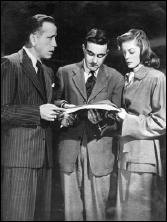
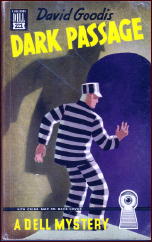
   She must have received a shock when he broke into the slick market with his novel, Dark Passage for the Saturday Evening Post in 1946. Not only did he receive a far higher rate of pay than he was getting for his pulp work, but Hollywood paid $25,000 for the screen rights. In today’s money that is around a quarter of a million. The movie was not just your usual effort, but starred Humphrey Bogart and Lauren Bacall.

   At this time it was goodbye to the pulps and the beginning of his Hollywood career. Despite receiving good money he still wore threadbare suits and slept on the couch of a friend for $4.00 a month. He soon found himself out of a job and back in Philadelphia, living in his parents house, and writing original novels for such paperback firms as Gold Medal.

   The Library of America edition reprints five complete novels. All five were made into interesting movies. and my comments on both the books and films follow:

● Dark Passage.   Though this is Goodis’ first real success, I don’t think it is an outstanding novel. My feeling on a second reading was that it is OK, good in spots by nothing that special.

   The story is not too believable and suffers from the happy ending. It reminds me of Cornell Woolrich, only not as good. I find the plot absurd with the rich, pretty girl falling in love with the loser convicted of murder. Also ridiculous to think that a cab driver and doctor would help the hero without even knowing anything about him.

DAVID GOODIS Five Noir Novels

   I watched the movie for the sixth time (I have a Bogart book which I annotate every time I see one of his films), and it’s hard to believe that they would cover up his face in bandages for most of the movie. But it does follow the plot of the novel and I find it better than the book.

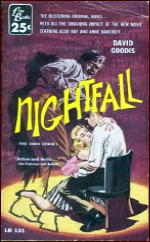
● Nightfall.   This also is just OK but nothing that special. Another innocent man framed for murder and robbery. Both these novels have a silly scene where the hero gets the gun away from the criminal by distracting him with talk. And another beautiful girl.

DAVID GOODIS Five Noir Novels

   Again I found the movie better than the book. It follows the basic plot with some changes but Aldo Ray is bland as the innocent man in trouble. Great villain.

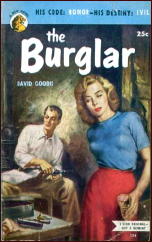
● The Burglar.   I found this novel to be better than the two above. Instead of the typical innocent man wrongly accused plots, this one was more believable with a professional jewel thief becoming involved in killings. Very downbeat ending, just what you would expect from Goodis.

DAVID GOODIS Five Noir Novels

   The movie stars Dan Duryea and Jayne Mansfield and follows the plot of the novel. The fact that David Goodis wrote the screenplay makes this even more interesting.

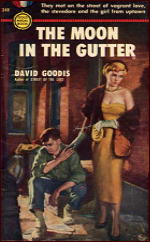
● The Moon in the Gutter.   With this book, it appears the novels are getting better. This one does not star a criminal or men framed for murder but has as a protagonist a laborer working on the docks and living in a slum area of Philly.

DAVID GOODIS Five Noir Novels

   He hangs out in a dive called Dugan’s Den, which has the atmosphere and characters right out of a Eugene O’Neill play. Vernon Street in Philadelphia takes on a life of its own and becomes a character in the novel.

   The movie was made in 1983 and is French with subtitles, starring Gerard Depardieu and Nastassia Kinski. It follows the basic plot of the novel.

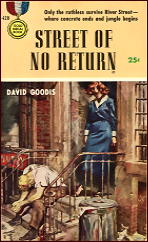
● Street of No Return.   Mediocre and not too believable. Skid row bum and drunk (a former famous singer) defeats criminal plan to cause race riots. Dialog is poor and the police act like idiots. Another beautiful girl falls for our hero.

DAVID GOODIS Five Noir Novels

   The movie was directed by Samuel Fuller and stars Keith Carradine. However in this case, the film was even more disappointing than the novel. Believe me, you don’t want to see Keith Carradine in a fright wig, trying to act like a bum.

   Despite the critical comments above, I did enjoy reading the five novels but lucky for me after reading them I immediately spent some time at a book convention buying and reading pulps. Otherwise, I might have hanged myself. No wonder Goodis lived such a short life, from 1917 to 1967.

       Bibliography (novels and story collections only)

Retreat from Oblivion, 1939.
Dark Passage, 1946.
Nightfall, 1947.
Behold This Woman, 1947.
Of Missing Persons, 1950.
Cassidy’s Girl, 1951.
Of Tender Sin, 1952.
Street of the Lost, 1952.
The Burglar, 1953.
The Moon in the Gutter, 1953.
Black Friday, 1954.
Street of No Return, 1954.
The Blonde on the Street Corner, 1954.
The Wounded and the Slain, 1955.
Down There (Shoot the Piano Player), 1956.
Fire in the Flesh, 1957.
Night Squad, 1961.
Somebody’s Done For, 1967.
Black Friday and Selected Stories, 2006.    [A collection of his shorter work from such magazines as Ten Story Mystery, Colliers, New Detective, Manhunt and Mike Shayne Mystery Magazine.]

THE SERIES CHARACTERS FROM
DETECTIVE FICTION WEEKLY
by Monte Herridge


        #12. INDIAN JOHN SEATTLE, by Charles Alexander.

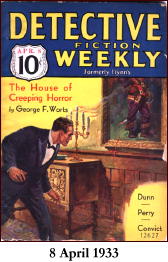
   This next installment of my columns for Mystery*File features a look at another series character who appeared in the pages of Detective Fiction Weekly. The “Indian John Seattle” stories by Charles Alexander made up a short series of at least fifteen stories published in DFW from 1933 through 1939, plus two stories in Ace-High Detective Magazine 1936-37.

CHARLES ALEXANDER Indian John Seattle

   The stories are rural in setting. Stories published in DFW were a mixture of settings, both urban and rural. Many stories took place in urban environments, but there were a large number that were rural in setting. The Tug Norton series by Edward Parrish Ware was one that had stories in both urban and rural settings. Ware’s Ranger Jack Calhoun series was mostly rural, with a little in small towns. Even an urban series such as Morton & McGarvey by Donald Barr Chidsey had some stories in a rural environment.

   Indian John Seattle is a sheriff of primarily rural Plainview County in Oregon, and his shabby office is in the courthouse in the town of Plainview. He gets his name from his learning all about Indian ways and outdoor skills. He spent his boyhood with the Nez Perce Indians. “He was an instinctive and Indian-trained hunter; criminals were his prey.” (Head Hunt)

   The first story, “Death Song,” states that to catch a killer, “he must play Indian cunning on them.” This seems to work, as he flushes out the guilty man into running and later confessing the murder. This story also notes: “Many crimes of the forest Seattle had solved. He knew men—knew them through and through when they placed themselves against the background of canyon and forest where he had gained his wisdom.” In a later story, “Up Death Creek,” Seattle is called “A human steel-trap in the path of the evil-doer.”

   In the second story, “Head Hunt,” his deputy sheriff is introduced: “Hal Minton, … a tall and neat and taciturn man in his late twenties.” He is also described as “tight-lipped and grim of eye, advertised the dignity of the law.”

   Minton does not always approve of the way Seattle does things. Seattle, by contrast to his deputy, was “a bandy-legged figure in worn moleskins, wearing a time-honored Stetson, …” He is slightly bent from much time in the saddle, although he regularly uses an ancient Ford automobile he calls Flap-fender.

   No mention is made of any family of Seattle’s, nor is it known where his home was. He kept odd hours as sheriff, and was likely to turn up making the rounds of the town of Plainview at 3 A.M. He seems to have lived for his job.

   His cases were murder-involved, and Sheriff Seattle had plenty of experience. He “had a nose for trouble, a reaction, perhaps instinctive, to the lurking threat of danger. Years in the wilderness had equipped him with the wariness of the wolf, the cat-like cunning of the cougar.” (Head Hunt)

   In “Head Hunt” he tracks down two murderers and finds the missing head of their victim, meanwhile avoiding a death-trap. Seattle carries an old .45 Frontier Model Colt, and certainly knows how to use it.

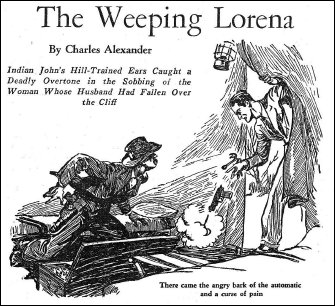
   In the story, “The Weeping Lorena,” there is also no mystery as to who are the murderers and what they did. The story is regarding Indian John Seattle’s discovery of the crime and dealing with the criminals. The criminals in this story are contemptuous of the local law enforcement, calling them “hick cops.”

CHARLES ALEXANDER Indian John Seattle

   However, they find that Sheriff Indian John Seattle is no fool as he quickly uncovers their scheme and crime. This story reveals that Seattle has no confidence in the abilities of his deputy, Minton. Seattle mentions that Minton is usually the first on the scene of the crime, but the last to solve the crime. In “Death Watch,” Minton actually interferes with Seattle’s attempt to uncover the crime and fasten the guilt where it belongs.

   There were other series in DFW about rural sheriffs who solved crimes. One of these was the series about Sheriff Whitcher Bemis, written by Harold de Polo and published in DFW from 1927-1928. De Polo also had another rural sheriff series in DFW: Sheriff Ollie Bascomb from 1931-1941. Both of de Polo’s series have a bit of humor in them, and the Whitcher Bemis series attempts a rural dialect for the characters.

   The Sheriff Indian John Seattle series is different than these two series primarily in having no humor present in the stories, and presenting the sheriff as a person of dignity, and not just a hick sheriff.

   â€œDeath Watch” involves another criminal who thinks he can outsmart Sheriff Seattle, and tries to kill him when his plans are failing. However, the criminal overlooks a simple thing in his plan, and it comes back to point the finger at him. In this story, Seattle actually kills one of the criminals. Usually he prefers to catch them alive for trial, although a number of times he has to wound the criminal in order to get his man. One of the better stories in the series.

   In “Up Death Creek” Seattle has to solve a bit of a puzzle in order to finish this case. The blurb for the story reads as follows: “The bullet pneumonia of Whisky Brown, the torn boot with the missing calk—Indian John had to read those sinister signs to save an innocent man from the gallows.”

   In “Claws of the Killer” the two murderers think they have a good plan by killing someone and claiming a wild bear did the crime. However, Sheriff Seattle manages to capture both and point out a large flaw in their scheme.

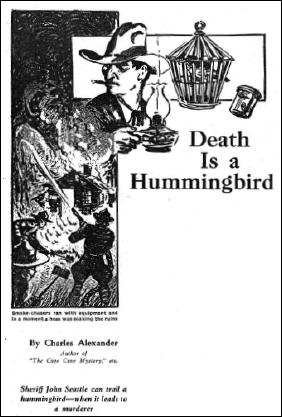
   â€œDeath is a Hummingbird” involves a bizarre and very improbable method of murder that I have not seen before. Using hummingbirds to start fires! An absurd idea. The story basically falls apart, and Sheriff Seattle uses a ridiculous bluff on the murderer to make him confess.

CHARLES ALEXANDER Indian John Seattle

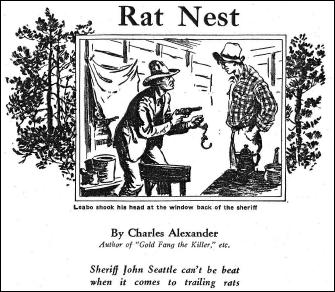
   In “Rat Nest,” a much better story, Seattle is investigating some poachers, and when he arrests one of them for murder he winds up making the biggest mistake of his career. However, when he investigates further, he learns the truth behind the matter.

CHARLES ALEXANDER Indian John Seattle

   In “Deputy Sheriff Rattlesnake” the murderers kidnapped Seattle and placed him in a death trap, from which he escaped. However, while he was missing, deputy sheriff Minton and the coroner argued over who should be sheriff if Seattle did not show up. So it sounds like he was feared, but not missed.

   This was an average series of stories compared to the many other series that ran in DFW, but it is better than the two rural sheriff series written by Harold de Polo. I prefer the series without much humor in it, compared to the humor present in the de Polo series.

      The Indian John Seattle series, by Charles Alexander:

   In Detective Fiction Weekly:

Death Song     April 8, 1933
Head Hunt     August 12, 1933
The Weeping Lorena     October 7, 1933
Bullet-Hole Business     January 27, 1934
The Hicks Have It     March 17, 1934
Death Watch     June 16, 1934
Up Death Creek     June 30, 1934
Back-Fire Murder     July 28, 1934
The Lady Says     October 6, 1934
Claws of the Killer     March 23, 1935
Homicide Expert     November 23, 1935
Death Walks on Water     June 4, 1938
Death is a Hummingbird     June 18, 1938
Rat Nest     September 24, 1938
Deputy Sheriff Rattlesnake     February 4, 1939

   In Ace-High Detective Magazine:

Black Creek Brimstone     September, 1936

CHARLES ALEXANDER Indian John Seattle

Drummer of Doom     February-March, 1937


    Previously in this series:

1. SHAMUS MAGUIRE, by Stanley Day.
2. HAPPY McGONIGLE, by Paul Allenby.
3. ARTY BEELE, by Ruth & Alexander Wilson.
4. COLIN HAIG, by H. Bedford-Jones.
5. SECRET AGENT GEORGE DEVRITE, by Tom Curry.
6. BATTLE McKIM, by Edward Parrish Ware.
7. TUG NORTON by Edward Parrish Ware.
8. CANDID JONES by Richard Sale.
9. THE PATENT LEATHER KID, by Erle Stanley Gardner.
10. OSCAR VAN DUYVEN & PIERRE LEMASSE, by Robert Brennan.
11. INSPECTOR FRAYNE, by by Harold de Polo.

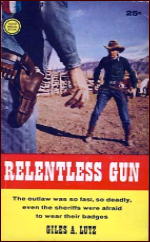
GILES A. LUTZ – Relentless Gun. Gold Medal 804, paperback original; 1st printing, September 1958. Numerous later printings.

   I own over 30 paperback westerns by Giles Lutz under his own name, and perhaps as many – if not more – which were published under several pen names he used, including Gene Thompson, Reese Sullivan, Hunter Ingram and Alex Hawk. (Some of these I did not know about until now, when I started looking up some information about him.)

GILES A. LUTZ Relentless Gun

   This may be the first of his “own work” that I may have read, and I enjoyed it. There is something about writing for the old pulp magazines that makes itself known right away – I can’t describe it exactly – but it has something to do with flavor and authenticity. Older western writers lived much closer to the time of the traditional western they wrote about. They grew up in it and took the life of the Old West much more for granted. Today’s western authors are excellent writers, but they’re writing about the past – a past they’re trying to recreate for readers also living in the present, far removed from the time the action of their novels is taking place.

   I hope I am making some sense of this, but whether I am or not, it’s an idea I hope to return to some day, once I’ve made my thoughts on the matter more solid than they are right now. And in any case, I was right. Once I started the book, I know Lutz had to have written for the pulps, and he did. As recorded to date in the Fiction Mags Index, he seems to have written only sports stories between 1939 and 1943. The first work western pulp fiction he did that’s currently listed there is “Square in the Saddle” a short story that appeared in Street & Smith’s Western Story, July 1945.

   As the pulps began to die out, Lutz turned to writing full length novels. The first of these, as far as I’ve been able to discover, was Fight or Run (Popular Library, 1954). From that point on, he was prolific enough to be worth doing a complete bibliography for, and maybe I will someday.

   Whether Relentless Gun was typical of his work, I can’t presently say, but it’s the one I just read. Dave Enders is the hero in this one, a guy who works for the law but doesn’t necessarily hang around in any one spot for very long. He’s heading for Tucson at the beginning of this one, to help out the sheriff there who needs his help in tracking down Miguel Blanco, a Mexican who’s the head of a gang wreaking havoc on the town.

   It turns out that the Blanco’s brother was the innocent victim of a lynching mob, and he is targeting members of the mob only for revenge – making him not entirely the total outlaw the townspeople think he is. Nor is Enders himself a man without faults. He’s a man with his own strengths and weaknesses, which he realizes, and which Lutz makes the reader realize too.

   There is one other complication – well, there are several, even though the book is only 144 pages long. But the one I’ll tell you about is the presence of Kate Lykens in town, a woman Enders has loved and lost before. She’s now the singer in the bar owned by Amos Busby, a man with wealth and some power in town, and you knew before I say anything more that the two men are not destined to be friends, didn’t you?

   Surprisingly enough there is some detective work to be done, and Enders is up to that job too, as well as tracking Miguel Blanco down. There is also a lot of action in the same amount of pages, and some surprisingly brutal deaths. There is also not a lot of wasted wordage; the story itself is a lean and sometimes mean one. It wasn’t the Spur Award winner for that year, nor was it probably even in the running, but it’s a solid piece of work.

A 1001 MIDNIGHTS Review
by Bill Pronzini


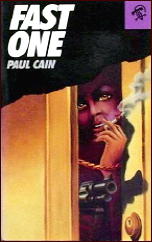
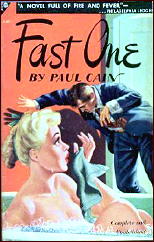
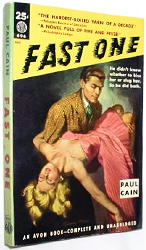
PAUL CAIN Fast One

PAUL CAIN – Fast One. Doubleday Doran & Co., hardcover, 1933. First appeared in serialized form in non-consecutive issues of Black Mask magazine between March and September, 1932. Bond Mystery #10, digest paperback, 1945. Avon #178, pbbk, 1948; Avon #496, ppbk, 1952. Southern Illinois University Press, hardcover, 1978. Popular Library, paperback, “American Fiction” series, 1980. Black Lizard, paperback, 1987.

   The hardest of the hard-boiled writers for Black Mask in the early 1930s was unquestionably Paul Cain (Peter Ruric). His style, as pulp authority Ron Goulart has noted, at times “becomes as sparse and clipped as that of a McGuffey’s Reader.”

   In an afterword to the Southern Illinois reprint edition, critic Irvin Faust says that Cain “hasn’t the time or patience for excess baggage. He picks up his literary scalpel and scrapes away conjunctions as if they were bad merchandise… He digs into the page with a hard sentence: simple, declarative, exact.”

PAUL CAIN Fast One

   Fast One is Cain’s only novel. (He was primarily a screenwriter and is responsible for such films as One for the Money, Grand Central Murders, and Mademoiselle Foi.)

   It was written on a bet and its various sections first appeared in Black Mask as five self-contained novelettes prior to book publication. It is unrelentingly grim and stark and brutal, to such an extent that it becomes uncomfortable to read; one begins to feel a kind of breathless despair well before the end.

PAUL CAIN Fast One

   The “hero” is Gerry Kells, a mysterious loner, a criminal who insinuates himself into the Los Angeles underworld and wreaks havoc on its denizens and on others who happen to get in his way. The dust jacket blurb on a 1978 reissue by Southern Illinois University Press says about Kells:

    “Only the strong prosper in the world of the Depression. Seemingly amoral, Kells does prosper. He strikes to survive, kills without conscience, without time for conscience. But he never becomes a mere killing machine. His integrity, his humanity, abides in a code demanding that he pay for all services: those rendered for him, those rendered against him. He pays with a two-sided coin-loyalty, revenge. He spends money freely, and those who cross him die hard.”

PAUL CAIN Fast One

   Cain knew his Los Angeles and he knew the ways of its Prohibition and post-Prohibition underworld. The portrait he paints of both, and of Gerry Kells, makes Fast One an important and compulsively readable novel, despite that feeling of breathless despair it engenders.

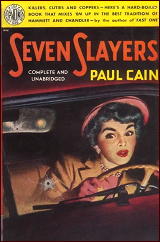
   The only other book by Cain is Seven Slayers (1946), a collection of seven of his other Black Mask stories, all of which are in the same tough vein and all of which are excellent samples of pulp writing at its best.

         ———
   Reprinted with permission from 1001 Midnights, edited by Bill Pronzini & Marcia Muller and published by The Battered Silicon Dispatch Box, 2007.   Copyright © 1986, 2007 by the Pronzini-Muller Family Trust.

REVIEWED BY WALKER MARTIN:


PAUL CAIN – The Complete Slayers. Edited and with a biographic essay by Max Allan Collins and Lynn F. Myers, Jr.   Centipede Press, hardcover, March 2012.

PAUL CAIN The Complete Slayers

   Recently I was very impressed by a collection of hardboiled literature and we discussed it here on Mystery*File. I’m talking about Frederick Nebel’s The Complete Casebook of Cardigan. Around the same time, a second collection was published, this time by Paul Cain (no relation to James Cain). The book is titled The Complete Slayers and has created a buzz on the internet and in some discussion groups.

   Paul Cain’s career was far shorter than Frederick Nebel and except for one short story in 1949, all his fiction appeared during the period between 1932 and 1936. At least three major newspapers have reviewed the book, one did not like it and the other two loved it.

   In The Wall Street Journal, Lee Sandlin bluntly states, “Cain wasn’t any good.” However in The Washington Post, Michael Dirda, who won a Pulitzer Prize for his reviews, gives the collection a very favorable review and stresses Raymond Chandler’s quote about Paul Cain’s style being “some kind of high point in the ultra hard-boiled manner.”

PAUL CAIN The Complete Slayers

   He then finishes his long review by saying, “There’s absolutely nothing to criticize about the knockout stories inside the book…” The Los Angeles Review of Books also gives it a favorable long review and discusses “The grim hardness of a neglected noir master.”

   I’ve been a long time admirer of Paul Cain and first read his work in Black Mask back in the 1970’s when I was picking up back issues for only a few dollars each. Of the 20 stories in this collection, 17 of them first appeared in Black Mask. Five were combined and published as Cain’s only novel, Fast One.

   I reread the novel a couple times over the years and now with this collection, which reprints the novel in its original magazine form, I feel I can safely say that Fast One definitely deserves to be on any list of the 10 best hardboiled novels.

PAUL CAIN The Complete Slayers

   On a recent panel at PulpFest in Columbus Ohio, the topic was Black Mask and the consensus was that Paul Cain was one of the very best writers for the magazine, after of course, Dashiell Hammett and Raymond Chandler. Exactly how editor Joseph Shaw discovered Paul Cain is still a mystery but we can recreate some of the details of what must have happened.

   In 1930 Dashiell Hammett stopped writing for Black Mask. He had been writing for the magazine for several years and had just about created the hardboiled detective. I say just about because some scholars also credit Carroll John Daly. He left not because of any disagreement but simply because the movie industry in Hollywood paid far more money.

   Shaw even sent Hammett a check for $500 as an advance on another story, but this money was now just pocket change since Hollywood was paying more than this every week.

PAUL CAIN The Complete Slayers

   In an attempt to replace Hammett, Joseph Shaw got Frederick Nebel to start writing a series about another agency detective called Donahue. There were over a dozen of these novelets, which will soon see publication as Tough As Nails (Altus Press). Then in 1932 he discovered Paul Cain, and it’s obvious that Cain was encouraged to write in the Hammett, tough hardboiled style.

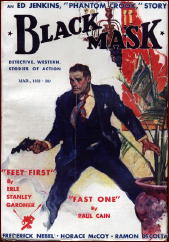
   The first story by Cain appeared in the March 1932 issue of Black Mask and was called “Fast One” The first novelet of a series that would eventually be published as the novel, Fast One.

   It stars Gerry Kells and relates the complicated plot of how Kells gets involved in gambling and corrupt politics. The story is very bleak, very violent, very fast.

   Kells gets his face carefully kicked, sapped on the head, shot in the leg, an ice pick in the back, and finally a car crash. If you are looking for a clean cut hero with a happy ending, then this is not the book for you.

PAUL CAIN The Complete Slayers

   His girlfriend Granquist has no first name and is a drunk. Again, not your typical pretty, young heroine of most novels. In fact I consider her to be one of the most believable gangster girlfriends that I have read about.

   Then in 1933, Shaw discovered Raymond Chandler as the hunt to replace Hammett continued. In 1936 Joseph Shaw left Black Mask over a salary dispute and he had such a big influence that several writers also quit the magazine.

   When he left, so did Paul Cain, Frederick Nebel, and Raymond Chandler. Lester Dent also stopped writing for the magazine. He only wrote two hardboiled stories but he might have written more with Shaw’s encouragement. The magazine became quite different after Shaw left, certainly less hardboiled.

   The Complete Slayers is published by Centipede Press in a special 500 copy edition, signed by the editors and the artist, Ron Lesser. The cover price is $75 but I see that amazon.com still is discounting it at $47.

PAUL CAIN The Complete Slayers

   This book is definitely worth the price. There are 622 pages, a biographical essay about Cain’s life, a 13 page color section of book and magazine covers, and each story has an introduction. The dust jacket cover is a knockout showing a scantily dressed blond, casually pointing a gun at some guy lying on the floor.

   There is one incorrect statement in the biography that has to be pointed out. The editors state that after Shaw left Black Mask in 1936, Daisy Bacon took over as editor. Daisy worked for Street and Smith and was responsible for the astounding success of Love Story, which was the biggest seller of all the pulp magazines. I’ve heard circulation reports of 600,000 a week.

   She eventually became editor of Detective Story in the 1940’s but at no time did she ever edit Black Mask. The lady who took over after Shaw was Fanny Ellsworth(1936-1940). Then Ken White became editor in 1940 when Popular Publications bought the title.

   If you like hardboiled fiction or the tough Black Mask style, then this collection is a must buy. It gets my highest recommendation.

PAUL CAIN The Complete Slayers

Reviewed by Walker Martin:


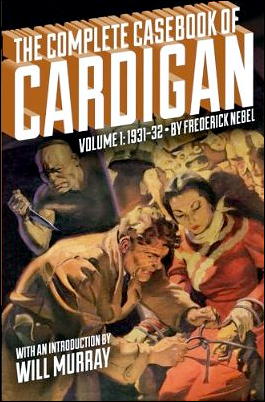
FREDERICK NEBEL – The Complete Casebook of Cardigan. Volume 1: 1931-1932. Altus Press, hardcover/paperback, February 2012.

   Matt Moring of Altus Press has just published a collection of stories by Fred Nebel that not only is an excellent collection of hardboiled fiction but also is quite historically significant. Fred Nebel (1903-1967) was one of the early Black Mask authors who started to write detective stories in the hardboiled style. He sold his first story to the magazine in 1926 and editor Joe Shaw encouraged him to join Dashiell Hammett and John Carroll Daly in the writing of hardboiled, tough, fast action stories.

FREDERICK NEBEL Cardigan

   Nebel had a long running series starring Captain Steve MacBride and a reporter by the name of Kennedy. This was followed by a later series about a private eye named Donahue. When Harry Steeger started Popular Publications, one of his early titles was Dime Detective and he offered Nebel and some of the other Black Mask authors a higher rate if they would also write for him.

   The top writers for Black Mask were probably getting around 3 cents a word, so this meant an increase to 4 cents, which at the time was very good money. a 10,000 word novelette could bring in a $400 check. In the depression era this was like over $4,000 in today’s money.

   The first issue of Dime Detective appeared with the date of November 1931, and it contained the first Nebel story for the magazine. Nebel during the period 1931-1937 would go on to write 44 of these hard driving, tough tales, all starring Jack Cardigan of the Cosmos Detective Agency. At first he was in charge of the St. Louis branch but then moved on to the main headquarters located in New York city.

   I’ve been collecting Dime Detective since 1969 and have read almost all the Cardigan stories, so when I received this book, I thought I’d just read a couple stories to make sure I still felt the same way about the quality and then file the book away with my other hardboiled books written by Hammett, Chandler, James Cain, and Paul Cain.

   However, I was surprised as to how well the stories held up to a second reading and before I knew it, I had read all of them in a space of a few days.

FREDERICK NEBEL Cardigan

   Altus Press plans to publish all 44 Cardigan stories and this first volume contains the first eleven, written in 1931-1932. There will be not only an additional three volumes, each around 400 pages, but also volumes reprinting Nebel’s series starring Kennedy and MacBride, and Donahue. The book has a nice introduction by Will Murray and each story has the original John Fleming Gould illustrations.

   Now, though I’ve mentioned Nebel with such names as Hammett and Chandler, I do not by any means place him on the same level. They are at the very top. I would place these stories on the the second level along with such writers as Paul Cain, Norbert Davis, Robert Reeves, Merle Constiner, etc, most of whom wrote for both Black Mask and Dime Detective.

   These writers I consider to be very good to excellent, while Hammett and Chandler are in the great class, often considered legitimate, no doubt about it, American Literature.

   So this collection and the future ones which will soon be published by Altus Press, gets my highest recommendation. If you try and collect the original pulps you will run into two problems. The first being that they are now very rare and hard to find, and the second being the prices are very high. Copies of Dime Detective in the 1930’s are now over the $100 per issue level and some are selling for $200 or $300 each. The Chandler issues are even higher.

   One interesting subject is discussed by Will Murray in the introduction and has also been covered before by Steve Mertz and others. This involves the reaction that Joe Shaw encountered when he was compiling the stories for The Hard-Boiled Omnibus, the first hardboiled anthology, published in 1946. He wrote Fred Nebel asking for permission to publish one of his Black Mask stories and Nebel turned him down saying that he considered his pulp work “dated” and not up to the quality of his best work.

FREDERICK NEBEL Cardigan

   This is another example of how blind some authors can be concerning the quality of their own fiction. In the early 1930’s Nebel broke into the slick market and he actually considered this slick work to be far better than his pulp stories. He certainly got paid a lot more and this must of blinded him to the relative quality.

   The slicks had a very high percentage of women readers and the editors felt that stories should have a strong love or romance element. Nebel was willing to write this type of fiction for such high paying magazines as the Saturday Evening Post, Liberty, Collier’s, and Woman’s Home Companion.

   I collect the slicks also and have read some of Nebel’s slick work and it cannot even begin to compare to his best pulp work as written for Black Mask and Dime Detective. I can understand him writing the slick formula because the pay was so high compared to the pulp rates. He was receiving thousands of dollars for short slick work compared to hundreds for pulp novelettes.

   He also wrote three novels and thought these would be remembered but nothing ever came of his hardcover writing career. While his slick magazine work has been completely forgotten, his pulp stories have appeared in just about every hardboiled pulp anthology. Mysterious Press even published six of the Cardigan novelets in a paper edition over 20 years ago but it failed to sell.

   Copies of this collection are easy to obtain for around $30 for a high quality paper edition and for $10 extra you can get a hardcover. I recommend the hardcover because of the historical and literary significance of the book. You can order from the Altus Press website or from Mike Chomko Books. Amazon.com also carries the paper edition.

   I encourage all lovers of hardboiled and pulp fiction to support this publishing project.

   We do indeed live in The Golden Age of Pulp Reprints.

FREDERICK NEBEL Cardigan


Contents:    (All stories reprinted from Dime Detective.)

“Death Alley” (November, 1931)
“Hell’s Pay Check” (December, 1931)
“Six Diamonds and a Dick” (January, 1932)
“And There Was Murder” (February, 1932)
“Phantom Fingers” (March, 1932)
“Murder on the Loose” (April, 1932)
“Rogues’ Ransom” (August, 1932)
“Lead Pearls” (September, 1932)
“The Dead Don’t Die” (October, 1932)
“The Candy Killer” (November, 1932)
“A Truck-Load of Diamonds” (December, 1932)

Movie Commentary by Walker Martin:
JOHN CARTER (2102)


JOHN CARTER OF MARS

   John Carter, the movie has not yet been reviewed on Mystery*File and this is a movie that demands to be mentioned here. I call it the Pulp Movie of the Century because it actually is. It has been 100 years since the novel appeared in the pulp, All-Story, as a six-part serial in 1912. The movie has been slammed by the critics and is not doing well at the box office, but it has been receiving very favorable comments on some discussion groups I belong to that are focused on pulpish subjects.

   Frankly, I don’t think some of the critics know what they are talking about. Despite some changes, this is a fairly faithful adaptation of the Edgar Rice Burroughs novels about Mars. His first published work was Under the Moons of Mars in All-Story and was the big first success in his Mars series.

JOHN CARTER OF MARS

   Without this serial in 1912, All-Story and Science Fiction as we know it might have had a different history. Burroughs was the driving force behind the decision by the All-Story editors to encourage their writers to write what has been called the Scientific Romance.

   When Sam Moskowitz decided to do a collection of SF stories from the Munsey pulps, he called it Under the Moons of Mars. (This by way, is a far better title than John Carter.) In addition to the stories, Moskowitz also included an excellent long history of SF in the pulp magazines up to 1920.

JOHN CARTER OF MARS

   What do I mean about the critics not knowing what they are talking about? They are treating this film like the plot is a copy of some tired previous SF movie. Gentlemen, this is the serial, the book, the plot, that started the whole craze for SF adventure in the pulps. Sure, there was H.G. Wells before Burroughs, but Wells is on a higher literary level for sure. Though he appeared in the pulps, it was mainly through reprints.

   The critics do not realize the impact in 1912 that Under the Moons of Mars had on the typical reader of popular magazines. It was like a bolt out of the sky shocking the reader who was hungry for imaginative literature.

   Things would never be the same after this serial in 1912. All-Story went on to publish scores of SF adventures and in 1926 the first SF pulp appeared. For many years after, readers in the letter columns requested reprints from the great old Munsey pulps. Then in 1939, a magazine was created that did indeed reprint the Munsey science fiction stories from All-Story, Argosy, and Cavalier. It was called Famous Fantastic Mysteries and is today considered one of the best looking and prettiest pulps ever published.

JOHN CARTER OF MARS

   So, to the jaded critics of today, sure John Carter has some faults, but in 1912 this story was a stunning achievement. Even decades later, readers would be amazed by the Mars books.

   I know I was at the age of nine years old. In the early 1950’s, I remember my father giving me a stack of the Mars and Tarzan novels and saying how great they were. A year later, I had read and reread them all, and used to think of which books I would try to save if the house ever caught on fire. My answer was always the same: the books by Edgar Rice Burroughs.

   Now, I’m not saying this movie is great, after all it has been 60 years since Burroughs grabbed hold of me. But it is good and not as bad as the critics are saying.

JOHN CARTER OF MARS

   As I was coming out of the theater, there were two young boys ahead of me, both of them jumping up and down with excitement. To me they looked to be around nine or ten years old, the same young age that I once was back when I first discovered John Carter and his adventures. One said to the other “Wasn’t John Carter great!,” and his friend replied that the movie was cool. They then started talking about seeing it again.

   There may have been only 15 or 20 people in the theater when I went for the noon showing but seeing these two kids made me realize once again Burroughs still had that power to excite, just like he must have excited readers in 1912. I have a feeling that John Carter may be a failure on this initial release, but like Blade Runner, it will be considered a success many years later.

« Previous PageNext Page »