Pulp Fiction


COLLECTING PULPS: A MEMOIR
PART ONE — BLACK MASK
by Walker Martin
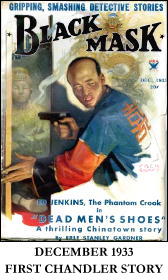

BLACK MASK MEMOIRS

   In the 1940’s an admirer of Raymond Chandler’s fiction wrote a letter asking Chandler if it was possible to obtain back issues of the magazines containing his stories. Chandler responded that it was just about impossible to find such back issues and he doubted if the correspondent would have any luck.

   Jump ahead more than 20 years to 1968 and that was my attitude also. I had been a SF fan for over 10 years collecting the pulps and digests, attending the SF conventions and reading the fanzines.

   Since I also was reading a lot of mainstream literature and mystery fiction, I was interested in back issue magazines that published fiction other than SF, but I was not finding the issues.

   I figured the SF and hero pulps survived because of teen age boys and their drive to collect things. So I reasoned that the adults must have read and thrown away their copies of the adult pulps like Black Mask, Adventure, Dime Detective, Short Stories, etc.

   However, in 1968 a life changing event occurred and I know we all laugh when we hear those words because often it is not really THAT “life changing”. But it was in my case and I never really realized the impact of simply buying one paperback until decades later when I was almost crushed by a collapsing, heavily loaded bookcase full of detective pulps.
BLACK MASK MEMOIRS

   As I lay there too stunned to move, I began the process of thinking how had my reasonable SF collection turned into a massive amount of pulps, vintage paperbacks, books, etc.

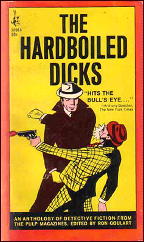
   The event I’m talking about is the mundane task of buying a book titled The Hardboiled Dicks, edited by Ron Goulart. It was a collection of crime stories from such pulps as Black Mask, Dime Detective, Detective Fiction Weekly. After reading the stories and Goulart’s editorial comments, I realized without a doubt, it was possible to collect the detective pulps and the genres such as western and adventure fiction.

   I wrote Goulart and asked him if it was possible to buy his copies of the detective magazines that he had used for his research. I’m happy to say he wrote back and sold me all the copies he had for only a couple bucks each.

   These few pulps that he sold me eventually caused me to accumulate complete sets of Black Mask and Dime Detective and an almost complete set of Detective Fiction Weekly, not to mention the other titles that I started to also collect. Almost 40 years later Ron Goulart wrote in my copy of The Hardboiled Dicks, “For Walker, whose life I ruined”.

    “Whose life I ruined” just about sums up the thoughts and feelings of many non-collectors when they see a house full of books and old magazines. I could give dozens of examples but I’ll try and control myself and just mention one early story from 1969 involving collectors, non-collectors, and romance.
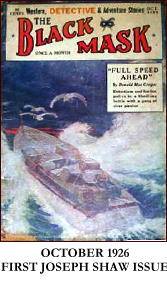
BLACK MASK MEMOIRS

   At the time I was busy writing hundreds of letters to collectors, book stores, etc. in an attempt to put together complete sets of Black Mask and the other detective magazines. This was pre-Pulpcon and the Internet did not exist, so everything was by regular slow mail.

   The Collector’s Bookstore in California sent me a package of about a dozen Black Mask’s from the thirties. Needless to say I was checking my mail every day but the day they came I was at work and the package was returned to the main post office. I showed up early the next morning before work with the postal slip saying there had been a failed attempt to deliver.

   The Trenton NJ post office was a massive structure and the postal clerk returned after a few minutes and told me he could not find the package. The next few minutes are still a blur in my memory, but let’s just say the head postal inspector was summoned and he tried to calm me down by saying there was nothing to worry about since the package was insured.

   I imagine every fellow collector reading this knows my response along the lines of “I didn’t care about the insurance, the magazines were rare collectables and irreplaceable.”

   After another long delay and search they found the stack of Black Mask’s with just some twine wrapped around them and no package left at all.
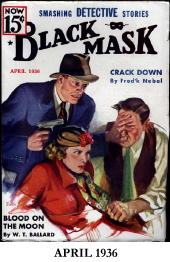
BLACK MASK MEMOIRS

   When I arrived at work I was completely frazzled and shaken. The employees I worked with could not understand why I was so upset about some old crumbly magazines.

   After I regained control, I showed the stack to a girl I was interested in who had the desk behind me. I told her about the importance of Raymond Chandler and Dashiell Hammett and even asked her if she would like to read any of the magazines.

   Her response of “no” was a deal breaker and the end of any possible romance. I never did have any luck in finding a woman who liked pulps.

   So began my lonely occupation of collecting back issues. The great number of letters I was mailing resulted in many collectors across the country selling me Black Mask’s . Richard Minter, who was the greatest mail order pulp dealer who ever lived, was especially helpful.

   At first he was surprised because all his customers were mainly SF and hero pulp collectors. He had no one interested in the detective magazines. But because of his extensive contacts among old time collectors, he started mailing me a steady stream of packages, all wrapped in brown paper with string and old stamps that someone must have paid him with.
BLACK MASK MEMOIRS

   I know this is hard to believe but he was asking only 2 or 3 dollars per pulp. This was the average price I was paying and the set was almost completed except for a very few issues.

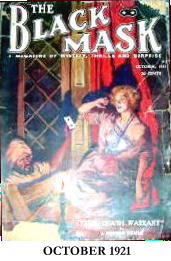
   My main activity during 1969,1970, and 1971 revolved around finding back issues of Black Mask. I cared nothing for my work career, it was just a means to be able to collect. By the first Pulpcon in 1972 I had a complete set of the 340 issues except I was lacking one hard to find issue, October 1921. Some of the issues were in rough shape, and for many years I continued to upgrade.

   At first, I had no real competition but as I started to rave to other collectors, my enthusiasm created the market and other people started to pick up issues. There was a fellow collector in Trenton who I kept talking to about how great the magazine was, and before I realized my stupidity, he was my main competitor.

   We both eventually ended up with complete sets and as far as I know there were only a couple other extensive runs, including one at UCLA, but nothing complete.

   At the end, in order to beat out the competition, I was sending dealers more than they asked for because I figured they would sell to me even if another collector beat me to the item. Many a time, someone would ask $5 for example and I send them double the amount, with my comment of “I feel the issue is worth more”. It always seemed to work.
BLACK MASK MEMOIRS

   Concerning the October 1921 issue, there must have been something wrong with print run of that date or perhaps many copies were destroyed in some accident, etc.

   I say this because out of 340 issues, 1920-1951, the two collectors with almost complete sets both needed this same issue. For many years I advertised and hunted for it and finally dealer Jack Deveny, at an early eighties Pulpcon, conducted a mini auction between me and several collectors. There was no way I was not going to get the issue and my sealed bid won at over $700. Back then, this was an unheard amount to pay.

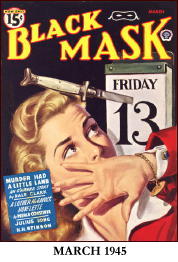
   Eventually, I tracked down three original Black Mask cover paintings, all from the 1940’s. One of them I managed to get from artist Raphael Desoto after a weekend of talking to him at an early book convention. I cried, I whined, I begged, etc. Nothing is too shameful among serious, out of control collectors.

   I also manage to find a stack of canceled checks paying Black Mask writers and artists. When I bought them back in the 1970’s no one would even pay $1.00 each. Now they bring far higher amounts.
BLACK MASK MEMOIRS

   After Black Mask died in 1951, Ellery Queen Mystery Magazine bought the title and beginning with May 1953 issue had a section in each issue reprinting two stories from the magazine. Eventually they cut back to one story and even published new stories in the Black Mask tradition.

   They soon added the subtitle “including Black Mask Magazine” on the contents page. This subtitled continued off and on through the fifties and sixties and I see it appearing even as late as the September, 1973 date.

   I’ve done extensive reading in the magazine during almost four decades. The twenties are not that readable, except for Dashiell Hammett, Frederick Nebel, Raoul Whitfield and Erle Stanley Gardner. Some readers even like Carroll John Daly.

   By the time Joe Shaw took over in late 1926, things began to improve and he encouraged the above writers. Most readers find the thirties the best and even some collectors present an argument for the 1940’s when Popular Publications took over with Ken White as the editor.

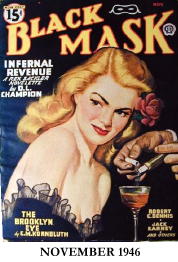
   Behind Hammett and Chandler, I think Paul Cain was the best writer even though he was not that prolific, then Nebel, Whitfield, and Norbert Davis. The 1940’s are full of excellent writers like Merle Constiner, John D. Macdonald, Robert Reeves, D. L. Champion, Cornell Woolrich, William Campbell Gault, and others.
BLACK MASK MEMOIRS

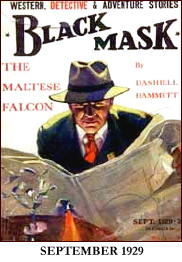
   To collect the magazine nowadays would require a lot of money and I’m not even sure a set could be put together. Hammett and Chandler issues are expensive, going for hundreds of dollars each. I recently saw the 5 issue “Maltese Falcon” issues go for almost $4000 and I thought this price was too low.

   Even without these two authors in the issue the 20’s and 30’s go for over one or two hundred, according to condition. The forties still are affordable with plenty of readable stories and it’s possible to find issues at the $25 to $50 price.

   Fortunately for readers who want to sample the fiction there are several collections:

      The Hard-Boiled Omnibus, edited by Joseph Shaw
      The Hardboiled Dicks, edited by Ron Goulart
      The Hard-Boiled Detective: Stories from Black Mask Magazine, edited by Herbert Ruhm
      The Back Mask Boys, edited by William Nolan
      The Black Lizard Big Books of Pulps edited by Otto Penzler (most of the stories).
      The Black Lizard Big Book of Black Mask Stories, edited by Otto Penzler (over 50 stories!)

   Thus ends my story of a 40 year love affair with a pulp. I can truthfully say I have only learned two things in life, “The non-collector will never understand the collector.” And “Never take the advice of a non-collector concerning your collection.”

   These two things are absolutely true and you might ask why? Because the non-collector knows absolutely nothing about your collection and just sees it as so much clutter, waste of money, and a crazy waste of time. But we know different, don’t we.

BLACK MASK MEMOIRS


COMING SOON:   Part Two — Collecting Dime Detective.

The 2010 NYC Vintage Paperback and Collectable Book Expo
by WALKER MARTIN


   Just back from attending this long running one day event that Gary Lovisi has managed to organize for over 20 years on an annual basis. Over 50 sellers in a large dealers’ room selling vintage paperbacks, pulps, new books, and original artwork. Prices seemed very reasonable to me and I managed to find several of my Dime Mystery pulp wants.

   Steve and I had discussed the problems in attending this show because we both were limping around due to overexertion. Steve couldn’t make it, but I manage to survive the train ride from Trenton, NJ to NYC with the help of long time collector Digges La Touche.

   We arrived at the show at a little after 9:00 am Sunday and were immediately met with the delicious aroma of old books and pulp paper. The crowd appeared even bigger than last year and consisted mainly of elderly book collectors of the male gender. There were a few females trying to reign in their husbands and boyfriends passionate love of collecting but it was a losing battle.

   You know what I’m referring to: the age-old battle between the non-collector and the collector. These battles have led to the breakup of many a marriage, and many a collection has been ordered sold by the courts in order to split the proceeds. A collector’s worst nightmare!

   There were numerous guests selling and signing their books. Too many to mention but I do want to give special note to someone I consider the most notable writer present: Ron Goulart. Not only has he been a professional writer for over 40 years but he has written some excellent books on the pulps such as Cheap Thrills, The Dime Detectives, The Hardboiled Dicks and others. C. J. Henderson had a table selling his numerous books and driving collectors nuts by yelling at them to come and visit “The Wonderful of Me”. This of course just scares everyone away.

   As we all know, a great part of the fun of collecting involves the many friends that we make over the years. Here are some notes about the collectors I talked to at the show:

   Tom Lesser. One of the great West Coast paperback collectors who organizes the annual LA Paperback Convention each year. He just had a bypass operation, and I’m happy to report he is up and about and looking better than ever.

   Dan Roberts. Another serious paperback and art collector who has one of the largest collections in the world.

   Paul Herman. Pulp and art collector who always has interesting items at his table.

   Ed Hulse. Publishing and editor of Blood n Thunder magazine which deals with the pulp and movie world.

   Nick Certo. A major pulp, paperback and art dealer.

   Mark Halegua. Organizer of the Gotham Pulp meeting every month in NYC.

   David Saunders. Artist and author of many articles in Illustration Magazine. He is the author of the excellent book on Norman Saunders and the new book on Ward, the pulp artist.

   Rich Harvey. Organizer of the annual Pulp Adventure Con in Bordentown, NJ.

   Chris Eckhoff. Dealer and expert in the field of paperback erotic novels.

   The above are just a sample of the crazed and over the top dealers and collectors that you can meet at this convention. The paperback collecting field is wide open, and most paperbacks are very inexpensive. This show and the LA show should not be missed, especially if you live within two or three hours driving distance. Collecting books has been called the grandest game in the world and this show proves it.

Reviewed by MIKE GROST:

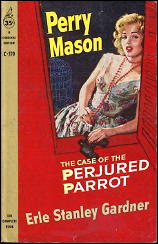
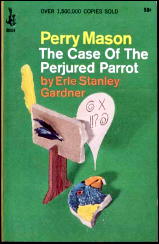
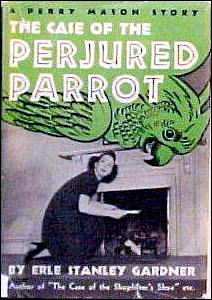
ERLE STANLEY GARDNER TCOT Perjured Parrot

ERLE STANLEY GARDNER – The Case of the Perjured Parrot. William Morrow & Co., hardcover, 1939. Pocket #378; 1st printing, August 1947. Reprinted many times, in both hardcover and soft.

   Gardner wrote a series of Western short tales set in desert locales for Argosy magazine (1930-1934). Some of these were collected in Whispering Sands (1981). “Law of the Rope” (1933) and “Carved in Sand” (1933) mix mystery puzzle plot elements, with the sleuth’s reconstruction of events during a crime by tracking trails left in the desert. This sort of reading of physical trails and evidence at a crime scene goes back to Gaboriau in mystery fiction.

ERLE STANLEY GARDNER TCOT Perjured Parrot

   The Case of the Perjured Parrot (1939) is a Perry Mason tale, set not in the desert, but in a mountain forest. But it has another hermit-like nature-lover, like several of the desert tales, and an emphasis on reading clues from a murder scene to reconstruct a crime.

   These clues are indoors at a fishing cabin, not outside, however, making a further difference from the desert tales. Some of this detection is done not by Perry Mason, but by a country sheriff whose good at “reading trail.”

   The long opening (Chapters 1-5) tells a pleasantly elaborate tale, with a great flow of story and several nice twists and turns. Gardner is especially good at spinning out plot.

ERLE STANLEY GARDNER TCOT Perjured Parrot

   The solution (Chapters 12-14) is none too surprising, and the novel does not excel therefore as a puzzle plot mystery. Still, the solution’s twists are decent, and continue both the deductions from crime scene clues and the book’s pleasing flood of story.

   The Case of the Perjured Parrot consists of one long murder investigation, of a single murder. It is more unified than many Gardner books. There is no preliminary mystery subplot in the opening chapters either: Perry Mason starts investigating the murder in the first chapter. Perry works less to defend a single client in this tale, and more purely as a detective, as well.

    The Case of the Perjured Parrot, like the desert-set The Case of the Drowsy Mosquito, has a bit of high technology in it. Gardner perhaps had some artistic association between nature settings and technology, in his story-creation process.

   Recommended.

— Very slightly revised from A Guide to Classic Mystery and Detection, by Michael E. Grost, with permission.


ERLE STANLEY GARDNER TCOT Perjured Parrot

Reviewed by DAVID L. VINEYARD:         


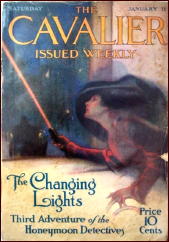
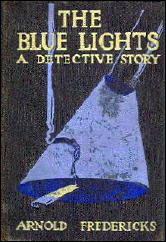
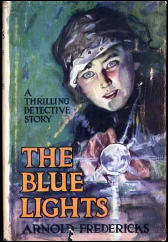
ARNOLD FREDERICKS – The Blue Lights. W. J. Watt & Co., hardcover, 1915. Hardcover reprint: Grosset & Dunlap, no date. Serialized (four parts) in The Cavalier as “The Changing Lights,” January 11 through February 1, 1913.

ARNOLD FREDERICKS The Blue Lights

    Before there was Nick and Nora Charles, or Pam and Jerry North, or even Lord Peter and Harriet Vane, a pair of happily married American sleuths were pursuing mystery across the international scene fighting crime tooth and nail.

    Robert and Grace Duvall were the creation of Frederick Arnold Kummer, a popular mystery writer both under his own name, and as Arnold Fredericks and an early tie to the burgeoning new cinema as both a scenarist and like Arthur B. Reeve, the creator of Craig Kennedy, adapting films to print. He also co wrote musicals with Sigmund Romberg and Victor Herbert — not bad company.

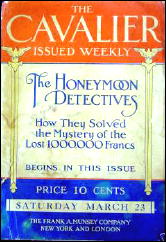
    The Duvalls debuted in the pulps in The Cavalier as “The Honeymoon Detectives,” a series Robert Sampson describes in Yesterday’s Faces, The Solvers (Volume 4) as “prose as bland as unsweetened farina.” There Robert Duvall, private investigator, and Grace Elliott, plucky American girl, met and fell in love. [Note: Follow the link above for a long excerpt from Bob Sampson’s book.]

    Richard, as the series opens, is a “gifted” private detective assigned to the staff of M. Lefevere, Prefect of the Paris Police.

    Despite being such a bright and gifted sleuth, Richard has nothing on Grace, who is front and center for most of their six adventures, finding more ways to get into trouble than Nancy Drew ever imagined. The six books cover a number of changes in the Duvall’s life. As The Blue Lights opens they are retired from crime fighting and living in Maryland on a plantation until Richard’s fame draws him reluctantly back into the world of crime and detection.

ARNOLD FREDERICKS The Blue Lights

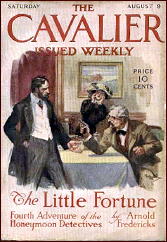
    Their adventures are: One Million Francs ( in Cavalier as “The Honeymoon Detectives”), The Ivory Snuff Box (which opens exactly one hour after the first book ends), The Blue Lights (in Cavalier as “The Changing Lights), The Little Fortune, “The Mysterious Goddess,” and Film of Fear (in which Robert aids movie star Ruth Morton).

    [Note: The publication dates for these adventures as they appeared in the pulp magazines can be found here. Unaccountably, “The Mysterious Goddess” has never appeared in book form.]

    In The Blue Lights an American millionaire’s son has been kidnapped in Paris and his agent rushes to the Duvall’s Maryland estate to enlist Robert in the investigation:

    “You must listen to what I have to say, Mr. Duvall, at any rate. Mr. Stapleton would not hear to my returning, after seeing you without having explained to you the nature of the case.”

    Duvall leaned back, and began to fondle the long moist nose of the collie which sat beside his chair. “If you insist, Mr. Hodgman, I will listen, of course; but I assure you It will be quite useless.”

    “I hope not. The case is most distressing. Mr. Stapleton’s only child has been kidnapped!”

    “Kidnapped!” Duvall sat up with a start, every line of his face tense with professional interest. “When? Where?”

    “In Paris. The cablegram arrived this morning…”

ARNOLD FREDERICKS The Blue Lights

    Stapleton is a banker who Duvall has worked for before — a “wealthy banker” as we are told (as opposed to a poor banker one supposes). Duvall reluctantly agrees to take the case. Robert doesn’t want to leave Grace, but she insists: “I think, Robert, that you had better go.”

    And go he does, allowing Fredericks to use his favorite device, the divided storyline, following Robert on one hand and Grace on the other, because no sooner has he departed than he receives an urgent message from his old friend and boss M. Lefevere begging him to come to Paris to take over a difficult case.

    Grace packs and heads for Paris, unaware that she will arrive there alone because Robert as taken a detour to New Jersey on one of his mysterious missions (like many sleuths of the era Robert is prone to omniscience when he isn’t dense as a teak two by four).

    In Paris, Lefevere enlists Grace as his new assistant with typical Gallic resignation:

    Immediately on reaching Paris, she drove to the office of the Prefect of Police, and sent in her card to Monsieur Lefevre. She thought it possible that he would expect her, as his agent in Washington would no doubt have communicated with him. Nor was she mistaken.

    He rushed into the anteroom as soon as he received her card, and embraced her with true Gallic fervor, kissing her on both cheeks until she blushed. Then he drew her into his private office…

    “But — it was for that very case that I desired his assistance. And by this Stapleton, who cables that the whole police force of Paris are a lot of jumping jacks! Sacre! It is insufferable!”

    “You wanted my husband for the same case?”

    “Assuredly! What else? The child of this pig of a millionaire is stolen — what you call — kidnapped! We have been unable to find the slightest clue. I am in despair… The efficiency of my office is questioned. My honor is at stake. I send for my friend Duvall, to assist me, and — sacre! — I find him already working for this man who has insulted me. It is monstrous!”

ARNOLD FREDERICKS The Blue Lights

    If you didn’t see this coming I have some lovely land in New Mexico I’d like to sell you — nice place called the White Sands Missile Testing Range …

    So Grace goes undercover so she will not be recognized as the wife of the brilliant Robert Duvall. Fredericks, true to the nature of the pulps, conveniently fills us in on what Grace is up to:

    On the day following that upon which she arrived in Paris, Grace Duvall sallied forth, determined to find out two things — first, the position occupied by Alphonse Valentin in the affair of the kidnapping; secondly, the identity of the man who had stolen the box of cigarettes from Valentin’s room, and gone with them to the house in the Avenue Kleber. The latter incident seemed trivial enough, at first sight; yet she reasoned that no one would risk arrest on the score of burglary, to steal anything of such trifling value, without an excellent reason.

    Meanwhile (there are a lot of meanwhile’s in this series) Richard arrives in Paris not knowing Grace is already there and finds his work complicated by his old friend and a police agent he doesn’t realize is a disguised Grace:

    “Good Lord, Chief, am I losing my senses? What is this affair, anyway, a joke?”

    “Far from it, Monsieur Duvall. The criminals are still at large. The boy is in their hands. We must recover him.”

    “But — this money– ”

    “I arranged to get it, in order to prevent Monsieur Stapleton from making a fool of himself. I wish to capture these men — not to let them blackmail him out of half a million francs.” “Had you not interfered, Monsieur Lefevre, they would have been in my hands, by now. I would have had them safely the moment they attempted to enter Paris…”

    Of course rather than simply explain the truth, everyone is as high handed and thick headed as possible without actually provoking the Dorothy Parker reflex (“This book should not be put aside lightly — it should be thrown with great force.”).

ARNOLD FREDERICKS The Blue Lights

    Robert may be “gifted,” but Grace is lucky. At one point she just walks into the kidnapper’s lair and finds the kidnapped child hidden in a plaster casting, then she herself spends a day hiding in a closet from which she luckily overhears all sort of vital information. All I ever heard in a closet was the sound of my clothes being devoured by hungry moths, but then I’m not a plucky sleuth.

    Of course on their separate courses the Duvall’s manage to solve the case, rescue the kidnap victim, and capture the villains after a few close calls:

   The semidarkness showed a terrifying spectacle. On the floor lay a woman, unconscious, clutching in her arms a child, trapped in a long gray coat. Down the dark hallway leading to the rear of the house dashed the figures of two men. One of them turned, as the attacking party entered, and hurled the lighted candle which he bore full into their faces. The entire scene was instantly plunged into darkness.

    Golly!

    But Robert brings it to a satisfying conclusion and explains all the convolutions of the case and how everyone but him was wrong, and M. Lefevere resolves that:

    “The credit belongs equally to both. And that, my children, is as it should be. This affair, so happily terminated, has taught me one important lesson. It is this: The husband and the wife should never be in opposition to each other. They must work together always, not only in matters of this sort, but in all the affairs of life. I attempted a risky experiment in allowing these two dear friends of mine to attack this case from opposite sides. But for some very excellent strokes of luck, it might have resulted most unhappily for all concerned. Hereafter, should Monsieur Duvall and his wife serve me, it must be together, or not at all.”

    You can hardly call these fair play detective stories. Indeed they are full of the sort of thing that the Detection Club and Van Dine’s famous rules were designed to correct, and yet despite prose as “bland as unsweetened farina,” and the high-handed hi-jinks of Robert Duvall, the books are fun and a pleasant read.

    And as Robert Sampson points out, Grace Duvall is something refreshing, in that her adventures continue after marriage rather than finding her ensconced in the home like some princess locked away in a tower. For her day she was a breath of fresh air, however musty the plots she was involved in.

    I enjoyed this and some of Fredericks other works (available on line at Manybooks and Google Books) on their own merits. Like most popular fiction of the age they require a bit of forgiveness by modern readers, but they also offer some genuine entertainment and polite well behaved thrills.

    And historically Grace Duvall is the grande dame of all those bright nosy tec wives to come. She might be a bit staid and prim, but she is a true cousin of Nora Charles, Pam North, Halia Troy, Iris Duluth, Phyllis Shayne, Jean Abbott, Arab Blake, Helene Justus, and the whole attractive brood replete with wicked jaws, long elegant legs (hollow in the case of Nora and Pam), golden curls, and unerring taste for murder.

    Though in all fairness after spending an evening with Robert you may well be wishing for one of Nora Charles and Pam North’s stronger martinis… Even as great detectives go, he really is a pain.

    Gifted my …

    Oh, well, see for yourself.

   The last time I was seriously online was Friday, which was when Hurricane Earl had us in New England squarely in his sights and was barreling up the coast toward us. Most of the projections were correct, though, and the storm missed us … by that much.

   We scurried around outside the house though, picking up and storing in the garage the table and chairs on the deck and anything else strong winds might pick up and dash down the street, or through a window, just in case. Sometime preparations in advance work, and it did this time. All we got was 15 minutes of rain and no wind to speak of.

   Just a little excitement to start the beginning of September and the end of summer. Wish I could say that postings on this blog are going to become a little less erratic, but I don’t think I can. Bear with me. I didn’t mean to go quiet all weekend, but that’s the way it turned out. It wasn’t planned; it just happened.

   I also am hoping to get caught up on email sometime soon. If you haven’t heard from me in a while, and you were expecting to, I apologize. Your only consolation might be that you’re not alone. I’ll try to do better.

   Looking back, I didn’t do a lot of reading in August, and that frustrates me, but everything I’ve read has been reported on here. Not reviewed have been six or so movies, but it’s been too long since I’ve seen them for me to report on them with any feeling that I could do them justice. You’ll have to wait until I watch them again, which I may.

   What follows are some announcements of sorts, some of this and more of that, as the heading says. Some might deserve posts of their own, but in order to cover them all quickly, I’ll combine them into this one long post.

    ● First of all, I’d like to to remind you that Dan Stumpf’s book ’Nada, as by Daniel Boyd, which I previewed here last July has now been published. You can buy it from Amazon and other online sources, and if I may once again, I strongly recommend that you do.

   I’ve just posted a version of my review of the book on Amazon, but I see that both Bill Crider and George Kelley have beaten me to it. (All three of us have given it five stars.)

    ● Ken Johnson has asked me to mention that he’s revised and expanded his checklist of the digest-sized paperbacks that were published mostly in the 1940s. I’m happy to do so, and in fact what I will do is publish his note to me in full:

    “I want to let people know that The Digest Index, my online reference to digest-size paperbacks, which was originally posted two and a half years ago, has now been substantially revised and reposted. It is hosted by Bruce Black on his Bookscans website and can be accessed here: http://bookscans.com/Publishers/digestindex/digestindex.htm

    “Among the revisions are the addition of 11 new imprints, the addition of series information into both author indexes (to books and contents), and the addition of artist identifications into the publisher index. Because I still lack a lot of cover artist data, I did not attempt a full artist index but instead supplied a summary of which imprints each artist was mentioned under and plugged in scanned samples of their signatures. This is in addition to tightening up the original data with more identification of abridgments and retitles, as well as additional personal data for a number of authors.

    “I’ve put a lot of effort into this Index, but it still has a lot of holes in it. Additions and corrections are always welcome. Actually, feedback of any kind is welcome; I get the sense sometimes that hardly anyone has seen it.”

   To which I reply, while I don’t go there every day, I do find the need to refer to it at least once a week. A large percentage of these books were either mysteries and westerns, making the information for me very useful. It’s a remarkable piece of work. Check it out!

    ● Finally, a comment left by the anonymous PB210 following my review of a Hugh North novel by Van Wyck Mason needs some additional exposure, I thought:

    “I tried to compare the Hugh North novels to other long running secret agent novel series by one author:

Malko Linge: 1965 to 2010 (presumed): 45 years, by Gerard De Villiers
Hugh North: 1930 to 1968, 38 years, all by Van Wyck Mason
Matt Helm: 1960 to 1993, 33 years, all by Donald Hamilton (one remains
unpublished)
Quiller: 1965 to 1996: 31 years, by Adam Hall/Elleston Trevor
Modesty Blaise (in prose): 1965 to 1996, 31 years, by Peter O’Donnell

    “So far based on what I have written above, De Villiers has the overall record, while Van Wyck Mason has the record in the English language. Others more knowledgeable may have thought of a longer series by one author.

    “Anyone have any information about Herbert New?”

   I’ve not had a chance to check any of PB210’s data, nor do I know the Herbert New to whom he refers in his last question, but comments and suggestions of other authors are most certainly welcome.

A 1001 MIDNIGHTS Review
by Bill Pronzini:


JOHN D. MacDONALD Pulp Fiction

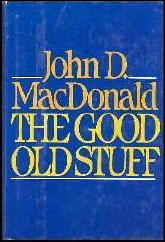
JOHN D. MacDONALD – The Good Old Stuff: 13 Early Stories. Harper & Row, hardcover, 1982. Fawcett Gold Medal, paperback, 1983.

   MacDonald, like so many other writers, learned his craft in the pulps. Between 1946 and 1952, he sold hundreds of crime stories to such magazines as Black Mask, Dime Detective, Detective Tales, New Detective, Mystery Book, and Doc Savage (as well as other short fiction to science fiction, fantasy, sports, and western pulps).

   A few of these criminous tales have been reprinted here and there over the years, but the greater percentage languished in (mostly undeserved) obscurity until 1981 , when Martin Greenberg, Francis M. Nevins, and Walter and Jean Shine — MacDonald aficionados all — persuaded John D. to collect the best of them.

JOHN D. MacDONALD Pulp Fiction

   They chose thirty stories; on rereading those thirty, MacDonald considered all but three worthy of reprinting. (Minor changes were made to update certain references for the sake of clarity; otherwise he allowed them to stand as first published.)

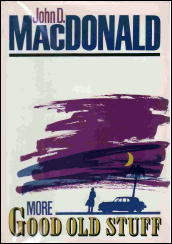
   But the final total of twenty-seven was deemed too many for a single book; the result is two volumes — The Good Old Stuff and its companion, More Good Old Stuff (Knopf, 1984).

   The thirteen stories in this first volume demonstrate MacDonald’s considerable range within the mystery! detective format, as well as his narrative talent and power. Among them are such gems as “The Simplest Poison” (whodunit); “Death Writes the Answer” (biter-bit); “Noose for a Tigress” (pure suspense); “Death on the Pin” (character study — and the world’s first and only crime story about bowling); and the novelette “Murder for Money,” whose protagonist, Darrigan, is a prototype of Travis McGee.

JOHN D. MacDONALD Pulp Fiction

   No fan of MacDonald’s work should miss either this batch or the fourteen equally excellent and diverse stories in More Good Old Stuff.

   Until these volumes, MacDonald’s collected short fiction was restricted almost entirely to selections from such slick magazines as Cosmopolitan, Collier’s, and Playboy — fifteen stories in End of the Tiger (1966) and seven in Seven (1971).

   His only previously collected pulp story was the title piece in the 1956 gathering of two novellas, Border Town Girl. Another two-story collection (both from the pulps), this one unauthorized, appeared in 1983 under the title Two.

         ———
   Reprinted with permission from 1001 Midnights, edited by Bill Pronzini & Marcia Muller and published by The Battered Silicon Dispatch Box, 2007.   Copyright © 1986, 2007 by the Pronzini-Muller Family Trust.

Reviewed by WALKER MARTIN:         


MICHELLE NOLAN – Ball Tales: A Study of Baseball, Basketball and Football Fiction of the 1930’s through 1960’s. McFarland, hardcover, February 2010.

MICHELLE NOLAN

   Over the decades I have collected just about every pulp genre except for love pulps and sport pulps. I have several issues of each type, but every time I’d try to read a romance or sports story, the strict formula that these magazines followed would defeat me.

   Most of the fiction was very upbeat with happy endings, even more formula-bound than the western pulps. At least I can read the other genres (western, SF, detective, adventure, etc), but not the love and sport pulps.

   And this prejudice is not mine alone. I’ve come across a few collectors like Digges La Touche and Steve Lewis who occasionally buy a love pulp, but until I met Michelle Nolan and possibly Randy Vanderbeek, I never really met someone who was seriously collecting runs of sport and love magazines.

MICHELLE NOLAN

   At PulpFest 2010 I had an opportunity to talk to Michelle and we briefly discussed her book, Love on the Racks, which mainly covers the romance comics with a few pages on the love pulps. But the main topic was her new book recently published by McFarland, Ball Tales. Copies are available on amazon.com for $35.00.

   If you are at all interested in sports fiction, then you should buy this book. The book mainly discusses sport fiction in books and paperbacks. However pulps are referred to in several chapters, and this is of course of interest to pulp collectors. I counted around 20 cover illustrations of pulps showing a sports scene and many other photos of book covers.

   The book is 279 pages long. Pulps are discussed in Chapter One, but the main subject is dime novels. Chapter Two is titled “The Great Pulp Sports Rally During the Depression” and covers sport fiction in many of the pulps like Argosy, Sport Story, and so on.

MICHELLE NOLAN

   However the best chapter on the pulps (this chapter is a nice long 32 pages) is Chapter Five where Michelle covers sports in many sport and even some love titles. She then covers in Chapter Twelve the only example of female sports competition portrayed on a sports cover (Sport Story, 1st March 1939). This is a very interesting observation when you consider that there were over 1500 sport pulp magazine covers.

   She also covers the fact that there have been very few sport pulp anthologies, only three that she lists. Think of it; we live in the Golden Age of Pulp Reprints, but no sport or love reprints from the pulps. (I quickly ordered the three anthologies from abebooks.com).

   Finally there is a very valuable appendix: three pages listing the different sport pulp titles, publishers, and years published.

   Fellow pulp readers and collectors, this is an excellent piece of original research and if you love sports fiction, or you collect pulps,then it should be in your library.

ADDENDA:  Three anthologies taken entirely from the sports pulps are:

Baseball Round-Up, edited by Leo Margulies (Cupples & Leon, 1948).

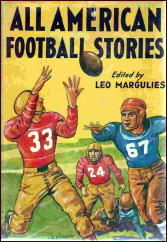
All American Football Stories, edited by Leo Margulies (Cupples & Leon, 1949).

MICHELLE NOLAN

While the Crowd Cheers, edited by David C. Cooke (E. P. Dutton, 1953)

   Michelle also calls The Argosy Book of Sports Stories edited by Rogers Terrill “wonderful,” but these came from the time when Argosy was a men’s adventure magazine, not a pulp. Buy the hardback (A. S. Barnes, 1953) because the paperback (Pennant P-61, 1954) cuts five stories.

HERBERT FLOWERDEW – The Villa Mystery. Brentano’s, US, hardcover, 1912. First published in the UK: Stanley Paul, 1912. Serialized in The Cavalier, May 24 through June 21 1913. Also available online here and in various POD editions.

   Before I discovered this book online and in various Print on Demand editions, I saw the title and author in this blog’s recent checklist of “Serials from Argosy Published As Books” and found a copy of the Brentano’s hardcover edition without too much difficulty. For less than twenty dollars in fact, which is one heck of a lot cheaper than finding a complete set of the five issues of The Cavalier which it appeared in.

HERBERT FLOWERDEW The Villa Mystery

   Of course, it does me no good to brag about this, not when you can read it online for free.

   But should you? Can an obscure mystery or detective novel written in 1912 be worth the time and effort? My answer’s yes, given certain conditions, and I’m about to tell you why.

   The story’s definitely an old-fashioned one – how could it not be? – and if you have an allergy to old-fashioned stories, you might as well stop reading this review right now. It begins with a young girl, totally destitute, making her way to a former friend of her dead father, a wealthy man who has refused to repay a loan.

   But now that she has found the IOU, which had gone missing, she hopes to persuade him to repay his debt — but he refuses to listen to her, requiring her to return in the morning. He has no time to listen to her now. She leaves, but then returns to watch through the window of the study where she saw him earlier before entering once again, leaving the IOU and making off with a suitcase of money she has decided is rightfully hers.

   In making her way back to the train station, however, she is accosted by one man and rescued by another. In the way that the world worked back in 1912, the latter is the stepson of the man whose debt to Elsa Armandy has been repaid in such an unorthodox fashion.

   In another of the ways that the world worked back in 1912, Nehemiah Grayle is soon found dead, possibly a suicide (or so the butler claims) but more probably not. Compounding Esmond Hare’s deepening dilemma, for he believes the girl’s story (and she is most attractive) is that to remove her from suspicion means incriminating his own mother, now estranged from the dead man.

HERBERT FLOWERDEW The Villa Mystery

   There is a local detective in charge of the case, but it is on Hare’s shoulders that solving the crime falls. But this is a story of romance as much as it is one of detective work, with much missing of connections as the characters move here and there and do not stay where they are supposed to stay, mostly because of revelations and stories not quite believed or not told in timely enough fashion.

   And all the while staying out of the hands of the police, especially Elsa, but Esmond also, who fears he may say and reveal too much if he is questioned further.

   Delicious, I say. They don’t write stories like this very much any more. But what’s even better is that there really are some even more delightful twists and turns in the detective side of things, including a final explanation which is really quite clever, almost as clever as one found in the best of the Golden Age of Detective stories.

   It’s just a little awkward in the telling, I have to confess, and there are some even clumsier aspects of the clues and what the characters make of them earlier on, in their naively old-fashioned way, so it’s with these caveats that I do recommend you read this one.

Bio-Bibliographic Notes: There are 16 books listed for the author in the Revised Crime Fiction IV, by Allen J. Hubin, but nine of them are indicated with a hyphen as being only marginally criminous.

   Herbert Flowerdew died in 1917 at the age of only 51. If he’d lived longer, perhaps he’d have taken this book as a stepping stone to a more significant mystery writing career, but that alas, we’ll never know.

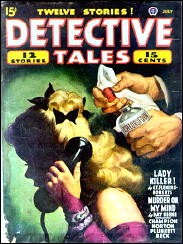
LADY CHASER. Producers Releasing Corporation, 1946. Robert Lowery, Ann Savage, Inez Cooper, Frank Ferguson. Based on the story “Lady Killer,” by G. T. Fleming-Roberts (Detective Tales, July 1945). Director: Sam Newfield.

G. T. FLEMING-ROBERTS

   It’s surprising, when you stop to think about it, that more movies weren’t based on stories that appeared in the pulp magazines, or at least those of the B-movie variety, either mysteries or westerns and even love stories.

   Both genres are based on quick action and minimal characterization, they’d be a natural for each other, and probably there are more adaptations than I’m thinking of, speaking off the top of head as I usually do when I sit down to write a review.

   A quick synopsis of Lady Chaser ought to be what I really begin with, seeing that there isn’t one on IMDB, nor any comments either, at the present time. The movie begins with two women writing letters across from each other in a room designed for that purpose in a downtown department store. One’s a blackmailer (Ann Savage), the other (Inez Cooper) is writing a letter to her fiancé (Robert Lowery).

   The latter has an uncle who’s opposed to the marriage, the former is, unfortunately, in over her head. The latter has a headache; the former gives her an aspirin. The latter gives the aspirin, unused, to her uncle, who dies. The aspirin was poisoned.

   You can figure out what happened, can’t you? And so can the fiancé, eventually, only he can’t prove anything, nor can he can convince the dunderheaded head of homicide (Ralph Dunn) that there’s anything to her story, and with the lack of a better one, she’s quickly convicted of the crime. Amateur detective work is always better than that of the police, in stories like this.

   There are a surprising number of twists that occur in Lady Chaser, especially when you consider that it’s only 58 minutes long. The problem is that to get to the twists there are some awfully creaky plot devices that have to be swallowed whole, or if not, there’s no other alternative but to throw up your hands and say Enough.

   I’d also have tried to conceal the killer’s identity a little while longer, but neither can I think of a way to avoid it, so we’ll have to call that a draw. My recommendation, if this movie should ever come your way, is to simply sit back and enjoy it, warts and all.

NOTES:   Previously reviewed on this blog was The Limping Man, by Frank Rawlings, a pen name of G. T. Fleming-Roberts.

   For a complete bibliography of Fleming-Roberts, including several articles and reviews, check out this page on the primary Mystery*File website.

Serials from ARGOSY published as books
by Denny Lien.


   Nobody [has] mentioned having seen this data reprinted anywhere, and it seemed too interesting to leave unreprinted. So I managed to obtain photocopies of both lists [as published in ARGOSY] and have transcribed the information below. I did change format (using a slash rather than ellipses to separate author and title, using ibid rather than ditto marks, and in the case of the first list moving the asterisk indicators from before title to after title) but did not make any corrections to the actual authors and titles as listed.

   Though I’ll note here that The Single Track appears both as by “Grant Douglas” and “Douglas Grant” — the latter is correct, though in any case this was a pseudonym for Isabel Ostrander.) I also noted after the fact that my original statement that the first list did not include work from GOLDEN ARGOSY was incorrect.

   While the lists speak of “serials,” I notice a few examples where the books were actually derived from story collections or from complete-in-one-issue novels (most obviously Tarzan of the Apes). The asterisk codes in the first list, indicating the book was then in print, were not used in the second.

          — Denny Lien / U of Minnesota Libraries.    [This compilation first appeared on the FictionMags Yahoo list.]


From the December 30, 1933 “Argonotes,” pp. 140-144

**********

410 ARGOSY BOOKS

At least four hundred ten serials which appeared in ARGOSY, ARGOSY-ALLSTORY, and ALLSTORY were later published in book form. Probably many more have not yet been included, and can be added later to this list which includes several we had not previously announced.

Of the following tales, those with two asterisks (**) are known to be still available in the $2.00 editions in this category; those with one asterisk (*) are available in the 75 cent editions.

ARGOSY AND ARGOSY ALLSTORY

Achmed Abdullah / The Man on Horseback
ibid / The Trail of the Beast
ibid / The Mating of the Blades *
Eustace L. Adams / Gambler’s Throw
Stookie Allen / Men of Daring (50 cents) *
Larry Barretto / To Babylon *
H. Bedford-Jones / The Gate of Farewell
ibid / John Solomon, Super-Cargo
ibid / Cyrano
ibid / The King’s Pardon **
Jack Bechdolt / South of Fifty-Three
Max Brand / The Guide to Happiness
ibid / Gun Gentlemen
ibid / Senor Jingle Bells *
ibid / His Third Master
ibid / Kain
ibid / The Stranger at the Gate
ibid / Tiger
ibid / Black Jack
ibid / The Garden of Eden
ibid / The Night Horseman *
ibid / The Seventh Man *
ibid / Dan Barry’s Daughter *
ibid / The Longhorn Feud **
George J. Brent / Voices
Loring Brent / Peter the Brazen
ibid / No More a Corpse **
John Buchan / The Three Hostages
Charles Neville Buck / Flight in the Hills
ibid / A Gentleman in Pajamas
Edgar Rice Burroughs / The Chessmen of Mars *
ibid / Tarzan the Terrible *
ibid / Tarzan and the Golden Lion *
ibid / Tarzan and the Ant Men *
ibid / The Bandit of Hell’s Bend *
ibid / The Moon Maid *
ibid / The War Chief *
ibid / Apache Devil **
ibid / Tarzan and the City of Gold **
Evelyn Campbell / The Knight of Lonely Land
Stanley Hart Cauffman / The Ghost of Gallows Hill
Robert Orr Chipperfield / Above Suspicion
ibid / Bright Lights
Arthur Hunt Chute / Far Gold
John Boyd Clarke / Findings Is Keepings
Frank Condon and Charlton R. Edholm / The Dancing Doll
Courtney Ryley Cooper / Caged
S.R. Crockett / Hal o’ the Ironsides
Ray Cummings / The Sea Girl
ibid / The Man Who Mastered Time *
Captain A.E. Dingle / Gold Out of Celebes
E. and J. Dorrance / Flames of the Blue Ridge
Grant Douglas / The Single Track
H.S. Drago and Joseph Noel / Whispering Sage
Harry Sinclair Drago / Following the Grass
ibid / The Snow Patrol
ibid / Smoke of the .45
ibid / Out of the Silent North
J. Allen Dunn / The Death Gamble
J. Breckenridge Ellis / The Picture on the Wall
Laurie York Erskine / The Confidence Man *
ibid / The Coming of Cosgrove *
ibid / The Laughing Rider *
ibid / Valor of the Range *
Hulbert Footner / A Self-Made Thief *
ibid / Officer!
ibid / Gentlman Roger’s Girl
ibid / The Velvet Hand *
ibid / Queen of Clubs *
ibid / Madame Storey
ibid / The Under Dogs *
ibid / The Doctor Who Held Hands *
ibid / Easy to Kill *
W. Bert Foster / From Six to Six *
David Fox / The Doom Dealer
ibid / The Handwriting on the Wall
ibid / Ethel Opens the Door
Edgar Franklin / White Collars
W.A. Fraser / Caste
Oscar J. Friend / Click of the Triangle T *
ibid / The Mississippi Hawk *
ibid / The Range Maverick *
Sinclair Gluck / Red Emeralds
John Goodwin / The Sign of the Serpent
Douglas Grant / Two-Gun Sue *
ibid / The Single Track
ibid / The Fifth Ace
ibid / Booty
Zane Grey / The Rainbox Trail *
ibid / The Lone Star Ranger *
Augusta Groner and Grace Isabel Colbron / The Lady in Blue
Katherine Haviland-Taylor / Yellow Soap
Arthur Preston Hankins / Cavern Gold
James B. Hendryx / Prairie Flower
ibid / Without Gloves *
ibid / Snowdrift *
John Holden / Prairie Shock *
Rupert Sargent Holland / The Mystery of the Opal
Fred Jackson / The Third Act
George M. Johnson / The Gun-Slinger
ibid / Squatter’s Rights *
ibid / Trouble Ranch
ibid / Riders of the Trail *
ibid / Jerry Rides the Range **
ibid / Tickets to Paradise **
ibid / Spyglass Range **
Rufus King / North Star *
Otis Adelbert Kline / The Planet of Peril
ibid / Maza of the Moon
ibid / The Prince of Peril
Slater LaMaster / The Phantom in the Rainbow
Harold Lamb / Marching Sands
A.T. Locke / Hell Bent Harrison *
Francis Lynde / David Vallory
Fred MacIsaac / The Vanishing Professor
ibid / The Hole in the Wall
ibid / The Mental Marvel
F.v.W. Mason / Captain Nemesis **
Johnston McCulley / The Mark of Zorro
ibid / The Further Adventures of Zorro
Lyon Mearson / The Whisper on the Stair
A. Merritt / The Ship of Ishtar
ibid / Seven Footprints to Satan
ibid / The Face in the Abyss
ibid / The Dwellers in the Mirage **
ibid / Burn, Witch, Burn! **
Mulford, Clarence E. / Hopalong Cassidy Returns *
ibid / Hopalong Cassidy’s Protege *
Talbot Mundy / Ho! for London Town
ibid / When Trails Were New
George Washington Ogden / Claim Number One
ibid / Trail’s End
ibid / The Duke of Chimney Butte
ibid / The Flockmaster of Poison Creek
ibid / A Man from the Badlands **
Frederic Ormond / The Three Keys
Isabel Ostrander / McCarthy Incog *
ibid / Dust to Dust *
ibid / Annihilation *
ibid / How Many Cards
ibid / Mathematics of Guilt
ibid / Liberation
Frank L. Packard / Pawned *
ibid / The Four Stragglers *
ibid / The Locked Book *
ibid / The Big Shot *
ibid / The Gold Skull Murders *
ibid / The Hidden Door **
ibid / The Purple Ball **
Lawrence Perry / Holton of the Navy
Kenneth Perkins / Strange Treasure
ibid / The Beloved Brute
ibid / The Gun Fanner
ibid / Gold *
ibid / Voodoo’d *
ibid / The Moccasin Murders *
ibid / The Canon of Light *
ibid / Ride Him, Cowboy *
ibid / The Discard
ibid / Starlit Trail
ibid / Wild Paradise
E.J. Rath / Mr. 44
ibid / Sam
ibid / The Nervous Wreck
Victor Rousseau / Wooden Spoil
ibid / The Big Muskeg
John Schoolcraft / The Bird of Passage
Charles Alden Seltzer / Lonesome Ranch *
ibid / The Trail Horde *
ibid / The Vengeance of Jefferson Gawne *
ibid / The Ranchman *
ibid / Beau Rand *
ibid / Drag Harlan *
ibid / Square Deal Sanderson *
ibid / The Way of the Buffalo *
ibid / Channing Comes Through *
ibid / Brass Commandments *
ibid / The Gentleman from Virginia *
ibid / Last Hope Ranch *
ibid / The Valley of the Stars *
ibid / Land of the Free *
ibid / Mystery Range *
ibid / The Mesa *
ibid / The Raider *
ibid / The Red Brand *
ibid / Gone North *
ibid / Double Cross Ranch *
ibid / War on Wishbone Range **
ibid / Clear the Trail **
George C. Shedd / The Invisible Enemy
ibid / In the Shadow of the Hills
Perley Poore Sheehan / Apache Gold
Garret Smith / I Did It *
Raymond S. Spears / The Flying Coyotes *
Louis Lacy Stevenson / Big Game
Charles B. Stilson / A Cavalier of Navarre
ibid / The Ace of Blades
T.S. Stribling / East is East
ibid / Blackwater
Albert Payson Terhune / Black Wings
ibid / Blundell’s Last Guest *
Lee Thayer / That Affair at “The Cedars”
Louis Tracy / The Passing of Charles lanson
W.C. Tuttle / The Silver Bar Mystery **
Stanley Waterloo / A Son of the Ages
Don Waters / The Call of Shining Steel *
ibid / Pounding the Rails *
Carolyn Wells / The Vanishing of Betty Varian
ibid / The Man Who Fell Through the Earth
ibid / More Lives Than One
ibid / The Bronze Hand
William Patterson White / The Buster *
Frank Williams / The Harbor of Doubt
George F. Worts / The Silver Fang
ibid / Who Dares *
ibid / The Blacksander *
ibid / Red Darkness
ibid / The Haunted Yacht Club

ALLSTORY AND ALLSTORY-CAVALIER

Achmed Abdullah / The Blue-Eyed Mandarin
ibid / Bucking the Tiger
ibid / Night Drums *
ibid / The Red Stain
ibid / Wings
Robert Aitken / The Golden Horseshoe
John Charles Beecham / The Argus Pheasant
Leslie Burton Blades / Claire
Earl Wayland Bowman / The Ramblin’ Kid
Cyris Townsend Brady / Britton of the Seventh
ibid / The Eagle of the Empire
ibid / The Patriots
Max Brand / Trailin’ *
ibid / The Untamed *
John Buchan / Salute to Adventurers *
ibid / The Thirty-Nine Steps
Charles Neville Buck / Destiny
ibid / When Bercat Went Dry
Edgar Rice Burroughs / The Beasts of Tarzan *
ibid / The Gods of Mars *
ibid / The Mucker *
ibid / A Princess of Mars *
ibid / The Son of Tarzan *
ibid / Tarzan and the Jewels of Opar *
ibid / Tarzan of the Apes *
ibid / Tarzan the Untamed *
ibid / Thuvia, Maid of Mars *
ibid / The Warlord of Mars *
ibid / Pellucidar *
ibid / The Mad King *
ibid / The Eternal Lover *
ibid / The Cave Girl *
ibid / At the Earth’s Core *
ibid / The Monster Men *
Octavus Roy Cohen / The Crimson Alibi
ibid / Gray Dusk
Will Levington Comfort / The Yellow Lord
Ridgwell Cullum / The Way of the Strong
Ray Cummings / The Girl in the Golden Atom
Charles Belmont Davis / Nothing a Year
George Dilnot / Suspected
Ethel and James Dorrance / Glory Rides the Range
George Allan England / The Alibi
ibid / Cursed
ibid / The Flying Legion
ibid / Pod, Bender & Co.
Jacob Fisher / The Quitter
A.H. Fitch / The Breath of the Dragon
Hulbert Footner / The Deaves Affair
ibid / The Fur Bringers
ibid / The Owl Taxi
ibid / The Huntress
ibid / The Sealed Valley
ibid / The Substitute Millionaire
ibid / The Woman from Outside
ibid / On Swan River
ibid / The Fugitive Sleuth
ibid / The Chase of the Linda Belle
David Fox / The Shadowers
Edgar Franklin / In and Out
ibid / Comeback
Arnold Fredericks / The Film of Fear
R. Austin Freeman / A Silent Witness *
Allen French / Hiding Places
Frank Froest / The Maelstrom
J.U. Giesy / Mimi
George Gilbert / Midnight of the Ranges
Jackson Gregory / The Joyous Troublemaker
ibid / Ladyfingers
ibid / The Short Cut
ibid / Six Feet Four
ibid / Wolf Breed
Zane Grey / The Border Legion *
Thomas W. Hanshew / The Riddle of the Night
Horace Hazeltine / The City of Encounters
James B. Hendryx / The Gold Girl
ibid / The Gun-Brand
ibid / The Promise
ibid / The Texan *
C.C. Hotchkins / Maude Baxter
ibid / The Red Paper
Eleanor Ingram / A Man’s Hearth
Jeremy Lane / Yellow Men Asleep
Henry Leverage / Where Dead Men Walk
Natalie Sumner Lincoln / The Moving Finger
ibid / The Red Seal
Francis Lynde / Branded
Johnson McCulley / Broadway Bab
ibid / Captain Fly-by-Night
Everett MacDonald / The Red Debt
Grace Sartwell Mason / The Golden Hope
E.K. Means / E.K. Means
ibid / More E.K. Means
ibid / Further E.K. Means
A. Merritt / The Moon Pool
Philip Verrill Mighels / Hearts of Grace
George Washington Ogden / The Rustler of Wind River
ibid / Steamboat Gold *
E. Phillips Oppenheim / The Curious Quest *
William Hamilton Osborne / The Catspaw
Isabel Ostrander / Ashes to Ashes
ibid / The Clue in the Air
ibid / Suspense
ibid / The Twenty-Six Clues
Frank L. Packard / The Beloved Traitor
ibid / From Now On *
ibid / The Sin That Was His
Randall Parrish / Comrades of Peril
ibid / Contraband
ibid / The Devil’s Own
ibid / The Strange Case of Cavendish
William MacLeod Raine / The Big Town Roundup
ibid / The Sheriff’s Son
E.J. Rath / Too Many Crooks
ibid / Too Much Efficiency
Mary Roberts Rinehart / The Circular Staircase *
ibid / The Man in Lower Ten *
C.A. Robbins / The Unholy Three
Charles G.D. Roberts / Jim
Lee Robinet / The Forest Maiden
C. MacLean Savage / The Turn of the Sword
John Reed Scott / The Man in Evening Clothes
Garrett P. Serviss / A Columbus of Space
Perley Poore Sheehan / The House With a Bad Name
ibid / If You Believe It, It’s So
ibid / The Passport Invisible
ibid / Those Who Walk in Darkness
Perley Poore Sheehan and Robert H. Davis / We Are French!
Robert Simpson / The Bite of Benin
ibid / Swamp Breath
Martha M. Stanley / The Souls of Men
Jack Steele / The House of Iron Men
Elizabeth Sutton / Dead Fingers
Albert Payson Terhune / Dad
ibid / The Unlatched Door
Harold Titus / Bruce of the Circle A
ibid / I Conquered
Louis Tracy / His Unknown Wife
Varick Vanardy / The Lady of the Night Wind
ibid / Something Doing
ibid / The Two-Faced Man
Louis Joseph Vance / The Black Bag
ibid / The Bronze Bell
Charles Edmonds Walk / The Paternoster Ruby
Ann Warner / The Tigress
Carolyn Wells / The Curved Blades
ibid / Faulkner’s Folly
ibid / Vicky Van
ibid / Raspberry Jam
Frank Williams / The Harbor of Doubt
C.N. and A.M. Williamson / Everyman’s Land
ibid / A Soldier of the Legion

ARGOSY AND GOLDEN ARGOSY (Juvenile)

Horatio Alger, Jr. / Do and Dare
ibid / Hector’s Inheritance
ibid / The Store Boy
ibid / work and Win
ibid / Helping Himself
ibid / Facing the World
ibid / In a New World
ibid / Struggling Upward
ibid / Bob Burton
ibid / The Young Acrobat
ibid / Dean Dunham
ibid / Luke Walton
ibid / Five Hundred Dollars
ibid / Driven from Home
ibid / The Erie Train Boy
ibid / Tom Turner’s Legacy
ibid / Walter Sherwood’s Probation
ibid / Digging for Gold
ibid / Debt of Honor
ibid / Jed
ibid / Chester Rand
ibid / Lester’s Luck
ibid / Rupert’s Ambition
ibid / The Young Salesman
ibid / Andy Grant’s Pluck
ibid / A Cousin’s Conspiracy
George H. Coomer / Boys in the Forecastle
Edward S. Ellis / Arthur Helmuth
ibid / Check No. 2134
G.A. Henty / Facing Peril
Frank A. Munsey / A Tragedy of Errors
ibid / The Boy Broker
ibid / Under Fire
ibid / Afloat in a Great City
ibid / Harry’s Scheme
Matthew White, Jr. / Eric Dane
ibid / The Adventures of a Young Athlete
ibid / My Mysterious Fortune
ibid / The Young Editor
ibid / The Tour of a Private Car
ibid / Guy Hammersley

**********************
**********************

From the June 23, 1934 “Argonotes, ” pp. 141-144

*********************

660

Thanks to the cooperation of readers Dale Morgan, R.L. Rocklin, and Julius Schwartz, and by further search of our own records, we have located more books from ARGOSY serials.

From ARGOSY alone, at least 368 books have been made. And in the other half of the ARGOSY–ALLSTORY WEEKLY — ALLSTORY — there were 195 books. For the first time we have made a list of CAVALIER books before its merger with ALLSTORY — 76 books, plus eight more in OCEAN and SCRAP BOOK which were merged with it. And there were 13 books from RAILROAD MAN’S MAGAZINE, merged with ARGOSY. 563 books from ARGOSY and ALLSTORY alone — and a grand total of 660 books serialized in the magazines which made up to-day’s ARGOSY!

Six hundred and sixty books since ARGOSY was founded in 1882. We’d be surprised if any other magazine can come within several hundreds of that total. And ARGOSY goes on — we know of several recent serials now on the book publishers’ presses, soon to be announced.

The following books were not included in the 410 listed Dec. 30 (a list which included several duplications and errors, all cancelled in totaling our 660):

ARGOSY

Frank Aubrey / A Queen of Atlantis
Edwin Baird / The Heart of Virginia Keep
Richard Barry / The Big Gun
Nalbro Bartley / The Whistling Girl
St. Clair Beall / The Winning of Sarenne
H. Bedford-Jones / The Seal of John Solomon
Arnold Bennett / The Grand Babylonian Hotel
Robert Ames Bennet / Sunnie of Timberline
Max Brand / The Sword Lover
Edgar Rice Burroughs / Pirates of Venus
H.D. Chetwode / John of Strathbourne
William Wallace Cook / The Fateful Seventh
ibid / The Eighth Wonder
ibid / The Desert Argonaut
ibid / The Sheriff of Broken Bow
ibid / An Innocent Outlaw
ibid / Jim Dexter, Cattleman
ibid / The Gold Gleaners
ibid / In the Wake of the Simitar
ibid / A Round Trip to the Year 2000
ibid / Cast Away at the Pole
ibid / Adrift in the Unknown
ibid / Marooned in 1492
ibid / The Cats-Paw
ibid / At Daggers Drawn
ibid / Rogers of Butte
ibid / The Spur of Necessity
W. Carleton Daws / The Voyage of the Pulo Way
Burford Delanncy / The Midnight Special
J. Allan Dunn / The Isle of Drums
ibid / A Man to His Mate
ibid / Fortune Unawares
Knarf Elivas / John Ship, Mariner
J.S. Fletcher / The Double Chance
Edgar Franklin / Mr. Hawkins’ Humorous Adventures
John Frederick / Luck
ibid / Pride of Tyson
Thomas Griffiths and Armstrong Livingston / The Ju-Ju Man
John H. Hamlin / Range Rivals
Donald Bayne Hobart / The Whistling Waddy
J.M. Hoffman / Six-Foot Lightning
Fred Jackson / The Diamond Necklace
George M. Johnson / Texas Range Rider
Rufus King / Whelp of the Winds
William Le Quieux / An Eye for an Eye
Henry Leverage / The Purple Limited
Will Levinrew / The Poison Plague
Fred MacIssac / Burnt Money
Arthur W. Marchmont / When I Was Czar
ibid / By Right of Sword
ibid / A Dash for a Throne
Edison Marshall / The Tiger Trail
Wyndham Martyn / The Mysterious Mr. Garland
William Stevens McNutt / The Endless Chain
Elizabeth York Miller / The Greatest Gamble
William D. Moffat / The Crimson Banner
ibid / Not Without Honor
Sinclair Murray ./ The Crucible
George Washington Ogden / The Ghost Road
ibid / The Trail Rider
ibid / The Well Shooters
John Oxenham / God’s Prisoner
Max Pemberton / The Phantom Army
Kenneth Perkins / Fast Trailin’
ibid / The Devil’s Saddle
Frank Lillie Pollock / Frozen Fortune
William MacLeod Raine / Steve Yeager
ibid / Moran Beats Back
E.J. Rath / Gas–Drive In
John P. Ritter / The Man Who Dared
Victor Rousseau / The Big Man of Bonne Chance
ibid / The Golden Horde
ibid / My Lady of the Nile
ibid / Mrs. Aladdin
Edwin L. Sabin / The Rose of Santa Fe
Frank Savile / Beyond the Great South Wall
F.K. Scribner / The Secret of Frontellac
Charles Alden Seltzer / Slow Burgess
ibid / Trailing Back
Garrett P. Serviss / The Moon Maiden
Perley Poore Sheehan / Three Sevens
Garret Smith / Between Worlds
Georges Surdez / Swords of the Soudan
W.C. Tuttle / Bluffer’s Luck
C.C. Waddell / Midnight to High Noon
Frank Williams / The Wilderness Trail

ARGOSY (Juveniles)

Harry Castlemon / Don Gordon’s Shooting Box
Edward S. Ellis / The Last Trail
ibid / Campfire and Wigwam
ibid / Footprints in the Forest
ibid / The Camp in the Mountains
ibid / The Last War Trail
ibid / Red Eagle
ibid / Blazing Arrow
W. Bert Foster / In Alaskan Waters
ibid / Arthur Blaisdell’s Choices
ibid / A Lost Expedition
ibid / The Treasure of South Lake Farm
ibid / The Quest of the Silver Swan
William Murray Graydon / With Cossack and Convict
Oliver Optic / Making a Man of Himself
ibid / Every Inch a Boy
ibid / Always in Luck
ibid / The Young Pilot
ibid / The Cruise of the Dandy
ibid / The Young Hermit
ibid / The Prisoners of the Cave
ibid / Among the Missing
Edward Stratemeyer / Reuben Stone’s Discovery
ibid / True to Himself
ibid / Richard Dare’s Venture

ALL-STORY (Merged with ARGOSY as THE ARGOSY ALL-STORY WEEKLY)

Achmed Abdullah / A Buccaneer in Spats
ibid / The Honourable Gentleman and Others
Achmed Abdullah, Max Brand, E.R. Means, and P.P. Sheehan / The Ten-Foot Chain
Edwin Baird / The City of Purple Dreams
H. Bedford-Jones / Loot
ibid / A Three-Fold Cord
John Charles Beechams / The Yellow Spider
Max Brand / The Children of Night
ibid / Clung
ibid / Who Am I?
ibid / Fate’s Honeymoon
J. Storer Clouston / Two’s Two
William Wallace Cook / Thorndyke of the Bonita
ibid / Back from Bedlam
ibid / The Deserter
ibid / The Last Dollar
ibid / In the Web
ibid / The Goal of a Million
Capt. A.e. Dingle / The Island Woman
ibid / The Pirate Woman
Maurice Drake / The Ocean Sleuth
J.S. Fletcher / The Diamonds
Juliette Gordon-Smith / The Wednesday Wife
James B. Hendryx / The One Big Thing
Headon Hill / Sir Vincent’s Patient
Henry Leverage / The White Cipher
Frederick Ferdiand Moore / Sailor Girl
George Washington Ogden / The Bondboy
William MacLeod Raine / A Daughter of the Dons
E.J. Rath / The Brat
ibid / A Good Indian
ibid / Elope if You Must
ibid / Good References
ibid / Once Again
ibid / When the Devil Was Sick
C.A. Robbins / Silent, White, and Beautiful
Victor Rousseau / Jacqueline of Golden River
ibid / The Lion’s Jaws
ibid / Draft of Eternity
ibid / The Big Malopo
ibid / The Sea Demons
Perley Poore Sheehan / The Bayou Shrine
ibid / The Whispering Chorus
August Weissl / The Mystery of the Green Car
C.N. & A.M. Williamson / This Woman to This Man

CAVALIER (Merged with ALL-STORY as ALL-STORY-CAVALIER)

Frank R. Adams / Five Fridays
Arthur Applin / The Girl Who Saved His Honor
Robert Barr / Cardillac
Arnold Bennett / Hugo
Cyrus Townsend Brady / The Sword Hand of Napoleon
Victor Bridges / Another Man’s Shoes
Edgar Beecher Bronson / The Vanguard
Charles Neville Buck / The Portal of Dreams
ibid / The Call of the Cumberlands
Stephen Chambers / When Love Calls Men to Arms
Dane Coolidge / The Fighting Fool
F. Marion Crawford / The Undesirable Governess
Florence Crewe-Jones / The Inner Man
ibid / The Red Nights of Paris
James Oliver Curwood / Flower of the North
ibid / Isabel
Beulah Marie Dix / The Fighting Blade
Maurice Drake / The Salving of a Derelict
James Francis Dwyer / The White Waterfall
ibid / The Spotted Panther
George Allan England / The Golden Blight
ibid / Darkness and Dawn
Jacob Fisher / The Cradle of the Deep
Herbert Flowerdew / The Villa Mystery
Hulbert Footner / Jack Chanty
Arnold Fredericks / One Million Francs
ibid / The Ivory Snuff Box
ibid / The Blue Lights
ibid / The Little Fortune
Tom Gallon / As He Was Born
J.U. Giesy/ All for His Country
Rufus Gillmore / The Alster Case
John Goodwin / Without Mercy
Jackson Gregory / Under Handicap
ibid / The Outlaw
H. Rider Haggard / Morning Star
Forrest Halsey / The Stain
Horace Hazeltine / The Snapdragon
James B. Hendryx / Marquard the Silent
Maurice Hewlett / Brazenhead the Great
Fred Jackson / The Gripful of Trouble
Elizabeth Kent / Who?
William Le Queux / The Room of Secrets
James Locke / The Stem of the Crimson Dahlia
ibid / The Plotting of Frances Ware
Caroline Lockhart / The Full of the Moon
Harold McGrath / Pidgin Island
William Brown Maloney / The Girl of the Golden Gate
Philip Verrill Mighels / As It Was in the Beginning
Edward Bredinger Mitchell / The Shadow of the Crescent
Frederick Ferdinand Moore / The Devil’s Admiral
E. Phillips Oppenheim / Mr. Marx’s Secret
Isabel Ostrander (Lamb) / The Heritage of Cain
ibid / At 1:30
Frank L. Packard / Greater Love Hath No Man
William McLeod Raine / The Pirate of Panama
E.J. Rath / Something for Nothing
ibid / The Mantle of Silence
ibid / The Sky’s the Limit
Mary Roberts Rinehart / Where There’s a Will
Theodore Goodridge Roberts / Two Shall Be Born
ibid / Jess of the River
E. Serao / King of the Camorra
Garrett P. Serviss / The Second Deluge
Ralph Stock / Marama
Arthur Stringer / The Shadow
Alice Stuyvesant / The Hidden House
Louis Tracy / One Wonderful Night
Varick Vanardy / Alias the Night Wind
ibid / The Night Wind’s Promise
ibid / The Return of the Night Wind
Louis Joseph Vance / The Destroying Angel
ibid / The Day of Days
Henry Kitchell Webster / The Ghost Girl
John Fleming Wilson / The Princess of Sorry Valley

SCRAP BOOK and OCEAN (Merged with CAVALIER)

Robert Ames Bennet / Into the Primitive
Stephen Chalmers / A Prince of Romance
ibid / The Vanishing Smuggler
William Wallace Cook / Fools for Luck
ibid / A Deep Sea Game
ibid / Frisbie of San Antone
Albert Dorrington / The Radium Terrors
Crittendon Marriott / Isle of Dead Ships

RAILROAD MAN’S MAGAZINE (Merged with ARGOSY)

Harold Bindloss / By Right of Purchase
Max Brand / Harrigan
William Wallace Cook / Running the Signal
ibid / The Paymaster’s Special
ibid / Dare, of Darling & Co.
ibid / Trailing the Josephine
Emmet F. Harte / Honk and Horace
Johnston McCulley / A White Man’s Chance
Bannister Merwin / The Girl and the Hill
Randall Parrish / The Highway of Adventure
E.J. Rath / Let’s Go (Sixth Speed)
Victor Rousseau / Eric of the Strong Heart
Louis Joseph Vance / The Brass Bowl

« Previous PageNext Page »