Pulp Fiction


A MOVIE REVIEW BY DAVID L. VINEYARD:         


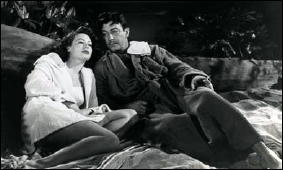
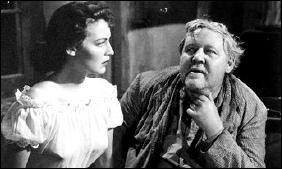
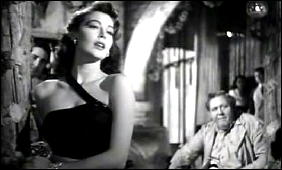
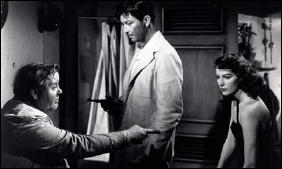
THE BRIBE Ava Gardner

THE BRIBE. MGM, 1949. Robert Taylor, Ava Gardner, Charles Laughton, Vincent Price, John Hodiak, John Hoyt, Samuel S. Hinds. Screenplay by Marguerite Roberts, based on a story by Frederick Nebel (Cosmopolitan, September 1947). Director: Robert Z. Leonard.

   This slick, well done film noir with a top notch cast may not be one of the greats of the genre, but it is an intelligent and handsomely done film with a top notch cast in attractive locations, plus a wonderfully sleazy portrayal by Charles Laughton as an opportunistic coward who almost lifts the movie far above itself.

   Robert Taylor is Rigby (“I never knew a crooked road could look so straight.”), a tough emotionally remote and cold hearted Federal agent sent to Central America to track down surplus WW II airplane parts that have gone missing (*) and are showing up places the government would rather they didn’t.

   Rigby’s only clue is the suspect Tugwell ‘Tug’ Hintten (John Hodiak) and his night club chanteuse wife Elizabeth (Ava Gardner), so he moves in on the couple and especially Gardner hoping to get close enough to find Hintten’s contacts.

THE BRIBE Ava Gardner

   But Rigby’s carefully polished armor begins to tarnish and show cracks under the powerful appeal of Elizabeth and the sensual tropical atmosphere.

   He discovers that there is more than one kind of bribe when he realizes that Hintten and the man behind him are using Elizabeth and the promise she offers to distract him and get him to turn his gaze away from their activities.

   Laughton is an expatriate, J. J. Beale, who attaches himself to Rigby like a leech, both gathering and selling information. It’s a superb little performance that stands out in this dark sweaty melodrama.

THE BRIBE Ava Gardner

   Vincent Price is Cardwell, a tourist who may be more involved than he seems. Not a great performance, but at the time Price specialized in these roles and did them with rare skill, and over the years Price played enough variations that you couldn’t always count on how his character would turn out, even when you were certain you knew going in.

   As Rigby grows more attracted to Elizabeth he is caught between his mission, her distrust of him. and the still open question of whether she is a victim or part of the plot. How loyal is she to Tug, her husband, and how far will she go to protect him even if she no longer loves him?

    Rigby: Look, why don’t you stop acting like you’re alone in the jungle?

    Elizabeth: I’m not?

    Rigby: OK, so you are, but you’d be surprised how nice the birds and the beasts can be if you’ll only give them a chance.

    Elizabeth: Tell me, Rigby, do you fly, walk on all fours…or crawl?

THE BRIBE Ava Gardner

   As Rigby gets closer to Elizabeth, and to betraying his mission for her, circumstances grow more desperate, and Tug begins to unravel under the pressure of his crimes and his dissolving marriage becoming a danger to his partners.

   The finale is a fine set piece set during Carnival, with a suspenseful and well staged shootout among the surging celebrating crowds in elaborate costumes. (Ironically it may remind you of a similar scene in Hodiak’s film Two Smart People set at Mardi Gras.)

   The Bribe is based on one of the few crime stories written by Black Mask alumnus Fred Nebel for the slicks, where he labored with notable success after the pulps died out as a regular along with Doc Savage creator Lester Dent.

THE BRIBE Ava Gardner

   (At the time the ‘slicks,’ as magazines such as The Saturday Evening Post and Colliers were called, actually paid better than selling a novel. Many writers works are largely lost to us since the major part of their output appeared in novella or novelette form in these now forgotten magazines, too long to be collected in most anthologies and too short to be published as a novel. As a result many highly successful writers are all but forgotten today because of the format and the market their work appeared in.)

   I admit I probably like this slick little noir film much better than it deserves. It is only superficial noir, lacking the raw qualities of many of the classics, but the leads are handsome and capable, the script taut and intelligent (though in some ways it is closer to silent melodrama than modern noir), and whenever Charles Laughton’s J.J. Beale is on screen, the film threatens to become something more than a good noirish thriller.

   The Bribe isn’t a noir classic by any means, but it is a capable A-film of its era and with that Laughton performance well worth catching.

THE BRIBE Ava Gardner

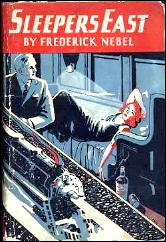
Note: Of course Fred Nebel is the legendary author of Sleepers East and the adventures of newsman Kennedy and his cop pal Captain Steve McBride. (For the movies Kennedy became a woman, Torchy Blaine, played by Glenda Farrell, Jane Wyman, and Lola Lane, with Barton MacLane and Paul Kelly among the Steve McBride’s.)

   He also penned the adventures of ruthless private eye tough Dick Donahue and the long running Cardigan series. Though many of his stories have been anthologized, his two novels have long been out of print, and his short fiction has been sadly neglected.

   There is one collection of the Donahue stories (Six Deadly Dames), one of the Cardigan stories (The Adventures of Cardigan), a few pulp story reprints, and sadly no collection of the Kennedy and McBride stories from Black Mask. Luckily his work appears in most noir anthologies and in The Black Lizard Big Book of Pulp Fiction an entire Kennedy and McBride serial from Black Mask is reprinted.

* For some reason this film always reminds me of Charles Leonard’s (M. V. Heberden aka Mary Heberden) Paul Kilgerrin books about a tough ruthless insurance investigator who appeared in Treachery in Trieste, Sinister Squadron, Secret of the Spa, and others.

Editorial Comment: The Bribe is scheduled to be shown next on TCM this coming Wednesday, May 5th, at 4 pm. It is also available from the Warner Archives site.

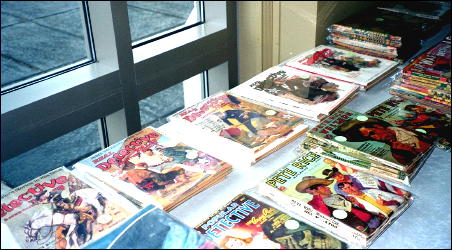
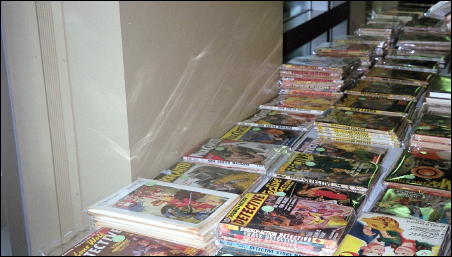
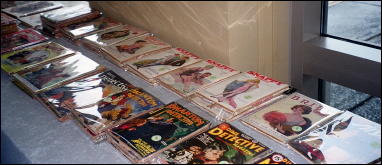
   The dealers room is, of course, the center of all activity at pulp conventions, whether it be Windy City or Pulpfest. If it’s your first visit, it’s a sight to see. For old-timers, it may be the smell of old musty paper that staggers the senses first:

WINDY CITY PULP SHOW 2010

WINDY CITY PULP SHOW 2010

WINDY CITY PULP SHOW 2010

   I don’t recognize any of the faces in these first three photos, but that’s Walker Martin’s back in the lowermost one (in the white T-shirt).

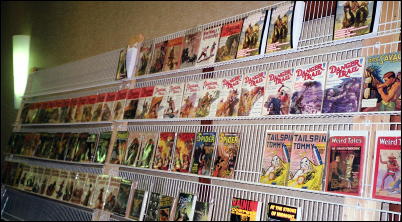
   The most jaw-dropping display was, as always, behind John Gunnison’s table. Nobody in the room had seen more copies of Danger Trail in one place at one time. Not only that, these were all in Very Good to Fine condition, if not better:

WINDY CITY PULP SHOW 2010

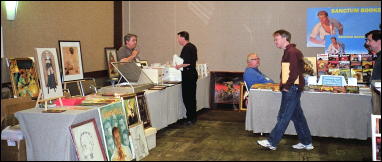
   Another shot of the room. That’s Nick Certo behind the table, making a deal (or small talk) with Paul Herman, whom I traveled to the show with.

WINDY CITY PULP SHOW 2010

   A better shot of Walker Martin, whose back you saw earlier above. I believe this was taken the day after the auction, where he outbid everyone on three large lots of romance or “love” pulps. This is what a collector looks like when he’s cornered the market on an entire category of pulp fiction:

WINDY CITY PULP SHOW 2010

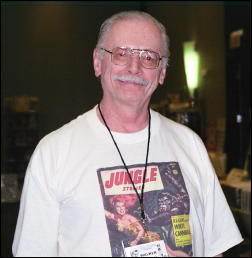
   Walker then obliged me by taking this photo of me:

WINDY CITY PULP SHOW 2010

   If you missed it, you can go back a few posts and read Walker’s report on the convention here.

   Here next are Gene Christie and Tom Roberts, the guys behind Black Dog Books. Gene forgot at the time that he’s no longer in my Squadron and he no longer has to salute me. I wish I’d managed to get some of the books they were selling into the photo:

WINDY CITY PULP SHOW 2010

   The first night’s auction was an estate sale, and the number and variety of scarce and hard-to-find pulps was significantly higher than there’s been in many years. First of all, a copy of the one-shot Underworld Love Stories, a magazine that most people had never seen before:

WINDY CITY PULP SHOW 2010

   I thought the magazine might sell for over a thousand dollars, but I was told that it went for only $720 or so. (If I’m wrong about this, I’m sure someone will let me know.)

   There was also a beautiful run of Real Detective Stories. I took two photos of these, hoping that at least one would come out:

WINDY CITY PULP SHOW 2010

WINDY CITY PULP SHOW 2010

   These were sold in several lots, each of which commanded a sizable stash of money. Next, a long run of Nick Carter pulps (not the dime novels) in very nice condition. Unfortunately I took only one photo of these, and you get a better glimpse of the spines, I’m afraid, rather than the covers:

WINDY CITY PULP SHOW 2010

   Both Snappy Stories and Breezy Stories were in good supply:

WINDY CITY PULP SHOW 2010

WINDY CITY PULP SHOW 2010

   Before heading off to the Art Room, I took a close-up photo of Paul Herman, last seen buying magic carpets from Nick Certo:

WINDY CITY PULP SHOW 2010

   And of course Paul demanded retribution, and he took this photo of me in return. You can see that Paul does not know how to take pictures, as I really do not ever look like this.

WINDY CITY PULP SHOW 2010

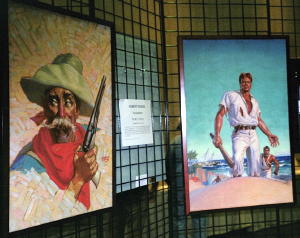
   The theme of the convention was the 100th anniversary of Adventure magazine. I failed to take any pictures during the panel discussion, but I did take several in the Art Room. All of original art on display came from Adventure or some of its several competitors. I also failed to take any notes on these, so I’m sorry I can’t tell you either the artists or the magazines:

WINDY CITY PULP SHOW 2010

WINDY CITY PULP SHOW 2010

WINDY CITY PULP SHOW 2010

   And all too sudden, the convention was over.

Con Report: WINDY CITY PULP & PAPERBACK SHOW, 2010
by Walker Martin

   I’m back from an eventful four days at the Windy City Pulp convention in Chicago. I got up Thursday at 4:00 am and met a fellow collector for the drive to Ed Hulse’s house where we packed boxes and pulp cover paintings into a 12 passenger van. Then four of us began the 14 hour drive to Chicago, which was completed in one insane burst of speed, with very few stops along the way. We arrived at 8:00 pm and headed for the hospitality room where the festivities were already in full swing. Thank god they had beer and potato chips.

   Despite some pre-con worries about attendance, there were over 400 registered attendees and around 125 tables, packed with pulps, pulp reprints, vintage paperbacks, old movies on dvd, and pulp artwork. Once again I was in pulp heaven and almost overdosed due to pulp fever. Among the people I saw and talked to were the following serious collectors:

   Nick Certo, Mike Chomko, Scott Cranford, Doug Ellis, Steve Haffner, Mark Halegua, Rick Hall, Scott Hartshorn, Paul Herman, Ed Hulse, Chris Kalb, Dave Kurzman, Steve Lewis, John Locke, Bill Mann, Rob Preston, Tom Roberts, David Saunders, Dave Scroggs, Tony Tollin, Al Tonik, Bill Ward, John Gunnison, Frank Robinson and Bob Weinberg. Too many to mention all and forgive me for those I have left out.

   In addition to thousands of pulps, there was the film program hosted by Ed Hulse, a panel discussing Adventure magazine, an art exhibit, and the auction. Not to mention the many meals and drinks shared with fellow collectors over the four intense and stressful days.

   The theme of the convention was Adventure‘s 100th birthday and it was a rousing success. The panel consisted of myself, Doug Ellis, Tom Roberts, and Ed Hulse. In a hour we attempted to cover just about every facet of the magazine’s incredible history: the editors, writers, artists, letter column, and as many other topics that we could think of.

   One thing that almost drove me crazy was the subject of picking one forgotten but excellent author. I couldn’t narrow it down to one and cheated by mentioning three: Leonard Nason, Hugh Pendexter, and Robert Simpson. Others mentioned were Georges Surdez and T.S. Stribling.

   The art exhibit concentrated on Adventure cover and interior art. Doug Ellis had many cover paintings on display and I brought five Adventure paintings to the exhibit. Tom Roberts and others also contributed. Frankly, I was so nervous about driving my paintings over 800 miles to Chicago that I was lucky to avoid a stroke. Only the honor of taking part in Adventure‘s birthday convinced me that I should display the paintings.

   The auction had an excellent number of rare and desirable pulps. I was stunned by the many rare and high quality condition Real Detective Tales. Many other detective titles were auctioned, including some fine condition copies of Nick Carter. One obviously crazed collector was high bidder on several lots of love pulps and the auctioneer gleefully poked fun at him. Several people questioned this demented soul as to why he was buying large amounts of love titles. He mumbled something about having collected everything else except love pulps.

   Something that I noticed was that there was no Guest Of Honor and no one seemed to notice this at all. I did not hear one single complaint and it certainly looks like such a lack is not a problem and has absolutely no impact on attendance. From what I observed, just about everyone was there to sell and buy pulp related items. The lack of a guest was not an important factor.

   The 14 hour drive back was done in another incredible burst of speed. How we managed to cram the big van with boxes, luggage, paintings, and four over-the-top collectors, is beyond me. Next stop PulpFest in Columbus, Ohio. Visit PulpFest.com and register, or you will miss the summer’s pulp collecting event of the year. Fellow readers and collectors, let’s support PulpFest and match the Windy City convention’s attendance of over 400!

   Those of you who are pulp collectors, and maybe even if you aren’t, you might want to take a look at a lengthy interview Laurie Powers did with Walker Martin on her blog, where many of the posts always seem to have something to do with either pulps or pulp collecting.

   Walker, of course, is an occasional contributor and a frequent commenter here on the Mystery*File blog, as regular visitors already know. Over on Laurie’s blog, the primary topic of their question and answer conversation is “My Favorite Pulps,” referring to Walker’s collection, but that’s just the starting point.

   Unfortunately Walker and I have known each other for 40 years, so I have to admit I knew all the answers he was going to give before he gave them, but it’s still interesting reading. Go, read, but do find your way back!

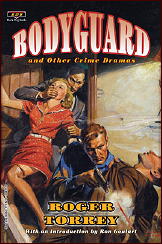
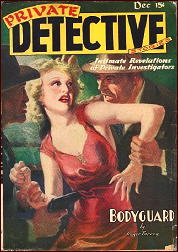
ROGER TORREY – The Bodyguard and Other Crime Dramas. Black Dog Books; trade paperback; 1st printing, 2009. Introduction by Ron Goulart.

ROGER TORREY

   Roger Torrey is probably not the first name you’d come up with if you were to start listing some well-known writers who wrote for the detective pulp fiction magazines, but in his day, he was one of the more prolific ones, and he traveled in high circles, with a considerable amount of his output in the 1930s being for one of the most prestigious of them all, Black Mask.

   Torrey wrote nearly 50 or so stories for that particular magazine, beginning in 1934 and continuing on to 1943, and one wishes that some of those could have been included in this particular collection. But alas, no. Even though this is a strikingly handsome volume, small press operations such as Black Dog Books do not have large budgets, and from all appearances the stories herein are all in the public domain.

   The magazines these stories were reprinted from, such as Romantic Detective, Private Detective and Super Detective, were not even of the second rank, as far as pulp magazines went. More like third or even fourth level, counting downward. Prestigious publications they were not.

ROGER TORREY

   I am sorry to have to tell you this. But not all is lost. Bodyguard is a handsome volume, as I mentioned before, and the stories that are in it were certainly among the best of the magazines they were in.

   Most of Torrey’s leading characters were private eyes, also a great big plus as far as I am concerned, but only a few of them have well-heeled clients or work for a big agency and have a steady job. Most of them seem to be struggling along in life as well as everybody else who inhabit these tales, and sometimes their clients have less money on hand than they do.

   One gets the feeling that Torrey’s characters live in the other end of town, and the stories he tells are earthier and closer to the ground than some of those by his contemporaries. One of the stories has a scene that is more than slightly risque, but otherwise the leading characters and the women they meet in these stories do what ordinary people do, casually but behind closed doors. Lots of hints, in other words, but nothing more than that.

ROGER TORREY

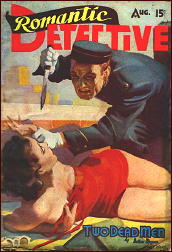
   The detective in “Two Dead Men” (Romantic Detective, August 1938) is a fellow named John Linehan, who in the course in telling this story reveals, without quite saying so, for example, that he’s been stepping out with his secretary on more than one occasion. It also is telling that she’s quite jealous when Lineham seems to be spending too much time in close proximity to a lady friend of his client, as they travels from party to nightclub and back again with his client and her boy friend.

   It seems as though she’s being blackmailed (her boy friend already has a wife) by someone who knows far too much about her, including the fact that she and the aforementioned boy friend were sharing a hotel room right next to one that from which a dead man jumped, falling not feet from Lineham, not working for Miss Morrison at the time.

ROGER TORREY

   It is a wonder that Lineham can solve the case, what with all of the heavy drinking that goes on in this story, but solve it he does. I’m not as sure of the “why” as he is, but I agree with the “who.” But readers of Romantic Detective were not so much interested in the detective end of things, I presume, and Torrey delivers what it was they were looking for.

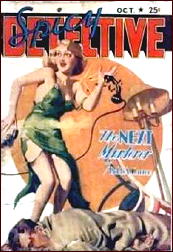
   Story number two is “Cook to Order” (Spicy Detective, October 1939), told by private eye George Andrews, who’s asked by a waitress in a place where he eats to find out what’s been bothering her roommate. Turns out that that’s just a ploy to get him over to her apartment, but as it turns out again, there actually is a case for “Andy” to solve.

   The plot is far too complicated for a story only ten pages long. The picture of tough living, dingy hash houses and bare-bones living quarters will stay with you a whole lot longer.

ROGER TORREY

   The title story, “Bodyguard” (Private Detective, December 1938) is one of the longer tales in the collection, almost forty pages long. It doesn’t mean that it’s one of the better ones, I admit, but it has it moments.

   The bodyguard in question is William Dugan, who hired by a man of some wealth when some threats against his life have escalated into actual shots being taken at him. To my mind, Bill is not much of a bodyguard, although in all honesty the beating death of a gardener can’t be held against him, since the incident happened before he showed up.

   Nor can the shooting of a deputy sheriff, since the man was hardly one of the family. But when the throat of one of Miles’s two daughters is found with her throat slit, you’d think he might be fired on the spot, but he manages to keep his job until the case is solved.

   The dead girl was the pure in faith one; the other, a honey blonde with the morals of a tramp is the one who’s all over Bill — picture one guy with a stiff arm out to stave off her advances, and you’ve got our detective pictured to a T. And naturally Angela is more than jealous when Bill takes up with the other good-looking woman who’s recently come to town — a platinum blonde who claims to be a reporter, but her newspaper has never heard of her.

   Bill checked — one of the better moves he makes.

ROGER TORREY

   This is as far I’m going to go. I’m sure you have the idea. There are eight more stories in this book, and I enjoyed them about as much as I did these first three. None of them is as good as Dashiell Hammett or Raymond Chandler, and maybe they’re not even half as good. On the other hand, who is?

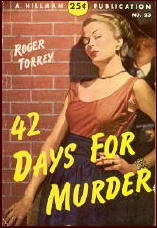
PostScript. Two more things. There is, first of all, a well-done checklist of all of Torrey’s pulp fiction that fills the last dozen pages of this book. (Torrey wrote only novel in his career — he died in early 1946 of acute alcoholism– that being 42 Days for Murder, published first by Hillman-Curl in 1938.)

   Secondly, if you are a pulp fiction fan of any vintage, old or new, you should also go visit the Black Dog Books website. They have a large number of other collections like this one already out or coming soon, including the one just above and to the right, and I recommend all of them to you very highly.

A 1001 MIDNIGHTS Review
by Bill Crider & Bill Pronzini:


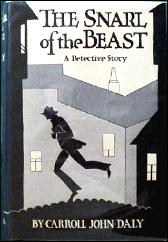
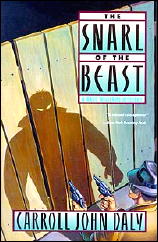
CARROLL JOHN DALY – The Snarl of the Beast. Edward J. Clode, 1927. Previously serialized in Black Mask, June-July-Aug-Sept, 1927. Hardcover reprint: Gregg Press, 1981. Trade paperback reprint: Harper Perennial, 1992.

CARROLL JOHN DALY Snarl of the Beast

   Carroll John Daly was one of the fathers of the modem hard-boiled private eye, a primary influence on such later writers as Mickey Spillane. His style and plots seem dated today, but the presence of his name on the cover of Black Mask in the Twenties and Thirties could be counted on to raise sales of the magazine by fifteen percent.

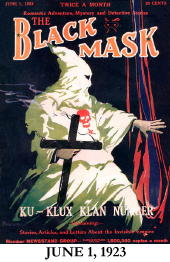
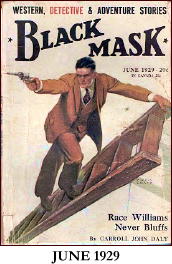
   Daly’s major contribution was Race Williams, the narrator of The Snarl of the Beast and the first fully realized tough-guy detective (his first appearance, in the June 1, 1923, issue of Black Mask, preceded the debut of Hammett’s Continental Op by four months).

   Williams was a thoroughly hard-boiled individual. As he says of one criminal he dispatches, “He got what was coming to him. If ever a lad needed one good killing, he was the boy.” Williams doesn’t hesitate to dole out two-gun, vigilante justice.

   The Snarl of the Beast has an uncomplicated plot: Williams is asked by the police to help track down a master criminal known as “the Beast” and reputed to be “the most feared, the cunningest and cruelest creature that stalks the city streets at night.”

   Williams is willing to take on the job and to give the police credit for ridding the city of this menace, just as long as he gets the reward. Along the way he meets a masked woman prowler, a “girl of the night,” and of course the Beast himself.

CARROLL JOHN DALY Snarl of the Beast

   Daly is not known for literary niceties — his style can best be described as crude but effective — yet there is a certain fascination in his novels and his vigilante/detective.

   Characterization is minimal and action is everything. “Race Williams — Private Investigator — tells the whole story. Right! Let’s go.”

   Race Williams also appears in The Hidden Hand (1929) and Murder from the East (1935), among others. Daly created two other series characters, both of them rough-and-tumble types, although not in the same class with Williams: Vee Brown, hero of Murder Won’t Wait (1933) and Emperor of Evil (1937); and Satan Hall, who stars in The Mystery of the Smoking Gun (1936) and Ready to Burn (1951), the latter title having been published only in England.

         ———
   Reprinted with permission from 1001 Midnights, edited by Bill Pronzini & Marcia Muller and published by The Battered Silicon Dispatch Box, 2007.   Copyright © 1986, 2007 by the Pronzini-Muller Family Trust.

Editorial Comment:   For a long expository commentary of the book as well as the author, see Mike Grost’s Classic Mystery and Detection website. Included is a breakdown of the novel into its singular parts as they appeared in Black Mask magazine.

Reviewed by DAVID L. VINEYARD:         


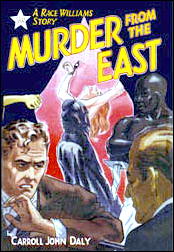
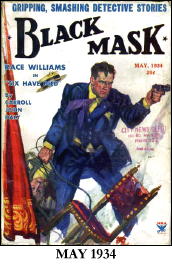
CARROLL JOHN DALY – Murder From the East. Frederick A. Stokes, hardcover, 1935. Previously serialized (as individual stories) in Black Mask, May-June, August 1934. Paperback reprint: International Polygonics, 1978.

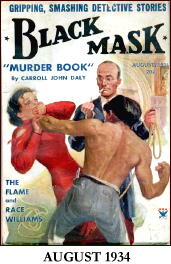
CARROLL JOHN DALY Race Williams

   Some books have everything — or nearly everything. Murder From the East is one of those. It has a bit of everything — the yellow peril, beautiful adventuresses, and tough guy private eyes.

   And as the latter goes, there was never anyone tougher than Race Williams. And if you don’t believe it, just ask him.

    “I just wanted to be sure that both your hands were occupied and that you were Race Williams. So — take that.”

    His right hand, that was under his jacket, flashed into view. For the moment the hard square surface of a black automatic showed; jerked up so that I looked down the blue barrel of a German Luger.

    Hard, red knuckles tightened and showed white. And — I shot him five times. Five times smack in the stomach, before he could ever squeeze the trigger.

    Surprised? He was amazed.

CARROLL JOHN DALY Race Williams

   So are we. But we shouldn’t be. Race Williams is the first private eye. True, Daly’s own Three Gun Terry Mack beat Race to the game, but Terry wasn’t a private eye, or a least never identified himself as one. He was an adventurer like Gordon Young’s tough gambler Don Everhard.

   Race is the first of his breed (not the first private detective, but the first in the hard-boiled mode) making his debut in the Ku Klux Klan issue of The Black Mask in “Knights of the Open Palm.” Some of the stories were pro Klan — Daly’s was anti.

   In Murder From the East Gregory Ford, who runs the biggest private detective agency in the city, is working for the government, and wants to hire Race to knock off a gunman who is gunning for Race anyway. But Race isn’t having any.

    “Same old Race,” he nodded. “Still trying to pose as a detective and not as a gunman.”

   But before the day is over the gunman has run down Race and met his just end. Then the man who hired the gunman shows up in Race’s office.

CARROLL JOHN DALY Race Williams

    Tall, thin, slightly bent at the shoulders and dressed to play the Avenue …His face! Well, it was pointed, with a sharp but certainly not protruding chin. I don’t know if it was the color of his skin or the peculiar narrowness of those yellowish brown eyes that gave the impression he was Oriental.

   His name is Count Jehdo, and he turns out to be from Astran, a country that is making trouble in Europe and Asia. He’s also involved in the “Torture Murders” the papers are screaming about.

   Pretty soon Race is in the pay of the General, the man behind Gregory Ford, and the trail leads Mark Yarrow, the man behind the torture murders and Astran’s crimes but even he doesn’t know about the Number 7 man, the General’s man inside the organization, and Race’s job is to destroy Yarrow while the Number 7 man brings down Jehdo.

   Then, who should show up but —

CARROLL JOHN DALY Race Williams

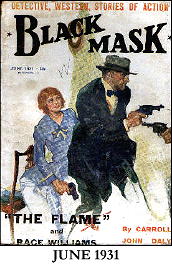
    “Florence!” I said. “Florence Drummond — the Flame!”

   The Flame and Race have been at this game for a while. She’s up to her neck in this new game and wants Race out of her way.

    “This racket,” she nodded and her lips were very thin; very set. “A billion dollar racket!” She came to her feet, walked across the room, pushed aside the curtains by the window, and stood there a moment. There was sarcasm in her words. “I was always one for romance, Race. Let us say a man took my hand, bent forward, kissed it and promised that the day would come when I would sit in the palaces of those who ruled the world.”

   But she has taken on more than a lover. She is now the Countess Jedho.

   The rest of the book precedes in a hail of gun smoke as Race thins the numbers of the organization and generally makes a nuisance of himself. He’s captured and tortured, but escapes thanks to the Flame and eventually smashes Yarrow and Jehdo and reveals the Number 7 man.

CARROLL JOHN DALY Race Williams

    “You made use of what you always make use of. It’s not your head; it’s the animal in you. The courage in you; the thing that drives you on. You’re licked — licked a dozen times, over and over. Everybody knows it but you! No, it’s not your head.”

   Much has been written about Daly’s shortcomings as a writer, and most of it is true, but what is also true is that he wrote at a sort of white hot level straight from the hip, like the hot lead pouring from is blazing .45’s, and for all the melodrama, cliches and corn, there is a conviction to his best work that few writers ever managed.

   In terms of style and literary considerations he is a pale shadow of Hammett and Chandler, and he could never plot or even created characters as well as Erle Stanley Gardner, but he was the most popular writer at the famed Black Mask, and his name on the cover drove sales up every month.

   Time passed Daly and Race by. For a time his tales of Satan Hall, a Dirty Harry style cop, surpassed Race, and Race eventually fell from the Mask to lesser pulps as Daly’s career sagged. By his death in the 1950’s his books couldn’t find an American publisher.

CARROLL JOHN DALY Race Williams

   For a time Race Williams and Carroll John Daly were kings of the hard-boiled private eyes. If they lacked the graces of the better writers they still offered their own brand of thrills and action, and in their wake marched the Dan Turner’s, Mike Hammer’s, and Shell Scott’s that followed. If nothing else Daly influenced Mickey Spillane, and in Spillane had a lasting impact on the genre.

   Race and his creator are fairly insubstantial figures now, but once they were giants, and traces of their footprints still leave a trail. Park a few of your critical judgments and you can still find a good deal of enjoyment in Race’s adventures.

   You may not applaud the writing, but you are likely to stay for the sheer entertainment. Perhaps more than many of the better writers from Black Mask, the true voice of the pulps thunders in the exploits of the one of a kind Race Williams.

Reviewed by DAVID L. VINEYARD:         


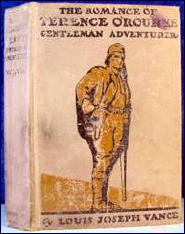
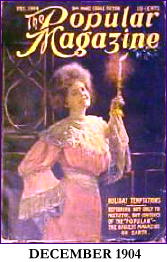
LOUIS JOSEPH VANCE – Terence O’Rourke, Gentleman Adventurer. A. Wessels Co., US, hardcover 1905. Reprinted as The Romance of Terence O’Rourke, Gentleman Adventurer: Bobbs-Merrill, US, hc, 1907; Grosset & Dunlap, no date (shown). Also: Grant Richards, UK, hc, 1906. Silent film: Universal, 1914. First appeared in The Popular Magazine, circa 1904-05. (See comments for additional information.)

   In 1904, ten years before he would pen the first adventure of Michael Lanyard, the Lone Wolf, Louis Joseph Vance was concerned with the adventures of another American in Paris, Colonel Terence O’Rourke, an American soldier of fortune, down on his luck and about to face a change of fortune.

   Now good reasons why a man may be out of sorts in a Paris springtime are few and far between; but they exist; O’Rourke had brought his with him … his supply of ready cash was not alarmingly low; it was nonexistent —

LOUIS JOSEPH VANCE Terence O'Rourke

   In short order he pawns a watch presented to him for bravery in a South American revolution, finds a casino, loses every penny, is challenged to a duel, pursued by a mob, and leaps into a carriage to escape — where he meets a beautiful woman, Beatrix, the Madame la Princess de Grandilieu, and by sheer luck — the kind of thing that was always happening to adventurers like ‘the O’Rourke’ — utters the secret password that leads her to believe he is the man she is supposed to meet.

   In the hands at a romancer like Vance, that’s all that is needed.

   O’Rourke learns her brother has plans to lead an army into the Sahara and make himself an emperor of the wastes… There is only one problem with his plan. The Emperor is a coward and a fool, known as ‘le petit Lemercier,’ the laughing stock of France for his foolish exploits.

    “Here,” he said, drawing O’Rourke’s attention to a spot on the west coast of the continent, “is Cape Bojador. Here again,” moving his finger a foot upon the coast line, “is Cape Juby. To the north lies Morocco; to the south lie the Spanish Rio de Oro possessions. But between the two capes is unclaimed land. There, messieurs, lies the land that shall become our Empire of the Sahara. There we shall establish and build up a country even greater than our France!”

   A grand scheme, one O’Rourke would likely by pass though if not for the beautiful Beatrix. He teams up with Daniel ‘Danny’ Mahone, once his batman, and takes command of the army of the Emperor of the Sahara. But no one asked the local nomadic bandits the Tawareks (Tuaregs).

    “They are the lords of the desert — inhabitants of the Sahara proper — a branch of the Berbers: perhaps the root-stock of the Berber family tree… They infest the caravan routes: in a word, they’re pirates, and rule the country with a rod of iron.

   Beatrix is kidnapped, and O’Rourke rides madly in the desert after her and her Tawarek captor…

    O’Rourke fired again, almost at random, risking everything, even the woman he loved, in the necessity of saving her from what was, if not death itself, worse than death.

   … her husband Prince Felix dies, and O’Rourke rescues the lady and leads a desperate battle, and bloody retreat.

   But he doesn’t get the girl. After all, she is a princess and he is a penniless adventurer — besides, his adventures were just beginning. Two sets of them flowed from Vance’s capable pen.

LOUIS JOSEPH VANCE Terence O'Rourke

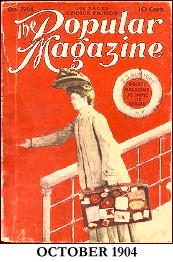
   O’Rourke adventured in the pages of The Popular Magazine where he wielded his sword and Mauser with deadly skill. After “The Empire of Illusion,” the series of stories which make up the tale comprising the first half of the book, he finds himself in a Ruritainian adventure rescuing a kidnapped prince and dueling an evil prince. After that he is discovered preventing a revolt against the British in Egypt.

   Always his fist, his sword, and his gun are quick to be employed in a good cause; always he just fails to make enough to reclaim his true loves hand; always he finds a new adventure.

   Beatrix, bless her, would have him anyway, but O’Rourke will not impoverish her. He’ll have a fortune for her or die trying. And he frequently comes perilously close to doing just that. Not that he is averse to other beautiful women. He’s loyal, not dead.

    “‘Tis yourself that would be the squire of dames is it, O’Rourke?” he said. “Faith, but it seems that ye will not. Let us go out and think about this thing — for, if ever a woman stood in need of a man’s strong arm … ’tis this countess, and upon this very night — I’m thinking.”

   Eventually he inherits one of those convenient fortunes from one of those equally convenient relatives that die and leave such fortunes in tales of adventure and romance, battles a deadly Duke on a vertiginous stairway, and sends him to hell through a doorway that leads only to a precipitous plunge a la David Balfour’s near fate in Kidnapped. He wins his ladies hand and lives happily ever after.

    Once she told him: “The frontier is not far, sweetheart. Once over that, beyond immediate pursuit, we will stop at an inn and summon a surgeon. Can you bear, O my dearest, to wait so long?”

    “I — Ah, faith! I could endure a thousand deaths — and yet live on — in your arms …”

LOUIS JOSEPH VANCE Terence O'Rourke

   Rudolph Rassendyll couldn’t have said it better to Princess Flavia while freeing the prisoner in the castle of Zenda.

   Of course Vance couldn’t keep a good man down, and O’Rourke returned in a prequel detailing his adventures with Danny before his fateful meeting in Paris. This was 1905 and only the Scarlet Pimpernel managed to keep adventuring after marriage. At least Beatrix was spared all those kidnappings suffered by Bulldog Drummond’s wife.

   The pleasures of O’Rourke’s adventures are many. Vance was a novelist before he was a pulpster, and his characters are fully developed human beings with believable motives, actions, and consequences for their actions. O’Rourke may be a pulp superman, but he is a believable superman, and his feats of heroism are just within the bounds of probability, and he is never better than when the odds are impossible and the moment is desperate.

   Terence O’Rourke, Gentleman Adventurer can be downloaded for free or read on-line at Google Books in PDF or EUPB format. A more detailed account of his life and adventures can be found in Robert Sampson’s Yesterday’ Faces: Violent Lives, Vol. 6 (Bowling Green University Press).

    O’Rourke was without food or water, without protection from the sun; he had nothing to depend on but this camel, his Mauser, and the high, bold heart of him.

   For us and O’Rourke that is enough. A sword, a gun, and the ‘high, bold heart of him.’ What more can an adventurer ask, even the armchair kind?

Editorial Comment:   For anyone wishing to read a contemporaneous review of this book, there is one online at The New York Times website. (A subscription may be required.)

   I have not yet confirmed them, but it seems likely that these are some of the stories that were combined to create the overall novel:

      In Which O’Rourke Serves the King (nv) The Popular Magazine Aug 1904
      In Which O’Rourke Saves a Throne (nv) The Popular Magazine Oct 1904
      In Which O’Rourke Pays a Debt (nv) The Popular Magazine Nov 1904
      In Which O’Rourke Sheathes His Sword (nv) The Popular Magazine Dec 1904

REVIEWED BY WALTER ALBERT:         


JAMES FRANCIS DWYER

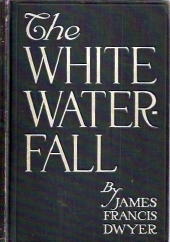
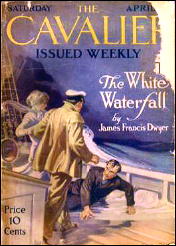
JAMES FRANCIS DWYER – The White Waterfall. Doubleday Page & Co., 1912; illustrated by Charles S.Chapman. W. R. Caldwell & Co., hc, International Adventure Library: Three Owls Edition. Serialized in The Cavalier in four parts, beginning 13 April 1912. Readily available in various Print on Demand editions and as an online etext.

   Australian writer Dwyer was a welcome regular in Blue Book Magazine in the 1930s, and this early South Seas adventure novel is a fine example of his robust, colorful narrative style.

   The remote, isolated island to which the characters travel, is thought to be uninhabited, but there are structures that pre-date the memory of any race that left written records, and a small group of natives perform ceremonies and make human sacrifices in the name of some savage God. This may remind some of a certain celebrated RKO film released in 1933, but the terrors are all too,human and no giant remnants of an earlier age live in the depths of the jungle.

JAMES FRANCIS DWYER

   The protagonist, and narrator, Jack Verslun, an itinerant seaman, is hired to serve on a ship chartered by Professor Herndon, an obsessive scientist who has brought along his two attractive daughters on what turns out to be an ill-advised and dangerous voyage to “The Isle of Tears,” which a rough-looking rogue named Leith has promised the Professor will yield scientific wonders that will make his reputation.

   The party, aside from a largely native crew, is completed by Will Holman, a feisty young American who — the son of the owner of the chartered boat they are traveling on — is along for the heck of it and for the love of the younger of the two Herndon girls, Barbara. An older daughter, Edith, is useful for completing a quartet that I needn’t spell out for you.

JAMES FRANCIS DWYER

   They reach the island after a terrific storm and when Jack is ordered to stay on the boat while Leith takes a small party to the island, concerned about Leith’s intentions, he jumps ship, catches up with the party and finds himself, Will, and the Professor and his daughters, in a situation that takes them to the brink of disaster.

   Dwyer is not, perhaps, as polished a stylist as John Russell, who wrote notable stories about adventures in the South Seas, but the slightly, pulpy cast of his story is perfectly pitched to drawn in a sympathetic reader, with the pace, once the horror of Leith’s intentions becomes clear, resembling the frantic drive of the flight through the jungle to the ship and escape of the earlier noted King Kong.

Editorial Comment: A brief biography of the author appears online at the Pulprack website, with another appearing here.

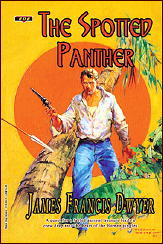
   And of special note to anyone reading this blog is The Spotted Panther, also by Dwyer, has recently been published in a handsome softcover edition by Black Dog Books. Highly recommended!

HAD I BUT KNOWN AUTHORS #1: ANITA BLACKMON
by Curt J. Evans


   In Murder for Pleasure, the essential 1941 study of the detective story as a literary form, Howard Haycraft listed ten women authors who constituted what he called the “better element”of the so-called HIBK, or Had I But Known, school of mystery fiction, which was founded by Mary Roberts Rinehart (1876-1958) over three decades earlier with the publication of her hugely popular debut novel, The Circular Staircase (1908).
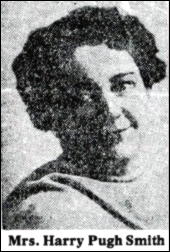
ANITA BLACKMON

   The Had I But Known school of mystery fiction, as it was so dubbed by (mostly male) mystery critics after the term was used by Ogden Nash in a satirical 1940 poem, typically included mysteries with female narrators given to digressive regrets over the things they might have done to prevent the novel’s numerous murders, had they only been able to see the dire consequences of their inaction.

   Haycraft’s list of the ten premier Rinehart followers includes several names still fairly well-known to genre fans today, namely Mignon Eberhart, Leslie Ford and Dorothy Cameron Disney, but also more obscure names as well.

   Three of these writers, Charlotte Murray Russell and the sisters Constance and Gwenyth Little, have recently had works reprinted and resultingly undergone some reader revival, but the remaining four, Anita Blackmon, Margaret N. Armstrong, Clarissa Fairchild Cushman and Medora Field, remain almost entirely forgotten.

   Over the next few weeks I plan to highlight genre work by these forgotten HIBK authors. I begin with Anita Blackmon.
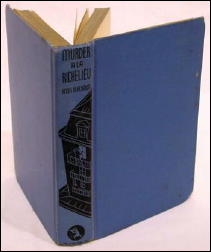
ANITA BLACKMON

   Anita Blackmon (1893-1943) published two mystery novels, Murder a la Richelieu (1937) and There Is No Return (1938). In the United States, both of Blackmon’s mysteries were published by Doubleday Doran’s Crime Club, one of the most prominent mystery publishers in the country.

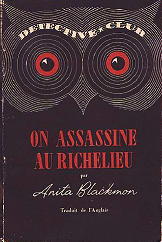
   Murder a la Richelieu was published as well in England (as The Hotel Richelieu Murders), France (as On assassine au Richelieu) and Germany (as Adelaide lasst nicht locker), while There Is No Return was published in England also (under the rather lurid title The Riddle of the Dead Cats).

   In classic HIBK fashion, Blackmon employed a series character in both novels, a peppery middle-aged southern spinster named Adelaide Adams (and nicknamed “the old battle-ax”).

   In the opening pages of Adelaide Adams’ debut appearance, Murder at la Richelieu, Anita Blackmon signals her readers that she is humorously aware of the grand old, much-mocked but much-read HIBK tradition that she is mining when she has Adelaide declare, “had I suspected the orgy of bloodshed upon which we were about to embark, I should then and there, in spite of my bulk and an arthritic knee, have taken shrieking to my heels.”
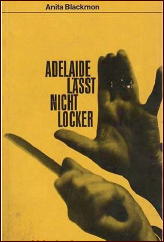
ANITA BLACKMON

   Yet, sadly, Adelaide confides, “there was nothing on this particular morning to indicate the reign of terror into which we were about to be precipitated. Coming events are supposed to cast their shadows before, yet I had no presentiment about the green spectacle case which was to play such a fateful part in the murders, and not until it was forever too late did I recognize the tragic significance back of Polly Lawson’s pink jabot and the Anthony woman’s false eyelashes.”

   Well! What reader can stop there? Adelaide goes on with much gusto and foreboding to relate the murderous events at the Hotel Richelieu, a lodging in a small southern city (clearly Little Rock, Arkansas; see below). Adelaide is a wonderful character: tough on the outside but rather a sentimentalist within, given to the heavy use of cliches yet actually rather mentally acute.

   The life in and inhabitants of the old hotel are well-conveyed, the pace and events lively and the mystery complicated yet clear (and at the same time played fair with the readers). Perhaps most enjoyable of all is the author’s strong sense of humor, ably conveyed through Adelaide’s memorable narration.

   Blackmon clearly knows that HIBK tales frequently are implausible and even silly in their convolutions and she has a a lot of fun with the conventions. Readers should have a lot of fun as well. Murder a la Richelieu emphatically deserves reprinting.
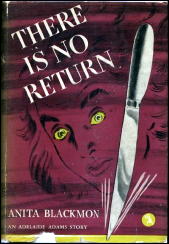
ANITA BLACKMON

   Blackmon’s follow-up from the next year, There Is No Return, is less successful. This tale finds Adelaide coming to the rescue of a friend, Ella Trotter, embroiled in mysterious goings-on involving spiritual possession at a backwoods Ozarks hotel, the Lebeau Inn (in fact the novel could well have been called Murder a la Lebeau).

   Though Return opens with yet another splendid HIBK declaration in the part of Adelaide ( “As I pointed out, to no avail, when the body of the third disemboweled cat was discovered in my bed, had I foreseen the train of horrible events which settled over that isolated mountain inn like a miasma of death upon the afternoon of my arrival, I should have left Ella to lay her own ghosts”), the novel is less amusing than Richelieu, its character less interesting and its mystery less cogently presented and credible.

   Yet it is still fun to encounter the old battle-ax one final time.

   When Howard Haycraft published Murder for Pleasure in 1941, he clearly classed Blackmon as a major figure in the HIBK school, though she in fact had not published a mystery novel in three years. Two years later Blackmon would die at the age of fifty, and her fiction would be largely forgotten. I have discussed her genre work a bit, but have so far left unanswered this question: who was Anita Blackmon?
ANITA BLACKMON

   Anita Blackmon was born in 1893 in the small eastern Arkansas town of Augusta. The daughter of Augusta postmaster and mayor Edwin E. Blackmon and his wife, Augusta Public School principal Eva Hutchison Blackmon, both originally from Washburn, Illinois, Anita Blackmon revealed a literary bent from a young age, penning her first short story at the age of seven.

   By all accounts, Blackmon grew up into a vivacious, attractive, outgoing young woman. The future novelist graduated from high school at the age of fourteen and attended classes at Ouachita College and the University of Chicago. Returning home from Chicago, she taught languages in Augusta for five years before moving to Little Rock, where she continued to teach school.

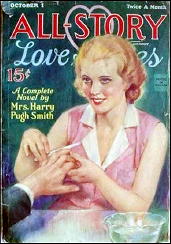
   In 1920, Blackmon left teaching and married Harry Pugh Smith in Little Rock. The couple moved to St. Louis, where Blackmon had an uncle who served as a St. Louis and San Francisco Railroad vice president, and in 1922 Blackmon published the first of what would be over a thousand short stories. Blackmon’s short stories appeared in a diverse collection of pulps, including Love Story Magazine, All-Story Love Stories, Cupid’s Diary, Detective Tales and Weird Tales.

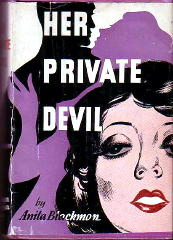
   Blackmon began publishing novels in 1934 with a work entitled Her Private Devil, one that provoked some scandalized talk back in Augusta. Devil was published by William Godwin, a press, as described by Bill Pronzini, that specialized in titillating novels that pushed the sexual envelope of the day.
ANITA BLACKMON

   Godwin titles by other authors in the writing stable such as Delinquent, Unmoral, Illegitimate, Indecent, Strange Marriage and Infamous Woman give some idea of the nature of most Godwin fiction.

   Blackmon’s book, which detailed the unhappy life of a southern small-town girl who gives into her strong sexual desires, is fairly bold, but by no means a “dirty” book. In actuality it is a serious study of a troubled young woman handled with considerable sensitivity and not especially explicit by today’s standards. Still, the book raised something of a stir in conservative Augusta, with some in the town expressing disapproval.

   Over the next few years Blackmon published traditional, mainstream novels under the name Mrs. Harry Pugh Smith, some of which had been previously serialized, before concluding her run with her two mystery novels, published, like Her Private Devil, under her maiden name.

   The best known of the Mrs. Harry Pugh Smith novels was Handmade Rainbows, a tale of middle class Depression-era life in small southern town very like Augusta. Part of the enjoyment one gets from Blackmon’s better novels stems from the author’s effective depiction of unique southern local color.
ANITA BLACKMON

   Blackmon’s Murder a la Richelieu clearly is set in Little Rock, where there was in fact a Richelieu Hotel, while There Is No Return is set far in the Ozarks. Certainly many Golden Age mysteries with Arkansas settings do not come to my mind!

   Why Anita Blackmon produced no more Adelaide Adams mysteries in her last five years of life is a mystery itself. Blackmon died after a lengthy illness in a nursing home in Little Rock, where she moved after the death of her husband.

   Perhaps under the circumstances she was not up to plotting and writing another full-length mystery novel, though she is said to have continued writing until shortly before her death. Though Blackmon’s mystery novel output is small, Murder a la Richelieu, at least, merits reprinting as a significant example of an HIBK tale.

   Also worth noting are the many now-unknown short stories that Blackmon wrote, some of which (those published in Detective Tales) might well be of interest to mystery genre fans. Clearly, further delving is in order!

NOTE:   Information on Anita Blackmon’s life was drawn from Woodruff County Historical Society, Rivers and Roads and Points in Between 3 (Fall 1975), pp. 21-22 and interviews with Rebecca Boyles and Virginia Boyles. Special thanks for his generous help to Kip Davis, Augusta City Planner.

     Bibliography    (Short Fiction; Incomplete) —

BLACKMON, ANITA

* * Glory That Flamed, (ss) Four Star Love Magazine Mar 1937
* * The High Heart, (ss) Cupid’s Diary Jun 28 1927
* * Love’s Precious Secret, (ss) Sweetheart Stories Feb 17 1926
* * The Mystery of Tip Top Inn, (sl) Sweetheart Stories Apr 14 1926
* * Under Another’s Name, (ss) Cupid’s Diary Dec 2 1925
* * With Hearts Aflame, (nv) Sweetheart Stories Mar 3 1926

SMITH, MRS. HARRY PUGH

* * Angel Face, (ss) Love Story Magazine Nov 27 1926
* * The Book of Death (nv) Weird Tales, Nov 1924
* * The Burnt Offering (?) Mystery Magazine, Aug 1 1922
* * Carnival Man, (ss) All-Story Love Stories Apr 15 1933
* * Chained [Part last of ?], (sl) All-Story Love Stories Nov 30 1935
* * Cheated, (ss) Cabaret Stories Jan 1929
* * The Colonel’s Daughter, (ss) Sweetheart Stories May 20 1930
* * A Cottage for Two, (ss) All-Story Dec 14 1929
* * The Devil’s Signet, (ss) Love Story Magazine Oct 31 1925
* * Double Motive (?) Detective Classics June 1930
* * Fettered, (ss) Love Story Magazine Sep 25 1926
* * Firecracker Kathy, (nv) All-Story Love Stories Jul 1 1932
* * Flower of Dusk, (ss) Cupid’s Diary Jun 12 1929
* * The Gay Deceiver, (ss) Love Story Magazine Oct 29 1927
* * Ghost Between [Part last of ?], (sl) All-Story Love Stories Feb 16 1935
* * Her Snobbish Dude, (ss) Far West Romances Jan 1932
* * The Hermit (?) Detective Tales Nov 16/Dec 15 1922
* * The Hindu, (ss) Detective Tales Feb 1923
* * An Interrupted Engagement, (ss) Love Story Magazine Dec 18 1926
* * The Jeweled Pin (?) Detective Tales Apr 1924
* * Jezebel, (ss) Breezy Stories Mar #2 1925
* * Little Lost Bride, (ss) Sweetheart Stories Jul 1935
* * Long Live the King!, (ss) Cupid’s Diary Dec 12 1928
* * Love at Last, (ss) Love Story Magazine Jan 2 1926
* * Love by Accident, (ss) All-Story Love Stories Apr 1 1933
* * The Love Fued, (ss) Love Story Magazine Nov 20 1926
* * Love’s Upward Trail, (ss) Love Story Magazine Jul 30 1927
* * The Marriage of Michael Malloy, (nv) All-Story Love Stories Mar 23 1935
* * Marry for Love, (ss) Sweetheart Stories Mar 1937
* * Marry Him If You Dare!, (sl) All-Story Love Stories Jan 30 1937
* * Maybe It’s Love, (sl) All-Story Love Stories Sep 19, Sep 26, Oct 3, Oct 10, Oct 17, Oct 24 1936
* * My Lady’s Dressing-Table, (vi) Breezy Stories Feb 1923
* * Object, Matrimony, (ss) All-Story Love Stories May 15 1933
* * One True Love [conclusion], (sl) All-Story Love Stories Sep 8 1934
* * The One-Track Heart, (sl) All-Story Love Stories Jan 18 1936
* * The Pride of Darcy, (ss) Love Story Magazine Nov 21 1925
* * Ranch Paradise, (nv) Street & Smith’s Far West Romances Jun 1932
* * The Sting of the Scorpion, (ss) Action Stories Feb 1923
* * A Tangled Skein, (ss) Love Story Magazine Mar 27 1926
* * The Town’s Bad Boy, (sl) All-Story Love Stories Mar 13, Mar 20, Mar 27, Apr 3 1937
* * With This Ring, (nv) All-Story Love Stories Jun 15 1932
* * The Yellow Dog (?) Detective Tales Oct 16 1922

SOURCES: The FictionMags Index; Mystery, Detective & Espionage Fiction, 1915-1974, Cook & Miller.
« Previous PageNext Page »