Magazines


S-F YEARBOOK: A Treasury of Science Fiction, Number One, 1967.     Overall rating: 2½ stars.

JOHN D. MacDONALD “Ring Around the Redhead.” [First published in Startling Stories, November 1948.] An inventor discovers a doorway to other dimensions, then must defend himself in court when it proves dangerous. Readable in spite of weak plot. (2)

CHARLES L. HARNESS “Fruits of the Agathon.” [First published in Thrilling Wonder Stories, December 1948.] Novelette. Agathon is a word from the Greek meaning death of an individual planned for the good of society. Confusing, disturbing, and unreadable, but much better than average. (4)

MARGARET ST. CLAIR “The Unreliable Perfumist.” [First published in Thrilling Wonder Stories, February 1953.] Intrigue between a family of Martian perfumists. (0)

GORDON R. DICKSON “Show Me the Way to Go Home.” [First published in Startling Stories, December 1952.] Two Cuperians need the help of a talking at to escape Earth. (1)

RAY BRADBURY “The Irritated People.” [First published in Thrilling Wonder Stories, December 1947.] Warfare is conducted by radio music, confetti, and mosquitos. (2)

MARGARET ST. CLAIR “The Stroller.” [First published in Thrilling Wonder Stories, August 1947.] About strange creatures from Venus. (0)

GEORGE O. SMITH “Journey.” [First published in Startling Stories, May 1948.] Space pilot has to come up with FTL theory to prove he traveled to Alpha Centauri. (3)

EDMOND HAMILTON “The Knowledge Machine.” [First published in Thrilling Wonder Stories, June 1948.] Two men take over an inventor’s discovery that speeds learning electronically. (3)

THEODORE STURGEON “The Sky Was Full of Ships.” [First published in Thrilling Wonder Stories, June 1947.] Strange visitors to Earth are concerned about the use of atomic power. A famous last line. (3)

– August 1967

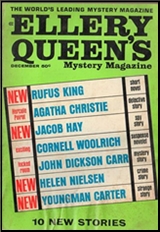
ELLERY QUEEN’S MYSTERY MAGAZINE, December 1966. Overall rating: 3 stars.

JACOB HAY “The Opposite Number.” The “inside” story of the spy business. (3)

AGATHA CHRISTIE “Hercule Poirot and the Sixth Chair.” Original title: “Yellow Iris.” Poirot stops a murder from occurring at a dinner party. (3)

WILLIAM BRITTAIN “The Boy Who Read Agatha Christie.” Schoolboy foils plan of college students. Enjoyable but trivial. (3)

ARTHUR PORGES “Private Beachhead.” Gimmick with radios too uncertain for story basis. (2)

YOUNGMAN CARTER “Seeds of Time.” SF story about visitor through time. Nothing unusual. (3)

CORNELL WOOLRICH “All It Takes Is Brains.” Novelette. Original title “Crime of St. Catherine Street.” Man on a bet enters Montreal with 75¢ and leaves with $1500, being wanted for murder in the meantime. Exciting in pulp style. (4)

CHRISTOPHER ANVIL “The Problem Solver and the Defector.” Verner finds secret plans. (3)

GEORGE EMMETT “Pushkin Pays.” Attempt to dispose of body in ocean fails, thanks to appearance of Russian submarine. (1)

HELEN NIELSEN “The Chicken Feed Mine.” Three ex-servicemen kill a desert rat for his “savings.” (3)

JOHN T. SLADEK “Capital C on Planet Amp.” SF, but in far-out camp style. Garbage. (0)

L. E. BEHNEY “The Long Hot Day.” Tale from home. Husband kills stranger his wife falsely accuses. (3)

JOHN DICKSON CARR “To Wake the Dead.” Original title “Blind Man’s Hood.” An adequate locked room mystery, but supernatural tone of story is forced. (2)

RUFUS KING “Anatomy of a Crime.” hort novel. Stuff Drscoll solves a murder made to appear a textbook suicide. Actually an inverted detective story as the reader follows the battle of wits between murderer and investigator with fascination. (4)

– August 1967


REVIEWED BY PAUL HERMAN:


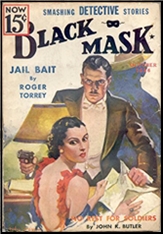
   After reading Steve’s recent review of “No Rest for Soldiers,” the first story in the October 1936 issue of Black Mask, I pulled out my copy and just finished reading it cover to cover. Not a stinker in this issue. Giving a rating of four stars for the highest, I rate them as follows:

   â€œNo Rest For Soldiers” – John K. Butler – 4.

   â€œJail Bait” – Roger Torrey – 3. Although a complete rip-off of the The Maltese Falcon without the “Falcon” to look for (main tec’s partner is killed and he’s going to find the killer, though they didn’t like each other), this is still a pretty good story. I’m not a great Torrey fan but this story works for me.

   â€œHeat Target” — Russell Bender — 4. Really well written! I don’t think I’ve ever read a story by Bender. I’ll now go see what else I can find that he wrote for Mask.

   â€œSail” — Lester Dent — 4. I can’t count the times I’ve read this story over the years. I still wish that he had written more than two stories for Mask before Shaw got the boot. As good as it gets!!

   â€œA Ride In The Rain” — W.T.Ballard — 4. One of my favorite Mask writers. If anyone out there has not read Ballard, do yourself a favor and try him. Holds up continuously, time after time!

   I really think this is a top issue of Mask from beginning to end. Steve, let us know how you feel after you finish your copy.

   Added later: Just checked on Russell Bender. He only wrote two others for Mask, though lots more for other titles: October 1938 and July 1940. I have both and will be checking them out soon.

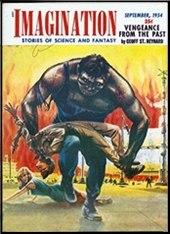
IMAGINATION. September 1954. Overall rating: One star.

GEOFF ST. REYNARD “Vengeance from the Past.” Short novel. Neanderthals try to take over space station. Nonsense. (0)

Update: Geoff St. Reynard was the pen name of Robert W. Krepps, about whom I know nothing. The story itself has never been collected or reprinted.

JEROME BIXBY “The Battle of the Bells.” In which an angel praises the rustic outhouse and the devil is flushed away. (1)

Update: Collected in Space by the Tale (Ballantine, paperback original, 1964) and in “One Way Street” and Other Stories (Armchair Fiction Masters of Science Fiction #2, trade paperback, 2011). I’ll let you comment on the basic concept of this one, if you’d care to.

DANIEL F. GALOUYE. “Immortality, Inc.” Novelette. Two immortals try to cheat a non-Stockholder of his life. (2)

Update: Never collected or reprinted. Galouye wrote perhaps a half dozen novels, but was better known for his short fiction. Of note, however, is his first novel, Dark Universe (1961), which was nominated for a Hugo.

ALLYN DONNELSON “Welcome to Paradise.” A repairmen exposes a secret military project by writing the President. (1)

Update: The author’s only published story.

RUSS WINTERBOTHAM “Three Spacemen Left to Die!” The last Earthmen sacrifice their lives to save another civilization. (3)

Update: Never collected or reprinted. Winterbotham’s writing career was broken in two parts. Part one between 1935 to 1943, then between 1952 and 1958, but even though I rated this story as the best of the issue, nothing he produced seems worthy of attention now.

– August 1967


Overall thoughts: A footnote to this page in my diary is telling: NO LONGER IN COLLECTION.

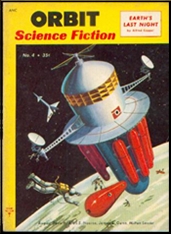
ORBIT SCIENCE FICTION. September-October 1954. Vol. 1, No. 4. Overall rating: 2 stars.

ALFRED COPPEL “Last Night of Summer.” The study of reactions to knowledge of Earth’s sudden destruction in a burst of flames. (4)

Comment: According to my view at the time, this was a best story in this issue. Reprinted in The End of the World, edited by Donald A. Wollheim (Ace, paperback, 1956) and Catastrophes!, edited by Isaac Asimov, Martin Harry Greenberg & Charles G. Waugh (Fawcett Crest, pb, 1981).

MICHAEL SHAARA “Death in the House.” A creature from a flying saucer disguises itself as a dog. (1)

Comment: Reprinted in Uncollected Stars, edited by Piers Anthony, Martin H. Greenberg, Barry N. Malzberg & Charles G. Waugh (Avon, pb, 1986). I suspect that this was due more to Shaara’s name value on the cover more than the quality of the story. (I could be wrong about this.)

JAMES E. GUNN “Danger Past.” Sabotage of a time machine leads to murder. (2)

Comment: As of last year, at 95 years old, Gunn was still active as a published writer. This story, however, has never been collected or reprinted.

MAX DANCEY “Me Feel Good.” Child from asteroid has strange powers. (0)

Comment: “Dancey” was one of several pen names used by author Peter Grainger. Others include Robert Flint Young and Peter Cartur. Under these various names he has thirteen SF tales to his credit, appearing between 1947 and 1974.

IRVING E. COX “No More the Stars.” A conspiracy to escape Earth’s oppression is broken up but does not fail. Quite familiar. (2)

Comment: Cox was the author of several dozen short stories between 1951 and 1965. This one has never been reprinted or collected in the US.

AUGUST DERLETH “The Thinker and the Thought.” A thinking machine mirror its inventor’s thoughts. (0)

Comment: Collected in Harrigan’s File (Arkham House, hardcover, 1975). I don’t know much about Tex Harrigan, the leading protagonist in this collection, but one online source says that he was a newspaperman who continually runs “up against strange inventions and curiously weird-science occurrences.” I do not seem to have been much impressed by this one.

ALAN E. NOURSE “The Image of the Gods.” Colonists of Baron IV find help from the natives in their struggle against Earth’s dominion. (3)

Comment: Reprinted in The Counterfeit Man: More Science Fiction Stories (David McKay, hardcover, 1963) and still in print electronically today.

PHILIP K. DICK “Adjustment Team.” [Novelette] An error in timing allows Fletcher to see the underlying reality of his existence, maintained by outsiders. Weak ending. (3)

Comment: First collected in The Book of Philip K. Dick (Daw, paperback, 1973) as well as several later collections. I do not believe that anything Dick ever wrote has not been reprinted or collected.

MILTON LESSER “Intruder on the Rim.” [Novelette] A husband-wife team of reporters are sent to Pluto’s moon and uncover a plot by the military in charge to take over the solar system. (1)

Comment: Lesser eventually changed his name legally to Stephen Marlowe; under this name he is well known as the author of many mystery and suspense novels. I do not believe any of his SF tales are at all memorable. This one has never been collected or reprinted in the US.

– August 1967

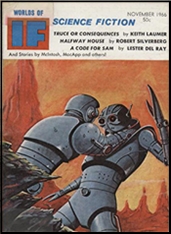
IF SCIENCE FICTION. November 1966. Overall rating: 2½ stars.

KEITH LAUMER “Truce or Consequences.” Novelette. Retief stops a war; any resemblance to the current Arab-Israeli conflict could not have been intended but neither is it coincidental. (3)

Comment: Laumer’s stories about no-nonsense galactic diplomat Jame Retief were great favorites of SF fans for many years. The first one, “Diplomat-at-Arms,” appeared in 1960. This one was first collected in Retief: Ambassador to Space (Doubleday, hc, 1969; Berley, pb, 1970) then in Retief: Diplomat at Arms (Pocket, pb, 1982; Baen, pb, 1987).

LARRY NIVEN “At the Core.” Novelette. Beowulf Shaeffer takes on another job for the puppeteers, this time taking a spaceship to the core of the galaxy. (3)

Comment: Many of Niven’s novels and stories fell into his future history known as “Tales of Known Space,” and this is an early one. Collected in Neutron Star (Ballantine, pb, 1968). Reprinted in The Second If Reader of Science Fiction (Doubleday, hc, 1968; Ace, pb, 1970).

C. C. MacAPP “The Sign of Gree.” Novelette. Another episode in the unending war against Gree. Steve Duke enlists the aid of the Remm. (1)

Comment: There were nine stories in MacApp’s “Gree” series; this was number eight. Probably pure space opera. My brief comment suggests I wasn’t very impressed. The story itself has never been collected or reprinted.

LESTER del REY “A Code for Sam.” Novelette. Del Rey suggests that Asimov’s Laws of Robotics may not be practical in the field. The point is well made. (3)

Comment: Collected in Robots and Magic (NESFA Press, hardcover, 2010). I’ve always found del Rey’s fiction to be unexpectedly uneven, but I wish I’d known about this collection before now.

JOHN T. SLADEK “The Babe in the Oven.” A wacky short story with no plot but plenty of wit. (4)

Comment: Collected in The Best of John Sladek (Pocket, pb, 1981). Reprinted earlier in Alpha 6, edited by Robert Silverberg (Berkley, pb, 1976).

ROBERT SILVERBERG “Halfway House.” In return for his life, an executive takes on the job of guarding the crossroads of all parallel world and deciding who may cross. (4)

Comment: First collected in Dimension Thirteen (Ballantine, paperback, 1969), then in several other books. I think most of Silverberg’s stories have been collected several times over!

J. T. McINTOSH “Snow White and the Giants.” Serial, part 2 of 4. The novel will be reported on in its entirety when all four installments have been read.

MIKE HILL “Hairry.” An unsquare story of a Martian spider who becomes a jazz buff. (2)

Comment: Mike Hill was the pen name of Paul G. Herkart, but under either name, this was his only published SF story.

THURLOW WEED “The Boat in the Bottle.” As the title suggests. (0)

Comment: Another author with a one and done.

– June 1967

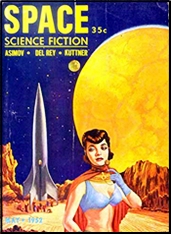
SPACE SCIENCE FICTION. May 1952. (Volume 1, Number 1.) Overall rating: 3 stars.

LESTER del REY “Pursuit.” Feature novel. A man with unknown assailants pursued for unknown reasons for the major part of the story finally discovers that it is his own unconscious mind plus an uncontrolled psi factor which has been creating his monsters. The plot, meant to sweep the reader along with the hero’s plight, jumps badly at times, simply because of vague details or incongruous background. Also, forty-two pages is a long time for confusion to run rampant. (1)

Comment: Collected in Gods and Golems (Ballantine, paperback original, 1973). Also of note, perhaps, is that Lester del Rey was also the editor of this magazine.

JERRY SOHL “The Ultroom Error.” A readable but pointless story of a life-germ transplanting process gone wrong. (2)

Comment: Collected in Filet of Sohl: The Classic Scripts and Stories of Jerry Sohl (Bear Manor Media, softcover, 2003). Besides a dozen or so SF novels published later on, Sohl also wrote scripts for Alfred Hitchcock, Twilight Zone, Star Trek and several other TV shows.

ISAAC ASIMOV “Youth.” Novelette. The illustrations give away the ending, obviously meant to be hidden. Two alien cultures meet and initiate friendly relations, but the identity of each cannot be determined from the context. (4)

Comment: Collected in The Martian Way and Other Stories (Doubleday, hardcover, 1955). This is clearly a small gem whose first appearance is hidden away in what is today an sadly obscure magazine.

HENRY KUTTNER “The Ego Machine.” Novelette. A badly confused robot carries on an ecological experiment in adjusting a Hollywood screenwriter’s character to his environment. The wild type of science-fictional comedy that made Kuttner famous. Incidentally, this novelette has only three pages fewer than the feature novel. (5)

Comment: ISFDb suggests that this story was co-written with C. L. Moore. Reprinted in Science-Fiction Carnival, edited by Fredric Brown & Mack Reynolds (Shasta, hardcover, 1953). Collected in Return to Otherness (Ballantine, paperback original, 1962).

BRYCE WALTON “To Each His Own Star.” A predictable story of four men lost in space, each wanting to go his own way. (2)

Comment: Reprinted in Space Odysseys: A New Look at Yesterday’s Futures, edited by Brian W. Aldiss (Doubleday, hardcover, 1976). Collected in “Dark of the Moon” and Other Stories (Armchair Fiction Masters of SF #1, softcover, 2011). Walton was the author of several dozen short stories between 1945 and 1969, but only one novel, one of the Winston series of YA books, which I’m sure explains why he’s a Little Known Author today.

– June 1967
REVIEWED BY MIKE TOONEY:

(Give Me That) OLD-TIME DETECTION. Summer 2020. Issue #54. Editor: Arthur Vidro. Old-Time Detection Special Interest Group of American Mensa, Ltd. 36 pages (including covers). Cover image: Unusual Suspects.

   The latest issue of OLD-TIME DETECTION (OTD) continues to maintain the high quality it has always enjoyed. Editor Arthur Vidro’s choices of material are, as usual, excellent; the world of classic detective fiction, long neglected, gets a new lease on life with every number.

   Indeed, nothing says “classic detective fiction” like commentary from Edward D. Hoch, an expert on the subject as well as a shining example of how to write it. Vidro reproduces two introductions by Hoch to mystery story collections.

   Ed Hoch’s fiction output is the envy of many writers, almost always matching quantity with quality. In his review of Crippen & Landru’s latest themed collection of Hoch’s stories, Hoch’s Ladies, Michael Dirda says it well: “His fair-play stories emphasize a clean, uncluttered narrative line, just a handful of characters, and solutions that are logical and satisfying. Each one sparks joy.”

   Next we have a valuable history lesson by Dr. John Curran concerning the earliest periods of the genre, “‘landmark’ titles in the development of crime fiction between 1841 and the dawn, eighty years later, of the Golden Age,” especially as reflected in the publications of the Collins Crime Club.

   Following Dr. Curran is a collection of perceptive reviews by Charles Shibuk of some pretty obscure crime fiction titles; for instance, have you ever heard of Brian Flynn’s The Orange Axe (“highly readable, steadily engrossing, well-plotted, and very deceptively clued”) or James Ronald’s Murder in the Family (“an absolute pleasure to read from first page to last”)?

   Cornell Woolrich was definitely not ignored by Hollywood, as Francis M. Nevins shows us in his continuing series of articles about cinema adaptations. The year 1947 was a rich one for films derived from Woolrich’s works — Fall Guy, The Guilty, and Fear in the Night — but, as Nevins indicates, the quality of these movies is highly variable.

   William Brittain is a detective fiction author who has been undeservedly “forgotten” of late, but a reprinting of one his stories (“The Second Sign in the Melon Patch”, EQMM, January 1969) shows why he should be remembered: “She wondered if anyone in Brackton held anything but the highest opinion of her would-be murderer.”

   Charles Shibuk returns with concise reviews of (then) recently reprinted books by John Dickson Carr, Agatha Christie, Anthony Dekker, Ngaio Marsh, Ellery Queen, Dorothy L. Sayers, and Josephine Tey.

   Dr. John Curran also returns. The world’s leading expert on Agatha Christie tips us off as to developments in Christieworld: a new short story collection, the closure of the long-running play The Mousetrap as well as the cancellation of the in-person Agatha Christie Festival and uncertainty about the release date for Kenneth Branagh’s version of Death on the Nile due to the beerbug, the publication of a new non-fiction book focusing on Hercule Poirot, and a radio play version of a previously unperformed non-criminous production by Dame Agatha dating from nearly a century ago.

   This is followed by a collection of smart reviews by Jon L. Breen (The Glass Highway by Loren D. Estleman), Amnon Kabatchnik (The Man in the Shadows by Carroll John Daily), Les Blatt (The Chinese Parrot by Earl Derr Biggers), Ruth Ordivar (The World’s Fair Murders by John Ashenhurst), Arthur Vidro (The Kettle Mill Mystery by Inez Oellrichs), and Thor Dirravu (The Ten Faces of Cornell Woolrich, a collection).

   Next we have Martin Edwards’s foreword to Joseph Goodrich’s collection of essays entitled Unusual Suspects (2020), which, Edwards is delighted to relate, “benefits from a quirky unpredictability and from being a mine of intriguing nuggets of information.”

   Rounding out this issue are the readers’ reactions and a puzzle page, the latter a snap only if you’re thoroughly familiar with the life and career of Hercule Poirot.

   Altogether this is a most satisfying issue of OLD-TIME DETECTION.

If you’re interested in subscribing: – Published three times a year: spring, summer, and autumn. – Sample copy: $6.00 in U.S.; $10.00 anywhere else. – One-year U.S.: $18.00 ($15.00 for Mensans). – One-year overseas: $40.00 (or 25 pounds sterling or 30 euros).

Payment: Checks payable to Arthur Vidro, or cash from any nation, or U.S. postage stamps or PayPal.

Mailing address: Arthur Vidro, editor, Old-Time Detection, 2 Ellery Street, Claremont, New Hampshire 03743.

Web address: vidro@myfairpoint.net
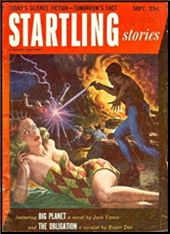
STARTLING STORIES, September 1952. Overall Rating: 1½ stars.

JACK VANCE “Big Planet.” Complete novel [92 pages]. A long and tedious account of the adventures of a commission from Earth as they make their way from their wrecked spaceship to their Enclave on Big Planet. Vance does a good job in describing the numerous cultures on this heterogeneous planet, but the effect is lost under the weight of so many. An adventure story only. (1½)

Comment: This was expanded (perhaps) and published in hardcover by Avalon Books (1957), then in paperback as half of an Ace Double (D-295; 1958). Reprinted in novel form several times since. I am aware that many readers consider this a minor classic, and I knew so even at the time, but it just didn’t click for me.

ROGER DEE “The Obligation.” Novelet. A fairly interesting story of Man’s first meeting with Alien, taking place during a wild storm on Venus. Ending tries to make up fo a lack of solid characterization. (3)

Comment: Reprinted in Adventures on Other Planets, edited by Donald A. Wollheim (Ace, paperback, 1955).

R. J. McGREGOR “The Perfect Gentleman.” An effort to show the effects of being lost in space on a woman’s repressed sexuality. (1)

CHARLES E. FRITCH “Night Talk.” Obvious parallel to Christmas story on Mars. (1)

Comment: Collected in Crazy Mixed-Up Planet (Powell, paperback, 1969).

– June 1967

ELLERY QUEEN’S MYSTERY MAGAZINE, November 1966. Overall Rating: 2½ stars.

MICHAEL INNES “The End of the End.” Short novel. Sir John Appleby solves a murder committed in a snowbound English castle. Method of murder quite contrived to make it appear suicide. (3)

Comment: According to the cover, this was the first publication of this story. Based on my short description of it, it’s one of my favorite sub-genre of traditional Golden Age stories, even though published way later, in 1966.

EDWARD D HOCH “The Spy Who Walked Through Walls.” Rand of Concealed Communications. Mystery of disappearing reports has a very obvious solution. (2)

Comment: While always solid tales, Hoch’s Rand stories have never seemed as memorable to me as those with either Dr. Sam Hawthorne or Nick Velvet.

FRANK SISK “The Face Is Familiar.” Crooked con becmes involved in bank robbery by his cousin. (3)

JONATHAN CRAIG “Top Man.” A gangland story based on an eventually obvious pun. (2)

HENRY SLESAR “The Cop Who Liked Flowers.” A detective story with heart. (5)

Comment: The highest ranked story of this issue. Apparently a sentimental story that caught my fancy.

MIRIAM ALLEN deFORD “At the Eleventh Hour.” Another execution story: no surprises. (1)

PAMELA JAYNE KING “Nightmare.” Clever short-short [2 pages] by junior high stoudent, about a girl in trouble. (4)

Comment: This was this issue’s First Story, a standard feature of the magazine. up through and including today. While I enjoyed this one, the young author never published another work of crime fiction.

PHYLLIS BENTLEY “Miss Phipps and the Invisible Murderer.” Miss Phipps solves a church killing in the last four paragraphs [of a 13 page story]. (1)

Comment: Miss Phipps was a writer of detective novels who kept stumbling onto mysteries to solve. Her earliest appearance was in 1937, but none of her many others appeared until 1954. Several were collected in Chain of Witnesses: The Cases of Miss Phipps (Crippen & Landru, 2014), but I do not know if this is one of them.

J. F. PEIRCE “The Pale Face of the Rider.” German artists painting save daughter. Weird. (2)

GEORGES SIMENON “Inspector Maigret Deduces.” First US publication. Maigret solves train murder from studying character. No real clues. (2)

Comment: This was, of course, Maigret’s usual way of solving crimes.

JAMES CROSS “The Hkzmp gav Bzmp Case.” The spy story is demolished by this inane nonsense. Title is code for “Spank the Yank.” (3)

VINCENT McCONNOR “Pauline or Denise.” Murder of his two sisters leaves playboy trapped in asylum. Distinctly French. (4)

HOLLY ROTH “The Game’s the Thing.” An interesting anticipation of Dr. Berne, but story may be overshadowed. (3)

Comment: Dr. Berne was the author of Games People Play: The Basic Handbook of Transactional Analysis (1964). This was Holly Roth’s last published story; she died in 1964.

LAWRENCE TREAT “M As in Mugged.” Lieutenant Decker’s 60th birthday. A comparison of present and past police methods, with experience the key factor. (1)

« Previous PageNext Page »