Bibliographies, Lists & Checklists


IT IS PURELY MY OPINION
Reviews by L. J. Roberts


M. J. TROW – The Island. Grand & Batchelor #4. Crème de la Crimem hardcover, January 2018. First published in the UK, 2017. Setting: Maine, 1873.

First Sentence:   The quarter-moon did little to light Summer Street that night in Boston.

   Investigators Matthew Grand and James Batchelor have travelled from England to Grand’s extensive family home on the coast of Maine for the wedding of Grand’s sister, Martha. Friends and family gather, including the surprise appearance of a cousin who hasn’t been seen for fourteen years. A greater surprise is the dead body found in an upstairs bedroom which leads to the question of what the tie is to the family.

   An interesting beginning informs one as to where the story is going; or does it? What is does, however, is provide introductions to the protagonists and their profession. One thing which is a bit rare, but is refreshing, is to show the vulnerable side of one of the men. The transition from Batchelor and Grand to their housekeeper, Mrs. Rackstraw, is also nicely done. She is such a delightful character.

   Trow’s style is subtle and often humorous. He slides in information, from location descriptions— “The docks at Southampton had not been conducive to chatting and Batchelor didn’t get a change to share something the Grand until they were in their laughingly called stateroom, in which a cat would be totally safe from being swung.” —to family structures— “My mother comes from a family of eight girls, thought I doubt they’ll all come to the wedding. Four of them are dead anyway, and one is in Wisconsin, so as good as. Auntie Mimi is as mad as a rattler and doesn’t travel.” The inclusion of Samuel Clemens (aka Mark Twain) as a character is a wonderful touch.

   It’s also a nice touch that, despite having been introduced to a myriad of characters, the murder victim is unexpected. Which also means the motive is as much a mystery as is the killer

   The truest sign of an author with an exceptional voice is that one has a desire to quote nearly every page. Trow is one of the few authors who can write parallel conversations—conversation held by two sets of characters at the same time in different places, without any confusion as to the speakers — and get away with it.

   He has a wonderful way of evoking the senses— “He had never known it before, not in London, but it really was possible, he realized to smell the spring. There was a green smell in the air, the smell of sap on the rise, alongside the sound of buds creaking with the effort of bursting. He felt he could almost smell the warmth of the sun …”

The Island is filled with humor, and excellent characters, plus there are murders; violent ones. It is a rare instance when one can call a mystery a delightful read.

— For more of LJ’s reviews, check out her blog at : https://booksaremagic.blogspot.com/.


       The Grand & Batchelor series —

1. The Blue and the Grey (2014)

2. The Circle (2016)
3. The Angel (2016)
4. The Island (2017)
JAMES E. MARTIN – The Flip Side of Life. G. P. Putnam’s Sons, hardcover, 1990. Avon, paperback, 1991.

   Cleveland-based PI Gil Disbro’s second case involves a missing college professor and his son, who may be the victim of grandparental kidnapping. There are also three murders before the book is finished, so all in all, in spite of the price tag [$21.95], you do get your money’s worth.

   Martin writes with nice clean prose, nothing too elegant, but he keeps the story moving. Some introspective passages, mostly with his live-in lady, add a bit to his character. It’s pretty good as a detective story too, even without a big surprise at the end.

— Reprinted from Mystery*File #22, June 1990.

      The Gil Disbro series —

The Mercy Trap (1989)
The Flip Side of Life (1990)
And Then You Die (1992)
A Fine and Private Place (1994)

REVIEWED BY BARRY GARDNER:


ROBERT CAMPBELL – The Wizard of La-La Land. Whistler #4. Pocket Books, hardcover, 1994. No paperback edition.

   This is the first Whistler since Sweet La-La Land in 1990. Campbell is best known for his Jimmy Flannery books, but my favorite series of his consisted of two books about railroad detective Jake Hatch, Plugged Nickel and Red Cent.

   Whistler, an ex-radio personality, a recovering alcoholic, and now a PI working the grungy streets of Hollywood, still remembers the unsolved murder of a cop friend’s young niece a decade ago. Now a young man dying of AIDS has whispered to a relative that he knows who did it, but hes murdered in his hospital bed before he names anyone. Old ghosts, new demons, and ever-present evil haunt Hollywood’s streets as Whistler tries to link past and present.

   The Whistler books are among the darker of PI stories, and as a matter of fact remind me to mood and sometimes subject matter of Andrew Vachss. They are rough, hard books that deal with unpleasant subjects, written in terse prose to match. Whistler has never really come alive as a character to me, though Campbell does a creditable job with some supporting players. The narration if shifting third person, and Campbell is adept at telling his stories in this way. These are for only the hardest of hardboiled fans.

— Reprinted from Ah Sweet Mysteries #14, August 1994.

       The Whistler series —

1. In La-La Land We Trust (1986)
2. Alice in La-La Land (1987)
3. Sweet La-La Land (1990)
4. The Wizard of La-La Land (1995)

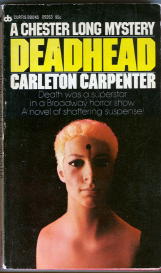
CARLETON CARPENTER – Deadhead. Curtis, paperback original; 1974. Paperback reprint: Black Walnut, 1985.

   If you were to do a search for Mr. Carpenter on the Internet, you’d find more in the movie and entertainment databases than you will regarding his writing career, which consisted of only a small handful of paperback originals. There’ll be a list of them soon, in case you’re interested.

   Before concentrating on the books, though, perhaps it suffices to say that Carleton Carpenter was a both a composer and an actor, in both the movies, on television and in Broadway musicals. One of the top musical hits of 1951 was “Aba Daba Honeymoon,” sung by Debbie Reynolds and Carleton Carpenter (from the film Two Weeks in Love). His career in the movies and on TV is summed up neatly at imdb.com (with some 42 credits as an actor).

   Here’s a list of Mr. Carpenter’s mystery fiction. As previously mentioned all of these are paperback originals. * = Chester Long mysteries. ** = billed as a Jasper Wild mystery.

Games Murderers Play. Curtis 07271, 1973; Black Walnut, 1985.
Cat Got Your Tongue? Curtis 07272, 1973; Black Walnut, 1985.
* Only Her Hairdresser Knew… Curtis 07299, 1973; Black Walnut, 1985.
Pinecastle. Curtis 09187, 1973, as by Ivy Manchester; Black Walnut, as Stumped, as by Carleton Carpenter.
* Deadhead. Curtis 09263, 1974; Black Walnut, 1985.
** Sleight of Hand. Popular Library 00661, 1975; Black Walnut, as Sleight of Deadly Hand.
The Peabody Experience. Black Walnut, 1985.

Short story: “Second Banana.” Alfred Hitchcock’s Mystery Magazine, October 1976.

   Little is known about Black Walnut Books, but they seem to have been in business only to print Mr. Carpenter’s books.

   Whether Jasper Wild appeared in any of the earlier books or was intended to be another continuing character is also unknown. It would also be interesting to learn whether the AHMM short story has either Chester Long or Jasper Wild as characters, leading or incidental. Someone with access to that issue will have to let us know.

   As you can see from the cover, Pinecastle (aka Stumped) was marketed and sold by Curtis as a gothic romance, but a quick scan through my copy indicates that the people who are in it all have a very strong theatrical background, which is not surprising.

   Chester Long is a hairdresser (straight). Jasper Wild’s occupation is unknown. Someone who has a copy of Sleight of Hand will have to let us know. If by chance he’s a magician as well as a detective, that would be worth knowing.

   As for the book at hand, Deadhead, when Chester is offered a position on the side as the head of the hairdresser crew for a musical bound for Broadway, he jumps at it. For the rest of the book he’s a fascinated observer behind the scenes, giving the reader an equally vicarious (and authentic) look at a world largely foreign to us mere mortals. Even so, as Chester admits on page 81:

   In my heart I knew I was nothing more than a voyeur who was being overpaid for the opportunity to peep.

   The going is as light and breezy as this for over 100 pages, chatty and gossipy in trunk loads. The murder of the show’s bizarrely flamboyant producer does not occur until page 104, which gives Chester the opportunity to show his flair as a sleuth. (Not that there’s any inkling of a previous criminous adventure. Until I checked out the bibliography, I was working under the impression that this was Chester’s first encounter with detective work.)

   With the entire company on the road and snowed in as a mammoth snowstorm hits Boston, the effect is that of an isolated country house, which means, of course, besides clues and motives, means and opportunities galore.

   And until the end, when things seem to fall apart plotwise, there would be much in the reading to recommend. While Carleton Carpenter is a story teller’s story teller, he unaccountably allows Chester’s previously mentioned flair as a sleuth to fizzle out well before the finale, all of his theories disappearing into smoke. On page 189, after the killer has been nabbed, and the case is being rehashed, Chester says:

   This has been hindsight babbling on. I was just as surprised as anyone else.

   In any case, all I can offer for a recommendation is hemi-semi-demi-positive one. The book is worth reading for the show business element – that part is simply Grade A all the way – but as a mystery, while it has its moments, the answer, if that’s what you’re asking, is, reluctantly, no. The cast and choreography are excellent, but the book itself? Good, but not up to par. It needs some work.

— April 2005

IT IS PURELY MY OPINION
Reviews by L. J. Roberts


CHRISTOPHER FOWLER – Bryant & May: Wild Chamber. Bryant & May #14. Bantam, US, hardcover, December 2017.

First Sentence: On a desolate rain-battered London midnight, the members of the Peculiar Crimes Unit went looking for a killer.

   London has many private gardens, accessible only to the residents who live around them. The gardener also has a key but doesn’t expect to find the body of a woman who’d taken her dog for a walk. She has been strangled and neatly laid out on the path, her dog missing, and the garden locked before the gardener’s arrival. A second such body is found in a public park. At risk are more murders, the city’s parks being closed to the public, and the PUC disbanded. The clock is ticking.

   An aerial chase, a traffic jam, a boy’s death and a man whose life implodes. This is an opening which catches one’s attention.

   That Fowler uses a memo to provide a cast of characters is both helpful and clever. That the list includes “Crippen, staff cat,” and the subsequent memo brings readers up to date on the situation at the aptly-named Peculiar Crimes Unit truly sets the tone for what follows. Fowler’s books are not one’s normal police procedural, as the characters, particularly those of Arthur Bryant and John May, are anything but what one would normally find. Fowler gives us something unique with present day crimes overlain with an education into obscure historical facts and writing which increases one’s vocabulary. But never fear; this book is anything but dry or boring.

   Fowler is skilled at juxtaposing historic London over that of the present day in a way that contributes to the plot. Part of that is an explanation as to how Bryant became a detective. Fowler creates evocative descriptions— “The wind was high in the trees, breathing secrets through the branches.” —and observations— “Looking down on King’s Cross you’d have noticed an odd phenomenon: Every other roof was covered in white frost, forming a patchwork quilt, an indicator of which properties were owned by overseas investors and which had warm families inside.” But yes, unfortunately, there are also quite a few completely unnecessarily portents.

   It is hard to say which is more enjoyable; the cast of strange and fascinating characters of Bryant’s acquaintance, the vast abundance of arcane and historical information — who knew it was Arthur Sullivan of Gilbert and Sullivan, who wrote the music to “Onward Christian Soldiers”? — the members of the PUC itself, of the plot which brings all these facets together into a perfect gem of a book with a well-done plot twist. We are even given a definition as to what is a murder mystery— “’A murder mystery,’ she told Bryant, ‘is an intellectual exercise, a game between reader and writer in which a problem is precisely stated, elaborately described, and surprisingly solved.’” —and Fowler does just that.

   Bryant & May: Wild Chamber is a murder mystery in the best sense. All the clues are given, if we but see them. The best part of the book is the very last line, but that everyone will have to read for themselves.

— For more of LJ’s reviews, check out her blog at : https://booksaremagic.blogspot.com/.


       The Bryant and May series —

1. Full Dark House (2003)

2. The Water Room (2004)
3. Seventy-Seven Clocks (2005)
4. Ten Second Staircase (2006)
5. White Corridor (2007)

6. The Victoria Vanishes (2008)
7. On the Loose (2009)
8. Off the Rails (2010)
9. The Memory of Blood (2011)
10. The Invisible Code (2012)
11. The Bleeding Heart (2012)
12. The Burning Man (2015)

13. Strange Tide (2016)
14. Wild Chamber (2017)
15. Hall of Mirrors (2018)

JANE DENTINGER – First Hit of the Season. Jocelyn O’Rourke #2. Doubleday, hardcover, 1984. Dell, paperback, October 1985.

   Jocelyn O’Rourke is a young actress and acting coach who knows her way around the Broadway theater thoroughly , both on- and off-, and her insight into the people involved — producers, directors, other actors, even critics — gives her boy friend, homicide detective Phillip Gerrard, plenty of additional meat to chew on while solving a case.

   Which in this case involves the death by poisoning of a Broadway critic with a vicious pen — a little too vicious for one of his victims, perhaps.

   Author Jane Dentinger, who herself at the time was in much the same profession as her leading lady, is very, very good when it comes to characters, personal relationships between them, backstage gossip and witty repartee. In this book, though, she is not as good when it comes down to clues and describing actual detective work. She knows the setting of this flavorful Broadway concoction like the palm of her hand, however, and while your opinion may vary, this goes a long way toward mitigating any weaknesses you also may find in the crime solving that’s involved.
   

      The Jocelyn O’Roarke series —

1. Murder on Cue (1983)
2. First Hit of the Season (1984)
3. Death Mask (1988)
4. Dead Pan (1992)
5. The Queen is Dead (1994)
6. Who Dropped Peter Pan? (1995)

J. HARVEY BOND – Kill Me with Kindness. Mike Lanson #3. Ace Double D-349, paperback original, 1959. Published back-to-back with The Guilty Bystander, by Mike Brett (reviewed here ).

   J. Harvey Bond was the pen name of Russ Winterbotham (1904-1971), who was probably better known as a writer of science fiction, both novels and short stories, starting as far back as 1935 and “The Star That Would Not Behave” as R. R. Winterbotham in the August issue of Astounding SF for that year.

   All of Winterbotham’s detective novels were written as by J. Harvey Bond, and all four were mysteries tackled by a newspaper reporter by the name of Mike Lanson. Kill Me with Kindness is the third of the four.

   Written up in ths one is a tale that’s a reliable old standard, that of corruption in a small town, with only the town newspaper interested enough to nose around and find out who’s behind it. The police are handicapped by either a lack of will or a lack of evidence, and probably both. Dead is a anti-vice crusader who the owner of Lanson’s newspaper believes is not beyond doing a little bit of shakedown on the side himself.

   There is also a good-looking girl involved, a strip-tease dancer named Luzy McGuire — that is probably her shown on the front cover above — and not only is she involved, but as Lanson also soon begins to learn, she is the key to his entire investigation.

   I needn’t tell you more. It all plays out from here just as you might suspect. This is the literary equivalent of any number of black-and-white movies being made at the same time, this one with John Payne, say, as Mike Lanson, and Marie Windsor, Terry Moore or Audrey Totter as Luzy. It might even be better as a movie. I know that that’s one I’d watch!

      The Mike Lanson series —

Bye Bye, Baby! Ace Double D-279, 1958.

Murder Isn’t Funny. Ace Double D-301, 1958.

Kill Me with Kindness. Ace Double D-349, 1959.
If Wishes Were Hearses. Ace Double D-483, 1961.

REVIEWED BY BARRY GARDNER:

   
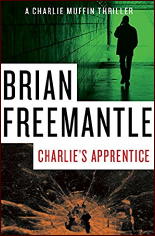
BRIAN FREEMANTLE – Charlie’s Apprentice. Charlie Muffin #10. St. Martins, US, hardcover, 1994. No US paperback edition. First published in the UK by Century, hardcover, 1993.

   Now that Anthony Price has retired Davis Audley, I suppose that Freemantle and his scruffy agent Charlie Muffin, are my favorites in the espionage line.

   The old director of Charlie’s Department has died, and Charlie really doesn’t know what to expect from his lady Deputy Director either. He’s more than a bit apprehensive when they finally call him in, but glad that they’ve quit ignoring him anyway. His relief is short-lived, though — he’s taken off the active agent rolls and assigned as a trainer.

   His first trainee is from the sort of semi-aristocratic background that he detests, but Charlie sets about to make the best of it for the moment. Concurrently, in China an agent in place is the last Jesuit establishment is beginning a process that will land him in very deep rice. And Charlie’s masters are up to something nasty.

   Everything and everybody converge in a typically convoluted fashion, of course, though we and Charlie are kep guessing until the end. Freemantle tells the story from multiple viewpoints, adding a piece at a time, and does so quite effectively.

   Charlie is still Charlie: the Eternal Prole, scruffy, resentful, watchful, a step ahead of everybody, and determined not to be the loser whatever the game. His old Russian lover, Natalia, has a role to play, too. Freemantle is one of the best of what he does, and for me, at least, Charlie Muffin is a character for the ages.

— Reprinted from Ah Sweet Mysteries #14, August 1994.

      The Charlie Muffin series

1. Charlie Muffin (1977) aka Charlie M
2. Clap Hands, Here Comes Charlie (1978) aka Here Comes Charlie M
3. The Inscrutable Charlie Muffin (1979)
4. Charlie Muffin’s Uncle Sam (1980) aka Charlie Muffin U.S.A.
5. Madrigal for Charlie Muffin (1981)
6. Charlie Muffin and Russian Rose (1985) aka The Blind Run
7. Charlie Muffin San (1987) aka See Charlie Run
8. The Run Around (1988)
9. Comrade Charlie (1989)
10. Charlie’s Apprentice (1993)
11. Charlie’s Chance (1996) aka Bomb Grade
12. Dead Men Living (2000)
13. Kings of Many Castles (2001)
14. Red Star Rising (2010)
15. Red Star Burning (2012)
16. Red Star Falling (2013)

REVIEWED BY BARRY GARDNER:


JOE R. LANSDALE – Mucho Mojo. Hap Collins & Leonard Pine #1 [actually #2; see below]. CD Publications, hardcover, limited edition, 1994. Mysterious Press, hardcover, 1994; paperback, 1995. Vintage Crime/Black Lizard, softcover, 2009. TV: Reportedly serves as the basis for Season Two of the Hap and Leonard television series (Sundance, 2016-2018).

   Lansdale is well-known (at least to Bill Crider and me), but primarily for horror, in which field he’s a multiple award winner. This is his first “traditional” crime novel to my knowledge. Mysterious thinks it’s a breakout.

   Hap Collins is white, fortyish, and working in the rose fields of East Texas. Leonard Pine is black, the same, and gay (but not very cheerful) on top of it. They’re tighter than ticks on the proverbial redbone, and Leonard has a bad leg gotten saving Hap’s life during some shady doings.

   They are sort of drifting along when Leonard’s Uncle Chester dies and leaves him a hundred grand and his house, which changes a lot of things. They discover that Uncle Chester was going senile before he died, and had hinted to the local police that somebody was murdering black children. Then, while putting his house in shape, they dicover a bunch of kiddie porn magazines and dig up the bones of a 10-year-old child buried in a box under the floor.

   The police think Uncle Chester did it, but Leonard doesn’t believe it, so he and Hap begin to dig deeper. So to speak.

   This is an entertaining book, and Hap and Leonard are interesting and refreshingly different characters. I don’t know that they’re all that believable; 40-year-old field hands with as much on the ball as our dynamic duo strike me as more than a little unlikely, but hey it;s a story, right?

   And a good one, too. Lansdale knows how to spin a yarn. He’s got a good East Texas “voice”, and Hap narrates the story effectively, with a fair share of quips and country sayin’s. There’s a lot of dialogue, and not much of the brooding atmosphere you might expect from Lansdale. It won’t be everybody’s cup of tea, but you won’t know if it’s yours ’til you try a sip.

— Reprinted from Ah Sweet Mysteries #14, August 1994.


The Hap Collins & Leonard Pine series —

1. Savage Season (1990)

2. Mucho Mojo (1994)
3. The Two-Bear Mambo (1995)
4. Bad Chili (1997)
5. Rumble Tumble (1998)

6. Captains Outrageous (2001)
7. Vanilla Ride (2009)
8. Devil Red (2011)
9. Honky Tonk Samurai (2016)
10. Rusty Puppy (2017)
11. Jackrabbit Smile (2018)


Bibliographic Notes: Unknown to Barry, who described this as the first in the series, there was one that had come out four years earlier, that being Savage Season, published by Mark V. Ziesing, a small press publisher based in California. Barry also seems to have assumed that the first edition of Mucho Mojo was done by Mysterious Press, but another small outfit called CD Publications, based in Baltimore, gets credit for that.

REVIEWED BY BARRY GARDNER:

   
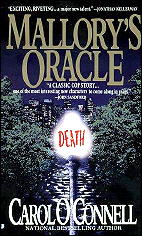
CAROL O’CONNELL – Mallory’s Oracle. Kathleen Mallory #1. G. P. Putnam’s Sons, hardcover, 1994. Jove, paperback, 1995.

   O’Connell is a painter turned novelist, and this is her first. Putnam thinks it’s going to be a good one. They paid a lot of money for it, and it’s already been published in England and sold to several other countries.

   Kathleen Mallory was a street kid and she was taken in at the age of 12 by a NYPD cop and his wife. Now she’s a Sergeant in the same department, and her father in all the real sense of the word has been murdered at the same time as the latest victim is killed by a serial killer who preys on old women.

   The Department places her on compassionate leave, but compassion is not a word she understands very well. She’s beautiful, a crack shot and a computer whiz, and underneath a thin veneer is a tough and nearly as amoral as the child she used to be. Mercy is another word that has little relevance to her as she begins tracking her prey.

   O’Connell may be this year’s Minette Walters, and this could easily be an Edgar winner for either First or Best Novel. Yes, I thought it was that good. It’s a powerfully written book, and often beautifully so. An Example: “She lay still in the body and quiet.”

   And watch for the passage about the insane pigeon — surely none of the more unlikely subjects upon which to base a memorable paragraph, but there it was. The third person narrative is mostly from Mallory’s viewpoint, though there are several illuminating shifts.

   The plot is convoluted, with maybe one or two too many threads to the skein, but the book’s strengths lie in O’Connell’s prose and the vivid characterizations of Mallory and a number of others. It isn’t a perfect book, but it’s a very, very strong one, and I think the field has another star here, folks.

— Reprinted from Ah Sweet Mysteries #14, August 1994.

      The Kathleen Mallory series —

1. Mallory’s Oracle (1994)
       — 1995 Anthony Award — First Novel (Nominee)
       — 1995 Dilys Award — Mystery Novel (Nominee)
       — 1995 Edgar Allan Poe Award — First Novel (Nominee)
2. The Man Who Lied to Women (1995) aka The Man Who Cast Two Shadows
3. Killing Critics (1995)
4. Flight of the Stone Angel (1997) aka Stone Angel
5. Shell Game (1999)
6. Crime School (2002)
7. The Jury Must Die (2003) aka Dead Famous
8. Winter House (2004)
9. Find Me (2006) aka Shark Music
10. The Chalk Girl (2012)
11. It Happens in the Dark (2012)
12. Blind Sight (2016)

« Previous PageNext Page »