Bibliographies, Lists & Checklists


REVIEWED BY DOUG GREENE:


GUY BOOTHBY – A Bid for Fortune. Dr. Nikola #1.  Appleton, hardcover, 1895. Published earlier in the UK by Ward Lock, hardcover, 1895. Reprinted as Enter Dr. Nikola. Newcastle, UK, paperback, 1975. Later reprinted by Oxford University Press, US, paperback, 1996; then many POD editions. Silent film: Unity-Super, 1917.
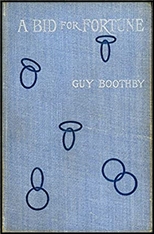
   Searching for books is often a frustrating task, not merely because (as we all know) some books simply won’t be found but also because those that are located often turn out to be disappointments. In my experience, many highly touted classics have not lived up to their publicity. That is not the case, I’m glad to report, with Guy Boothby’s first novel about Dr. Nikola.

   I leave it to others to discover whether Dr. Nikola is fiction’s first arch-criminal (is Moriarty in the same category?), but it seems likely that the Nikola books form the first sustained series featuring such a nefarious malefactor. A Bid for Fortune has coincidences galore and occasional purple prose (“Oh, my girlie! my poor little girlie! what have I brought you to through my. obstinacy?”), but it is generally well-told and well-plotted. Boothby keeps the reader interested not by overwhelming use of violence – indeed, I don’t recall a single murder in it – but by a sense of mystery.

   The book opens with Dr. Nikola meeting 3 co-conspirators who plan, for an unnamed reason and by unspecified means, to ruin a man named Wetherell: “My toils are closing on you … you will find yourself being slowly but surely ground into powder. Then you may be sorry you thought fit to baulk Dr. Nikola.” The scene then shifts to Australia, to young Dick Hatteras who has made a fortune pearling and who plans to visit his ancestral home in England. He falls in love with Wetherell’s daughter, and on shipboard they pledge their troth (as they used to do; nowadays they just shack up).

   Once in London, his fiancee is forced to 1eave him; he meets Dr. Nikola, and befriends a young nobleman whom he agrees to guide to Australia. The plot becomes steadily more complicated, as Nikola’s minions kidnap Hatteras and the young Lord in Cairo. Eventually, they return to Australia, and rescue all in distress, but Dr. Nikola obtains what he has sought from Wetherell. Nevertheless, the veil of mystery remains even in the final paragraph: “What gigantic coup [Nikola] intends to accomplish … is beyond my power to tell.”

   Boothby, an Australian, had not only a sense of mystery but also a talent for description of 19th century England, Australia and Egypt. A Bid for Fortune is an excellent example of leisurely but engrossing fin de siecle storytelling.

– Reprinted from The Poison Pen, Volume 4, Number 2 (April, 1981). Permission granted by Doug Greene.

   
      The Dr. Nikola series

A Bid for Fortune; or, Dr. Nikola’s Vendetta. Ward 1895.
Doctor Nikola. Ward 1896.
The Lust of Hate. Ward 1898.
Dr. Nikola’s Experiment. Hodder 1899.
Farewell Nikola. Ward 1901.
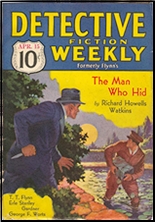
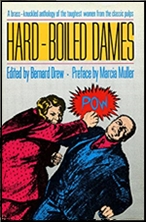
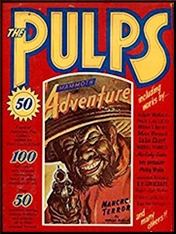
T. T. FLYNN “The Deadly Orchid.” Trixie Meehan & Mike Harris #1. First published in Detective Fiction Weekly, April 15, 1933. Reprinted in The Pulps, edited by Tony Goldstone (Chelsea House, hardcover, 1970) and Hard-Boiled Dames, edited by Bernard Drew (St. Martin’s Press, hardcover, 1986).

   I have written about the bickering pair of PI’s by the name of Trixie Meehan and Mike Harris before. You can find my review of “Barred Doors,” the seventh in the series, here. To recap quickly, though, they both work for the Blaine Agency and are always casting barbs at each other – in a friendly way, you know —  or at least I think so.

   In this, their first appearance, they go undercover in a plush hotel disguised as husband and wife (but in a suite of adjoining rooms, with a lock on the door between them). With the benefit of an unlimited expense account, they also are pretending to be a fabulously wealthy pair of Texans (oil money), and living it up greatly.

   Their target: a incredulously beautiful wisp of a girl, nicknamed the Orchid, who is also a notorious blackmailer who has also been known to kill her victims when things don’t work out perfectly with one of her schemes.

   Mike is the one who tells the story and the one who works up the plan to discover where the love letters she is holding over her latest victim are located, but Trixie is no slouch either when she is needed to take part in the action.

   There’s not a lot of depth to the tale, but it’s smoothly told, in something of a screwball story sort of way. Somebody really ought to put together a complete collection of their adventures together.
   

      The Mike Harris & Trixie Meehan stories –

The Deadly Orchid (ss) Detective Fiction Weekly Apr 15 1933
Falling Death (nv) Detective Fiction Weekly Oct 28 1933
Murder’s Masquerade (nv) Detective Fiction Weekly Mar 31 1934
The Yin Shee Dragon (na) Detective Fiction Weekly Sep 29 1934
Murder Harbor (nv) Detective Fiction Weekly Dec 1 1934
The City Hall Murders (na) Detective Fiction Weekly Mar 23 1935
Barred Doors (na) Detective Fiction Weekly May 18 1935
Nitro! Nitro! (na) Detective Fiction Weekly Apr 4 1936
The Letters and the Law (na) Detective Fiction Weekly Jun 27 1936
Abbey of the Damned (na) Detective Fiction Weekly Oct 30 1937
Murder Circus (na) Detective Fiction Weekly May 21 1938
The Secret of the Swamp (na) Detective Fiction Weekly Feb 25 1939
Brother Murder (na) Detective Fiction Weekly Dec 2 1939
Mike Finds Trouble (sl) Detective Fiction Weekly Aug 17 1940, etc.
Build Up for Murder (nv) Detective Fiction Aug 20 1941
Killer in the Clouds (ss) Detective Tales Mar 1951


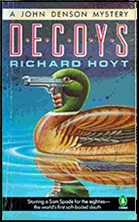
RICHARD HOYT – Decoys. John Denson #1. M. Evans, hardcover, 1980. Penguin, paperback, 1984.

   John Denson is a Seattle-based private eye. While his first case is no out-and-out classic, it is refreshingly different, and Denson’s a character I’d love to see again.

   Nor would I mind if his competition in this book for an unknown treasure – unknown to Denson, that is – were to show up along with him. She is Pamela Yew, also a private investigator, and she knows what the objective is. They make a bet. She will win the $50,000 piece of artwork adorning Denson’s office. He will win, um, her.

   A lot of male/female stuff comes into play. Denson does not think PI work is a woman’s line. She refuses to stay on the pedestal he offers her. Who wins? You’ll have to read this one for yourself to find out.

   There are also a large number of “decoys” in this book. It all depends on how deep allegorically you want to dig. And even so, if you like your detective fiction fast-paced with a lot of twists, and populated by characters who know what they are all about, I can’t imagine your failing to enjoy this one.

Rating: A minus.

–Very slightly revised from The MYSTERY FANcier, Vol. 5, No. 2, March/April 1981.

   
     The John Denson series –

Decoys (1980)
30 for a Harry (1981)
Siskiyou (1983; aka “The Siskiyou Two-Step”)
Fish Story (1985; aka “Contract Killer”)
Whoo? (1991; aka “Flight of Death”)
Bigfoot (1993)
Snake Eyes (1995)
The Weatherman’s Daughters (2003)
Pony Girls (2004)

      Short Stories –

“Private Investigations” (1984, The Eyes Have It)

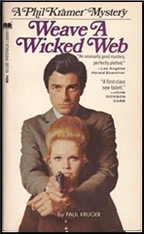
PAUL KRUGER – Weave a Wicked Web. Phil Kramer #2. Simon & Schuster, hardcover, 1967. Paperback Library 63-180, paperback; 1st printing, December 1969.

   There’s a little reviewer’s license going on there in the line up above. Phil Kramer’s not a licensed PI. What he is instead is a practicing attorney, but what he’s hired to do in this, his second appearance, is definitely a PI’s job, and the way he tackles it is exactly how a PI would. A PI in other colors is still a PI, no matter how you may look at it. Or him, as the shoe may fit.

   It all begins when a beautiful blonde walks into his office to have a woman called Kitty Bates found. She also has a description of her, but nothing about her background or anything else. She also will not say why she wants her found. There’s not much for Kramer to go on, but when he sees a story in a newspaper about a woman’s otherwise unidentified body having been found, the wheels in the case finally get going.

   And what a case it is. It turns out that Kitty Bates – yes, it is she – has been blackmailing someone in his client’s family for a long time, and that possibly even before she was killed, someone else had impersonated her to obtain $50,000 in cash from someone else in the family. And then two, maybe three, other deaths occur, Kramer is knocked out from behind at least once, and all of the alibis of those who may have responsible are leaking like sieves.

   This, in other words, is a detective story with a capital D. Do not expect any more character development than there is in your average Perry Mason novel, for there is none. There are twists galore in the telling, culminating in a long scene at the end, over ten pages long, in which all of the suspects have been gathered together while Kramer explains all – naming two killers in succession before finally implicating the real one.

   All fine and good, but even if this sound fine and good to you (and I freely admit that some may not), the telling is awfully dry, with lots of repetition as Kramer continually goes over the facts with everyone he speaks to. It’s a good mystery, no doubt about it, but with only a minimum amount of  juice in it to speak of, it’s not a great one.


      The Phil Kramer series –

Weep for Willow Green. Simon 1966
Weave a Wicked Web. Simon 1967
If the Shroud Fits. Simon 1969
The Bronze Claws. Simon 1972
The Cold Ones. Simon 1972

   Besides her five Phil Kramer novels, “Paul Kruger,” a pen name of Roberta Elizabeth Sebenthall,   (1917-1979), has five other works of crime fiction included in Al Hubin’s Crime Fiction IV.

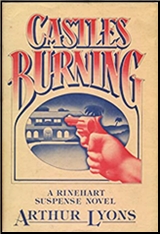
ARTHUR LYONS – Castles Burning. Jacob Asch #5. Holt Rinehart & Winston, hardcover, 1979; paperback, 1982. Movie adaptation: Slow Burn (Showtime, 1986). Reviewed here.

   I didn’t care much for The Dead Are Discreet, the first of several adventures of PI Jacob Asch that Arthur Lyons has written up. It was four years ago when I read it, and in these pages I called it “mired in … muck [with] a plot full o! inconsistencies …” and I gave it a “D.”

   I might have been wrong. (Well, maybe .) At any rate, what Castles Burning strongly suggests is that I should not have been automatically skipping all the books he’s written since then.

   Not that this one started out all that well. Asch decides to give an artist a helping hand in tracking down the latter’s son, the spoils of a marriage that went on the rocks some ten years before. The artist’s specialty: kinky sex, brought lovingly to life on canvas. Quoting the artist’s agent on page three, “We live in an erotic age, dear boy.”

   But group groping and decor in leather are soon dismissed as a major topic of interest, and thankfully so. The true theme cuts just a little closer to home: alienated children, children with all that money can buy, but junked-out children nonetheless, and maybe therefore. Quoting again, this time from page 190, “They grew up bent because that was the way the light was coming in.”

   The boy Asch is looking for is dead. The mother has remarried, and now she has a stepson instead. Thanks perhaps to Asch’s inquiries, the boy is kidnapped, and Asch’s client is blamed.

   The characters are vivid and sensitively drawn. Pain and anguish always tend to do that to people, but this time it’s real and not simulated. Asch’s Jewishness only once comes to the fore, serving briefly to help escalate his growing sense of guilt. In all, the kidnapping serves to create some nicely tension-packed scenes before they fade off into a fairly tame closing.

   But only in comparison. For some books the ending would be enough; it’d be what they’d build upon.

–Very slightly revised from The MYSTERY FANcier, Vol. 5, No. 1, January-February 1981.

Rating: A minus.

   
   The Jacob Asch series —

The Dead Are Discreet (1974)
All God’s Children (1975)
The Killing Floor (1976)
Dead Ringer (1977)
Castles Burning (1979)
Hard Trade (1981)
At the Hands of Another (1983)
Three With a Bullet (1984)
Fast Fade (1987)
Other People’s Money (1989)
False Pretenses (1994)

         Short stories:

“Trouble in Paradise” (1985, The New Black Mask # 1)
“Missing in Miami” (1986, Mean Streets)
“Double Your Pleasure” (January 1989, AHMM)
“Dead Copy” (1988, An Eye For Justice)
“Twist Of Fate” (January 1990, AHMM)
“The Tongan Nude” (October 1997, AHMM)

REVIEWED BY RAY O’LEARY:


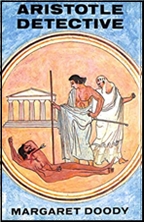
MARGARET DOODY – Aristotle Detective. Bodley Head, UK, hardcover, 1978. Harper, US, hardcover, 1980. Penguin, paperback, 1981.

   Stephanos, a young Athenian and ex-pupil .of Aristotle, is taking a morning walk when he hears cries coming from the house of a wealthy neighbor named Boutades, who is shortly thereafter discovered with an arrow in his throat. A few days later, Stephanos’ cousin Philemon, who is in exile for having killed a man in a tavern brawl, is accused of the murder.

   As Philemon’s nearest relative, Stephanos must defend him in the ancient Greek equivalent of a trial. Naturally, considering the title of the book, he goess to his old mentor for help in clearing his cousin’s name.

   An interesting and entertaining excursion into ancient Greek culture, with an intriguing mystery and a lot of information about the Athenian legal system passed painlessly and pleasantly along to the reader.

— Reprinted from A Shropshire Sleuth #42, November 1989.

   
      The Aristotle and Stephanos series —

1. Aristotle Detective (1978)
2. Aristotle and Poetic Justice (2002)
3. Aristotle and the Secrets of Life (2003)
   aka Aristotle and the Mystery of Life
4. Poison in Athens (2004)
5. Mysteries in Eleusis (2005)
6. Aristotle and the Egyptian Murders (2010)
7. A Cloudy day in Babylon (2013)

   Short Story:

Aristotle and the Fatal Javelin (1980)


From Wikipedia: “Margaret Anne Doody (born September 21, 1939) is a Canadian author of historical detective fiction and feminist literary critic. She is professor of literature at the University of Notre Dame, and helped found the PhD in Literature Program at Notre Dame, and served as its director from 2001-2007.”

REVIEWED BY RAY O’LEARY:


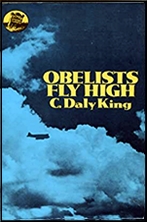
C. DALY KING – Obelists Fly High. [Lt. Michael Lord & Dr. L. Rees Pons #3. Harrison Smith & Robert Haas, US, hardcover, 1935. Dover, trade paperback, 1986, 2015. Published in the UK by Collins, hardcover, 1935.

   A re-read of a book I probably bought when it was first reprinted. In this case, I didn’t remember anything about it, so it was like reading it for the first time.

   Dr. Amos Cutter, a prominent surgeon and brother of the Secretary of State goes to the Police after receiving a letter saying he will be murdered on the following day at noon central time. Cutter is going to Reno, where his sister is getting a divorce and his brother is in the hospital in need of an operation that Cutter is one of the few surgeons who can perform.

   The Commissioner assigns Capt. Michael Lord to protect Cutter as they fly across country with Cutter’s nieces: the beautiful Fonda Mann, who is fond of men and her sister Isa who is a lesbian. (Note that King wasn’t very subtle with his names). Also along is Cutter’s assistant Hood Tinkham. Among the passengers is Lord’s friend, psychologist Dr. L. Rees Pons, who is going to Hollywood to provide psychological background for a script involving two women in love with each other (obviously pre-Code.)

   There’s also author Hugh L. Craven, who is a friend of the girl’s father, a former British spy during the Great War and a believer in the theories of Charles Fort. (ASIDE: Some 30 or so years back I came across a one volume edition of Fort’s books and read it. Some of the stuff is pretty interesting in a Ripley’s-Believe-It-Or-Not sort of way. Other stuff is just damn silly.) Anyway, at noon central time as they’re flying over the mid-west, Cutter dies, and it’s up to Lord to find the killer before the plane reaches Reno.

   Of all the Dover reprints I’ve read this is probably the most poorly written. Characters and dialogue are mediocre at best and there’s an elaborate timetable provided that I couldn’t bother going through. However, King manages to pull off a big surprise midway through the book and then tops that in the final few pages. He also provides at the end a list of clues with the page and the line on that page where they were given so that the reader can go back and verify them.

— Reprinted from The Hound of Dr. Johnson #40, September 2005.


Editorial Notes: Quoting from Martin Edwards’ blog and a review he wrote of Obelists en Route:

   “‘Obelist’ was a word that King made up. He defined it in Obelists at Sea as ‘a person of little or no value’ and then re-defined it in Obelists en Route as ‘one who harbours suspicion’. Why on earth you would invent a word, use it in your book titles, and then change your mind about what it means?”

   Another online review can be found here at the Invisible Event blog. (He gives it Zero stars.)


      The Obelists series —

Obelists at Sea. Knopf 1933.
Obelists en Route. Collins 1934. No US publication.
Obelists Fly High. H. Smith 1935.
Careless Corpse. Collins 1937. No US publication.
Arrogant Alibi. Appleton 1939

   Lt. Lord makes a solo appearance in Bermuda Burial (Funk, 1941)

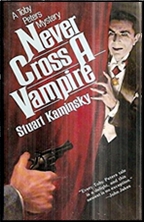
STUART KAMINSKY – Never Cross a Vampire. Toby Peters #5. St. Martin’s Press, hardcover, 1980. Mysterious Press, paperback, 1984, 1995.   ibooks, paperback, 2000.

   As a flight into the past, Stuart Kaminsky’s series of adventures starring Hollywood private eye Toby Peters has come now to be a regularly scheduled event. As in his previous four cases, this affair, which introduces both Bela Legosi and aspiring screenwriter William Faulkner as clients, is fairly dripping with nostalgia. With a capital N.

   The time is January 1942, just as the US was gearing up for its mammoth forthcoming war effort, and every so often we are obliged to sit down and listen to Peters recite his breakfast menu, brand name by brand name, and to read his newspaper along with him, item by item.

   This litany of places, names, and events, while marginally interesting, becomes very much suspect, however, the moment Peters mentions having listened to a program on the popular radio series Suspense. As it so happens, the first program in the series, which lasted until 1962, or some twenty years, was not broadcast until June 17, 1942, or not until six months after the events related here.

   Kaminsky has put more effort than usual into the plot this time, which includes, very briefly, a locked room murder, but sloppy and inaccurate time-tabling – not month and year this time, but the time of day – makes it a little difficult to do more than guess who done it.

Rating: C

–Very slightly revised from The MYSTERY FANcier, Vol. 5, No. 1, January-February 1981.

   
      The Toby Peters series (with a tip of the topper to his page on the Thrilling Detective website) —

   NOVELS

Bullet for a Star (1977; Errol Flynn).
Murder on the Yellow Brick Road (1977; Judy Garland).
You Bet Your Life (1978; Marx Brothers).
The Howard Hughes Affair (1979; Howard Hughes).
Never Cross a Vampire (1980; Bela Lugosi).
High Midnight (1981; Gary Cooper).
Catch a Falling Clown (1982; Emmett Kelly).
He Done Her Wrong (1983; Mae West).
The Fala Factor (1984; Eleanor Roosevelt).
Down for the Count (1985; Joe Louis).
The Man Who Shot Lewis Vance (1986; John Wayne).
Smart Moves (1986; Albert Einstein, Paul Robeson).
Think Fast, Mr. Peters (1988; Peter Lorre).
Buried Caesars (1989; General MacArthur).
Poor Butterfly (1990; Leopold Stokowski).
The Melting Clock (1991; Salvador Dali).
The Devil Met a Lady (1993; Bette Davis).
Tomorrow Is Another Day (1995; Clark Gable).
Dancing in the Dark (1996; Fred Astaire).
A Fatal Glass of Beer (1997; W.C. Fields).
A Few Minutes Past Midnight (2001; Charlie Chaplin).
To Catch a Spy (2002; Cary Grant)
Mildred Pierced (2003, Joan Crawford)
Now You See It (2004; Harry Blackstone).

   SHORT STORIES

“The Man Who Shot Lewis Vance (1984, The Eyes Have It)
“Busted Blossoms” (1986, Mean Streets)
“Long Odds” (2002, Murder on the Ropes)
“Denbow” (2009, Sex, Lies and Private Eyes)

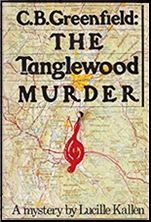
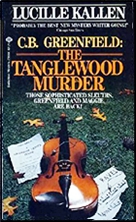
LUCILLE KALLEN – C. B. Greenfield: The Tanglewood Murders. Wyndham Books, hardcover, 1980. Ballantine, paperback, 1981.

   Have you ever noticed how much more you enjoy a mystery novel, say, when the setting is a local one, or one you know? Take, for example, Tanglewood. As everyone in most of New England, at least, must know, Tanglewood is the annual summer home of the Boston Symphony Orchestra, a small village and environs nestled up in the lush green hills of the Massachusetts Berkshires, close to the New York border.

   An apparent plot against the orchestra seems to be motivated by more than usual resentment lodges against them by the local townspeople, upset by the yearly influx of gawking tourists. Tackling an solving the murder that eventually results, in their second case, are C. B. Greenfield, crusty publisher of a weekly upstate New York newspaper, and his star reporter, Maggie Rome.

   It’s Maggie who does the legwork, and Greenfield, although long and lean, who supplies the Nero Wolfian ratiocination. While their combined detective technique lacks polish and remains determinedly amateurish is style, the two sleuths are most decidedly up to the intellectiual challenge of the musical clue left as a dying message – from Ravel’s “Rapsodie Espanole.” That, plus a helpful quote from Shakespeare, and the quiet serenity of one of this country’s most charming corners is quickly restored.

Rating: B plus.

–Very slightly revised from The MYSTERY FANcier, Vol. 5, No. 1, January-February 1981.

      The C. B. Greenfield series –

1. Introducing C. B. Greenfield (1979)
2. The Tanglewood Murder (1980)
3. No Lady in the House (1982)
4. The Piano Bird (1985)
5. A Little Madness (1986)

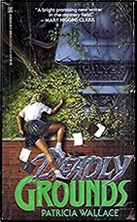
PATRICIA WALLACE – Deadly Grounds. Sydney Bryant #2. Zebra, paperback original; 1st printing, May 1989.

   I don’t remember the title of the first one, but this is [San Diego-based] PI Sydney Bryant’s second recorded adventure. She’s hired here by a neighbor, a 15-year-old schoolgirl who finds the body of a friend along a pathway of the private girls’ academy they both attended.

   Complicating the story is Sydney’s potentially torrid love affair with the policeman in charge. While Wallace’s easy writing style often seems to explain too much, as if telling the story to someone reading a mystery for the first time, she does know teenage girls.

PostScript: Well, she convinced me, at least. It’s really too badthat both the title and packaging make th book look to much like a run-of-the-mill horror novel, at least at first glance — and how much chance does a book get to find its proper audience, anyway?

–Reprinted from Mystery*File #13, June 1989

      The Sydney Bryant series —

Small Favors. Zebra 1988


Deadly Grounds. Zebra 1989
Blood Lies. Zebra 1991


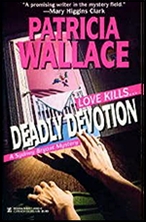
Deadly Devotion. Zebra 1994


August Nights. Five Star, hardcover, 2002

« Previous PageNext Page »