Bibliographies, Lists & Checklists


   As a brief introduction to this piece, I’ll begin by saying that mystery writer John T. McIntyre was the subject of a post you saw here last Saturday, albeit somewhat accidentally so: he was the author of “Blows in the Dark,” the lead story in Complete Detective Novel Magazine for November 1931.

   Thanks go first to Mike Grost for the comments he left after that preceding post, during the course of which in part he reviewed Ashton-Kirk: Secret Agent. According to Mike, it starts out as a pure imitation of the Sherlock Holmes stories, then dissipates its early promise into becoming a cliched and routine espionage novel. Not a surprising report, I suppose, given the lack of name recognition that McIntyre has a writer today, but still a disappointing one.

   But here is some news. I’ve conferred with Al Hubin, and in the next installment of the online Addenda to the Revised Crime Fiction IV, the books in the following separate entry will be merged with those of John T. McIntyre. (Note the previous misspelling of the author’s name.)

MacINTYRE, JOHN THOMAS. 1871-1951. Pseudonym Kerry O?Neil, q.v.

O?NEIL, KERRY. Pseudonym of John MacIntyre, 1871-1951, q.v.

      Mooney Moves Around (n.) Reynal 1939 [Jerry Mooney; Philadelphia, PA] “Private detective murder mystery surrounding the fashion industry.” NOTE: This novel was a SEALED Bonus Mystery. The last chapter of the book, containing the solution to the murder, was tightly sealed in a paper wraparound with printed bonus certificate. The reader would have to break the seal to finish the book. If unbroken, the book could be returned for a full refund; otherwise the purchaser could redeem the coupon for 35 cents.
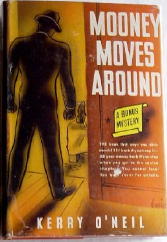
KERRY O'NEIL Mooney Moves Around

      Death at Dakar (n.) Doubleday 1942 [Senegal] “In which an American newspaperwoman [Patricia Cornell] trumps her opponent?s ace.” Add to setting: Rio de Janeiro, Brazil.
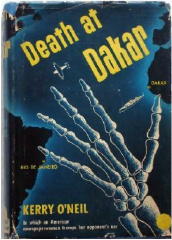
KERRY O'NEIL Death at Dakar

      Ninth Floor: Middle City Tower (n.) Farrar, 1943 [Jerry Mooney; Philadelphia, PA] “Jerry Mooney, a cop turned private detective, investigates the disappearance of an expensive ruby and the murder that follows.”

      Death Strikes at Heron House (n.) Farrar, 1944 [Jerry Mooney; Philadelphia, PA]
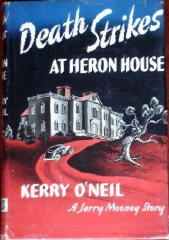
KERRY O'NEIL Death at Heron House

   At the moment I don’t know much more about Jerry Mooney. He’s not included in Kevin Burton Smith online directory of private eyes, and what I do know (see above), I’ll pass along to him.

   Checking out the pulp fiction written by Kerry O’Neil, I’ve discovered a story written as by him in the October 10,1948, issue of Short Stories, a work called “A Short Shot at Purdy.” Given that John McIntyre’s first entry in CFIV was In the Toils, a criminous play published by Penn in 1898, it certainly makes for a long if not entirely illustrious career.

[UPDATE.] Later the same day. Google is wonderful. I’ve found a long, meaty profile of John McIntyre online here. It’s entitled “Noir Town: The hard life of John McIntyre, the legendary Philly novelist nobody’s heard of,” by Kevin Plunkett (2006). I’d love to reprint it here on the blog, but I’ll remain content to have you follow the link and read it for yourself. Highly recommended!

   Here are the last couple of paragraphs:

    “At his death, John McIntyre was already fading into obscurity. The intervening decades took care of the rest.

    “Today his hard-edged Philadelphia novels are forgotten and ‘only hard core mystery buffs’ are aware of the gutsy writer from Northern Liberties, notes Thomas Whitehead [manager of Temple University’s Special Collections Department]. And hardly a soul peruses the John T. McIntyre Papers. And that’s a shame. Because McIntyre rendered Philadelphia’s darker edges into some of the toughest and finest fiction this city has ever seen. ‘He was the Philadelphia writer who captured the realistic parts of city life: the street life, the politics, the ethnic groups in the city, all the relationships,’ Whitehead says. ‘I think he did it well.'”
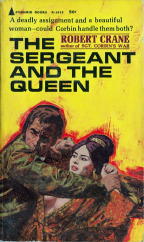
ROBERT CRANE – The Sergeant and the Queen.

Pyramid R-1012; paperback original. First printing: May 1964.

   Some information about the author first, shall we? He’s not a name known to me, nor is this a book I bought in 1964, even though I bought a lot of Pyramid’s back then. But from Crime Fiction IV, by Allen J. Hubin, comes the following:

CRANE, ROBERT; pseudonym of Con Sellers, (1922-1992); other pseudonyms Ric Arana & Ladd E. Linsley.

      Sgt. Corbin’s War. Pyramid, 1964. [Ben Corbin; Korea]
      # The Sergeant and the Queen. Pyramid, 1964. [Ben Corbin; Korea]
      Operation Vengeance. Pyramid, 1965. [Ben Corbin; Tokyo]
      Strikeback! Pyramid, 1965. [Korea]
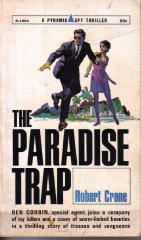
      # The Paradise Trap. Pyramid, 1967. [Ben Corbin; Hawaii]

ROBERT CRANE Paradise Trap

      # Tongue of Treason. Pyramid, 1967. [Ben Corbin; California]
      Time Running Out. Papillon, 1974. [Ben Corbin; Tokyo]
      Out of Time. Decade, 1980; reprint of Time Running Out (Papillon 1974).

SELLERS, CON(nie Leslie, Jr.) (1922-1992); see pseudonyms Ric Arana, Robert Crane & Ladd E. Linsley.

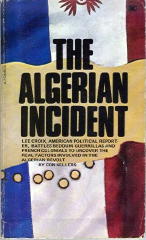
      The Algerian Incident. Powell, 1970. [Algeria]

CON SELLERS The Algerian Incident.

ARANA, RIC; pseudonym of Con Sellers, (1922-1992); other pseudonyms Robert Crane & Ladd E. Linsley.

      The Silent Seducers. Challenge, 1967.
      Big Dano. Powell, 1969. [California]

LINSLEY, LADD E.; pseudonym of Con Sellers, (1922-1992); other pseudonyms Ric Arana & Robert Crane.

      Widow for Hire. Powell, 1969.

   The books I own are the ones with indicated with a #. I thought I had a large paperback collection, and I am not greatly impressed at how low the percentage is of these that I have. There is obviously some work to be done by me as far as Mr. Sellers’ books are considered. (I also do not recall ever have seen a book published by Decade. This is something else that will have to be looked into.)

   From Contemporary Authors comes a partial list of more fiction (I think), but none of them crime related. These, unless indicated otherwise, are under his own name:

F.S.C.: The Shocking Story of a Probable America, Novel Books, 1963.
Too Late the Hero, Pyramid Books, 1970.
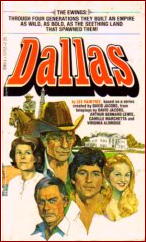
Dallas (novel adapted from the TV series), Dell, 1978. (Under the pseudonym of Lee Raintree.)

CON SELLERS Dallas.

Bed of Strangers, Dell, 1978. (With Anthony Wilson)
Marilee, Pocket Books, 1978.
Sweet Caroline, Pocket Books, 1979.
The Last Flower, Pocket Books, 1979.
Since You’ve Been Gone, Jove Books, 1980.
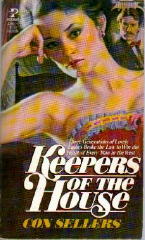
Keepers of the House, Pocket Books, 1983.

CON SELLERS Keepers of the House.

This Promised Earth, Bantam, 1985.
The Black Magnolia, Bantam, 1986.
Trouble in Mind, Bantam, 1986.
Mansei!, Bantam, 1987.
Those Frightened Years, Bantam, 1988.
Brothers in Battle, Pocket Books, 1989.
“Men at Arms” series, four books, Pocket Books, 1991-1992.
   CA also says: “Con Sellers was a prolific writer who produced over 100 novels under a wide range of pseudonyms, including Robert Crane and Lee Raintree. His subjects ranged from pornography to romance, science fiction to war.”

   Mr. Sellers is also quoted thusly: “The most important step in my career was finding my agent, Jane Rotrosen Berkey. Until she took me in hand, I had never gotten more than $3,000 advance; now we talk $100,000.”

   Nice work, and not bad, considering he started with Novel Books, the lowest of the lows, but if his work sold, which it appears it did, he was worth every cent of it. Before turning to writing, using the GI bill as a stepping stone, he was in the military with the U.S. Army from 1940 to 1956; earned more than forty awards, including French Croix de Guerre with Palm, Bronze Star, Combat Infantry Badge with Star, and Purple Heart.

   I thought Sellers’s army service was worth a mention, if only because The Sergeant and the Queen could have been written only by someone in the army, someone who’s been there, knows what it’s like to give orders, take orders, and what it’s like to fight along those who are not ready to be there — kids in a man’s army. This latter theme resonates clearly throughout the book.

ROBERT CRANE Sgt and the Queen.

   The plot of which is rather slim, to say the least. A word first about Ben Corbin, though. I’ve not read the first book he was in, obviously, since I don’t have a copy, but there’s little need to, since his life story is thoroughly gone over in this one. Born in Korea, the son of a fire-and-brimstone Christian minister to that country, Ben Corbin turned instead to the military rather than religion for his own life’s work. Marrying a Korean woman was also what helped turn his life around, transforming him into one of that country’s greatest heroes — with most of his feats accomplished while deeply undercover — a man of legendary fighting abilities, and all aimed to the good of his adopted land.

   The plan in The Sergeant and the Queen, on the part of Corbin and a handful of others, is to bring in the granddaughter of the last empress of Korea to unite the country, a land torn through the middle after the conflict involving China and the UN, and still very much on edge. What the conspirators do not plan on, however, is how greatly attractive Helen Min finds Ben Corbin to be, and even though he is happily married, how little he is able to resist.

   Corbin fights many personal battles in this book, and whenever he does, the book’s forward motion slows to a near crawl. Those who bought this book in 1964 for the action will have found it — when aroused, Ben Corbin is a veritable one-man army, there’s no denying that. But I wonder what they made of the book’s true strength, the portrayal of a man fighting himself, the memories of his father, and a woman who seems to have her way with him, much of it through his own badly conflicted thoughts and emotions.

   A surprising book, in other words, and one not at all what I expected. A minor if not negligible book in the overall scheme of things, but on its own terms? Five stars out of five.

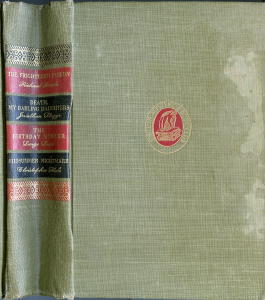
JONATHAN STAGGE – Death, My Darling Daughters.

Unicorn Book Club; hardcover reprint, June 1946. Hardcover first edition: Doubleday Crime Club, 1945. UK hardcover: Michael Joseph, as Death and the Dear Girls, 1946. Digest paperback reprint: Bestseller Mystery #B164; no date stated but circa 1953.

JONATHAN STAGGE

   Most of my time this week has been spent on doing my taxes, which are now done, at last. In the meantime, I’ve posted some old reviews to keep you from stopping by and seeing nothing new. I haven’t chosen the last two at random, though. I had a small design in mind, with no further explanation. I’ll let you put two and two together on your own.

   Jonathan Stagge was the author of nine mysteries published under Doubleday’s Crime Club imprint between 1937 and 1949. Each of these book featuring a country doctor by the name of Dr. Hugh Westlake as their leading sleuth. A widower, he lived with his daughter Dawn, who had only incidental roles in the cases he solved — I think. Maybe I’m wrong on that, as I’ve only read two or three of them, and none toward the end of the series, where she may have not appeared at all. And in some of the earlier ones, read a long time ago, she may have had more a part to play than she does in Death, My Darling Daughters.

   If you’ve been following me as I’ve gone along, however, you won’t be surprised to learn that Jonathan Stagge was a pen name and not a real person. He was instead the writing combo of Richard Wilson Webb and Hugh Callingham Wheeler, who also wrote at various times as Patrick Quentin and Q. Patrick. (Later on in his career, Wheeler co-wrote a play with Stephen Sondheim called Sweeney Todd, the Demon Barber of Fleet Street. I didn’t know that, until just now.)

   It’s not clear how old Dawn is when the book at hand begins. Westlake calls her “my young daughter,” and mentions that he had moved with her to the small Massachusetts town of Kenmore after his wife’s death ten years earlier. Dawn is therefore old enough to be left alone in their home for long periods of time, but young enough to naively point out (and strongly suggest) women who might make good wives for him.

   New in town, or rather newly back in town, is the family descended of one of Kenmore’s more famous citizens, Benjamin Hilton, who at one time was the Vice President of United States. (One of the more obscure ones, you may be sure.) Dawn is the reason that Dr. Westlake gets to meet the family, a mother and two daughters, all rather standoffish from the rest of the town’s inhabitants, but it’s the death of their aged nanny that gets him involved with their problems in his other capacity of town coroner.

JONATHAN STAGGE

   And when the other branches of the family come to visit, both headed by famous research doctors, it is Inspector Cobb, whom Westlake has assisted before, who asks him to stay underfoot and see what he can learn. They suspect murder, but the local D.A. is wisely afraid of annoying such important people.

   And when a second death occurs, they know they’re right, and the D.A. wrong. There is a sense of slyly malicious humor involved in Stagge’s telling of the tale, but even though this is nearly the equivalent of English manor house mystery, with only a very few suspects living together under one roof, the fact is that the people are all very unlikeable. (Some more than others.)

   It slows the reading down, this small fact does, but it is important. The daughters, both in their late teens or early 20s, have been sexually repressed by their mother, in the good old Puritan tradition. Nor are their aunts of much assistance, both rather weak and futile creatures. The two men in the family are greedy and overbearing, along with any other faults that you think might apply to the stuffy male aristocracy of New England.

   Dr. Westlake has the very desirable trait of allowing nearly perfect strangers tell him their life histories, which certainly eases the way when his sleuthing hat is on. Nonetheless, as the book begins to close, and you (the reader) are starting to wonder if there is any real puzzle to be solved, the answer I’m going to be ambiguous and say only that persevering to the end usually pays off.

   Overall? There are some dull spots in the reading — and looking back, I can’t see any way the author could have avoided them, or not easily — but there’s enough solid substance here to give the book a thumbs up. But two of them? I’ve thought it over, and the answer is no, as much I’d like to, I just can’t do it.

[ADDED LATER.] Using Al Hubin’s Crime Fiction IV as a guide, here’s a list of all the Jonathan Stagge books, in chronological order:

      The Dogs Do Bark. Doubleday 1937 [Dr. Hugh Westlake; Pennsylvania]
      Murder by Prescription. Doubleday 1938 [Dr. Hugh Westlake; Pennsylvania]
      The Stars Spell Death. Doubleday 1939 [Dr. Hugh Westlake; Pennsylvania]
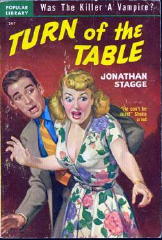
      Turn of the Table. Doubleday 1940 [Dr. Hugh Westlake; Pennsylvania]

JONATHAN STAGGE

      The Yellow Taxi. Doubleday 1942 [Dr. Hugh Westlake; Pennsylvania]
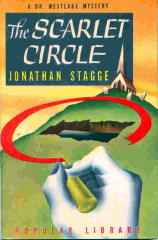
      The Scarlet Circle. Doubleday 1943 [Dr. Hugh Westlake; New England]

JONATHAN STAGGE

      Death, My Darling Daughters. Doubleday 1945 [Dr. Hugh Westlake; Massachusetts]
      Death’s Old Sweet Song. Doubleday 1946 [Dr. Hugh Westlake; Massachusetts]
      The Three Fears. Doubleday 1949 [Dr. Hugh Westlake; Massachusetts]

   The news of mystery writer Arthur Lyons’s unexpected death appeared quickly on the mystery blogs today. First to report was Jiro Kimura’s The Gumshoe Site, followed up soon after by Jeff Pierce at The Rap Sheet, with a long and personal homage to Mr. Lyons. The latter died on March 21st of complications from pneumonia and a stroke; he was only 62.

   Arthur Lyons’s primary character, the one who appeared in all the novels he wrote on his alone and not as part of a twosome, was a LA-based private eye named Jacob Asch. Borrowing Kevin Burton Smith’s words:

    “JACOB ASCH was a glib, cynical, half-Jewish reporter for the L.A. Chronicle until he got sent to jail for refusing to reveal a source. He did six months on a contempt of court beef, and when he was sprung, the glamour of journalism, for some reason, had lost its appeal for him. So now he’s a glib, cynical, half-Jewish LA private dick who gets involved in some very nasty murders, instead.”

   From an interview that Jeff Pierce did with Arthur Lyons some time ago, here’s the author’s take on his character:

    “You’ll never find Asch doing anything unlikely. He will not usually find stuff through coincidence. He’s a plodder. That’s what private detection is, going through papers. All of Asch’s cases come out of paper. He works with paper more than he does people, whereas in Ross Macdonald and with most of those guys, they do it with information people tell them. But there aren’t too many people out there who are going to spill their guts to an investigator, unless the guy has a handle on what’s going on.”

    Here’s a complete list of Arthur Lyons’s work, at least in printed form. Taken and expanded upon from Crime Fiction IV, by Allen J. Hubin, I’ve been able to find covers from all but one of the Jacob Asch books. I apologize that it’s a mixture of hardcovers and paperbacks, nor have I made note of the various reprint editions in which his books have appeared.

LYONS, ARTHUR (Jr.) (1946-2008)

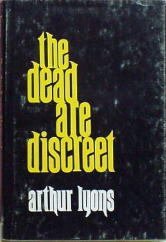
* The Dead Are Discreet (n.) Mason/Charter 1974 [Jacob Asch; Los Angeles, CA]

ARTHUR LYONS The Dead Are Discreet

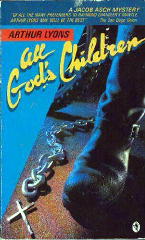
* All God’s Children (n.) Mason/Charter 1975 [Jacob Asch; Los Angeles, CA]

ARTHUR LYONS All God's Children

* The Killing Floor (n.) Mason/Charter 1976 [Jacob Asch; Los Angeles, CA]

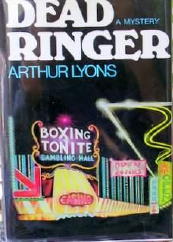
* Dead Ringer (n.) Mason/Charter 1977 [Jacob Asch]

ARTHUR LYONS Dead Ringer

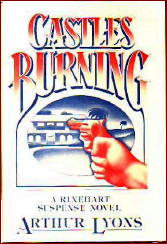
* Castles Burning (n.) Holt 1980 [Jacob Asch; Los Angeles, CA]

ARTHUR LYONS Castles Burning

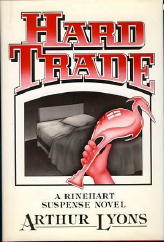
* Hard Trade (n.) Holt 1981 [Jacob Asch; Los Angeles, CA]

ARTHUR LYONS Hard Trade

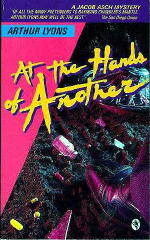
* At the Hands of Another (n.) Holt 1983 [Jacob Asch; California]

ARTHUR LYONS At the Hands of Another

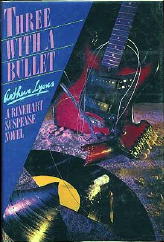
* Three with a Bullet (n.) Holt 1985 [Jacob Asch; Los Angeles, CA; Idaho]

ARTHUR LYONS Three with a Bullet

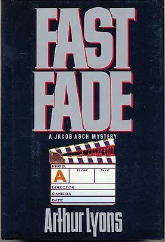
* Fast Fade (n.) Mysterious Press 1987 [Jacob Asch; California]

ARTHUR LYONS Fast Fade

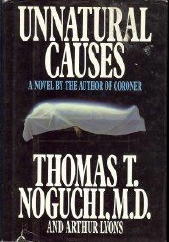
* Unnatural Causes [with Thomas T. Noguchi, M.D.] (n.) Putnam 1988 [Los Angeles, CA; Dr. Eric Parker]

ARTHUR LYONS Unnatural Causes

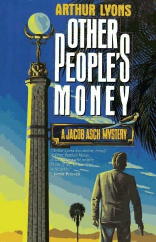
* Other People’s Money (n.) Mysterious Press 1989 [Jacob Asch; Los Angeles, CA]

ARTHUR LYONS Other People's Money

* Physical Evidence [with Thomas T. Noguchi, M.D.] (n.) Putnam 1990 [Los Angeles, CA; Dr. Eric Parker]

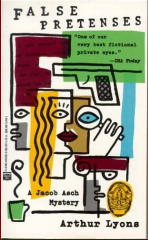
* False Pretenses (n.) Mysterious Press 1994 [Jacob Asch; Los Angeles, CA]

ARTHUR LYONS False Pretenses

Films:

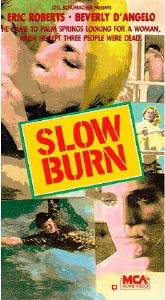
       Slow Burn, based on Castles Burning. Starring Eric Roberts as Jacob Asch.

ARTHUR LYONS Slow Burn

Non fiction:

       The Second Coming: Satanism in America (1970)
       Satan Wants You: The Cult of Devil Worship in America (1971)
       The Blue Sense: Psychic Detectives and Crime (1991) (with Marcello Truzzi)
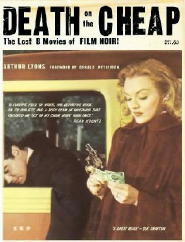
       Death on the Cheap: The Lost B Movies of Film Noir (2000)

ARTHUR LYONS Death on the Cheap


[UPDATE] 03-26-08. For an insightful essay by Jeff Pierce on both Lyons and Jacob Asch, may I suggest a return visit to The Rap Sheet. It was written in 1981 or thereabouts, but its age does not diminish the timeliness of this followup post in any way whatsoever.

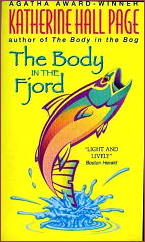
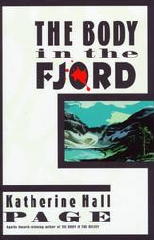
KATHERINE HALL PAGE – The Body in the Fjord.

Avon, paperback reprint; 1st printing, November 1998. Hardcover first edition: William Morrow, November 1997.

PAGE The Body in the Fjord

   False advertising. Although her name is not on the front cover, it’s on the back cover and all over the first couple of blurb pages. This is supposedly a “Faith Fairchild” mystery, and it isn’t.

   Faith Fairchild, for those of you who may not know, is a minister’s wife who lives in Aleford MA (a small fictional village somewhere outside Boston), and she’s solved many a case in her day, but not this one. She appears in a few pages at the beginning, a couple in the middle at the other end of a telephone call, and a few more at the end. That’s all.

   Besides being a sleuth, a wife and a mother, and not necessarily in that order, Faith also has a catering business on the side. Working for her part-time is Pix Miller. What Pix knows about murder cases, she’s learned from Faith, but it hardly seems enough for her to tackle a book’s worth of adventure on her own – and it isn’t, I’m reluctantly sorry to say.

   Pix and her mother Ursula head for Norway in this book – which should hardly come as a surprise, given the title of the book – where they try to track down Kari, the granddaughter of Ursula’s best friend Marit. Kari and Eric, her boy friend, had been working as stewards on a guided tour through the land of the fjords for a group largely consisting of Americans.

PAGE The Body in the Fjord

   But Eric has been found dead, and Kari is missing. You might think it would be the utmost in audaciousness for two American women to come to a foreign country to do the job of the local police, and for the most part, you would be right. Mitigating this rather shaky basis of the story line is the picturesque quality of the tour they join, asking all kinds of questions as they go. Most of the central part of the book is as much a travelogue as it is a mystery, which is what we primarily signed up for, or at least I did, complete with recipes in the back.

   Possible reasons for Kari’s disappearance: she and Eric may have stumbled upon a stronghold of Nazi survivors or sympathisizers; or a gang of smugglers of Norwegian artifacts; or a cabal of industrial spies in the oil business; or the romance between the two young people may have ended in a lovers’ spat and that is that.

   Or any combination of the above. The police don’t make an appearance until page 167, leaving Pix and her mother the only ones on the scene asking questions and getting into serious trouble, especially Pix. It’s all a case of too much, which is quite a paradox, since it’s also a case of far too little.

   Here’s a list of all the Faith Fairchild books, expanding upon the entry in Crime Fiction IV, by Allen J. Hubin. I’d recommend that you read one or another of this list instead, at least for the first one. If you’ve already read one, you’re probably way ahead of me on this.

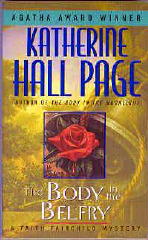
PAGE The Body in the Belfry

The Body in the Belfry. St. Martin’s 1990
The Body in the Bouillon. St. Martin’s 1991
The Body in the Kelp. St. Martin’s 1991
The Body in the Vestibule. St. Martin’s 1992
The Body in the Cast. St. Martin’s 1993
The Body in the Basement. St. Martin’s 1994
The Body in the Bog. Morrow 1996
The Body in the Fjord. Morrow 1997
The Body in the Bookcase. Morrow 1998
The Body in the Big Apple. Morrow 1999
The Body in the Moonlight. Morrow 2001
The Body in the Bonfire. Morrow 2002
The Body in the Lighthouse. Morrow 2003
The Body in the Attic. Morrow 2004
The Body in the Snowdrift. Morrow 2005
The Body in the Ivy. Morrow 2006
The Body in the Gallery. Morrow 2008

LES ROBERTS – The Cleveland Local.

St. Martin’s; paperback reprint, December 1998. Hardcover first edition: St. Martin’s, November 1997. Trade paperback: Gray & Company Publishers, June 2005.

   I’ll begin, not at the beginning, or not really, with a list of all the mystery fiction that Les Roberts has written. This I put together from what I found in Crime Fiction IV, by Allen J. Hubin, plus the bibliography that Mr. Roberts provides on his own website:

         The Saxon Series:     [A Los Angeles actor turned private eye.]

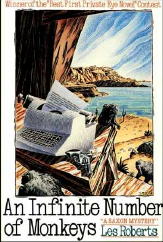
ROBERTS An Infinite Number of Monkeys

• An Infinite Number of Monkeys (St. Martin’s Press, 1987)
• Not Enough Horses (St. Martin’s Press, 1988)
• A Carrot for the Donkey (St. Martin’s Press, 1989)
• Snake Oil (St. Martin’s Press, 1990)
• Seeing the Elephant (St. Martin’s Press, 1992)
• The Lemon Chicken Jones (St. Martin’s Press, 1994)

         The Milan Jacovich Series:      [A private eye of Slovenian heritage based in Cleveland OH.]

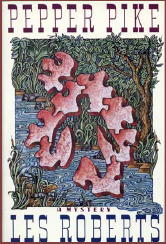
ROBERTS Pepper Pike

• Pepper Pike (St. Martin’s Press, 1988)
• Full Cleveland (St. Martin’s Press, 1989)
• Deep Shaker (St. Martin’s Press, 1991)
• The Cleveland Connection (St. Martin’s Press, 1993)
• The Lake Effect (St. Martin’s Press, 1994)
• The Duke of Cleveland (St. Martin’s Press, 1995)
• Collision Bend (St. Martin’s Press, 1996)
• The Cleveland Local (St. Martin’s Press, 1997)
• A Shoot in Cleveland (St. Martin’s Press, 1998)
• The Best-Kept Secret (St. Martin’s Press, 1999)
• The Indian Sign (St. Martin’s Press, 2000)
• The Dutch (St. Martin’s Press, 2001)
• The Irish Sports Pages (St. Martin’s Press, 2002)

         Stand Alones:

• The Chinese Fire Drill (Five Star, 2001)
• The Scent of Spiced Oranges (Five Star, 2002)

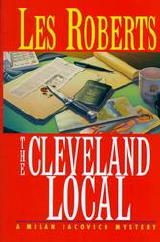
   Here’s the real beginning, the first sentence of The Cleveland Local: “It was a black-and-white-movie morning when I opened my office, looked out the window down the Cuyahoga River, and saw the angry thunderheads hunkered over Lake Erie.”

ROBERTS The Cleveland Local'

   And here’s how the man pronounces his name: MY-lan YOCK-o-vitch, which he proudly makes sure the reader knows by page 3. Milan is an ex-football player and pretty much of a blue-collar kind of PI. He knows his way around every section of Cleveland, though, from the ethnic neighborhoods where he grew up to the ritzier parts of downtown and areas where the richer people live.

   In The Cleveland Local he’s hired to tackle a rather cold case, that of the shotgun murder of a young professional lawyer on the Caribbean island of San Carlos ten weeks earlier. Obviously there’s no way the Cleveland cops can get involved, so the case is steered Milan’s way. The dead man’s sister, also an attorney, is picking up the tab.

   What Milan can’t understand is why the dead man’s father, a noted well-to-do labor attorney, wants nothing to do with the investigation, making him wonder if the sister might be right, and that there’s a local connection, not just another botched robbery attempt in a foreign country and international resort area.

   And of course there is. That’s almost not the point. What Roberts is equally interested in, besides the mystery, is to illustrate why and how he loves the city of Cleveland, the ins and outs, the people who run it, mostly behind the scenes, in a fictional paean to the town, with a hint of melancholy for the older days. There’s also some introspective father-son stuff involved as well, without being overly blatant about it, plus a generous hint of a budding romance. (Milan is divorced from his two boys’ mother.)

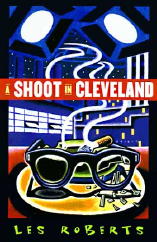
ROBERTS A Shoot in Cleveland.

   Milan’s technique consists of asking good common sense questions, persistence, a tough guy attitude (which at over 40 he can still back up) and persistence. An excellent combination, marred by the fact – and I dislike having to bring it up – by the relative weakness of the mystery. The motive for the murder seems too slight, the method too complicated, and people in retrospect don’t seem to have behaved in appropriate fashion to it.

   Can I say that and still say that I enjoyed the book? I can, and if you didn’t notice, I just did. I should also point out, as many of the reviewers on Amazon also do, that the ending is one that will have readers immediately reaching for the next book in the series, which – thanks to the bibliography above – would have been A Shoot in Cleveland. It looks like a must read to me.

JEAN HAGER – Sew Deadly.

Avon, paperback original. First printing, December 1998.

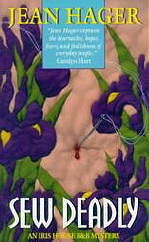
JEAN HAGER Sew Deadly

   At one time Jean Hager had three different mystery series going, but while I’m not 100% sure, there doesn’t seem to have been any books to appear from her in a while. She was born in 1932, so if she happens to be retired from writing, as seems likely, she’s had a very decent career to show for it.

   Ms. Hager wrote romances in the beginning, under both her own name and under several pseudonyms, before edging her way into mystery fiction by writing Gothics (as Amanda McAllister and Sara North) in the late 1970s. Her first true detective novel may have been The Grandfather Medicine in 1989 — but let’s do it the easier way. Here’s a complete list of all the books in each the three series that I mentioned just a minute ago, thanks primarily to Crime Fiction IV, by Allen J. Hubin:

   Chief Mitchell Bushyhead: [half-Cherokee and head of the four-man police force in Bushkin, Oklahoma]

      The Grandfather Medicine. St. Martin’s, 1989.
      Nightwalker. St. Martin’s, 1990.
      Ghostland. St. Martin’s, 1992.
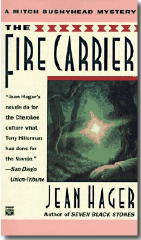
      The Fire Carrier. Mysterious Press, 1996.

JEAN HAGER The Fire Carrier

      Masked Dancers. Mysterious Press, 1998.

   Molly Bearpaw: [a major crimes investigator and advocate for the Cherokee Nation of Oklahoma]

      Ravenmocker. Mysterious Press, 1992.
      The Redbird’s Cry. Mysterious Press, 1994.
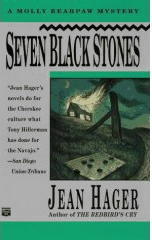
      Seven Black Stones. Mysterious Press, 1995.

JEAN HAGER Seven Black Stones

      The Spirit Caller. Mysterious Press, 1997.

   Tess Darcy: [owner of the Iris House, a bed-and-breakfast in Victoria Springs, Missouri]

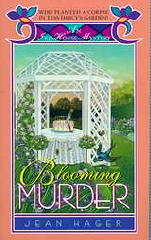
      Blooming Murder. Avon, pb, 1994.
      Dead and Buried. Avon, pb, 1995.
      Death on the Drunkard’s Path. Avon, pb, 1996.
      The Last Noel. Avon, pb, 1997.
      Sew Deadly. Avon, pb, 1998.
      Weigh Dead. Avon, pb, 1999.
      Bride and Doom. Avon, pb, 2000.

   Relative to the Tess Darcy books, there’s a long online interview with Jean Hager about the series at http://bandb.about.com/library/weekly/aa060898.htm.

   Any mystery novel with an amateur female detective, especially one who operates a bed-and-breakfast establishment, is going to be called a “cozy,” no matter that two people are murdered in it, and more or less on stage rather than off, one of them in fairly gruesome fashion. (While sometimes I wonder exactly how cozy “cozies” really are, I’m not going to argue, or least not here.)

JEAN HAGER Blooming Murder

   Probably because a B&B can’t have too many murders take place in it and stay in business, the primary setting of Sew Deadly has shifted by this time, the 5th book in the series, to the local seniors’ center, where Tess volunteers during the winter months, with no reservations in sight until March.

   The first victim comes as no surprise. It is a meddlesome little old lady who lives in near poverty and seems to delight in finding various ways of annoying her fellow seniors, even to the extent of a little minor blackmail, just for fun. (The second to die is more of a shocker, as I mentioned above, both as to who the victim is and the manner of death.)

   It does mean that there are plenty of good suspects, including the dead woman’s nephew and his supposed wife, who just happen to be visiting to make sure he’s remembered in her will, for whatever small amount it might be. And because Jean Hager as an author is quite good as describing what might have been totally stereotypical regulars to the senior center, the detective work is for the most part very well done — and in fact the emphasis is on the detective work, and not Tess’s love life, which seems to be moving well enough along so as not to cause anybody any concern.

   Perhaps you noticed that I used the phrase “for the most part.” The killer is fairly obvious to spot, but while there are lots of clues planted along the way, some of them leading to dead ends, of course, the clincher is not discovered until page 202 (of a 210 page book), meaning that Tess knows for sure only a fraction of a moment before the reader does.

   If the reader has been paying attention, that is. The end result is an “almost but not quite” fair play detective story, but in some cases, like this one, the “almost” is almost good enough.

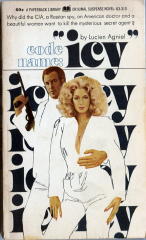
LUCIEN AGNIEL – Code Name: “Icy”

Paperback Library 63-310; paperback original, May 1970.

Agniel: Code Name Icy

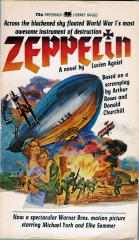
   Of the three books I have by Mr. Agniel, none are copyright in his name, only by either Coronet Publications, who owned Paperback Library, or Warner Brothers. (More about the latter in a minute.) That’s usually a fairly broad hint that the author didn’t exist, that it was a pen name or, more likely, a house name.

   Not so in this case. First of all, and I just noticed this, my copy of Code Name: “Icy” has a handwritten inscription on the first inside blurb page, dedicating the book to Elizabeth. I’ll refrain from repeating the entire inscription. It’s not embarrassing, but I think it should remain private.

   Then, looking in Crime Fiction IV, by Allen J. Hubin, we find not only dates for Mr. Lucien (1919-1988), but a note that he’s included in Contemporary Authors. Pulling up the CA web page, I found that Elizabeth was his first wife, who died in 1973.

   Over the years Lucien Agniel served in World War II and was awarded a Bronze Star, among other honors; worked for the Charlotte News, the US Information Agency, Radio Free Europe, and US News and World Report, among other jobs and occupations.

Agniel: Zeppelin

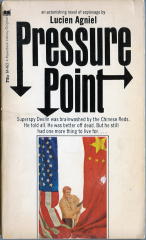
   There are two books listed in CFIV for Mr. Agniel, this one in hand, plus Pressure Point, also from Paperback Library (November, 1970). Arguably there should be another, and I will send the suggestion on to Al in my next email to him: a book entitled Zeppelin (Paperback Library; May 1971), an adaptation of the Warner Brothers movie of the same title.

   I don’t know if you’ve seen the film, starring Michael York and Elke Sommer, but since I haven’t, I looked up the story line on IMBD, which reads as follows: [An allied spy who has pretended to defect to Germany in World War I] “finds himself aboard the maiden voyage of a powerful new prototype Zeppelin, headed for Scotland on a secret mission that could decide the outcome of the war.”

   Most of Code Name: “Icy” takes place in Paris, where the paths of the following characters converge: Eric Eis, an East German assassin who is working with the Russians but who apparently is a former American soldier presumably dead but whose body was never recovered. Fred Sherman of the CIA, who has received an anonymous letter reporting that Eric Hendricks, an American deserter, is still alive; Dr. Richard Hendricks of St. Louis, the brother of the man presumed dead; “Gloria,” who sent the anonymous letter to Fred Sherman; and Nicole, of Birmingham, England, working as a gold-digging stripper in a Parisian night spot, and whom Fred Sherman appears to becoming excessively fond of.

Agniel: Pressure Point

   There is one other incidental participant in the tale, one unnamed, but suitably snooty President of France. It will come as no surprise that he survives. None of the others’ plan work out exactly as they had planned, however, except perhaps Nicole’s.

   All in all, a rather modest affair, one that can be read in a couple of nights before turning off the light. Fred Sherman seems a fairly sappy guy for a CIA agent at first, but he redeems himself reasonably well toward the end. A quick skim through Pressure Point doesn’t turn up his name as an active participant, so it looks like this was his one and only outing – the only one worth recording in book form, that is.

   After my recent review of Les Savage’s collection of western stories THE SHADOW IN RENEGADE BASIN, Keith Chapman left a comment about Señorita Scorpion, the aptly named blonde heroine who appeared in one of them. As part of my reply to him, I thought I’d work up a checklist of all of the stories that she was ever in.

   This turned out to be a lot more difficult than I’d planned. There may already be such a list, but if so, I couldn’t find one on the Internet. Without a collection of the magazines themselves, and rather than struggle more than I needed to, I went to the source himself, Jon Tuska, who’s been busily editing and packaging Les Savage’s work to various publishers over the years. Here’s his reply:


Dear Steve

   There were originally seven Señorita Scorpion stories. The first three were first collected in THE LEGEND OF SEÑORITA SCORPION (Circle V Westerns, 1996). The fourth story was collected in THE RETURN OF SEÑORITA SCORPION (Circle V Westerns, 1997). The sixth story was collected in THE LASH OF SEÑORITA SCORPION (Circle V Westerns, 1998). These were large print editions.

   Only the first collection of three stories appeared in a standard print hardcover: THE LEGEND OF SEÑORITA SCORPION (Gunsmoke, 2003) published in the Gunsmoke series distributed worldwide by BBC Audiobooks Ltd. The reason we stopped the stories from appearing in this Circle V Western series is that they began to appear in Les Savage, Jr., trios published in the Five Star Westerns. They now have all appeared in such Five Star trios.

   Here are the seven stories in terms of first restored appearances in the Five Star Westerns:

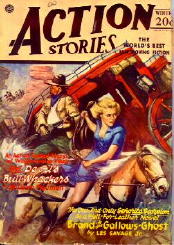
    “Brand of the Gallows-Ghost” by Les Savage, Jr. in Action Stories (Winter, 45) was originally titled by the author “The Brand of Penasco” and was collected under this title in THE SHADOW IN RENEGADE BASIN (Five Star Westerns, 2000).

Action Stories

    “The Sting of Señorita Scorpion” by Les Savage, Jr. in Action Stories (Winter, 49) was originally titled by the author “Scorpion’s Return” but was collected under its magazine title in THE STING OF SEÑORITA SCORPION (Five Star Westerns, 2000).

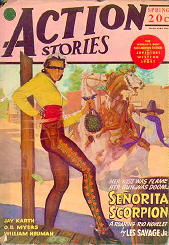
    “Señorita Scorpion” by Les Savage, Jr. in Action Stories (Spring, 44) was originally titled by the author “Death ’Rods the Big Thicket Bunch” but was collected under its magazine title in THE DEVIL’S CORRAL (Five Star Westerns, 2003).

Action Stories

    “The Brand of Señorita Scopion” by Les Savage, Jr. in Action Stories (Summer, 44) was originally titled by the author “Señorita Six-Gun” but was collected under its magazine title in THE BEAST IN CAÑADA DIABLO (Five Star Westerns, 2004).

    “Secret of Santiago” by Les Savage, Jr. in Action Stories (Winter, 44) was originally titled by the author “Secret of the Santiago” and was collected under this title in TRAIL OF THE SILVER SADDLE (Five Star Westerns, 2005).

Action Stories

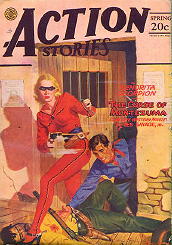
    “The Curse of Montezuma” by Les Savage, Jr. in Action Stories (Spring, 45) was originally titled by the author “Six-Gun Serpent God” but was collected under its magazine title in THE CURSE OF MONTEZUMA (Five Star Westerns, 2006).

Action Stories

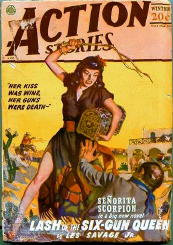
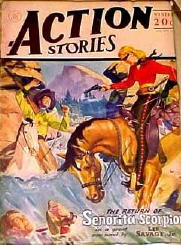
    “Lash of the Six-Gun Queen” by Les Savage, Jr. in Action Stories (Winter, 47) was originally titled by the author “The Return of Señorita Scorpion” but was collected under the title “The Lash of Señorita Scorpion” in WOLVES OF THE SUNDOWN TRAIL (Five Star Westerns, 2007).

Action Stories

   There is a lot of background on each story in the head notes in these various collections. Savage was not as fond of these stories as was Malcolm Reiss at Fiction House, and hence his writing of them was somewhat sporadic. Although he expanded several of his short novels for magazines into book-length novels, he never went back to do so with any of these stories, nor did he try to weld them together into collections the way we have done.

Best Wishes,

      Jon Tuska


NOTE: These cover images came from Phil Stephensen-Payne’s mammoth Galactic Central website, a source that every Fiction Magazine collector should absolutely know about.


[UPDATE] 02-08-07. Turns out that someone has done a list, as I suspected, even though I still haven’t seen it. And not only that, but there’s a story missing in Jon’s list above, but that’s because Les Savage didn’t write it.

   After posting a link to this blog entry on the Yahoo PulpMags group, Will Murray vaguely remembered that maybe Emmett McDowell did a Señorita Scorpion story. This rang a bell with me, too. Then Brian Earl Brown came up with the title. It’s in John DeWalt’s book Keys to Other Doors:

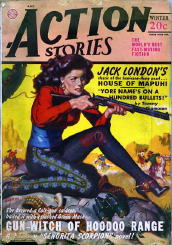
       “Gun-Witch of Hoodoo Range,” Action Stories, Winter 1948/1949, by Emmett McDowell.

Action Stories

   Thanks, gents!

[UPDATE #2.] 02-08-07. From long-time pulp fan Jerry Page, reprinted from the PulpMags group with his permission:

   For years I read only sf and fantasy pulps — I owned some non-sf pulps and had read some hero novels, Spider, Shadow, Doc, etc., but I wasn’t all that interested in pulps outside the sf field.

   Then, wondering through the dealers’ room at a convention I saw a stack of Action Stories on a table and the Winter 1947 issue caught my eye. I knew I had seen it before.

   Where? On the Winter 1947 issue of Planet Stories.

Action Stories

   Both covers were by Allen Anderson. The Planet cover illustrated Erik Finnel’s “Black Priestess of Varda.” The Action cover was the same figure of a woman holding a whip and being attacked by either an outlaw or Indian (I haven’t tried digging it out of the box its in so forgive me, but this is from memory).

   Obviously done from the same reference photo of the same model in the same pose. Composition and so on the same. But one was SF and the other was Western. I bought the Action Stories, took it home and compared it with the Planet Stories and confirmed what I thought I had seen. I think I bought three Actions and in each of them there was a Senorita Scorpion story by Les Savage. I read one of them and it was pretty good. I concluded Savage might be a better than average writer. So I read the others. They weren’t quite as good as the first one, but they were good.

   And that’s how I started reading pulps outside the SF field. I still think Savage is one of the better western writers. Reading him led to reading more Westerns, and I also started reading other kinds of pulps, discovering the great wealth of fiction to be found in Adventure, Black Mask and the better Air War pulps such as Wings. (Joel Townsley Rogers is one of the great pulp writers, and his best World War I stories, especially the aviation stories are close to being masterpieces.) I examined my Argosy issues I’d picked up because they contained fantastic stories, and started reading other types of fiction.

—Jerry

   Additional installments of the online Addenda to Allen J. Hubin’s Revised Crime Fiction IV don’t usually occur as quickly as this, but I uploaded Part 24 to the website this afternoon.

   A primary source of much of the new data this time came from Kenneth R. Johnson’s new online index of digest paperbacks of the 1940s.

   As Ken says in the first two lines of his introduction, “The digest-sized paperbacks are very much the forgotten step-children of the American paperback revolution. The earliest series predate the advent of Pocket Books by two years. They were published in parallel with the smaller mass-market paperbacks, flourishing even amid the paper rationing of World War II.”

   Later on he states: “The largest genre published was detective fiction (almost 1100 books); western fiction was much less prolific (circa 325 books), and science fiction was marginally on the radar. Almost as prolific as the mysteries was a long-defunct genre called ‘love novels,’ with circa 925 books.”

   If Ken’s bibliography is not complete, it certainly comes close. At present it includes, he says, 2688 books, but he’s very anxious to add any that he’s missed, if you have information about them.

   But as I said up toward the top, from Ken’s index so far, Al Hubin has already discovered pages of information now incorporated into Part 24 of the Revised CFIV Addenda. This consists largely of dates and settings, but many alternate titles as well and a stray pen name or two, previously unknown to Al.

« Previous PageNext Page »