TV mysteries


Nero Wolfe on Page and (Small U.S.) Screen:
“Immune to Murder”
by Matthew R. Bradley
   

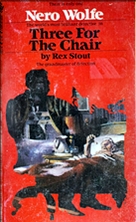
   Three for the Chair (1957) is a somewhat transitional work, containing the last two Nero Wolfe novellas originally published in The American Magazine  —  as all others had been: “Immune to Murder” (November 1955) and “A Window for Death” (as “Nero Wolfe and the Vanishing Clue,” May 1956). Rex Stout’s longtime outlet ceased publication with its August 1956 issue, so “Too Many Detectives” (September 14, 1956) debuted in Collier’s (which ironically followed suit soon after). “Window” concerns a murder committed in the Churchill Towers, and thus occasions mentions of “Tim Evarts, assistant house dick, security officer to you,” although Archie himself later repeats the “house dick” reference.

   â€œDetectives” also marks the first appearance in the canon proper of early female P.I. and occasional employee Theodolinda “Dol” Bonner, who after a solo effort, The Hand in the Glove (1937), figured in the Tecumseh Fox novel Bad for Business (1940), but ended up on the cutting-room floor when the latter was rewritten as the Wolfe novella “Bitter End” (1940).

   â€œI am against female detectives on principle,” Archie begins, but “there are times when a principle should take a nap, and that was one of them.” In Albany, he meets Dol and operative Sally Colt when all 590 private detectives licensed by the state, including a typically tetchy Wolfe, are summoned for questioning due to the “wiretapping scandals.”

   Three confreres from the Association of Licensed Private Detectives of New York State (ALPDNYS) — Steve Amsel (fired by Del Bascom), Jay Kerr, and Harland Ide — are also waiting to follow as Albert Hyatt, a special deputy of the secretary of state, questions our heroes. A man purporting to be Otis Ross had hired them to tap his own phone, which is legal, and disappeared when they learned he was not; Hyatt tells Wolfe he has a surprise, and gets one himself when the client, waiting in another room, is found strangled. Leon Groom, Albany’s chief of detectives, arrests them as material witnesses in the murder of William A. Donahue, who claimed Wolfe knew his identity…and that the tap was illegal.

   Bailed out by Stanley Rogers at the behest of Parker, and compelled to take a room at the Latham Hotel, Wolfe gathers the confreres/suspects to pool knowledge and resources; he learns that each had similar experiences but Amsel, who says he refused a tap-request by Donahue using his own name. Those tapped and his target manqué constitute the Charity Funds Investigating Committee, and Wolfe has the 48 operatives they collectively supply look into any connections with Hyatt, who had arranged for all seven to be there that day. The counsel for one of the suspect fund-raising organizations, Hyatt planned to scapegoat Donahue, believed safely out of the state, and killed him after he appeared unexpectedly.
   â€œImmune” finds Wolfe and Archie as guests at River Bend, the Adirondacks mountain lodge of Hemisphere Oil Co. (Hemoco) tycoon O.V. Bragan, at the request of Assistant Secretary of State David M. Leeson; Ambassador Theodore Kelefy, of “a foreign country with which our country wanted to make a deal,” has asked to catch a brook trout and have it cooked by Wolfe. A friend/advisor, financier Spiros Papps, identifies the others as oil-syndicate representative James Arthur Ferris and spouses Sally Leeson and Adria Kelefy. One of the five anglers doesn’t get to sample the baked brook trout Montbarry: Leeson, whom Archie finds in the river, his skull smashed in, while landing his own “supertrout.”

   Noting that the Kelefys and Papp enjoy “diplomatic immunity from arrest or detention,” D.A. Jasper Colvin says the evidence points to murder by somebody at the lodge, with a club from the woodpile, and the obvious inference a connection with the rivalry between Bragan and Ferris over Kelefy’s oil rights. Wolfe (weight-watch: Archie specifies his as 278 lbs.), who refuses to explain why the 20 trout he cooked included none caught by the ambassador — as verified by cook Michael Samek — wants only to go home. As all await the arrival of state A.G. Herman Jessel, Wolfe reluctantly tells Kelefy, “it amuses me to twist the tails of highly placed persons…I thought it would be nice touch of mockery…”

   Wolfe tells Jessel, Colvin, and Sheriff Nate Dell he’s ready to identify the murderer, but only with everyone present — and after a call to the Secretary of State, in which he reveals the true reason: Kelefy’s trout had been caught prior to the others, allowing him time for the murder. Having conferred by phone (in French, as a trooper listened) with Parker, he knew he might risk imprisonment if Kelefy were maltreated by “officers of the law,” thus the call to Washington. The motive is revealed to have no “relation to his public mission or the negotiations” but was purely personal, as Sally confirms that her husband had been seduced by Adria while he was the embassy secretary in their unnamed fictional country.

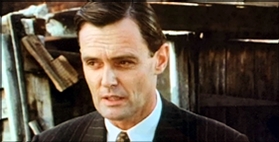
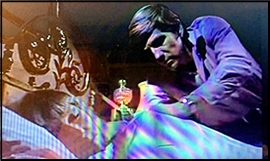
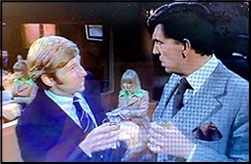
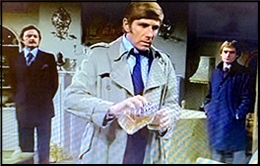
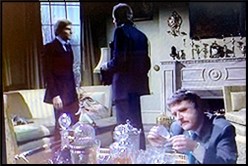
   Directed by John R. Pepper, and also broadcast in a double-length international version, “Immune to Murder” (8/18/02) was the final episode of A Nero Wolfe Mystery, and the only one adapted by Stuart Kaminsky. The prolific, Edgar Award-winning novelist, film professor/biographer, Mystery Writers of America president, and occasional scenarist  —  e.g., Sergio Leone’s Once upon a Time in America (1984) — specifies Kelefy (Giancarlo Esposito) as the “Vezenhuegan ambassador.” Local law has been scrambled somewhat, with Colvin, Dell, trooper Lt. Hopp, and Jessel recombined into Captain Colvin Jasper (sic; Richard Waugh), trooper Nate (Matthew Edison), and D.A. Jessel (Steve Cumyn).
   A faux news report kicks off the episode, identifying Bragan (David Schurmann), Ferris (Seymour Cassel, previously seen in “Before I Die” [6/16/02]), and Papps (Carlo Rota),  on camera. A reporter (Adam Reid) interviews Leeson (Robert Bockstael), who calls the gathering “an experiment on how being in nature — away from the secretaries, the pens and paper, [and the] long tables of formal diplomacy…may actually be able to change people’s minds,” explicitly compared with Ike’s then-imminent use of Camp David. In his narration, Archie (Timothy Hutton) notes that, “Twenty years ago…Wolfe [Maury Chaykin] got the papers that made him a U.S. citizen,” and thus agreed out of gratitude.

   Here, Papps has a predetermined “migraine,” sitting out the angling with Sally (Susannah Hoffmann) and Adria (Manon von Gerkan), as the Cook (George Plimpton) makes an ill-advised joke to Wolfe about his recipe requiring salt and onion. The credits are typically careless: Waugh’s character is addressed as Captain Colvin in the dialogue, and Cassel’s identified as, respectively, “Janus” and “James” in the opening and closing titles. Sadly, the series does not end on a high note, with pervasive scenery-chewing by, e.g., Waugh, Schurmann, and even Chaykin, as he bellows (via Kaminsky, not Rex Stout) about being in “a nightmare, dime-store, frontier theme park filled with bacteria-infested animals…”

         — Copyright © 2023 by Matthew R. Bradley.
   

Up next: “Christmas Party”

Edition cited  —

      Three for the Chair: Bantam (1958)

Online source —
Nero Wolfe on Page and (Small U.S.) Screen:
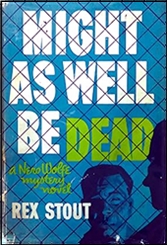
Might As Well Be Dead
by Matthew R. Bradley


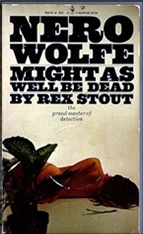
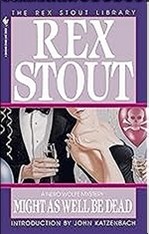
   In Rex Stout’s Might as Well Be Dead (1956), James R. Herold hires Nero Wolfe to find his son after learning that he had wrongly accused Paul — who has been sending birthday cards to his mother and sisters, postmarked New York, for 11 years — of stealing $26,000 from his Omaha hardware wholesale business. Because people often select an alias using the same initials, Wolfe places an ad directed at “P.H.,” only to have it widely assumed as a reference to Peter Hays, on trial for first-degree murder. This seems like a coincidence, until attorney Albert Freyer pops in and reveals that he knows nothing of his client’s past, and while headed down to the courtroom for a look, Archie realizes he is being followed.

   Freyer disbelieves that they have no interest in Hays when he sees Archie, who becomes certain that he matches Paul’s graduation photo by his defiant look after the guilty verdict is announced, which Freyer says is inconsistent with a despairing view that “he might as well be dead.” Convinced that Hays was framed, he gets Archie in to see him, and Hays begs them not to tell his father; since Archie’s tail suggests that someone is threatened by the possibility of his being cleared, Wolfe agrees to postpone informing Herold as Freyer starts the appeal process and he investigates the murder. The advertising copywriter had allegedly killed real-estate broker Michael M. Molloy because he loved his wife, Selma.

   Hays denied shooting him, but offered no explanation for the key to their building and the pistol — both found on him — or anything else, while Selma testified that the abusive Mike falsely accused her of infidelity, refusing to grant a divorce. Freyer reports Hays’s claim that he found Mike dead after an anonymous caller said he was beating her, opining that he is shielding Selma, who has an alibi that may not be airtight but in turns believes Hays guilty. Giving the ’teers and occasional operative Johnny Keems various jobs, Wolfe has Archie pump Delia Brandt, Selma’s successsor as Mike’s secretary, for information, with the pretext of gathering material on his last days, for an article to appear under her byline.

   Mike rented a safe-deposit box as “Richard Randall” and died intestate, but Selma refuses to be his administrator; she proposes his friend Patrick A. Degan, head of the Mechanics Alliance Welfare Association, and accepts Wolfe’s suggestion of Nathaniel Parker as her lawyer. As the conference is winding up, Stebbins calls to tell them Johnny was killed by a stolen car while investigating Selma’s theater companions that night, Thomas L. Irwin and Jerome and Rita Arkoff. She’d been asked to fill in for Fanny Irwin, benched with a headache, and Wolfe thinks that the killer not only knew she’d be out of the way but also may have engineered her absence, yet what Johnny might have learned is not yet known.

   Selma asks the couples to come to Wolfe’s, noting that Rita — also a former model, who wed TV producer Jerry — thought Fanny and Pat “were snatching a snuggle,” and Tom’s company did printing for MAWA; they are preceded by Delia’s fiancé, William Lesser, whom Archie assures they can vet the article before publication. Johnny saw all four of them, and Rita reports that she had asked Selma at the suggestion of Tom, but Fanny says the idea was originally hers, “because I could trust him with her.” They leave Wolfe with “no gleam anywhere,” and are followed by Cramer, who provides a list of the contents of Johnny’s pockets, missing the $100 given him for expenses, presumably used for a bribe.

   Watched by Archie, Parker, and an agent of the New York State Tax Commission, Degan finds $327,640 in cash in the safe-deposit box, and agrees to try to learn its source. Saul tentatively i.d.’s the body found bludgeoned behind a lumber pile on 140th Street as Ella Reyes, the Irwins’ maid and the likely bribee; Archie has Selma confirm that — which she does under an alias without alerting Donovan, the morgue desk sergeant from The Black Mountain (1954) — and stay with them for safety. Cramer arrives, “fed up,” unwilling to concede Hays’s innocence, and deduced to have led Lieut. Murphy of Missing Persons to spill the beans about his true identity to Herold, who briefly fired and then rehired Wolfe.

   Mike had invited Delia on a “business trip” to South America, and since Archie intuited that she’d been receptive, which she denied, he and Saul go to her apartment in search of anything he might have stashed there, finding it rifled and, on her strangled body, the key to a Grand Central locker. Documents from the suitcase therein cause Wolfe to convene the interested parties and finger Degan, who’d conspired to embezzle funds from MAWA with Mike, and killed him to forestall his betrayal. Johnny and, in turn, Ella died because she told him Fanny did not develop her “headache” until after a call from Pat, suggesting that she forego seeing Julie Harris in The Lark, ostensibly to discuss some private matter.

   Directed by series mainstay George McCowan, “Might as Well Be Dead” (2/13/81) was the only episode of NBC’s Nero Wolfe series featuring William Conrad to be scripted by Seeleg Lester, a longtime writer-producer on Perry Mason. Natalie Wood’s sister, Lana, who played Plenty O’Toole in Diamonds Are Forever (1971), guest-starred as Delia, with John de Lancie, best known as Q in the Star Trek franchise, as Tom. It simplifies the plot by establishing Hays (A.C. Weary) as innocent from the outset, as the audience actually sees him get the anonymous call, hear shots from outside the apartment, find Mike dead with no sign of his wife, Maggie (Gail Youngs), and pocket the gun before he is caught.

   Lester efficiently interpolates exposition by dramatizing testimony in the trial, and before they meet with Herold (Stephen Elliott), news vendor Charlie (Ralph Manza) tells Archie (Lee Horsley) that Hays, refusing to take the stand in his own defense, must be guilty. In looking at the front-page story, Wolfe immediately notices a similarity in the photos, the identical initials, and the fact that Paul refused to defend himself of embezzlement, all of which he terms “synchronicity.” Stymied by Hays’s lack of cooperation, Freyer (Michael Currie) gives Archie a transcript of the trial and thinks Wolfe could help; streamlining the plot yet again, Pat (Bruce Gray) had been Mike’s lawyer and agrees to serve as Maggie’s.

   The Arkoffs are now Jerry (John Findlater) and Tina Nelson (Deborah Tranelli), and with Saul out of town, Johnny (Herb Braha) is assigned to investigate them, Tom, and Fanny (Karen Montgomery). The death of a recurring character dating to the second book, The League of Frightened Men (1935), lacks resonance with his televised appearances limited to two quick scenes here. After Ella is killed, Cramer (Allan Miller) brings a warrant for Maggie, whom he believes Hays is shielding; Lester borrows an incident — mentioned by Purley in the novel — from The Rubber Band (1936), as Wolfe conceals her in the plant rooms, hidden underneath some seedlings he and Theodore (Robert Coote) are spraying.

         — Copyright © 2023 by Matthew R. Bradley.
   

Up next: “Immune to Murder”

Edition cited: Might as Well Be Dead in Seven Complete Nero Wolfe Novels: Avenel (1983)

Online source [link mislabeled as “Blue Ribbon Hostage”]

ALLEYN MYSTERIES “Artists in Crime.” BBC1, 23 December 1990 (pilot episode). Simon Williams (Chief Inspector Roderick Alleyn), Belinda Lang (Agatha Troy), William Simons (Inspector Fox), Ursula Howells (Lady Alleyn). Based on the novel by Ngaio Marsh. Director: Silvio Narizzano.

   There was a three year gap between this one-shot pilot and the series that eventually developed from it. In the meantime, actor Simon Williams became unavailable, and his role as Inspector Alleyn was taken by Patrick Malahide, while Simons and Lang continued in two seasons of eight additional TV films of Ngaio Marsh’s mysteries.

   I can’t comment on the latter actor in the part (not yet, that is), but I had a difficulty time at first with Simon Williams in the role. Not because he wasn’t more than acceptable. The problem was that while I’ve read about half of the Alleyn mysteries, I had only a general idea of what he looked like. The same is true about his wife-to-be, Agatha Troy, and his second-in-command “Br’er” Fox.

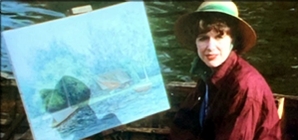
   This is the story in which Alleyn first meets Agatha Troy, and in the film at least, he is smitten immediately. The problem he faces is that she is intimately involved in the mystery, and she in fact is for some time an actual suspect. She is the artist overseeing a group of paying clients trying to learn to paint and living together in the same large home if not mansion. Dead is a sexy model, and in strange fashion, impaled by a knife sticking upward from the bed where she has been posing.

   She, as it turns out, and not surprisingly, is also a blackmailer. This means that Agatha Troy, whom Alleyn’s mother looks favorably upon, is hardly the only suspect. The film is beautifully filmed, a period piece set in the late 40s, but I found it difficult to keep in mind who the other suspects were, and what their involvement might be. Remembering the book only vaguely, I believe the killer’s identity was the same, but they changed the motive.

   Overall, almost more a very tentative romance than a detective story, but as we know Alleyn and Agatha Troy did eventually marry. Oh, one more thing. In this TV version, at one point Alleyn goes into a deep silent mood, and his mother explains he’s been that way since the war. Never happened in the books, nor (so I’ve been told) in any of the TV episodes that followed.


BOURBON STREET BEAT. “A Taste of Ashes.” ABC, 05 October 1959 (Season 1, Episode 1). Richard Long (Rex Randolph), Andrew Duggan (Cal Calhoun), Arlene Howell (Melody Lee Mercer), Van Williams (Kenny Madison). Guest Cast: Joanna Moore, Fredd Wayne, Karl Weber, Isobel Elsom, Jean Byron, Jean Allison. Based on the novel by Howard Browne. Director: Leslie H. Martinson. Currently streaming online here.

   When you’re a private detective and your partner is murdered, you’re obliged to do something about it. Especially when the local cop tells you it’s suicide and you know it’s not. Such is the case that Rex Randolph (Richard Long) finds himself on, taking over from the one that his partner, a chap named Jelkens, was working on.

   Randolph’s office is in New Orleans (not Chicago, as in the book), but most of the action takes place in Pelican Point, a town run by a wealthy matriarch who doesn’t want certain information made public. Blackmail is a nasty business, but the head cop doesn’t want Randolph or any of his assistance anywhere around. An older man on the force, tired of working under younger fellows, is a lot of more sympathetic, and I hope I don’t spoil anything for anybody by telling you that this older guy is named Cal Calhoun (Andrew Duggan), who by episode’s end is Randolph’s new partner.

   There is a noirish vibe in this episode – well, why not, being set in New Orleans and close environs as it is – that’s less present in contemporary stablemate Surfside 6, say, or even 77 Sunset Strip. at least this time around.

   The book is still better, though, a well-recognized masterpiece in the hardboiled/PI/noirish vein. (For Bill Pronzini’s 1001 Midnights review of the book, go here.)


REVIEWED BY MIKE TOONEY:


THRILLER “The Double Kill.” ITV, UK,  First broadcast either on February 18 or April 19, 1975 Series 5, Episode 2, Number 31 of 43. Cast: Gary Collins (Hugh Briant), James Villiers, Peter Bowles (Superintendent Lucas), Stuart Wilson, Penelope Horner (Clarissa Briant), John Flanagan, Hilda Fenemore, Griffith Davies, Michael Stainton, Gordon Salkilld, Norman Mitchell, Paul Nicholson. Series creator: Brian Clemens (1931-2015). Writer: Brian Clemens. Director: Ian Fordyce (1931-1988).  Currently streaming on Pluto TV and YouTube (see below).

   Clarissa Briant has it all: a stately home in the country filled with valuable artwork (with more to come), the great wealth that such possessions betoken, and Hugh, her American husband, to share it with.

   But Hugh seems more eager to share knowledge of Clarissa’s acquisitions with the world at large, especially at social occasions and even in the local pub to perfect strangers. He has become the incarnation of that old wartime adage about loose lips sinking ships, blabbing to one and all, for instance, about how their security systems are yet to be installed, puzzling behavior even for an American.

   Sure enough, it isn’t long before a burglar has a go at those objets d’art gracing the walls and mantelpiece, only to get caught by Hugh in flagrante delicto. You’d think that Hugh has laid a trap and an unsuspecting bug has fallen into it — and you’d be right; but you’d be wrong in assuming Hugh is going to do the proper thing and turn the burglar in.

   No, Hugh has big plans, and a common variety thief like this one just won’t do. Hugh needs someone who is willing to go much further than simply purloining stuff, someone with enough guts to go that extra step to murder . . . .

   “The Double Kill” fits snugly in the “perfect crime” subgenre, two fine examples of which are Double Indemnity (1944) and Dial “M” for Murder (1954). Although it comes closer to the Hitchcock film, “The Double Kill” excels in plot twists, enough to make Dial “M” look as uncomplicated as a typical investigation with Encyclopedia Brown.

   While Gary Collins (1938-2012) carries on the British tradition of importing American actors to boost international sales, he is very good here, veering from smug overconfidence to near desperation, his barely concealed anger and frustrations bubbling up from time to time. Although he appeared in a few movies, Collins spent most of his career on the small screen, starring, for example, in the Night Gallery spin-off series, The Sixth Sense (1972, 25 episodes). Along with another American, Donna Mills, he had the most repeat appearances (3) on Thriller.

   Similarly, Penelope Horner (born 1939) performed in both movies and TV, retiring in 1986.

   Another versatile actor who could handle drama and comedy equally well was Peter Bowles (1936-2022), the wily Superintendent Lucas, whose conduct during the investigation takes a surprising and almost Machiavellian turn.
   

MICHAEL SHAYNE “Man on a Raft.” Unsold TV Pilot. Aired on the NBC summer replacement series Decision, 28 September 1958. Cast: Mark Stevens (Michael Shayne), Merry Anders (Lucy Hamilton), Robert Brubaker (Tim Rourke), Robert Stevenson (William Gentry). Guest star: Diane Brewster. Teleplay by Steve Fisher, based on thee characters created by Brett Halliday. Directed by Mark Stevens. Currently streaming here on YouTube.

   The summer replacement series that replaced The Loretta Young Show for 13 weeks in 1958 consisted entirely of pilot episodes for various series, most of which never came to fruition. The first one shown was picked up, though, and went on to considerable success, that being The Virginian, starring James Drury.

   Not so for this early attempt to get a Mike Shayne series on the air. (The one starring Richard Denning as Shayne came along later.) In it a young good-looking girl comes to Shayne for help in determining when her playboy husband died. He lost his life in a boat at sea, and a good deal of money depends on whether he died before or after his birthday. The other two men on the boat survived, but barely, and the only way of determining what actually happened is by means of a diary one of them kept.

   You can take it from there, but as usual with private eye shows on television, thirty minutes of running time (less time-out spots for would-be commercial buyers) is not enough for more than a bare bones mystery to develop. Other than Mark Stevens as Shayne, none of the rest of the regulars had time enough to make an impression, and Stevens would not have been my choice of an actor to play him. He’s a little too dour for my tastes. In his series Denning looked as though he was having fun playing the role.


WILD CARD. “Pilot.” Lifetime.. 02 August 2003. Joely Fisher (Zoe Busiek), Chris Potter, Rae Dawn Chong, Bronson Picket. Director: Stephen Surjik.  Currently streaming on YouTube (see below).

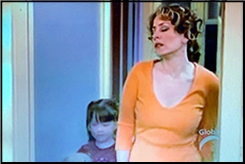
   Zoe Busiek is making living as a blackjack dealer in Las Vegas, when she learns that her sister has died in an automobile accident back East, and she decides to quit and head there to take care of her three young children, two girls and a boy. Only the youngest, a girl, takes at all warmly to her sudden abrupt presence in their lives.

   Her new life, in other words, will not be easy. Making matters worse is that the insurance company has determined, on the basis of eye witnesses, that her sister was at fault, and there will be no money coming in from them. Feeling something is wrong, she decides to investigate on her own, and – you will not be surprised to learn – she is right. It takes a lot of perseverance and footwork to get there, but each in its way pays off.

   Not only that, when all is said and done, she is offered a job as an investigator with the insurance company. Or should that last sentence end with an exclamation point?

   I’ve chosen not to. All signs have been pointing to this all episode long. The happy conclusion – and yes, the kids becoming OK with her now as well – comes as all in due course, the way things should be., especially on the Lifetime network. Putting things into a proper perspective, I’d consider the entire production a step up from a similar concept on say, the Hallmark Channel. Not quite as sentimentally cloying, and maybe just a hint more of a solid edge to it, the series lasted for two seasons of eighteen episodes each.

   One additional note: I did not realize until I started writing this review that Joely Fisher is the daughter of Eddie Fisher and Connie Stevens. And a half-sister of Carrie Fisher. Talk about family values!

MONTE NASH “The Long Ride.” Syndicated / Four Star Productions. September 17, 1971 (Season One, Episode One). Harry Guardino (Monty Nash). Guest stars: Don Gordon, Lew Gallo. Based on the character and books by Richard Telfair. Director: Nicholas Colasanto. Currently streaming on YouTube (see below).

   Monty Nash is a government agent who, in this short-lived syndicated series (it lasted only 14 episodes), is assigned the task of getting a government witness safely from a jail in South Bend, Indiana, to a courtroom in Chicago. The plan is to use a decoy while Nash and the witness drive by car.

   Things don’t go well. There must have been a leak. Somebody on the inside must be on the take.

   Problem is, as far as any enjoyment there may have been in watching this really really disappointing misfire, is that the Bad Guys are Utterly Inept. Even shooting at Nash’s car from a helicopter, wouldn’t you think that would be enough to get the job done? No, sir. Not this time around. It turns out they turn tail and skedaddle as soon as Nash opens fire on them with only a handgun.

   As an actor, tough and gruff Harry Guardino fits the part the screenwriter and director wanted him to play. The direction is OK. The story, though, collapses under its own triteness into something not worth watching. Luckily the show is only 22 minutes long, streaming as it does without space for commercials.

   And oh yes. The music is too jazzy and too loud. I think they were trying to make believe something interesting was going on.
   

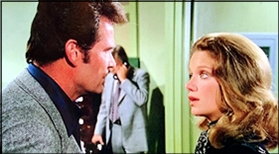
THE ROCKFORD FILES. “The Countess.” NBC. 27 September 1974 (Season 1, Episode 4). James Garner, Gretchen Corbett, Joe Santos, Tom Atkins. Guest stars: Susan Strasberg, Art Lund, Dick Gautier, Harold J. Stone, Gloria Dixon. Teleplay by Stephen J. Cannell, based on a story by Roy Huggins (credited as John Thomas James). Director: Russ Mayberry. Currently streaming on the Roku Channel.

   Rockford is hired by a young woman (Susan Strasberg) who is being blackmailed by a man from her past (Dick Gautier, in a perfect role for him, just oozing oily sleaze) who knows a secret about her earlier life so destructive to her marriage to her second husband she won’t even tell Rockford what it is.

   Of course she does, eventually. And so I assume I can tell you, too. (If I’m wrong, please close your eyes now.) She grew up in a small town in Illinois, and life happened. After skipping bail in Chicago, she ended up in Europe and marrying a count she met there, thus referring to herself as a countess ever since. Now back in the US and happily married again, she wants to stay that way. Blackmailers being who there are, when this fellow is killed, Rockford’s client is high on the list of suspects.

   As well as a couple of syndicate hoodlums whom Rockford soon discovers following his every move. But of course the primary suspect is Rockford himself. He was there on the scene when the fellow was killed, with eyewitnesses, a fact that strains his usually friendly relations with Detective Becker (Joe Santos). Luckily Rockford has a good lawyer at hand, namely Beth Davenport (Gretchen Corbett), who does more lawyer work in this one than she has previously in the series (which largely consisted of wheedling Rockford to work for her pro bono).

   Although I have not reported on any of the earlier episodes, I have been watching the series in order, and this is the first time I can definitively say the people in charge have gotten their acts together. The case is simple but coherent, there are a lot fewer scenes of cars driving endlessly around in this one, and much less padding of the running time with the camera following people along as they’re quietly strolling from one place to another.

   But the big thing I noticed in this one is the comfortable feeling the regular players have reached in interacting with each other. Garner’s natural good-looking charm and his occasional sheepish grin are also in full force in this one.

Nero Wolfe on Page and (Small U.S.) Screen:
The Golden Spiders
by Matthew R. Bradley


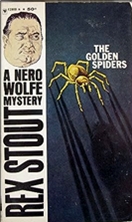
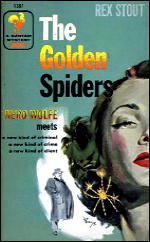
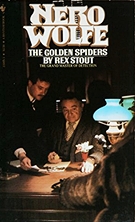
   Like “Before I Die” (1947), The Golden Spiders (1953) is among Rex Stout’s few works to be adapted for the Nero Wolfe series starring William Conrad and Maury Chaykin, and interestingly, it was selected to kick off both, serving as the premiere episode (1/16/81) of the former on NBC and the two-hour pilot film (3/5/00) for the latter on A&E. The novel finds 12-year-old Pete Drossos offering to cut Wolfe in on a case: wiping windows at the corner of 35th and 9th, he sees the driver of a Caddy, wearing the titular earrings, mouth, “Help, get a cop.” Seen by the passenger apparently jabbing a gun in her ribs, he gets the license number, so Wolfe has Archie report possible illegal activity in connection with it.

   The next day, Purley Stebbins visits to say that Pete was run over on the same corner by a man in the same car, its plate taken from one stolen months ago, and is departing as Mrs. Anthea Drossos arrives. Pete’s last words — spoken to her in the ambulance—were, “Tell Nero Wolfe he got me…. Give him my money in the can,” his savings of $4.30; refusing to return or donate it to the Red Cross, Archie uses it to place an ad asking the woman to make contact with them…since, per “Black Orchids” (1941), “Contact is not a verb under this roof.” She calls to make an appointment while Cramer is there reporting that the car, found parked on 186th Street, had killed Matthew Birch in an alley by a South Street pier.

   Yet the identifying scratch on her cheek, when she offers $500 for Pete’s whereabouts, is recent enough to discredit widow Laura Fromm, who says she was having cocktails at the Churchill with lawyer Dennis Horan when he was killed. Not yet hired, Wolfe agrees to hold her $10,000 retainer and refrain from reporting her visit until the day after, warning her to “beware!” Sure enough, she becomes roadkill, so Archie leaves an account of their conversation for Cramer; in no time, Horan calls, seeking the return of her check, already certified, but Wolfe says he’ll earn it, sending Archie to the Gazette for information, with Lon Cohen revealing that she had dined with Dennis and Claire Horan before her demise.

   The other guests were Angela Wright, the Executive Secretary of Laura’s favorite cause, the Association for the Aid of Displaced Persons (aka Assadip); p.r. expert Paul Kuffner; and magazine publisher Vincent Lipscomb. Hit on the head with a wrench, she was run over by her own Caddy, and had no known connection to I.N.S special agent Birch, so to learn more about her last hours, Wolfe assigns Archie to Laura’s personal secretary, Jean Estey, but he learns little before Kuffner summons her away. When Wolfe asks the ’teers for ideas, Saul suggests posing as a displaced person to seek an Assadip/I.N.S. link, while Orrie tackles the earrings, and Fred tests the hypothesis that Birch was the man Peter saw.

   As they wind it up, Horan and James Albert Maddox, respective counsels for Assadip and Laura, appear unbidden, the latter insisting that as Laura’s executor, he could demand the check from Wolfe, who refuses to reveal what they said, and reports the visit to Cramer. Sent to stir the pot, Archie feigns an offer to spill the beans for $5,000…rejected in quick succession by Jean, Claire, Angela (with Saul slumped in the outer room), and Lipscomb. Back from the offices of Modern Thoughts, he finds Kuffner — clued in by Angela — who tries to accept it, but Wolfe declines; Jean sics the police on Archie, who tells Detective Randall and A.D.A. Mandelbaum, both of Prisoner’s Base (1952), he has broken no law.

   Julius Gerster clams up when Orrie asks about the earrings seen in his shop window, but after Archie — having seen his presumed young son — tells him about Pete, he says Laura bought them. Directed to Horan by Angela and her assistant, Chaney, the undocumented “Leopold Heim” tails the man who tries to extort $10,000 for help; Archie sends Orrie to help as Fred reports learning at bookie Danny Pincus’s bar that Lips Egan has the skinny on Birch. Mort Ervin takes Fred to Lips at Nunn’s Garage, where his cover is blown and they begin torturing him, forcing an eavesdropping Archie to intervene by disarming both thugs, and when the shooting is over, Saul and Orrie appear, having been following Egan.

REX STOUT The Golden Spiders

   Himself tortured (which, while deserved, discomfited me, as it did Steve in his review of the novel), Lips confirms that Birch was in both car and racket, but claims he can identify neither the driver nor the woman who tipped him off to Heim with the password, “Said a spider to a fly.” As Horan appears and is held by Saul, Archie calls for instructions from Wolfe, who has them apologize and suggest that he represent Egan when the pair is taken to the brownstone, where Wolfe brings Cramer up to speed — excepting a notebook listing Egan’s “clients.” In a 180, Horan “reveals” that Laura had fingered Egan, whom he now refuses to represent, and Birch, sending him to Nunn’s to investigate and prevent scandal.

   Tossed to the wolves, Lips returns the compliment; while he is implicating Horan, Wolfe departs punctually for the plant rooms, asking that the trio be removed by an incredulous Cramer, who retaliates by taking Archie, Saul, and Fred as well, but Orrie is on an errand. Hauled before, successively, Deputy Commissioner Neary, boss Skinner, and their fellow mayoral wannabe, D.A. Bowen, Archie is also re-grilled by Mandelbaum regarding Jean, and Cramer interrupts a top-brass confab to say that Horan has been tentatively identified as Pete’s killer. Wolfe summons all and sundry, plus three plainclothes policewomen, to the office to earn his fee, and announces that the murderer was actually a woman in drag.

   Having gotten wind of the blackmailing, and perhaps overheard the password, Laura saw the earrings in the window, gave them to the woman she suspected, and retrieved them to impersonate her, not knowing that she had killed Birch and, fearing he could identify her, Pete. Fetched by Orrie (whose first name, later contradicted in a typical inconsistency, is given here as Orvald), Bernard Levine picks Jean out of Wolfe’s policewoman-enhanced line-up as the woman who bought a man’s felt hat and suit in his Newark clothing store. She claims to have done so on behalf of Claire, whose husband and Lips blow the whistle on Jean; when the dust has settled Wolfe burns the list of the displaced blackmail victims.

   The only episode of Nero Wolfe directed by Michael O’Herlihy, “The Golden Spiders” was adapted by Peter Nasco and David Karp, the latter credited as “Wallace Ware,” as he was on “Murder by the Book” (3/13/81). George Voskovec, playing Fritz opposite Lee Horsley’s Archie, was a scientist in the unsold 1959 Kurt Kasznar/William Shatner Nero Wolfe pilot, “Count the Man Down,” as was John McLiam, later seen in Conrad’s “Death and the Dolls” (4/10/81). Best known as Colonel Pickering in My Fair Lady on stage (1956) and screen (1964), Robert Coote played his final role as Theodore, and George Wyner, cast as Saul, had a recurring one as Murray Chase on Horsley’s Matt Houston.

   An Oscar-winner for Tom Jones (1963), series composer John Addison reportedly called his equally whimsical theme for Murder, She Wrote his “old-age pension.” His feature-film credits include Alfred Hitchcock’s Torn Curtain (1966) — abruptly replacing a score by Bernard Herrmann, which ended their legendary collaboration — and A Bridge Too Far (1977), depicting a battle in which he had participated with the British XXX Corps tank force. Katherine Justice, cast as Angela (now Bell), also appeared with Conrad in three episodes of Cannon; Dennis Horan is now Michael Doran (John Petlock), the p.r. man is Barry Green (James Parkes), and Paul Kessler (Liam Sullivan) is a colleague of Angela’s.

   Wolfe displays amused tolerance as Pete (David Hollander) — foisted upon him by Archie as payback for a childish outburst at Fritz — reports his brief encounter with Jean (Carlene Watkins) and Birch. Now no longer fatal, the hit and run puts him into the I.C.U., yet it’s “touch and go,” per Archie, preserving the poignancy as his mother (Rhoda Gemignani) brings his inflation-adjusted $12.35.

   Posing as Jean, Laura (Penelope Windust) says that “her” plea for help was a misunderstanding and she wants to thank Pete but, learning of the attack, leaves Wolfe with no check, only her promise to return the next day; after a fatal fall from the balcony of her apartment, she is identified by fiancé Doran and Jean.

   When Cramer (Allan Miller) reveals the murder of Birch, who matches Pete’s description of the passenger, his habit of annoying Wolfe by “get[ting] out of a chair [using] just his legs, never his arms or his hands,” is noted, as it is in the novel. Faux-turncoat Archie is rejected by Jean and Angela; in the Assadip garage, his “trusty burglar alarm” (a match placed between hood and body) forewarns him of the car bomb planted by L.A. hit man Joseph Moore, who then attempts to silence Pete — also anticipated by Wolfe — and dies in a struggle with Archie. Saul infiltrates the “vile scheme to smuggle the riffraff of the world into this country — the murderers, the terrorists, the fascists — for exorbitant fees.”

   Saul’s timely rescue from Frank Egan and an unnamed friend in the garage is interrupted by Cramer, who has tailed Archie ever since fruitlessly telling Wolfe to “lay back” due to federal pressure. Convening those concerned, Wolfe turns Angela, Barry, and Paul over to “the men of the 18th [Precinct]” for arranging the entrance of the refugees; fingered as the murderer, who conspired with Birch to blackmail them and killed him after a falling out, Jean claims Laura fell accidentally as they’d argued because “she was going to leave me.” Befitting Wolfe’s somewhat softer side on the series, the episode ends as he returns to the brownstone after leaving a check and orchid for his hospitalized young “partner.”

   Neither the director of The Golden Spiders, Bill Duke, nor scenarist Paul Monash carried over onto the ensuing series, but producer Susan Murdoch and composer Michael Small did, while two of the regulars were recast, as Saul Rubinek switched roles from Saul here (replaced by Conrad Dunn) to Lon Cohen (replacing Gerry Quigley).

   In a parallel acting career, Duke appeared with Arnold Schwarzenegger in Commando (1985) and Predator (1987); Monash was the respective producer and writer of the Stephen King adaptations Carrie (1976) and Salem’s Lot (1979). Elizabeth Brown (cast as Claire) and Philip Craig (Maddox) each made their only series appearances in “Disguise for Murder” (6/17/01).

   Featured were soon-to-be repertory players Gary Reineke (as Horan), Beau Starr (Lips), Nancy Beatty (Mrs. Drossos), Nicky Guadagni (Angela), Hrant Alianak (Gerstner [sic]), Peter Mensah (Mort), and Robert Bockstael (Kuffner). As Archie (Timothy Hutton) sits at his typewriter in an opening montage of the brownstone, with expository narration, we see the portrait of Sherlock Holmes hanging above his desk, mentioned as far back as The Rubber Band (1936). The sage vs. saffron and tarragon kerfuffle, almost verbatim, deftly introduces Fritz (Colin Fox); the day after Pete (Robert Clark) reports on Birch (Dwayne McLean) and Jean (Larissa Laskin), Purley (R.D. Reid) brings news of his brutal murder.

   The ad in the Mirror (replacing the Gazette as Lon’s employer) elicits the visit by Cramer (Bill Smitrovich), revealing the Birch/Drossos link, with Laura (Mimi Kuzyk) hard on his heels; the scratch is omitted, as is Lipscomb, and Wolfe intuits her imposture. Dressed as a mortician, getting him in to Jean, Archie returns as Wolfe tells Orrie (Trent McMullen), Fred (Fulvio Cecere), and Saul, “I resent the assumption that those who come to seek my help may be murdered with impunity.” Saul’s encounters with Angela at the Association of European Refugees (AER), Horan, and Lips are depicted, rather than merely related in the book, while young Irving (Brian Miranda) is explicitly identified as the jeweler’s son.

   The top brass confronting Archie is consolidated in the person of Neary, now “promoted” to Commissioner and given a first name, Walter (James Purcell). Wolfe’s final gathering, where he observes, “This is the first time I’ve undertaken to single out a murderer from a group of mostly strangers” before producing surprise witness Levine (Jack Newman, later seen in “Poison à la Carte” [5/26/02]), is true to Stout, as Chaykin invests his retelling of the crimes with dramatic tension. Monash replaces the burning of Egan’s notebook with an effective coda in which, because Wolfe and Pete were “partners” on the case, Anthea is presented with half of Laura’s fee by Archie, given Wolfe’s aversion to crying women.

         — Copyright © 2023 by Matthew R. Bradley.
   

Up next: Three Witnesses

Edition cited

      The Golden Spiders: Bantam (1955)

Online sources

« Previous PageNext Page »