Authors


   I’ve just received what has to be a first, or for me personally, I know it is. As perhaps you already know, Berkley is in the process of publishing a new mystery series by “debut” author Sarah D’Almeida, beginning with Death of a Musketeer, in which Alexander Dumas’s famous characters, Athos, Porthos, Aramis and D’Artagnan, add sleuthing duties to their usual ones of romantic adventure and royal intrigue. Yes, indeed, the Three Musketeers are back.

Cover

   That’s hardly surprising. Over the past ten years or so mystery writers have been using the talents of loads of other fictional characters as detectives — even those you would never think of as a detective — and plenty of real life notables from the past as well. Who is there, if I may ask, who lived at the same time as Sherlock Holmes, fictional or otherwise, who hasn’t yet been involved in a case with the great detective?

    No, what’s unusual is the promotional item for the book that came in today’s mail. I didn’t get the book today– it came out in November, and it’s stacked somewhere in my TBR pile — but what I did get is a short preview of the story in comic book form. It’s six pages long, and the art is by Rob Dumuhosky. To my eye, it’s very well done. It may come out too small to be readable, but I think you can get a fairly good idea of what it looks like from the image below.

Musketeers

    For a better look at the artist’s work, go here.

    When I referred to the author of this new series in my first paragraph up above, I put the word debut in quotes. A little googling quickly reveals that Sarah D’Almeida is in reality well-known fantasy writer Sarah A. Hoyt. This is not surprising. It’s only a short step from constructing a world of pure fantasy to writing a novel taking place in the past. The skills involved are pretty much the same. In either case, the task is to take the reader into another world that he or she is unfamiliar with, and be convincing about it.

     I haven’t read the book yet, so I can’t tell you how successful the author’s been in transforming the trio (plus one) into a group of working detectives, but the book does sound intriguing, and beyond a doubt, this is certainly the first comic book that I’ve received to promote one.

     And, oh yes, there were the usual bookmarks that came along with a small stack of the booklets, and — of course! — a small candy bar.

[UPDATE: 01-18-07] After seeing the post above, Sarah Hoyt emailed me and said:

Dear Steve,

Thanks for the mention. 🙂

Actually, I always wanted to write mystery. It just worked out fantasy first. D’Almeida is my maiden name.

Oh, and I’ve JUST sold books 4 to 6 on the series, so there will be at least that many. 🙂

   Sarah

I replied, wishing her well with the series and asking if I might post her comments as an update to this blog entry. Her response came right away:

Steve,

Certainly. Don’t know if you want to post this but… The first book was more bound by certain self-imposed strictures, like the fact that I wanted to evoke enough of the plot to attract people who’d only seen the movies of the Three Musketeers. It’s ALMOST (though not quite) Musketeer’s mystery fan fic. So some incidents will be startlingly familiar.

After that, each book becomes more of an historical mystery in its own right, though still featuring the Three Musketeers. I purposely tried to keep the language simple yet evocative enough. (My fantasy series featuring Shakespeare suffered from too much authenticity, perhaps, making it — on reread, several years later — a little too difficult to follow.)

I had a wicked level of fun writing the “footnotes” on what M. Dumas got “wrong.”

All in all, the series is lots of fun to play in, so I’m thrilled about the sale. The books are, in order: Death of A Musketeer, The Musketeer’s Seamstress, The Musketeer’s Apprentice, The Musketeer’s Inheritance, The Musketeer’s Servant and The Musketeer’s Confessor.

Oh, and the first book sold to the bookclub, though I have no details yet. 🙂

As Sarah A. Hoyt I’m doing a fantasy series for Baen (and soon an sf series as well, hopefully) starting with Draw One In The Dark, which came out in November (urban fantasy) and a fantasy series for Bantam (first book to be delivered to editor this month) which takes place in an alternate, magical British Empire (Heart of Light in Africa; Soul of Fire in India; Heart and Soul in China).

   Sarah

To which I say, Sarah, please take a break from the keyboard every once in a while, will you? This is all terrific news. Congratulations on staying so busy!

You start out as a reader, you love mysteries and maybe you know someone else you does and perhaps more likely, you don’t. The authors, the people who write the books, why they’re in a category by themselves. But you write to some of them, you meet other fans and you hang around them long enough and before you know it, sooner or later, some of them go professional and become mystery writers themselves. But you knew them before they went pro, and somehow that puts them into a separate category.

The first fan I knew who went down this route was Bill Crider, whose contribution to the Nick Carter canon, The Coyote Connection, came out in 1981. There have been a number of others in between, but I’d like to bring to your attention the latest, Ed Lynskey.

Ed was an contributing editor to both the print version of Mystery*File, and when I took it digital, the M*F website. He specialized in interviews with mystery writers then, and if they were no longer with us, overviews of their careers. Authors in either or both categories are Robert Wade, Ed Lacy, Stephen Greenstreet, and Dennis Lynds.

In the past year or so Ed, as I said up above, has turned author. His first book was a private eye novel entitled The Dirt Brown Derby (Mundania Press, 2006). No one should have been surprised that his first novel was a PI affair, given the authors above whose work has he’s obviously enjoyed.

Derby

Frank Johnson is the private eye who’s in The Dirt Brown Derby, and now he has a second case under his belt, or he will have in March, a book called The Blue Cheer (PointBlank, 2007).

Publisher’s Weekly
has a review of it, and I quote:

The Blue Cheer

Ed Lynskey. Point Blank (www.pointblankpress.com), $12.95 paper (224p) ISBN 978-0-8095-5667-0

Set in the remote mountains of West Virginia, this gritty contemporary detective novel, Lynskey’s second to feature former PI Frank Johnson (after 2006’s The Dirt-Brown Derby), will remind many of such masters of hard-boiled prose as Loren Estleman. Johnson has sought to still the memories of a deadly encounter with the Ku Klux Klan by retreating to the Appalachian town of Scarab, where people—and friends—are few and far between. Johnson witnesses what appears to be a Stinger missile strike against an unmanned aerial drone hovering above his yard, and he calls on his closest local companion, Old Man Maddox, a retired CIA agent. When the pair pursue the mystery with the local sheriff, a cascade of violence overwhelms the quiet community—murders that may be connected with a shadowy local racist cult known as the Blue Cheer. Despite a somewhat predictable resolution, the first-rate writing will leave readers eager to see more of Johnson. (Mar.)

Cheer

Here’s a bit more about Ed, taken from the PointBlank website:

Ed Lynskey is a crime fiction writer and poet living near Washington, D.C. His first two books are mysteries featuring his PI Frank Johnson: THE DIRT-BROWN DERBY (Mundania Press, 2006) and THE BLUE CHEER (Point Blank/Wildside Press, 2007). Two sequels include PELHAM FELL HERE (Mundania Press, 2007) and TROGLODYTES (Mundania Press, 2008). His work has been anthologized by St. Martin’s Press and University of Virginia Press. His short fiction has appeared in Alfred Hitchcock Mystery Magazine. His poems have appeared in The Atlantic Monthly. His reviews have appeared in New York Times Book Review and Washington Post. His mystery fiction has been praised by Linda Fairstein, Ken Bruen, Bill Pronzini, and John Lutz.

What more can I add? Way to go, Ed!

I don’t know the true protocol for this, having only been a blogger for just under three weeks, but I’d like to re-post some of the comments that I’ve received on my checklist of Real Estate Detectives. If I don’t do it this way, I have a feeling that they’ll fall through the cracks, and people who’d enjoy reading them might not otherwise. (From my own personal experience, I read the comments when I read someone’s blog entry, but I never go back and see if anyone’s commented later.)

First, from author Lou Allin:

My realtor sleuth Belle Palmer lives in the Nickel Capital, Sudbury, Ontario, and specializes in cottage properties, which lets her roam around the bush at will. As mentioned earlier, there are four books in the series, Murder, Eh? being the latest. In that novel, I finally got around to letting Belle find a body at a house showing. For that, I earned a mention on a strange website called “Bathtub murders in Toronto.” The next entry in the series may be titled Dial Belle for Murder. Selling houses is an ideal job for an amateur sleuth because she’s always coming in contact with new people…often with secrets to hide.

Lou Allin

My reply:

Hi Lou. It’s good to hear from you. It’s also good news that Belle will soon have another case to solve. I don’t fully understand the premise of the website you mention, but you’re right, there you are at http://torontoseeker.com/torontobathtubmurderers.htm

Then from author Nina Wright:

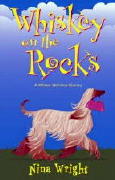
Hi, Steve. Thanks for mentioning Whiskey Mattimoe, my Realtor turned amateur sleuth. I agree with Lou Allin; a career in real estate offers our protagonists access to the private lives of many fascinating strangers. Moreover, since choosing a place to live is an expensive and emotional decision, high stakes are already in place.

My humorous series is set in Magnet Springs, Michigan, a fictional tourist town across the Lake from Chicago. In addition to a cast of artistic and eccentric regulars, Whiskey encounters affluent vacationers who pack their dark sides when they leave home.

Another perk of the Realtor protagonist is her legitimate excuse to snoop (a little). Since I’m personally fascinated by architecture and home design, one of the promises I make to my readers is that Whiskey will find herself inside at least one uniquely fascinating property per book. I enjoy concocting those details as much as the gourmet mystery writers probably savor their recipes.

Nina Wright

My reply, which is now the last one posted, but it also contains a short response from Lou Allin:

To both Lou and Nina,

I believe that you’ve pointed out something essential in each of your posts. The biggest problem in maintaining an amateur detective as a continuing character is how do you (believably) make sure that your detective keeps coming across murders to solve?

At first I was surprised at the large number of realtor-sleuths that turned up. Now I’m wondering why there aren’t more of them!

>>> Lou’s email reply to me:

Hi, Steve

One cliche I avoid (selective memory privilege) is having people comment to the sleuth, “Oh so you’re the one who keeps finding bodies. Any luck lately?” or some such. We all know that even police detectives don’t normally work on murder after murder (well, maybe in New Orleans or L.A.).

If readers want amateur sleuth mysteries, they’ll agree with the willing suspension of disbelief.

Lou

   John Herrington is one of the more prolific contributors to the continuing flow of Addenda to Allen J. Hubin’s Revised Crime Fiction IV. He describes his recent activity as follows:

    “What I am doing, out of ennui after Christmas, is going through CFIV at random and picking out authors, with a handful of titles or more, whom Allen has yet to find any information on – then googling them. Slow old business as for every name I find something, there are a score or more that remain anonymous.”

The information that follows arrived in a recent email to Al. To provide the proper context, I’ve included the full entries for each of the authors as they presently stand in CFIV, with John’s comments following:

TINSLEY, REBECCA
* * *The Judas File (Headline, 1995, hc) [Charlotte Carter; Ireland]
* * *Settlement Day (Headline, 1994, hc) [Charlotte Carter; London]

Tinsley

   This lady is a journalist, having written in New Statesman, Times, Telegraph etc., and once worked for BBC. Very involved in Humans Rights according to Internet references to her. But no date of birth.

TANNER, JANET
* * *Daughter of Riches (Century, 1992, hc) [Australia] St. Martin’s, 1993.
* * *Deception and Desire (Century, 1993, hc) St. Martin’s, 1995.
* * *Folly’s Child (Century, 1991, hc) St. Martin’s, 1992.

Tanner

   Janet Tanner has written all her life, hundreds of short stories published worldwide before she turned to novel writing. No date of birth. though she is a grandmother with young grandchildren.

TORGERSON, EDWIN DIAL
* * *The Cold Finger Curse (U.K.: Falcon, 1933, hc) [Sgt. Pierre Montigny; New York City, NY]
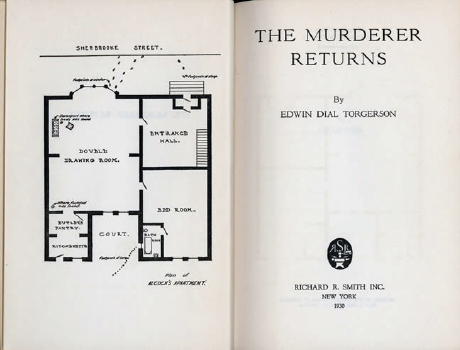
* * *The Murderer Returns (Lane, 1931, hc) [Sgt. Pierre Montigny; Montreal, Canada] Smith, 1930.

Torgerson

   Found at the website for the Archives Collections at the University of Mississippi:

“The son of a Swedish-immigrant architect, Torgerson was born in Meridian, Mississippi in 1896 and spent part of his early childhood in Oxford. After graduating from high school, he worked for a number of newspapers and edited Hearst’s American Weekly. Torgerson also wrote short stories that appeared in well-known periodicals, including several detective tales. His first full-length novel, The Murderer Returns, takes place in Montreal, Canada. The principal clue is a set of paw prints left in the snow by a cat. In 1937, he moved to Hollywood after MGM invited him to write a screenplay based on one of his mysteries, and he died there the following year.”

From The FictionMags Index, the following magazine short stories (an incomplete listing):

TORGERSON, EDWIN DIAL
* * The Challenger, (ss) McCall’s Jul 1937
* * Heart and Carrots, (ss) McCall’s Nov 1931
* * High Game, (ss) Argosy Dec 31 1938
* * No Questions Asked, (ss) Detective Story Magazine Apr 8 1919
* * One-Horse Bank, (ss) The American Magazine Feb 1936
* * The Second-Seer, (ss) Argosy Sep 13 1919
* * Uneasy Money, (ss) The American Magazine Mar 1935

   From the same University of Mississippi website comes the first discovery of the year. I’ll begin with the present CFIV entry:

BUCHANAN, CARL
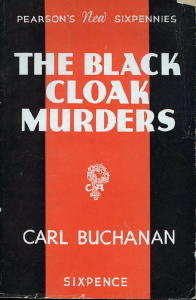
* * *The Black Cloak Murders (Pearson, 1936, hc) [North Carolina]
* * *Night of Horror (Mellifont, 1939, pb)
* * *The Red Scorpion (Mellifont, 1939, pb)

Buchanan

   â€œCarl Buchanan was the pseudonym used by James Robert Peery on The Black Cloak Murders published in London by C. Arthur Pearson, Ltd. in 1936, with later translations in Spanish and Danish. Set in the southern United States, a murderer seeks information concerning a treasure buried in Europe at the end of World War I. Peery was born outside Stewart, Mississippi in 1900 and grew up in Eupora. During World War I, he served in the U.S. Army’s Signal and Intelligence divisions. Once home, he worked in banking and cotton before settling into journalism. Pulp magazines accepted several pot-boilers submitted by him under a penname. Peery reserved his real name for two literary novels that appeared in 1938 and 1940.”

Again from The FictionMags Index:

BUCHANAN, CARL
* * The Crag Island Murders, (nv) Five-Novels Monthly Apr 1932
* * Crimson Goblet, (ss) Clues Aug 1934
* * Finger for Sale, (ss) Clues Oct 1935
* * Laughter in the Chapel, (ss) Clues Apr 1934
* * The Mystery of the Two Glasses, (ss) Clues Jul #2 1930
* * Red Haven, (ss) Clues Dec 1934
* * Rhapsody in Blood, (ss) Clues Feb 1934
* * Right Guy, (ss) Clues Aug #1 1930
* * Screams of the White Cockatoos, (ss) Clues Jul 1934
* * Sweet Racket!, (ss) Clues May #2 1930
* * The Time of the Crime, (na) The Thriller Dec 9 1933
* * 2 Minutes from Murder, (ss) Clues Mar 1935

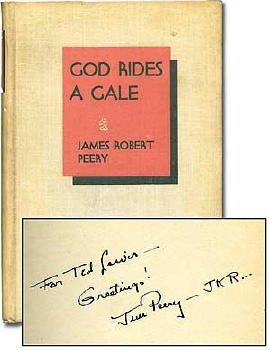
   [Steve again.] One of the books published by James Robert Peery under his real name is God Rides a Gale (Harper & Brothers, 1940). Curiously, the ABE seller who has a copy of this book describes it thusly: “Inscribed by the author: ‘For Ted Lewis – Greetings! Jim Perry – JKR.’ The second of two literary novels by this Mississippi-born author, who also published mysteries with a co-author under the pseudonym Carl Buchanan.”

Peery

Peery’s first literary novel does not appear for sale on the Internet, nor at present is there an entry for James Robert Peery in CFIV. Al Hubin says: “I’ll add brief notes to the Tinsley and Tanner entries (in Addenda #9); the Torgerson information is pretty well what I have in the Revised CFIV. But the Peery info (along with his 1954 death date) will go into #9 with pleasure.”

   Online presently are Addenda installments 1 through 8. Look for Part 9 shortly.


[UPDATE: 01-22-07]
Taken from an email sent by Victor Berch:

Steve:

To Carl Buchanan’s repertoire, you can add the following:

Blind Trail, All-Star Detective Stories Oct. 1930
The Head That Lived, Super Detective Stories July 1935
Hot Car Wreckage, All-Star Detective Stories Apr. 1932
The Monk’s-Hood Murders, All-Star Detective Stories July 1930
Murder By Candlelight, Mystery Apr. 1933
Murder in the Rain, The Underworld Magazine Aug. 1931
The Red Scorpion Murders, World Man Hunters Feb. 1934
Rope’s End, Murder Stories Sep-Oct 1931

There was one other tale under the name Robert Peery, who, I assume, is our man:

The Spy Champion, Startling Detective Stories Mar. 1930.

>> Thanks, Victor. I’m inclined to agree with you about that last story.    –Steve

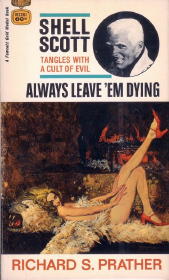
I just received an email from Linda Pendleton, widow of crime fiction writer Don Pendleton, telling me about an interview she did late last year with Richard S. Prather, now 85 and most well-known as the creator of private eye Shell Scott, whose wacky capers in the 1950s, mostly for Gold Medal, kept kids (teen-agers) like me turning the pages as quickly as they could.

The interview is online as part of her own website. It’s a long one, and it goes deeply into both Prather’s writing techniques and his philosophy of writing as well as his views on life itself.

What I’ll do is tease you with some of the questions. You’ll have to read the interview to learn what Prather’s answers were.

Prather

Linda: The first Shell Scott novel, Case of the Vanishing Beauty was published in 1950 and your long career was off and running. Was that your first publication or sale of your work? Did you have an agent for your first sale?

Linda: You have had a number of short stories published almost from the beginning of your career. Have you enjoyed writing short stories as much as novels?

Linda: Let’s talk about the creation of your Shell Scott character. Obviously, with the number of books you have written in the Shell Scott series, and the huge success you achieved, there must be special qualities about him as a protagonist that stay with your readers. Many fans have found your stories to be full of humor and some fans even refer to them as hilarious. As the creator of Shell Scott, what do you consider to be the essence of Shell Scott? What qualities did you give him as a character that made him outstanding and appealing to readers? I assume he “grew” during the years of writing the series. In other words, how did his world view evolve from his “younger” days?

Linda: You’ve been one of the lucky authors who was able to have a solid career and write full time. And I know you had the support of your beautiful wife, Tina, throughout those years. Having lost Don, I personally know how difficult it has to be for you since Tina’s death two years ago, and after 58 years of marriage. You very well may hold the record for the longevity of marriage for a writer! I understand Tina helped you with your work, such as suggesting that good book title you just mentioned—and typed, and I would imagine gave you some critical appraisal of manuscripts from time to time. Writing can be such a lonely endeavor as we are sequestered with our fictional characters, sometimes for long periods of time. How important was it to you, and to your relationship, that she was so supportive throughout the years?

Linda: Don had Executioner cover art by artist/illustrator, Gil Cohen on many of his books, who captured the essence of Mack Bolan. You mentioned many of your Gold Medal editions cover art was done by well-known illustrator, Robert McGinnis, and he just did the cover for your recent reissue release of The Peddler — and, by the way, the cover looks very nice. Obviously, McGinnis’ illustrations of beautiful sexy women on the covers of your books may have caught the attention of book buyers. I understand you wrote an Introduction to The Paperback Covers of Robert McGinnis by Art Scott, published in 2001. You covered some of this already, but again, how important do you feel cover art is for the sale of a book? Did you have any influence on cover design on your novels?

Prather2

Linda: Richard, here it is at the end of 2006 and you are now eighty-five years of age. What are your thoughts on the technological and scientific advances you’ve seen in your lifetime?

Linda: I understand you have a Shell Scott unpublished manuscript, The Death Gods, of 1,000 pages. What are your plans for this novel?

Richard: Ah, yes. The Death Gods. You’re right, Linda, I do have that 1,000-page manuscript here. It’s …

Richard S. Prather – Bibliography

Don Pendleton – Bibliography

Here’s the entry for her as it presently appears in Crime Fiction IV, by Allen J. Hubin:

STONE, ELINORE COWAN (1884-?) Born in Michigan, raised in Pittsburgh and Boston; newspaperwoman, teacher, magazine short story writer; living in Pittsburgh in 1930s.

* * *Fear Rides the Fog (Appleton, 1937, hc) [Pittsburgh, PA]

The entry is not impressive in itself, but the biographical notes added by Al suggest that there was more to her life than the one mystery novel. What’s nice to be able to do, when it can be done, is to discover the story behind the story, as it were. To that end, the following, which was sent to me by Al a day or so ago, does exactly that.

Article from unnamed newspaper, dated Thursday, March 22, 1973:

   90-Year-Old Couple Enjoys Life By Jan Rider

Today is the 90th birthday of Mrs. Elinore Cowan Stone, Morehead City [North Carolina]. Mrs. Stone has been upset since she lost her wedding ring several months ago. She cannot figure out when, where or how she could have lost it. It is a ring she has worn since June 7, 1915. Today her husband, C.A. Stone, who was 90 years old last month, gave her a new ring. Of course it cannot replace the old one completely, but it is the thought that counts.

Mr. and Mrs. Stone have been married almost 58 years. They have been residents of Morehead City for 19 years. The Stones have a long and happy history. Mrs. Stone does point out, however, that they have not been totally happy. “Nobody can be totally happy. We have been mad as hell at one another at certain times.”

The Stones have enjoyed life. They have traveled and they have both been blessed with good health. Mr. and Mrs. Stone met at the University of California, Sacramento, when they were doing graduate work. “I really can’t remember exactly where we met,” Mrs. Stone said. “It was in an English class. The professor was a real wit,” interjected Mr. Stone. “Don’t you remember? His name was Smith, I think.” “I don’t remember him,” Mrs. Stone said, “But I remember you, so what is fame?”

The Stones came to Morehead City from Pittsburgh, Pa. They had lived there longer than anywhere else, 30 years. They came to Morehead City because of the Chamber of Commerce. When Mr. Stone was planning his retirement, Mrs. Stone wrote to the Chambers of Commerce in numerous towns asking for information concerning the cost of living and facilities in the town. “Morehead City was one of the few towns that sent us any information,” said Mr. Stone, “We liked it the best and moved here in 1954.”

Prior to their marriage, Mrs. Stone taught school in Honolulu. There she developed her interests in drama. She coached several plays during her stay, one of which was “As You Like It.” After their marriage, the Stones lived in California for awhile. They enjoyed the mountains and spent many days camping and scouting the wilds of California.

Later the Stones moved to the Midwest. While there Mrs. Stone continued her teaching. She first taught in a small one-room school on an Indian reservation in New Mexico. Her experiences there are recorded in her first novel, “The Laughingest Lady,” which was published in 1927. The book’s title, Mrs. Stone says, was the name many of her Indian pupils called her. “I don’t think they had ever met anyone like me before. I was always joking and enjoying myself.”

In a faded picture album, Mrs. Stone pointed out pictures of herself and several of her students standing in front of their mud dwellings. Later in the Midwest, Mrs. Stone taught in a one-room school on a large ranch. In 1934 the Stones moved to Pittsburgh when Mr. Stone, an employee of the Navy’s Quality Control department, was transferred. In Pittsburgh Mrs. Stone wrote a column for a local newspaper and continued her writing. While in Pittsburgh, Mrs. Stone published her second book. The book, entitled, “Binks, His Dog and His Heart,” was a children’s story. It was published in 1937. In that same year she also published a mystery novel entitled “Fear Rides the Fog.”

Also published during this same time period were numerous short stories, two of which are included in the “O. Henry Memorial Award” volumes. As Mrs. Stone became more involved in her teaching and her column, written for a Pittsburgh newspaper, her books and short stories became fewer.

Mr. and Mrs. Stone agree that life in Morehead City has been good for them. They have grown to love the area, the people and especially the sea and the salt breezes. Occasionally they will drive over to the beach and walk along the oceanfront. Since Mrs. Stone fell and broke her hip about 10 years ago, their walks have been limited to the board walk area. She is unable to walk safely on the loose sand. On most evenings the Stones can been seen walking around the Camp Glenn school grounds. They enjoy the exercise and fresh evening air.

What do two people 90 years old do all day? “Well, to be honest, we sleep much of the time,” said Mr. Stone. “He watches that thing,” said Mrs. Stone, pointing to the television set. “I can’t stand the cackling voices.” “She doesn’t hear too well any more,” said Mr. Stone. “I hear too well,” said Mrs. Stone.

It is obvious to anyone visiting their home that the Stones do more than sleep or watch television. Two walls in the living room are lined with books. On the shelves are the complete works of Dickens, Kipling, Shakespeare, and Buck. On the side table on top of a recent news magazine is a large magnifying glass used for reading. Numerous volumes of Reader’s Digest Condensed books are noticed and to complete the room are several reading lamps. This world, sometimes referred to as “cold and cruel,” has been warm and gentle for Mr. and Mrs. Stone, probably because they are warm and gentle people.

Here’s Al’s followup note:

It appears CFIV is one year off on her birth year (should be 3/22/1883, if the article is correct). I’ll now see if I can track down a death date, now that I have that date and know that they were last living in Morehead City, North Carolina.

[Later] I’ve found her record in the social security death benefits. And this gives her birth as 3/22/1885 (and death in November 1974). Looks like the article was premature in calling her a 90-year-old … and she didn’t quite make it to that milestone, as it turns out, though her husband did.

Obituary from The News-Times, Morehead City, Beaufort, NC, Thursday, Feb. 1. 6, 1975, pg. 9-A:

Clarence A. Stone. A memorial service for Clarence Stone, 91, Morehead City, was conducted at 4 p.m., Wednesday in St. Andrew’s Episcopal Church. He died Tuesday in Carteret General Hospital. The Rev. King Cole, rector, officiated. Mr. Stone has no immediate survivors.

>> As of 11:30 this morning, no copies were found of Mrs. Stone’s mystery novel offered for sale on the Internet. About five copies of The Laughingest Lady were found. About one the seller adds: The name “Irene L. Cowan” is on the flyleaf (possibly related to the author?).

The short story “The Devil-Fish, by Elinore Cowan Stone, appears in A. Merritt’s Fantasy Magazine, October 1950. Probably a reprint. [See UPDATE 01-25-07]

From The FictionMags Index, here is a partial list of her other stories:

* * All in the Day’s Work, (ss) The Century Sep 1927
* * Be My Valentine, (ss) Woman’s Home Companion Feb 1927
* * The Gritty Little Devil, (ss) The American Magazine Jul 1930
* * Hands Off, (ss) McCall’s Nov 1931
* * Leetla Dog, (ss) Woman’s Home Companion Jul 1925

Also, from Good Housekeeping, February 1926:

“Lonch [sic] for Two” by Elinore Cowan Stone is a short story dealing with the “Americanization” of Hispanic children.

O. Henry prize-winning stories:

1925. Elinore Cowan Stone: “One Uses the Handkerchief” Women’s Home Companion, November 1924.

[UPDATE 01-25-07] Victor Berch did some further investigating into the life of Mrs. Stone, and the results have been posted as a separate entry. Besides uncovering evidence that she was born in 1883 and not 1885, as the Social Security records show, Victor has also added a large number of stories to her bibliography. These should be added to the ones above.

In terms of the story “The Devil-Fish,” a cry for assistance from the members of the Yahoo FictionMags group produced the following response from Ned Brooks:

    “I have a copy of that — it’s an seven and a half page story with a full-page Finlay illo. The ToC blurb is mysterious and seems too complex to be covered in 7.5 pages: “Could Salisbury’s medico-science-filled world find a way to bring him back from the embrace of a civilized savagery?” It has to do — from a quick scan — with a not altogether successful attempt to remove a whole-body tattoo.

    “There is indeed prior copyright information. On both the ToC (under the blurb) and on the bottom of the title page of the story itself (p.92) there is the line —
“Copyright 1926 by Popular Publications, Inc.” The editorial, which runs about a page, discusses George Allan England and Jack Williamson (who have the novel and novelette in the issue) and the contents for the next issue — which never appeared, as this is the last of the five existing issues. No mention of Elinore Cowan Stone there. The Miller/Contento CD-Rom I have knows no more, listing the A. MERRITT printing and the earlier one but with no magazine title given. The attribution to “Popular Publications” is probably incorrect — according to PulpWiki anyway, Steeger founded Popular Publications in 1930.”

Thanks, Ned. My instinct was correct. It’s highly unlikely that Mrs. Stone would have stopped writing in the 1920s only to write a single fantasy story 20 or more years later. I’m not too concerned about the copyright date, assuming that when Popular bought out a magazine that had folded, they transferred all of the copyrights along with it. The question remains, however, which presumably non-genre magazine in 1926 was it that the story first appeared?

[UPDATE 01-27-07] From a posting by Mike Ashley on the Yahoo FictionMags Group, the answer is now known. He said, and I quote:

    “The Devil-Fish” by Elinor Cowan Stone first appeared in Argosy [All-Story Weekly] for 6 March 1926.

And from Ned Brooks again, a description of the story itself —

    No particular reason the story had to be in an SF pulp, it isn’t that skiffy and the borders were a lot fuzzier then anyway. The only skiffy element is that a way to remove a tattoo had been discovered. I think they use lasers now, but removing a full-body tattoo would still be arduous and expensive. The system failed in that when the fellow blushed, the “devil-fish” (a squid or octopus) reappeared in red on his forehead.”

At present the entry for mystery writer Pat Stadley in Crime Fiction IV, by Allen J. Hubin, looks like this:

STADLEY, PAT (Anna May Gough) (1918- ); Reference: CA (Contemporary Authors)

* * * Autumn of a Hunter (Random, 1970, hc) [California] Collins, 1971. Also published as: The Murder Hunt. Major, 1977.
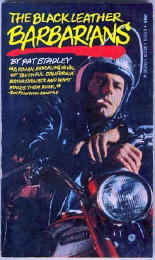
* * * The Black Leather Barbarians (Bobbs, 1960, hc) [Los Angeles, CA]
* * * -Daddy-O (Signet, 1960, pb)
* * _The Murder Hunt (Major, 1977, pb) See: Autumn of a Hunter (Random 1970).

Recently discovered is that Autumn of a Hunter was the basis for the TV movie The Deadly Hunt ( Four Star, 1971; scw: Eric Bercovici, Jerry Ludwig; dir: John Newland).

Searches and double-checking into birth and death dates never end as well. Taken from a recent email, Al reveals what he has learned most lately about Ms. Stadley:

This one is a bit confused, but here’s what I’ve found and what I’ve concluded. Stadley has a CA entry, which gives her birth as 8/31/1918 and her residence as Citrus Heights, California. On the other hand, the social security death benefits record has a Patricia A. Stadley, born 9/1/1917, died 2/27/2003 in Citrus Heights, California. I conclude that this is the author in question and I’m going to adopt the social security dates for CFIV.

A plot description for Autumn of a Hunter might read thusly: “A wealthy woman trying to outrun three hired killers in the woods of the high Sierras is trapped by a forest fire.”

… while the cover blurb on the Signet reprint of The Black Leather Barbarians certainly tells the would-be reader what’s in store:

Stadley

“A rough, revealing novel about youthful California motorcyclists and what makes them roar.” — San Francisco Chronicle.

   
The death date of Phyllis Gordon Demarest, an author now with two credits in Crime Fiction IV, was noted in a previous post on this blog, which concluded with some information provided by Victor Berch about Ms. Demarest’s parents, and her stepfather, actor William Demarest.  Thinking that that was not the end of the story, Victor continued his search into her past.  Here are the results of his investigation:


Some Background Notes on Phyllis Gordon Demarest
by Victor A. Berch


Thursday evening, January 4, 2007.

    Estelle Collette [note the spelling correction] appears to have been the stage name of Phyllis Gordon Demarest’s mother.  She was more than likely first married to Samuel Gordon (1871-1927), the English novelist. At what point in time and why they separated is unclear.  Nor is her real name known.

    In the 1920 U.S. Census, she is listed as Estelle Demarest, living with the actor Carl [William] Demarest as his wife. Living with them was William Demarest’s mother, Minnie [her actual name was Wilhelmina].  It is unclear at that point in time whether Estelle was actually married to Demarest.  Strangely enough, returning from a trip to England on board the S.S. Aquitania, which landed in New York on September 9, 1921, Estelle Collette, violinist, is among the manifest of aliens entering the U.S. As she was required to give the name and address of someone in the U.S. who could vouch for her, she gave the name of C. W. Demarest as her friend, while giving her home address as 16 Burgin Place, Long Island, an address different than that of William Demarest.

    In that same 1920 U.S. Census, Estelle lists her parents as being born in Russia; that is to say, somewhere in the then Russian Empire.  What her real name might have been still remains a mystery.  Samuel Gordon, born in Bavaria, came to England as a young boy.  His father, the Rev. Abraham Elias Gordon, was the leading cantor in the Great Synagogue of London.  I strongly doubt that Samuel Gordon would have married outside of his religion. This leads me to suspect that Estelle Collette was of the Jewish faith.


Friday morning, January 5, 2007.

    After rereading what I had written on Thursday, I was more convinced than ever that Phyllis Gordon Demarest’s mother, Estelle Collette, was indeed using that name as a stage name. That name kept popping up in the newspaper reviews of theatrical acts in which she appeared with William Demarest in the early 1920s.  But what was her real name?  The few theatrical reference books on stage/screen actors kept referring to her as the wife of William Demarest.  No birth or death dates were given for her. 

    Since it had been established that Phyllis Gordon Demarest was the daughter of the English novelist, Samuel Gordon, and the then Mrs. William Demarest, I felt that the answer might lie with Samuel Gordon.


Friday afternoon, January 5, 2007.

    I quickly found an obituary for Samuel Gordon in the New York Times .  He died in London on January 10, 1927.  There was no mention of a wife, but it did say that he was survived by a daughter.  Again, no mention of who she might be.  I then went to the London Times and it carried about the same news as the New York Times. No hint of a wife.

    It then occurred to me that, perhaps with a person of his stature in the Jewish community of England, an obituary could be found in the Jewish Chronicle of London.

    Sure enough, in the January 14, 1927 issue, there was an obituary.  It stated that Samuel Gordon was born September 10, 1871 in Buk, Bavaria [then part of the German Empire].  He had come to England at the age of 12, attending the City of London School and later Cambridge.   Further down, the obituary stated that in 1907 he had married Miss Esther Zichlin, “a violinist of great promise. There was one child of the marriage, a daughter.”  So!  At last, here was the real name of Estelle Collette.

    Who, then, was Esther Zichlin?  And when in 1907 did Samuel Gordon marry her?  I ran her name through the usual genealogical databases that I subscribe to and the only hit that I got was one that gave her marriage date as sometime in the April to June quarter of 1907.  Well, that certainly narrowed the time frame that I would need for examination of those issues of the Jewish Chronicle for a wedding announcement.

    Within a half an hour I did find an article announcing the marriage of Samuel Gordon and Esther Zichlin in the June 14, 1907 issue of the Jewish Chronicle.  They had been married on June 12th.  There were even  photographs of the bride and the groom.

    There was a short description of the wedding, but there was no mention of any relatives of the bride at the wedding.   She had been given away as a bride by Samuel Gordon’s father, the Rev. A. E. Gordon, and she was attended by the two-year old niece of the groom.  The best man was Samuel Gordon’s brother, Leo.

    Again I asked myself “Who was Esther Zichlin?” As Estelle Collette, she claimed to have been born in England.  As Estelle Demarest, the SSDI gave her birth and death dates as October 26, 1886 and November 19, 1968 and her birthplace was given as England.  Therefore, she should have appeared somewhere in either the 1891 or 1901 English Census.  Such was not the case.  Perhaps, when the 1911 English Census appears, we might learn Esther Gordon’s real nationality. (Unlike the US Census records, those wishing to access the English Census records are required to wait until 100 years have elapsed).

    I also ran the name Zichlin through other genealogical databases without any luck.  But there were quite a few Polish and Jewish last names for Zychlinski or Zychlinsky (a name meaning someone from the town of  Zychlin).  My conjecture about her early life is that she was born in Russia/Poland and sent to England as a young girl to advance her studies.

    There is one minor correction to be made in the the previous posting about Phyllis Gordon Demarest.  I’m not sure who is to blame for the mistranscription of PGD’s birth date.  She was born 3/31/1908, not 3/13/1908.  That date of birth was confirmed in the Jewish Chronicle of April 3, 1908.


Copyright © 2007 by Victor A. Berch.

Today was the last day of GoodisCon 2007, and no, I wasn’t able to go, and whether there will be another, I have no idea. But here’s a question that occurs to me. What other mystery writer has had a convention dedicated to him and him alone?

null

I’ll qualify that by saying that Anthony Boucher is not an acceptable answer, as Bouchercons were always about more than Mr. Boucher. And as a brief aside, I suspect that many attendees of Bouchercons in recent years do not even know who Mr. Boucher was.

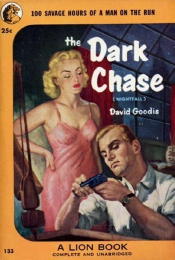
Searching on the Internet just now, I came across several sites relating to David Goodis that may be of interest, the first one of which may contain cover images of every edition of every book that Goodis wrote. (It does say “a selection,” so it’s more than likely that I’m exaggerating, but there are certainly quite a few for you to look at here, many of which I’ve never seen before. Not the one below, but many of the later editions and almost all of the foreign editions.)

Chase

You may have to follow the link at the bottom of the page that the link above leads you to. The first page that comes up contains a short biography of Goodis by Dave Moore. There are many other sites that I might send you to, but back in Crimesquad‘s archives I found another short biography and a review of Black Friday and Selected Stories (Serpent’s Tail, trade pb, July 2006).

It’s a book I missed when it came out. I’d put it on my birthday list, but then I’d have to wait another whole year. I’d rather not wait that long.

   Contents:

Black Friday. Novel. Lion 224, pbo, 1954.
“The Dead Laugh Last.” Goodis writing as David Crewe. 10 Story Mystery Magazine, October 1942.
“Come to My Dying!” Goodis writing as Logan C. Claybourne. 10 Story Mystery Magazine, October 1942.
“The Case of the Laughing Ghost.” Goodis writing as Lance Kermit. 10 Story Mystery Magazine, October 1942.
“Caravan to Tarim.” Collier’s, October 26, 1943.
“It’s a Wise Cadaver.” New Detective, July 1946.
“The Time of Your Kill.” Goodis writing as David Crewe. New Detective, November 1948.

I wonder what a copy of 10 Story Mystery Magazine for October 1942 goes for these days.

   
   —

UPDATE: It didn’t take long for a report to appear online from someone who was there. Who better to give with some details than crime novelist Duane Swierczynski (pronounced “sweer-ZIN-ski”) on his blog, which you should be reading as a matter of course anyway…

Jamie Sturgeon and I saw the same book listed on eBay around the same time, and each of us sent the information hidden in the listing to Al Hubin, author of Crime Fiction IV: A Bibliography (Revised), within a day of each other.

Jamie was one step ahead of me, however, and he’d already been in touch with the seller, who told Jamie how he’d gotten his information about the author of the book, Donald Deane, about whom nothing has been known until now.

It turns out that there never was a “Donald Deane,” and that the three books attributed to him in CFIV were actually written by Mary Fair, a rather progressive lady living in the Eskdale lake district of England, nestled at the foot of that country’s highest mountains.

Following the link from her name to the website devoted to her, you’ll find her life’s accomplishments described in considerable detail. I’ll quote only a summary that was printed in a newspaper about her, shortly after her death:

“Archaeologist, welfare-worker, explorer, geneaolgist, naturalist, photographer, writer and lecturer … this familiar and friendly figure, sometimes half-tramp, sometimes professorial, trudging up the fells in foul or fair weather to deliver orange juice or medicinal oil out of her knapsack to some infant arrival in a remote farmhouse; or, at midnight, popping up disturbingly from behind a beck-side drystone wall, where she had been recording the seasonal note of an unusual owl. … we shall miss more than her erudition: we shall miss her friendly, twinkling eye, her crisp opinions- sometimes inventively ornamented and not infrequently critical- but particularly we shall miss her humanity: her readiness to give a knowledgeable helping hand wherever it was needed.”

Of course it is her connection to the world of crime and detective fiction that is of interest. I’ll add another quote below, if I may. (Sorry. I said only one quote, but I was wrong.)

Oh, and by the way, she wrote detective novels, under the name Donald Deane. She never told anybody, but another of her friends, Whitehaven librarian Daniel Hay, solved the mystery. Published by John Hamilton of London, they were The Fifth Tulip (1930); The Luck of Luce (1931) and Hidden Clues: A Lakeland story (1932). Most of the manuscript for a fourth novel, set in Scotland, also survives, written in cheap exercise books.

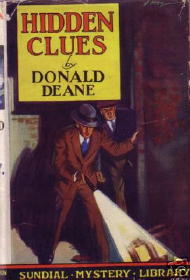
Here’s a cover scan of the third of these books, taken from the eBay listing that helped lead to this discovery:

Deane

Another entry, it almost goes without saying, if anyone’s keeping track, in the ongoing list of female mystery writers who kept their identities hidden by using initials in their byines or under the names of men.

« Previous PageNext Page »