Authors


AN APPRECIATION OF MELVILLE DAVISSON POST
Submitted by Mike Tooney


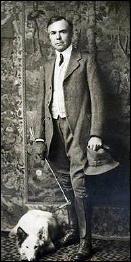
   Author and editor Grant Overton (1887-1930) thought it something of an injustice that Melville Davisson Post (1869-1930) had not received due recognition for his short story writing skills.

MELVILLE DAVISSON POST

   In an article in The Bookman (June 1924), Overton sought to rectify that oversight.

   Long-time mystery readers should readily recognize Post’s name in regard to his two most famous creations: the righteous Uncle Abner (a stern but wise judge of human fallibility) and the deplorable Randolph Mason (morally the polar opposite of both Abner and another lawyer who would bear the name of Mason, yet just as clever).

   Overton spends a great deal of time discussing Post’s most famous short story, “The Doomdorf Mystery” (1918), his intention being to show how Post took the mystery tale and refined it into something more meaningful than a mere conundrum (and, mirabile dictu, without giving away the full solution to the locked room problem).

   While it would be best if you read Overton’s article yourself, here are a few statements that caught my attention:

    “Mr. Post is one of the few who believe the plot’s the thing… [He] takes his stand thus definitely against what is probably the prevailing literary opinion.”

    “…there is a creed, cardinal with many if not most of the best living writers, which says that the best art springs from characterization and not from a series of organized incidents, the plot; which says, further, that if the characters of a story be chosen with care and presented with conviction, they will make all the plot that is necessary or desirable by their interaction on each other.”

    “Mr. Post had, initially, two difficulties to overcome. The first was fiction’s rule of plausibility. The second was art’s demand for emotional significance, a more-than-meets-the-eye, a meaning.”

    “In fiction, there is no plausibility of cause and effect outside human behavior. The implausible (because unmeaning) manner of Doomdorf’s death is superbly supported by two flanks, the behavior of the evangelist and the behavior of a terrified, superstitious, and altogether childlike woman.”

    “In other particulars ‘The Doomdorf Mystery’ exemplifies the artistry of the author. If I have not emphasized them, it is because they are cunning of hand and brain, craftsmanship, things to be learned, technical excellences which embellish but do not disclose the secret of inspiring art. The story is compactly told; tension is established at once and is drawn more tightly with every sentence; and the element of drama is much enhanced by the forward movement.”

    “The prose style, by its brevity and by a somewhat Biblical diction, does its part to induce in the reader a sense of impending justice, of a divine retribution upon the evildoer.”

    “We commonly call one type of story a detective story simply because the solution of the mystery is assigned to some one person. He may be amateur or professional; from the standpoint of fictional plausibility he had, in most cases, better be a professional.”

    “As a noticeable refinement upon this discovery Melville Davisson Post has invented the type of mystery or detective-mystery tale in which the mysteriousness and the solution are developed together. Not suitable for the novel, which must have action, this formula of Mr. Post’s is admirable for the short story, in which there is no room for a race with crime but only for a few moments of breathlessness before a denouement.”


Resources:

“Melville Davisson Post and the Use of Plot” (1924)
– Grant Overton (1887-1930)
– THE BOOKMAN
– June 1924
– Pages 423-430
http://www.unz.org/Pub/Bookman-1924jun-00423

OUR SHORT STORY WRITERS (1920)
– Blanche Colton Williams
– Chapter XVII: “Melville Davisson Post”
– Pages 293-308
– SPOILER ALERTS
http://www.unz.org/Pub/WilliamsBlanche-1920?View=ReadIt3

Wikipedia:
– “Melville Davisson Post”
http://en.wikipedia.org/wiki/Melville_Davisson_Post

A Randolph Mason story:
– “The Corpus Delicti”
http://www.unz.org/Pub/HawthorneJulian-1909v08-00065

THE BACKWARD REVIEWER
William F. Deeck


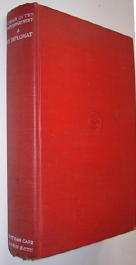
“DIPLOMAT” – Murder in the State Department. Jonathan Cape & Harrison Smith, hardcover, 1930.

DIPLOMAT Murder in the State Department

    “Diplomat” dedicates this, his first mystery, to the “pacifists and bootleggers of the United States, without whom the author would have been at a loss for a motive for a murder in the State Department.” This gives you some idea of the tone of the book, and those who are neither pacifists nor bootleggers may read safely on with the pleasant anticipation that someone else’s ox will be gored.

    A guard at the State Department finds Harrison “Handsome” Howard in his office, a steel filing spike transfixing a top-secret unsigned treaty, Howard’s hand, and Howard’s heart, in that order. Also in the office is a revolver with a silencer, unused.

    (Who is it that makes silencers for revolvers? Does anyone outside the characters in mysteries purchase them? Why is there never dissatisfaction with their performance?)

    Only one other person is working in the building — Howard’s rival for position and prestige. He, however, has an unimpeachable alibi. Dennis Tyler, Chief of the Bureau of Current Political Intelligence (Now there’s an oxymoron! Oops. Sorry.) has a low opinion of police investigators, so he takes charge.

    Tyler talks like a mixture of Bertie Wooster and Reggie Fortune; his intellect, at least to this reader, is closer to Bertie’s than Reggie’s. Still, he does come up with the solution, which is for the most part plausible. Those who can accept an exchange like the following with good heart and maybe even appreciation should enjoy the novel:

    “The chemical man turned over to the parson a cylinder of a secret new gas, the effect of which is to make people go to sleep….”

    “Ether?” Nichols suggested.

    “Either that or something like it,” Tyler admitted.

    Amiable nonsense, for which I admit a weakness.

— From The MYSTERY FANcier, Vol. 12, No. 2, Spring 1990.


Bibliographic Notes:   “Diplomat” was, according to Hubin, the pseudonym of John Franklin Carter, 1897-1967. According to Wikipedia, Carter was an American journalist, columnist, biographer and novelist. Dennis Tyler appeared in all of the novels Carter wrote under that name, as follows:

Murder in the State Department (n.) Cape & Smith 1930.
Murder in the Embassy (n.) Cape & Smith 1930.
Scandal in the Chancery (n.) Cape & Smith 1931.
The Corpse on the White House Lawn (n.) Covici Friede 1932.
Death in the Senate (n.) Covici Friede 1933.
Slow Death at Geneva (n.) Coward 1934.
The Brain Trust Murder (n.) Coward 1935.

   Al Hubin reviewed this same title earlier on this blog; you may check it out here. In the course of the review and the update that followed, much more information about the author was supplied. (You may also enjoy Al’s opinion of the book, and compare it with Bill had to say.)

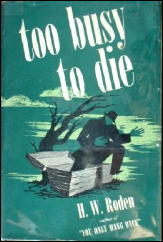
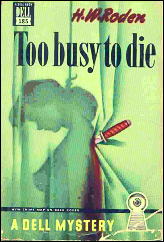
H. W. RODEN – Too Busy to Die. Detective Book Club, hardcover reprint, 3-in-1 edition (no date). First edition hardcover: William Morrow, 1944. Other hardcover reprints: Grosset & Dunlap (no date); World, 1946. Paperback: Dell #185 [1947] & #349 [1949]; both mapback editions.

H. W. RODEN Too Busy to Die

   Knowing little about the author, H(enry) W(isdom) Roden, 1895-1963, I first checked with Al Hubin’s Crime Fiction IV (naturally), and besides the information found in the first part of this sentence, I learned that Roden was an executive with various food corporations over his lifetime. Private detective Sid Ames was a character in all four of his mystery novels; sharing the bill on three of them was public relations expert, Johnny Knight.

   Here are the titles of the four books, all published first in hardcover by Morrow, in what I believe is correct chronological order: You Only Hang Once (1944), Too Busy to Die (1944), One Angel Less (1945 and the only solo appearance of Sid Ames), and Wake for a Lady (1946).

   Four books in three years, then no more. Searching on the Google, I also found an appearance by Roden on Ellery Queen’s radio program, “The Secret Weapon,” February 28, 1945. As was standard procedure for the show, Roden was a guest “armchair detective” whose job in the closing minutes to name the killer before Ellery did. (If Roden succeeded or not, I do not know. Most of the EQ radio programs are not available for listening.)

   On Kevin Burton Smith’s thrillingdetective.com website, he claims the city that Ames and Knight called home was New York City, but I’m not convinced. It’s not named in Too Busy to Die, but the surroundings to me don’t feel like Manhattan — much more like a small Midwestern town, but it had me wondering all the way through. Tellingly, Hubin does not identify the setting either.

   Sid Ames takes only a secondary role in the one I’ve just read. The story is told by Johnny Knight, who hires Ames after a client is found murdered in his hotel room. The old man, now rich with Oklahoma oil money, had come to Knight with a far-fetched story of trying to locate his former adoptive family, from whom he had run away when he was a kid. “Lammed,” is his very word.

   So, with a $2000 fee in hand, Knight feels obligated to find the man’s killer. This is one of those typically 1940s wacky type of screwloose capers, complete with a beautiful blonde, a pint-sized bombshell named Patricia Rodkins who is not only deeply involved in the case but who also goes completely gaga over Knight at first glance, reason unknown but Johnny does not mind.

   Diamonds are also involved, in a package the dead man had left in Johnny’s care, and two families (and hangers-on) of strangely-behaved matrons, dipsy husbands, assorted personal assistants, a hulking lug named Homer and a butler who is also the operator of a well-known west side crap game.

H. W. RODEN Too Busy to Die

   Here’s a quote from page 88, a total non sequitur, I grant you, but I liked it:

    I dropped Pat at her house and returned to my apartment. I found I had a visitor.

    Sid Ames sat in my living room. He looked very comfortable. He was stretched out full length on the couch. He had taken off his coat and shoes. A half-emptied highball glass rested on the floor within easy reach. He had just turned to the final pages of the latest Perry Mason story when I walked in.

    “That Della Street is some dish.” He addressed me as if Della were a personal friend of mine. “But what’s the matter with that guy Mason? There she is all the time waiting to be– Oh, well–” he finished, tossing the book on the floor.

    “Make yourself at home, fellah,” I grinned at him.

   With the body found on page 189, however, there are no more jokes. Things get serious and quite a bit darker in tone, and in spite of the relative loony atmosphere at the beginning, you begin to wonder if the mystery could possibly have a well-explained, coherent ending. It doesn’t.

   Which is not bad, you understand, but a last minute confrontation with the killer, which consists largely of eight pages of Johnny Knight doing all of the explaining, even though the killer on page 201 says:

    “…So why shouldn’t I want to talk about it? In fact, I’ve wanted to talk about it. I’ve wanted to tell someone … [how] … clever I’ve been.”

   And the aforementioned eight pages of tangled reasoning and impossible coincidences ensue. Johnny is also one of those guys who reports on what he sees but nothing more, nothing on what he’s actually thinking. And when he doesn’t comment on the obvious, the reader (that’s me) begins to think that either (a) he’s a lunkhead, or (b) the reader (again that’s me) was wrong, or at least sadly mistaken.

   On the other hand, do I regret the two or three late evening sessions I spent reading this? No, not at all, and I must have the other three of Roden’s books around here somewhere.

— March 2004


   NOTE: Previously reviewed on this blog, both times by Bill Deeck: You Only Hang Once and One Angel Less. (Follow the links)

THE BACKWARD REVIEWER
William F. Deeck


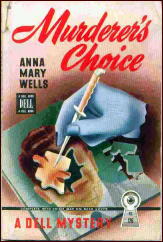
ANNA MARY WELLS – Murderer’s Choice. Alfred A. Knopf, hardcover, 1943. Dell #126, paperback, mapback edition, no date [1946]. Perennial Library, paperback, 1981.

ANNA MARIE WELLS Murderer's Choice

   Charles Osgood, famous mystery writer and creator of Silas Smith, bucolic detective, is one of those, it is to be hoped, rare mystery writers who are nasty characters in their own right, and maybe write.

   Charles tells his cousin, Felix Osgood, whom he obviously dos not like, that he, Charles, is ging to commit suicide in such a way that the death will seem like murder. Charles also says he will leave clues pointing to Frank.

   He adds that be is leaving everything to Frank in his will and has made him the beneficiary of a large insurance policy so that everyone will know who gains by the death. Frank, Charles tells him, will be charged with homicide and executed.

   Charles does indeed die, but the death is considered natural. Frank, who has waited nervously for the ax to fall and the evidence to make its appearance, can wait no longer. He hires the Keene Detective agency to look into his cousin’s death, and the agency assigns Grace Pomeroy, a new employee and a former nurse, to the case.

   Well written but requires a good deal of suspension of disbelief.

— From The MYSTERY FANcier, Vol. 12, No. 2, Spring 1990.


      BIBLIOGRAPHY —     [Taken from the Revised Crime Fiction IV, by Allen J. Hubin.]

ANNA MARY WELLS [aka Anna Mary Wells Smits, at one time an associate professor of English at Douglass College], 1906-2003.

   A Talent for Murder (n.) Knopf 1942 [Dr. Hillis Owen; Grace Pomeroy]
   Murderer’s Choice (n.) Knopf 1943 [Grace Pomeroy]
   Sin of Angels (n.) Simon & Schuster 1948 [Dr. Hillis Owen; Grace Pomeroy]
   Fear of Death (n.) Wingate 1951
   The Night of May Third (n.) Doubleday 1956

Editor’s Note: John F. Norris reviewed this same book over on his blog a couple of years ago. Check it out here.

FIRST YOU READ, THEN YOU WRITE
by Francis M. Nevins


   Hello again! I won’t attempt to describe the health problems that forced me to abandon this column and just about everything else these past few months, but they seem to be behind me now and I’m ready to take up where I left off. Care to join me?

***

   Not long before I put the column on hiatus, I learned from Fred Dannay’s son Richard that I’d made a mistake in Ellery Queen: The Art of Detection, and I can’t think of a better place to correct it than here.

   On page 241 of the book I state that the 1968 Queen novel The House of Brass was written by Avram Davidson from an outline by Fred. It’s true that Davidson was commissioned to and did expand Fred’s outline to book length, but that’s only a small part of the story, which is told in full in the Dannay papers, archived at Columbia University.

MIKE NEVINS

   Among the House of Brass documents are: (1) two different drafts of Fred’s synopsis, one running 74 pages, the other 61; (2) Davidson’s expansion of the synopsis, which runs 181 pages; (3) two copies of the 266-page version of the novel written by Manny Lee after the Davidson version was rejected; (4) two copies of the final draft of the novel, which runs 275 typed pages. These facts are indisputable, and I thank Richard Dannay for sharing them with me.

   As I documented in my February column, we know from Manny’s letter to Fred dated November 3, 1958 that he was at work turning a Dannay synopsis into a new novel but had been put behind schedule by health problems. (Whether these included the onset of writer’s block remains unknown.)

   We also know that the book in question was not The Finishing Stroke, which had been published much earlier in 1958 and was the last novel in what I’ve called Queen’s third period. So what happened to the book Manny was working on near the end of the year?

   I can envision three possibilities. (1) Fred gave up on it completely. (2) He gave up on it as a novel and he or another writer turned it into the novelet “The Death of Don Juan” (Argosy, May 1962; collected in Queens Full, 1965). (3) Manny went back to the project after recovering from writer’s block and it was published as Face to Face (1967).

   My own guess, which is speculative but (I hope!) informed, is the third possibility. With that as my premise, I offer the following timeline.

   Late 1958 or early 1959 — Manny develops writer’s block and is unable to continue expanding the latest Dannay synopsis into a novel.

   1961 or 1962 — A decision is made to bring in other writers to perform Manny’s traditional function.

   1963 — Publication of The Player on the Other Side, written by Theodore Sturgeon from Fred’s synopsis.

   1964 — Publication of And on the Eighth Day, written by Avram Davidson from Fred’s synopsis.

   1965 — Publication of The Fourth Side of the Triangle, written by Davidson from Fred’s synopsis.

   1966? — Davidson expands Fred’s synopsis into The House of Brass, but Fred and Manny reject his version and the project is shelved.

   1966 or 1967 — Manny recovers from writer’s block and finishes his work on the project that was left incomplete back in the late Fifties. This book is published as Face to Face (1967).

   1967 or 1968 — Manny completely rewrites the rejected Davidson version of The House of Brass, which is published under that title in 1968.

   The final Queen hardcover novels — Cop Out (1969), The Last Woman in His Life (1970), and A Fine and Private Place (1971), whose publication Manny did not live to see — were written by the cousins without input from outsiders, Fred preparing the plot synopses as usual and Manny expanding them to book length.

***

   As editor of Ellery Queen’s Mystery Magazine, Fred had reprinted dozens of the pulp stories of Dashiell Hammett but just one tale by Raymond Chandler and that only after his death. Of course the vast majority of Chandler’s short fiction was too long for EQMM’s requirements, but from Fred’s point of view the most serious problem with the creator of Philip Marlowe was that, unlike Hammett, he had a pervasive tendency to get lost in his own plot labyrinths. In fact he once said that plot didn’t matter to him, only the individual scenes did.
MIKE NEVINS

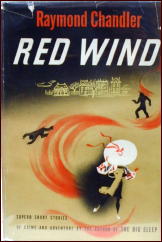
   This tendency can be seen as far back as his first published story, “Blackmailers Don’t Shoot” (Black Mask, December 1933; collected in Red Wind, World 1946, and in Stories and Early Novels, Library of America 1995).

   Trying to make sense of this story is like trying to nail jelly to a wall. One of the main characters is Landrey, a gambler and racketeer who earlier in his life had tried to launch a Hollywood career. In those days he had had an affair with Rhonda Farr, a young beauty who had become a major star. Apparently wanting to rekindle the romance, Landrey pretends that Rhonda’s love letters to him had been stolen and has his underworld buddies demand blackmail money from her. Then he hires the story’s protagonist, a PI named Mallory, to thwart the blackmailers and recover the letters.

   All these events have taken place before the story begins. Chandler opens with a nightclub scene where Mallory pretends to have the letters himself and, hoping to force the blackmailers to go after him, demands $5,000 from Rhonda. (What would he have done if she had said “Show me you have them”?) Chandler never makes up his mind whether Rhonda had asked Landrey to help get her letters back.

   At pages 71 and 106 of the Red Wind collection and pages 7 and 37 of the Library of America volume it seems she did, at pages 111 and 42 respectively it seems she didn’t. If she didn’t, how could Landrey have known she was being blackmailed unless he was behind it himself?

   At no point does Chandler provide any details about how the letters were stolen. In fact at pages 104-105 and 36-37 respectively it’s hinted that Landrey had returned the letters long ago and that they’d been stolen not from him but from her. To make matters even more chaotic, he for no earthly reason is carrying the letters in his own pocket on the night of the action!

   Simultaneously with the fake blackmail plot, Landrey has arranged for Rhonda to be kidnaped and held for ransom so that he can rescue her and earn her eternal gratitude. Apparently none of his underlings are ever privy to his overall plan, but a remark of Mallory’s — “When the decoy worked I knew it was fixed” (pp. 112 and 43 respectively) — suggests that in some mystic manner our sleuth knew the truth almost from the get-go.

   Somehow, although again Chandler spares us any details, Landrey’s partner Mardonne is involved in the master scheme, and Mallory miraculously discovers this aspect of the plot too (pp. 115 and 46 respectively). Small wonder that Mardonne (on pp. 112 and 43 respectively) remarks “A bit loose in places.”

   Parsing other Chandler stories will have to be done by someone else. Life’s too short.

***

   How better to celebrate one’s recovery from serious illness than with one of the immortal works of Michael Avallone? The Flower-Covered Corpse (1969) is rife with the scrambled sentences that are his unique claim to fame but I’ll limit myself to a handful. The “I” in these quotations is New York PI Ed Moon, who is to detectives what Ed Wood was to directors.
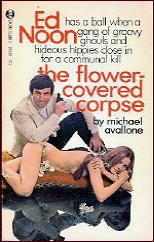
MIKE NEVINS

   I had never heard of Louis La Rosa. Didn’t know him from Robert J. Kennedy.

   Blood played tag in my little grey cells.

   â€œ….Hep you may be but you are unitiate….”

   The mad evening had come to its final, inexorable totem pole of weird unreality.

   More marbles scattered across the floor of what was left of my brain.

   Right after War Two, he had plunged into the Police Academy bag and come up with an apple pie in each hand.

   I didn’t have a client except myself and my own neck.

   He tried to smile, still huddling his lovely fortune cookie.

   Femininity and Melissa Mercer are blood sisters.

   The .22 spit like a sneeze.

   I said a handful and a hand has five fingers so I guess I should have stopped halfway through my list. But there’s something about Avalloneisms that almost forces me to say — again and again and again — “Just one more.” I hope you didn’t mind too much.
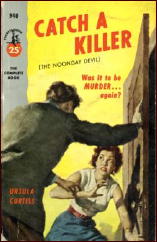
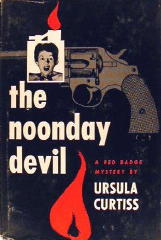
URSULA CURTISS – Catch a Killer. Pocket 940; 1st printing, June 1953. Hardcover edition: Dodd Mead, 1951, as The Noonday Devil.

URSULA CURTISS Catch a Killer

   It’s my guess that every time one of Ursula Curtiss’s books is reviewed today, it begins with the observation that her mother was mystery writer Helen Reilly, and that her sister was mystery writer Mary McMullen. (And equally obviously, I’m no exception.) It must have been in the genes, but during the time when all three were actively writing (Reilly from 1930 to 1962; Curtiss from 1948 to 1985, with a posthumous collection of short stories; and McMullen from 1951 to 1986), do you suppose that anyone ever asked them what was in the water they were drinking?

   While Helen Reilly had a series detective who appeared in most of her books, Inspector McKee of Manhattan Homicide, Ursula Curtiss and Mary McMullen, were heavy practitioners of (suburban?) domestic malice and/or romantic suspense, and neither of them (as far as I know) used a repeating character in any of their books.

   As far as Curtiss is concerned, this is the only book of hers I’ve read. So far. In any case, what you expect is not always what you get. In Catch a Killer, for example, I was surprised (although not nonplussed) to discover that the leading character is male, and that the story begins in Manhattan. I had the uneasy feeling that I was leaning one way, and the book, with Curtiss in charge, was going another.

   In the second half of the book, though, the scene changes, and rather drastically. Under some pretext or another, all of the leading characters seem to find their way to the same small country town in New England, and when they do, everything seems to revert to normal. (By which I mean, closer to what was expected, if not anticipated.) And as a direct consequence, perhaps with the characters’ closer proximity to each other, the action seems to pick up as well.

URSULA CURTISS Catch a Killer

   The atmosphere is dark, introspective and moody throughout. And coincidences simply thrive in such climates, beginning as they do here, in Chapter One. When you walk into an unfamiliar bar for the first time, for example, you never know whom you’ll meet, and that’s where Andrew Sentry finds a man who had been in the same Japanese prison camp as his brother Nick – an encounter occurring only by chance.

   Nick, as it happened, died in a fatal attempt to escape, and his death, Andrew for the first time is now told, was no accident. There was an informer – someone Nick knew. Someone who told their guards of Nick’s plans, which were then foiled. This is an unusual (if not unique) means of killing someone, but who was the mysterious man who called himself Sands, and what was his motive?

   More coincidences. Every male in Andrew’s small circle of friends and acquaintances seems to have been a Japanese prisoner in the Philippines at some time or another during the war. Nick’s fiancée Sarah Devany may have received a postcard in code from him just before he died, but when a simple question might have unraveled the mystery before it has even begun, there are, unfortunately, barriers which, as it happens, have been laid in the way.

   When Andrew came to break the news of Nick’s death to Sarah, it is revealed, he found her kissing another man, and he has not spoken to her since. And since the case for murder is so flimsy, the police cannot be called in, which limits Andrew’s resources to himself and whoever he feels he can trust, the list of whom changes chapter by chapter.

   And so does the reader’s grip on the story, or vice versa, the story’s grip on the reader. Excellent characterizations are mixed helter-skelter with a plot that’s held together with a strong brand of duct tape. Nonetheless, New England summer towns can be filled with as much malice as large population centers such as Manhattan, and the generally capable touch of Ursula Curtiss goes a long way in proving it.

— January 2004

THE BACKWARD REVIEWER
William F. Deeck


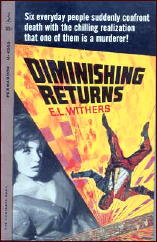
E. L. WITHERS – Diminishing Returns. Holt Rinehart & Winston, hardcover, 1960. Permabook M-4203, paperback, 1961.

E. L. WITHERS - Diminishing Returns

   Six people are having a nightcap. All are poisoned, but only one dies. Then the other five start dying one by one the next time they get together in ways that are made to appear accidental.

   An excellent plot here. Unfortunately, Withers is not able to carry it out without gaping flaws.

   The poison used in the first instance is arsenic, which the author thinks acts almost immediately upon ingestion. There is no explanation for the efforts to make the later deaths appear to be accidents when it is obvious — well, fairly obvious — that the poisoning was murder. One “accidental” death is from a broken neck; possible, to be sure, but most unlikely as described. There are other problems that will be left to the keen-eyed reader to spot.

   To make up for the somewhat strained logic, Withers provides a most delightful detective — this is his only appearance, alas — named Weatherby, who seems to have no first name.

   Weatherby is a retired lawyer, probably a septuagenarian, who likes to sleep until noon and stay up late, who smokes a lot and drinks a great deal, leading to “a slight fuzziness which was always urbane and gentle and good-humored.” He also has no desire “to walk when he could stand still, or to stand still when he could sit, or to sit when he could recline.”

   Read this for the “little old man” detective.

— From The MYSTERY FANcier, Vol. 12, No. 2, Spring 1990.


          Bibliography:    (Taken from the Revised Crime Fiction IV, by Allen J. Hubin.)

E. L. WITHERS. Pseudonym of George William Potter, Jr., 1930-2010.

   The House on the Beach. Rinehart 1957
   The Salazar Grant. Rinehart 1959
   Diminishing Returns. Rinehart 1960
   Heir Apparent. Doubleday 1961
   The Birthday. Doubleday 1962

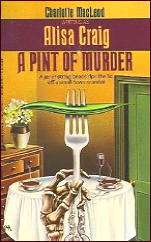
ALISA CRAIG A Pint of Murder

ALISA CRAIG – A Pint of Murder. Doubleday Crime Club, reprint hardcover, 1980. Detective Book Club, reprint hardcover, 3-in-1 edition. Bantam, paperback, 1981; Avon, paperback, 1988 (shown).

   Of all the detective murder mysteries that have ever been committed in fiction, a small but sizable number of them have been tackled by a member of the Royal Canadian Mounted Police. Tackled and solved, of course. The Mounties always get their men, as everyone well knows.

   Ms. Craig does nicely in adding to the total. The case is that of the food-poisoning death of a crotchety but scrupulously careful old lady in the New Brunswick town of Pitcherville. Inspector Madoc Rhys (a Welshman!) is the Mountie who is called in to investigate.

   The story, well, it could be likened to a breath of fresh clear Canadian air, containing only the slightest bit of pollution, and that of the sort produced by the gossipy thoughts and attitudes of small village minds with nothing to rein them in.

   This is also a book for those who do not mind a little romance mixing it up with their mystery fiction. By book’s end it quite definitely is clear that the Mounties almost always get their women as well.

Rating:   C plus.

— Reprinted from The MYSTERY FANcier,
       Vol. 4, No. 4, July-August 1980 (slightly revised).


Bibliographic Notes: This was the first of five books in the Alisa Craig’s Madoc Rhys series. Since I did not mention it at the time, I suspect that I did not know then what I know now: that Alisa Craig was a pen name of Charlotte MacLeod (1922-2005), who under her own name wrote both the Peter Shandy and the Sarah Kelling & Max Bittersohn series — among many other works of mostly humorous mystery fiction.

THE BACKWARD REVIEWER
William F. Deeck


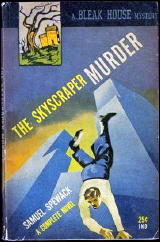
SAMUEL SPEWACK – The Skyscraper Murder. Macaulay, hardcover, 1928; Bleak House #17, no date [1947/48?].

SAMUEL SPEWACK The Skyscraper Murder

   When the reader is informed by the publisher that the writer of a mystery is also the author of “a long list of Broadway and Hollywood hits,” some nervousness about the quality of the mystery may be aroused. In this instance it is definitely justified.

   An alleged bridge expert, Oliver Sewell has four closets in his apartment devoted to female attire for his four lovers of the moment and his lovers, he hopes, to be. After having attended a nightclub with one of his paramours and her former husband, Sewell is found shot dead in his apartment.

   His body, although he was killed elsewhere, had been placed in a chair three feet from a mirror. Sewell should not have been in his apartment, dead or alive, because he was not seen returning from the nightclub, nor could his killer have escaped without being noticed.

   The butler reports having served meals for two, although no one lived with Sewell. A Sewell paramour is spotted coming out of a concealed room. Do the authorities scratch their heads puzzledly, then exclaim “Eureka!” and search for another hidden passages? Nope.

   The assistant medical examiner, who aids the police detective in the case, tells the detective that Sewell had been dead two hours. “That means — if it means anything — Sewell was killed just before midnight, ha?” the detective asks brightly. The doctor does not disagree.

   A short while later it is confirmed that Sewell had been in a nightclub at 1:00 a.m. Any consternation on the part of the doctor or the detective? Nope. It turns out that the murder took place about 2:00 a.m. and that this mistiming is merely the author’s bewilderment.

   The gun used to kill Sewell was taken from Sewell’s business associate while he was sleeping at Sewell’s apartment. It was employed in the dirty work and then returned to the associate in the hope of framing him. When the associate discovers that his gun was the murder weapon, he gets rid of it. Nonetheless, when another character is shot, the bullet, according to the police laboratory, came from the original gun.

   Possible, you say; yet the killer in his confession mentions in passing that he had his own revolver and that he used it, not the original pistol, to shoot the second victim. Show biz has obviously taken its toll on our author.

   Under the name of Leonard Slater, Sewell had planned to sail to Europe with one of his lovers. Later the killer goes to Europe on that same ship, and he cunningly uses the name of Leonard Slater. Why? Otherwise our fine pair of detectives would still be nonplussed.

   Another completely absurd plot development takes place, but to describe it in all its inanity would be giving away who the killer was. And there may be someone who cares, although it would be hard to understand why.

— From The MYSTERY FANcier, Vol. 12, No. 2, Spring 1990.


Bibliographic Note:   According to Al Hubin’s Crime Fiction IV, Samuel Spewak was the author of one other work of detective fiction: Murder in the Gilded Cage (Simon & Schuster, 1929). Based on the novel was a film entitled Secret Witness (Columbia, 1931). For more on the author himself, his Wikipedia entry can be found here.

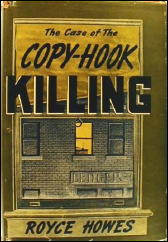
ROYCE HOWES – The Case of the Copy-Hook Killing. E. P. Dutton, hardcover, 1945.

   Howes started out with a bang as a mystery writer. In the five years between 1935 and 1939 he wrote seven novels, all published by Doubleday and the Crime Club. Then the war came along, and Howes, a newspaperman, did any further writing in the ETO for the Army News Service — information provided, incidentally, by the back flap on the dust jacket. (If you’re like me, you’ll read anything.)

ROYCE HOWES Ben Lucias

   Both Howes and his leading character, Captain Ben Lucias of the Homicide Squad, returned from the war in 1945. Lucias had been in five of the Crime Club books, but this was the last outing for both of them. Why it was done for Dutton instead of Doubleday, I don’t know, but I can guess. As a mystery, it’s Not Very Good.

   But, a copy-hook? I hear someone asking. A copy-hook is what one of those sharp steel spikes are called that reporters used to use to file their stories on. The scene, naturally enough, is a newspaper office, and it’s the reception clerk who’s been murdered. He was the guy whose job it was to keep the nuts coming in from the street from off the editors’ backs.

   And so Lucias’ ensuing investigation has him busily checking out the crackpots and all the other assorted creeps who saw the dead man last. It’s obvious that Howes knew the type well. He laughs at them, and if his characters reflect his own opinions at all, he despises them as much as they do.

   What is equally obvious is that the solution to the murder has nothing to do with this list of weirdos that Lucias has to work his way through. But downright distasteful, however, is Captain Lucias’ interrogation technique. Slugging a prisoner around in police headquarters is not likely to have been a remarkable occurrence back during the forties, long before today’s attempt at enlightened police procedures had begun to make some headway.

   It’s just that it’s difficult for me to recall it being done by a series character in police uniform before, one supposedly functioning as a competent detective, as well as one trying to maintain the respect of the reader.

— Reprinted from The MYSTERY FANcier,
       Vol. 4, No. 4, July-August 1980 (slightly revised).


     The Captain Ben Lucias series —

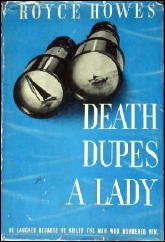
Death Dupes a Lady. Doubleday, 1937.

ROYCE HOWES Ben Lucias

Night of the Garter Murder. Doubleday, 1937.
Murder at Maneuvers, Doubleday, 1938.
Death Rides a Hobby. Doubleday, 1939.
The Nasty Name Murders. Doubleday, 1939.
The Case of the Copy-Hook Killing. Dutton 1945.

   Howes was also the author of two non-series mysteries, Death on the Bridge (Doubleday, 1935) and The Callao Clue (Doubleday, 1936).

PostScript:  From Wikipedia: “Royce Bucknam Howes (January 3, 1901 – March 18, 1973) was a Pulitzer Prize–winning journalist and author who also published a biography of Edgar Guest and a number of crime novels. He worked for the Detroit Free Press from 1927–1966 and won the Pulitzer Prize in 1955 for an editorial on the cause of an unauthorized strike by an autoworkers local that idled 45,000 Chrysler workers.”

« Previous PageNext Page »