Authors


THREE CRIME NOVELS BY C. M. KORNBLUTH
by Josef Hoffmann


   C. (Cyril) M. Kornbluth (1923–1958) is a well-known science fiction author. What is less well known, however, is that he was also a successful crime writer. In the second half of the 1940s he wrote detective stories for pulp magazines. Later, he published crime novels under the pseudonyms Jordan Park and Simon Eisner. According to Hubin’s bibliography, these were:

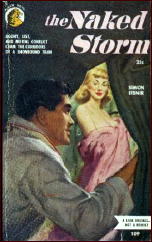
— Simon Eisner: The Naked Storm, Lion Books #109, 1952; cover art: Robert Skemp.

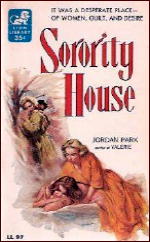
— Jordan Park: Sorority House, Lion Library LL97, 1956 (together with Frederik Pohl); cover art: Clark Hulings.

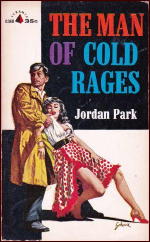
— Jordan Park: The Man of Cold Rages, Pyramid Books G368, 1958; cover art: Harry Schaare.

   A further novel, written jointly by Pohl and Kornbluth, can be found in Hubin: Gladiator-at-Law (Ballantine, 1955). In addition, there were Kornbluth’s novels Takeoff (Doubleday, 1952) and The Syndic (Doubleday, 1953). These novels have elements of a criminal plot, but because the action is set in the future and these novels are generally considered to be science fiction, I omit them here.

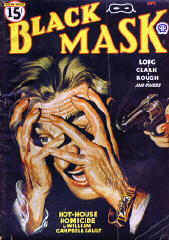
   Kornbluth’s earliest crime stories include the two detective stories in Black Mask: “Beer-Bottle Polka” (September 1946; Vol 29 #1; pp 35-43) and “The Brooklyn Eye”, 29, No. 2 (Nov 1946; Vol 29 #2; pp 79-94). The hero and narrator in each case is Tim Skeat, a private detective in New York City. Some action elements from earlier Pulp stories are reused in the crime novels.

C. M. KORNBLUTH

   The Naked Storm tells of a train journey through a snowstorm from Chicago to San Francisco. The locomotive eventually gets stuck in the snow on a pass in the Rocky Mountains, and the people on the train are cut off from civilization for three days. Using numerous observations and experiences, the novel describes how individual persons prepare for the train journey while the snowstorm is approaching, as well as the journey itself and the catastrophe.

   The novel has no underlying continuous narrative thread, but is instead constructed from larger and smaller illustrations of impressions and actions on the part of the persons involved. The combined narrative particles generate an overall impression that constantly changes, like the pictures in a kaleidoscope. While the reader is at first somewhat clueless, due to the diversity of the impressions and experiences, events intensify during the train journey around four persons:

— Hal Foreman, a news agency boss; he is being coerced by a gangster syndicate into establishing a news agency in San Francisco.

— Mona Greer, a lesbian bestselling author, who uses her glamorous status to seduce inexperienced young women, who she then proceeds to discard, once she has enjoyed her sexual conquest.

— Joan Lundberg, a pretty young woman, who is traveling to a political conference in San Francisco.

— Boyce, a businessman in the floor coverings industry, who is unhappily married.

   Both Boyce and Greer have their eye on Joan Lundberg. Foreman supports Boyce, as he hates lesbians like Mona Greer.

   The novel describes how environmental conditions influence people’s behavior, in particular how they compulsively abandon their moral standards in the face of snow and freezing ice. The bar is plundered, drugs are stolen from the doctor’s bag, insults and fistfights abound. And Foreman decides to murder Greer.

   The novel is more of a mainstream novel than a crime novel. Some of Kornbluth’s own experiences are worked into the depiction of Hal Foreman. This makes it all the more dubious that the reader is expected, through the manner in which the novel is written and concludes, to identify with Foreman’s prejudice against and hatred of homosexuality. This diminishes the quality of the novel considerably.

C. M. KORNBLUTH

    Sorority House is to an even greater extent more of a mainstream novel than a crime novel. Life in the Eleusis Academy for Women, a college in a small provincial town in Pennsylvania, is presented in a socially critical manner. The head of the college is Dr. Mildred Matthewson, an old maid and historian, who tyrannizes and spies on both students and teaching staff. She is malicious, extortionate and scheming.

   Four female students and three teachers form the centre of events. The four young women are accepted into to the sorority of the Lambs and enjoy the privilege of living in their house. They are Ann Riker, an aspiring writer, who is keen to suppress her lesbian inclinations, Kathryn Jackson, a stipendiary from the lower classes, who wishes to become a Latin teacher, Joy Squires, a beauty who embarks on a relationship with a young lecturer, and Clara Gwynn, a rather chubby student who develops a talent for mathematics. The three lecturers are the young English teacher Jim Henschel, the journalism teacher James McGivern, a drinker, and the new, unapproachable mathematics teacher Dr. Crouch.

   The entanglements that befall the students and lecturers are told in an exciting manner. But the action only takes a turn towards becoming a crime novel from page 166. During a dance party, arranged elaborately by the Lambs, Dr. Matthewson is found dead in the night, away from events, in the Mall. The police investigation, which commences immediately, establishes that the death was violent: it is murder. As the head of the college was not short of enemies, there are numerous suspects. Some detection and dramatic action takes place on the last 25 pages. The solution is no surprise.

   From our current perspective the prejudices against lesbian love and against women who aspire to social mobility by means of an academic education are reactionary. These prejudices become apparent above all at the end of the novel, which is not revealed. There is also an alarming empathy for a kind of self-justice. Finally, the different blurbs on both Lion Books falsify the content of the narrative by means of exaggeration, which I find annoying, and which does not do justice to the authors.

C. M. KORNBLUTH

   The hero of the third novel, The Man of Cold Rages, is Leslie Greene. His wife Peg and son Val are run over and killed by a car in Chicago. The car is driven by contract killers who shot Dr. Emilio Hernandez, who was sitting on a bench, and then killed the two likely witnesses to the crime, Peg and Val, with their car. Hernandez had been granted political exile. He came from the (fictional) Republic of La Paz, a small South American country ruled by the fascist dictator General Serrano. Hernandez was obviously murdered because of his oppositional political activities.

   Life no longer has any meaning for Leslie Greene. The only thing that still interests him is the punishment of the murderers. However, the police investigation is unsuccessful. Greene decides to travel to La Paz in order to kill the person who ordered the murders, General Serrano. For an indeterminate period he moves into a hotel in the republic’s capital city, which is decorated by countless portraits and statues of the dictator.

   Because Greene is an artist who can paint excellent portraits, he tries to attract attention by painting the portrait of the hotelier’s cousin, Senorita Isabel Rocas. He achieves this quite quickly, leading to the intended invitation to see General Serrano. It is arranged that he will paint a portrait of the dictator, who will model for the painting regularly.

   At the same time, Greene makes contact with the opposition, which operates underground. The opposition is planning a non-violent upheaval and a general strike. Greene’s plan to murder the dictator is rejected by the members of the opposition. But Greene sticks to his decision. Events take their course and are complicated further by the fact that Isabel falls in love with Greene.

   The Man of Cold Rages is a mixture of political thriller and suspense novel and resembles at times the novels of Eric Ambler. The typical Ambler protagonist lands in terrible danger and political adventure, without knowing what is happening to him; in contrast, Kornbluth’s hero seeks out the challenge cold-bloodedly.

C. M. KORNBLUTH

   This novel is not for readers who prefer their books to be as realistic as possible. For example, it is very unlikely that a visitor to a severely guarded dictatorship can transport a loaded pistol in his luggage on an airplane without any prior precautions, so that the weapon is only discovered by an overly enthusiastic chambermaid in the hotel. Otherwise the thriller is well written, with a number of very impressive scenes. It is exciting to read, albeit not without a certain amount of clichés.

   While Kornbluth’s first Black Mask story is roughly hewn and bursting with violence and cruelty, he refined his narrative technique in the crime novels, using violent scenes in a more differentiated manner. Kornbluth sometimes found himself to be cruel. This was contradicted by acquaintances, who considered his behavior to be friendly.

   The truth is that he was cruel in his fantasy world, as demonstrated in his first Black Mask story and – in diluted form – still in his first thriller. However, his literary attitude towards violence and self-justice obviously changed over the years, as can be seen in his final crime novel.

   It is a pity that the author died so young; we have been deprived of some probably very entertaining thrillers as a result. To those who wish to learn more about Kornbluth I recommend the detailed biography by Mark Rich: C. M. Kornbluth: The Life and Works of a Science Fiction Visionary.

— Translated by Carolyn Kelly.

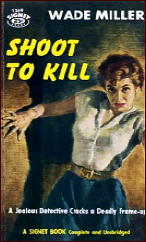
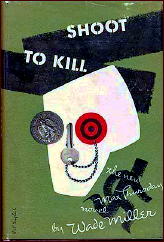
WADE MILLER – Shoot to Kill. Hardcover: Farrar, Straus & Co., hardcover, 1951. Reprint paperbacks include Signet 1369, 1957; Perennial, 1993.

WADE MILLER Shoot to Kill

   This is the last of the six Max Thursday private eye novels that the writing team of Robert Wade and Bill Miller produced, and one can only wonder what might have been. Could they have found anything possibly more to say about their character after the way they left him at the end of this book?

   There is a pair of firsts that occur in this novel, unless someone can come up with some earlier instances of each: (1) This is quite possibly the first private eye novel in which the hero loses his girl friend (police beat reporter Merle Osborn) to his client (sporting goods chain store owner Bliss Weaver). (2) This is also quite possibly the first private eye novel in which the hero manipulates the evidence to make sure the police know that his own client is guilty in a murder case.

   Most fictional private eyes are in some great sense larger than life. Very few real world PI’s ever get anywhere near a murder case, go to bed with their beautiful female clients, or do more than routine routine.

   And that’s why it’s such a shocker to find Thursday essentially a loser, unable to keep his own woman and prone to such human emotions as jealousy and deceit — as human as you or I. His rationale is that he knows that Weaver is guilty, and if he gets himself mixed up in the case, then Merle gets hurt.

WADE MILLER Shoot to Kill

   Of course Thursday messes that up as well, and when he’s called on it by his friend on the police force, Lt. Clapp, he confesses right away, and in his sense of guilt and shame, starts to realize that Weaver is very likely not the killer after all.

   I can think of no other mystery novel with a story line anything like this one. If you believe I have told you too much of the plot already, you should note that there are at least two Really Great plot twists yet to come, and I am not going to tell you about those. If you have not come to know what High Intensity means before now, after reading this book, you will know — and I do not mean only “action,” which of course there is. I mean Personal Anguish without letting it show. I mean Tough Decisions to Be Made. I mean, as I said up in the first paragraph above, Where Does He Go From Here?

   Here are the last couple of paragraphs. I believe Wade and Miller were correct to leave Max Thursday at this point, never to write about him again:

    Later, himself in a hospital bed, Thursday would find out about Bliss Weaver, about his time in hiding, the confused and desperate and soul-searching time. […] But now Thursday thought simply of the two of them united, Bliss and Merle. He scowled wistfully. That seemed to be what he had fought for; that seemed to be what he had won, his Grand Prize. Why? he wondered. But then he remembered the grim alternative he had conquered.

    “Clapp,” he croaked again. “He’ll have to tell me I made up for it, after all. I did, didn’t I?”

    He sat spraddle-legged in the ashes and debris, leaning the elbow of his broken arm on the tool kit, stubbornly keeping himself conscious. He heard the cry of a siren in the distance and he waited for the law to come and relieve him of his responsibility.

— February 2004 (slightly revised)


PostScript:   For as much information on “Wade Miller” as I could put together at the time, including an interview with Robert Wade himself, check out this page on the main Mystery*File website:   THE AUTHORS WHO WERE WADE MILLER: Robert Wade and Bill Miller.

THE BACKWARD REVIEWER
William F. Deeck


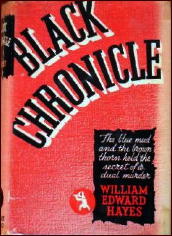
WILLIAM EDWARD HAYES Black Chronicle

WILLIAM EDWARD HAYES – Black Chronicle. Doubleday Crime Club, hardcover, 1938.

   This, the third novel featuring private detective Arthur Halstead, begins with a remarkable coincidence. Into Halstead’s office comes a goon to employ Halstead to dig up dirt or invent some on Neil Allison. After the plug-ugly leaves, Allison himself arrives to hire Halstead to investigate two attempts on his life. It seems he is involved in, as Halstead puts it, the eternal triangle with a little reverse English on it.” Halstead declines to do anything.

   On the Eastern Shore of Maryland, however, the reverse-English part gets murdered by a cunning killer who, in the hope of disguising his crime, arranges to have the victim’s car run into by a train. Good planning, one would think, but there was no train scheduled for that time. Still, one does show up, sort of machina ex machinus, if I’ve gotten my Latin right. I will spare you the car that at one moment has snow chains on its tires and the next moment is ” roiling smoothly” down the road.

   Perhaps Halstead was delineated well in his previous investigations. Here he is a few idiosyncrasies in a semi-fair-play and rather dull novel.

— From The MYSTERY FANcier, Vol. 13, No. 1, Winter 1991.


BIBLIOGRAPHY:   All with PI Arthur Halstead.

      The Black Doll. Doubleday, 1936.   Film: Universal, 1938
      Before the Cock Crowed. Doubleday, 1937.
      Black Chronicle. Doubleday, 1938.

   Says Al Hubin of the author in Crime Fiction IV: Born in Muncie, Indiana (1897-1965?); had numerous jobs with railroad lines, then reporter and drama critic for New York Evening Journal; editor of Railroad Magazine; later executive with Rock Island Lines.

A REVIEW BY MARYELL CLEARY:
   

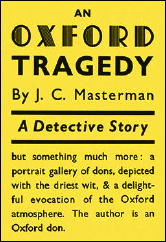
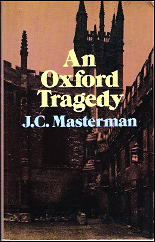
J. C. MASTERMAN An Oxford Tragedy

J. C. MASTERMAN – An Oxford Tragedy. Victor Gollancz, UK, hardcover, 1933; Penguin, UK, paperback, 1954. Dover Press, US, softcover, 1981.

   Mysteries set in Oxford have a cultured, leisurely way with them, The protagonists are generally dons; the conversation in the Senior Common Room is on matters of scholarly import, over coffee, port, and good cigars. One feels the ease and contentment of that sort of life, and it’s acknowledged by Winn, the narrator of this one. Then murder breaks in and changes everything.

J. C. MASTERMN An Oxford Tragedy

   The reality of people’s feelings comes out from beneath the veneer of affability. Suspicion clouds the easy daily routine. Such is An Oxford Tragedy. The title informs us that this is more than mere murder. Shirley, an unpopular don, is shot and killed in the rooms of the dean, Hargreaves, who has left a loaded gun on his table and carelessly told the high table of that fact.

   Brandel, an Austrian lawyer with some experience of criminal investigation, happens to be visiting in college for a week. He is immediately brought into the matter by Winn, who acts as his Watson.

   Winn makes a good Watson, “infirm of purpose” and constantly analyzing his own actions and motives. Brendel is almost too good to be true, a Germanic Holmes. The interest in the book, now so dated, lies in its depiction of life at Oxford in the good old days.

— Reprinted from The Poisoned Pen, Vol. 6, No. 2, Winter 1984/85.


Bio-Bibliographic Notes:   Ernest Brendel solved only one other case that was recorded by author J. C. Masterman for posterity; that is to say, The Case of the Four Friends (Hodder, UK, hardcover, 1957; no US edition). For more on the author himself, you might go first to his Wikipedia entry, which begins thusly:

    “Sir John Cecil Masterman (12 January 1891 – 6 June 1977) was a noted academic, sportsman and author. However, he was best known as chairman of the Twenty Committee, which during World War II ran the Double Cross System, the scheme that controlled double agents in Britain.”

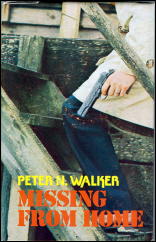
PETER N. WALKER – Missing from Home. Robert Hale, UK, hardcover, 1977.

PETER N. WALKER Missing from Home

   You’d have to live in the UK to have heard of Peter N. Walker, I suspect, even though he’s written tons of books (figuratively) under not only his own name, but that of Andrew Arncliffe, Christopher Coram, Tom Ferris and Nicholas Rhea too.

   He’s probably best known under the latter byline for his rather cozy “Constable” series, which was also the basis for a TV series called Heartbeat, which may be well known in England, but is far from that over here. (An understatement, I suspect.)

   Missing from Home, written under his own name, is a straightforward and standalone crime novel, but in his own words, Walker says this about one of the series characters whose adventures he also related:

    “Carnaby was a flamboyant and very unorthodox detective who had a private income in addition to his police salary. His wealth enabled him to enjoy the roving commission he used for his undercover CID work. There are eleven titles in the series which ran from 1967 to 1984…”

   If there is a detective of record in Missing from Home, it is a lowly (and very new to the job) Police Constable named Keith Bowman, in an even lowlier police outpost in a small village called Brocklesford. It is only Bowman who takes seriously the case of a missing woman, a wife and mother of two small children, a woman who simply would not take off on her own without warning.

   And once it turns out that the woman was kidnapped by an escaped prisoner with a grudge against the system that sent him there, it is also Bowman, in spite of all of the high ranking superiors who by then are on the job, who comes up with the location where the woman is being held prisoner.

   A straightforward crime novel, as I said up above, but down to earth and direct storytelling, and smooth sailing all the way. No depth, one would have to admit, but smooth.

THE BACKWARD REVIEWER
William F. Deeck


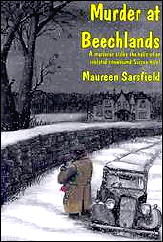
MAUREEN SARSFIELD – A Party for Lawty. Coward-McCann, US, hardcover, 1948. Nicholson, UK, 1948, as Dinner for None. Reprinted in the US as Murder at Beechlands, softcover, Rue Morgue Press, 2003.

MAUREEN SARSFIELD A Party for Lawty

   Driving back from a week of duck shooting, Inspector Lane Parry of Scotland Yard becomes stranded in a Sussex blizzard. Seeking shelter is a big mistake, as he ends up at the Beechlands Hotel, which isn’t, as he first concludes, a lunatic asylum. It does, however, run that institution a close second.

   A party was to be held for Lawrence “Lawty” Lawton, World War II hero and ladies’ man. Since someone has done him in at the hotel, the festivities don’t take place. Several people have motives, with jealousy and money being foremost among them. And why do so many people want to remove something from the hotel’s safe?

   Parry, who would dearly love to avoid an investigation among the peculiar inhabitants and employees of the hotel, finds himself operating alone against a determined murderer who strikes again. A frenetic investigation and not a fair-play type, I would conclude, but then I got lost amid all the excitement and may have missed the clues.

   Fine reading here.

— From The MYSTERY FANcier, Vol. 13, No. 1, Winter 1991.


Bibliographic Notes:   Maureen Sarsfield, the working byline of Maureen Pretyman (or vice-versa?), was the author of one other crime novel, that being Green December Fills the Graveyard (Pilot, UK, 1945), reprinted in the US as Murder at Shots Hall by Rue Morgue Press in 2003. As usual for Rue Morgue, there is a very informative article discussing all that is known about Maureen Sarsfield. (If one were to wish to read A Party for Lawty, in all likelihood it will have to be the Rue Morgue edition. Only one other copy was found just now on the Internet, and that one was in French.)

HUMOR & JOHN DICKSON CARR
by Marv Lachman.


JOHN DICKSON CARR / CARTER DICKSON

   Rereading portions of the Sir Henry Merrivale series recently made me realize again how humor in the mystery has deteriorated since the days of Carr-Dickson, Craig Rice, and Alan Green. Nowadays the closest we come to humor is the first-person narrator emulating a stand-up comedian with wisecracks. Spenser, Claire Malloy, and Kinky Friedman are examples.

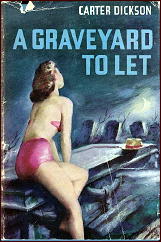
   In the Merrivale series almost every book had a slapstick sequence that was the mystery equivalent of the Marx Brothers. Take the riot Sir Henry causes on the New York subways in A Graveyard to Let (1949).

JOHN DICKSON CARR / CARTER DICKSON

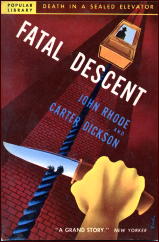
   The humor in the series is not entirely visual — e.g., the delicious confusion between the words “kleptomania” and “nymphomania” in Fatal Descent. Sure, John Rhode is listed as co-author of that 1939 book, but does anyone really think Rhode could have written those lines, even if his life depended on it?

   In the same book, the unimaginative Inspector Hornbeam says regarding a corpse discovered in a double-locked “room” (a sealed elevator car within a sealed elevator shaft): “There’s a flaw somewhere. There’s got to be. Otherwise the thing’s impossible. And it’s impossible for a thing to be impossible.”

   Pure Carr.

— From The MYSTERY FANcier, Vol. 13, No. 1, Winter 1991.

THE BACKWARD REVIEWER
William F. Deeck


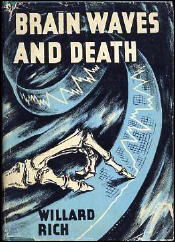
WILLARD RICH – Brain-Waves and Death. Charles Scribner’s Sons, hardcover, 1940.

WILLARD RICH Brain-Waves and Death

   Don’t be misled by the title, which sounds like some-thing Phoenix or Arcadia would have published. According to Hubin, this is the only novel by Rich, a pseudonym, and that’s a pity, for it’s a good one.

   One of those not too bright blackmailers has not only let himself be known to his victims but is spending the weekend with some of them. He also volunteers to undergo a brain-wave test in the early days of electroencephalography. When the blackmailer’s brain is presumably fried, Inspector Noonan is called in from Boston to investigate. It’s a complicated case, but Noonan gets it all straightened out. Unfortunately, he then has to start all over again.

   Nothing much happens after the murder except for Noonan’s interrogations of the suspects, a well-assorted and interesting group of scientists, scientific pretenders, and a few hangers-on. Noonan’s personality and humor and the odd characters are more than sufficient, though, to keep a reader’s interest.

   Hubin says this novel is set in Boston, but it actually takes place in the country. Fair play is present — I think. My brain tends to become more numb than usual when timetables are involved. Still, this did not detract from my enjoyment of the novel, nor did the package of Chesterfields turning into Lucky Strikes.

— From The MYSTERY FANcier, Vol. 13, No. 1, Winter 1991.


Bibliographic Notes: Hubin’s most recent edition of Crime Fiction IV still says the novel takes place in Boston. Of the author, Al says: “[A] pseudonym of William Richards, (?-1940); Professor of Chemistry at Princeton.

   The book itself is scarce. While there are currently seven offered for sale on ABE, the least a copy will cost you is $650.00. Says one dealer of the book:

    “Brain-Waves and Death was published posthumously under the pseudonym “Willard Rich” a few weeks after its author, William T. Richards, took his own life. Richards worked for Alfred Lee Loomis and his novel was a thinly veiled account of a real-life laboratory located about 40 miles north of New York City nicknamed “Tuxedo Park.” This “secret palace of science” was founded and funded by Loomis, arguably one of the most significant and uncredited figures in the history of modern military science. Loomis, a world-class tinkerer in his own right, was a visionary who saw that technology would win the looming war-and indeed that an investment in “big science” would be the key to national strength in the future. Loomis went on to establish the MIT Rad Lab and later was instrumental in setting up the Manhattan Project. According to legend, Loomis had all copies of Richards’ roman-a- clef bought up and destroyed. Obviously he missed a few copies, but the book is uncommon , especially in jacket.”

FIRST YOU READ, THEN YOU WRITE
by Francis M. Nevins


   The first time I saw Mickey Spillane was at a Bouchercon, back when he was the public face of Miller Lite beer. The second and last time I saw him was on April 27, 1995, the evening of that year’s MWA dinner. As 1994 Awards chair I got to host the pre-dinner cocktail party for Edgar nominees, and Spillane got to attend because, over vehement objections from some older mystery writers who were on the other side of the culture wars of the HUAC-McCarthy-Red Menace era, he was about to be given the Grand Master award.

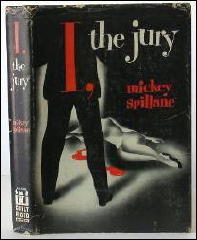
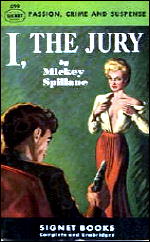
MICKEY SPILLANE I, the Jury

   Like just about everyone else in America I had read Spillane’s early novels — the septet of bestsellers that began with I, the Jury (1947) and climaxed, if that’s the word, with Kiss Me Deadly (1952) — but almost nothing that he’d written in the Sixties and later. Like just about no one else in America except intellectuals and critics, I thought his books were terrible. What turned me off was not so much the rabid right-wing politics or the gruesome sadism of the action scenes as it was the inept plotting and linguistic boners.

   The basic storyline of I, the Jury is simplicity itself. Manhattan PI Mike Hammer vows to personally execute the murderer of his buddy, ex-cop Jack Williams, who had lost an arm in the Pacific saving Hammer’s life. In his search he meets a seductive female psychiatrist, a pair of man-hungry twin sisters, a medical student who lives with a racket boss, and other lovables. After wading through the carnage of four more murders he gets to carry out his grim sentence, gut-shooting the psychiatrist and narcotics queenpin Charlotte Manning. The last two lines of the book are justly famous, or at least infamous. Manning: “How c-could you?” Hammer: “It was easy.”

   I could devote several pages to how and where I, the Jury goes off the rails but will limit myself to three specimens of track-jumping, the first trivial but telling, the others crucial.

   (1) In Chapter 3 Hammer is discussing the case with his friendly enemy Captain Pat Chambers of Homicide. Chambers argues that “somebody was afraid of what [Williams] knew and bumped him.” Hammer suggests that Chambers doesn’t know much about murderers and offers the alternate theory that “To protect himself, the killer knocked Jack off.” Talk about a distinction without a difference!

MICKEY SPILLANE I, the Jury

   (2) The second and third murders take place in a whorehouse which Hammer has under personal surveillance. Both the second victim and Charlotte Manning, the murderer, are by this time well known to our sleuth, and neither of them knows he’s on the scene, yet both manage to get in by the front door without Hammer spotting them. Miraculous luck is again with Charlotte as she escapes from the house and area while police have the whole block surrounded.

   (3) The fourth and final murder victim is Jack Williams’ fiancée Myrna Devlin and the crime takes place at a society party with 250 guests. Would you believe that every blessed one of them turns out to have an alibi for the fatal minutes? At the time Charlotte shoots her, Myrna is wearing Charlotte’s coat. (Don’t bother to ask why.) This means that afterwards she has to take her coat off Myrna’s body, find Myrna’s coat, put a bullet hole in exactly the spot to coincide with the hole in Myrna, put that coat on the dead woman, and cover up the hole in her own coat. She also has to gamble that neither the gun nor its silencer nor the hole in her coat will be noticed during the investigation and that she’ll be able to get all three items off the premises under Hammer’s eagle eye. Once again miraculous luck sits on her shapely shoulders. Yikes!

   In Chapter 12 Hammer visits a movie theater and sees a crime film, calling it “a fantastic murder mystery which had more holes in it than a piece of Swiss cheese.” The perfect description for any Spillane novel!

***

MICKEY SPILLANE I, the Jury

   One of the things that surprised me when I revisited I, the Jury recently was that so much of the writing is so pedestrian and ordinaire. Clearly Spillane hadn’t yet mastered the psychotic rants which pockmark his novels of the early Fifties. But every so often one finds a linguistic flub that lingers in the memory:

    “My thoughts wandered around the general aspects of the case without reaching any conclusions.”

    “Living alone with one maid, a few rooms was all that was necessary.”

    “It gave me ideas, which I quickly ignored.”

    “He took off like a herd of turtles.”

    “When Velda heard about this she’d throw the roof at me.”

   â€œâ€˜Well, you know that he was in a medical school. Pre-med, to be exact.’”

   Talk about a distinction with a difference! Was Spillane the inspiration for all those lunatic lines that began streaming from the smoking typewriter of Michael Avallone a few years later?

***

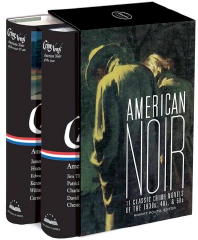
   A year and some months after Spillane was named a Grand Master, the publisher of the prestigious Library of America series asked me to comment on the authors and titles tentatively selected for the Library’s two-volume American Noir project. My only suggestion for Volume One, which covered the Nineteen Thirties and Forties, was that Cornell Woolrich’s I Married a Dead Man be replaced by three or four of his short novels.

MICKEY SPILLANE I, the Jury

   Volume Two, which dealt with the Fifties, was slated to include two books I didn’t think could be called American Noir: Patricia Highsmith’s The Talented Mr. Ripley, because most of it doesn’t take place in America, and Ross Macdonald’s The Galton Case, because having a series character and first-person narrator readers can easily identify with (Lew Archer, of course) seemed to me to rule it out as noir.

   I proposed as a substitute someone who was conspicuous by his absence in the table of contents. You guessed it. Mickey Spillane. As a writer, I argued, Spillane stands beside Highsmith and Macdonald roughly where Ed Wood stands among film-makers vis-a-vis Hitchcock and Fritz Lang. But in terms of the development of noir he’s of such immense historical significance that American crime fiction and crime films of the Fifties just can’t be understood without him. (This is why I never objected to his receiving that Grand Master award.)

   Mike Hammer of course is a series character and first-person narrator just as much as Lew Archer but he’s certainly not one readers can easily identify with. In fact, I contended, critics would long ago have ranked Hammer with Lou Ford in Jim Thompson’s The Killer Inside Me as one of the genre’s most convincing sociopaths if only Spillane hadn’t labored under the delusion that he’d created a hero.

   I’ve been commenting on mystery fiction and mystery writers for almost half a century but have discussed Spillane only once in a chartreuse moon and have never advocated for him except in my correspondence with Library of America. How did Atticus Finch do? Miserably. How many of my suggestions were accepted? You guessed it. None. But I did enjoy the interchange and wound up with complimentary copies of some very nice volumes. One of which I expect to figure in my next column.

CORNELIA PENFIELD – After the Town Clerk Died. Typed manuscript with corrections made by hand. No date. Unpublished.
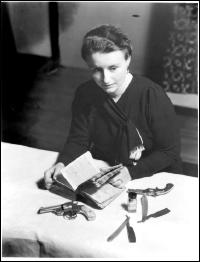
CORNELIA PENFIELD

Prologue: Cornelia Penfield was the author of two published works of detective fiction, both of which have recently been reviewed on this blog: After the Deacon Was Murdered and After the Widow Changed Her Mind. If you haven’t already, I’d recommend going back to read the earlier reviews (follow the links) before continuing:

   The Internet is wonderful. It’s terrific. It took only a few days to trace down the family of Mrs. Cornelia Penfield Lathrop. She died in 1938, and a son Robert died several years ago, but Marilyn Lathrop, Cornelia’s daughter-in-law, is still alive and well. She lives two towns over to the east of me, and I’m not sure exactly what she thought when she opened the letter I wrote her, asking if she indeed was who I thought she was. (No, I have that wrong. I wrote the letter to Robert Lathrop, as the telephone is in his name, and I wasn’t sure if it were Robert the son, still living, or perhaps Robert, a grandson.)

   In any case, she wrote back, saying yes, Cornelia was her mother-in law, and yes, she’d welcome a chance to talk to me on the phone. I called not too late the following evening, hoping to set up a time when we could talk longer. What happened instead was a conversation about Cornelia Penfield that lasted at least 30 minutes. I no longer remember whether I received the answer in the initial letter that she wrote me or in that conversation, but the question that I was simply itching to ask, given the first suitable opportunity, was “Do you know why the third book was never published?”

   What I didn’t expect, whenever it was that the question was asked, or at least not realistically, was the reply that manuscript still existed, and would I be interested in seeing it sometime? I think my mind went blank right about then, but you know what my reply had to have been.

   I went to see it, had a chance to have another lengthy conversation with Marilyn Lathrop and (which I never really anticipated) I was allowed to borrow it. I have kept it far too long. There were some extenuating circumstances, including a number of unexpected events that intervened and kept me from starting to read it, but I think the real reason I put off reading it for so long was that for me, it was a once-in-a-lifetime event, and I was simply relishing the anticipation much longer than I should have.

   As to the answer to the question as to why the book was rejected – and this is the family’s version of what happened – is that the publisher said it “wasn’t seamy enough.” When we get to the review proper, I’ll go into that, but later on Marilyn partially reconsidered, saying that perhaps “seamy” wasn’t the word that was used, but even if it wasn’t, it was close.

   What I didn’t realize right away, though, is that the title of the manuscript I have is NOT the title of the third book that was promised, and there is nothing in the story itself to suggest the title was changed, there being no doctor in the tale that I have.

   So there is a fourth novel, and it is still missing, and unless someone in the Lathrop family remembers something – a box or trunk never opened – we shall reluctantly have to assume that it no longer exists.

   It also seems possible that After the Town Clerk Died is a novel that was never sent to Putnam’s. It may have been that After What the Doctor Said was the one that was rejected, with the aforesaid comment attached, and that Town Clerk was abandoned before completion, almost but never quite finished.

   It is, I am sure, no longer possible to say. It is remarkable that the typed pages still exist. As a mystery, it needs some work. I’ve never tried to write a full-fledged detective novel, or even an unfledged one. Reading this, in what I’m going to continue to think of as being in the form of a rough first or second draft, gave me quite a bit of insight into the physical problems of doing so. Being sure that an event mentioned on page 233 (say) as having happened earlier on page 165, really occurred, for example, and that a clue discussed on page 198 (say) was mentioned and pointed out back on page 53.

   That’s what still needs some fixing, not a lot, and editors of detective story fiction deserve all the praise we can give them. (There are still a few of them, but not as many as before.)

   Jane Trimble, the semi-elderly genealogist who appeared in the two published books, also appears in this one, her primary focus being that of keeping her friend Gordon Burr from becoming a suspect in the death of a man in a suspicious fire. Burr is a writer who is not only having problems completing his latest book, but who is also having domestic troubles with his wife, and Jane cherishes them both.

   I don’t imagine retelling the plot in detail makes a lot of sense, as when is anyone else ever going to be able to read this as a work of detective fiction? I’ll retract a good deal of what I was going to say, and start painting things with a wider brush.

   But what I started to say still applies. Jane was hardly the detective of record in the first book at all, and it was something of a surprise to find that she appeared in the second. In the second one, Widow, she shared sleuthing duty with another character, but in this one, she is the primary detective, even to the extent that she is the one with a watchful eye out for trouble even before there is trouble to be had.

   And here lies a problem. It takes nearly 150 pages before the body of the dead man is discovered, and it takes a fairly talented mystery writer to keep the reader’s interest that long, with little or no “action” taking place. There are a lot of characters to identify, a lot of refined conversation to listen in on – this is suburban Connecticut, after all, and even in (say) 1935, the level or refinement was greater than many another part of the world.

   Once Jane’s detective activities begin in earnest, it is quite a complicated state of affairs the mystery finds itself in, and – here’s another problem – many of the clues happened or were discovered back in the earlier portion of the book when no one (but Jane) even suspected that they were clues. An alert reader might get glimpses of the essentials of the plot in its early going, but as the manuscript now stands, some strong rewriting seems to be very much necessary.

   There is a great to-do about who was where and saw what when, and even more about beards, false beards, who had one and who shaved one off and who hired someone to impersonate them who did or did not have a beard when he needed one. I may not have implied what I wanted to in that sentence. It is all very fascinating.

   Penfield’s great talent was in miniature characterization, burbling good humor, dialogue, and in the end, a kindly heart. The mystery, as in Widow, turns out to have been a minor affair, complicated by a myriad of factors, related and unrelated, but once again – with a sense of forgiveness for loose ends – it’s a charming affair that I’m glad to have had the pleasure to read. (By the way, the Town Clerk’s death is involved, but he died of natural causes, and his involvement comes only in a clever way, one that could have been known only by someone intimately involved with the problems of genealogical research, and as such, it may be a First. The entire series, in other words, and this one in particular, may be “One for the Books.”)

Postscript: I have debated for a while whether I should do this, and once again, since you’re reading this, you will know that the better argument won. Here’s a longish quote from pages 245-246, getting within a hundred pages from the end. It will give you a sense, I think, of Cornelia Penfield’s knowledge of the conventions of the mystery field, and how, as I’ve mentioned in the two previous reviews, how she liked to play around with them.

   Reviewing her evening with the Admiring Confidants, in the foggy dawn of a New York spring day, Jane felt she had not shone. How was it that fictional detectives made themselves the center of awestricken attention, summed up their findings in crisp dramatic sentences, and stated so authoritatively that the criminal must have done this and that as was clearly shown by these and those?

   How was it that invariably they enlisted the kindly and obsequious services of? (1) Scotland Yard (2) the Division of Investigation of the Department of Justice (3) the Police Department of the metropolis concerned – (Select (1), (2), or (3) giving reasons for choice and write in your own words a complete detailed description of methods employed by that organization.)

   By what magic did they also find various district attorneys, solicitors, barristers, photographers, experts in criminology and laboratory practice, reporters, butlers and valets to abet and assist the Super-Detective without wanting any reward beyond a kindly smile, who argued with him just sufficiently to point out his infallibility- and were content with being yes-men and filling about two hundred and ninety pages of escape literature?

   None of her own intense concentration and really intelligent work on the Dymchurch affair had to date earned her a darned thing — and might possibly, as Judge Whitaker had hinted, be bringing her activities suspiciously into the official limelight.

   However positive she might be that at least one of the theories so neatly worked out and counter-indexed in her notebook was a correct solution, just how was she going to submit the notebook to the Principal Official and secure his kind attention? After having, for reasons which at the time appeared to her sound, led him to believe her a romantic and muddleheaded moron?

   And coming down to her own friends from whom at least she had the right to expect some awed silent admiration, what had been their attitude?

   Merely a polite and passing interest in the least important phases of the whole affair – the beard and the altered entry – and in order to explain those she had had to battle against guppies and banal bunnies as conversational topics!

   Worse of all, Judge Whitaker upon whom she had relied for so much of encouragement and intelligent cooperation, had not only failed her utterly, but had expressed his opinion in tactful judicial terms that she was a Meddlesome Mattie, and had better let the state of Connecticut and the town of Dymchurch deal with their own affairs as they were so well equipped and prepared to do.

   â€œAh well,” said Jane, ringing the pantry service. “A bit of breakfast may chirk me up. I must hold to the thought that I am not a Super-Detective, but merely riding a hobby-horse I found grazing along the roadside: and that even so I am an unpretentious Jarrocks and not eligible to the Hunt Club: nor am I called upon to demonstrate haute école before a circus audience that thinks a balotade is probably an off-color French joke… But, all the same, if this sinister Langton person does do away with me and dispose of my body in a crematory way, won’t all the grown-ups be sorry and begin to appreciate the risk I am taking?”

   The pause-giving difficulty would be that she would not be around to hear the post-mortem regrets and to see Judge Whitaker turn her notebook pages with trembling fingers or to hear him say “Poor Jane! How little we appreciated all this clever work of hers!”

   She sipped her coffee and enjoyed one of the famous St. Crispin croissants and decided to live a while longer, Langton willing. Even though a few more deaths were needed to bring the Dymchurch quota up to a good Van Dine average.

   I’ve decided that if I’m going to do long quotes from the text, I ought to do it right. Here’s an earlier passage, from pages 35-38, in which Jane meets Don Wyckoff, a local attorney, who may or may not be representing either artist Jack Collins or his wife Julia in their upcoming divorce proceedings. As part of their conversation, some more light is shed on Jane’s detective proclivities:

   Wyckoff smiled diplomatically. “… But I can’t undertake to nurse Jack Collins all the time.”

   â€œAre you representing him or Julia in the oncoming action? Or doesn’t one ask?” Phyllis nibbled a cracker.

   â€œOne doesn’t – not at this moment.”

   â€œBut is Julia really going to carry it through, Don? I should almost think after all these years … tell the waitress no mayonnaise for me, please – just the diet dressing … I’m sorry, Don. Ethics always seem so silly among friends – professional ethics, I mean.”

   There was a slight frown on Wyckoff’s bland forehead and he addressed his next remark directly to Jane. “Judge Whitaker spoke of you as a triple A detective, Miss Trimble.”

   â€œI suppose he referred to the Gleason will case. That was simple genealogical research. Elementary.”

   â€œThe name is Wyckoff, not Watson. And I know an unfortunate lot about how much ability as well as research that sort of thing takes. Being myself mostly a digger-out of facts for others to profit by.”

   â€œOh, Don! Don’t be so ’umble. He’s in with the oldest, snootiest law firm in Tidewater, Jane – seven names and an ampersand on the door – and every one of the seven is a judge or a trustee or a receiver or something.”

   â€œExcept me and the ampersand. The only way I maintain my dignity out of office-boy hours is to keep a few clients of my own over here in Dymchurch.”

   He began to outline amusingly a case involving a farmer and his step-son. Phyllis listened with applauding phrases at the right moment. Jane divided her attention between the table in the alcove – as yet unclaimed – and his bland face and pleasant voice. She had rather a prejudice against young lawyers, so given as a rule to screening their uncertainties by bumptious pronouncements and bristling authority. Wyckoff was of another sort. He had an adaptable geniality that hinted of the politician – of experience in gaining the confidence of folk of all degrees. A tactful young man, she concluded, who had been about a bit, who was sure of himself but not irritatingly so, and who might will be exactly what her beloved old neighbor, Judge Whitaker had been in his green legal youth. The anecdote finished, he again referred to Jane’s detective experience.

   â€œIt’s been rather accidental and incidental,” she said. “If I ever tried real detecting, I’m afraid I’d be much more interested in a criminal’s heredity and background and other antecedents than in the crime and whodunit. In the long run, though, I suppose detection and genealogy require about the same amount of patience and imagination and experience – and luck – ”

   â€œThe ideal job of detection may,” laughed Wyckoff, “but the detectives I’ve met in real life depend principally upon a lack of delicacy and a certain flair for installing dictaphones, breaking down doors, and otherwise intruding on the private life of a sincere criminal. Not picturesque persons – and the less imagination the better. You ought to hear our local chief of police, Hal Flint, cuss out detective story detectives. So many of the young literary colonists scribble mystery novels and they keep looking Flint up and getting in his hair and asking him questions.”

   â€œAnd I suppose he replies in the same spirit as did the doctor whose dinner-partner wanted free medical advice and asked him what he did when he had a cold – he snorted at her and said ‘Same as everybody else ma’am. I cough and sneeze’ –”

   â€œExactly the way Flint feels. Routine and romance don’t team successfully. And what’s more, if your average detective has no imagination, your average criminal certainly has less. I’ve never met a master-mind, I never hope to see one – but if I do, I’ll call you in, Miss Trimble. I promise.”

   â€œThank you,” said Jane solemnly. “I’ll endeavor to cope genealogically.”

   One more quote. I hope I’m not overdoing this, but I’d like to demonstrate what I mentioned earlier about Cornelia Penfield’s knack for dialogue. Jane is talking to Mrs. Turner, the cook in the Burrs’ household. Her husband Jim is the Burr’s handyman, and Beulah is their daughter, whom they’ve been concerned about. Either I’m right, or I’m hopelessly wrong, but I think this is the way people actually talk, instead of in neat diagrammable sentences. From pages 76-77:

   â€œPerhaps I can give Mrs. Burr a few hints when she comes back,” concluded Jane. “She hasn’t, I know, the faintest idea of making it hard for you.”

   â€œI know she hasn’t. That’s why I’ve kep’ my mouth shut and tried to do my best. Of course I never thought I’d get to do housework for other folks, but we couldn’t have it nicer than we have here, with our own little house an’ all. And after stretchin’ an’ strainin’ so many years, it’s a real rest to spend somebody else’s money for a change … not but what I don’t try to manage just as close ’sif it was my own” – added Mrs. Turner conscientiously, “But Mr. and Mrs. Burr, they’ve never had to count every cent twice, and they both do like good victuals … if we only had Beulah back and Jim didn’t get upset so easy–”

   â€œAbout her?”

   â€œYes. That’s the whole trouble. Jim kep’ straight ’s string till she went off t’ New York, but people ’round here don’t give him credit for that. An’ I was hopin’ maybe if she did come home–” Mrs. Turner’s tight lip quivered – “You see, Miss Trimble, we lived out of Branford on a farm of our own when we was first married, and all the time Beulah was growin’ up we had all our own things nice. Then the bank closed in New Haven where we had our money, and the other bank foreclosed on a moggidge Jim had taken out to buy some more proputty with, and it was before they started the Home-Owners’ Loan or anything and we couldn’t beg or borrow a cent – so we lost our place and had to sell our furniture for what it’d bring – I had real nice walnut suites that had b’longed to my folks – and the best we could do was try to live with Jim’s step-uncle over Redding-way, but he’d never liked Jim – and his second wife didn’t get along with Beulah an’ we all had it pretty hard till Beulah took a notion to take her high-school cookin’ and so on seriously and get herself a job waitin’ on tables at the Tavern. She did real well with tips an’ all an’ then she found out there’d be this place for us all so we decided we’druther be independent an’ work for pay than keep on where we were … Only with Beulah gone and no relyin’ on Jim no more, I guess the Burrs is about ready to make a change. And if we haveta leave here, Jim’ll just get from bad to worse.”


In conclusion: Thanks again to Marilyn Lathrop for allowing me the use of the manuscript, and for the conversations we have had concerning her husband’s mother. Since Marilyn never knew her mother-in-law, her own knowledge is based on what Robert and other members of the family have told her over the years. Cornelia’s daughter Helen Harriet Petty is still living. She is in her late 80s, and the memories she has of her mother have been conveyed to me through Marilyn. A nephew, Fred Lathrop, is also still alive, and he has assisted me in proofreading the reviews and commentary above. He remembers her only as a young boy, recalling for the most part the years toward her death, when she was often bedridden with tuberculosis.

   My impression of Cornelia Lathrop, through these conversations, was that she was a very progressive woman, ahead of her time in many ways. Similar in nature, I believe, to Eleanor Roosevelt, a lady whom Cornelia is said to have met. Not many women in the 1920s, for example, would take her three children to live in France for well over a year without her husband, who stayed home working.

   She was always interested in the arts. Besides her brief involvement with Broadway, previously mentioned, in the mid-30s she also wrote several articles for Stage Magazine, including five in a 1936 series on famous Hollywood directors.

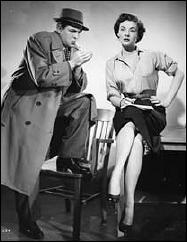
   The photo you see at the top of this article/review is a publicity shot taken by her mystery publisher, G. P. Putnam. It’s nice to be able to display it again.
— February 2004

« Previous PageNext Page »