Authors


THE BACKWARD REVIEWER
William F. Deeck


WILSON TUCKER – The Chinese Doll. Rinehart, hardcover, 1946. Detective Book Club, hardcover, 3-in-1 edition, May 1947. Dell #343, mapback edition, 1949.

WILSON TUCKER The Chinese Doll

   While you might think that a private detective in Boone, Illinois, would be underemployed, you would be right. In this documentary novel — in the form of letters from Charles Horne to Louise, the woman he is in love with — Horne is in his office trying to keep warm and working on his book, Lost Atlantis, of which seven chapters have been completed.

   Into the office comes Harry W. Evans, who gives Horne $500 to bail him out of jail since he claims he will inevitably be arrested for spitting on the sidewalk, or jaywalking, or shoplifting, or whatever.

   Naturally, Home is somewhat nonplussed, for the authorities in Boone are not noted for monkey business. To coin a phrase — or is it a clause? — little does he know. Evans leaves Home’s office, and as Horne is watching, a Studebaker sedan with supercharger strikes Evans, killing him, and then speeds off. Later Horne is invited into another Studebaker with supercharger, this time a coupe, driven by a beautiful Chinese girl, and ends up at an illegal gambling club.

   All of this and another “accidental” death tie in with Evans. Horne doggedly and intelligently — though not brilliantly — investigates, getting some idea of who Evans was through Evans’s membership in an amateur publishing association and discovering another beautiful Chinese girl.

   Even after he’d metaphorically rubbed my nose in it, Tucker fooled me on the villain, for which I give him great credit. The novel is well-written, amusing, and believable, up to the point of revealing the villain.

   While I probably won’t make myself clear here, I accept that the villain was who Tucker says it was — the facts, once Horne pointed them out, prove it — but I don’t accept that the villain was who Tucker says it was. You’ll have to read the book to see what I mean, and you ought to read it anyhow, for it’s an excellent private-eye novel.

— From The MYSTERY FANcier, Vol. 13, No. 4, Fall 1992.

   
NOTE:   Wilson “Bob” Tucker, was much more well known as a Science Fiction fan and author than he was a mystery writer. His entry on Wikipedia can be found here.

       The Charles Horne series:

The Chinese Doll.Rinehart, 1946.
To Keep or Kill. Rinehart, 1947.
The Dove. Rinehart, 1948.
The Stalking Man. Rinehart, 1949.
Red Herring. Rinehart, 1951.

FIRST YOU READ, THEN YOU WRITE
by Francis M. Nevins


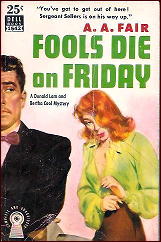
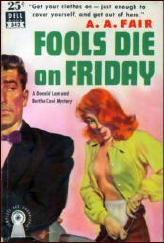
   For my last column I revisited one of the Bertha Cool/Donald Lam novels written by Erle Stanley Gardner as A.A. Fair, and for this one I tackled another. Fools Die on Friday (1947) is more straightforward than Bedrooms Have Windows and the plotting more under Gardner’s control.

A. A. FAIR Fools Die on Friday

   The firm is hired to protect a real-estate tycoon from having his food poisoned by his second wife, who married him after his first wife died of, you guessed it, food poisoning. Donald quickly catches on that his new client isn’t who she claims to be. Then he devises a scam to delay the poison plot by posing as PR man for a manufacturer of anchovy paste and offering to put Wife Two in ads for the product.

   The realtor is poisoned anyway — with arsenic in the paste Donald left at his house as samples — and so is his wife. He recovers but she doesn’t. Then his secretary is strangled and Donald finds the body. Mixed into the ragout are a devious dentist, a machine that handicaps horse races, and a wandering package of arsenic.

   There’s very little detection in this opus, but the pace is furious (as usual with Gardner) and the climax, with one character literally getting away with murder, would never have been allowed in a contemporaneous Perry Mason novel since the Masons were being serialized in the Saturday Evening Post and the Cool/Lam books weren’t.

   Among other dividends in Fools Die we get to learn a new word. In Chapter 5 Cool tells Lam she’s trying to get the firm’s client “in a position where she has to pungle up more money.” In Chapter 15 she asks him: “You pungled up a hundred bucks in cold cash on the nose of one pony on the strength of it [i.e. the handicapping machine]?”

   I’ve never seen the word before in my life but Webster’s New International Dictionary assures me that it’s a genuine verb, meaning to pay or contribute. I wonder where Gardner came across it.

***

   Ever hear of Walter Kaufmann? He was born in Germany of Jewish parents in 1922, left his homeland on a scholarship to an American college just before Hitler launched World War II, returned to Germany with Military Intelligence during the war, and eventually was hired by Princeton University as a professor of philosophy. I discovered him in my teens and have been reading him all my life.

   Why am I recounting all this here? Because in one of his best-known books, Critique of Religion and Philosophy (1958), he tossed off a comment about our genre that is well worth preserving:

   â€œEven as it is the fascination of a detective story that the truth is finally discovered on the basis of a great many accounts of which not one is free of grievous untruths — even as it is sometimes given to the historian to reconstruct the actual sequence of events out of a great many reports which are shot through with lies and errors…”

   The balance of this sentence is for our purposes (if I may cite a Gardnerism) incompetent, irrelevant and immaterial. I wouldn’t be surprised to learn that among Kaufmann’s favorite whodunits were those in which the detective acted as historian, for example Ellery Queen’s The Murderer Is a Fox (1945) and Josephine Tey’s The Daughter of Time (1952).

   We’ll never know for sure. Kaufmann died horribly in 1980 at age 58. Anyone interested in the details can access his brother Felix Kaufmann’s account of his death by googling both men’s names.

***

   Still bogged down as I am in the index for The Art of Detection, I’ll pad out this column to its usual length with the help of that nonpareil, that nonesuch, that Ed Word of the written wood, Michael Avallone.

   Over the decades I’ve culled from his 200-odd novels well over a thousand prime specimens of the Avalloneism. Both Bill Pronzini and I as well as some others have offered samples taken from his Ed Noon PI novels, but readers of this column are less likely to have seen those he perpetrated in the dozens of paperback Gothics he wrote under female bylines back in the Sixties.

   From The Second Secret, as by Edwina Noone (Belmont pb #B50-686, 1966) I’ve harvested 7½ single-spaced pages of howlers, which I hope to dole out over the next several columns. Page numbers are provided in case anyone wants to quote these in an academic journal. Hold onto your hats and here we go:

   The tree had come to represent the rainbow of wishful thinking. (9)

   He had been gone four long years and Cherry Williams had never stopped loving him. Like the red oak tree, she could not remember a time when she hadn’t loved dark-haired, handsome, surly Adam Freneau. (10)

   The sturdy frame of his muscular young body, presaging the manhood that was to come, had engraved itself on her heart. (11)

   She had only to say his name to herself or see his face in her fancies and the blood in her body would stir warmly. (13)

   Cherry felt her heart stop beating, the lungs in her bosom squeeze unbearably. (14)

   For a wild second, she wanted to run.
   But her legs refused to heed the random irresolution of her mind. (14)

   The tone of the words were worldly weary, yet unmistakably condescending. (16)

   A mammoth, all-encompassing scarlet flare of color seemed to paint the world in flaming colors. (19)

   (B)oth women could now hear the far off clang and trumpetry of the fire bells strategically placed all over Englishtown and vicinity. (20).

   Miraculously, the stone pillars and colonnades had held off the worse that the flames could do. (20).

   Of course, any number of Avallone’s Gothics are utterly devoid of such gems. When I find one of these I usually fling it across the room, snarling: “Why did I pungle up good money for this garbage? Someone edited it!” But so many of his immortal works are so lavishly studded with verbal cow pies that I could keep quoting like this till at least my 90th birthday. If there should be one.

[Editorial Comment.]   11-7-12.   By the time Dell got around to reprinting their 1951 edition of Fools Die on Friday (#542), the first cover was considered risque enough that some changes had to be made. See below:

A. A. FAIR Fools Die on Friday

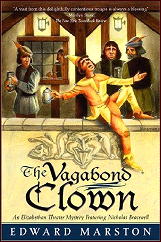
EDWARD MARSTON – The Vagabond Clown. St. Martin’s, hardcover, August 2003.

EDWARD MARSTON The Vagabond Clown

   Marston is a wonderfully prolific writer. Besides two separate series written as by Keith Miles, which as it happens is his real name, he has three additional series under this particular pseudonym, all historical mysteries: (1) with Christopher Redmayne, an architect, and Jonathan Bale, a constable in 1600s London, England; (2) the Domesday series, with Ralph Delchard, soldier and Gervase Bret, lawyer in medieval England; and (3), of which this is the latest, a series featuring Nicholas Bracewell, book holder for Westfield’s Men, an accomplished acting company in Elizabethan times.

   A book holder includes the jobs of both stage manager and road manager, and Nicholas has his work cut out for him in The Vagabond Clown, what with one clown incapacitated with a broken leg, and the second, recruited from a debtor’s cell, subject to serious bouts of wine, women and japery.

   Murder and other calamities also follow the trail of the travelers as they make their way from London to Dover, making adjustments to their plays as they go. The jealousies and acrimony between the two clowns make for fine amusement, and it is hard to imagine how the life of troupers like these on the road could be better described.

   The solution to the mystery is more than a little weak, alas, with motivations hidden until the very end, far too late to be of any help to the reader at home, though the culprits themselves are painfully obvious. An uneven entry in the series, therefore, but one that’s definitely worth reading.

PostScript: For the sake of completeness, the detective novels written under the Keith Miles byline are (1) the Alan Saxon mysteries, in which the current day golfer goes from country to country solving crimes and (2) a rather new series following the adventures of Merlin Richards, a young Welsh architect and a Frank Lloyd Wright protégé, taking place in Phoenix and Chicago in the 1920s and 30s.

   This is embarrassing. Marston/Miles can write faster than I can read.

— October 2003


[UPDATE] 10-03-12. Here it is, nine years later. The Vagabond Clown was the 13th in the Nicholas Bracewell series; there are now 16. Other current totals:

Eleven books in the Domesday series.
Six books in the Christopher Redmayne series.
Ten books in the Inspector Robert Colbeck series (begin in 2004).
Five books in the Captain Rawson series (begun in 2008).
Two books in the Inspector Harvey Marmion and Sergeant Joe Keedy series (begun in 2011).

       As by Keith Miles:

Six books in the Alan Saxon series.
Two books in the Merlin Richards series.

       As by Martin Inigo (not mentioned above):

Two books in the Dan Hawker series

   In the past nine years, if my count is correct, Marston/Miles has written 23 books.

RICHARD DEMING’s Manville Moon Series,
by Jon L. Breen


RICHARD DEMING

   Richard Deming (1915-1983) was a solid and reliable pro whose crime-writing career extended from late 1940s pulps to early 1980s digests. He also wrote several volumes of popular non-fiction late in his life.

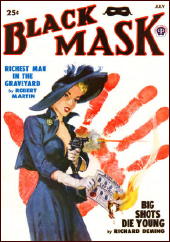
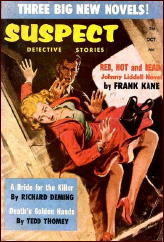
   He is most likely to be remembered as one of the most prolific contributors to Manhunt and the early days of Alfred Hitchcock’s Mystery Magazine and as a paperback original writer, sometimes of novels based on TV shows (Dragnet, The Mod Squad, and under the pseudonym Max Franklin, Starsky and Hutch). He was also a frequent ghost for the Ellery Queen team on paperback originals and for Brett Halliday on lead novelettes for Mike Shayne Mystery Magazine.

   The private-eye hero of Deming’s earliest pulp stories and a number of his Manhunt stories was Manville Moon, who lost a leg in World War II, a disability that slows him down occasionally but not much.

RICHARD DEMING

   The four full-length novels about Moon, all reissued as ebooks by Prologue Books and available at Amazon in the three-to-four dollar range, are notable for their uncharacteristic (for Deming) hard covers and (with one exception) their evocative titles. They reveal Deming to be, in common with Rex Stout, George Harmon Coxe, Erle Stanley Gardner, and quite a few others, a writer who drew on both classical and hardboiled conventions.

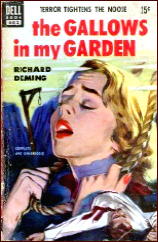
   In The Gallows in My Garden (1952), Moon tells his story in smooth, relaxed, somewhat Goodwinesque first person. The terrific title comes from G.K. Chesterton’s “A Ballade of Suicide.” The setting is an unnamed Midwestern city, and the author exhibits a comfortable postwar Midwestern sensibility. The book is dedicated as follows: “To my mother, who would prefer me to write innocuous tales about members of Dover Place Church.”

RICHARD DEMING

   Though he will go through all the tough-guy paces, Moon is not really such a hardass and certainly a gentleman in his dealings with women. There’s some good character drawing but the secondary regulars (girlfriend Fausta Moreni, an Italian war refugee turned restaurateur; annoying comic sidekick Mouldy Green, a Moon Army buddy; and irascible friendly enemy cop Warren Day) seem made for radio.

   The case is a classical whodunit setup, focused on an inheritance. Moon’s client, a 19-year-old heiress who will not collect her massive fortune until her twenty-first birthday, tells him a series of seemingly accidental close calls have convinced her someone is trying to kill her.

   But it is her brother who becomes a murder victim. Many will share my immediate suspicion that Deming had lifted the plot and its ultimate solution from a very famous Golden-Age detective novel, and even those who do not know the novel in question might see that solution coming.

   Does Deming have a surprise in store? Moon conducts a gathering of the suspects to reveal the generously-clued killer. The devotion to fair play puzzle spinning continues in all four novels, but this first is much the best of them.

RICHARD DEMING

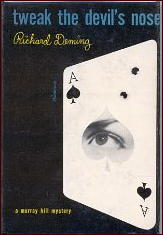
   Tweak the Devil’s Nose (1953) begins with the shooting of the lieutenant governor of Illinois outside El Patio, Fausta Moreni’s nightclub and restaurant. Fausta is rich, which is a problem for Manny, a situation similar to those in many of William Campbell Gault’s novels. More of the obligatory gangsters and fight scenes are there to pay Deming’s hardboiled dues. It’s highly readable and entertaining, though not as good as its predecessor.

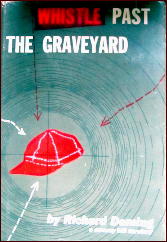
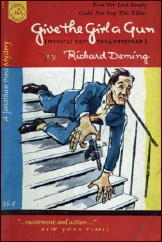
   Give the Girl a Gun was originally published as Whistle Past the Graveyard (1954), a much better title, though the new one at least fits the story. Central to the plot is a new invention designed to prevent hunters from accidentally shooting each other. Deming inserts fisticuffs and a standard girlfriend in danger suspense sequence not vital to the main plot before another gathering of the suspects clears things up.

   Juvenile Delinquent, published in Great Britain in 1958, apparently never appeared as a complete novel in the United States prior to the Prologue ebook, though it was published in Manhunt (July 1955) in a shorter version.

RICHARD DEMING

   It lacks the light touch of earlier books in the series, offering a serious look at the J.D. problem with much preachment and speechifying included. It has a kind of procedural feel early on, reflecting a change of style and fashion in the middle fifties. The serious intent may be admirable, and I would never go so far as to miss the comic relief, but the didacticism makes this generally less successful purely as entertainment.

   Fausta and the utterly unbelievable Mouldy finally appear in the second half, but the change to a lighter tone doesn’t help much. The cop contact is present but more subdued. The mystery plot is on the thin side, though the solution is typically well worked out.

   In sum, Deming is a consistently reliable performer, always readable and entertaining. And admirers of the classical puzzle might see through the fisticuffs to a refreshing adeptness at misdirection.

       The Manville Moon series —

   The Gallows in My Garden. Rinehart & Co., hardcover, 1952. Dell #682, paperback, 1963.
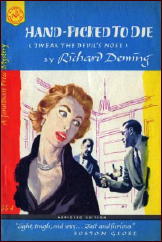
   Tweak the Devil’s Nose. Rinehart & Co., hardcover, 1953. Jonathan Press J-91, paperback, as Hand-Picked to Die, 1956 (abridged).

RICHARD DEMING

   Whistle Past the Graveyard. Rinehart & Co., hardcover, 1954. Jonathan Press J-83, paperback, as Give the Girl a Gun, 1955 (abridged).

RICHARD DEMING

   Juvenile Delinquent. Boardman, UK, hardcover, 1958. (No US print edition.)

THE BACKWARD REVIEWER
William F. Deeck


JAMES CORBETT – Murder While You Wait. Herbert Jenkins, UK, hardcover, 1937.

   Readers — oh, all right, one to be exact, and she was pixilated — have insisted that I at least occasionally remind them of the works of James Corbett, that unfortunately neglected genius of the thriller. Since this is the final issue of TMF and thus vociferous complaints from others cannot be published, I will courageously risk it.

   If you are unacquainted with his works, the first thing to be said about Corbett is that when the familiar disclaimer is printed– “All the characters in this novel are purely imaginary and have no relation whatsoever to any person, living or dead” –he is one of the very few authors telling the literal truth. Or one certainly hopes he is.

   In this novel, Reginald Harcourt, M.P. for West Singleton, has been shot down in front of his residence after receiving a threat from “Murder While You Wait,” or M.W.Y.W. Seth Mannering, a rich barrister who had talked with Harcourt the night before his death and scoffed at the death threat, hires Malcolm Egerton, distinguished criminologist, to investigate the case.

   It is a complicated one, for twenty-six other people are apparently also in danger. Harcourt and the others had testified in the Broxton Financial Scandal. Some of the group begin receiving notices of their imminent death, and die they do. One is stabbed to death in a taxi, while another is murdered by machine-gun.

   When one of the threatened men commits suicide, Egerton explains it this way: “He was bluffing in Daly’s Cafe, and he left a note to that effect!” (The emphasis is Corbett’s.) Since you are all experienced and perceptive readers, you will understand that without my having to explain it.

   One person is threatened by M.W.Y.W. and is surrounded by Egerton, Mannering, the heroine, and a Scotland Yard detective. He dies anyhow at precisely the time predicted after having a nip of brandy. Mystery buffs will immediately suspect one of those four individuals. But if they do they will have forgotten that this is a James Corbett novel; the man actually died of a heart attack, a pure, if that’s the word I want, coincidence.

   Several times it is pointed out by the investigators that if they knew the name of the killer, they would have a better chance to catch him. As his many admiring readers are aware, Corbett never spares the logic.

   When another stabbing death occurs, Egerton keenly orders an X-ray. That, he is sure, will reveal that the same knife was used in the two murders. Unfortunately, the reader is never vouchsafed the results of this forensic miracle.

   Near the end of the novel, Egerton reveals the reason for his superb investigative ability: “I always get into contact with the unseen, with the mystic forces of the universe, then, after a long period of waiting, there comes a light in the picture.”

   Some readers, unused to Corbett’s characters, might wonder why he didn’t get in touch with the unseen earlier to solve the case; others might wonder why he isn’t doing it even as he speaks. Actually, since he is a Corbett character, he never does it.

   Or maybe he did and he doesn’t reveal it. He catches the murderer by identifying the five distinct clicks from a call-box when the killer picks up the receiver. Since the murderer hadn’t at that point given Egerton’s number, perhaps mystic forces did after all put a light in the picture.

— From The MYSTERY FANcier, Vol. 13, No. 4, Fall 1992.


Editorial Comment:   Bill Deeck was a great champion of Corbett’s work, as you can readily discern from this review. You can also find a full page of quotes online that Bill accumulated from several of Corbett’s mysteries: http://www.mysterynet.com/books/testimony/genius/.

   Here are but two of my favorites from that page:

    “It was a morning gown of blue silk, one that stressed her grace of figure and matched her complexion.”

    “Pritchard sat up like a full-blown geranium.”

   Most of Corbett’s work was never published in the US, and unfortunately many of them are very hard to find. For example, there is at the moment but one copy of Murder While You Wait up for sale online, priced in the $70-75 range, depending on the venue. Perhaps a bargain at half that price! (Follow the link for a complete bibliography.)

From The Satan Sleuth #2: The Werewolf Walks Tonight by MICHAEL AVALLONE.   Warner Paperback Library, paperback original, December 1974.

MICHAEL AVALLONE The Werewolf Walks Tonight

   … a wet suit, the dark, rubberized costume particular to scuba divers, frogmen, and anyone engaged in the pursuit of aquamarine adventure.   (Page 39)

   Philip St. George had not come to Fletcherville unprepared and half cocked.    (Page 43)

   … the cheap gold lettering on the cover which proclaimed it as the New Testament, St. James Version.    (Page 45)

   Besides being Fletcherville’ s only and most successful banker …    (Page 48)

   There was devils walking in the world, all right.    (Page 55)

   Dean Williams’s Good Book, the St. James version …   (Page 78)

   It was in all the ancient papers, the only known weapon against a lycanthrophobe–    (Page 80)

   There was no saliva in her mouth for she had yet to have any water. Her tongue was a dead lizard in her gullet.   (Pages 83-84)

   Dawson was bound to put two and two together and get a positive four. If he got five, well, forget that, too.    (Page 97)

   No one who saw him could not help feeling sorry for the stranger…   (Page 103)

   On his feet, dark canvas sneakers loomed, the track model.    (Page 107)

   His face was expressionless, his mind perfectly and unwaveringly resolute. He had licked up the scent of the Fletcherville Demon at last. Once and for all. Forever. The moment was electrifyingly tense. There was a high, sharp keen to the atmosphere, as if the rhythms of the spheres of the universe were blending in a moment of truth.    (Page 119)

   Nausea climbed upward from her stomach, joined the horror in her brain, fusing electrically, exploding once more in a final burst of stupefying terror.    (Page 127)

   When the thing snarled, a snarl compounded of rage and pain, and dropped back, releasing its savage hold on his own shoulders, the sound was something joyful to Philip St. George. Like a bugle sounding a cavalry charge or the “Hallelujah Chorus” from Handel’s Messiah. Not even the mammoth grizzly bear of the North can stand up to a frontal assault on his small testicles.    (Page 140)

— Collected by Bob Briney and reprinted from his DAPA-Em zine, Contact Is Not a Verb #63, March 1991.

REVIEWED BY WALTER ALBERT:         


RAYMOND CHANDLER in HOLLYWOOD

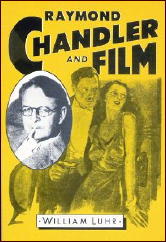
WILLIAM LUHR – Raymond Chandler and Film. Frederick Ungar, hardcover/softcover, 1982; bibliography and index, photographs, filmography. Florida State University, trade paperback, 1991.

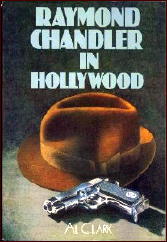
AL CLARK – Raymond Chandler in Hollywood. Proteus, hardcover/softcover, 1983; index, filmography. Silman-James Press, trade paperback, 1996.

   I have paper editions of both these books: the Luhr is a 5-1/2 x 8″ yellowback, the cover sporting a portrait of Chandler set into an oval frame next to a pulp illustration; the Clark is a large-sized 8 x 10⁻³/4″ book, the cover featuring a brown hat with a revolver resting on the brim.

   The Luhr pages are densely packed with text in small type, while the Clark is profusely illustrated with stills, lobbycards and other advertising material for the films. Luhr is an associate professor of English and film at St. Peter’s College, and Al Clark is a Spanish-born publicist and magazine editor who is currently creative director of the Virgin Records group, based in London.

   The copy for Clark’s biography is probably written by him and is a tongue-in-cheek view of his life; Luhr’s credentials are presented soberly. The casual reader is likely to assume that Luhr is writing a serious study of Raymond Chandler’s Hollywood career and that Clark has put together an album for the film buff.

RAYMOND CHANDLER in HOLLYWOOD

   In fact, both books are valid contributions to the literature on Chandler’s Hollywood years. Luhr’s approach is largely analytical, a close reading of his films. Clark went to Los Angeles where he interviewed people involved in the films and people who knew Chandler, and his narrative is a mixture of production information and film analysis.

   Clark unfortunately only cites his sources in his preface: there are neither notes nor bibliography. He seems more sensitive than Luhr to information furnished by people like Leigh Brackett, but both men communicate their enjoyment of the films and of Chandler’s fictional world, and I would not want to be without either book.

   The layout on the Clark book is handsome, and the stills, not the tiny postage stamps one often sees, are generously displayed in an attractive format. I compared the two accounts of The Long Goodbye, and while they are not perfectly congruent they are in general agreement, with, as one would expect, Luhr going into greater detail about the film and Clark more enlightening on the actual production. He incorporates a lengthy interview with Nina Van Pallandt into the chapter, and it is the insight furnished into the making of the film that makes Raymond Chandler in Hollywood a more intimate look at the Raymond Chandler film world.

— Reprinted from The MYSTERY FANcier,
       Vol. 7, No. 2, March-April 1983.


Hi Steve,

   If possible, can you put out this inquiry.

   Being a fan of the Inspector Pel books by Mark Hebden (i.e., John Harris ), I was a little surprised to see in the Curtis Brown archive at Columbia University that a Barry Fox was also mentioned as writing as Hebden. The archive was unable to help with further information.

   I have never thought of it before but three of the Hebden books were published after the death of Harris. So it seems possible that another hand was involved in writing those last books. Then there are the Juliet Hebden books about Pel, supposedly by Harris’ daughter.

   I asked Allen Hubin and the others, but no one had heard of a Barry Fox in relation to the Hebden books. But then I discovered that there is an American ghost-writer by that name. His website is at http://taylor-fox.com/

   I doubt that he will reveal anything because of confidentiality agreements, but I wonder if anyone else knows anything ?

   I would be grateful if you can add this to your inquiries.

   Many thanks

               John Herrington

      The Inspector Clovis Pel series, by Mark Hebden —

Death Set to Music (n.) H. Hamilton 1979 [Theatre; France]
Pel and the Faceless Corpse (n.) H. Hamilton 1979 [France]
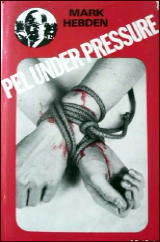
Pel Under Pressure (n.) H. Hamilton 1980 [France]

MARK HEBDEN Inspector Pel

Pel Is Puzzled (n.) H. Hamilton 1981 [France]
Pel and the Bombers (n.) H. Hamilton 1982 [France]
Pel and the Staghound (n.) H. Hamilton 1982 [France]
Pel and the Pirates (n.) H. Hamilton 1984 [France]
Pel and the Predators (n.) H. Hamilton 1984 [France]
Pel and the Prowler (n.) H. Hamilton 1985 [France]
Pel and the Paris Mob (n.) H. Hamilton 1986 [France]
Pel Among the Pueblos (n.) Constable 1987 [Mexico]
Pel and the Touch of Pitch (n.) Constable 1987 [France]
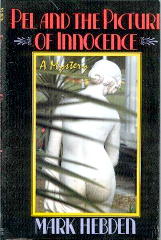
Pel and the Picture of Innocence (n.) Constable 1988 [France]

MARK HEBDEN Inspector Pel

Pel and the Party Spirit (n.) Constable 1989 [France]
Pel and the Missing Persons (n.) Constable 1990 [France]
Pel and the Promised Land (n.) Constable 1991 [France]

MARK HEBDEN Inspector Pel

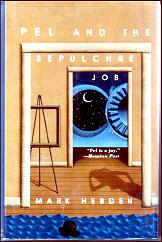
Pel and the Sepulchre Job (n.) Constable 1992 [France]

MARK HEBDEN Inspector Pel


      The Inspector Clovis Pel series, continued by Juliet Hebden —

Pel Picks Up the Pieces (n.) Constable 1993 [France]
Pel and the Perfect Partner (n.) Constable 1994 [France]
Pel the Patriarch (n.) Constable 1996 [France]
Pel and the Precious Parcel (n.) Constable 1997 [France]
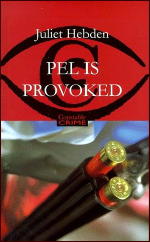
Pel Is Provoked (n.) Constable 1999 [France]

MARK HEBDEN Inspector Pel

Pel and the Death of the Detective (n.) Constable 2000 [France]
Pel and the Butchers’ Blades (2001)
Pel and the Nickname Game (2002)

FIRST YOU READ, THEN YOU WRITE
by Francis M. Nevins


   It’s official, gang. I’ve just signed a contract with Perfect Crime Books for the publication of — how shall I describe it? It may not be quite as hefty as my book on Cornell Woolrich, whose title I adapted for the titles of these columns, but it will certainly qualify as a literary doorstop.
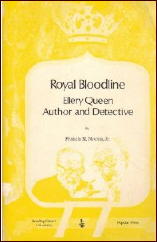
ELLERY QUEEN Royal Bloodline

   Back in the 1980s I wanted my Woolrich book to answer almost any imaginable question about the haunted recluse I’ve called the Hitchcock of the written word. Now as I slipslide into senility I want my new book to be just as comprehensive about the two first cousins from Brooklyn who wrote some of the most complex and involuted detective novels of the genre’s golden age.

   Are you familiar with everything bagels? This tome will be, I hope, the Everything Book on Frederic Dannay and Manfred B. Lee. Its tentative title is Ellery Queen: The Art of Detection.

   I think I heard a question from cyberspace. “Hey, didn’t you do that book already, back in the Watergate era?” Well, sort of. But as I got older I became convinced that I hadn’t done all that good a job.

   Fred Dannay was the public face of Ellery Queen, and in the years after we met he became the closest to a grandfather I’ve ever known, but I never really got to know the much more private Manny Lee. He and I had exchanged a few letters, and we met briefly at the Edgars dinner in 1970, but he died before we could meet again.

   Because of his untimely death Royal Bloodline inadvertently gave the impression that “Ellery Queen” meant 90% Fred Dannay. One of the most important items on my personal bucket list was to do justice to Manny.

   Thanks largely to the memoirs published by his son Rand Lee, and to the Dannay-Lee correspondence (in Blood Relations, published early this year by the same Perfect Crime Books that will issue The Art of Detection), and to the correspondence between Manny and Anthony Boucher, which is archived at Indiana University’s Lilly Library, I’ve come to a much clearer understanding of Manny, of who he was and how he lived and worked and thought.

   The Art of Detection improves on Royal Bloodline in all sorts of ways but for me this one is the most important. In addition it provides much more detail on subjects like the EQ radio series (1939-48) and the decades-long interaction between the cousins and Boucher.

   And of course it covers all sorts of subjects that postdate the early 1970s, like the EQ TV series with Jim Hutton, and Fred’s third marriage and last years and death. And there will be a number of photographs never seen before.

   When I first discovered the Ellery Queen novels, that byline was a household name. It still was when I first met Fred Dannay. I can’t believe that in my lifetime the Queen name has (except in Japan) been so completely forgotten. Maybe, just maybe, with the publication of Blood Relations this year, and of my book next year, and of Jeffrey Marks’ biography-in-progress two or three years from now, I’ll live to see the return of Ellery Queen to the public eye.

***

   On June 5, at age 91, Ray Bradbury died. In his own field he was and will remain a giant. As far as I can determine, among the hundreds of authors whose work Anthony Boucher reviewed in the San Francisco Chronicle during and for a while after World War II, he was the last one standing.
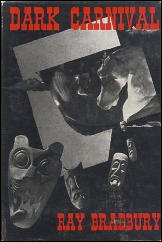
RAY BRADBURY Mystery pulps

   Reviewing Bradbury’s Dark Carnival collection in his Chronicle column for June 22, 1947, Boucher called the author “the most fascinating and individual talent to appear in the fantasy field for a long time….[T]here’s no telling what may come of this still very young man.”

   During his early and middle twenties Bradbury also wrote stories for crime pulps like New Detective, Dime Mystery and Detective Tales. Was Boucher familiar with them?

   â€œFor years,” he wrote in his Dark Carnival review, “I have been prowling newsstands and buying any magazine with a Ray Bradbury story.” Observe that that sentence isn’t limited to fantasy-horror magazines.

   In any event Boucher was long dead by the time Bradbury’s earliest crime tales were collected in the paperback original A Memory of Murder (Dell, 1984). We know that Bradbury was a great admirer of Cornell Woolrich, and he may well have been the first writer for whose short crime fiction Woolrich was the model and polestar.

   Woolrich never once used a series character. After two tales about a character called the Douser — for my money the weakest of the fifteen in the collection — Bradbury followed that lead. He never approached Woolrich’s mastery of pure edge-of-the-chair suspense but, for a kid in his middle twenties, did a noble job creating noir atmosphere Woolrich style.

   The more you’re at home in Woolrich, the more you feel a sense of deja vu when you read Bradbury’s stories. “Yesterday I Lived!” (Flynn’s Detective Fiction, August 1944) echoes Woolrich’s “Preview of Death” (Dime Detective, November 15, 1934; collected in Darkness at Dawn, 1985) in the sense that both are about a Hollywood plainclothesman of low rank investigating the death of a lovely actress while she’s filming a scene:
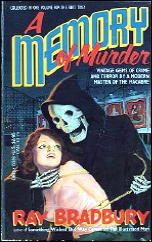
RAY BRADBURY

   â€œHe went out into the rain. It beat cold on him… Cleve clenched his jaw and looked straight up at the sky and let the night cry on him, all over him, soaking him through and through; in perfect harmony, the night and he and the crying dark.”

   In that paragraph and countless others in these stories, it’s obvious whom Bradbury is channeling.

   Sometimes Bradbury offers his own take on a Woolrich springboard situation, for example in “It Burns Me Up!” (Dime Mystery, November 1944), which tracks Woolrich’s “If the Dead Could Talk” (Black Mask, February 1943; collected in Dead Man’s Blues, 1947) in that each is narrated in first person by a corpse.

   Sometimes there’s an echo even in the titles, for example “Wake for the Living” (Dime Mystery, September 1947), which evokes Woolrich’s classic “Graves for the Living” (Dime Mystery, June 1937; collected in Nightwebs, 1971).

   Bradbury’s prose tends to be more shrill and lurid than Woolrich’s, and pockmarked with exclamation points — even in the titles! — as Woolrich’s never was, but the influence is crystal clear.

   In his introduction to A Memory of Murder, Bradbury was quite modest about his contribution to our genre:

   â€œI floundered, I thrashed, sometimes I lost, sometimes I won. But I was trying … I hope you will judge kindly, and let me off easy.”

   This old jurist has done just that, and urges others who reread these stories to bang their gavels softly.

***

   â€œSweet, dear, impossible man. I wonder who he’s making love to now. I wish it were me. I have the education and breeding to appreciate a gentleman like he is.”

   No one seems to have guessed who wrote those ludicrous lines, supposedly from the viewpoint of an educated woman, that I quoted in my last column.

   Maybe that’s because in a sense I was trying to mislead. The malapropisms from Keeler, Avallone, John Ball, William Ard and myself were false clues in the Carr-Christie-Queen manner, playing completely fair with the reader but designed to give the impression that the sixth quotation was by a sixth person.

   In fact it wasn’t. The perp, as at least one reader should have figured out, was the ineffable Avallone. Here’s another from the same inexhaustible cornucopia:

   â€œWolfman Dakota, born of an Apache mother and a Texan rancher, with bronze skin and hot blood in his veins … killed with a weapon unique in crime-land circles. A blowgun filled with poison-tipped darts. A leftover from his Apache heritage….”

   Ah yes, who can forget the climax of Stagecoach, with those damn red savages chasing the coach across the salt flats, blowing their poison darts at the Duke and Claire Trevor and all the other passengers?

THE BACKWARD REVIEWER
William F. Deeck


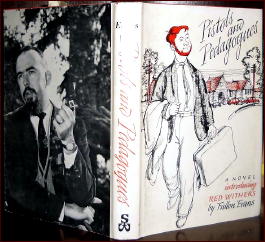
FALLON EVANS – Pistols and Pedagogues. Sheed & Ward, hardcover, 1963.

FALLON EVANS Pistols and Pedagogues

   A placid town, at least on the surface, is Stratford, home of Saint Felicitas, a small Catholic college for girls. About the biggest thing that has happened there is the recent ostensible elopement of a professor with one of the students, the daughter of a Chicago gangster.

   Into this placidity comes Red Withers, professional student and sponger. Withers has been invited to temporarily give up racking balls in a billiard parlor and lecture on James Whitcomb Riley at the college.

   The invitation has come about through the good offices of a friend, who should have known better. The lecture doesn’t go well, though the reader will enjoy it, Withers is mistaken for the eloping professor by the gangster and for a flasher by the police, finds himself under attack by all sides, discovers a murder, and has to clean up the town’s drug element.

   Withers is five foot three in his elevator shoes, when he has them. He also has a scraggly red beard, without which he looks like a wizened juvenile. People think that he is trying to conceal something with the beard, and he is: all that wizen.

   This is an amusing picaresque novel, with a rogue who does not laugh in the face of death but who can joke about it afterwards. [Hubin says the setting is Chicago, but Stratford is half a day’s journey from Chicago by train.]

— From The MYSTERY FANcier, Vol. 11, No. 1, Winter 1989.


Bibliographic Data:   This is my nominee (so far) for the most obscure detective novel to be reviewed on this blog this month. It was the author’s only work of detective fiction. Evans’ other novel, The Trouble with Turlow (Doubleday, 1961), is described by one online bookseller as “A light-hearted spoof on life and the education system.”

   If this might lead you to believe that Evans real-llife profession was in the realm of academia, you would in all likelihood be correct. A “Fallon Evans” was the editor of the Twentieth Century Literature: a Scholarly and Critical Journal in the late 1960s and early 70s. Although the online WhitePages site finds 13 Fallon Evans in the US, the name is still relatively uncommon, and one can easily assume the two to be one and the same. [Perhaps the Fallon Evans described on one website as being “a professor of English at Loyola Marymount University” in the mid-1980s.]

   Also note that Hubin’s current edition of Crime Fiction IV has updated the setting of the novel to Illinois.

« Previous PageNext Page »