Authors


REVIEWED BY BARRY GARDNER:


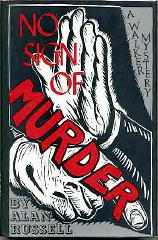
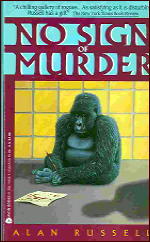
ALAN RUSSELL – No Sign of Murder. Stuart Winter #1. Avon, paperback reprint, 1993. First published by Walker & Co., hardcover, 1990.

ALAN RUSSELL No Sign of Murder

   I read this out of the library when it came out in 1990. It says something about my memory and the number of mysteries I was reading that I didn’t begin to remember pieces of it until and a number of pages into my re-reading.

   Stuart Winter is a San Francisco PI, fallen from the lofty heights of the financial community (and marriage to the daughter of one of its big shots) because of his integrity. He’s a bird-watcher and a Scotch drinker, and describes himself as a “cleaner.”

   He is hired by an Oakland socialite to find her deaf daughter, who has been missing now for six months. The family was not a close one, but the mother is convinced she would have heard from her if she was all right. Winter warms her that investigations often turn up unpleasant truths, but she hires him anyway.

ALAN RUSSELL No Sign of Murder

   I liked the book, and the character, quite a bit/ The supporting cast, including a quirky psychiatrist friend of Winter’s, a deaf friend of the missing girl, and the very interesting voice of Winter’s answering service, were nicely done. The portrait of the missing girl was also very finely drawn.

   Russell writes well, and tells a good story. I didn’t believe, however, in the characterization of the murderer, and there was fillip at the end that I found both unpalatable and unnecessary.

   All told, this was a good book, and Winter a worthy member of the PI ranks. I’m going to hunt up the second in the series, which I don’t think I’ve read. I wouldn’t bet any huge amount on it, though.

— Reprinted from Ah, Sweet Mysteries #8, July 1993.


Bibliographic Data:   Stuart Winter’s second case was The Forest Prime Evil (Walker, 1992), but that was the end of his career, as far its having been recorded in book form. Russell also wrote two mysteries in a followup series about Am Caulfield, a former surfer turned hotel detective, then four standalone psychological thrillers and suspense novels.

THE BACKWARD REVIEWER
William F. Deeck


HUGH HOLMAN John Macready

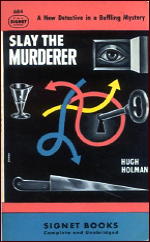
  HUGH HOLMAN. Slay the Murderer. M. S. Mill Co., hardcover, 1946. Signet #684, paperback, 1948.

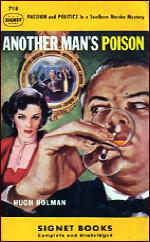
    — Another Man’s Poison. M. S. Mill Co., hardcover, 1947; Signet #718, paperback, 1949.

   Apparently the third book in the series featuring Sheriff John Macready of Hart County, South Carolina, Slay the Murderer finds the sheriff in something of a bind. Election Day is only two days off, and a prominent citizen is discovered stabbed and poisoned in a locked room.

   The killer ought to be obvious, since he, too, is in the locked room, but Macready is considerably more than just a hick sheriff — though he wouldn’t want the voters to know that — and he finds contradictory evidence.

HUGH HOLMAN John Macready

   Still, if Macready doesn’t arrest the obvious person or doesn’t find out who did indeed do it and how, his re-election to a fairly cushy job that he usually enjoys is doubtful.

   In the later Another Man’s Poison, Macready leaves his county to complain to a politician about the appointment of an inept postmaster. Before he can talk to him, the politician drinks one of his own special cocktails and dies of poison.

   Macready is a witness, and there seems to be no way that the drink could have been poisoned by anyone. Also, it can’t be certain that the politician was the target of the poisoner, for he had taken the glass from someone else. Macready is glad it’s someone else’s problem until the murderer attacks him.

   Two excellent mysteries with an appealing lead character.

— From The MYSTERY FANcier, Vol. 11, No. 1, Winter 1989.


       The Sheriff John Macready series —

Trout in the Milk. Mill, 1945.
Up This Crooked Way. Mill, 1946.
Slay the Murderer. Mill, 1946.
Another Man’s Poison. Mill, 1947.

   Hugh Holman (1914-1981) was the author of two other mysteries: Death Like Thunder (Phoenix, 1942) and as Clarence Hunt, Small Town Corpse (Phoenix, 1951).

   Holman, however, was more than a writer of better than average detective novels, using Bill’s review as a basis for that statement. From http://museum.unc.edu:

    “In 1946, he entered graduate school at the University of North Carolina, where he received his doctorate with a dissertation on William Gilmore Simms. He joined the UNC English department and taught there until his retirement. He served as department chair, acting dean of the College of Arts and Sciences, dean of the graduate school, provost, and special assistant to the chancellor. From 1957 to 1973, he served as chair of the Board of Governors of the University of North Carolina Press. Holman was the recipient of a Simon Guggenheim Fellowship (1967), the Thomas Jefferson Award (1975), and the Oliver Max Gardner Award (1977). He was a fellow of the American Academy of Arts and Sciences and a founding editor of the Southern Literary Journal.”

MURDER AD-LIB — Interviews by Ellen Nehr:
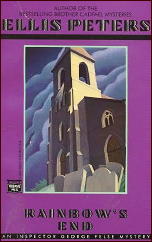
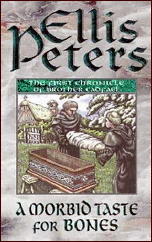
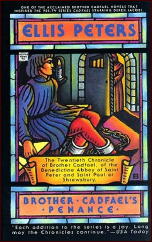
EDITH PARGETER (ELLIS PETERS), Summer 1991.


EN: When you wrote the first Brother Cadfael mystery, did you plan on making it a series?

ELLIS PETERS Interview

EP: Not at all. In fact, the first one was written in a slightly different style, a little lighter, and was conceived as a one off. I hadn’t intended for it go ahead. Indeed I wrote one modern tale between the first and second Brother Cadfael novels, but that’s the last time I’ve been back from the 12th Century.

EN: Will you ever do another Inspector Felse?

EP: I’d like to in a way, but somehow this series has gotten into a rhythm and keeps flowing, so it carries me from one book to the next, and it would be difficult to break the chain. Maybe some day I will.

EN: When you started the Inspector Felse series, you and Michael Innes were the only two who mentioned the home life and family of the officer. What kind of research into police practice did you have to do?

EP: I had to research into police procedures to some extent, but I must confess I was more interested in the family relations and the police officer’s relationships with the people be encounters in the case, which sometimes become personal in a way, and make the whole thing more interesting, I think.

EN: You have used archaeology in some quite unexpected places. Was this deliberate?

ELLIS PETERS Interview

EP: Not really. I suppose that I was just interested, and it became a natural thing to make use of it. There’s the one about the Roman Site (The City of Gold and Shadows) that isn’t a photocopy of but certainly is based on Uriconium.

   That’s very close, about three miles, from Shrewsb1ry where there was a ford of the river on a Roman road. We have quite a bit of an ancient city there, which suggested the site of the book.

EN: Could the water have come up and been doing the damage to the bank that disclosed the heating pipes?

EP: Yes, it could, because it is right on the Severn River, and in a flood time it certainly could. Even the inn which I’ve described there is suggested by one just a bit down the river from there.

EN: Have you always lived in that area?

EP: Yes. Within about three miles of where I live now, apart from traveling, of course.

EN: Do you speak Welsh?

EP: No, very little. Quite a lot of Welsh don’t speak it, I’m afraid. It is being taught more again, especial]y in the south, the parts that became industrialized. Welsh is less spoken than it used to be. My grandmother spoke it, but I never learned it properly.

ELLIS PETERS Interview

EN: If you had been brought up in another part of Great Britain, how different do you suppose your books would have been?

EP: I think they would have been affected by my surroundings. My writing is extremely visual. It is definitely based on where I am, since I’m describing pictures I can see in my own mind from around me.

EN: Over a period of time have you accumulated an extensive reference library?

EP: Yes, I have quite a big library because if there is a book that I want to use, I like to have it in the house to go back to. Usually, since I was born here, I’ve accumulated knowledge about the region, being interested in history. A lot of it has been historical and archaeological interest.

EN: Now that you are a well-known resident of Shrewsbury, do you find that people are bringing to your attention things that you might have had to research on your own?

EP: Yes, indeed they are. One expert actually came with his own wife to visit me and taught me to make fire. He brought flint, steel, and all the makings, and he left me flints and tinder, although charred cloth would catch.

ELLIS PETERS Interview

EN: In The Heretic’s Apprentice you described just how parchment was made. I was fascinated.

EP: Well, I got that out of a history of illuminated manuscripts. Some of the descriptions of the book and the timing of the book came from the same history. There isn’t such a gift book as I’ve described, but that wedding did take place, and the people were real; the Prince from the western empire and Princess from the East did marry that year, and there could have been a present such as that.

EN: I just finished your new book, The Summer of the Danes, and wondered why the Danes lived in Ireland.

EP: They had a small kingdom in Dublin, on and off. Sometimes they lost it; sometimes they got it back again. This all happened over a matter of a hundred years or so. They left a lot of their progeny there, and there was quite a bit of intermarriage. It’s mentioned in the book that 0wain’ s grandmother was a Danish princess.

ELLIS PETERS Interview

EN: How and when did the war between King Stephen and Queen Maud finally get settled?

EP: I hope the books may even reach that point. Everyone was exhausted with the war and fed up with it, and from the point that I’ve reached, action actually began to slacken off very much. Each side was just holding on to what it had, and eventually Stephen’s eldest son, whom he hoped would succeed him, died. That left the way rather clearer, and a lot of his own supporters began to think, “We’ve got to settle this somehow.”

   Eventually an agreement was made that Maud’s son, who became the young Henry II, should succeed to the throne, but only when Stephen died. From that time on, there was peace, but Henry II had quite a bit clearing up to do. Stephen died in 1154, and that is ten years further on from where we are now.

EN: When you finish the 12th century books that we are reading in the 20th century and know who did it and why, do you, in your mind, interpret justice as it was then in their context of right or wrong, or as the way we perceive it today?

ELLIS PETERS Interview

EP: Well, this I think is essentially the difference between secular sense of justice and the law; between the law and justice in fact and justice tempered with mercy. The Church had the privilege of tempering the secular justice, but I don’t say they did it often, by any means.

   Cadfael doesn’t take the law’s exact point of view. He makes up his own mind on what is for the best, as he did in one case where he let a murderer go away, but having laid on him the penance of remembering life long and acting differently.

   So he got his own way. It’s not secular justice, and it’s a theme I’ve taken up in other books, the conflict between the human sense of justice and what’s dictated by the law. It’s a big question.

EN: Are you a Roman Catholic?

EP: No, I’m an Anglican, but then we were all Roman Catholics, so I’ve tried to project myself.

EN: What do the Benedictines think of the books?

   EP: I have quite a number of Benedictine correspondents and even a lot of clerics and a lot of historians, and on the whole, they very much approve. And they approve of what you’ve touched on, this sense of human compassion coming into the question of justice. They’ve been a great help to me, and they’ve given me great encouragement.

— Reprinted from Mystery*File 31,
       September 1991.


[UPDATE] 06-23-12. Ellis Peters wrote 13 books in her Inspector Felse series; the last one appeared in 1978. She also wrote 20 books in which Brother Cadfael appeared, two of them after this interview took place. Both she and and my good friend Ellen Nehr died in 1995.

PULP AUTHOR CHARLES W. TYLER,
by Victor A. Berch

   
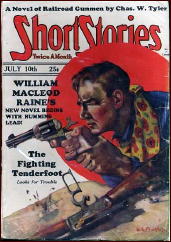
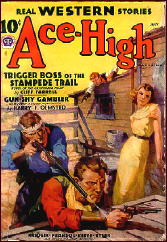
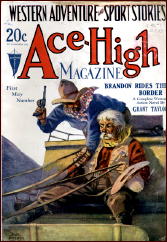
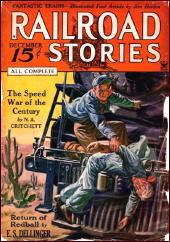
   Charles W. Tyler was perhaps the most prolific pulp writer you never heard of. He was the author of 100s of novelettes and short stories, in all genres, many of which are listed below. He wrote detective stories, adventure stories, railroad stories and westerns, but except to a small handful of enthusiasts, his name is no longer known today.

   He is the author of two titles included in Crime Fiction IV, by Allen J. Hubin:

            Blue Jean Billy (Chelsea, 1926, hc)
            Quality Bill’s Girl (Chelsea, 1925, hc)

   The second of these is described as being “three novelets presented as a novel.” Since Tyler wrote six “Blue Jean Billy” stories that appeared in Detective Story Magazine (see below), a strong conjecture would be that Quality Bill’s Girl contains the first three, and Blue Jean Billy contains the final three.

   Tyler’s two most prominent series characters in the detective pulps were Big-Nose Charley and Blue Jean Billy Race. Here are descriptions of both, as excerpted from the online website The Pulp Heroes, by Jess Nevins. (Follow the link for more.)

    Big-Nose Charley was created by Charles W. Tyler […] appeared in a number of stories, starting with “Big-Nose Charley’s Get Away,” in the 5 April 1917 issue of Detective Story Magazine. […] Charley is a thief who, though occasionally relying on the more artistic forms of crime such as mail fraud, customarily uses strong-arm tactics to get his swag. […] [W]hat kept Big-Nose Charley going for so many years, and what makes his stories remembered fondly today, is the humor within them. The Big-Nose Charley stories are humorous, and meant to be, poking fun of themselves as well as at the genre.

   and

    Blue Jean Billy Race, the “highway woman of the sea,” was the creation of Charles W. Tyler, a fireman, magazine writer, and draftsman [..] Billy appeared in Detective Story Magazine beginning in “Raggedy Ann” on March 26, 1918 […] [Her father] raised Billy to hate society and its hypocrites and hypocrisies […] Billy is a thief and a pirate, stealing aboard ships to rob the owners and passengers at gunpoint and then slipping over the side and disappearing into the night. She’s not just a thief, though; she’s a thief taking revenge on the evil rich, those liars and cheats who rob from and swindle the poor.

   
   Tyler’s entry in the Crime, Mystery & Gangster Fiction Magazine Index, 1915-2010, compiled by Phil Stephenson-Payne, William G. Contento & Stephen T. Miller (2010), mentions only that he flourished from 1917-1935.

   He is also found in the online FictionMags Index, where no dates are given for birth and death, but it is noted that he was born in North Hinsdale, MA and that he should not be confused with Charles Waller Tyler nor Charles Willis Tyler.

   In Allen J. Hubin’s massive bibliography Crime Fiction Bibliography, 1700-2000, it is stated he was born in Massachusetts, was a fireman, magazine writer and draftsman.

   Armed with these bits of information, I set out to see what I could unearth through my subscription to the databases held by the New England Historic Genealogical Society to determine what information it might have on a Charles W. Tyler, born in Massachusetts prior to 1915 and born in Hinsdale (or North Hinsdale) Massachusetts.

   It was only a matter of seconds to learn that no Charles W. Tyler showed up in the Society’s databases.

   What was my next step to be?

   Having a world-wide subscription to Ancestry.com’s databases, I knew that that was to be my next avenue of research to see what that might produce.

   There were loads of Charles W. Tylers, but one that caught my attention was a Charles W. Tyler who lived in Quincy, MA and was described as a novelist in the city directories for 1918 and 1920.

   Poking his name into the US Census records from 1900 on up, I was taken by surprise at the entry of a Charles W. Tyler, born 1887 in Hinsdale, New Hampshire. Could it be that there were two Hinsdales? One in Massachusetts and one in New Hampshire and somehow the compilers of the Fictionmags Index and Allen J Hubin’s CFIV had mistakenly assigned the birthplace of Charles W. Tyler to Massachusetts.

   To verify this supposition, I turned to Wikipedia and sure enough, it verified that there was a Hinsdale, Massachusetts and a Hinsdale, New Hampshire,

   Hinsdale, Massachusetts is in Berkshire County, Massachusetts and is part of the Pittsfield, Massachusetts, statistical area. While Hinsdale, New Hampshire is in Cheshire County, New Hampshire, south of Brattleboro VT near the Pisgah State Park at the border of New Hampshire and Massachusetts.

   So, once again I turned to my Ancestry subscription. From previous searches on Ancestry, I knew that someone born in the 1880s had to register for the draft of World War I and I began to explore what might be in that particular database. I entered the name Charles W. Tyler and birthplace New Hampshire and up came Charles Warren Tyler, born 1887 in Hinsdale, New Hampshire and living in Quincy, Massachusetts.

   The clinching piece of data was that he described himself as a writer for the Frank Munsey Company in New York. However, his birth date was given as September 1, 1888. Why Mr. Tyler chose to make himself a year younger is anyone’s guess. But it was not an unusual practice, especially with women and oft times men in the public’s eye.

   Now, one of the great features of the Ancestry database is that it will suggest other of its databases to examine that relate to this person.

   So, in the 1900 US Census, it showed Charles W. Tyler, age 12, born 1887, living in Hinsdale, New Hampshire, living with his mother, Clara, a widow.

   In the 1910 Census, Charles W. Tyler, age 22, is shown living at No. 18 George St., Boston, MA as a boarder. His occupation, an artist with a general practice. (This seems to concur with Hubin’s description of him being a draftsman.)

   For some reason, he does not show up in the 1920 Census. But in the 1930 Census, Charles W. Tyler, age 42, born in New Hampshire, is living in Glendale, California with his wife, Alice. His occupation is listed as a fiction writer.

   And finally, the California Death Index shows that Charles Warren Tyler was born September 1, 1887 in New Hampshire and died April 3, 1952 in Los Angeles County, of which Glendale was a part. His mother’s maiden name was listed as Smith.

   In the book A History of the Doggett/Daggett Family, it states that his mother, Clara Smith, was born in Boston Jan. 17, 1850 and had married Olcott B. Tyler of Hinsdale, NH. Their offspring was Charles Warren Tyler.

   As an added bit of information, his story “Raggedy Ann,” which had appeared as a short story in Detective Story Magazine, March 26, 1918 was the basis for the silent film The Exquisite Thief, scenario by Harvey Gates and directed by Todd Browning. 6 reels and copyrighted April 4, 1919.

       Short fiction [crime and detective stories only]

TYLER, CHARLES W. BNC = Big-Nose Charley; BJB = Blue Jean Billy.

* At Milepost 92, (na) Detective Story Magazine Apr 13 1920
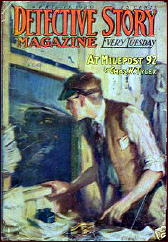
CHARLES W. TYLER

* Big-Nose Charley and Any Old Port [BNC], (ss) Detective Story Magazine Nov 18 1919
* Big-Nose Charley and Deuces Low [BNC], (ss) Detective Story Magazine Apr 6 1920
* Big-Nose Charley and His Jenny [BNC], (ss) Detective Story Magazine Apr 17 1926
* Big-Nose Charley and Human Clay [BNC], (ss) Detective Story Magazine Sep 2 1919
* Big-Nose Charley and Madeyline [BNC], (ss) Detective Story Magazine Aug 15 1925
* Big-Nose Charley and the Double Cross [BNC], (ss) Detective Story Magazine Aug 17 1920
* Big-Nose Charley and the Merry Widow [BNC], (ss) Detective Story Magazine Jun 11 1927
* Big-Nose Charley and the Promised Land [BNC], (ss) Detective Story Magazine Feb 24 1920
* Big-Nose Charley and the Simple Life [BNC], (ss) Detective Story Magazine Oct 2 1917
* Big-Nose Charley and the Tout [BNC], (ss) Detective Story Magazine Oct 14 1922
* Big-Nose Charley at Home [BNC], (ss) Detective Story Magazine Dec 16 1919
* Big-Nose Charley at the Auto Show [BNC], (ss) Detective Story Magazine Jun 4 1921
* Big-Nose Charley at the Opera [BNC], (ss) Detective Story Magazine Feb 13 1926
* Big-Nose Charley at the Policemen’s Ball [BNC], (ss) Detective Story Magazine Apr 16 1921
* Big-Nose Charley at the Races [BNC], (ss) Street & Smith’s Detective Story Magazine Nov 21 1931
* Big-Nose Charley Enters the City of Angels [BNC], (ss) Detective Story Magazine Mar 8 1924
* Big-Nose Charley Finds a Brother [BNC], (ss) Detective Story Magazine Sep 5 1925
* Big-Nose Charley Gets an Interview [BNC], (ss) Detective Story Magazine Dec 10 1921
* Big-Nose Charley Gets His Match [BNC], (ss) Detective Story Magazine Feb 24 1923
* Big-Nose Charley Hops Off [BNC], (ss) Detective Story Magazine Mar 28 1925
* Big-Nose Charley in New Orleans [BNC], (ss) Detective Story Magazine Jul 20 1929
* Big-Nose Charley in the City of Culture [BNC], (ss) Detective Story Magazine Jan 22 1921
* Big-Nose Charley in the Magic City [BNC], (ss) Detective Story Magazine Jun 9 1928
* Big-Nose Charley Leaves His Card [BNC], (ss) Detective Story Magazine Oct 24 1925
* Big-Nose Charley Lends a Hand [BNC], (ss) Street & Smith’s Detective Story Magazine Mar 25 1935
* Big-Nose Charley Meets Some Home Folks [BNC], (ss) Detective Story Magazine Jun 21 1924
* Big-Nose Charley on the Barbary Coast [BNC], (ss) Detective Story Magazine Apr 1 1922
* Big-Nose Charley on the Mt. Division [BNC], (ss) Detective Story Magazine Dec 25 1917
* Big-Nose Charley on the Painted Plain [BNC], (ss) Detective Story Magazine Oct 25 1924
* Big-Nose Charley Rolls His Own [BNC], (ss) Detective Story Magazine Mar 25 1919
* Big-Nose Charley Sits in the World [BNC], (ss) Detective Story Magazine May 5 1923
* Big-Nose Charley Works Alone [BNC], (ss) Detective Story Magazine Sep 11 1917
* Big-Nose Charley, Alias Santa Claus [BNC], (ss) Detective Story Magazine Dec 20 1924
* Big-Nose Charley, Bad Man [BNC], (ss) Detective Story Magazine Jan 29 1918
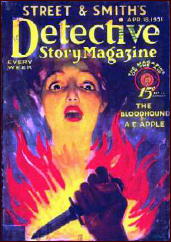
* Big-Nose Charley, Gentlemun [BNC], (ss) Street & Smith’s Detective Story Magazine Apr 18 1931
CHARLES W. TYLER

* Big-Nose Charley, Goober Grabber [BNC], (ss) Detective Story Magazine Jan 7 1928
* Big-Nose Charley, Hijacker [BNC], (ss) Detective Story Magazine Oct 11 1924
* Big-Nose Charley, On the Cross [BNC], (ss) Detective Story Magazine Apr 16 1918
* Big-Nose Charley, Racketeer [BNC], (ss) Street & Smith’s Detective Story Magazine Aug 15 1931
* Big-Nose Charley’s Color Blind [BNC], (ss) Detective Story Magazine Jan 21 1928
* Big-Nose Charley’s Derby Hat [BNC], (ss) Street & Smith’s Detective Story Magazine Jul 10 1934
* Big-Nose Charley’s Dog Helps Out [BNC], (ss) Detective Story Magazine Aug 27 1921
* Big-Nose Charley’s Florida Front [BNC], (ss) Detective Story Magazine Mar 24 1928
* Big-Nose Charley’s Get-Away [BNC], (ss) Detective Story Magazine Apr 5 1917
* Big-Nose Charley’s Ha-Ha [BNC], (ss) Detective Story Magazine Jan 10 1931
* Big-Nose Charley’s Safe [BNC], (ss) Street & Smith’s Detective Story Magazine Feb 13 1932
* Big-Nose Charley’s Trick Umbrella [BNC], (ss) Street & Smith’s Detective Story Magazine Jul 25 1935
* Blue Jean Billy and the Lone Survivor [BJB], (ss) Detective Story Magazine Aug 22 1925
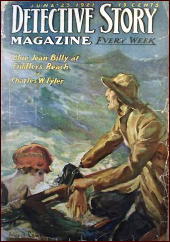
* Blue Jean Billy at Fiddler’s Reach [BJB], (nv) Detective Story Magazine Jun 25 1921
CHARLES W. TYLER

* Blue Jean Billy Plays Fair [BJB], (ss) Detective Story Magazine Jan 18 1930
* Blue Jean Billy, Sky Pirate [BJB], (nv) Detective Story Magazine Apr 4 1925; Best Detective Magazine Mar 1937
* Blue Jean Billy, Waif of the Sea [BJB], (ss) Detective Story Magazine Nov 6 1926
* Cold-Hands Kate, (ss) Detective Story Magazine Apr 15 1919
* Dim Trails [Railroad Detective], (na) Detective Story Magazine Feb 19 1921
* The Dub at Eagle Bridge, (ss) Detective Story Magazine Oct 12 1920
* Echo Bowl, (ss) Detective Story Magazine Nov 6 1917
* Expensive Cigarettes, (nv) Detective Story Magazine Oct 26 1920
* Fair Pickin’s, (ss) Detective Story Magazine Nov 3 1928
* Fate Snaps the Shutter, (ss) Detective Story Magazine Jul 15 1922
Best Detective Magazine Feb 1931
* The Foothill Tiger, (ss) Detective Story Magazine Oct 31 1925
* The Green Mask, (nv) Detective Story Magazine Jun 19 1926
* The Haunt of Raggedy Arm, (ss) Detective Story Magazine Oct 7 1919
* The Haunted House on Dungeon Road, (na) Detective Story Magazine Jul 6 1920
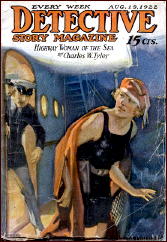
* Highway Woman of the Sea [BJB], (na) Detective Story Magazine Aug 19 1922
CHARLES W. TYLER

* Hounded by Habit, (ss) Detective Story Magazine Jul 30 1921
Best Detective Magazine Oct 1933
* In Hungry Man’s Canon, (ss) Detective Story Magazine Sep 17 1918
* It Was Signed “Bill”, (ss) Detective Story Magazine Jun 8 1920
Best Detective Magazine Apr 1933
* Jimmy the Quilt, (ss) Detective Story Magazine Apr 30 1921
Best Detective Magazine Aug 1934
* Judy’s Touch, (ss) Street & Smith’s Detective Story Magazine Oct 17 1931
* A Kiss for Big-Nose Charley [BNC], (ss) Street & Smith’s Detective Story Magazine Oct 25 1934
* Landlubbers, (ss) Detective Story Magazine Apr 8 1922
* Lon Durgin’s Honor System, (ss) Detective Story Magazine Oct 19 1920
* Look Out!, (ss) Detective Story Magazine Apr 7 1928
* Loose Ends, (ss) Detective Story Magazine Apr 9 1918
* The Loot of the Overland, (ss) Detective Story Magazine Apr 20 1917
* The Lying Signal, (ss) Detective Story Magazine Apr 30 1927
* Mountain Misery, (ss) Detective Story Magazine Aug 16 1924
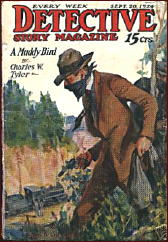
* A Muddy Bird, (nv) Detective Story Magazine Sep 20 1924
CHARLES W. TYLER

* Nix’s Mate [BJB], (ss) Detective Story Magazine Mar 11 1919
* On the Right Side of the Wrong Street, (ss) Detective Story Magazine May 14 1921
* The Pal in the Pullman, (nv) Detective Story Magazine Nov 29 1924
* Pat Brady — Flatfoot, (ss) Street & Smith’s Detective Story Magazine May 10 1933
* Phantoms of Wolf River, (ss) Detective Story Magazine Oct 29 1918
* Raggedy Ann, (ss) Detective Story Magazine Mar 26 1918
* Raiders from Raggedy Ann, (ss) Detective Story Magazine Jul 16 1918
* Raw Silk, (ss) Detective Story Magazine Dec 2 1919
* Sea Law and Blue Jean Billy [BJB], (nv) Street & Smith’s Detective Story Magazine Nov 14 1931
* Second No. 12, (na) Detective Story Magazine Aug 31 1920
* 77 and a Wink, (ss) Detective Story Magazine Feb 26 1921; Best Detective Magazine Jul 1934
* Shattered Evidence [Railroad Detective], (ss) Detective Story Magazine May 27 1919
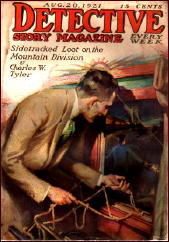
* Sidetracked Loot on the Mountain Division, (na) Detective Story Magazine Aug 20 1921
CHARLES W. TYLER

* The Slicker Bandit, (ss) Detective Story Magazine Jan 23 1926
* Stormy Petrel, (ss) Detective Story Magazine Jan 10 1925
* There Were No Clews, (ss) Detective Story Magazine Mar 23 1920; Best Detective Magazine Aug 1932
* The Third Thirteen, (ss) Detective Story Magazine Apr 27 1920
* Too Soft, (ss) Detective Story Magazine Feb 18 1928
* Tramps—Hoboes—Bums, (ss) Detective Story Magazine Apr 25 1925
* Unlucky Luke McCloskey, Gun, (ss) Detective Story Magazine Jun 25 1918
* The Wrong Sucker, (ss) Street & Smith’s Detective Story Magazine Sep 10 1934

ss = short story; nv = novelette; na = novella.

      Short fiction [everything else; likely incomplete]

TYLER, CHARLES W. Born in North Hinsdale, Massachusetts; not to be confused with Charles Waller Tyler (1841-1920) or with Charles Willis Tyler (1857-1922)

* The Angel of Canyon Pass, (ss) Railroad Stories Apr 1936; Railroad Magazine Feb 1973
CHARLES W. TYLER

* At Five Paces, (ss) Western Story Magazine Apr 29 1922; Far West Stories Aug 1930
* Back on the Main, (ss) Railroad Man’s Magazine Dec 1931; Railroad Magazine Oct 1964
* Bad Men of Old Hat, (ss) Western Story Magazine Jun 21 1924
* Baldy Sours [Baldy Sours], (ss) Quick Trigger Stories of the West Apr 1930
* Baldy Sours and a Cock-Eyed Cupid [Baldy Sours], (ss) West Jan 8 1930
* Baldy Sours and Burning Brands [Baldy Sours], (ss) West Oct 1 1930
* Baldy Sours and Skates Ajar [Baldy Sours], (ss) Short Stories Oct 10 1937
* Baldy Sours and the Chariot Race [Baldy Sours], (ss) Ace-High Magazine Oct #1 1927
* Baldy Sours and the Day of Judgment [Baldy Sours], (ss) West Nov 13 1929
* Baldy Sours and the Firing Squad [Baldy Sours], (ss) Western Trails Jan 1930
* Baldy Sours and the Fountain of Youth [Baldy Sours], (ss) Ace-High Magazine Jul #1 1928
* Baldy Sours and the Golden Fleece [Baldy Sours], (ss) Ace-High Magazine Jan #1 1927
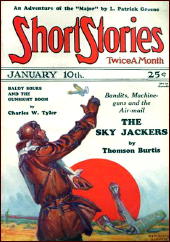
* Baldy Sours and the Gunsight Boom [Baldy Sours], (ss) Short Stories Jan 10 1929
CHARLES W. TYLER

* Baldy Sours and the Human Race [Baldy Sours], (ss) Adventure Mar 1937
* Baldy Sours and the Mexican War [Baldy Sours], (ss) Western Trails Sep-Oct 1929
* Baldy Sours and the Pig Skin Game [Baldy Sours], (ss) Short Stories Apr 25 1929
* Baldy Sours and the Polo Game [Baldy Sours], (ss) Short Stories Jun 25 1935
* Baldy Sours and the Spark of Life [Baldy Sours], (ss) Western Aces Nov 1937
* Baldy Sours and the Tin Horse [Baldy Sours], (ss) Short Stories Dec 25 1934
* Baldy Sours and the Woolly West [Baldy Sours], (ss) Short Stories Apr 25 1937
* Baldy Sours at a Gold Strike [Baldy Sours], (ss) Ace-High Magazine Sep #1 1927
* Baldy Sours Takes the Count [Baldy Sours], (ss) Ace-High Magazine Mar #2 1928; Thrilling Western Magazine Spr 1970
* Baldy Sours, Arabian Knight [Baldy Sours], (ss) Short Stories Nov 25 1928
* Baldy Sours, Bad Man from the West [Baldy Sours], (ss) Quick Trigger Stories of the West Aug/Sep 1930
* Baldy Sours, Badman [Baldy Sours], (ss) Ace-High Magazine Dec #1 1927
* Baldy Sours, Errant Knight [Baldy Sours], (ss) Ace-High Magazine Jun #2 1927
* Baldy Sours, King [Baldy Sours], (ss) Western Adventures May 1931
* Baldy Sours, Promoter [Baldy Sours], (ss) Western Adventures Nov 1931
* Baldy Sours, Rain Maker [Baldy Sours], (ss) Ace-High Magazine May #2 1927
* Baldy Sours, The Late Lamented [Baldy Sours], (ss) Ace-High Magazine Oct #2 1928
* Battle-Call for Johnny Bates, (nv) Star Western Oct 1939
* The Bird That Knew, (ss) Western Story Magazine Feb 3 1923
* The Blue-Dome Mustang, (ss) Ace-High Magazine Jun #2 1923
* The Bo Who Rode No. Two, (ss) Short Stories Sep 25 1929
* The Boothill Parson of Babylon Bend, (nv) Star Western Jan 1944
* Boothill’s Buryin’ Man, (ss) New Western Magazine Dec 1950
* Brand Pirates of the Big Muddy, (nv) Star Western Oct 1941
* The Brand-Blotters Want War!, (nv) Star Western Aug 1942
* Buzzards at Bay, (na) Far West Illustrated Oct 1927
* C-Bar, Grab Your Guns!, (ss) Star Western Jun 1947
* Calico’s “Booty” Contest, (ss) Ace-High Magazine Aug #2 1925
* Cassidy’s Kid, (ss) Short Stories Oct 25 1937
* Clear Iron, (ss) Railroad Stories Feb 1934
* Clear the Iron, (ss) Short Stories Aug 10 1936; Short Stories Apr 1952
* Code of the Morse Man, (ss) Short Stories Nov 10 1947
* The Cop on the Beat, (ss) Short Stories May 10 1934
CHARLES W. TYLER

* The Coronation of Baldy Sours [Baldy Sours], (ss) Ace-High Magazine Aug #2 1926
* The Courtship of Baldy Sours [Baldy Sours], (ss) Ace-High Magazine Sep 18 1926
* Cow-Pirates of the Smoky Trail, (ss) Star Western Sep 1939
* Cowboy Sleuths [Baldy Sours], (ss) Ace-High Magazine Aug #1 1927
* Cowboys Amuck, (ss) Ace-High Magazine May #1 1926
* Cowboys at Stove Pipe, (ss) Ace-High Magazine Mar #2 1926
* Crazy Well [Baldy Sours], (ss) Ace-High Magazine Mar #1 1927
* Crossed Wires at Poverty Bend, (ss) Western Story Magazine Mar 19 1921
* Cut Two Notches, (ss) All Western Magazine Nov 1936
* Dead Man’s Bend, (ss) Short Stories May 10 1936
* Dead Man’s Key, (nv) Short Stories Jul 10 1929
CHARLES W. TYLER

* Derelict Cowman’s Last Stand, (nv) Ace-High Magazine Feb 1938
* The Devil Deals Three Tough Jokers, (ss) Star Western Jul 1947
* Devil Makes a Cowman, (ss) [??] 1939; Fifteen Western Tales Sep 1952
* Diamond Jack of Wyoming, (nv) Western Story Magazine Mar 11 1922
* Double-Breasted Mike, (ss) Railroad Man’s Magazine Dec 7 1918
* Down Sunset Trail, (ss) People’s Magazine Feb 1917
* Down the Smoky Road, (ss) Short Stories Aug 25 1935
* Fast Bullet Man, (na) Fifteen Western Tales Feb 1949
* The Fastest Gun, (nv) Far West Illustrated Apr 1927
* Feud Herd Coming Through!, (nv) Ace-High Magazine Jul 1938
CHARLES W. TYLER

* Fighting Men of the Union Pacific, (nv) Star Western Mar 1942
* A Firin’ Fool, (ss) Short Stories Jul 25 1933
* For the Little Lady, (ss) People’s Magazine May 1917
* Fresh in the West, (ss) Far West Illustrated Nov 1928
* From the Primer of Hate, (ss) Far West Illustrated Magazine Sep 1926
* God of the High Iron, (ss) Railroad Man’s Magazine Mar 1930
* Gun Lord of Poverty Empire, (nv) Star Western Oct 1940
* Gun Rider for the Overland, (ss) 10 Story Western Magazine Nov 1942
* The Gun River Pilgrims, (nv) Star Western Apr 1940
* Gunmen of the Rails, (na) Short Stories Sep 10 1929
* Gunmen of the Rails, (ss) Short Stories Sep 10 1929
* Gunmen’s Trails, (nv) West Mar 2 1932
* Guns of the Graveyard Trick, (na) Short Stories Jul 10 1935
* Gunsmoke Funeral at Yellow Cat, (nv) Star Western Jul 1940
* Hard As Nails, (ss) People’s Favorite Magazine Aug 10 1917
* He Forgot to Pay, (ss) Western Story Magazine Nov 5 1921
* He Knew It All, (ss) Western Story Magazine Jul 18 1925
* Hell in Their War-Sacks! [Dewlap, Wattles and the Hairpin Kid], (nv) Star Western Jul 1945
* Highballing the Moonbeam Trail, (ss) Railroad Man’s Magazine May 1930
* Hiram at a Rodeo [Hiram Pertwee], (ss) Western Story Magazine Oct 8 1921
* Hiram in a Hold-Up, (ss) Railroad Man’s Magazine Apr 1916
* Hiram in No Man’s Land, (ss) Railroad Man’s Magazine Nov 9 1918
* Hiram on a Down-Hill Road, (ss) Railroad Man’s Magazine Feb 1915
* Hiram on the High Seas, (ss) Railroad Man’s Magazine Nov 1918
* Hiram on the Yellowstone Trail [Hiram Pertwee], (ss) Western Story Magazine Dec 31 1921
* Hiram Rides “Parson Pickax”, (ss) Western Story Magazine Mar 5 1921
* Hiram Ropes a Kitty Cat [Hiram Pertwee], (ss) Western Story Magazine May 7 1921
* The Horned Toad Detour, (ss) Railroad Man’s Magazine Nov 1930
* Hot Shot (with Griff Crawford, E. S. Dellinger, James W. Earp, William Edward Hayes, John Patrick Johns, Gilbert A. Lathrop, A. Leslie, John A. Thompson & Don Waters), (ss) Railroad Stories Apr 1934
* Igo, the Killer, (ss) Western Story Magazine Sep 24 1921; Far West Stories Mar 1930; Western Winners May 1935
* The Iron Warpath, (nv) Short Stories Oct 10 1943
* Johnny Bates Adopts a War!, (ss) Star Western Dec 1939
* Johnny Bates’ Running-Iron Rebellion, (nv) Star Western Dec 1944
* Johnny Gosh, Top Rope, (ss) Western Story Magazine Sep 10 1921
* The K.K.K., (sl) National Magazine Jul 1906
* The Kid from Gunhammer Vreek, (na) Dime Western Magazine Jul 1946
* Killer Country, (nv) Street & Smith’s Western Story Magazine Oct 15 1932
* The Killer of Canyon Diablo, (nv) Wide World Adventures Oct 1929
* The Killer of Canyon Diabolo, (nv) Ace-High Magazine Apr #2 1923
* The Last Witness, (nv) Short Stories Feb 25 1937; Short Stories Aug 1951
* Little Joe, (ss) Short Stories Jan 25 1938
* Make Way for the Eastbound, (ss) Railroad Magazine Oct 1954; Railroad Magazine Feb 1974
* The Male of the Species, (ss) Breezy Stories Sep 1916
* A Message from Mescal, (ss) Western Aces Jan 1938
* Mohave Buckaroo, (nv) Short Stories Mar 10 1939
* A Mountain Division Man, (ss) New Story Magazine Jul 1914
* The Murder Syndicate, (nv) Argosy All-Story Weekly May 12 1923
* Night Operator, (ss) Railroad Magazine Jan 1971
* Night Trick, (ss) Railroad Magazine Jan 1953
* No Cattle Sold in Hell, (nv) Ace-High Magazine Jun 1938
* No Law on the Tonto Rim, (na) 10 Story Western Magazine Dec 1941
* Old “Harqua Hala” Bill, (ss) Ace-High Magazine Sep #2 1923
* On First 303, (ss) The Railroad and Current Mechanics Oct 1913
* On Time!, (ss) Railroad Man’s Magazine Mar 1931
* The Ora Hanna Stampede, (ss) Ace-High Magazine Jan #1 1926
* Out Where the Worst Begins, (ss) Ace-High Magazine May #1 1928
CHARLES W. TYLER

* Outlaw Frontier, (na) Short Stories Jun 10 1932
* Outlaws of Milestone Mesa, (na) Western Story Magazine Apr 30 1921
* Over the Big Divide, (ss) Western Story Magazine Jun 3 1922
* Owlhoot Roundup at the Horned Moon, (nv) 10 Story Western Magazine Dec 1940
* The Parson Buries His Dead, (ss)
* The Parson of Owlhoot Junction, (nv) Star Western Nov 1943
* Parson Pickax in the Pictures, (ss) Ace-High Magazine Mar #2 1924
* Peelers in Peril, (na) Western Story Magazine Jan 21 1928
* Petticoat Doolittle’s Emancipation, (ss) Ace-High Magazine Jun 1 1926
* Pirates’ Trail, (na) Western Story Magazine Mar 9 1929
* Pistoleers West of the Pecos, (ss) Dime Western Magazine Jul 1950
* Ragtown Shall Rise Again!, (nv) Star Western Oct 1945
* Railroad Drummer, (na) Railroad Stories Dec 1934
CHARLES W. TYLER

* Railroad Engineer, (ss) Railroad Stories Oct 1933
* Railroad Romeo, (ss) Short Stories Mar 25 1937
* Rails West, (ss) Short Stories Sep 10 1944
* Range of Missing Men, (na) Dime Western Magazine Feb 1951
* Ranger Wanted—in Hell!, (nv) Star Western Mar 1944
* The Rattler Racket, (ss) Railroad Man’s Magazine Aug 1931
* The Reign of Baldy Sours [Baldy Sours], (ss) Ace-High Magazine Feb #1 1927
* Reply to Johnson’s letter, (ms) Big-Book Western Magazine Jun 1949
* Ribbons of Iron, (ss) Top-Notch Oct 15 1921
* The Road to Yesterday, (ss) Railroad Stories Feb 1936
* The Rustlers’ Union Votes for War!, (nv) Star Western Mar 1941
* Shoddy Mike’s Last Stand, (ss) Western Story Magazine May 14 1921
* Shoot ’Em Quick—Plant ’Em Fast!, (nv) Star Western Nov 1947
* The Shuffle Trick, (ss) All-Story Weekly May 22 1920
* The Sky Hoss, (ss) Ace-High Magazine Mar #1 1926
* Smiling Smith Sits In, (ss) Railroad Man’s Magazine Aug 1930
* Smoke Blue Ranch, (na) Western Story Magazine Aug 27 1921
* Smoky Smith—Sheriff, (nv) West Apr 15 1931
* Star and Six-Gun, (sl) West Dec 10, Dec 24 1930, Jan 7 1931
* The Star on Outlaw Trail, (ss) All Western Magazine Jan 1937
* Strange Guns Invade the Rim Rock, (ss) Star Western Oct 1937
* “Sunset” Jones, (nv) Western Story Magazine Feb 10 1923
* Telegraph Joe, (ss) Western Story Magazine Jul 16 1921
* The Tenderfoot of Buzzard Flat, (nv) Western Story Magazine Oct 7 1920
* The Terrible Trail to Dodge, (nv) Zane Grey’s Western Magazine Jun 1953
* Texas Sends ’Em Tough!, (na) Big-Book Western Magazine Mar 1949
* There’s Hell in Johnson Country, (na) 10 Story Western Magazine Apr 1942
* They’re Shipping Hell from Texas!, (na) Star Western Jan 1947
* Those Grave-Digging Brand-Hawks!, (nv) Star Western Jul 1943
* Those Three Texas Hellions, (nv) Star Western Jun 1943
* Three from Texas, (nv) Dime Western Magazine Jan 1952
* The 3-Cross Button Rides Gun, (ss) Ace-High Magazine Nov 1938
* “To Hell with the Rangers!”, (nv) Star Western Jan 1943
* Too Many Guns, (na) Western Story Magazine Jul 21 1923
* Track Clear at Algodones, (ss) Argosy Sep 1945
* Track Clear!, (ss) Argosy Nov 1943
* Trouble at Cottonwood Station, (ss) Argosy Jan 1944
* Trouble in the Canyon, (ss) Railroad Magazine Oct 1952
* Trouble Rides from Texas!, (ss) 10 Story Western Magazine Dec 1949
* Two-Gun Justice (with W. D. Liberty), (nv) Lariat Story Magazine Sep 1926; Cowboy Story Magazine Apr 1927
* The Walking Fool, (ss) Western Story Magazine Apr 2 1922
* War Call of the Singing Wire, (na) Ace-High Western Stories Jan 1942
* War of the Branding Iron, (na) Short Stories Nov 25 1935; Boston Sunday Globe Magazine Dec 10 1939
* Welcome to Bullfrog, (ss) Western Story Magazine Mar 28 1925
* The Western Union Kid, (ss) Railroad Stories May 1934
* When Hoboes Rode, (ss) Railroad Stories Jun 1935
* When Rangers Ride the Death-Watch, (nv) Star Western Jun 1944
* When the Chips Were Down, (ss) Railroad Magazine Jul 1945; also as “When the Chips Are Down,” Railroad Magazine Dec 1968
* When the Lights Are Green, (ss) Short Stories Aug 25 1936
* Wolves of the Iron Trail, (sl) West Sep 2, Sep 16, Sep 30 1931

          SOURCES:

The Crime Fiction Index, by Phil Stephensen-Payne, William G. Contento and Stephen T. Miller (CD-ROM, Locus Press).

Crime Fiction IV, by Allen J. Hubin (CD-Rom, Locus Press).

The FictionMags Index.

The Pulp Heroes, by Jess Nevins.

   With a special note of gratitude to Phil Stephensen-Payne for not only generously allowing such extensive usage of the bibliographic material above, but also for letting us use his wonderful Galactic Central website as a source for the cover images you see here. Thanks, Phil!

© 2012 by Victor A Berch
THE BACKWARD REVIEWER
William F. Deeck


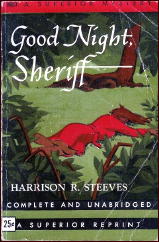
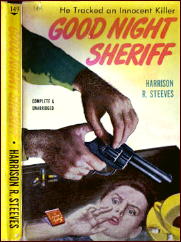
HARRISON R. STEEVES – Good Night, Sheriff. Random House, hardcover, 1941. Mercury Mystery #60, digest paperback, no date, abridged. Superior Reprint M657/The Military Service Publishing Co., paperback, 1945. Note: The Superior paperback was also released with a dust jacket published by Bantam and numbered #149. (See the two cover images below.)

HARRISON R. STEEVS Good Night, Sheriff

   Having graduated from medical examinations for an insurance company to “medical investigator,” Dr. Patterson is asked to read the inquest of the shooting death of Agnes, wife of Dr. Thomas Earlie, who either died by accident or murder.

   Patterson notices some oddities in the testimony and goes to the scene, somewhere in New England, to determine whether the beneficiary of Mrs. Earlie’s insurance policy might have murdered her.

   Pretending to be merely a physician interested in hunting, Patterson fools nearly no one. All those involved in any way with the death are intent on protecting Dr. Earlie, who did not stand to gain from his wife’s death.

   One of Patterson’s conclusions — dismissing a most likely murderer since “temperamentally he couldn’t have done it” — bothered me, but he does in the end spot the culprit through an unusual motive. Or does he?

   An only mystery, whose limited action is more than made up for by solid writing and good characterization.

— From The MYSTERY FANcier, Vol. 11, No. 1, Winter 1989.


HARRISON R. STEEVS Good Night, Sheriff

Editorial Notes:   There was a lucrative deal between the military in the mid-1940s and Ian Ballantine in which the army furnished the paper and Penguin supplied the books, which were then distributed to the various armed forces. Among the books published this way was the line of “Superior Reprints.” The troops received the books free, but they were available for purchase by the general public as well.

   For more on this arrangement, check out the Bookscans website.

   When Ballantine left Penguin to start Bantam, he brought some of the Superior paperbacks with him and re-released them with Bantam jackets. The jackets have mostly disappeared over the years, making them extremely collectible. Once the jacket is removed, if there is any way to tell a Superior paperback from one released as a Superior/Bantam hybrid, I do not know. (I have always assumed not.)

   As for Harrison Steeves, the author himself, I found the following online at the Golden Age of Detection Wiki:

    “Harrison Ross Steeves was born [in 1881] in New York City and educated at Columbia, where he became head of the English department before his retirement in 1947. […] After retirement he lived in New Hampshire. His sole detective work was Good Night, Sheriff (1941).”   [According to Crime Fiction IV, by Allen J. Hubin, he died in 1981.]

FIRST YOU READ, THEN YOU WRITE
by Francis M. Nevins


   I spent a goodly chunk of April on the road, driving to the east coast with many stops along the way, then taking Amtrak from New York to Salem, Massachusetts, where I visited Bob Briney’s grave and conferred with the attorney handling his estate.

   He drove me out to Bob’s house, which I hadn’t seen in almost 22 years, and together we went through some of his files. Among them were several manila folders containing letters to Bob from me, hundreds of them, dating as far back as the late Sixties.

   Recently I received a huge package in the mail which turned out to contain those letters, returned to me by the attorney. Since then I’ve spent several hours re-reading them. A strange and sort of spooky experience, almost like going back in time to the decades when I was young and, judging from all the projects I was involved in, bursting with energy.

   After a few years of corresponding with Bob I got into the habit of passing along to him some of the dreadful lines I had encountered in my reading. Care to sample a few? Here’s one from Harry Stephen Keeler’s The Monocled Monster:

   â€œIt was a dark and narrow corridor down which the nurse led Barry Wayne. Cork-paved, his feet and hers made no sound.”

   And another from the king of Malapropia, Michael Avallone:

   â€œWidows who see bachelors like you suddenly running around with women is the curiosity that kills all cats.”

   To commemorate the current celebrations in London I offer this exchange of dialogue from William Ard’s The Sins of Billy Serene:

   â€œJesus Christ,” Gino said hollowly, “you’re a whore.”

   â€œAnd what’d you think I was — Queen Elizabeth?” she asked tartly.

   From John Ball of In the Heat of the Night fame:

   â€œThe two blacks sprinted out of the store … running like maddened eels.”

   Finally a gem that would have bedecked my own novel Corrupt and Ensnare (1978) if I hadn’t caught it in time. Loren Mensing reflects that Incident A and Incident B “bore the earmarks of the same hand.” At the bottom of the letter in which I shared this gaffe with Bob I found in his handwriting: “And the handiwork of the same mind, no doubt.”

***

   More than forty years ago I copied for Bob the following paragraph, which is supposed to be the first-person narration of an educated woman. “Sweet, dear, impossible man. I wonder who he’s making love to now. I wish it were me. I have the education and breeding to appreciate a gentleman like he is.” Anyone want to guess who perpetrated it?

***

   I don’t usually go back to old columns of mine months later but a few weeks ago for some unfathomable reason I revisited one that was posted in January 2011. Part of it dealt with a radio director named Fred Essex, now in his nineties, who in a memoir talked about having directed an episode of The Adventures of Ellery Queen in which Ellery was played by Carleton Young, the guest armchair detective was comedian Fred Allen, and the murder “was committed in a radio studio that was supposedly rehearsing a crime program.“

   The problem, as I pointed out, is that there’s no known episode during Young’s tenure as EQ where Ellery solved a crime in a radio studio and no episode at any time where Fred Allen was the armchair sleuth.

   Among those who happened to read my column was Fred Essex himself, who insisted that his memory hadn’t played him false. In August of last year, Queen expert Kurt Sercu gave us the answer to this conundrum. What Essex remembered was not an EQ episode with Fred Allen as guest sleuth but an episode of The Fred Allen Show (June 6, 1943) which featured an EQ spoof skit with Carleton Young himself playing Ellery and Allen and a couple of his comedy characters as armchair detectives. Vielen Dank, Herr Sercu!

***

   When a writer trying to come across as an authority on the mean streets makes a mistake that his most sheltered readers catch, the egg on the guy’s face just won’t rub off.

   In putting together last month’s column I caught a classic howler of this sort in one of the earliest stories of Henry Kane. In “The Shoe Fits” (Esquire, ??? 1947; collected in Report for a Corpse, 1948) private richard Peter Chambers tells us about a gangster who had taken over a top spot “directing traffic from Old Mexico to California, hashish traffic, call it marijuana….”

   No, you did not dream you read that. Kane thinks hash and pot are the same substance! At least he did in 1947 when very few were drug-savvy.

***

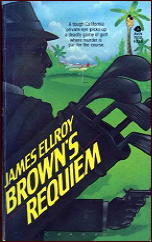
JAMES ELLROY Brown's Requiem

   Among the treasures of my library are two signed mint copies of James Ellroy’s first novel, the paperback original Brown’s Requiem (Avon, 1981), which I first read back in the Eighties.

   Its protagonist and narrator is Fritz Brown, a lover of classical music (German Romantic composers exclusively) who after being kicked out of the LAPD became a repo man and occasional PI. The plot is a Chandleresque labyrinth — a beautiful cellist, a serial arsonist, golf caddies, corrupt cops, a welfare racket — but the style is closer to Bill Pronzini and, with its dysfunctional family and ceaseless journeys into the past, the mood is closer to Ross Macdonald.

   Anyone expecting the telegraphic non-sentences and epic bloodletting of the later Ellroy will be surprised to discover that Requiem is coherently written and minimally violent, although when it comes the violence is pretty gory.

   There are some laughably self-indulgent moments, as when Brown treats us to a farrago of irrelevant anecdotes about caddies (or, as they call themselves, loopers) and later — twice in five pages! — to a loony poem he’s composed in a dream.

   But it’s a powerful read, and offhand I can’t recall any other non-series PI novel that deserves to stand on the same shelf with Stanley Ellin’s 1958 classic The Eighth Circle. Which, thanks to the alphabetical proximity of their names, is just where it stands in my library!

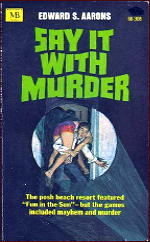
EDWARD RONNS Say it With Murder

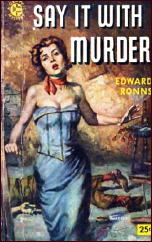
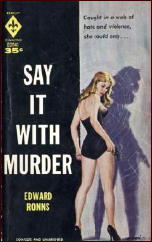
EDWARD RONNS – Say It with Murder. Graphic #76, paperback original; 1st printing, 1954. Berkley Diamond D2041, paperback, 1960. Reprinted as by Edward S. Aarons: Macfadden, paperback, 1968; Manor, paperback, 1973.

   In case anyone’s not quite sure, Ronns was the pen name, Aarons was his real name. His writing career, as far as mystery novels were concerned, began back in 1938, when he was 22 years old, with a hardcover novel entitled Death in a Lighthouse, published by Phoenix Press. He didn’t use his own name until 1948 and a book called Nightmare, also in hardcover, this time for McKay.

EDWARD RONNS Say it With Murder

   His career really didn’t start rolling, though, until 1950, and the era of the paperback original. His first book for Gold Medal was again as Ronns and a book entitled Million Dollar Murder. He was especially prolific in the early 1950s, with five books in 1950, two in 1951, three in 1952, four in 1953, and two in 1954, including Say It for Murder. His first Sam Durell novel, Assignment to Disaster, the long-running spy series for which he is best known, came out in 1955.

   I have sometimes wondered if the four books he wrote for Graphic Books between 1953 and 1955 were rejects from Gold Medal, or if he had so many books in him at the time that he had to spread them out over more than one publisher.

EDWARD RONNS Say it With Murder

   Personally, I don’t believe that Say It for Murder is as good as the books he was writing for Gold Medal at the time, so I have a feeling that Graphic was only a backup market for him. It does have something of a noirish feeling to it, a la Day Keene, Gil Brewer and Charles Williams, with the protagonist, pianist Bill Carmody, getting into one jam after another, either with the police on one side and the guys he’s forced to hang around with on the other.

   But Carmody is essentially a nice guy who only made one mistake, and not a guy who continually tries to cut sharp corners as he makes his way through life, and we have the sense he’s going to work his way out of his troubles – and get the girl – with the only question being how.

   I don’t know. I was going to tell you more about the plot, which begins with Carmody joining up with two other former Korean prisoners of war in getting even with the guy they think turned traitor on them, and the mysterious death of the man’s wealthy wife, but maybe this is all you need to know.

   There’s nothing deep to the story, but there’s certainly something going on in it all the time, and sometimes that’s all you need just before heading off to bed at night.

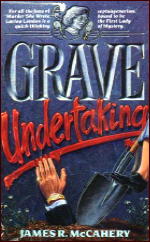
JAMES R. McCAHERY – Grave Undertaking. Knightsbridge Bestseller Mystery #12, paperback original; 1st printing, 1990.

JIM McCAHERY Lavina London

   This book is bound to be a Collector’s Item, simply because it’s going to be so hard to find. Maybe things were different in your part of the country, but in the central part of Connecticut where I live, it never went on sale, and I know, because I was looking for it. Knightsbridge is a small struggling publisher, and they just didn’t have the oomph to push an author whose first book this is.

   The other question is, is the book worth looking for? I think it is, even though it has some problems, but it has some pluses too, the primary one being its lead detective, Mrs. Lavina London, an ex-radio actress in her 70s who finds that even at her age, one can still have her wits about her. Occasional bits of old radio shows are dropped here and there, but — you may be interested to know — they’re nowhere nearly as profuse and possibly underfoot as the mentioning of old mystery writers and their works are in Carolyn Hart’s books.

   The plot as to do with graveyards, ha ha, as you would probably have already gathered from the title. The first victim is a wealthy funeral home director who hasn’t made as many friends in this world as he thought he had.

   Besides the fact that I learned more about funeral directors, cemetery owners, and florists than I really wanted to — there is more backstabbing possible between funeral directors, cemetery owners, and florists than I ever dreamed there could be — I thought the book itself was rather uneven. It starts well, begins to fade in the middle (as many books do), picks up again to what seems will be a grand finale — and collapses in a final confrontation with the killer that seems to go on forever, although it’s gone on for only 18 pages when the killer says to Lavina: “Well, enough of this chit-chat, Mrs. L. … I don’t want to hang around here too long.”

   I also thought for a while that the author Jim McCahery hadn’t played fair with us, but after some consideration I decided that a reasonable amount of clues were there after all. (I probably wasn’t paying attention.) I’d still have trimmed the novel down some, if I’d had any say, but I also say that if you care for “little old lady” fiction at all, you should make a point of picking this one up, if and when you ever find a copy.

— Reprinted from Mystery*File 28,
       February 1991 (slightly revised).


JIM McCAHERY Lavina London

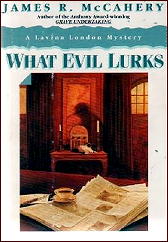
[UPDATE] 05-31-12. Offhand, I don’t know how long Knightsbridge, the publisher of Grave Undertaking, was able to stay around, but I’ll look into it. I don’t think it was more than a couple of years. It was Kensington/Zebra who published Jim’s second book, What Evil Lurks, in 1995.

   The latter was also Lavina London’s second appearance, but if there was to be a third, it didn’t happen. Jim McCahery died in 1995, at the far too young age of 61. Although we met only twice, we were friends by mail and through an outfit called DAPA-Em, which until it recently disbanded, published stapled-together compilations of each members’ fanzines every two months for something like 35 years.

   We’ve gone digital instead. Many former members leave comments on this blog and/or have their own. Or contribute here from pages of old mailings, with Walter Albert, Dan Stumpf, Marv Lachman, Geoff Bradley and Stan Burns as prime examples.

   I possibly exaggerated the scarcity of Grave Undertaking, as there are 24 copies offered for sale on ABE, and considerably more of the second. I hadn’t known until looking just now that the second was published in hardcover before it appeared in paperback. I’m happy to know that.

THE BACKWARD REVIEWER
William F. Deeck


EDITH HOWIE – No Face to Murder. M. S. Mill, US, hardcover, 1946. TV Boardman, UK, paperback, 1946.

   As the choir of the St. Thomas Episcopal Church is finishing its practice session, Miss Tess King, a chorister and the church secretary, discovers in trying to recover her dropped anthem that her hand is soaked with blood. A body is subsequently located with its throat slit, and then another is found that has been murdered the same way.

   From the evidence, it would seem that a choir member or the organist, who had a tendency not to follow the score but to let the choir follow him, must have done the killings. All, of course, have something to hide.

   Miss King is a passable narrator and a sensible person, except when the author turns her temporarily into a Gothic idiot. Ran Garrison, the police investigator and Miss King’s boyfriend, is a competent but dull investigator. Only when Bishop Walters shows up midway in the novel does it take on any life.

   Unfortunately, he gets bopped on the head by someone who may be the murderer and decides, wisely for him but not for the reader, to end his career as a sleuth almost as soon as it was begun.

   Hubin’s bibliography says that this novel is set in Missouri. I haven’t figured out how this was ascertained.

— From The MYSTERY FANcier, Vol. 11, No. 1, Winter 1989.


Bibliographic Notes:   Edith Howie, dates uncertain, was the author of seven crime novels written between 1941 and 1946. A complete list may be found here. A short synopsis and review of No Face to Murder that appeared in The Saturday Review may be seen here.

A REVIEW BY MARYELL CLEARY:
   

MIRIAM BORGENICHT – Fall from Grace. St. Martin’s, hardcover, 1984. No paperback edition.

   A twenty-six year old nurse marries a sixty-seven year old doctor and two months later he’s dead, a suicide, leaving a note that seems to imply that the marriage was a mistake.

   What does the world think? Naturally, that she’s to blame. But the world was wrong. Nan Dunlop has married Dr. William Gardner for love, and their marriage was happy. So, after his death, she sets out to find the “mistake” that had driven him to his death.

   Probing into his past, she finds his younger sister, an alcoholic whose dull husband made it big with a defense contract. She finds two nurses who had fallen for the glamorous doctor 21 years before. She finds a research project begun with great enthusiasm and abandoned for no apparent reason.

   Her husband’s lawyer, suspicious of her motives, follows the course of this delving into the past. So does Dr. Collins, who is supportive. After two attempts are made on her life, she realizes that there is something of greater moment than an old love affair to be found. Slowly the suspense builds, as Nan uncovers the solution to this engrossing puzzle.

— Reprinted from The Poisoned Pen, Vol. 6, No. 4,
Fall 1986.


         Biographical Notes:

   Miriam Borgenicht (1915-1992) was the author of 17 crime novels written between 1949 and 1991. Her obituary in the New York Times states that “She completed her last, yet unpublished, by dictating the conclusion to a daughter from her hospital bed.” She was also an occasional contributor to The New Yorker magazine.

   On the main Mystery*File website, Marvin Lachman had this to say about her work: “Miriam Borgenicht was one of those writers who never seem to write the same book twice. These writers typically don’t have series characters since having a continuing protagonist usually leads to a certain predictability. Andrew Garve was another whose books followed little pattern, though, as I have written elsewhere, Garve was probably his own series character. Borgenicht was a sophisticated writer who created many different strong female protagonists….”

« Previous PageNext Page »