Authors


A REVIEW BY MARYELL CLEARY:
   

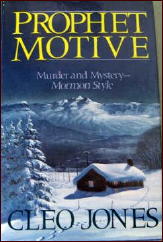
CLEO JONES – Prophet Motive. St. Martin’s, hardcover, 1984. No paperback edition.

CELO JONES Prophet Motive

   This is a first mystery, though not a first novel, and it’s a real find. In Magpie, a suburb of Salt Lake City, Police Chief Christopher Danville, himself a lapsed Mormon, must deal with the murder of Mormon Bishop Manion in an atmosphere of suspicion and hostility.

   Newcomer Naomi Green, Planned Parenthood director, is the townspeople’s prime suspect because of their opposition to her work. There are also Mormon fundamentalists who hold on to the old way of polygamy. Danville’s sergeant, Wilkes, turns out to be one of them, so he is automatically a suspect.

   Danville himself is a complex character. Divorced from a “good Mormon wife,” feeling guilty about not spending enough time with his daughter, sexually attracted to Naomi, his own conflicts get in the way of his work. However, he goes about tracking down a good Mormon husband who has supposedly run off with a dancer at a Las Vegas casino owned by a wealthy Magpie Mormon.

   He finds that there are others interested in the missing man as well. The denouement is startling, but no more so than some of the action along the way. I recommend this highly, except to Mormons, who aren’t going to like the inside information this ex-Mormon author spills.

— Reprinted from The Poisoned Pen, Vol. 6, No. 4,
Fall 1986.


Bio-Bibliographic Notes:   Al Hubin has no information about the author, except to say that she is an “ex-Mormon living in Utah.” I have a feeling that ‘Cleo Jones’ may be a pen name. She wrote one other mystery, The Case of the Fragmented Woman (St. Martin’s, 1986), which takes place in San Francisco and does not involve Police Chief Danville as a character.

IT’S ABOUT CRIME, by Marvin Lachman

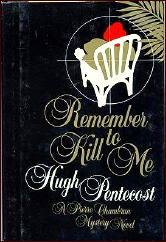
HUGH PENTECOST – Remember to Kill Me. Dodd Mead, hardcover, 1984. Worldwide, paperback, 1988.

HUGH PENTECOST Remember to Kill Me

   Longevity is one of the strong points of Judson Philips, who was a sports reporter while a student at Columbia University where he was a contemporary of Cornell Woolrich and Jacques Barzun in the early 1920s.

   He’s been writing ever since, under his own name and the more famous pseudonym of Hugh Pentecost, with hundreds of magazine stories in the “pulps” and the “slicks” plus over a hundred novels since his first in 1936.

   Never a great literary stylist, Philips-Pentecost is often not readable, especially when his plot is weak. On the other hand, considering his prolificity, he has done some very good work, and one of his best recent Pentecost novels, Remember to Kill Me, has recently been reprinted by Worldwide Library in paperback.

   In a far from new plot device, terrorists take over the luxury Beaumont Hotel, holding hostages and planting bombs throughout the building. The Pentecost nuts-and-bolts prose works beautifully here as the suspense builds up while Pierre Chambrun tries to resolve matters without loss of life.

   The growth in books about what the television networks call “hostage situations” has led to this new sub-genre of the mystery, which I’ll call “howdoit,” depending upon how (if at all) the authorities will end a siege without loss of life. Remember to Kill Me is one of the best and most suspenseful of this new breed.

— Reprinted from The MYSTERY FANcier,
Vol. 11, No. 1, Winter 1989.


[UPDATE] 05-14-12.   Judson Philips died in 1989, at the age of 86, with one book published after his death. Pierre Chambrun, one of his most popular characters, appeared in 22 novels and one short story collection. For more about the author, his Wikipedia entry can be found here, and his page on the Golden Age of Detection wiki is here.

THE BACKWARD REVIEWER
William F. Deeck


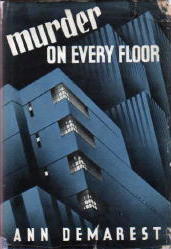
ANN DEMAREST Murder on Every Floor

ANN DEMAREST – Murder on Every Floor. Hillman-Curl, hardcover, 1939. Mystery Novel of the Month #39, digest-sized paperback, 1942.

   As New York City’s worst winter in fifty-five years begins, Christine Howarth has passed up the opportunity to go to Bermuda with a rich young man. She is moving to Greenwich Village with the hope of painting at least one really good picture.

   Unfortunately, there’s no opportunity for her to achieve her goal since the very first night she moves into a new apartment there is murder done across the hall. No matter that she just arrived that evening and knows no one in the building, she is a suspect.

   Howarth is an engaging character. Her lawyer, who helps the police investigate and who is interested in Howarth, and the occupants of the apartment building are not, nor are they well drawn.

   Read the book if you come across it and it’s free or cheap, but don’t make it a point to look for it.

— From The MYSTERY FANcier, Vol. 11, No. 1, Winter 1989.


Bibliographic Notes:   Anne Demarest was the pen name of Florence Demarest Foos Bond (1905-?). The only other mystery novel to her credit, according to Hubin, was She Was His Secretary (Gramercy, 1939), and that one is denoted as having only marginal crime content.

FIRST YOU READ, THEN YOU WRITE
by Francis M. Nevins


Esquire

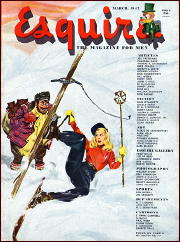
   During the last months of World War II the editors of Esquire decided to launch a series of short detective stories and invited various mystery writers to create new characters for possible publication in the magazine.

   Among the invitees was Harry Stephen Keeler (1890-1967), perhaps the nuttiest author on earth. Harry got miffed at the thought of being asked to “submit a sample like a guy with a tin cup” and demanded $100 in advance. He must have fallen on the floor in shock when Esquire immediately sent him a check, although the editors specified that the advance wasn’t a commitment to accept his submission.

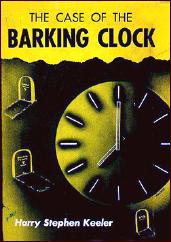
   Keeler proceeded to string together a 14,000-word adventure about a barking clock and an astigmatic witness, with a 7½-foot-tall mathematically educated hick from the sticks serving as detective. At first the character was named just that — Abner Hick to be precise — but before sending out the manuscript Keeler prudently changed his name to Quiribus Brown.

Barking Clock

   When Esquire rejected the story, Keeler yanked Quiribus out of the plot, replaced him with that bedraggled old universal genius Tuddleton T. Trotter (who had starred in Harry’s mammoth extravaganza The Matilda Hunter Murder back in 1931), and added 85,000 more words to the story.

   His Spanish publisher Instituto Editorial Reus issued the result as El Caso del Reloj Ladrador (1947). Keeler’s U.S. publisher, the bottom-rung Phoenix Press, put out a shorter version that same year as The Case of the Barking Clock.

   Since Phoenix dropped Keeler in 1948, leaving him without a U.S. publisher for the rest of his life, Quiribus never saw the light of print in his native land. But Harry made him the protagonist in The Case of the Murdered Mathematician, issued in 1949 by his London publisher Ward, Lock.

***

Henry Kane

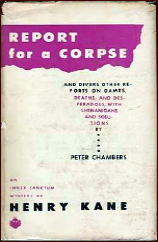
   So what new detective was chosen to grace the pages of Esquire? A New York PI named Peter Chambers whose creator was Henry Kane, a lawyer and something of a Chandler wannabee. Chambers narrates his own cases in an idiom, known to connoisseurs as High Kanese, which is worlds removed from Keeler’s style but just as lovably eccentric.

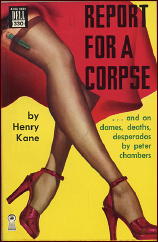
   The first six Chambers stories appeared in Esquire between March 1947 and June 1948 and were collected as Report for a Corpse (Simon & Schuster, 1948).

   The timing was unfortunate in the sense that the book came out several months after Anthony Boucher was let go as reviewer for the San Francisco Chronicle and before he became mystery critic of the New York Times. I’d love to know what Boucher thought of this volume, but it was his predecessor Isaac Anderson who reviewed the book in the Times.

   I read the tales a few decades ago but had forgotten them completely when I started to reread them earlier this year. They’re more cleverly plotted than most PI stories during the years Chandler dominated the genre, but there’s nothing truly memorable about any of them and the narration is a pale shadow of what would soon become mature Kanese.

***

Henry Kane

   According to just about any print or electronic source you might check, Henry Kane was born in 1918 and is still alive. Apparently neither of these statements is true.

   Lawrence Block had several conversations with Kane in the early 1970s and, while preparing a memoir of him for Mystery Scene, did some investigative work that was worthy of his own PI Matthew Scudder. An old girlfriend of Kane’s told Block that “he was most likely born not in 1918 but in 1908.” At least when Block knew him, he “lived on Long Island — Lido Beach, if memory serves — and spent Monday through Friday in an apartment on 34th Street west of Ninth Avenue.”

   Block tells us that he “took his work seriously, and insisted that each page be perfectly typed before he went on to the next one.” He was of Jewish descent but told Block that he “didn’t believe in any of that mumbo-jumbo.”

   His lifestyle was that of the stereotypical PI: a Dexedrine pill every morning, at least a quart of Scotch and a couple of packs of cigarettes a day. “It must have been sometime in the early ’80s that he died,” Block surmises.

   Of the eleven Henry Kanes listed in the Social Security Death Index, the one who was born in 1908 and died in 1988 is most likely our man. I would love to have met him, though not necessarily in that smoke-choked apartment.

***

Henry Kane

   In his years as conductor of the “Criminals at Large” column for the Times, Anthony Boucher reviewed most of the Kane novels and collections, even though they were published in the unprestigious paperback-original format.

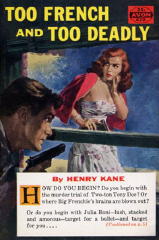
   I still recall vividly the time he reviewed one of those novels twice. Its U.S. title was Too French and Too Deadly (Avon pb #672, 1955). In his Times column for December 18, 1955 he called the book “probably enjoyable; Peter Chambers stories are usually amusing, and this one is said to include ‘a locked room within a locked room.’

   â€œBut the publishers have chosen to crowd a full-length novel into 122 pages by squeezing 500 words onto a 4-inch by 6-inch page; and squinting one’s way through the book is too much to ask of a reviewer, a reader, or anyone save possibly a Lord’s-Prayer-on-Pinhead engraver.”

   Apparently Kane then sent Boucher a copy of the hardcover British edition, The Narrowing Lust (Boardman, 1956). In his column for June 24, 1956, Boucher reported that “now that it’s legible, it’s also highly readable” and “includes an unusually impossible-seeming locked room problem. It’s a welcome blend of strict detective puzzle and crisp and sexy thriller….”

***

Jazz Noir

   In my last column I quoted the late Fred Steiner, composer of the Perry Mason theme: “You look at those old film noir pictures, they’ve always got jazz going for some reason or other.”

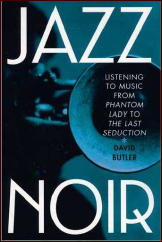
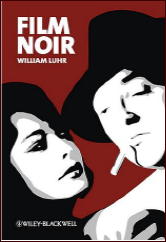
   Since then I’ve discovered that this seems to be a classic case of false memory. The point was demonstrated by David Butler in his book Jazz Noir: Listening to Music from Phantom Lady to The Last Seduction (Praeger, 2002) and confirmed by William Luhr in his just published Film Noir (Wiley-Blackwell, 2012):

   â€œAlthough many neo-noir movies have used single-instrument jazz solos to evoke the film noir era, it is difficult to find a canonical film noir [i.e. one that dates from the Forties or Fifties] that opens in that way. Most used full orchestral scores, as was standard studio practice.”

Film Noir

   It’s only in TV private-eye series like Peter Gunn that jazz became the norm. And, as Lawrence Block points out, the strongest uncredited influence on that landmark series was the novels and stories of Henry Kane — who wound up writing the Peter Gunn tie-in novel (Dell pb #B155, 1960)!

   Is this a weird world or what? Luhr’s book is one of the few that discusses in depth both canonical noir and the more recent evocations of the genre, of which perhaps the finest is Chinatown (1974). I recommend it highly to anyone invested in that type of film. And aren’t we all?

      Previously on this blog:

A Corpse for Christmas, by Henry Kane. Reviewed by Bill Deeck.
Trinity in Violence, by Henry Kane. A 1001 Midnights review by Art Scott.
The Midnight Man, by Henry Kane. A 1001 Midnights review by Bill Pronzini.
A Corpse for Christmas, by Henry Kane. Reviewed by Steve Lewis.
Until You Are Dead, by Henry Kane. Reviewed by Steve Lewis.

   A long quote from the latter book is included as a big chunk of the review.

DAVID GOODIS vs. THE FUGITIVE
by Francis M. Nevins


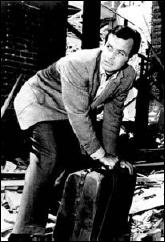
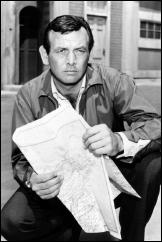
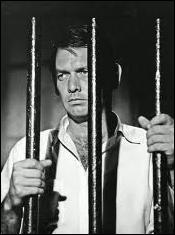
    In the last few years of David Goodis’ life, one of the most popular TV series was ABC’s The Fugitive, the saga of Dr. Richard Kimble (David Janssen) who was wrongly convicted of his wife’s murder, escaped from the wreck of a prison-bound train, and spent the next several years on the run, criss-crossing the country, changing identities constantly, being stalked relentlessly by the Javert-like Lt. Gerard (Barry Morse) as he searched for the one-armed man who was the real murderer.
DAVID GOODIS vs THE FUGITIVE

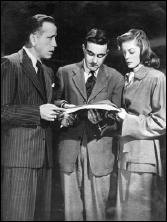
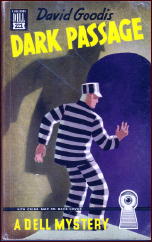
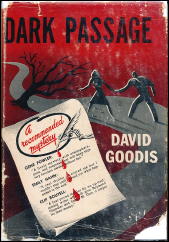
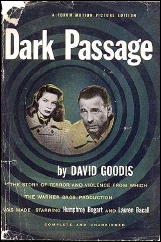
    The series was produced by United Artists Television and ran on ABC for four seasons (1963-67) and 120 hour-long episodes. A year or so into its run, Goodis became convinced that the series was a rip-off of his own first crime-suspense novel, Dark Passage (1946), which had been serialized in the Saturday Evening Post before book publication and, a year later, became the basis of a Warner Brothers movie starring Humphrey Bogart and Lauren Bacall.

    Both the novel and the movie told the story of Vincent Parry, who was not a doctor but did escape from prison after being wrongly convicted of his wife’s murder and, although never stalked by a cop, did set out to clear himself and find the real killer, who was not a one-armed man.

    Goodis’ suit against United Artists TV raised three interesting legal issues. The one we’ll address first and last was whether The Fugitive infringed the copyright in Goodis’ novel. The Copyright Act of 1909, which was the governing law throughout Goodis’ lifetime, says that the owner of a copyrighted work has the exclusive right to “copy” the work. (The operative verb in the present Copyright Act is “reproduce.”)

    But neither statute sets any sort of standard for determining whether one work infringes another. What is that standard? Copyright law would be absurd and useless if it required absolute identity between the two: otherwise I could rip off The Da Vinci Code simply by changing the hero’s name to Langbert Robdon.

    But the law would be equally absurd, and contrary to public policy and probably to the First Amendment also, if it allowed authors to claim copyright protection for the ideas in their works, so that, for example, the first person who wrote a novel or story about an intelligent dignified black detective could sue anybody else who later did the same thing.

    In order to avoid both these extremes, the judicial decisions interpreting the Copyright Act have required for generations that in order to win an infringement suit a plaintiff has to establish that his work and the defendant’s work are “substantially similar” on the layer or level not of abstract ideas but of concrete expression.

    The problem of course is that the line separating ideas from the expression of ideas is indefinable. But in order to prevail in an infringement suit the plaintiff has to establish substantial similarity on the expression side of that indefinable line. This is what Goodis set out to do when he sued over The Fugitive.
DAVID GOODIS vs THE FUGITIVE

    During the litigation the defendants took Goodis’ deposition, and their attorney questioned him intensely about what common elements he found between Dark Passage and The Fugitive. A few years ago, at a conference in Philadelphia, the law firm that had represented Goodis gave a presentation about the case. I was supposed to be there but missed my train.

    Some kind soul knew of my interest and saved me a copy of Goodis’ deposition, which was handed out to those who attended. I decided that, shorn of side issues and redundancies, this document would make a good teaching tool in my Copyright Law course because it illustrates so vividly how the game is played.

    Goodis, obviously well coached by his lawyers, tries to make the similarities seem as concrete as possible while the defense team tries just as hard to reduce them to abstract ideas. Let’s travel back in time and eavesdrop:

    You say that you have seen some 20 to 25 … episodes of The Fugitive, is that correct?

    Yes, possibly more, but that would be a minimum, yes.

    Based upon your familiarity with Dark Passage and that stated familiarity with The Fugitive, what similarities with respect to ideas do you see, if any, between the two works?

    …[T]he nucleus of the plot is exactly the same… In Dark Passage, the entire story is based upon a situation involving a man who has been unjustly sentenced for the murder of his wife. Subsequently he…escapes from prison and seeks to find the murderer but through a series of unfortunate circumstances he is forced to keep running… [I]n the course of his escape … the protagonist, Vincent Parry, is aided by a young woman named Irene Janney who is present at the courtroom proceedings and who believes in his innocence. In a particular segment of The Fugitive … the protagonist, Richard Kimble, is aided by a young woman [played by] Suzanne Pleshette who is present at the courtroom proceedings wherein Kimble was found guilty and sentenced and who believes in his innocence….

    Please continue with respect to any ideas that you found to be similar between Dark Passage and … The Fugitive.

    Now in Dark Passage the protagonist, Vincent Parry, is portrayed as a mild-mannered man who is not bitter against society as a result of being unjustly condemned but who, when the situation demands it, is capable of great valor … and physical strength…. [T]he protagonist of The Fugitive, Richard Kimble, is portrayed in essentially the same light. Next point: In the course of his fleeing, Vincent Parry assumes disguise, physical disguise.

    That is by having plastic surgery performed on his face, is it not?

    That is correct, sir.

    Continue, please.
DAVID GOODIS vs THE FUGITIVE

    In the course of his fleeing in this same connection, Richard Kimble in The Fugitive assumes disguise.

    What type of disguise?

    By having his hair dyed, by dyeing his hair. Next point: In Dark Passage the protagonist, Vincent Parry, confronts the actual murderer of his wife but is unable to use her confession to absolve himself inasmuch as the murderess falls out of a window to her death. In The Fugitive the protagonist, Richard Kimble, confronts the actual murderer … but is unable to use the murderer’s confession inasmuch as the murderer … gets away before the police arrive.

    Was that particular [episode of The Fugitive] the same one to which you referred earlier as featuring Suzanne Pleshette?

    No, sir…..

    Please continue.

    In the novel and film Dark Passage, Vincent Parry … is aided in the course of his escape by a somewhat offbeat taxi driver whose philosophy is somewhat cynical. In the same connection, in various segments of The Fugitive, the protagonist Richard Kimble is aided by various offbeat characters whose philosophies are somewhat cynical and at times world-weary.

    Were any of them cab drivers?

    Not to my recollection.

    Go ahead.

    In the novel and film Dark Passage, Vincent Parry in the course of his escape is harassed by a character [named Arbogast but] … who attempts to utilize Parry’s predicament for his own selfish motives … a form of blackmail…. In the same connection, in various [episodes] of The Fugitive Richard Kimble in the course of his fleeing is harassed by various individuals who attempt to utilize his predicament for their own selfish motives.

    Did any of them attempt blackmail or extortion, do you recall?

    To the best of my memory, these motives included various forms of monetary gain. I can’t tell you truthfully whether blackmail was utilized per se. I can’t remember.

    In Dark Passage the fellow named Arbogast has followed Parry almost from the time of his escape up to the time of their final confrontation in the book…, where they meet in a hotel room and have their final confrontation which takes place there and subsequently in Arbogast’s car. Is that correct?

    That is correct.

    In The Fugitive series is there any one character who is continually following the protagonist, as you call him, Richard Kimble?

    Yes. [There are] many, many instances where characters who attempt to use Kimble’s predicament for their own selfish gains… follow him.

    [I]sn’t there one particular character in The Fugitive who is continually following Richard Kimble?

    Not in that connection, not in the connection of utilizing Kimble’s predicament for his own selfish motives, no.

    Is there any character, regardless of his motives, that is continually following Richard Kimble in The Fugitive series?

    Yes… That is a detective….

    Will you please continue with your comparison of ideas.

    ….I noticed in watching various [episodes] of The Fugitive similarity in characterization of the protagonist based mainly on the fact that the protagonist in Dark Passage is a man who…thinks of others before he thinks of himself and because of this is constantly falling into jeopardy….[I]n many, many segments of The Fugitive, the protagonist Richard Kimble is portrayed as a man who thinks of others before he thinks of himself and because of this is constantly falling into jeopardy.
DAVID GOODIS vs THE FUGITIVE

    Later in the deposition, obviously reading from notes, Goodis summarized the alleged similarities between his novel and the TV series.

        (1)   In Dark Passage Parry is primarily motivated by his determination to discover the truth concerning the murderer of his wife and the identity of the murderer. In The Fugitive Kimble is primarily motivated by his determination to discover the truth concerning the murderer of his wife and the identity of the murderer….

        (2)   In Dark Passage Parry is described as a man who is not especially aggressive or physically powerful but he is equal to the occasion when threatened with physical violence. In The Fugitive Kimble is portrayed as a man who is not especially aggressive or physically powerful but he is equal to the occasion when threatened with violence….

        (3)   In Dark Passage Parry is portrayed as a quiet-spoken, reserved type, sensitive and kindly, considerate of others and with high standards of moral behavior. In The Fugitive Kimble is portrayed as a quiet-spoken, reserved type, sensitive and kindly, considerate of others and with high standards of moral behavior….

        (4)   The treatment of Dark Passage places emphasis on Parry’s panic and fear of being apprehended before he can find the murderer of his wife rather than his bitterness at being unjustly accused and condemned. The treatment of The Fugitive places emphasis on Kimble’s panic and fear of being apprehended before he can find the murderer of his wife rather than his bitterness at being unjustly accused and condemned….

        (5)   In Dark Passage Parry is forced by circumstances to live and behave like a hunted animal. He can trust no one, not even those who want to help him. The treatment of the novel … places considerable emphasis on this aspect of the story. In The Fugitive Kimble is forced by circumstances to live and behave like a hunted animal. He can trust no one, not even those who want to help him. The treatment of the television series places considerable emphasis on this aspect of the story…

        (6)   In Dark Passage Parry is portrayed as a man whose “lips are not made for smiling,” a man whose eyes reflect a sadness caused by his loneliness and his awareness of the unpredictable tides of fate. In The Fugitive Kimble is portrayed as an unsmiling, sad-faced man, whose eyes reflect a certain sorrow caused by his loneliness and his awareness of the odds imposed by the unpredictable hand of fate….

        (7)   In Dark Passage Parry’s actual escape from prison is merely a prologue for the ensuing events. The story itself is treated from the standpoint of the hazards facing an innocent man who must keep running and hiding while at the same time seeking the means to eventually prove his innocence. In the same connection, in The Fugitive the entire series is based on a montage used in various segments as a prologue for the ensuing events. This prologue, accompanied by the voice of a narrator, depicts the escape of an innocent man and is of course the springboard for the episode that follows. Regardless of the content of the segment, the plot and theme of the entire series are based on the hazards facing an innocent man who must keep running and hiding while at the same time seeking the means to eventually prove his innocence…

    [W]hat is the theme of Dark Passage?

    …The theme of Dark Passage involves the plight of an innocent man condemned for the murder of his wife, constantly on the run after having escaped from the authorities, aided by those who sympathize with him and menaced by others who are motivated by their own selfish interests.

    What do you understand…to be the theme of [The Fugitive]?

    Essentially the same….

    What is the plot of Dark Passage as you understand it?

    …[A]n innocent man condemned to life imprisonment for the murder of his wife escapes from prison and is aided by those sympathizing with him and menaced by others who are motivated by their own selfish interests.

    What did you consider to be the plot of The Fugitive … to the extent that you found one?….

    The same thing, essentially the same.
DAVID GOODIS vs THE FUGITIVE

    The defendants made a motion for summary judgment, asking the court to throw out the suit purely on legal grounds, but it wasn’t based on any claim that as a matter of law Dark Passage and The Fugitive were not substantially similar.

    In effect UA TV took the position: “Assuming for the sake of the argument that we did take substantial material from Dark Passage, we were legally entitled to do so.”

    The first of the two legal arguments they offered was based on the 1945 contract by which Goodis for $25,000 sold Warner Bros. the movie rights in his novel. Like most such contracts in Hollywood’s golden age, this one included language permitting the studio not only to make a movie based on the novel but to remake it as often as the studio chose. United Artists TV claimed that The Fugitive was legal on the basis of those remake rights, which it had bought from Warners.

    Could the contractual language have been broad enough to justify such a claim? Could a clause primarily intended to authorize one or at most a handful of theatrical remakes be stretched to justify the making of a TV series that lasted for 120 hour-long episodes?

    The federal district court hearing the case ruled that it not only could be but was, and on January 2, 1968, almost a year after Goodis’ death, granted summary judgment to the defendants on that basis, quoting from the 1945 contract at great length. Anyone who wants to go to a law library and read the decision will find it in Volume 278 of the Federal Supplement, beginning at page 120.

    The defendants’ second legal argument grew out of the Goodis deposition. Apparently the UA TV attorneys hadn’t previously realized that the Saturday Evening Post had paid Goodis $12,000 for the right to publish Dark Passage in six weekly installments before its publication in book form.

    Unfortunately the only copyright notice in those six issues of the Post was the general notice on the table of contents page in the name of the Curtis Publishing Company. But Curtis wasn’t the copyright owner of Dark Passage; it was merely the licensee of magazine serialization rights from Goodis, the real copyright owner.

    Therefore, the defendants argued, Dark Passage had been published serially without a proper copyright notice, with the consequence that it had been in the public domain ever since and anyone could make any use of it that they pleased.

    This may sound to 21st-century ears like an argument worthy of Alice in Wonderland or Catch-22, but under the 1909 Copyright Act, which was in force at the time of this case and remained the law until the beginning of 1978, it was a sound contention, and the District Court granted UA TV’s motion for summary judgment for that reason also. The Goodis estate appealed both rulings.

    The case moved through the legal system like a frozen snail. It took more than two years for the Second Circuit Court of Appeals to hand down its decision, but from the viewpoint of Goodis’ successors it was worth waiting for.

    In Goodis v. United Artists Television, which was dated March 9, 1970 and can be found in Volume 425 of the Federal Reporter, Second Series, beginning at page 397, the appeals court reversed the trial judge on both grounds.

    All three appellate judges sitting on the panel — Kaufman, Lumbard and Waterman — agreed, in Chief Judge Lumbard’s words, that “where a magazine has purchased the right of first publication under circumstances which show that the author has no intention to donate his work to the public, copyright notice in the magazine’s name is sufficient to obtain a valid copyright on behalf of the beneficial owner, the author or proprietor.”

    The court’s refusal to impose Draconian consequences on an author because of a minor defect in a copyright notice constituted a landmark decision at the time, and the law has continued to evolve in the same direction ever since. Indeed under our present Copyright Act no notice at all is necessary in order for a work to be protected.

    On the question of interpreting the contract between Goodis and Warners the three appellate judges split. Lumbard would have upheld the district court’s grant of summary judgment but was outvoted by Kaufman and Waterman.

    “The question presented here,” Waterman wrote, “is whether the contract language demonstrates unambiguously that Goodis meant to convey to Warner Brothers the right to create a television series such as The Fugitive or whether a genuine issue of material fact exists as to what the parties intended by the language they used… It is our holding that the contract language does not so clearly permit production of The Fugitive as to entitle the defendant to a grant of summary judgment.”

    This too constituted a major improvement in authors’ rights. Thanks to the court’s refusal to hold as a matter of law that the contract between Goodis and Warner Bros. conveyed extremely broad rights as UA contended, it would be up to a jury to decide that issue if and when the case came to trial.

    That trial never took place. After the Second Circuit decision the defendants paid Goodis’ successors a small amount of money to drop the suit and go away. But since UA TV had never admitted any substantial taking from Dark Passage, at trial Goodis would still have needed to show substantial similarity between his novel and The Fugitive.

    Could he have done so? I’ve read the novel and seen the movie based on it, and 40-plus years ago I watched The Fugitive TV series regularly. I’ve also taught copyright law for almost 40 years and written some crime-suspense fiction of my own, and of course I’ve read Goodis’ deposition several times.

    My tendency is to demand a strong showing before I find two works substantially similar, so perhaps I’m a bit prejudiced. But Goodis’ case strikes me as very weak, so weak that the trial court might well have refused to allow a jury even to consider the issue, on the ground that no reasonable jury could have decided in Goodis’ favor on the evidence he presented.

    We’ll never know. A lawsuit is like a horse race: anything can happen. One of the great lawyerly virtues is prudence. It was prudent of UA TV to offer a settlement and prudent of the Goodis successors to accept it.

    We also cannot know whether Goodis himself would have accepted a settlement had he lived. But if there’s an afterlife and they serve liquor, he no doubt would have toasted the wisdom of the Second Circuit Court of Appeals in using his case to strike two blows on behalf of all authors living and dead.
REVIEWED BY WALKER MARTIN:


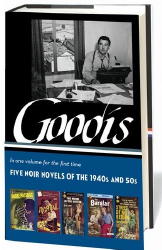
DAVID GOODIS – Five Noir Novels of the 1940’s and 1950’s. Library of America, hardcover, March 2012.

DAVID GOODIS Five Noir Novels

   I’ve been reading and collecting books from The Library of America ever since they first started coming out. At first it looked like they would just be publishing the works of the established literary figures, great authors like Henry James, Eugene O’Neill, Mark Twain, Herman Melville, and so on.

   But lately they have crossed over into more popular areas and genres by publishing two volumes of crime novels (including Down There by David Goodis), Dashiell Hammett, Raymond Chandler, H.P. Lovecraft, Philip K. Dick, Edgar Rice Burroughs, Kurt Vonnegut, two volumes titled American Fantastic Tales, and now David Goodis.

   I see this as a very good sign for popular culture and the mystery and SF genres. I guess it is too much to hope for volumes dealing with great western fiction but seeing this volume on Goodis makes me hope that we will see collections by Jim Thompson, Peter Rabe, Charles Williams, John D. Macdonald, Ross Macdonald, Gil Brewer, and others.

   We should not be surprised to see Goodis singled out for such attention because the French have long thought he was exceptional and in fact the only full length biography is in French. He was the poet of the bleak, doomed, and lost. It’s been said that Goodis did not write novels; he wrote suicide notes.

DAVID GOODIS Five Noir Novels

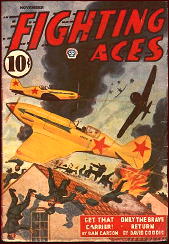
   I first became aware of David Goodis back in the 1960’s when I started to collect the pulp magazines. His pulp career lasted from 1939 to about 1947. He has been quoted as saying that he produced millions of words for the sport, detective, and western pulps. But most of his work was published in what I call the air-war pulps. I eventually accumulated extensive runs of such titles as Fighting Aces, Battle Birds, RAF Wings, Dare-Devil Aces, and Sky Raiders. Goodis appeared in all these pulps with dozens of stories, perhaps over a hundred.

   I would have to admit that I found his pulp work to be less than interesting. I’ve always had a problem with the air pulps with seemed to concentrate too much on airplanes and flying, while ignoring characterization and believable plots. I eventually sold, traded, and disposed of all my air-war magazines.

   There is an excellent DVD dealing with Goodis’ life, marriage, and career called David Goodis … to a Pulp It’s a must for anyone interested in his writing and one of the extras points out that Goodis’ wife evidently felt the same way as I did concerning his pulp stories.

   His wife told her second husband that the reason she left Goodis and divorced him was because she couldn’t stand his pulp writing that he was doing for the air-war magazines.

DAVID GOODIS Five Noir Novels

   She must have received a shock when he broke into the slick market with his novel, Dark Passage for the Saturday Evening Post in 1946. Not only did he receive a far higher rate of pay than he was getting for his pulp work, but Hollywood paid $25,000 for the screen rights. In today’s money that is around a quarter of a million. The movie was not just your usual effort, but starred Humphrey Bogart and Lauren Bacall.

   At this time it was goodbye to the pulps and the beginning of his Hollywood career. Despite receiving good money he still wore threadbare suits and slept on the couch of a friend for $4.00 a month. He soon found himself out of a job and back in Philadelphia, living in his parents house, and writing original novels for such paperback firms as Gold Medal.

   The Library of America edition reprints five complete novels. All five were made into interesting movies. and my comments on both the books and films follow:

● Dark Passage.   Though this is Goodis’ first real success, I don’t think it is an outstanding novel. My feeling on a second reading was that it is OK, good in spots by nothing that special.

   The story is not too believable and suffers from the happy ending. It reminds me of Cornell Woolrich, only not as good. I find the plot absurd with the rich, pretty girl falling in love with the loser convicted of murder. Also ridiculous to think that a cab driver and doctor would help the hero without even knowing anything about him.

DAVID GOODIS Five Noir Novels

   I watched the movie for the sixth time (I have a Bogart book which I annotate every time I see one of his films), and it’s hard to believe that they would cover up his face in bandages for most of the movie. But it does follow the plot of the novel and I find it better than the book.

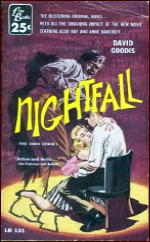
● Nightfall.   This also is just OK but nothing that special. Another innocent man framed for murder and robbery. Both these novels have a silly scene where the hero gets the gun away from the criminal by distracting him with talk. And another beautiful girl.

DAVID GOODIS Five Noir Novels

   Again I found the movie better than the book. It follows the basic plot with some changes but Aldo Ray is bland as the innocent man in trouble. Great villain.

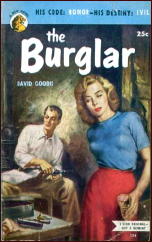
● The Burglar.   I found this novel to be better than the two above. Instead of the typical innocent man wrongly accused plots, this one was more believable with a professional jewel thief becoming involved in killings. Very downbeat ending, just what you would expect from Goodis.

DAVID GOODIS Five Noir Novels

   The movie stars Dan Duryea and Jayne Mansfield and follows the plot of the novel. The fact that David Goodis wrote the screenplay makes this even more interesting.

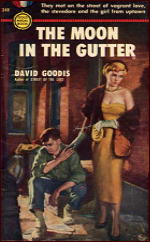
● The Moon in the Gutter.   With this book, it appears the novels are getting better. This one does not star a criminal or men framed for murder but has as a protagonist a laborer working on the docks and living in a slum area of Philly.

DAVID GOODIS Five Noir Novels

   He hangs out in a dive called Dugan’s Den, which has the atmosphere and characters right out of a Eugene O’Neill play. Vernon Street in Philadelphia takes on a life of its own and becomes a character in the novel.

   The movie was made in 1983 and is French with subtitles, starring Gerard Depardieu and Nastassia Kinski. It follows the basic plot of the novel.

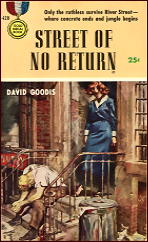
● Street of No Return.   Mediocre and not too believable. Skid row bum and drunk (a former famous singer) defeats criminal plan to cause race riots. Dialog is poor and the police act like idiots. Another beautiful girl falls for our hero.

DAVID GOODIS Five Noir Novels

   The movie was directed by Samuel Fuller and stars Keith Carradine. However in this case, the film was even more disappointing than the novel. Believe me, you don’t want to see Keith Carradine in a fright wig, trying to act like a bum.

   Despite the critical comments above, I did enjoy reading the five novels but lucky for me after reading them I immediately spent some time at a book convention buying and reading pulps. Otherwise, I might have hanged myself. No wonder Goodis lived such a short life, from 1917 to 1967.

       Bibliography (novels and story collections only)

Retreat from Oblivion, 1939.
Dark Passage, 1946.
Nightfall, 1947.
Behold This Woman, 1947.
Of Missing Persons, 1950.
Cassidy’s Girl, 1951.
Of Tender Sin, 1952.
Street of the Lost, 1952.
The Burglar, 1953.
The Moon in the Gutter, 1953.
Black Friday, 1954.
Street of No Return, 1954.
The Blonde on the Street Corner, 1954.
The Wounded and the Slain, 1955.
Down There (Shoot the Piano Player), 1956.
Fire in the Flesh, 1957.
Night Squad, 1961.
Somebody’s Done For, 1967.
Black Friday and Selected Stories, 2006.    [A collection of his shorter work from such magazines as Ten Story Mystery, Colliers, New Detective, Manhunt and Mike Shayne Mystery Magazine.]

THE BACKWARD REVIEWER
William F. Deeck


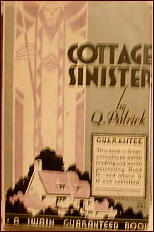
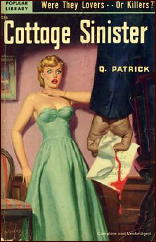
Q. PATRICK Cottage Sinister

  Q. PATRICK – Cottage Sinister. Roland Swain Co., hardcover, 1931. Popular Library #386, paperback, 1951.

   In the village of Crosby-Stourton in a charming cottage called Lady’s Bower lives Mrs. Lubbock with one of her daughters, a nurse. Two other daughters are visiting and die of hyoscine poisoning. A fair number of people had the opportunity, several had the means, but a motive is difficult to find.

   Archibald Inge, better known as the Archdeacon because of his resemblance to a Hound of Heaven rather than an earthly sleuth, is brought down from Scotland Yard to investigate. The Archdeacon is “an expert at psychological crimes because he never used his imagination — an adept in motiveless murder because he firmly believed that there was no such thing.” Thus, he was adroit at solving mysteries because he never thought anything mysterious.

   Two more deaths occur after the Archdeacon arrives in the village. It is obvious to him near the end of the investigation who did it. Unfortunately, he is mistaken. Still, he should have realized that the motive he attributed to the suspect was nonsensical.

   A well-written and amusing mystery, though the clues leave something to be desired. The Archdeacon is a fascinating character.

— From The MYSTERY FANcier, Vol. 11, No. 1, Winter 1989.


Q. PATRICK Cottage Sinister

  Bibliographic Notes:   The tangle of names behind the “Q. Patrick” pen name is as bad as the mess of cables hidden behind my computer. Most of the books written under that byline were by Richard Wilson Webb and Hugh Callingham Wheeler. Cottage Sinister, along with one other, was written by Webb and Martha Mott Kelley. Two other books were done by Webb in collaboration with Mary Louise Aswell.

   At another time and another day, an explanation of where Patrick Quentin and Jonathan Stagge also fit into the picture would be well worth doing, but for now, I’ll let Google do what it does best. While I haven’t checked it for completeness, here is a website that comes up early in the search, is organized very well, and should prove to be helpful to anyone who’s new to the author.

   Unless something has slipped by Al Hubin, this was the only appearance of Archibald Inge, the “Archdeacon.”

THE BACKWARD REVIEWER
William F. Deeck


LAWRENCE LARIAR

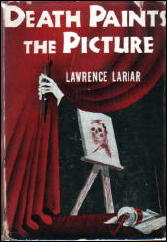
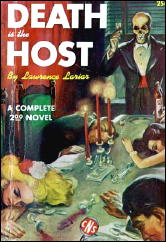
  LAWRENCE LARIAR – Death Paints the Picture. Phoenix Press, hardcover, 1943. Crime Novel Selection, nn [#6], digest-sized paperback, as Death Is the Host, no date [1943].

   A cartoonist himself, Lariar has as his detective Homer Bull, quite overweight and mastermind of the daily comic strip “True Stories of Crime.” Bull writes the strip while his assistant, Ham MacAndrews, does the cartooning. Ham also narrates Bull’s investigations. “‘Great jumping ginch!’ I blatted” is an example of MacAndrews’s speech which leads one to hope he draws better than he speaks.

LAWRENCE LARIAR

   Because his man Shtunk was on a binge, Bull misses the invitation to weekend with Hugh Shipley, famed illustrator for the weekly magazines. It is an ill-assorted group that includes Bull’s ex-wife, a gossip columnist, and a tobacco mogul.

   If Bull had attended, he might have been able to prevent Shipley’s alleged suicide, alleged because Bull, who shows up afterwards, is convinced Shipley was murdered, despite the room having been locked with no way for any murderer to have escaped.

   Another murder made to look like suicide, though it doesn’t fool Bull, takes place before Bull figures out who and how. Probably because I have perverse tastes, I enjoyed the book.

— From The MYSTERY FANcier, Vol. 11, No. 1, Winter 1989.


BIBLIOGRAPHIC NOTES:

       The Homer Bull series —

Death Paints the Picture. Phoenix Press, 1943.
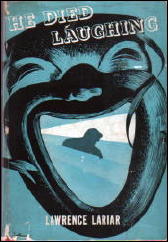
He Died Laughing. Phoenix Press, 1943.

LAWRENCE LARIAR

The Man with the Lumpy Nose. Dodd Mead, 1944.
The Girl with the Frightened Eyes. Dodd Mead, 1945.

   Lawrence Lariar has his own page on Wikipedia. Here’s the first paragraph:

    “Lawrence Lariar (December 25, 1908 – October 12, 1981) was an American novelist, cartoonist and cartoon editor, notable for his ‘Best Cartoons of the Year’ series of cartoon collections. He wrote crime novels, sometimes using the pseudonyms Michael Stark, Adam Knight and Marston la France.”

   He wrote nine mystery novels under his own name; nine as Adam Knight, including eight adventures of PI Steve Conacher and one with female PI Sugar Shannon; two paperback originals as by Michael Lawrence, both cases for PI Johnny Amsterdam; and one book as by Michael Stark.

   If he wrote the one mystery credited to Marston La France, it is news to Al Hubin. (Marston La France was a long-time professor and academic dean at Carleton University in Ottawa. The mystery he authored, Miami Murder-Go-Round, was copyrighted in his name. It features yet another PI, Rick Larkan.)

FIRST YOU READ, THEN YOU WRITE
by Francis M. Nevins


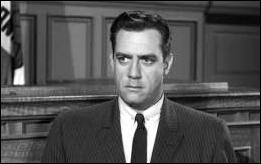
   When stuck for something to write about, browse the Web. I did that recently and discovered on the Bernard Herrmann Society website an excellent item to kick off this column with, an interview with composer Fred Steiner (1923-2011), whose main claim to fame for mystery lovers is that he wrote the theme for the Perry Mason TV series, which you may listen to here.

   Here, laboriously transcribed by my own fingers, is what he had to say on that subject in the 2003 interview:

   â€œA lot of people have asked me about it. ‘How did you come up with that theme?’ I really don’t know. I found some old sketches for the Perry Mason theme, some old pencil sketches, and they have no resemblance to what I finally came up with. So it’s a complete mystery to me.

   â€œI think the first time we recorded it, of all things, was in Mexico City, because of union complications. The original title was ‘Park Avenue Beat.’ And the reason for that was, I conceived of Perry Mason as this very sophisticated lawyer, eats at the best restaurants, tailor-made suits and so on, and at the same time he’s mixed in with these underworld bad guys, murder and crime.

   â€œThe underlying beat is R&B, rhythm and blues, and for the crazy reason that in those days, and even to this day, jazz or R&B is always associated with crime. You look at those old film noir pictures, they’ve always got jazz going for some reason or other. It’s like every time you see a Nazi they play Wagner.

   â€œ[The theme is] a piece of symphonic R&B. That’s why it’s called ‘Park Avenue Beat,’ but since then it’s been known as the Perry Mason theme… It’s always been used. It’s gone through several changes depending on the timing, because they would change the main titles year in and year out.”

   During the late Fifties and early Sixties when Perry Mason was in prime time, the head of the CBS west coast music department was Lud Gluskin (1898-1989) and the best-known composer working for him of course was Herrmann (1911-1975), whose ominous music was heard frequently in the episodes from the first two years of the series.

   Steiner went on to tell of another Herrmann-Mason connection:

   â€œI heard a story from Bernard Herrmann that at one point somebody said that they were tired of the theme and could we get something else. So Lud Gluskin got Benny to write the theme, but then the story is that Benny Herrmann said ‘What do you want me to write a theme for? Steiner’s is perfectly good.’ So they relented, went back to my theme. They never changed it.”

   Listening to Steiner’s words as Perry Mason would listen to the testimony of a witness against his client, do you detect the ambiguity I do? If Steiner were on the stand and you were cross-examining him, wouldn’t you ask the same question I would?

   â€œMr. Steiner, do you know whether Herrmann actually wrote a new theme for the series before he persuaded his bosses that they didn’t need one?”

   Steiner died last June so the answer may never be known. But if he had replied that Herrmann did indeed write such a theme, wouldn’t you love to knew where it is? Or better still, to hear it?

   At least we can see Steiner and hear the interview on YouTube.

***

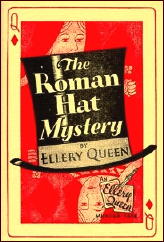
   From the Fifties let’s retreat to 1928, the year Fred Dannay and his cousin Manny Lee were writing The Roman Hat Mystery and creating Ellery Queen. How did they come up with the name?

   It’s been known for decades that Ellery was the name of Fred’s closest friend when he was growing up in Elmira, New York. How they settled on Queen was explained in an audio recording played at the Columbia University’s Queen centennial conference in 2005.

   The speaker is Patricia Lee Caldwell (1928- ), Manny’s oldest daughter, who had the story from her mother, Manny’s first wife, Betty Miller (1909-1974). Manny had married her in 1927 when she was 18 years old and he was 22. They were living in an apartment on Ocean Avenue in Brooklyn when their daughter was born.

   â€œMy mother told me that the families used to get together a lot over the weekends… She said that one weekend cousin Fred and Manny were playing cards… I think she said it was bridge… This was … around the time when they were writing The Roman Hat Mystery, and they were trying to think of a name for their character and for their pseudonym.

   â€œThey had already decided on Ellery … but they hadn’t decided on a last name. Well, they were playing cards, and my mother said that they suddenly looked at the picture cards and they said: ‘Yeah, wait, the picture cards. Maybe this will give us something.’

   â€œAnd they suddenly decided it would be Ellery King … but it didn’t seem quite right, and so they diddled around with it a little and they said: ‘No, Queen. Queen!’ The letter Q is extremely unusual in the English alphabet, and it would be much more memorable.”

   And which of us shall say that it wasn’t?

***

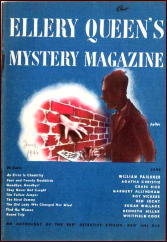
   Now let’s jump forward to a time when Ellery Queen was a household word, specifically to the fall of 1946 when the first volume of The Queen’s Awards brought together the prizewinners in the first annual story contest that Fred Dannay conducted for Ellery Queen’s Mystery Magazine.

   Among the winners of the six second prizes — $250 apiece, which was a nice chunk of money in those days — was William Faulkner for “An Error in Chemistry” (EQMM, June 1946), the future Nobel laureate’s only original contribution to the magazine. (The two other Faulkner stories Fred bought were reprints.)

   From various Faulkner biographies we learn that he lost no time deriding both the magazine and the prize. “What a commentary,” he wrote his agent. “In France I am the father of a literary movement. In Europe I am considered the best modern American and among the first of all writers. In America I eke out a hack’s motion picture wages by winning second prize in a manufactured mystery story contest.”

   A true Southern gentleman, yes?

THE ARMCHAIR REVIEWER
Allen J. Hubin


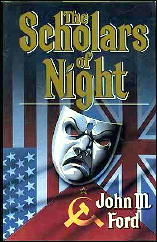
JOHN M. FORD The Scholars of Night

JOHN M. FORD – The Scholars of Night. Tor, hardcover, 1988; paperback, 1989.

   John M. Ford, author of an award-winning fantasy novel, enters the espionage lists with The Scholars of Night. Nicholas Hansard is hardly anything like a spy. He’s an academic, a historian, a man of no violent urges and no particular physical prowess.

    He’s also a member of Raphael’s Washington think tank, and his best friend is Allan Berenson, master of board games of politics and war. And dead. And, apparently, a traitor.

   A recently uncovered four-hundred-year-old play, possibly by Christopher Marlowe, has something to do with all this. Hansard, in sorrow and rage, resigns from the tank. But Raphael asks him first to go to England, have a look at the play, give his opinion on historicity.

   He agrees. So easy to get lured into the world of death and double-dealing. Quite an artistic job we have here by Ford, crafty and complex … and perhaps a bit too fuzzy around the edges.

— Reprinted from The MYSTERY FANcier,
       Vol. 11, No. 1, Winter 1989.


Bio-Bibliographic Notes:   This is the only work of crime or espionage fiction by the witty and multi-talented John M. Ford included in Al Hubin’s Crime Fiction IV, but he had a long list of science fiction and fantasy novels to his credit when he died in 2006. He left us far too early; he was only 49 at the time of his passing. For more information, check out his Wikipedia page here.

« Previous PageNext Page »