Authors


THE BACKWARD REVIEWER
William F. Deeck


PAUL HAGGARD [STEPHEN LONGSTREET] – Dead Is the Door-Nail.   J. B. Lippincott, US, hardcover, 1937.

PAUL HAGGARD / Stephen Longstreet

   One of the many problems associated with a lack of a sense of humor by a reviewer is the inability to tell when an author is teasing the reader. What is one to make of this: “The paunch and jowl of raffish apartment houses catapulted their elegant heights above the streets in a pageant of foppish decadence.”

   And yet it is closely followed by: “…to the wise mob of drunks, hop-heads and flamboyant slatterns of both sexes, it was a sanctuary and first-aid station. In Hilton’s electric cabinets, steam baths, needle showers and sun booths, the elect were tried and found wanton.”

   In the first of four novels featuring Mike Warlock, sports reporter for the New York Globe, and his faithful companion and cameraman, Abner Gillaway, they are assigned by the paper to cover the murder of Doris Castle, rich and the World’s Champion Lawn Tennis Player.

   Lots of suspects here, despite a few getting knocked off along the way. Did Castle’s husband, crooner Ira Wells, kill her because the marriage was unconsummated after three months? Or one of Wells’s many lovers? Or the odious Professor Ott, who once peddled a combination cough medicine and dandruff cure? Or Ott’s assistant, a coward and a blackmailer? Or the devilish Dr. Delcro, up to who knows what?

   Considerable action in an amusing hard-boiled novel in which the author just may have had his tongue in cheek. And if he didn’t, it’s still funny.

— From The MYSTERY FANcier, Vol. 11, No. 2, Spring 1989.


      Bibliographic Data:    [Expanded from the Revised Crime Fiction IV, by Allen J. Hubin.]

HAGGARD, PAUL. Pseudonym of Stephen Longstreet; other pseudonym: Henri Weiner.
      Dead Is the Door-Nail. Lippincott, 1937. Mike Warlock
      Death Talks Shop. Hillman-Curl, 1938. Mike Warlock.

PAUL HAGGARD / Stephen Longstreet

      Death Walks on Cat Feet. Hillman-Curl, 1938. Also published as: The Case of the Severed Skull, as by Henri Weiner.
      Poison from a Wealthy Widow. Hillman-Curl, 1938. Mike Warlock.

LONGSTREET, STEPHEN. Born Chauncey Weiner; 1907-2002. Pseudonyms: Paul Haggard & Henri Weiner. Also a screenwriter.
      The Crime. Simon & Schuster, 1959.

PAUL HAGGARD / Stephen Longstreet

       -The Pedlock Inheritance. McKay, 1972
       The Ambassador. Avon, pb, 1978.

WEINER, HENRI. Pseudonym of Stephen Longstreet; other pseudonym: Paul Haggard.
      Crime on the Cuff. Morrow, 1936.   “Introduces one-armed sleuth John Brass, former Secret Service man who is also a popular cartoonist, creator of the comic strip, ‘Georgie the G-Man.'”
      The Case of the Severed Skull. Mystery Novel of the Month, pb, 1940. Reprint of Death Walks on Cat Feet, as by Paul Haggard.

PAUL HAGGARD / Stephen Longstreet

A REVIEW BY CURT J. EVANS:         


P. R. SHORE – The Bolt.   E. P. Dutton, US, hardcover, 1929. Methuen, UK, hardcover, 1929.

P. R. SHORE The Bolt

   This long forgotten mystery novel was published in England and the United States in 1929. In the latter country it was published by E. P. Dutton, who at this time published several British mysteries with excellent endpaper maps.

   I have no idea whether these maps originated with the original English editions, having never seen the original English editions, but I plan to review all such Dutton mysteries that have come into my purview. I start with The Bolt.

   The author of The Bolt evidently was a man, Peter Redcliffe Shore. He is said to have been born in 1892 and to have authored one other detective novel, 1932’s The Death Film (about a slaying in a theater). That is the sum total of my knowledge of this author.

   I originally had assumed the author was a woman, because the tale is one of those English village “cozies” and it is narrated by a female character, a thirty-nine year old “spinster,” one Marion Leslie. Given that the author was truly a man I am impressed with his ability to carry off this character.

P. R. SHORE The Bolt

   The first fifth of the novel is given over to setting up its murder, and this part is effectively done. The village of Ringshall comes equipped with a Manor and a pub, The Lady & Hare, as well as a Squire, his nineteen-year-old daughter, his unpopular new wife, an eligible bachelor curate, the daughter’s boyfriend (a relative of Miss Leslie’s), a designing female of uncertain reputation, and assorted rustics, including a maid at the Manor House and her ambitious laboring boyfriend, a village witch and her “idiot” son. Oh, and the assorted gossiping ladies of the village.

   This part of the book is done so well, that it is almost a disappointment when comes murder (of the Squire’s wife during the day of the village fair, by means of a rifle equipped with a flint arrowhead, or “elf-bolt,” as the superstitious locals call it).

   Of the Squire’s wife maddening propensity to interfere with and dictate all aspects of village life (which includes patronizing the poor with dubious benevolence), the narrator amusingly notes: “She was the only person I’ve ever known who really bought those bundles of haircloth flannel and shoddy serge which certain shops advertise as ‘suitable for charity’ — which I suppose they are, if you take Mrs. Ward’s view of charity.” (I assume this is a reference to the popular Victorian novelist Mrs. Humphry Ward?)

   No one in Ringshall could stand the Squire’s wife, but several villagers had especial reason to dislike her. Could one of these people have done the deed, or was it someone from her past?

P. R. SHORE The Bolt

   Although professional detectives pop in and out, most of the work is done by Miss Leslie and her friend the curate. The solution finally comes by means of some hidden papers, but the reader is given a chance to put most of it together herself.

   The solution is good enough, though it is not cut to a multi-faceted, Christie-like brilliance. However, I have to wonder whether this novel might have influenced Agatha Christie’s The Murder at the Vicarage, which was published the following year. The village setting is certainly similar, as is the central situation of a locally prominent man, his second wife and his young adult daughter (though in the Christie novel it is the husband, not the wife, who is murdered).

   The Bolt also resembles John Dickson Carr’s Till Death Do Us Part, which involves rifle ranges and murder during a village fair. Though it is not as clever as either of those classic English detective novels, The Bolt is worth reading for lovers of traditional village mysteries.

Editorial Comments:   This book was listed by Curt in his recent list of Forty Favorites from the Twenties, which you can go back and read here. As it was one of the more obscure ones he chose, I was delighted when he offered to send a review of it.

   As for the author, all that Al Hubin adds that Curt did not is that Shore was “born in Hampton; educated privately and at Oxford; educator; living in Somerset in 1930s.” His second book was published by Metheun in 1932 and never appeared in the US. There are, unfortunately, no copies of either book currently offered for sale on the Internet.

[UPDATE] 10-17-10.   Curt provided the image of the book’s endpapers, but his copy lacked a dust jacket. From Bill Pronzini’s collection, however, comes cover images of both of Shore’s two mysteries, those which you now see above. Thanks, Bill!

[UPDATE #2] 10-18-10.   What do you know? It turns out Curt was right all along. Check out his statement at the beginning of paragraph four, in which he says his original assumption was that P. R. Shore was female.

   Which she was. Thanks to the combined detective work of Jamie Sturgeon, Al Hubin and Steve Holland, it’s been discovered that the name “Peter Redcliffe Shore” was total fiction. The author of The Bolt is now identified as Helen Madeline Leys, 1892-1965, who also wrote ghost stories as Eleanor Scott. Randalls Round, a highly regarded collection of these tales, was recently published by Ash-Tree Press (1996) in a limited hardcover edition

   Congratulations to all for coming up with this. Good work!

FIRST YOU READ, THEN YOU WRITE
by Francis M. Nevins


   On Sunday, September 12, at age 80, Claude Chabrol died. He was one of the most creative French film directors, and one of the most deeply committed to the crime-suspense genre, and the only one I ever met.

TEN DAYS WONDER

   It was in the summer of 1986, at an international festival on Italy’s Adriatic coast where he and I and countless others were guests. We were introduced by another mystery writer, the late Stuart Kaminsky, and over the next several days we were on some tours together — including one to the castle of Cagliostro — and had a number of conversations.

   I can’t claim to have seen all or even most of the dozens of films Chabrol directed in his career of more than half a century behind the cameras, not even all the crime-suspense-noir pictures with which his filmography is studded.

   But among those I knew well were 1969’s Que la bête meure (The Beast Must Die) and, from 1971, La décade prodigieuse (Ten Days’ Wonder), the former very freely based on a classic Nicholas Blake novel and the latter on a classic by Ellery Queen.

   His then most recent film, which was premiered at the festival, was Inspecteur Lavardin. After seeing Lavardin, and connecting what I took to be dots between it and the other two, I saw all three as sharing a common theme: the meaning of being a father.

Chabrol

   Remembering that Ten Days’ Wonder in both novel and film form climaxed with a death-of-God sequence, I ventured to suggest to him that all three films tell us: “There is no God the father, therefore we must be good fathers.” His reply: “Yes, yes, yes!”

   We talked about Cornell Woolrich, a few of whose stories he had adapted and directed for French TV, and after returning to the States I sent him, at his request, a few Woolrich tales that might be adapted into Chabrol features.

   Nothing came of this, but among the many films he made in the quarter century after our meeting was Merci pour le chocolat (2000), based on Charlotte Armstrong’s The Chocolate Cobweb, which is also centrally about fatherhood. Among the other world-class crime novelists whose work he translated to film are Stanley Ellin, Patricia Highsmith and Georges Simenon. Adieu, cher maître.

***

   In my student years I read just about every one of Frances and Richard Lockridge’s Mr. & Mrs. North mysteries, but I hadn’t revisited any of them in decades. Recently I reread The Norths Meet Murder (1940), first in the long-running series, and found it as charming and enjoyable as I had long ago.

NORTHS MEET MURDER

   It’s also a lovely piece of evidence in support of Anthony Boucher’s contention that one of the valuable functions of mysteries is that they show later generations what life was like “back then.”

   The Norths Meet Murder takes place in late October and early November 1939. On September 1 Hitler had launched World War II, and in New York there’s an organized boycott against buying “Nazi goods,” which impacts at least one of the murder suspects.

   The latest consumer novelty is the electric razor. Walking New York’s night streets, you see men working on the new subway line under floodlights. Those who read this novel back in 1940 probably took these verbal snapshots for granted, just as those of us who as kids watched the early TV private-eye series Man Against Crime took for granted the chases all over the New York landmarks of the early 1950s.

   Now in the 21st century they strike me as treasures, and perhaps help explain why, given the choice between a vintage whodunit or a new one, or an episode of a vintage TV series or a new one, I tend to go for the gold in the old.

***

   I recently attended a convention in suburban Baltimore but arrived before my hotel room was ready. Luckily there was a bookstore with comfortable chairs in the mall across the street, and I killed some time in the mystery section with “Arson Plus,” the first of Dashiell Hammett’s Continental Op stories, originally published in Black Mask for October 1, 1923 and recently reprinted in Otto Penzler’s mammoth Black Lizard Big Book of Black Mask Stories.

DASHIELL HAMMETT

   For decades this was one of the rarest of Hammett tales, revived only by Fred Dannay (in Ellery Queen’s Mystery Magazine, August 1951, and in the Queen-edited paperback collection Woman in the Dark, 1951).

   Today it’s in the Penzler anthology and a major hardcover Hammett collection (Crime Stories and Other Writings, Library of America 2001) and can also be downloaded from the Web in a few seconds.

   The other day I felt an urge to compare the e-text with the EQMM and Library of America versions, and made a discovery that startled but didn’t really surprise me. The Web version I downloaded is identical with Fred’s except for a few changes in punctuation and italicization, but both are quite different from the Library of America text, which uses the version originally published in Black Mask.

   Fred believed that every story ever written was too long and therefore tended to trim the tales he reprinted, even those by masters like Hammett. Some of the bits and pieces he cut were perhaps redundant, but he also axed part of the Continental Op’s explanation at the end of the story.

   Reprinting “Arson Plus” in 1951, he must have felt a need to update some of the price references to reflect post-World War II inflation. At the very beginning of the original version, the Op offers a cigar to the Sacramento County sheriff, who estimates that it cost “fifteen cents straight.” The Op corrects him, giving the price as two for a quarter. Fred raised these figures to “three for a buck” and ”two bits each” respectively.

DASHIELL HAMMETT

   He also added a cool ten thousand dollars to the purchase price of a house that in the 1923 version sold for $4,500. Where a Hammett character disposes of $4,000 in Liberty bonds (sold by the government to finance World War I), Fred has him sell $15,000 worth of common or garden variety bonds.

   Whenever Hammett refers to an automobile as a “machine,” Fred changes it to “car.” Where three men in a general store are “talking Hiram Johnson,” Fred has them merely “talking.” (Hiram Johnson, as we learn from a note in the Library of America volume, was governor of California between 1911 and 1917 and later served four terms as senator.)

   He also unaccountably changes the name of a major character from Handerson to Henderson. A quick check of Fred’s versions of a few other Continental Op stories with the original texts yielded similar results and a clear conclusion: to read Hammett’s tales as they were meant to be read, you have to read them in the Library of America collection. This doesn’t help, of course, with the eight Op stories not collected in that volume, but it’s a start.

   In every version of “Arson Plus” the plot is of course the same: a man insures his life for big bucks, assumes another identity, sets fire to the house he bought, and the woman named as beneficiary demands payment.

   Did these people really think any insurance company would be fooled for a minute when there were no human remains in the ashes of the destroyed house? Didn’t Hammett with his experience as a PI realize that this plot was ridiculous? Was Fred ever bothered by its silliness?

***

   My nonfiction collection Cornucopia of Crime, which I subtly plugged a few columns ago, is now officially available (Ramble House, 2010).

   So too is Night Forms (Perfect Crime Books), a collection of 28 of the short stories I’ve written over the last four decades including my earliest (“Open Letter to Survivors”), my latest (“The Skull of the Stuttering Gunfighter”), and a huge pile of tales that fall between that unmatched pair.

   I’ve completely forgotten where the picture of me on the back cover came from, but whoever took it deserves some kind of award for improving on reality more than any other photographer in history.

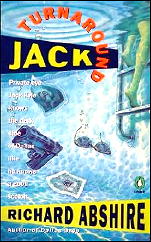
RICHARD ABSHIRE – Turnaround Jack. Morrow, hardcover, 1990. Penguin, paperback, 1992.

   According to the short biography inside the front cover, Abshire was a policeman for 12 years before becoming a real-life PI for two. And not so coincidentally, this is exactly why the activity in this mystery, the second recorded case of fictional PI Jack Kyle, is authentic enough to be — dare I say it? — boring.

RICHARD ABSHIRE Jack Kyle

   Which is by no means meant to be derogatory. In fact, quite the opposite. Most real-life PI work consists of endless hours doing nothing but watching, checking down leads, looking up information, and sitting and driving and sitting again.

   That’s just what the case is here, and it’s well into the second half of the book before anything at all out of the ordinary begins to happen.

   Kyle is hired to take some pictures of a rich man’s wife, and on page 127 he has turned in his report, along with some well-received video tapes. The client is very pleased.

   Case closed? No, sir. Seven pages later Kyle is worked over by a couple of professionals. A body is found, then two, and a customs agent suddenly seems to have disappeared.

   This is a hard-boiled detective story, and in spite of the slow beginning, the second half of the book is well worth waiting for. And so that you don’t get me wrong, let me hasten to add that even in the first half Abshire is nearly as witty in descriptive passages as Robert B. Parker, say, and it doesn’t drag. It speeds by almost as fast as a hot rod on roller skates. (This is NOT an example of the author’s wit.)

   Sometime in his past, Kyle earned his nickname — the book’s title — from his tendency to become involved in cases amply endowed with the inscrutable art of the double-cross, in its several and sundry forms.

   So it is with the story in this book. There are a couple of small glitches in the plot, but none, I dare say, that are even closely essential to the story line. They’re just enough to make you wonder why editors don’t bother to edit any more.

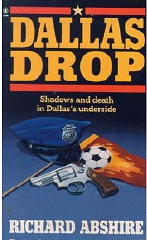
   The first Jack Kyle mystery was Dallas Drop (1989). Did a third one ever appear? If so, I’ve missed it, and from the evidence shown here, I certainly hope I haven’t.

— September 1993.


RICHARD ABSHIRE Jack Kyle

[UPDATE] 09-29-10.   There was a third one, as I suspected at the time, The Dallas Deception (1992), but that was it. No other cases for Jack Kyle besides these three, which may be a case of Too Bad, given my comments above.

   In the 1980s Richard Abshire was the co-author of two mystery novels with a series character called Charlie Gants, who according to one website, is an ex-homicide detective who as a PI of sorts investigates cases with a super-natural twist. In 1991 he and William R. Clair collaborated again under the name of Terry Marlow, producing one police novel, a thriller titled Target Blue.

   As Cliff Garnett, a house name, in 2000 Abshire wrote at least one of the “Talon Force” men’s adventure books, but he doesn’t appear to have written anything since.

    Back in January of 2009, I posted an article by Nicholas Flower about his role in creating new titles for Charles Williams’ crime novels when they were published in the UK by Cassell.

    The piece was updated in February, and in March cover images of five more dust jackets of books in the Cassell series were added, thanks to Bill Pronzini, along with new commentary about them by Nicholas.

    Cassell published fifteen Charles Williams thrillers, though, and until last week there were only twelve that were included in Nicholas’ article. And there things stood, until now, thanks to some helpful online booksellers who very kindly supplied us with images of the three that were missing. All fifteen covers are now part of that original post.

    I hope you’ll go back and take a look. You can find the post here. I think it’s worth the visit, or even a revisit!

                    — Steve

A REVIEW BY GEORGE KELLEY:


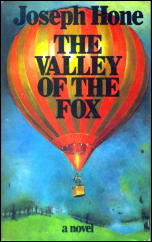
JOSEPH HONE – The Valley of the Fox. St. Martin’s Press, US, hardcover, 1984. Reprint paperback: Collier, US, 1989. First edition: Secker & Warburg, UK, hardcover, 1982.

JOSEPH HONE

   Joseph Hone has written some fine espionage novels — The Oxford Gambit, The Sixth Directorate and The Private Sector — so The Valley of the Fox comes as a surprise.

   Peter Marlow, retired spy featured in the earlier Hone books, marries a beautiful but mysterious widow named Laura whose anthropologist husband was killed in Africa. Laura has a daughter named Clare who doctors have pronounced “autistic” but who holds many surprises.

   Marlow’s life is idyllic until a masked man enters his house and kills Laura and attempts to kill Peter. Marlow, finding out he’s being framed fqr his wife’s murder, flees into the surrounding English countryside. There he meets a bizarre woman named Alice who helps him rescue Clare from the nearby hospital and allows Peter and Clare the run of her strange estate.

   The plot continues to twist and turn as Marlow investigates his dead wife’s past and the deadly secrets Clare holds. This is not an espionage novel in the conventional sense but Hone manages to pull off an off-beat novel about a retired spy in an incredible plot.

   Recommended!

— From The Poisoned Pen, Vol. 6, No. 4, Fall 1986.


   Bibliography [Taken from the Revised Crime Fiction IV, by Allen J. Hubin.]

HONE, JOSEPH. 1937– .
       The Private Sector (n.) H. Hamilton 1971. Peter Marlow.
       The Sixth Directorate (n.) Secker 1975. Peter Marlow.
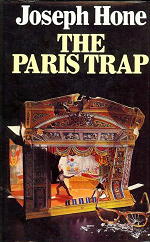
       The Paris Trap (n.) Secker 1977

JOSEPH HONE

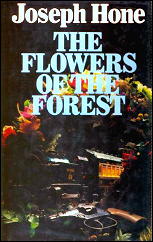
       The Flowers of the Forest (n.) Secker 1980. US title: The Oxford Gambit. Peter Marlow.

JOSEPH HONE

       The Valley of the Fox (n.) Secker 1982. Peter Marlow.

FIRST YOU READ, THEN YOU WRITE
by Francis M. Nevins


   During World War II John Creasey wrote dozens of thrillers set in London that were never published outside the UK — until decades later when, as a superstar of the genre, he revised them for US publication, cutting out all the vivid wartime atmosphere that made them special.

JOHN CREASEY Toff Is Back

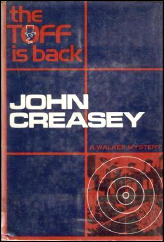
   Recently I picked up The Toff Is Back — first published in 1942 and, according to the copyright page, revised in 1971, two years before Creasey’s death — and found to my surprise that all the ambiance of a largely bombed-out London survived the revision intact.

   The Hon. Richard Rollison, a.k.a. The Toff, returns from military service in North Africa to find that a well-organized gang has been looting bombed jewelry shops on a grand scale and framing innocent residents of his beloved East End for their crimes.

   Over the years I’ve read, or rather tried to read, several revised Creaseys alongside the 1940s versions, and every time found the originals infinitely better. I’ve never seen the wartime version of this one but it reads as if it hasn’t been revised at all, for which I shout Hallelujah.

   In fact, even the occasional gaffes which are inevitable when a book is written at the rate of 10,000 words a day seem to have been preserved. The racket boss is named Barte Lee while other characters live in Bartley Square, and on page 54 we read “Very slowly and deliberately Lee leaned forward,” which reminded me of the hilarious “Everywhere a Lee Lee” song from 1776.

   Gaffes and all, I highly recommend this one to any reader who wants to be taken back, like viewers of the early seasons of the Foyle’s War series, to a London being nightly pulverized by Hitler’s Luftwaffe.

***

   Anyone who would like to sample Creasey’s unretouched WWII thrillers without hitting used book shops has a golden opportunity in store. His first five Roger West novels, originally published between 1942 and 1946, will be reprinted a few months from now by Battered Silicon Dispatch Box, the Canada-based publishing operation owned by George Vanderburgh, as the omnibus volume Inspector West Goes to War.

   I’ve written an introduction for the book and have just finished proofreading the computer-scanned texts of those novels. It was a tedious task with two capital T’s but there’s no other way I could have learned so much about the stylistic oddities of these chronicles of London during and immediately after the war.

JOHN CREASEY Holiday for West

   Quirks and all, the early West novels are still amazingly readable today. Unlike any other Scotland Yard series I can recall, these books are packed with vivid action scenes. One might almost be reading a series of old-time Westerns except for the fact that guns are sparingly used, both by the bad guys and the bobbies.

Pounding out those ten thousand words a day, Creasey couldn’t avoid perpetrating some Avalloneisms, but far fewer than in the works of the grand master of malapropisms, Mike Avallone himself.

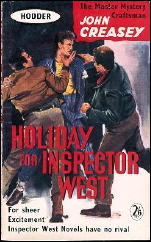
   One I found while proofreading is worth preserving. In Chapter 11 of Holiday for Inspector West (1946) Roger questions a female suspect and then her father, of whom Creasey says: “Like his daughter he had become a changed man.”

   As editor of this five-volume omnibus I’ve decided to substitute “person” for the last word of that sentence.

   Blatant mistakes of this sort, grammar-wise, usage-wise or otherwise, are being corrected, but I am not Americanizing any British terms: those four rubber doughnuts that are found on motor vehicles are called tyres, and when a car has engine trouble, the driver pulls into the kerb and looks under the bonnet.

   What you will read in Inspector West Goes to War is (except for those blatant slips) precisely what Creasey wrote at white heat as that war was raging and immediately afterward.

***

Between late June and late August 1939, during the first ten weeks that the 60-minute Adventures of Ellery Queen radio series was broadcast on CBS, each episode featured original background music composed and conducted by the soon to be famous Bernard Herrmann.

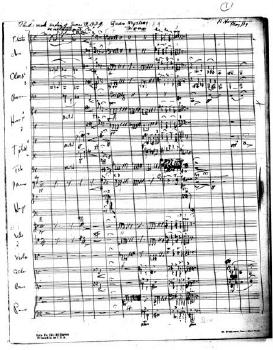
   None of those episodes survive, and the last time anyone heard what Herrmann wrote for the EQ series was 71 years ago. But today, thanks to the wonderworld of the Web, you can see some of the pages of Herrmann’s score on your computer screen:

BERNARD HERMANN    

   First, go to the Bernard Herrmann Society website. Click on “Talking Herrmann.” Enter the box at the bottom of the first page and, among the options given, click on “Topics for the Last Year.” Near the bottom of the fourth page is a thread entitled “Adventures of Ellery Queen 1939.” [This link, if it holds up over time, should take you there directly.]

   There lies the treasure, allowing those who can read a score and have an appropriate instrument to play some of Herrmann’s EQ music in their own homes.

   I wish I were one of that number. When I was a child my mother tried to make a pianist out of me but I resisted and today, sixty years later, I can’t read a note. Damn!

***

   The second and final Herrmann-Queen interface took place almost a quarter century later. Among the episodes of the second season of The Alfred Hitchcock Hour on CBS-TV was “Terror in Northfield” (October 11, 1963), based on Queen’s 1956 non-series novelette about a string of violent deaths on the exact same spot. [Hulu link.]

HITCHCOCK HOUR

   Harvey Hart directed from an adaptation by Leigh Brackett that dropped most of the detection in the Queen tale and stressed suspense. The puzzled deputy sheriff, the menaced local librarian and the mad farmer were played respectively by Dick York, Jacqueline Scott and R.G. Armstrong.

   Herrmann composed the score for this and several other Hitchcock Hour segments as well. May I still be alive and the owner of a decent pair of ears on the day when his scores for that series and others of the same period, like The Richard Boone Show and The Virginian, become available on CD.

REVIEWED BY BARRY GARDNER:


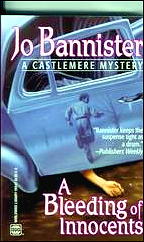
JO BANNISTER – A Bleeding of Innocents. Frank Shapiro & Liz Graham #1. St. Martin’s Press, US, hardcover, 1993. Macmillan, UK, hc, 1993. Worldwide Library, paperback, 1997.

JO BANNISTER Shapiro & Graham

   Jo Bannister has written other mysteries, and won an EQMM prize, but this is the first of her work that I’ve read. It’s also the first in a new series.

   The police force in Castlemere, England is in disarray. A Detective Inspector has been killed and a Detective Sergeant injured in what may have been a hit and run; or may, as the Sergeant believes, been a deliberate murder engineered by a local racketeer.

   Chief Inspector Shapiro brings in an old colleague, DI Liz Graham, to temporarily replace the slain DI, and she is greeted by the shotgun murder of a retirement home nurse. At the same time, she must try to work with the injured Sergeant, a difficult person who had a close relationship with his slain boss, and who is determined to pin the death on the racketeer he suspects.

   I have a predilection for British police stories, and I’m happy to say that this is a pretty good one. It isn’t of John Harvey or Reginald Hill caliber, but it’s competently done and well written. The third person narrative is straightforward, and shifts among the three police officers.

   Characterization is not really in depth, but sharp enough that Graham and the Sergeant are brought to life decently, though Shapiro was less well developed. The plot was the weakest link, but tolerable.

   I did think that the book ran on a bit at the end after the real denouement, with perhaps a little too much talk, but that’s a minor cavil. On limited exposure, I think Bannister fits comfortably in the middle of the pack with which she’s chosen to run.

— Reprinted from Ah, Sweet Mysteries #10, November 1993.


       The Shapiro & Graham “Castlemere” series —

1. A Bleeding of Innocents (1993)
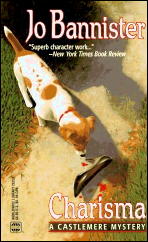
2. Sins of the Heart (1994) aka Charisma (US)

JO BANNISTER Shapiro & Graham

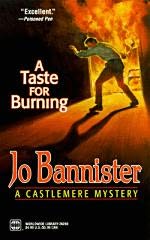
3. Burning Desires (1995) aka A Taste for Burning (US)

JO BANNISTER Shapiro & Graham

4. No Birds Sing (1996)
5. Broken Lines (1998)
6. The Hireling’s Tale (1999)
7. Changelings (2000)

   Jo Bannister has also written four books in her Dr Clio Rees (Marsh) and Harry Marsh series; two books with Mickey Flynn; two in a series about columnist Primrose “Rosie” Holland; and nine books featuring Brodie Farrell, a woman who “finds things for a living.” She’s also written nine standalone novels, not all of which are crime related.

Reviewed by DAVID L. VINEYARD:         


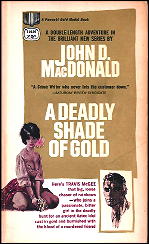
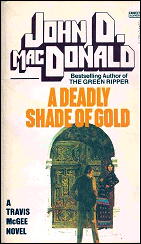
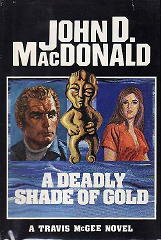
JOHN D. MacDONALD – A Deadly Shade of Gold. Gold Medal d1499, paperback original, 1965. UK edition: Robert Hale, hardcover, 1967. First US hardcover edition: J. B. Lippincott, 1974. Reprinted many times.

    “Drink to me my friend. Drink to this poisonous bag of meat named McGee. And drink to little broken blondes, a dead black dog, a knife in the back of a woman, and a knife in the throat of a friend. Drink to a burned foot, and death at sea, and stinking prisons and obscene gold idols. Drink to loveless love, stolen money, and a power of attorney, mi amigo. Drink to lust and crime and terror, the three unholy ultimate’s, and drink to all the problems that have no solution is this world, and at best a dubious one in the next.”

JOHN D. MacDONALD A Deadly Shade of Gold

    The fifth of the Travis McGee series, and the first labeled a double novel ( or what would become the standard length for entries in the series), A Deadly Shade of Gold is probably the most interesting book in the McGee canon historically for undermining virtually everything critics, fans, and attackers tend to say (and repeat endlessly) about John D. MacDonald and McGee.

    “Perhaps you are an angel of death … the branch that breaks, the tire that skids, the stone that falls. Perhaps it is not wise to be near you.”

    In this book McGee not only doesn’t save a woman with redemptive sex, he doesn’t save one at all, suffers guilt over taking advantage of an emotionally vulnerable woman ( “Much of lust is a process of self delusion … back in my own bed I said surly things to jackass McGee about taking rude advantage of the vulnerable, about being a restless greedy animal …”), flat out turns down one such woman’s offer (or Meyer’s on her behalf), is rescued by an attractive woman who initially doesn’t want to have sex with him, watches their relationship deteriorate, and goes home sadder but wiser.

    If this is what some critics call the swinging sixties lifestyle as Hefner and Playboy defined it I must have missed a few issues or misread them. In addition he kills a sunbunny ( “… genus playmate californicus …” who is trying to kill him “Hero McGee wins the shootout. He’s death on sunbunnies.”).

    This isn’t as unusual as it seems. Critics of Mickey Spillane, Ian Fleming, and even Ernest Hemingway all tended to write a good deal of nonsense about their work based on a superficial and often unsympathetic reading. If it were only critics who made these incomplete statements it would be bad enough, but fans don’t seem to have read the books either in many cases.

    McGee here views himself with as jaundiced an eye as any contemporary bachelor in the post feminists world and judges himself more harshly than any critic could ( “We are all guilty. Also, we are all innocent, every one.”). If there is anything here paternalistic, it’s McGee’s constant worry that he will do more harm than good to the women in the case — and all the innocents, and even some of the guilty, who tend to get smashed along the way.

    MacDonald doesn’t think women are equal to men — if anything he thinks they are superior ( “I got the hell away from her before I had more awareness than I could comfortably handle.”)

    One fan-site that calls MacDonald’s books “classy trash” says more about the fan than MacDonald. Judith Krantz was classy trash. John D. MacDonald was a major American voice working within the boundaries of popular fiction.

    Classy trash seldom bears re-reading, MacDonald’s work begs it. Ian Fleming was classy trash, and glad to be that, but MacDonald had higher aspirations and achieved them even within the confines of a series character like McGee. Calling his work classy trash because it appeared in paperback originals is singularly narrow.

JOHN D. MacDONALD A Deadly Shade of Gold

    Hemingway wrote for Esquire, Fitzgerald the Saturday Evening Post, and Nabokov for Playboy — Mackinlay Kantor, Stephen Becker, Robert Wilder, and Vivian Connell all wrote paperback originals (and all for Gold Medal) — you can’t always judge a writer by his milieu.

    A Deadly Shade of Gold opens with the death of McGee’s old friend Sam Taggart, who has just returned to Florida looking to reconnect with Nora Gardino ( “… a lean dark vital woman …”), an attractive local boutique owner he walked away from when he went to Mexico.

    With Taggart’s brutal murder McGee finds himself drawn into a case that involves some ancient gold figures Sam has found. The trail leads him to an auction house in New York where he sleeps with a young woman ( “With a brassy forlorn confidence …”) to get information and feels exploited and exploiter for it ( “The physical act, when undertaken for any for any motive but love, and need, is a fragmenting experience.”).

    This leads him with Nora to a small (fictional) Mexican fishing village ( “For all the years the generations of them, in the dust and mud and sea smell, had lived and worked and died in this coastal pocket …”) where he is drawn into the illegal trade in antiquities run by a ruthless American, and the schemes of some violent Cuban exile groups.

    McGee makes some forays against the American behind the racket ( “… a dull, self-important, rich, silly, sick little man.”), meets a whore who loved Taggart and who is quite human, real and lacking a heart of gold, emotionally smashes an aging playgirl to find out what he needs, feels guilt about exploiting Nora’s grief sexually and gets Nora killed (or blames himself for it), returns to Los Angeles, meets the fabulous Connie ( “I have a very rational approach to my needs and desires.”), who agrees to help him but wants nothing to do with him as a sex partner ( “It would take us too long to find out who was winning, and in the process I might lose.”) because they would fight for control of the situation, avenges Sam, scores a nice profit, damn near gets killed, is rescued by Connie ( “I do not think she expected anything for herself …”), has a brief affair with her that is redemptive for neither of them, and ends up fleeing back to Florida before all that is left are bitter memories ( “There is one thing Senor McGee that is the exact opposite of death.”).

    All that remains of McGee is an ironic Knighthood, a spavined steed, second class armor, a dubious lance, a bent broadsword, and the chance, now and again, to lift into a galumphing charge at capital E Evil, brave battle oaths marred by an occasional hysterical giggle.

    Remind me again about the jovial boat bum who saves all the damsels with his charm and sexual charisma and patented sexual healing while living the Playboy lifestyle:

    “The guilty have all been punished?”

    “Yes, along with the innocent.”

    Are we reading the same books?.

    And always there are the little moments many of us read MacDonald for, snippets from here and there:

JOHN D. MacDONALD A Deadly Shade of Gold

    A Southern pusgut who fancied himself a liberal.

    She could have stood there forever, Lot’s wife.

    … the challenging promise of great feminine warmth.

    A smear of blood has a metallic smell. It smells like freshly sheared copper,

    “She is disaster prone, compelled by a bruised heart.”

    At sea level the heat was moist, full of the smell of garbage and flowers and a faint salty flavor of the sea.

    It is a bedroom gun, with a brash bark like an anxious puppy.

    From the shadowy corner came the sound of the bride’s febrile chuckle, and soon he walked out, obsessed with the legality of it all, the permissive access, and all the fishermen at the bar turned slow heads to appraise the departing ripeness of her, and seemed to sigh.

    Anxiety makes dreams all to vivid.

    She was not pretty. She was merely strong, savage, confident …. and muy guapa .

    She was not legend. She did not have a heart of gold, or a heart of ice.

    … the deep, ancient, rhythmic affirmations of the flesh.

    The ones with no give, the ones with the clear little porcelain hearts shatter.

    “His name is Lagarto. Lizard. Hammer-headed thing with a mean eye.”

    … the slightest touch would ease her out of that jump suit like a squeezed grape.

    These are just a few at random, simply page flipping. This too is another reason to read MacDonald, and why he is not simply classy trash, and why attention should be paid, and the memory of his best work should be accurate and clear, and not the mere repetition of what we have read elsewhere and been told and accepted without testing and knowing for ourselves.

    He, and we, deserve better.

    John D. MacDonald was the only writer to ever win the National Book Award in the mystery category (for The Green Ripper) it is time we recall who he was, what he did, and admit his achievements go beyond just entertaining us. He wrote a portrait of a place and time and world as real and as accurate as has ever been written, and it is our loss if we forget that or lessen it because he is not as politically correct as some would like.

    Much of what he had to say about the American character and American society is as true and accurate today as it was when it was written, and while we should admit his flaws and that he was a man of his world and time, it is past time to discard our own prejudices and honestly evaluate his remarkable contribution.

    He was a remarkable writer for his time, or any time. We are only cheating ourselves if we throw him out because we changed while failing to recognize that in many ways the world he showed us has not.

Reviewed by DAVID L. VINEYARD:         

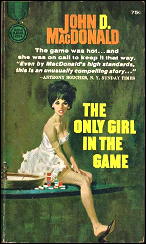
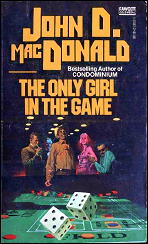
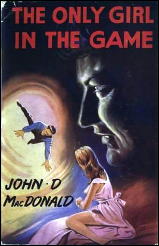
JOHN D. MacDONALD – The Only Girl in the Game. Gold Medal s1015, paperback original; 1st printing, July 1960. First hardcover edition: Robert Hale, UK, 1962. Reprinted many times.

If there was justice in the world, writers would rise each morning and bow three times in the direction of John D. MacDonald’s grave. If that seems a bit extreme, read this description of a typical night in a Las Vegas casino, better still “listen” to it, its cadences and its rhythms:
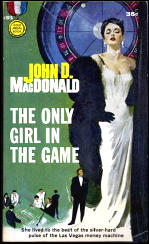
JOHN D. MacDONALD The Only Girl in the Game

    Casino play was exceptionally heavy. All tables were in operation, and the customers stood two and three deep around the craps and roulette. The murmuring crowd noises blended with the chanting of the casino staff, the continuous roar of the slots, the music from the Afrique Bar and the Little Room, and the muffled burst of applause from the Safari Room where the dinner show was coming to an end. As he worked his way through the throng, Hugh was once again aware at how truly joyless these casino crowds really were.

When play was this heavy there was a special electric tension in the air, but there was something dingy about it. There was laughter, but no mirth. This was the raw sweaty edge where luck and money meet in organized torment. Money is equal to survival. So it is as mirthless as some barbaric arena where slaves are matched against beasts. People in casinos ignore each other. It is a place where each man is intensely and desperately alone, but you can still play Casino games, even online by using  this comparison of top 10 online casino here.

There is a tendency to discuss MacDonald’s work as if he was yet another suspense novelist, and while he wrote some fine suspense novels, I have always thought of him as first and foremost a novelist. His concerns are those of the mainstream of American literature, and while few writers had his skill or ability at creating suspense, what sets him apart from almost every other writer in the field in that novelist’s eye.

His special skill was not only in creating suspense and character but illuminating the darker byways of the everyday world of business and life. His plots and characters intersect at the place where the day to day world of business breaks down and lines are crossed morally and criminally. No one ever took a more jaundiced or more clear eyed view of the morality — and lack of it — of the average American business enterprise, whether it be a Florida real estate deal gone bad, a con game out of control, or the operation of Vegas casinos.

Vegas and its casinos are the perfect milieu for both MacDonald’s savage moral eye and his very human and sometimes morally fragile characters. Hugh Darren, the hero of this novel, is the assistant manager at the Cameroon’s hotel, one of the big casinos. He is ideally suited to his job, a person with a sharp mind, people skills, and a clear eyed view of the world.
JOHN D. MacDONALD The Only Girl in the Game

The Cameroon was once the worst run hotel on the strip. Hugh changed all that. But this is a city and a world where success isn’t measured just by results. Sometimes it is measured by whose knife is in your back or at your throat.

Hugh has just run afoul of Max Haines, who runs the casino side of the operation who “knows a lot about how things run around here.” He knows things about their boss Al Marta too, and about secrets the manager of the hotel might not know — or care to know.

Hugh wants to run the hotel at a profit. Max is old school and believes the hotel should lose money to better support the casino, the real source of money. And making sure the margins for the casino stay where they always have been is a job Max does, and boss Al Marta turns his head from, at any cost.

As might be expected, there are two notable examples of MacDonald women in this one. First is Betty Dawson, “a tall brunette with unusually dark blue eyes, and a loveliness of face that was reminiscent of Liz Taylor.” Betty is a singer (“I’ve got no voice and I can’t play much piano …”) who works in one of the hotels rooms and has recently fallen hard for Hugh, the kind of stand up guy she never had in her life before: “We just didn’t have this kind of thing in stock when you first started to trade with us, Betty,” is how she sees it:

    Don’t ever love me, Hugh. Just let me love you. I’m ready for hurt. I’m braced for it. You are worth too much to ever fall in love with what I have become.

Betty also acts as a hostess at the hotel. It’s not exactly prostitution — she doesn’t have to sleep with customers — but she does have to lead them on. She knows who and what she is, she doesn’t yet know what it will cost her beyond what it has already cost, her self respect, and something of her heart and her soul.

But for the time being Betty is the happiest she has been in a long long time, and anyone who has ever read John D. MacDonald should know that excess joy is never a good sign.

Sex is one of MacDonald’s great themes, not only the healing power of good sex, but the destructive dangers of the other kind. He sees it both as a blessing and a curse, a redemption and a damnation. His heroes tend to redeem the women in their lives both with sex and with compassion, but it is never cut and dried.
JOHN D. MacDONALD The Only Girl in the Game

Too much has been made over the redemptive aspect of sex in MacDonald’s books, and not enough perhaps of the awful toll it sometimes takes. Contrary to what some critics like to suggest, a good man is not always enough to save a MacDonald heroine, and even in the McGee books there is a stubborn refusal to allow easy answers.

His heroes are often catalysts in the life of the women in his books, but MacDonald seldom suggests that is enough. It is only one part of healing, one part of life, not everything.

Some critics would do better to actually read MacDonald, rather than simply repeat what they have read about him.

The other MacDonald woman is Vicky Shannard, “… in her thirtieth year, a cuddly dumpling, a pwetty widdle pigeon, a blonde, pink and white, cushiony little cupcake …” who parlayed a history of stripping and living as a professional guest to marriage to Temple Shannard a moneyed older man from New Providence, a golden tongued promoter who operates in the Bahamas and is now in Vegas. But lately their marriage is drifting apart and coming to the Cameroon isn’t going to help.

Vicky is a type MacDonald is never particularly kind to, but he does draw them as they are with due prejudice, but also with an honest eye. She isn’t a monster and Tempe isn’t a victim. They are just people who can’t overcome who and what they are.

At heart John D. MacDonald has the pure American streak of the Calvinist about him. He is attracted to and repelled by the glamour of money and power. Glitter, sin, and easy money bring out the savage in him even as he cannot ignore them or stay away.

All of these people might not create quite so much drama anywhere else, but as Hugh explains to Vicky in a statement that might be the theme of the novel:

    “Vicky, dear, when you give people the maximum opportunity to make damn fools of themselves, sexually, financially, and alcoholically, in an environment that makes movie sets look like low-cost housing all sorts of things can happen.”
JOHN D. MacDONALD The Only Girl in the Game

Finally there is Homer Gallowell of Fort Worth, Texas, a figure that appears in many MacDonald novels in many forms. Homer is a canny old coot, a player and an operator, the sane voice of a man who “had the hard bitten look of a man who had spent the first half of his life sleeping on the ground.”

Gallowell is the kind of individualist who MacDonald always champions over the corporate mind of any business enterprise, smart, tough, straight, and sentimental about only two things — good men and women and good booze.

He’s a fairly common figure in business related novels of the fifties and sixties, the last of a breed before buttondown minds accompanied button-down collars, before the bottom line became the moral standard.

Homer has come to Vegas and the Cameroon to beat the house at its own game.

Homer is an old friend of Betty Dawson too, which is why Max Haines thinks she may be able to play him, because Homer is the one thing Vegas fears more than card counters and con-men — an intelligent gambler with enough money to give them a run for their money, to play their odds, and to win. Max had used Betty for this kind of thing before:

    “Now that wasn’t so bad was it?”

“It was as easy as cutting your own throat, Max.”

To give him full credit, MacDonald makes the operations and philosophy of a casino and the machinations of Homer, Max, Al Marta, and Tempe Shannard as suspenseful as any spy novel or bank heist. No one wrote as compellingly about the high pressure world of money and power.

As the strands of the novel tighten into a single skein, the center falls apart as it so often does in MacDonald’s novels. The sham that is Tempe and Vicky’s marriage begins to shatter, Betty’s past begins to catch up with her, and Hugh Darren’s basic morality and honesty is about to come in conflict with Vegas version of the bottom line.

    It seemed to Hugh as he sat there that this was a very bad place on the face of the earth, that it was unwise to bring to this place any decent impulse or emotion, because there was a curiously corrosive agent adrift in this bright desert air. Here, attuned to the constant clinking of the silver dollars in forty thousand pockets, honesty became watchful opportunism, friendship became a pry bar, love turned to licence, and legitimate sentiment drowned in a pink sea of sentimentality.
JOHN D. MacDONALD The Only Girl in the Game

It would not be a good thing to stay in such a place too long, because you might lose the ability to react to any other human being save on the level of estimating how to use them, or how they were going to use you. The impossibility of any more savory relationship was perfectly symbolized by the pink-and-white-and-blue neon crosses shining above the quaint gabled roofs of the twenty-four-hour-a-day marriage chapels.

We are all familiar with MacDonald’s use of color- coded themes, but someone should write a paper on his use of the color pink. He seems to embody all the sins and flaws of the American Dream in the color pink.

The crisis comes when Betty Dawson, her own morality awakened by being asked to play Homer, defies and crosses Max Haines, and through her Hugh Darren faces his own moral and ethical crisis. But when Max and Al push Hugh too far and hit him too hard, he reacts in the true manner of a MacDonald hero and with a little help from Homer …

    “What is the one thing in the world most important to these fellers? What do they love the best.”

“Money.”

“And what’s the greatest weapon in the world?”

“Money.”

Hugh and Homer bring down Max Haines and his pals, but at a cost they would neither of them have cared to pay. Some heroines can’t be saved and some dragons are never really slain.

    The cabs are bringing the marks in from McCarran Field to fill up the twelve thousand bedrooms. At all the places the gaudy roster of the strip — El Rancho, Sahara, Mozambique, Stardust, Riviera, the D.I. Sands, Flamingo, Tropicana, Dunes, Cameroon, the T-Bird, Hacienda, New Frontier — the pit bosses are watching all the money machines.

Smoke, shadows, colors, sweat, music, the bare shoulders of lovely women, the posturings of the notorious — and that unending, indescribable, chattering roar of tension and money, I shall never see it again, but I will always know it is going on, without pause or mercy, all the days and nights of my life.

The names have changed, the strip is bigger and gaudier than ever, more a playground and fantasy than ever, but MacDonald’s savage critique remains as true and as well observed as before. No one ever looked harder, longer, or more honestly at the phony sentiment, cruel lies, and emotional paucity of big money and big business.

Whether in the standalone novels or the Travis McGee books, whether writing about crime or business that deteriorates into crime, his great theme was an anger and even grief over the soul-numbing results of wounded people in a society with too few second chances.

MacDonald, in the true tradition of the American novel, and not just the hard-boiled school, still echoes Twain’s Huck Finn at the end of his adventures. “I been there before.” That echoes across American literature, that sense of loss and frustration, that realization that life indeed goes on, and we have all “been there before” and will be there again.

« Previous PageNext Page »