Authors


   I was working in Part 4 last week. These are consecutive entries in the S’s.

SHEPPARD, STEPHEN. 1945- . Ref: CA. Born in England. Actor & painter; author of three novels included in the (Revised) Crime Fiction IV, including the one cited below.
      Monte Carlo. TV movie: CBS, 1986 (scw: Peter Lefcourt; dir: Anthony Page)
Monte Carlo

SMITH, CRAIG (BRIAN). 1947- . Note: Separate this entry from the one following; they are two different authors. Besides the title below, his only entry in the (Revised) Crime Fiction IV, this Craig Smith was the screenwriter for three crime films made between 1996 and 2002.
      Ladystinger. Crown, US, hc, 1992. Setting: New Orleans, Jamaica. (Add the latter.) TV movie: Showtime, 1993, as Scam (scw: Craig Smith; dir: John Flynn). Nominated for an Edgar in 1993 as Best First Novel. [A mistress of the scam may get herself double-looped by her own chicanery.]

SMITH, CRAIG (S.) 1950- . Ref: CA. Ph.D. in philosophy from the University of Southern Illinois; lives in Switzerland. Note: Separate this entry from the one preceding; they are two different authors.
      Silent She Sleeps. Heinemann, UK, hc, 1997. US title: The Whisper of Leaves. Setting: Illinois; academia. [Innocent man is framed by corrupt cop.]
      _The Whisper of Leaves. Southern Illinois University Press, pb, 2002. US title of Silent She Sleeps.
Craig Smith Whisper of Leaves

SMITH, WILBUR (ADDISON)
      Wild Justice. TV movie: Syndicated, 1993. Also released as Covert Assassin and as Dial. (scw: J. H. Carrington; dir: Tony Wharmby)

SOHMER, STEVE
      Favorite Son. TV movie [mini-series]: NBC, 1988 (scw: Steve Sohmer; dir: Jeff Bleckner)

SPECHT, ROBERT. 1928-1997. Ref: CA. Editor; free-lance TV writer and story editor. Of two novels written, one is included in the (Revised) Crime Fiction IV. See below. This constitutes the author’s complete entry.
      The Soul of Betty Fairchild. St. Martin’s, hc, 1991. Setting: South Carolina. Add TV movie: NBC, 1997, as NightScream (scw: Eugenia Bostwick-Singer, Raymond Singer, Gary Tieche; dir: Noel Nosseck). [Twenty-four years after Betty Fairchild is murdered, a young woman shows up who is identical to her in appearance and behavior, and seems to suffer from multiple personalities.]

SPEIGHT, RICHARD (DOBBS). 1940- . Trial lawyer living in Nashville, TN. His son, Richard Speight Jr., is an actor currently [2007] in a recurring role on the TV show Jericho. Author of two books listed in the (Revised) Crime Fiction IV, one of which is cited below.
      Desperate Justice. TV movie: ABC, 1993, as A Mother’s Revenge; also released as Desperate Justice (scw: John Robert Bensink; dir: Armand Mastroianni)
Desperate Justice

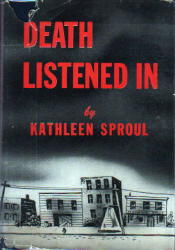
SPROUL, KATHLEEN. 1903?-1977? Author of five detective novels included in the (Revised) Crime Fiction IV. Series sleuth Dick Wilson appears in the four published by Dutton between 1932 and 1935; covers for one of these is shown below. Her fifth and final mystery is listed immediately thereafter.
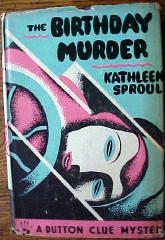
Kathleen Sproul

      Death Listened In. Phoenix Press, hc, 1946. Add setting: Midwest. Said Anthony Boucher in the San Francisco Chronicle: “Passable enough up to the ending, which hinges upon a device of such monstrous improbability that it makes Buck Rogers look strictly scientific.”
Sproul- Death Listened IN

   I’ve been working with Part 9 yesterday and today, this time more or less in the A’s, but things quickly branched out from there:

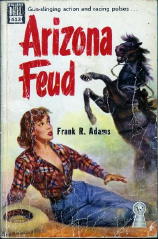
ADAMS, FRANK R(AMSEY). 1883-1963. Chicago reporter; writer of songs and screen plays. Also the author of eight mystery and adventure novels included in the (Revised) Crime Fiction IV, two marginally. One of these was reprinted in paperback by Dell in 1950 as western fiction; see below. One other book by Adams was purely a western: Gunsight Ranch (Doubleday Doran, hc, 1939).
      Arizona Feud. Doubleday Doran, US, hc, 1941. Harrap, UK, 1944. “The homecoming of a young Arizonian revives a blood feud three generations old.”

Adams- Arizona Feud

ANDREAE, PERCY. 1858-1924. Confirm birth date and add date of death. Influential anti-prohibitionist in the US in the 1900s. Between 1894 and 1902, the author of five novels included in the (Revised) Crime Fiction IV, including the two below. Two of the other titles are indicated as being only marginally crime-related.
      Stanhope of Chester. Smith Elder, UK, hc, 1894. Rand McNally, US, pb, 1896. The Bookman (Vol. III, No. 1, March 1896): “The most notable ghost story that has appeared for many years.”
      The Vanished Emperor. Ward Lock, UK, hc, 1896. Rand McNally, US, 1896. Alternate history novel set in Europe. “Sir John Templeton solves the case of the missing German emperor.”

ANDREWS, CAROLYN. Pseudonym of Carolyn Hanlon, 1940- , q.v. Add real name and year of birth. Under this pen name, a writer of romance fiction, with one title included in the (Revised) Crime Fiction IV. See below. [Other pen name: Cara Summers; not used for criminous fiction before the year 2000.]
      The Marriage Curse. Harlequin, pb, 1996. [A lovely innkeeper determined to solve the mystery surrounding her resident ghost clashes with her overly solicitous landlord.]

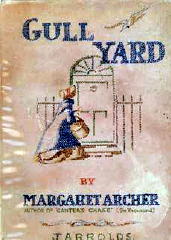
ARCHER, MARGARET. Author of six crime novels listed in the (Revised) Crime Fiction IV, including the two below. Published in the UK between 1945 and 1953, none appeared in the US.
       Gull Yard. Jarrolds, UK, hc, 1947. [Nellie Greene, the new governess to the Rev. Arthur Cagg’s household, arrives in London’s Gull Yard during early Victorian times.]

Archer: Gull Yard

       The Silent Sisters. Jarrolds, UK, hc, 1950. Add setting: England.

ARMSTRONG, RAYMOND. Pseudonym of Norman (Harold) Lee, 1898-1964, q.v. Under this pen name, the author of 13 mystery novels included in the (Revised) Crime Fiction IV, all published only in the UK between 1947. The series characters who appeared in these books include J. Rockingham Stone, Inspector Dick Mason, and Laura Scudamore, sometimes individually and on occasion, all three in the same books. It must be Laura Scudamore who is known as “The Sinister Widow,” as the phrase is part of the title in all seven books in which she appears.

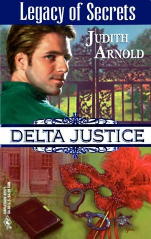
ARNOLD, JUDITH. Pseudonym of Barbara J. Keiler, 1953- , q. v. Add real name and year of birth. Lives in a small town near Boston. Under this pen name, a writer of romance fiction with two titles in the (Revised) Crime Fiction IV, one marginally. See below. [Other pen names: Ariel Berk, Thea Frederick; neither was used for criminous fiction through the year 2000.]
      -Legacy of Secrets. Harlequin, pb, 1998. Setting: Louisiana. [Book 11 in the Delta Justice series.]

Arnold: Legacy of Secrets

      A Stranger’s Baby. Harlequin, pb, 1996. Setting: Maryland.

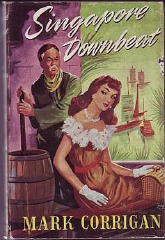
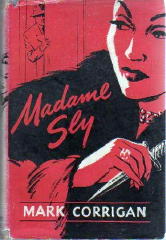
CORRIGAN, MARK. Pseudonym of Norman (Harold) Lee, 1898-1964, q.v. Under this pen name, described online as the author of “30 mystery/detective novels with series character Mark Corrigan of US Intelligence who, with sidekick Tucker Maclean, has first-person romantic adventure thriller experiences in exotic locations.” Two of these are shown below.
         Mark Corrigan: Singapore Downbeat

      Corrigan- Madame Sly

HANLON, CAROLYN. 1940- . Pseudonym: Carolyn Andrews, q.v. Add this entry with the author’s real name and year of birth. [Other pen name: Cara Summers; not used for any criminous fiction before the year 2000.]

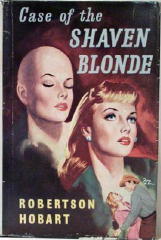
HOBART, ROBERTSON. Pseudonym of Norman (Harold) Lee, 1898-1964, q.v. Under this pen name, the author of four mystery novels included in the (Revised) Crime Fiction IV. Series character Inspector Grant Vickary appears in two of them; the setting for each is Australia. One of these is shown below:

Hobart- Shaven Blonde

KEILER, BARBARA J. 1953- . Pseudonym: Judith Arnold, q.v. Add this entry with the author’s real name and year of birth. [Other pen names: Ariel Berk, Thea Frederick; neither was used for criminous fiction through the year 2000.]

LEE, NORMAN (HAROLD). 1898-1964. Correction of dates & addition of middle name. Add as pseudonyms: Raymond Armstrong, Mark Corrigan, Robertson Hobart, qq.v. Also add the titles indicated with a (*) below. The following is now the complete entry in the (Revised) Crime Fiction IV for the author under his own name. (Others novels appear to be adventure or sea stories only.)
      -Deputy Wife. Mitre, UK, pb, 1946.
      The “Four Winds” Mystery. Mitre, UK, pb, 1946.
      Peril at Journey’s End. Foster, UK, pb, 1947.
      (*) Ship of Adventure. Skilton, UK, 1948. Setting: Ship.
      (*) The Terrified Village. Lutterworth, UK, hc, 1947. Setting: England, 1800s. Subtitle: A Tale of the Kent and Sussex Smugglers. [Historical tale based on the exploits of the Zack o’Lantern gang, in which the son of a London lawyer falls in with smugglers.]

LEE, NORMAN. 1905-1962. Delete this entry. This eliminates an apparent second Norman Lee whose presumed pseudonyms are now correctly attributed in the entry above.

   I was working in Part 9 yesterday, primarily in the L’s, when I came across a pair of authors who are twin sisters, a fact that hadn’t been pointed out before.

BURFORD, PAMELA. 1954- . Add date of birth and married name: Pamela Burford Loeser, q.v. Twin sister of Patricia Ryan, q.v. Under her maiden name, the author of many romance novel, primarily for Harlequin and its various imprints. Two of them are included in the (Revised) Crime Fiction IV. See below.
       His Secret Side. Harlequin, pb, 1996. Silhouette, UK, pb, 1998. [Investigating her best friend’s murder in Vermont, the last thing a woman expects is to be both attracted to and fearful of the small town’s doctor.]
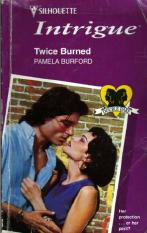
      Twice Burned. Harlequin, pb, 1997. Silhouette, UK, pb, 1998. Setting: New York. [A young woman determined is forced to accept help from an FBI agent who wants to keep her locked away and safe.]

Pamela Burford- Twice Burned


HOPWOOD, BRENDA CECILIA. 1878-1959. Pseudonym: Patrick Leyton, q.v.

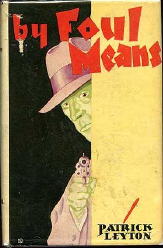
LEYTON, PATRICK. Add: pseudonym of Brenda Cecilia Hopwood, 1878-1959, q.v. Under this name, the author of 20 crime thrillers published in England between 1925 and 1948. Two were reprinted in the US; one is shown below. Note: This discovery was made by John Harrington, who has also found evidence that around 1919 the author legally changed the family name from Gregge-Hopwood to Hopwood only.

Patrick Leyton- By Foul Means


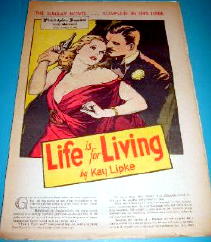
LIPKE, KAY. 1896- . Full name: Kathleen Bellows Lipke. Add year of birth. Author of one hard-to-find mystery novel included in the (Revised) Crime Fiction IV. See below. Another novel, Life Is for Living, appeared in the Philadelphia Inquirer book section on December 27, 1936; it appears to have criminous content.
      Rain on the Roof. Dial Press, hc, 1931. Methuen, UK, hc, 1932. Setting: California.

Lipke- Life Is for Living


LOEWENKOPF, SHELLY (ALAN). ca.1931- . Add middle name and tentative year of birth. Co-author of two books in the long-running Nick Carter paperback series, both included in the (Revised) Crime Fiction IV. See below.
       _Arms of Vengeance [as by Nick Carter]. Co-authored by Dennis Lynds. Jove, pb, 1989. [#255]
       _Law of the Lion [as by Nick Carter]. Co-authored by Dennis Lynds. Jove, pb, 1989. [#252]

LOESER, PAMELA BURFORD. 1954- . Add date of birth and married name of Pamela Burford, q.v.

RYAN, PATRICIA (née BURFORD). 1954- . Add date of birth and maiden name. Twin sister of romantic fiction writer Paula Burford, q.v. Also a writer of romances, two of them included in the (Revised) Crime Fiction IV. See below. As P. B. Ryan, later the author of a series of post-Civil War historical mysteries featuring Boston governess Nell Sweeney, the first being Still Life with Murder (Berkley, pb, 2003).
      A Burning Touch. Harlequin, pb, 1996. Mills, UK, pb, 1996. Setting: New Jersey. [India Cook offers her services to the police department; detective Jamie Keegan knows all about con artists.]
      Silken Threads. Topaz, hc, 1999. Setting: London, 1100s. [Graeham Fox is on a secret mission: rescuing his lord’s illegitimate daughter from the clutches of her abusive husband.]

Patricia Ryan- Silken Threads

FIRST YOU READ, THEN YOU WRITE
by Francis M. Nevins

   In the first edition of Cornell Woolrich’s The Bride Wore Black (1940), each of the novel’s five parts opens with a motto, whose respective sources are Rodgers & Hart, Guy de Maupassant, Cole Porter, and de Maupassant twice more. In the first paperback edition (Pocket Books #271, 1945), the first and third of these are dropped and replaced by lines attributed respectively to Poe and the social philosopher Herbert Spencer. The Poe couplet at the beginning of Part One reads as follows:

The Black Angel         How silent is the night — how clear and bright!
         I nothing hear, nor aught there is to hear me.

   Not long ago an Italian author who is preparing an anthology of essays on Woolrich emailed me to ask if I knew the source of that couplet, which doesn’t appear in any known poem of Poe’s.

   Splitting the first line into its component parts and calling on trusty Google produced one and only one hit. According to www.authspot.com, the quoted matter comes from the first verse of The Murderer, which is billed as an unpublished poem by Edger (sic) Allen (sic) Poe, rewritten (with many other misspellings) by one coyote103 and posted last March. But lines I quoted above must have been published before 1945 or whatever copyright-paranoid munchkin at Pocket Books substituted them for Woolrich’s Rodgers & Hart quotation couldn’t have known about them.

   A later email from my Italian correspondent solved the problem. The quoted couplet is part of a 70-line fragment first published almost forty years after Poe’s death in George W. Conklin’s Handy Manual (Chicago, 1887). No scholar today believes they were written by Poe but the first three lines ( “Ye glittering stars! How fair ye shine tonight/And O, thou beauteous moon! Thy fairy light/Is peeping thro those iron bars so near me”) are quoted in Thomas Ollive Mabbott’s definitive edition of Poe’s poetry (Harvard University Press, 1969).

   How Pocket Books came across them more than a quarter century earlier remains a mystery.

***

Let Us Live   The year The Bride Wore Black first came out is commonly considered the year when film noir came into being. But the more movies I see from the years immediately preceding 1940, the more I tend to question that consensus. Turner Classic Movies recently and for the first time ran Let Us Live (Columbia, 1939), directed by John Brahm and starring Henry Fonda and Maureen O’Sullivan.

   The storyline is pure Woolrich — perverse coincidence and police pressure on witnesses lead to two guys down on their luck being falsely convicted for bank robbery and murder and precipitate a race by the desperate fiancee of one of them to find the real criminals before it’s too late — and the visuals are as shadowy and menacing as anything in the downbeat classics of the Forties. If this isn’t film noir, toads fly.

***

The Dark Page   Devotees of films noir and their fictional sources will want to check out Kevin Johnson’s The Dark Page: Books That Inspired American Film Noir, 1940-1949. In this coffee-table book, recently published by Oak Knoll Press, each right-hand page is devoted to a lush full-color reproduction of the dust-jacket from one of the novels or story collections which was the source, sometimes very remotely, for a film noir from the Forties. Each left-hand page contains a technical description of the jacket and brief comments on the relevant book and film.

   Mr. Johnson, the owner of Baltimore’s Royal Books — whose website, www.royalbooks.com, is worth checking out — is working on a companion volume which will deal with the literary sources of various films noir released between 1950 and 1965. I understand he ll be present at NoirCon, which will be held in Philadelphia early in April. That website (www.noircon.com) is worth checking out too.

***

   Our Poetry Corner guest star for today is A. H. Z. Carr. Anyone remember him? He was born in 1902 and his early stories appeared in Harper’s, Saturday Evening Post and other top general fiction magazines of the Thirties, but he first registered on mystery readers’ radar when his “The Trial of John Nobody” was published in Ellery Queen’s Mystery Magazine (November 1950).

The Mighty Quinn   His fourth EQMM original, “Tyger! Tyger!” (October 1952), is perhaps the finest short crime story to deal centrally with poets and poetry. Malcolm Ridge, struggling to express his feelings about the Atomic Age, becomes prime suspect in the murder of the owner of a Russian restaurant in Greenwich Village and uses his skills as a poet not only to clear himself and identify the real killer but also to use the experience in conjuring up the exact words his poem-in-progress needed.
   Carr died in October 1971, about six months after his Finding Maubee won the Edgar for best first novel of 1970. Starring in the much later film version, 1989’s The Mighty Quinn, was the young Denzel Washington.

   I was working in Part 8 of the online Addenda this afternoon, primarily in the J’s, but as often happens, this required jumping around and filling in some of the other entries as well.

BECKE, (GEORGE) LOUIS. 1855-1913. Most sources suggest that his name at birth was George Lewis Becke. Australian author of many novels and stories about the South Pacific. To the 15 novels and collections included in the (Revised) Crime Fiction IV, add the following:
       -The Mystery of the Laughlin Islands. With Walter (James) Jeffery, 1861-1922, q.v. Unwin, UK, hc, 1896. Setting: Ship.

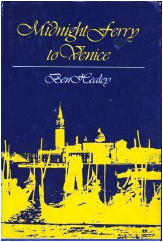
HEALEY, BEN(JAMIN JAMES). 1908-1988. Add year of death. Pseudonyms: J. G. Jeffreys, Jeremy Sturrock, qq.v. Artist and designer in British film industry. Under his own name, the author of 12 mystery novels listed in the (Revised) Crime Fiction IV published in the UK between 1965 and 1981. Series characters: (1) artist Paul Hedley and(2) art thief Harcourt d’Espinal, who generally worked separately but appeared together in Last Ferry from the Lido (Robert Hale, 1981) aka Midnight Ferry to Venice (Walker, 1982). Four of the books were published in the US.

Healey- Midnight Ferry


JEFFERY, WALTER (JAMES). 1861-1922. Add as a new author entry. Born in England; noted Australian writer & journalist. Co-author of one marginally crime-related title:
       -The Mystery of the Laughlin Islands, with (George) Louis Becke, 1855-1913, q.v. Unwin, UK, hc, 1896. Setting: Ship.

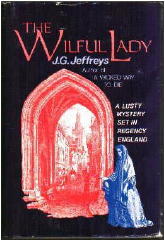
JEFFREYS, J. G. Pseudonym of Ben(jamin James) Healey, 1908-1988, q.v. Add year of death. Other pseudonym: Jeremy Sturrock, q.v. The first seven adventures of Jeremy Sturrock of the Bow Street Runners, a series set in Regency times, were first published in the UK as by Sturrock; then in the US under the Jeffreys byline. One of these is shown below; an additional title, The Thistlewood Plot (Walker, 1987) appeared only in the US.

Jeffreys- Wilful Lady


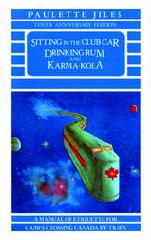
JILES, PAULETTE. 1943- . Ref: CA. Add as a new author entry. Born in Missouri; immigrated to Canada, 1969. Journalist, writer, memoirist, poet.
       -Sitting in the Club Car Drinking Rum and Karma-Kola. Polestar, Canada, pb, 1986. Setting: Canada, train. A novella (104 pages) subtitled: A Manual of Etiquette for Ladies Crossing Canada by Train. Described as “a parody of the 1940s detective novels of Raymond Chandler and Dashiell Hammett, [the story] follows its heroine as she avoids the payment of $50,000 in overdue bills by fleeing across country.” Illustrated with the Dome Car floor plan.

Jiles- Sitting in the Club Car


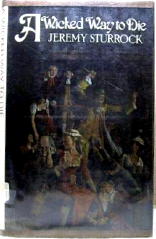
STURROCK, JEREMY. Pseudonym: Ben(jamin James) Healey, 1908-1988, q.v.. Add year of death. Other pseudonym: J. G. Jeffreys, q.v. The primary character in each of the books under this pen name was the same as the author’s, Jeremy Sturrock of the Bow Street Runners. A series set in Regency times, it displayed, says one online source, “a nice raunchy low-life vulgarity.” Seven books were published in the UK between 1972 and 1983; one of these is shown below. When published in the US the byline was given as J. G. Jeffreys. A final book appeared in 1987 only in the US.

Jeremy Sturrock- A Wicked Way to Die

   Bill Pronzini, author of the long-running “Nameless” PI series, has been chosen by the Mystery Writers of America to receive their 2008 Grand Master Award.

Bill Pronzini- The Snatch

   To make this personal, although he and I have met only once, at a Pulpcon where he was a Guest of Honor several years ago, Bill and I have corresponded since the 1970s. Our common interests have always been detective pulp magazines and collecting obscure mystery fiction, both hardcover and paperback, and facts and information about their authors. Bill’s been a solid supporter of Mystery*File in all of its many shapes and forms, first as a print zine, then the web site, and now the blog.

   We’ve collaborated on several mystery-oriented projects together in recent years, most notably the annotated checklists we did with Victor Berch of the Guilt Edged mystery series from Dutton and the Ziff Davis Fingerprint series. I’m now assisting him in supplementing Bill Deeck’s book Murder at 3 Cents a Day (see the sidebar on the right) by uploading cover images of almost all of the mystery fiction that’s included in it.

   Word of this honor came in a news release from the MWA:

**********************************************************************
And the 2008 Grand Master is…

**********************************************************************

   Author Bill Pronzini has been selected to receive the coveted title of Grand Master, Mystery Writers of America’s (MWA’s) highest honor bestowed on an individual. He will be honored at the 62ndAnnual Edgar ® Awards banquet on Thursday May 1, 2008 at the Grand Hyatt Hotel in New York City. The “Edgars,” as they are commonly known, are named after Mystery Writers of America’s patron saint Edgar Allan Poe and are awarded to authors of distinguished works in more than a dozen categories.

   The Grand Master Award represents the supreme level of achievement in the mystery field and was established to acknowledge important contributions to the genre, as well as significant output of consistently high-quality material.

    “Bill Pronzini is not only a passionate author and reader of crime fiction–he is also one of the most ardent proponents of the genre,” said Daniel J. Hale, Executive Vice President of Mystery Writers of America. “For forty years he has distinguished himself with consistently high-quality writing and editing in all areas of the field, including creating one of the longest lasting detective series ever.”

   Bill Pronzini started down his path toward the Grand Master in 1969, when he embarked upon his professional writing career. Since then, Pronzini has experienced a prolific career, penning more than 70 novels and non-fiction books, including 32 novels in his popular “Nameless Detective” series and three novels written in collaboration with his wife Marcia Muller (MWA’s 2005 Grand Master).

   Pronzini is no stranger to critical acclaim for his achievements. He is a six-time Edgar nominee, including a nomination in 1987 with his wife Marcia Muller for Best Critical Biographical Work, 1001 Midnights: The Aficionado’s Guide to Mystery Fiction. He is also a recipient of three Shamus awards and the Lifetime Achievement Award from the Private Eye Writers of America. Pronzini’s suspense novel, Snowbound, was the recipient of the Grand Prix de la Litterature Policière as the best crime novel published in France in 1988.


Bill Pronzini- Savages

    — Thanks to Ed Lynskey for sending the MWA announcement along. See also The Rap Sheet for the coverage there, the best source for mystery-related news around anywhere on the web.

   The link in the first line above will take you to Kevin Burton Smith’s article about Bill on his Thrilling Detective website, complete with a long, and I think complete bibliography of all of Bill’s mystery-related activities: novels, short stories, anthologies and reference works.

   On DorothyL someone wondered if “Nameless” is the longest-running series character still operating today. I’m not sure, not having researched it completely, but for the record, Nameless first appeared in “It’s a Lousy World” aka “Sometimes There Is Justice,” which appeared in the August 1968 issue of Alfred Hitchcock’s Mystery Magazine). His first novel-length case was The Snatch, hardcover, Random House, 1971. Out earlier this year from Forge was the 31st in the series, Savages.

   Either way, it’s an honor well deserved, and to many of us, one that’s been too long in coming. Now is certainly a fine time, though. Congratulations, Bill!


UPDATE [11-16-07]. It all comes down to a matter of definition, as it almost always does. P. D. James’s Adam Dalgleish first saw the light of print in Cover Her Face, which came out in 1962, and most recently appeared in The Lighthouse, 2005. I’ve not read the latter. Is there anything in it to indicate that this was Dalgleish’s final performance? And even if so, there’s nothing to prevent an encore, is there?

   And there may be other characters with long careers whom I haven’t thought of yet. We may have to qualify “Nameless” as being the longest running PI series character who’s currently active. And it looks as though he’ll be around for a while yet. I sure damn hope so.

   It was just over a month ago — on September 18th, to be precise — that I announced that Part 19 of the Addenda to the Revised Crime Fiction IV, by Allen J. Hubin, was online.

   But new data has continued to flow in — it never seems to even slow down — and Part 20 was uploaded this morning. In WordPerfect format, this installment was a mere 29 pages long.

   Most of the information consists of added (or corrected) years of birth and/or death, but a sizable chunk of what otherwise is new you will already have seen (I hope) in Victor Berch’s checklist of Tip Top Detective Tales. See the previous post on this blog.

Valery Shore

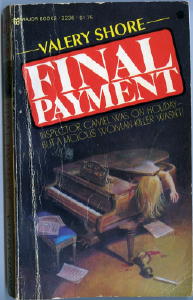
   Also in Part 20, but rather hidden so that you might not notice it without my pointing it out, is that we have recently learned that the mystery novel, Final Payment, by “Valery Shore,” reviewed here several months ago, was not the sole work of Lon Viser, as until now has always been assumed.

   A comment left by Lon Viser’s son, and confirmed by a separate email from the wife of another son, apparently sent independently of each other, says that the book was written by — well, I’ll allow Ed Viser to tell it:

    “I can certainly remember when Yvonne Beltzer, Rhoda Luczon (my mother) and my Dad, Lon Viser wrote this book. The name Valery Shore came from the magazine my parents started Valley & Shore Magazine, later named by the owners Valley Magazine (San Fernando Valley), a sort of Sunset Magazine for the L.A. suburbs. He also wrote several books under other pen names.”

   Last week on his blog, Pulpetti, Juri Nummelin discussed the career of Gold Medal paperback writer Frank Castle, prompted by his (Juri’s) discovery of one of Castle’s books that was published in Finland but never in this country.

   This turns out, as Juri explains, not to have been an uncommon event. Several other American authors apparently had some of their books published in Finnish but never in English, including Dean Owen, Bruce Cassiday and Robert Sidney Bowen. Here’s the cover of the Castle book, the title of which, roughly translated, means “The Sowers of the Doom.”

Frank Castle: Sowers of Doom

   If you’re interested, Juri does the obliging thing and translates the first few paragraphs back into English.

   The post prompted several comments about Castle’s career, and just a few minutes ago, I chipped in with the following:

   Not much seems to be known about Frank Castle. You and the other commenters seem to have covered almost everything he did, unless you count his role as The Punisher for Marvel Comics beginning sometime around 1974. But maybe that was a different Frank Castle. And like the comic book guy, maybe our Frank Castle wasn’t his real name either.

   For his mystery fiction, here’s what appears in Al Hubin’s Crime Fiction IV:

   FRANK CASTLE. Born in New Mexico; graduate of University of Oklahoma; magazine and book writer. Pseudonym: Steve Thurman.
      Move Along, Stranger (n.) Gold Medal 1954
      Dead–and Kicking (n.) Gold Medal 1956 [California]

Dead and Kicking

      The Violent Hours (n.) Gold Medal 1956 [Los Angeles, CA]

The Violent Hours

      Lovely and Lethal (n.) Gold Medal 1957 [California]

Lovely and Lethal

      Murder in Red (n.) Gold Medal 1957 [New Mexico]

Murder in Red

      Vengeance Under Law (n.) Gold Medal 1957 [New Mexico; Past]
      Hawaiian Eye (n.) Dell 1962 [Hawaii]

Murder in Red

   STEVE THURMAN
      Night After Night (n.) Monarch 1959 [Ship]

Steve Thurman

      “Mad Dog” Coll (n.) Monarch 1961 [New York City, NY; 1932] Novelization of film: Columbia, 1961.

      I haven’t put together a list of the westerns Castle wrote under both names, but at a quick glance, he may have written more of those than he did crime novels. (And I’ve only realized this just now, but there’s at least one book overlap between his western novels and the crime fiction that’s already been listed.)

      I’ve read some of his Gold Medals, but since that was when they first came out, I couldn’t tell you anything about them. I do remember a few of the covers, though. (See above.)

   The death of Denny Martin Flinn, a rather unique contributor to the realm of detective fiction, does not seem to have been widely noted in the world of mystery fandom. The fact appears in Part 19 of the Addenda of the Revised Crime Fiction IV, which I’m working on now. Otherwise only Jiro Kimura’s Gumshoe Site seems to have mentioned it.

   Obituaries have appeared in several entertainment-oriented news sources, however, including Variety and Broadway World. A man of talent in many fields, Mr. Flynn died of complications of cancer on August 24th of this year. He was 59.

   Here are his credits in CFIV, by Allen J. Hubin, slightly updated and amended. I’ll get back to the books in a minute.

      FLINN, DENNY MARTIN (1947- 2007)
           San Francisco Kills (Bantam, 1991, pb)  [Spencer Holmes; San Francisco, CA]
           Killer Finish (Bantam, 1991, pb)  [Spencer Holmes; San Francisco, CA]

   But first, here are some of Mr. Flinn’s non-mystery writing accomplishments. For more information on any of these, you may follow the links above.

   ● He performed on Broadway in Sugar and the revivals of Pal Joey and the Pearl Bailey company of Hello, Dolly!

   ● He choreographed Charles Strouse’s off-Broadway musical Six and he restaged Sugar for its West Coast premiere.

   ● As a performer, he appeared in the national companies of Fiddler on the Roof, starring Jan Peerce and Theodore Bikel as well as two-and-a-half years in one of the national tours of A Chorus Line.

   ● Flinn wrote and directed the musical Groucho, starring Lewis J. Stadlen, which played off-Broadway and toured the country for two years.

   ● As a writer, his first book was What They Did for Love, the story of the making of the Broadway musical A Chorus Line.

   ● He co-authored with Nicholas Meyer the screenplay for Star Trek VI: The Undiscovered Country.

      THE MYSTERY NOVELS:

San Francisco Kills. Bantam, pb, January 1991.

San Francisco Kills

      From the front cover:    “He bears the family name and has a talent for detection. Just call him Holmes … Spencer Holmes.”

      From the back cover:   … If there be any here present who knows just cause why they may not be lawfully be joined in marriage, I require him now make it known …

   Following the priest’s request, a shot rang out and the groom fell dead.

   What kind of killer was clever enough to get away with murder in front of hundreds of witnesses? That is just the sort of question that appeals to Spencer Holmes, a San Francisco detective who has inherited a fascination for foul play, a talent for deduction, good looks, and hoards of money from his illustrious grandfather, the immortal super sleuth Sherlock Holmes.

   In a case as complicated as they come, Spencer Holmes, assisted by his inscrutable companion, Sowhat Dihje, must use his formidable intelligence to follow a faint trail that leads from the mansions of the well-to-do into the not-so-distant past – to ferret out a remakable affair of friendship, love … and murder.

Killer Finish. Bantam, pb, August 1991.

Killer Finish

   From the front cover:   “When it comes to solving crimes, he was born to it. … He’s Spencer Holmes, San Francisco sleuth.”

   From the back cover:    “It does appear that the Great Gandolfo has suffered an irreversible mistake in an otherwise well-conducted act!”

   And in this case, appearances were not deceiving. The Great Gandolfo was run through with his own sword, and it didn’t take a Sherlock Holmes to see that the erstwhile magician had died on stage – literally.

   What it did take was Spencer Holmes, Sherlock’s equally talented grandson, who happened to be attending Gandolfo’s final performance. And what the master sleuth, along with his sidekick, Sowhat Dihje, finds upon investigation, is a twisted trail of colorful suspects, grand illusions, missing persons, and voices from the dead. And that is only the beginning. For in the city by the bay, the mixture of magic and murder is potent – so potent that even the most pedigreed of detectives will be astounded by a … KILLER FINISH.

   In a short author’s biography on the final page of Killer Finish, it was announced that Mr. Flinn was working on a third novel, one called Lady Killer. For whatever reason, it was never published.

   Searching the Internet, it appears that Irene Adler is the lady in question, if you are asking the one I think you are, and on another site it is stated that “Spencer’s mansion in Frisco has a Nero Wolfe Room, which perhaps hints at his parentage, since it has already been well-established that Wolfe is Sherlock Holmes’ son.”

   On page 14 of San Francisco Kills, the plaque attached to the door of Holmes’ mansion door reads:

SPENCER HOLMES
Consulting Detective
2210 Baker Street

which I believe entitles him to be called a Private Detective. One who does not do divorce or “keyhole” work, but one who takes only the cases that intrigue him the most.

   One other site briefly describes the books are humorous pastiches. Here, for example, from page 194 of the same book cited above, is the following passage. Spencer Holmes is speaking to a fellow who has just finished a game of tennis:

    “How was your game today?” Spencer inquired.

    “Fine. And yours?”

    “Afoot.”

    “I don’t think I understand.”

    “I’m sorry. It is a colloquial expression. Before your time, I think.”

    “Ah.”

  Steve:

Cheap Thrills

   Goodness, it’s been a long time since we’ve encountered each other. I’ll be at Gary Lovisi’s doings next Sunday but you don’t seem to attend them any more. A very handsome new edition of Cheap Thrills came out earlier this year, with color illustrations and reprints of many of the actual letters I gathered when first doing the book many long years ago. My next book is due out in October, entitled Good Girl Art and covering that comic book genre from Sheena to the present.

   As to your blog about the Phantom. Here’s a correction on pennames. I am not now nor never have been Marshall Macao. This attribution is, I think, due to the fact that some chap wrote some sleazy kung fu books and a listmaker mixed them up with the two novelizations of the old Kung Fu TV show I did. Macao was once a Portuguese possession and I am half Portuguese, but that’s the only connection.

   The source of the Frank S. Shawn penname, which I have oft explained to crowds of uninterested fans of mine, is this — I took the name of my wife, Frances and the initial of my younger son, Steffan, and the first name of my older son Sean, and fashioned an alias.

   I actually worked with Falk on these, dropped into his Park Ave. South apartment once, talked to him on the phone quite a bit. The novels were all based on old strip continuities and King Features would send me proofs of whatever strips were being adapted. Of course, with the novels I had to add quite a bit in the way of characters and subplots. And the books were much better written.

Good Girl Art

   Bruce Cassiday also did three of Avon’s Flash Gordon novels back then. I wrote the first three but got tired of dealing with the fellow at King Features, who was a lintpicker (as we used to say in the old days). He complained several times that I was ending chapters in the middle of the page and thus robbing them of several half pages of copy that they were paying for.

   I got the Phantom job originally because Falk, who didn’t keep up with things, had offered it to Alfred Bester, a friend of mine. Bester had ghosted Falk’s strip for a while during WWII and gone on to write The Demolished Man, etc. Knowing nothing of this, Falk assumed he’d be available for the assignment.

   Working with Falk was no problem. One of the few things he told me not to do was mention the color of the Phantom’s costume. At the time it was purple in America, but red and brown in other countries.

   Keep in touch.

Best,

      Ron Goulart


>> Alas, I won’t be at Gary’s paperback show once again this year. It’s next Sunday, but I go to Michigan every Columbus Day weekend to visit my sister, and my brother comes over from London Ontario for a short family get-together. Something had to give, and Gary’s show will go on, but without me, I’m sorry to say.

   Thanks for your comments on working with Lee Falk, though, and I’ll pass the word along to Al Hubin to delete your Marshall Macao reference. Question: You did two of the four novelizations of the Kung Fu TV series. None of the books (as by Howard Lee) are in Crime Fiction IV. I remember the series, and in fact have the first season on DVD. Would you say that the books as written have enough crime content that they should be included? My general impression is that they do.

   To everyone who’s planning their Christmas and holiday present list, from spouses, kids, parents, or simply to give yourself, there are a couple of big hints subtly hidden on this page.

— Steve

« Previous PageNext Page »