Reviews


REVIEWED BY DOUG GREENE:

   
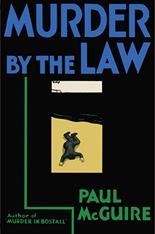
PAUL McGUIRE – Murder by the Law. Supt. Fillinger #2. Skeffington, UK, hardcover, 1932. No US edition.
TECH DAVIS

   Paul McGuire is known almost exclusively for his classic, A Funeral in Eden, taking place on an imaginary island. Many of his other novels, set in more prosaic locales, deserve better than the almost complete neglect which has been their fate.

   A case in point is Murder by the Law. The crime – -murder of a thoroughly detestable author – is standard, but the book is enlivened by the setting, the character of the detective, and McGuire’s sardonic writing style, The events take place at a meeting of The New Health and Eugenist Conference, and McGuire so thoroughly punctures the movement that even R. Austin Freeman, had he read the book, might have had second thoughts about Eugenics.

   The narrator, Richard Tibbetts, wonders whether a convinced Eugenist might have killed Harold Ambrose simply because the world would be a better place without him. There are, of course, additional suspects, as Ambrose was writing a novel which would embarrass every woman with whom be had an affair.

   The case is competently handled by Superintendent Fillinger, McGuire’s series detective who also appeared in at least two other books, Daylight Murder and The Tower Mystery (which Tibbetts calls “an odd, queer volume”). Fillinger, at more than 400 pounds, may put even Dr. Fell and Nero Wolfe almost literally in the shade. But he is not so eccentric as those worthies. The investigation is straightforward. And it is not until the final four lines that the murderer is revealed.

– Reprinted from The Poison Pen, Volume 6, Number 3 (Fall 1985). Permission granted by Doug Greene.

   
Bibliographic Update: As it so happens, there are now known to be seven recorded adventures in Fillinger’s case file, to wit:

Three Dead Men. Skeffington 1931.
Murder by the Law. Skeffington 1932.
The Tower Mystery. Skeffington 1932.
Death Fugue. Skeffington 1933.
There Sits Death. Skeffington 1933.
Daylight Murder. Skeffington 1934.
Murder in Haste. Skeffington 1934.

   
   As for Australian-born Paul McGuire (1903-1978), he has sixteen works of mystery and detection listed in Hubin, all between 1931-1940, including the seven above. Five of his novels have been published in the US, but as noted above, not this one.

   And, not surprisingly, while Al Hubin reviewed this one here earlier on this blog, there is not a single copy to be found offered for sale. But also by Paul McGuire and  previously reviewed here is Murder in Bostall (US: The Black Rose Murder), this time by Bill Deeck.
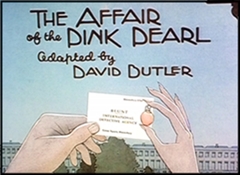
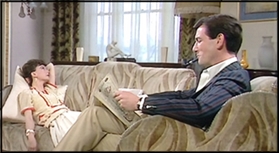
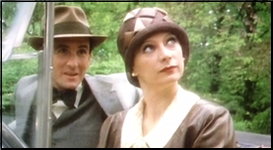
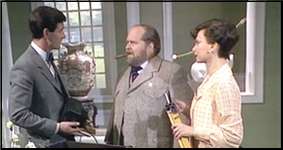
AGATHA CHRISTIE’S PARTNERS IN CRIME “The Affair of the Pink Pearl.” London Weekend Television (LWT), 16 October 1983 (Season 1, Episode 1). Francesca Annis (Tuppence Beresford), James Warwick (Tommy Beresford). Guest Cast: Dulcie Gray, Graham Crowden, Noel Dyson, Arthur Cox. Screenwriter: David Butler, based on the stories “A Fairy in the Flat,” “A Pot of Tea,” and “The Affair of the Pink Pearl,” by Agatha Christie (all three included in her collection, Partners in Crime). Available on DVD; currently streaming on BritBox.

   While this was the first episode of the 1983 series on the BBC, it was preceded the week before by a standalone showing of that same network’s adaptation of The Secret Adversary, starring the same two players as Tuppence and Tommy. (I tell you this because it confused me for a while, but I see no need for you to be, should it ever come up.)

   The first portion of this true first episode serves as an introduction to the characters and their first case, as chronicled in “A Fairy in the Flat” and “A Pot of Tea.” Fairly rich (I am assuming) and bored, the married couple are delighted with the opportunity to take over the International Detective Agency. (It may be that Tuppence is the more delighted of the two.) Their first case is a slam dunk (in today’s terminology), as they are hired by a young man of the upper class whose sweetheart, a shop girl, has gone missing. I will not tell you why it is a slam dunk, though.

   The titular tale is more of a challenge, as it involves a valuable pink pearl which has disappeared after some careless handling of it during a dinner party, which means, luckily for the viewer, lots of suspects, including the servants and other staff, all of whom need questioning as to who was where and when. I didn’t think the showing was quite fair to the viewer, though; perhaps the original story was better in this regard.

   The setting is bright and cheerful, and the dialogue very witty. As it is too long since I have read the books, and then only N or M? within the last ten years, I cannot tell you how well Francesca Annis and James Warwick fit their roles. N or M? was published some twelve years after the story collection, so of course it is natural that I pictured them that many years older.

   One thing I do remember about the books is that each story in its telling parodied another of Ms Christie’s contemporary authors at the time. “Pearl,” for example, used R. Austin Freeman’s Dr. Thorndyke as a model for the pair to emulate. That particular aspect of the stories seems to have been dropped from this particular television version.


REVIEWED BY DAN STUMPF:


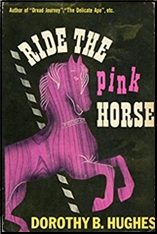
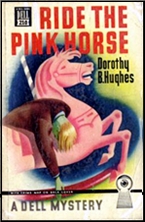
DOROTHY B. HUGHES – Ride the Pink Horse. Duell, Sloan & Pearce, hardcover, 1946. Dell #210, mapback edition, date? [1948. See comments.] Reprinted many times since.

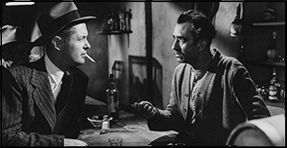
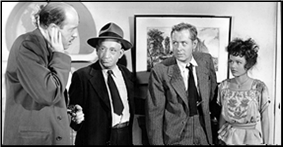
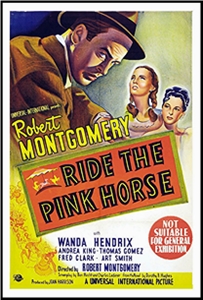
RIDE THE PINK HORSE. Universal, 1947. Robert Montgomery, Wanda Hendrix, Andrea King, Thomas Gomez, Fred Clark, Art Smith, Martin Garralaga and John Doucette. Screenplay by Ben Hecht and Charles Lederer, based on the novel by Dorothy B. Hughes. Directed by Robert Montgomery. Available on DVD but not found on any streaming platform at the present time.

   I wish I’d read the book first. Having seen the movie and its made-for-TV remake (The Hanged Man, 1964, directed by Don Siegel), I wasn’t fully attuned to what Dorothy B Hughes was doing until the last pages.

   What she was doing was taking a tough gangster tale and turning it into a metaphysical hike into Hell. When the story opens, a tough Chicago hood called Sailor arrives in a small New Mexico town to collect a debt from a senator (called Sen) who doesn’t want to pay. Since the debt in question is Sailor’s fee for killing Sen’s wife, the matter has to be settled with some delicacy, but Sailor is tough, smart, and up to the job.

   Or so he thinks. But he’s walking into a trap set for him not by Sen, but by a cruel universe. The small town is the scene of a local festival that has filled every hotel and spare bed in town, so Sailor has to hustle just for the necessities. The mix of frolic, need, superstition, duplicity, and spirituality that mark the pageant have an odd effect on his psyche, awakening old memories and vague fears, hemming him in with uncaring crowds who speak a foreign language — but it’s Sailor who is the real foreigner in an alien landscape.

   Hughes fills the story with memorable characters: a thoughtful cop, the weaselly senator, a mysterious girl, an earthy laborer, bartenders, clerks, and a lovely innocent, seen only at a distance until a final corrosive moment when—. But I’m telling too much.

   Suffice it to say that Hughes evokes a struggle for Sailor’s soul, with self-appointed guardian angels rolling the dice against the darker forces (the name Sen seems meaningful here) that keep pulling him into nightmare. She also keeps us firmly caged in Sailor’s perceptions, as she did with the killer of In a Lonely Place, making this is a tale to compare with the most harrowing pulp nightmares of Jim Thompson and David Goodis.

   Robert Montgomery softened the story out of necessity — the murdered wife ploy becomes a bit of extortion attempted by a rubbed-out friend of Sailor’s (here named Lucky Gagin) and the Senator is now a war profiteer, superbly limned by Fred Clark, one of the finest and most unsung character actors of his time.

   Likewise, Thomas Gomez does quite well as the sweaty and philosophical Mexican carousel impresario, Art Smith makes a surprisingly gentle G-Man, Wanda Hendrix combines a mysterious mien with a touching teenage crush, and Andrea King provides chills as one of the coldest femmes fatales in all of noir.

   Robert Montgomery directs smoothly and unobtrusively, as if apologizing for his work on Lady in the Lake (1946). Looking back on it, Lake was a mistake that someone had to make sooner or later, but that’s a discussion for another day. The only problem with Montgomery in Ride the Pink Horse is that he lacks the type-cast toughness that Bogart, Cagney, or Dick Powell could have brought to the role. He’s obviously acting here, acting very well, but still not living the part.

   I saw the TV remake sometime in my callow youth, and I wish I could have watched it again for this piece, but it seems to have sunk into the oblivion that swallowed all too many films of its ilk. Too bad, for I remember it fondly.


PARKER. 2003. Jason Statham, Jennifer Lopez, Michael Chiklis, Patti LuPone, Emma Booth, Nick Nolte. Based on the book Flashfire, written by Donald Westlake under the pen name Richard Stark. Director: Taylor Hackford. Currently streaming on Netflix.

   I imagine most of you reading this review already know who Parker is, and if so, you probably knew about this movie long before I did, and if so you probably watched it long before I did. But just as a basis to begin with, Parker is the toughest (anti)hero you ever don’t want to meet, and if you do, you don’t want to mess around with him. He appeared in a series of 24 books by Donald E. Westlake, and while a couple of movies were made from the books, this is the first one in which he’s called Parker.

   I wouldn’t want to say that it’s the best of the three, because Point Blank, the one with Lee Marvin, has become what some critics call a cult classic. But while I can see why they might want to say that, I have to tell you that I think this is the one that captures the essence of what makes Parker Parker the best.

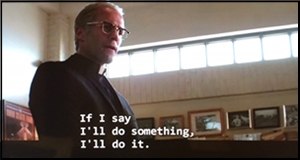
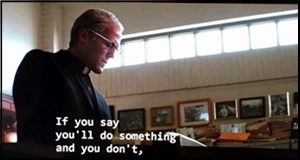
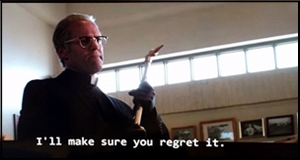
   Which is this. Basically who he is a thief, and he’s good at what he does. What you do not want to do is cross him, though, in any shape or form:

   In the opening of this one, Parker is disguised as a priest while the rest of his crew are made up as clowns. The robbery of the Ohio State Fair box office goes off like clockwork, but when the rest of gang tells Parker that they need his cut to finance their next theft, he does not take it kindly, to say the least. He objects, they leave him for dead, but naturally he is not, which is a mistake by the gang they soon wish they hadn’t made.

   The trail leads to Palm Beach, which is where Jennifer Lopez comes in. She’s a real estate agent, divorced, pushing 40 and with no idea where life is leading her. He needs her to show him around, but it doesn’t take her long to know what is up, and she wants in. In the meantime, there is enough action to keep anyone who loves this kind of movie as well satisfied as any movie with this kind of firepower in it could ever do.

   The ending is a little lame, with loose ends flying everywhere, but that’s only in comparison to the rest of the film, and if you were to have asked me afterward if they really needed Jennifer Lopez in it, I would have to agree and say maybe not. I suppose that this was meant to be the first of a franchise, but for what ever reason, it didn’t happen, and Jason Statham went on to other, if not better, things. To me, though, he made a perfect Parker, and I would have liked to have seen more.


IT IS PURELY MY OPINION
Reviews by L. J. Roberts


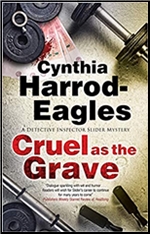
CYNTHIA HARROD-EAGLES – Cruel As the Grave. Detective-Inspector Bill Slider #22. Severn House, hardcover, February 2021.

First Sentence: Atherton was singing in his Dean Martin voice.

   Personal fitness trainer Erik Lingoss is found murdered in his flat by a young woman who fancied herself in love with him. A box full of cash in his closet, 700 pounds under his pillow, and his missing mobile phone indicates things may not be as indicated. The more Slider and his team investigate, the more suspects emerge. Under pressure to clear the case, they work to find the who and why of the murder.

   Beginning a new book by Cynthia Harrod-Eagles is akin to being given one’s favorite dessert. First, there is no prologue, not even one masquerading as a first chapter. The story begins on page one and continues to the end. Second, wonderful dialogue filled with wry humor— “Let he who is without sin bore the pants off everybody else.” Last, the sense of time and place. Her evocative descriptions employ all the senses.

   The characters are alive– “…Atherton stretched, catlike. Tall, elegant, sartor’s plaything, he was as out of place at a dreary crime scene as an orchid in a vegetable patch.” The balance is Slider, not a Lone-Ranger cop, but respected by a team where each has their role to play. The plot may initially present itself as straightforward, yet one knows it won’t stay that way long— “Thirteen thousand pounds. …Normal people don’t keep large amounts of cash in the wardrobe.”

   Including characters’ families in the story adds humanity and dimension. Unlike the questionable stability of the relationships of Supt. Jim Atherton, his long time partner, Slider has an extended family of his wife, son and a child on the way, a daughter by his first marriage, a father and his partner. A wonderful hospital scene touches the heart.

   The author’s use of language, including the chapter headings, is a pleasure. One small caution, or treat, is that it is very British, meaning there are numerous British terms and idioms. It can be confusing, but the meaning is easy enough to glean from the context— “The bathos almost made him smile.” The use of malaprops— “Putting the cat before the horse, aren’t you?” —and literary references are fun to spot. The banter between Slider and Atherton realistically reflects that of friends/colleagues who know each other well.

   The plot focuses on the real police work of identifying the many suspects, following leads, and looking for evidence. What drives Slider as much as finding the killer is discovering the motive which is poignant.

   Cruel As the Grave is such a good read. Harrod-Eagles is a skilled writer who evokes empathy for the killer. It was truly the dessert’s finishing touch.

Rating: Good Plus.

REVIEWED BY DAVID FRIEND:


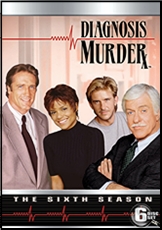
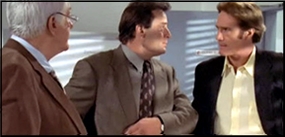
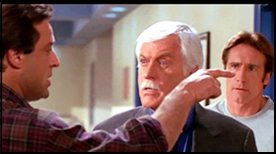
DIAGNOSIS MURDER. “The Last Resort.” CBS, original air-date: 19 November 1998 (Season 6, Episode 9). Dick Van Dyke (Dr. Mark Sloan), Victoria Rowell, Charlie Schlatter, Barry Van Dyke (Steve Sloan). Guest star: Joe Penny. Written by Paul Bishop. Director: Christian I. Nyby II. Series available on DVD. Not known to be currently streaming online.

   I used to love Diagnosis Murder. When I was eleven and twelve years old, my mum would record (on VHS!) the daily afternoon repeat while I was busy enduring institutional betrayal at school. It may not have been the coolest television programme around, but it was light-hearted and often reasonably exciting, with a nifty mystery plot and maybe a bit of action too.

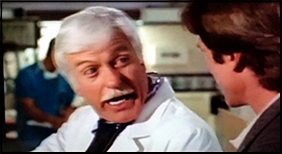
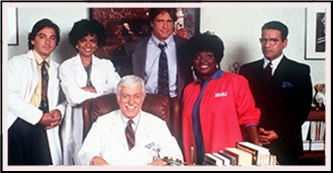
   As I’m sure everybody here knows, the show revolved around ebullient sixty-something Dr Mark Sloan (Dick Van Dyke), the Chief of Internal Medicine at Community General Hospital in Los Angeles, who also doubles as an amateur sleuth and eventual consultant for the L.A.P.D., often working alongside his homicide detective son Steve (a permanently purse-lipped Barry Van Dyke, Dick’s real-life son).

   Assisting Mark are a couple of young, attractive medical colleagues, sensible and assertive Dr Amanda Bentley (Victoria Rowell) and boyishly enthusiastic Dr Jessie Travis (Charlie Schlatter), though all three are often hindered by the fussy, fulminating hospital administrator Norman Briggs (Michael Tucci), who believes they should remain focused on their patients instead of trying to solve crimes.

   The series depended almost disproportionately on its star and the good-will he had accrued from his eponymous sitcom and triptych of big-screen musicals from the early-to-mid 1960s. Like Andy Griffith, that other wholesome ’60s comedy lead who turned to the less demanding mystery genre in old age, Van Dyke was able to carve out a niche, catering to a more mature audience and working as a sort of counter-programming to gritty police procedurals like NYPD Blue and Homicide: Life on the Street.

   Stylistically, it was a less twee and ever so slightly more plausible Murder, She Wrote, without ever becoming a similarly solid ratings champion. Indeed, Diagnosis Murder sputtered every year into almost reluctant renewals by a higher-brass who knew how appealing the older demographic was to advertisers compared to the younger, more impecunious generations proceeding them.

   Whereas many episodes had a minor, frivolous subplot to offset all the murder and petty revenge, there was a small shake-up in the sixth season when things occasionally became a little bit darker than regular viewers might ordinarily expect. “The Last Resort” was one such episode, and there’s nary a chuckle to be had in its forty-four minutes, beginning with Steve apparently losing his professional perspective and attacking a suspect during interrogation – even throwing a chair through the one-way glass.

   The sudden meltdown, after five years of watching this wearily workmanlike detective harrumphing his way through a slew of homicide investigations, is surprising, particularly as we’re told that he was supposed to be a calming influence on his new partner Reggie.

   An abrasive, confrontational cop, Reggie Ackroyd (Joe Penny) is constantly on the brink of getting fired or even arrested himself, only justifying his erratic behavior with the dubious assertion that his wife and daughter were kidnapped by a criminal named Sykes. Things get even worse for the pair when Steve inadvertently kills an unarmed rapist and reluctantly allows Reggie to cover it up.

   After further trouble, the men are strong-armed into attending a psychiatric rehabilitation program at Community General Hospital – a “Betty Ford clinic, except it’s for cops” – and struggle through sessions of group therapy led by the bluntly incisive Dr Sinclair (Reginald Val Johnson).

   While Steve is weighed down by guilt of the cover-up, Reggie begins losing all sense of reality, the frustration and anger over his family’s supposed capture uncoiling into a series of vividly disturbing hallucinations.

   Will he find them? Or is there something even more sinister going on?

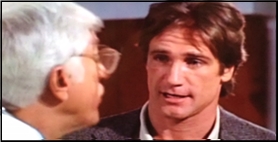
   A dark story, with one of its biggest surprises being the absence of a breezy tag-scene which typically closes every episode, and the decision to let its grimly unsettling final fade-out stew in the viewer’s mind. Joe Penny, formerly of the now almost-forgotten Jake and the Fatman (a series which originated the Mark Sloan character in a one-episode guest turn, though Penny plays another role here), is excellent as the cold and mercurial Ackroyd, a man driven to insanity from rage, remorse and the pressures of a police career.

   To my eyes, at least, he looks like Sylvester Stallone, with a similar, moodily masculine persona to match. Barry Van Dyke, meanwhile, is subtly effective, though mostly this is due to the unexpected novelty of a more personal plot-line for the character rather than a genuinely compelling performance.

   Elsewhere in the episode, there’s a more conventional mystery sub-plot which keeps the other two regulars occupied as they investigate the locked room murder of a lab technician. For once, Jessie confront the culprit, and in a slyly charismatic manner too, demonstrating how a puppy-ish medical prodigy can lull any criminal into a false sense of security.
   

REVIEWED BY DAN STUMPF:


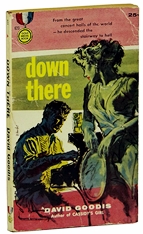
● DAVID GOODIS – Down There. Gold Medal #623, paperback original, January 1956. Black Lizard, paperback, 1987. Included in Crime Novels: American Noir of the 1950s, hardcover, Library of America, 1997.

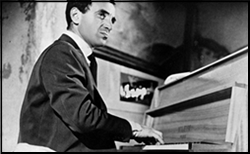
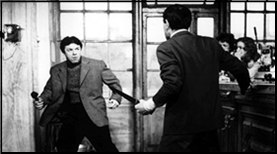
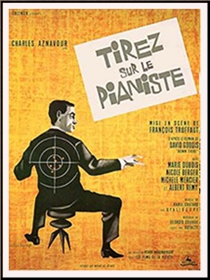
● SHOOT THE PIANO PLAYER. France, 1960, released as Tirez sur le pianiste. Astor Pictures Corporation, US, 1962. Charles Aznavour, Marie Dubois, Nicole Berger, Michèle Mercier. Based on the novel Down There by David Goodis. Director: François Truffaut.

   In substance, Down There is pretty typical Gold Medal stuff, what with fistfights, chases, mobsters, broads, and other rugged manly stuff — the story is something about a threadbare piano player (Eddie in the book, Charlie in the film) at a seedy bar getting involved with gangs and a waitress — but flavored here with the boozy poetry unique to David Goodis. Goodis could hear the circular logic of a drunk and find in it the awesome redundancy of a Beethoven composition. His characters keep trying to grapple with the meaning of it all, keep losing, keep grappling again….

   Oftentimes they succeed in resolving whatever the plot is – they catch the killer, foil the criminal, rescue the damsel — only to lose some more Important objective, stuck in whatever personal swamp they started out the book in. So the final lesson of Down There is not just that You Can Go Home Again… your destiny was to never really leave,

   Shoot the Piano Player takes the fatalism of the novel and infuses it with director Francois Truffaut’s soft heart and Gallic wit. The circular story is still there, faithfully filmed from the novel down to small detail, but it seems somehow more human, as if it isn’t fate so much as the characters themselves that leads them to their predestined ends.

   Along the way there are plenty of pauses for the bit players to get out and stretch their legs a bit — stock characters in Goodis novels and Truffaut films simply refuse to behave like stock characters — so when Charlie (Charles Aznavour) and Lena (Marie Dubois) are kidnapped by gangsters early on, their captors end up swapping jokes with them. And later on, a thuggish bartender muses aloud about his bad luck with women as he’s trying to choke Charlie to death.

   The point, if there is one (it’s never quite safe to go looking for a moral lesson in Truffaut films or Goodis novels), may be that no one is really ordinary: not In pulp novels, B-movies or what we call Real Life; skid-row bums might be heroes, goons can feel tenderness, and a spearcarrier in the back row of Aida may actually be singing an aria, if we listen closely.

— Reprinted from The Hound of Dr. Johnson #42, January 2006.


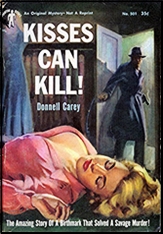
DONNELL CAREY – Kisses Can Kill! Chase Coburn #1. Phantom #501, digest-sized paperback original; 1st printing, 1951.

   Donnell Carey, an author you probably never heard of, was actually the pen name of Joe Barry Lake, who never wrote any mysteries under that name, but who did write several as by Joe Barry, five of which were hardcovers featuring PI Rush Henry as the detective of record. I have not read any of these but on the basis of Kisses Can Kill!, at the moment I see no reason to rush right onto the Internet to find any of them.

   This was Barry’s only book as Donnell Carey, and hence, almost automatically, the only appearance of PI Chase Coburn. Coburn is as generic a moderately tough PI as there could be. His only claim to fame may be that he’s part of a small group of PI’s who belong to the club of “my partner’s been killed and it’s up to me to do something about it.” His partner was a guy who played fast and loose with the ladies, while Chase has always been somewhat soft on the dead man’s wife.

   The case that Dave, Chase’s partner, was working on was mostly financial. He’d been in Cincinnati trying to find out why a branch of a Manhattan-based clothes designer firm is not doing as well as it should. Chase spends a big chunk of the middle portion of the book out in Ohio and across the river into Kentucky doing not much of anything before returning to Manhattan to close up the case.

   Which turns out to be one of blackmail on Dave’s part. Who did him in is meant to be a surprise, but with plenty of time to think things over on the part of the reader, while the less interesting part of the story is going on, it is lot easier than it should have been to see the twist coming.

   Overall then, Kisses Can Kill! is no more than an average PI story, told with some competence, but not one you’ll remember for more than a day or so.

Rating: C Minus

REVIEWED BY BARRY GARDNER:


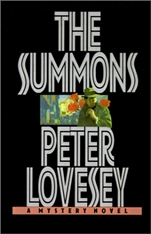
PETER LOVESEY – The Summons. Peter Diamond #3. Mysterious Press, hardcover, 1995; paperback, 1996. Published first in the UK by Little Brown, hardcover, 1995.

   I thought the first Peter Diamond book [Last Detective, 1991] was pretty good, but the second one [Diamond Solitaire, 1992] offended me mortally with one of the most stupid and unrealistic plots I’d come across in a decade or so. Which Lovesey / Diamond do we get here?

   Ex-Superintendent Peter Diamond of the CID (he resigned in a huff in the first book in the series) is called back to his old headquarters when a prisoner he helped put away escapes and kidnaps the daughter of a police official, The escapee has staunchly maintained his innocence all along and still does, and his price for freeing the girl is for Diamond to find the real killer.

   Diamond is far from convinced that he made a mistake, but feels he has little choice but to look into it. He and Detective Inspector Julie Hargreaves embark on a time-deadly search for buried answers several years old.

   I’m happy to say that this is the Peter Lovesey that I’ve enjoyed over the years, and not the one who wrote the unintentional farce published as Diamond Solitaire. He has created a vivid character in ex-Superintendent Peter Diamond, neither faceless nor (in this book, at least) larger than life. It is also an excellent detective story, with tracking down and talking to. Lovesey has a real knack for character and dialog, and tells a good story.

   I’m not sure things could have worked out quite as neatly for Diamond as they did, but it didn’t require me to suspend more disbelief than I could endure.

— Reprinted from Ah Sweet Mysteries #21, August-September 1995


REVIEWED BY DAVID VINEYARD:


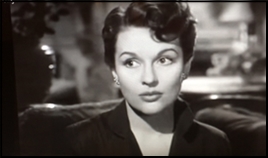
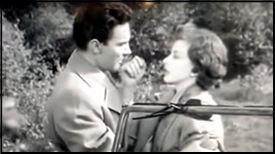
● THE STEEL KEY. Eros Films, UK, 1953. Terence Morgan, Joan Rice, Raymond Lovell, Diane Foster, Esmond Knight. Screenplay: John Gilling & Roy Chanslor. Directed by Robert S. Baker.

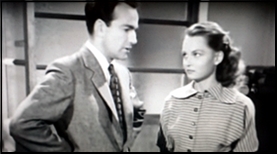
● SALUTE THE TOFF. Nettlefold Studios, 1952. John Bentley, Carol Marsh, Roddy Hughes, Wally Patch, Valentine Dyall, Arthur Hill, Peter Bull, Tony Britton, Sheilagh Fraser. Screenplay John Creasey, based on his novel of the same title. Directed by Maclean Rogers.

   As The Steel Key begins, Inspector Forsythe (Raymond Lovell) of the Yard is waiting at Heathrow when Johnny O’Flynn (Terence Morgan) arrives and none too happy to see him. O’Flynn is what used to be known as a “Gentleman Adventurer” and has a history of playing fast and loose with the law. In fact Forsythe isn’t entirely sure O’Flynn hasn’t stolen and then “recovered” and collected the reward on a few items in the past.

   This time he’s on the trail of the “steel key,” a process for hardening metals that is not only vital to industry but also national security. The formula is held by two scientists, Professor Newman in England, and Dr. Metcalfe in the States, and O’Flynn has shown up pretending to be Metcalfe.

   Things get more complicated when O’Flynn manages to avoid Forsythe and shows up at Newman’s home in time for the Professor’s funeral where his attractive widow Sylvia (Diane Foster) is obviously not in mourning and obviously attracted to O’Flynn.

   O’Flynn wants Newman’s formula and Sylvia wants Metcalfe’s, and there is a lot of obvious conspirators surrounding the dangerous black widow.

   Pretty Doreen Wilson (Joan Rice) gets involved and soon it turns up Newman may not be as dead as advertised, while the real Metcalfe shows up complicating things for O’Flynn who finds himself hunted by Scotland Yard for a murder he didn’t commit (not that it ever bothers him much, he eludes the Yard with the skill of Houdini).

   It’s a pretty standard British crime film, attractively played by Morgan as the charming roguish O’Flynn, and works up to a fairly well done chase and a pretty good climax at sea.

   Nothing special, save for one thing.

   Without ever saying it, without trying too hard, it’s the Saint. It is so obviously the Saint I’m shocked Leslie Charteris didn’t sue. In fact it is so much the Saint Morgan behaves exactly like Simon Templar, replete with his witty repartee with Inspector Teal — I mean Forsythe — and even down to Morgan having the same bouffant hair-do as Roger Moore nine years later.

   And there is the fact of the director, Robert S. Baker (The Siege of Sydney Street, The Hellfire Club, Jack the Ripper), who only directed ten films, but was rather better known as the producer of the Saint television series with Roger Moore.

   Granted it was nine years before Baker succeeded in putting the Saint on television, but it is hard to see this as anything but a pilot, albeit a nine year old one, as it plays almost exactly as an episode of the series, only missing the signature theme and Morgan glancing bemusedly at his halo a la Moore.

   Salute the Toff, starring John Bentley, who was also Paul Temple, is the first entry in the two film series with a screenplay by Creasey based on his novel with the entire cast, Jolly (Hughes), Bert Ebbutts (Patch), and Inspector Grice (Dyall) in an even better and faster moving adventure than Hammer the Toff which I reviewed earlier.

   Secretary Fay Gretton is concerned her boss John Draucott is missing and despite being dismissed by Canadian crime reporter Ted Harrison (Arthur Hill, very young, very tall, and very thin pre-Owen Marshall days) who never-the-less points out Richard Rollinson, the Toff, to her at a club.

   She calls on Rolly and in short order he finds a body in Draycott’s flat, but it isn’t Draycott, instead it is the son of wealthy Mortimer Harvey whose daughter Draycott is engaged to.

   Lorne (Peter Bull) and his cut-throats killed the younger Harvey and are after paper’s Draycott has that might incriminate the elder Harvey. Rolly puts Jolly on the trail of Draycott as he foils a trap set for Fay to get the papers involved, and it all comes to a head with a chase, a kidnapping, and a pair of twists in a fast moving film that like its sequel, does do justice to Creasey’s gentleman sleuth.

   Both films are currently on YouTube (here and here, along with Hammer the Toff), and depending on your tolerance for such things an entertaining way to spend an evening with two of the best of the gentleman adventurers. All the Paul Temple films are available too, so if you plan a weekend of British thrillers, you are set.

« Previous PageNext Page »