Reviews


REVIEWED BY JONATHAN LEWIS:

CHAIN REACTION. 20th Century Fox, 1996. Keanu Reeves, Morgan Freeman, Rachel Weisz, Fred Ward, Kevin Dunn, Brian Cox, Joanna Cassidy. Director: Andrew Davis.
   It may not be overly memorable, but Chain Reaction is a solidly crafted 1990s thriller that benefits immensely from both a strong cast and a screenplay that never condescends to the audience. Directed by Adam Davis, who is perhaps best known for directing The Fugitive (1993) starring Harrison Ford and Tommy Lee Jones, this suspense film also involves an innocent man on the run from law enforcement.

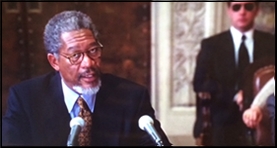
   Eddie Kasalivich (Keanu Reeves) is a scientist working on a university science project that would convert water into energy. The director of the project believes that the technology should be freely available to all countries and all peoples. In opposition to this idealism stands Paul Shannon (Morgan Freeman), a shady Washington figure who represents the interests of the defense lobby.
   When an explosion destroys the laboratory, both Eddie and his physicist partner Lily Sinclair (Rachel Weisz) are fingered as domestic terrorists. Enter FBI agent Leon Ford (Fred Ward) who begins to suspect that there is something amiss about the whole affair. As it turns out (spoiler alert), Eddie and Lily are not terrorists after all, but rather pawns in an elaborate government conspiracy headed by intelligence operative Lyman Earl Collier (Brian Cox).

   Aside from the somewhat ridiculous nature of the premise, the film overall works. It sets out what it intends to do; namely, to be a diversionary piece of entertainment. While I am not exactly convinced Reeves was the best choice for the lead role, I can say with conviction that Morgan Freeman, Brian Cox, and Fred Ward were nearly perfect choices for their respective roles. Given the fact that there are no particularly memorable lines or sequences, there’s no particular reason to watch this movie twice. But once? Certainly. You could do a lot worse.
   

REVIEWED BY DAN STUMPF:


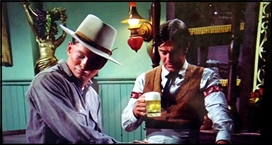
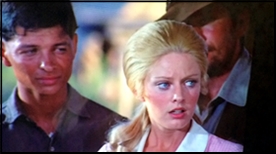
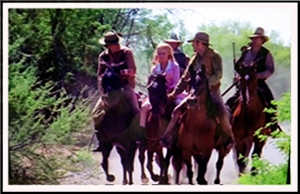
A TIME FOR DYING. Fipco, 1969/71/82. (*) Richard Lapp, Anne Randall, Robert Random, Audie Murphy, Victor Jory, Beatrice Kay, Burt Mustin, Peter Brocco, Walter Reed and Emile Meyer. Written and directed by Budd Boetticher.

   The last film of legendary westerners Audie Murphy and Budd Boetticher, and the best I can say is that it will probably do their reputations no lasting damage.

   Murphy, of course, is remembered as the most decorated soldier of WWII (Neville Brand was the fourth most decorated.) and as the rather retiring hero of numerous westerns, some pretty good, including fine performances in THE UNFORGIVEN and RED BADGE OF COURAGE.

   Budd Boetticher’s films are a mixed bag, but he hit his stride with a series of Randolph Scott Westerns, most of them produced by Harry Joe Brown, including SEVEN MEN FROM NOW, THE TALL T, COMANCHE STATION and RIDE LONESOME. Same Peckinpah’s RIDE THE HIGH COUNTRY is often seen as a continuation of the series and a fitting coda to Scott’s career.

   Boetticher’s subsequent career was notably rockier, including a lengthy exile in Mexico laboring to produce ARRUZA, which is only fair-to-middling, the screenplay for TWO MULES FOR SISTER SARAH, and this one, A TIME FOR DYING, which was plagued with money troubles during and after production — note the various release dates — probably because it isn’t very good.

   Boetticher’s best work was spiced with the fiery Karen Steele and memorable baddies like Lee Marvin and Richard Boone, anchored by the authoritative presence of Randolph Scott at the films’ center. DYING offers some fine character actors, but they only serve to show up the inadequacies of the leading players, who never seem to relax into the natural performances that grace the earlier films.

   If you can get past this (and you can’t, really) you run into an uncharacteristically aimless screenplay from Boetticher. His films with Randolph Scott had a sense of movement (One critic called them “journey films.) with the characters and the story visibly progressing to a conflict defined early on. Or as another critic put it: “Partly metaphorical odysseys, partly floating poker games where every character took turns bluffing about his hand until the final shoot-out.”

   There’s movement in A TIME FOR DYING, but it’s mostly just Richard Lapp and Anne Randall (Never heard of them? See this and find out why.) bounced from one encounter to another without ever realizing their place in Boetticher’s existential universe. And the result is a story that meanders when it needs to move.

   If there’s a saving grace, it’s Boetticher’s elliptical, near-poetic dialogue. Dialogue written to be spoken, not read. As in a Mexican stand-off:

SHOTGUN: “Billy, that woman drop a hammer on you, I’ll blow her husband’s head clear across the street.”

BILLY: “That woman drop a hammer on me, it don’t make a damn what you do to her husband’s head.”

   But I’m afraid it’s just not enough. This is available free on Amazon Prime, and worth every penny, but if you’re inclined to see it, talk yourself down and watch RIDE LONESOME instead.

      —

(*) From Wikipedia: A rough cut of the film premiered at the National Film Theatre in London on May 27, 1969. The finished version of the film premiered in Dallas, Texas on September 15, 1969. The film was shown throughout Texas, but following legal problems after Murphy’s death in 1971, the film only had limited showings and did not screen in New York until 1982.


THE SHADOW “Death Rides a Broomstick.” Mutual, 02 March 1941. Bill Johnstone (Lamont Cranston, a/k/a The Shadow), Marjorie Anderson (Margot Lane). Script: Jerry Devine. Sponsor: Blue Coal.

   Packed into this short 30 minute drama is boatload of old pulp clichés, beginning with a woman accused of being a witch in the Scottish highlands in 1741. Before she is burned to death at the stake, she issues a curse upon the McCavery clan responsible: “death to all male descendants still living 200 years later,” which is when the story then takes up.


   Add a mysterious dark mansion where Margo and Lamont are greeted but turned away by a gangster who calls himself The Smiler, a open graveyard outside, an escaped convict who is a prisoner inside, a dingy tavern by the sea filled with all sorts of thugs, a twist in the tale, ending with the curse fulfilled and a spooky cackle in the air.

   Pure nonsense of course, but with the lights turned down low, nonetheless a lot of fun.

REVIEWED BY DOUG GREENE:


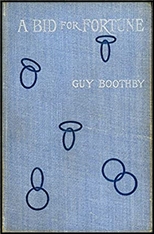
GUY BOOTHBY – A Bid for Fortune. Dr. Nikola #1.  Appleton, hardcover, 1895. Published earlier in the UK by Ward Lock, hardcover, 1895. Reprinted as Enter Dr. Nikola. Newcastle, UK, paperback, 1975. Later reprinted by Oxford University Press, US, paperback, 1996; then many POD editions. Silent film: Unity-Super, 1917.

   Searching for books is often a frustrating task, not merely because (as we all know) some books simply won’t be found but also because those that are located often turn out to be disappointments. In my experience, many highly touted classics have not lived up to their publicity. That is not the case, I’m glad to report, with Guy Boothby’s first novel about Dr. Nikola.

   I leave it to others to discover whether Dr. Nikola is fiction’s first arch-criminal (is Moriarty in the same category?), but it seems likely that the Nikola books form the first sustained series featuring such a nefarious malefactor. A Bid for Fortune has coincidences galore and occasional purple prose (“Oh, my girlie! my poor little girlie! what have I brought you to through my. obstinacy?”), but it is generally well-told and well-plotted. Boothby keeps the reader interested not by overwhelming use of violence – indeed, I don’t recall a single murder in it – but by a sense of mystery.

   The book opens with Dr. Nikola meeting 3 co-conspirators who plan, for an unnamed reason and by unspecified means, to ruin a man named Wetherell: “My toils are closing on you … you will find yourself being slowly but surely ground into powder. Then you may be sorry you thought fit to baulk Dr. Nikola.” The scene then shifts to Australia, to young Dick Hatteras who has made a fortune pearling and who plans to visit his ancestral home in England. He falls in love with Wetherell’s daughter, and on shipboard they pledge their troth (as they used to do; nowadays they just shack up).

   Once in London, his fiancee is forced to 1eave him; he meets Dr. Nikola, and befriends a young nobleman whom he agrees to guide to Australia. The plot becomes steadily more complicated, as Nikola’s minions kidnap Hatteras and the young Lord in Cairo. Eventually, they return to Australia, and rescue all in distress, but Dr. Nikola obtains what he has sought from Wetherell. Nevertheless, the veil of mystery remains even in the final paragraph: “What gigantic coup [Nikola] intends to accomplish … is beyond my power to tell.”

   Boothby, an Australian, had not only a sense of mystery but also a talent for description of 19th century England, Australia and Egypt. A Bid for Fortune is an excellent example of leisurely but engrossing fin de siecle storytelling.

– Reprinted from The Poison Pen, Volume 4, Number 2 (April, 1981). Permission granted by Doug Greene.

   
      The Dr. Nikola series

A Bid for Fortune; or, Dr. Nikola’s Vendetta. Ward 1895.
Doctor Nikola. Ward 1896.
The Lust of Hate. Ward 1898.
Dr. Nikola’s Experiment. Hodder 1899.
Farewell Nikola. Ward 1901.

A 1001 MIDNIGHTS Review
by Bill Pronzini & George Kelley

   
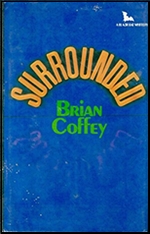
BRIAN COFFEY – Surrounded. Mike Tucker #2. Bobbs-Merrill, hardcover, 1974. No paperback edition.

   Brian Coffey is one of several pseudonyms used by prolific writer Dean R. Koontz. During the early 1970s, Koontz wrote a series of three caper novels featuring professional thief Mike Tucker – a more genteel version of Richard Stark’s Parker.

   Tucker’s straight job is as an art dealer, but in order to live the wealthy life-style he’s accustomed to, he and various other professionals plan and execute occasional big-money heists. Tucker has his principles: He steals only from institutions – banks, insurance companies, department stores – whose losses are fully covered by insurance. And he is good enough so that after fourteen operations in three years, he has never failed.

   Surrounded is the middle book in the series, and easily the best of the three. Tucker, along with two men, Frank Meyers and Edgar Bates, plan to rob the posh Oceanview Plaza shopping mall in southern California; the mall includes a bank. a jewelry store, and eighteen other business establishments. The plan is to hit the mall at night, get in and out as quickly as possible, and Tucker has it all worked out perfectly. Except for one thing – a vital. piece of information that Meyers, for reasons of his own, has withheld from Tucker.

   The result is that an alarm is sounded during the robbery, the police arrive, and Tucker and the others are trapped inside the mall, completely surrounded, with no way out. In a clever variation on the classic locked-room gambit, they manage to hide themselves so that the police aren’t able to find them and assume they somehow must have escaped. (The reader isn’t told their hiding place until some time afterward, so that you may either match wits with Tucker or share the cops’ frustration.)

   This is a well-written novel, ingenious and suspenseful. Tucker is no Parker when it comes to toughness, hut in the brotherhood of crooks he holds his own. His first caper, Blood Risk (1973), is also nicely done: It features another heist that goes sour, that of the biweekly take of a Mafia cell. Here, too, Tucker must improvise to save his own life and those of his partners. The last Tucker novel, The Wall of Masks (1975), is less successful: It has a convoluted and rather implausible plot involving Tucker’s specialty, art treasures (the Mayan variety), plus some strained humor.
   
———
Reprinted with permission from 1001 Midnights, edited by Bill Pronzini & Marcia Muller and published by The Battered Silicon Dispatch Box, 2007.   Copyright © 1986, 2007 by the Pronzini-Muller Family Trust
   

REVIEWED BY JONATHAN LEWIS:

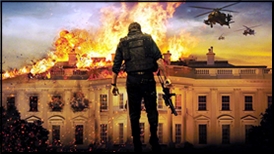
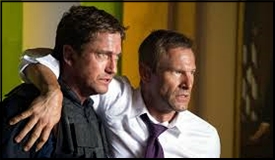
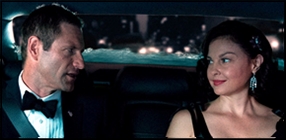
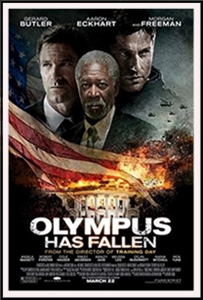
OLYMPUS HAS FALLEN. Millennium Films, 2013. Gerard Butler, Aaron Eckhart, Morgan Freeman, Angela Bassett, Robert Forster, Cole Hauser, Ashley Judd, Melissa Leo, Dylan McDermott, Radha Mitchell, Rick Yune. Directed by Antoine Fuqua. Available on Blu-ray and DVD and is streaming now on Netflix.

    For the first hour or so, Olympus Has Fallen is a kinetic, exceptionally violent action movie that grabs your attention. It’s a barrage of gunfights and explosions, choreographed to near perfection by action auteur Antoine Fuqua (Training Day). With an exceptional cast – including the late Robert Forster who portrays a general tasked with responding to a major terrorist incident – the movie initially feels like a solid piece of cinematic escapism.

    All that changes, however, by the third act. That’s when the viewer begins to recognize that what one is watching is essentially a Die Hard (1988) knock-off. But unlike Die Hard, this action flic is utterly bereft of character development, offbeat humor, and memorable one-liners. It’s all the carnage of Die Hard amped up to the max, but with none of the heart.

    Gerald Butler portrays Mike Banning, a Secret Service agent tasked with saving the president from North Korean terrorists, Banning is no John McClane; he has no witty dialogue to speak of. Truth be told, he has no wit at all. Just brawn and a propensity toward cruelty toward his enemies. And while that holds the movie together for a while, it eventually wears thin.

    The only character in the film who has any depth to speak of is Speaker of the House Alan Trumbull. This is largely due to the fact that he is portrayed by the always enjoyable Morgan Freeman, who imbues the role with necessary gravitas.

    It’s not that Olympus Has Fallen is a bad movie; it’s just a rather empty one. A facsimile. Fuqua has done much better, particularly in his collaborative efforts with Denzel Washington. What went wrong here? I suspect it was the screenplay. Or the reliance on audiences not noticing how very derivative it all is. That said, the movie fared well at the box office and did spawn two sequels. Make of that what you will.


REVIEWED BY BOB ADEY:


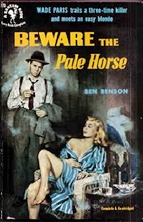
BEN BENSON – Beware the Pale Horse. Captain Wade Paris #2. M. S. Mill, hardcover, 1951. Bantam #1070, paperback, 1953. Wildside Press, trade paperback, 2018.

   Competent, well clued and thought out police procedural starring State Detective Wade Paris. Paris’s difficulties stem not only from trying to find out who killed both a police colleague and oriental art collector, Charles Endicott, but also from the political pressures that are put upon him to wrap things up quickly and successfully.

   This political angle is brought in most convincingly and the investigation itself is logical and systematic. The clues are spread with care and cunning and the main one I should have spotted deceived me. Short on humour, but otherwise I can find nothing to complain of in this very professional job.

   A pity (from my point of view) as it’s the first I’ve read of half a dozen Bensons I own, and I was looking for an excuse to make a small reduction in the overcrowding on my shelves. Now I’ll be looking for even more Bensons!

– Reprinted from The Poison Pen, Volume 4, Number 2 (April, 1981). Permission granted by publisher/editor Jeff Meyerson.

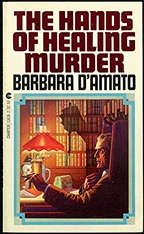
BARBARA D’AMATO – The Hands of Healing Murder. Charter, paperback original, 1980.

   For a first novel, and a paperback original at that, this book turns out to have a surprising number of things going for it. It also succeeds in going against the current flow of action/suspense/horror fiction in being a decently presented work of detective fiction. (Note the emphasis.)

   The detective is Dr. Gerritt DeGraaf, a pathologist who happens to be there at the scene of the first murder. He also happens to be a close friend of Inspector Craddock, and this allows him to channel his bubbling enthusiasm for life and the challenge of the impossible into solving the case as well.

   The victim dies in a room where eight other people are playing duplicate bridge, although not in full view of any of them. The fingerprints on the murder weapon belong to none of them, however, and as it happens, no one else could have entered the room. In short, the impossible has happened.

   Some interesting discussion of the technology of fingerprints eventually takes place. A question of morality also comes up – that which underlies the constant pr0blem faced by doctors whenever they must decide who it is who lives and who will die in the confrontation of both limited time and limited resources.

   The story is obviously intelligently written, if not always imaginatively. It is Craddock who tells the story, and sometimes this is awkward, as there are parts of it which he can tell only as hearsay. It is also not quite clear when DeGraaf has the solution, and the hint of late-blooming romance (storywise) seems oddly out of place.

   Overall, however, a cozy, comfortable sort of detective story, which, coincidentally enough, I was exactly in the mood for when I read it. It’s certainly an above average debut, and one definitely not to be missed if Agatha Christie, for example, is your idea of a perfect “10.”

Rating: B plus.

–Very slightly revised from The MYSTERY FANcier, Vol. 5, No. 2, March/April 1981.


UPDATE: There was to be only one more case to be solved by Dr. DeGraaf, that being The Eyes on Utopia Murders (Charter, 1981). Most of Barbara D’Amato’s mystery fiction came in the form of her Cat Marsala series, she being an investigative reporter based in Chicago, of which there were eight novels and one short story.

IT IS PURELY MY OPINION
Reviews by L. J. Roberts


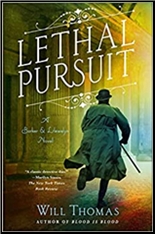
WILL THOMAS – Lethal Pursuit. Cyrus Baker & Thomas Llewellyn #11. Minotaur Books, hardcover, November 2019; trade paperback, December 2020. Setting: England, 1892.

First Sentence: The express from Dover was still coming to a stop when Hillary Drummond leapt onto the platform.

   A man is found murdered on a train newly arrived at Charing Cross Station. In his shoe is the key to a railway locker containing a satchel. It is 1892; the threat of war is in the air. Enquiry agents Barker and Llewelyn are tasked by the Prime Minister to deliver the satchel to Calais as it contains a document, an unnamed first century gospel. With the satchel sought by secret societies, political groups, and the German government, Llewelyn is perplexed by Barker’s delay in fulfilling their assignment considering it places them under repeated attack.

   Rarely are prologues necessary. However, Thomas’ prologue captures and captivates one immediately with suspense, danger, intrigue, and yes, death. With the receipt of an old brass key, stamped with the letter “Q,” the characters go— “Down the rabbit hole.” One cannot help but smile at their destination, and Llewellyn’s admiration of what he sees there is understandable.

   Thomas’ voice is enviable. Even during a serious scene, he makes one smile with the simplest line even when in a serious situation. It is only a part of what makes reading him such a pleasure. His dialogue is a pleasure to read— “The things you know, Thomas!” “Yes, well, the more I know, the more I know how little I know.”

   Characters are Thomas’ strength. It is nice to have a series with characters who have developed over time. Still, for those who have not read the previous books, one won’t feel lost as Thomas provides well-presented introductions to the characters. Llewelyn’s wife, Rebecca, deals with the conflict of being shunned by her family for being married to a gentile. Their marriage and commitment adds a nice touch and humanness to the story— “There was still something strange about being separated from Rebecca for more than a few hours. It was like slow asphyxiation.” A scene between Llewelyn and his father-in-law is particularly well done.

   Thomas conveys mood well, in this case, it is that of a man adrift. A significant change is made in the roles and responsibilities of Barker, Llewelyn, and others ensure a shift in future books.

   The backdrop of Victorian England makes the plot particularly effective. The drums of war are beating in the distance, the underlying anti-Semitism, and the inclusion of an Evangelical preacher from the United States advocating eugenics. There is action and suspense, but also serious subjects which require consideration.

Lethal Pursuit maintains one’s interest from the beginning to an ending that is clever in so many ways, including the ultimate question— “Why do evil men prosper?” This is more than an average historical mystery. Thomas is an author to add to one’s list.

Rating: Very Good.
   

      The Barker & Llewelyn series

1. Some Danger Involved (2004)
2. To Kingdom Come (2005)
3. The Limehouse Text (2006)
4. The Hellfire Conspiracy (2007)
5. The Black Hand (2008)
6. Fatal Enquiry (2014)
7. Anatomy of Evil (2015)
8. Hell Bay (2016)
9. Old Scores (2017)
10. Blood Is Blood (2018)
11. Lethal Pursuit (2019)
12. Dance with Death (2021)

      Novella —

An Awkward Way to Die (2017)

ANNE MORICE – Scared to Death. Tessa Chrichton #11. Macmillan, UK, hardcover, 1977. St. Martin’s, US, 1978. Detective Book Club 3-in-1 edition, hardcover. Bantam, US, paperback, 1986.

   All but two of Anne Morice’s 25 mystery novels featured actress-amateur sleuth Tessa Chrichton and were strictly in the Golden Age of Detection traditions, albeit in solid contemporary (1970s-80s) surroundings. (You can find out a lot more about her on Curtis Evans’ blog here. He has been writing about her quite extensively lately.)

   Spurred by his reviews of her books, Scared to Death was the easiest for me to find. It was one of the three books in the Detective Book Club edition on the top of the bookshelf next to me as I type this. (You cannot make up coincidences such as this.) Unfortunately, let me put it this way, maybe I should have started with another one.

   This one begins as a elderly, eccentric, rich and quite controlling acquaintance of Tessa becomes strangely haunted by a doppelgänger of herself wherever she goes, and each time she sees her, her health takes another turn for the worst. No one else manages to see this double, so it is passed off as a curious fantasy on her part. Until, that is, she is completely bedridden and dies.

   No one thinks more of it but Tessa, whose inquisitive nature wants to know more. The police do not take part in any of her secret undercover investigation, which involves a boatload of relatives and close friends, a will that there may or may be the current one, and a fictionalized diary the dead woman was in the process of writing.

   There are a number of witty lines in the telling, but there aren’t enough of them to make up for the fact that the tale just isn’t all that interesting, nor are any of the possible suspects. The story goes from slow to slower and then even slower.

   Morice’s way of hiding clues is to hide them in a disorienting mix of clouds and confusion, which is not Agatha Christie’s usual method of operation: which is to leave right out in the open and dare you to spot them, which I almost never have. Even a table that matched up names in the diary with their real-life counterparts did nothing to brighten up Tessa’s explanation of how she solved the case.

   The end may prove worthy of the journey, but overall quite the disappointment, then. Your opinion may vary.

« Previous PageNext Page »