Reviews


COSMOS. Elliander Pictures, 2019. Tom England, Joshua Ford, Arjun Singh Panam. Screenwriter-directors: Elliot Weaver & Zander Weaver.

   There is a tremendous dichotomy about this movie between those leaving reviews of it on IMDb. About half seem to have found it boring beyond belief, while the other half have found it both fascinating and inspiring. Me, I think they’re both right.

   In the first 50 minutes nothing happens except for the conversation between three science and engineers geeks sitting in a large station wagon or a small mini-van setting up their computers, telescopes and the other equipment as they get ready for an all night’s vigil watching and listening to the stars.

   The story then does jump into higher gear when they start receiving signals from who or what somewhere in the sky. There is no action, only the stunned reaction of the three friends as it slowly begins to dawn on them as to what they are probably the first people on Earth to be seeing and hearing. Fascinating and inspiring? I’d say yes, and all the more so because I know personally people who could each be one of the three, and if I knew more about astronomy, I’d probably be one of them.

   That this is a bare bones, love-of-making-movies production goes without saying. I can’t really recommend this movie to everyone, as there are plot holes galore in the story line, and the ending, as the three of them stand looking happily up into the night sky, all wearing their red Astro Nuts caps, goes on for far too long. But if ever we are approached by being from space, I think it could very easily go like this. Or, let’s put it this way. I hope so.


REVIEWED BY RAY O’LEARY:


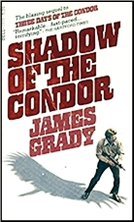
JAMES GRADY – Shadow of the Condor. Ronald Malcolm #2. Putnam, hardcover, 1975. Dell #7570, paperback, 1977.

   A sequel to Grady’s Six Days of the Condor, which was a competent effort made into a superior film (Three Days of the Condor), thanks to improvements made by an intelligent screenwriter and an excellent cast.

   When a member of Air Force Intelligence is found shot to death at a missile silo in Montana, they ask the Liaison Board, headed by the “Old Man” (John Houseman in the film) to take charge of the investigation and discover what sort of plot the dead agent had stumbled onto. He decides to use Ronald Malcolm, the retired “Condor,” as the front man in an obvious operation taking place in Montana, while other agents try to discover what happened from the European end, where the dead man had been stationed.

   Despite the fact that most of the characters are strictly from Cardboard, I found Shadow a real page-turner for the most part, with a gripping twisty plot that gets even twistier when Grady rings in two Red Chinese agents just over the Montana border, who also have a keen interest in the matter.

— Reprinted from A Shropshire Sleuth #40, July 1989.

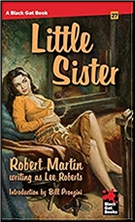
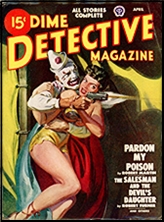
ROBERT MARTIN writing as LEE ROBERTS – Little Sister. Andrew Brice #1. Stark House Press / Black Gat Book #27, trade paperback, August 2020. Based on the story “Pardon My Poison,” as by Robert Martin, Dime Detective Magazine, April 1948, in which the leading character was Jim Bennett. Introduction by Bill Pronzini. First published as a paperback original by Gold Medal, #229, March 1952, as by Lee Roberts.

   Between 1951 and 1964 and under his own name, Robert Martin wrote fourteen novels in which PI Jim Bennett was the leading character, but back in the 1940s Bennett was the detective of record in several dozen pulp stories, largely but not exclusively for Dime Detective Magazine. Bennett was a down to earth sort of guy, based in Ohio with a steady girl friend whom he later married. He wasn’t flashy, and in quiet contrast to all of the other PI’s of the same era, as Bill Pronzini points out in his introduction to the upcoming Stark House reprint, “he never once gets laid.”

   This may be the reason why the Jim Bennett of the earlier pulp version of this story gets replaced by Andy Brice in this one. The setting is still Ohio, PI Andy Brice is still a nice guy, but yes, one big difference is, he does get laid. He’s hired by the older sister of a younger girl, who if the word “sexpot” hadn’t been invented yet, they’d have had to come up the word, just to describe her. She is the kind of girl who cannot seem to keep her clothes on properly, at least whenever she’s in the same room as Brice. Her bigger problem, though, when she comes home on night in a doped-up daze, what they also find in the trunk of her car is the body of a dead man.

   It isn’t the younger girl whom Brice spends the night with, however, and wishes for more, but his client, the older sister. And while on the case for her, Brice is also poisoned and shot at, while other characters fare much worse. There are a lot of characters to keep track of, many of them men with eyes for Linda, the little sister, but Martin’s prose is smooth and easy and keeps things running like a well-tuned engine.


REVIEWED BY DAVID VINEYARD:


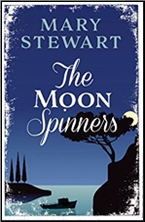
MARY STEWART – The Moon-Spinners. Hodder & Stoughton, UK, hardcover, 1962. M. S. Mill Co. & Morrow, US, hardcover, 1963. Crest #R717, US, paperback; 1st printing, May 1964.

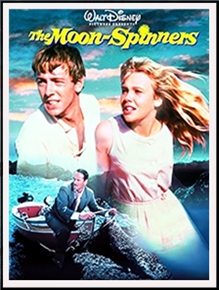
THE MOON-SPINNERS. Buena Vista (Walt Disney), 1964. Starring Hayley Mills, Eli Wallach, Joan Greenwood, Peter McEnery, Irene Pappas, Pola Negri, John LeMessurier, Andre Morell. Screenplay: Michael Dyne, based on the book by Mary Stewart. Directed by James Nielson.
   â€œEven in Crete nobody’s going to murder a visitor.”

   So speaks young Englishwoman Nicola Ferris as she chides the couple that has given her a ride to the remote seaside village of Agios Georgios, St. George, in the shadow of the White Mountains. Nicola works for the British embassy, and for her holidays she is meeting her older cousin Frances Scorby, a naturalist who has written several books on flowers and who hopes to study local wild flowers.

   Frances, who she calls Aunt Frances, raised her.

   It seems a perfect holiday, beautiful setting, fine food, the sea, and a family reunion for the orphan Nicola.

   The best laid plans and all that.

   This being Mary Stewart, the best of the writers of romantic suspense (and as good as any man in the adventure/suspense/adventure genre), you know things won’t be quite that simple, especially when Nicola runs into a strange man while exploring the island, a fugitive being hunted, and finds herself up to her neck in a mystery involving the attractive mysterious Englishman named Mark Langley hiding out on the mountain with a bullet wound and concerned for his younger brother Colin who has been missing since he was wounded.
   Then there is the attractive Tony Gamble who she meets at the hotel where he does the cooking, and the mysterious Stratos whose sister Sofia runs the inn and who only recently arrived from the West and despises the poverty and ignorance of his own people. And why does Sofia look so frightened of Gamble and her brother?

   And what is the mystery of the Bay of Dolphins where the fates, the ones who spin the silver moon from the title, spin a silver full moon so that you might one night see the lost treasure ship at the bottom of the bay? Because treasure is involved, if not the one the Moon-Spinners reveal.

   I strained across the moving whispering darkness. As before, it was full of sounds, far fuller than when, on the ridge, I stood insulated by the air from the subdued and roaring life of the sea.

   Stewart, like Daphne Du Maurier had a genuine talent for the romance of adventure and lonely places, the Stevensonian voice out of Buchan and Geoffrey Household that gives life to the landscape around her heroines.

   Soon enough Nicola finds Colin, held prisoner, and is drawn even deeper into the mystery that ends in a dangerous battle on Stratos caique.

   The Walt Disney film is shot on location, and while it does away with Colin and combines Mark Langely and Tony Gamble into a single character, stays fairly close to the book until midway through when it dissipates some of the suspense by adding some extraneous characters that seem to have wandered in from The 39 Steps, including Pola Negri as a mysterious woman on a yacht and John LeMessurier as a shady British consul with a wife who drinks and talks too much..

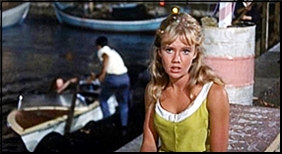
   Hayley Mills in an early grown up (sort of — Disney isn’t quite ready for her to be a Hitchcock blonde exactly) role is Nicola, traveling with her Aunt (Joan Greenwood) in Crete to record folk music (an excuse for some musical interludes) who arrives in Agios Georgios and discover the sinister zodiac obsessed Stratos (Eli Wallach) who wants no one at the hotel, especially the Englishman Mark Gamble (Peter McEnery) who is staying there.
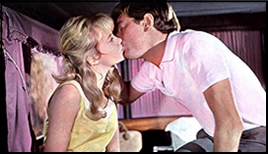
   Some of the suspense is lost, and the ending is a bit too neat, but it is gorgeously shot, the music, including the title song “Moon-Spinners” is good, the actors are all far better than the material, and even with the changes something of the suspense and romantic mood is captured.

   Mills is good as the feisty Nicola, and not all that far from Stewart’s heroine if a bit younger, McEnery a decent leading man, and Wallach by turns sinister, threatening, ingratiating, and threatening.

   Irene Pappas hasn’t much to do but is gorgeous, Joan Greenwood gets to be Joan Greenwood, and Pola Negri — well, that part I can’t explain, but someone must of thought it was needed.

   As a Stewart fan, of course, I would much prefer they had filmed the book, and even with Mills in it, I can’t see what the need of all the business with Negri and LeMessurier was, saving someone involved had seen too many Hitchcock films.
   But how exactly anyone would quite capture the quality of Mary Stewart’s writing on film is hard to see.

   …when the big white bird flew up among the glossy leaves and the lemon flowers, and wheeled into the mountain, I followed it. What else is there to do, when such a thing happens on a brilliant April noonday at the foot of the white mountains of Crete; when the road is hot and dusty, but the gorge is green, and full of the sound of water, and the white wings, flying ahead flicker in and out of deep shadow, and the air is full of the scent of lemon blossoms?

   

REVIEWED BY DAN STUMPF:


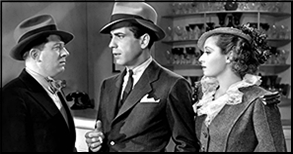
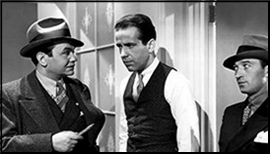
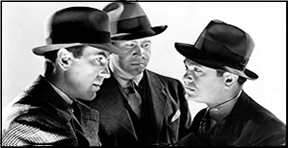
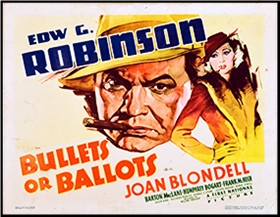
BULLETS OR BALLOTS. Warner Brothers, 1936. Edward G. Robinson, Joan Blondell, Barton MacLane, and Humphrey Bogart. Written by Seton I. Miller and Martin Mooney. Directed by William Keighly.

   A dumb title on a story guaranteed to surprise no one, but so well-mounted I didn’t care.

   Edward G. Robinson stars as a veteran plainclothes cop, who opens the show by throwing a cheap hood through a glass door — Warner’s way of telling us he’s tough and straight — but not puritanical; he flirts with hard-boiled Joan Blondell, who runs a numbers game, and chums around with Barton MacLane as an upper-echelon gangster.

   Then, following a departmental house-cleaning, Robinson gets fired, fired up, socks the Police Captain and joins MacLane’s mob, where he quickly rises in importance. But don’t worry folks, it’s all a ruse, a sham, and a ploy, designed to get Eddie access to the really big boys who give the orders and rake off the profits.

   Well, as movie-schemes go, it’s not bad. The only real problem is Humphrey Bogart as MacLane’s trigger-happy Number Two, understandably upset by Robinson’s rise in the ranks and all too eager to demote him permanently.

   At this point Bullets or Ballots (what the hell does that title refer to?) becomes a vigorous game of cat-and-mouse, with Bogie and Eddie taking turns as predator and prey, trying to outmaneuver each other in games of gunfire and gangland politics, done with typical Warners panache: squealing tires, blazing guns and the gentle pitter-patter of fists on faces. I particularly liked one scene where Eddie walks into a room full of hostile hoods and director Keighly emphasizes his isolation with subtle camera placement and composition, then gradually eases the visual tension as Robinson wins them over.

   This was Bogie’s first film at Warner Brothers after his memorable Duke Mantee in The Petrified Forest, and his first team-up Edward G. Robinson, whom he would definitively kill in Key Largo. Here we have all the nastiness of Mantee, but none of that independent spirit that ennobled the earlier part. No, Bogie is the classic Meanie here: vicious, cowardly and compulsively watchable. There were better parts to come — and some definitely worse — but fans of Bogart need to see this one.


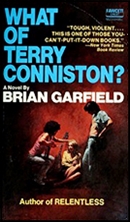
BRIAN GARFIELD – What of Terry Conniston? World, hardcover, 1971. Fawcett Crest, paperback, February 1974.

   The five members of a chronically out-of-work rock group (and a motley, unsavory group they are) decide to try their hand at kidnapping. Their target: Terry Conniston, the daughter of an Arizonan multimillionaire. After they grab her, though, complications set in. Things go wrong on both sides, but the comedy of errors is not funny à la Donald Westlake. The girl’s life is really at stake.

   Garfield deftly mixes dollops of marital infidelity and family discord, stock manipulation, a Chicano uprising, and Mitch Baird, an unwilling participant in the kidnapping. And Terry herself has her own attractions. The cliché about not being able to put a book down strikes again.

Rating: A minus.

–Very slightly revised from The MYSTERY FANcier, Vol. 1, No. 2, March 1977.

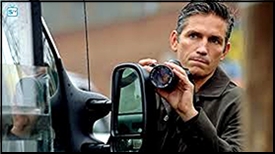
PERSON OF INTEREST “Pilot.” CBS, 22 September 2011. Jim Caviezel as John Reese, Michael Emerson as Harold Finch. Guest cast: Natalie Zea. Seriescreated by Jonathan Nolan; executive producers: Nolan, J. J. Abrams, Bryan Burk, Greg Plageman, Denise Thé, and Chris Fisher. Director: David Semel.

   This series lasted for five years, but when it was first suggested to me that it was excellent and I really had to watch it, it was part way through the third year, and believe you me, I had no idea what was going on. Science fictional TV series like this one has a tendency to get that way, especially when the basic concept was so complicated to begin with.

   To wit: A former government contractor named Harold Finch is  the man who helped build a super computer program that… What the hell. I’m just going to quote Wikipedia:

   â€œ…that is capable of collating all sources of information to predict terrorist acts and identify people planning them. The Machine also identifies perpetrators and victims of other premeditated deadly crimes, but, because the government considers these ‘irrelevant,’ he programs the Machine to delete this information each night. Anticipating abuse of his creation, Finch created a backdoor into the Machine. Tormented by the ‘irrelevant’ deaths that might have been prevented, he eventually decides to use his backdoor to act covertly. To escape detection, he directs the Machine to provide only a tiny fragment of data: the social security number of a ‘person of interest.’ The person may be a victim, a perpetrator, or an innocent bystander caught up in lethal events.”

   In the pilot, the social security number is that of a successful female prosecutor. What kind of problem is she having, or will she have? There are many low life characters in her life every day. Is she in danger? To help him find out, Finch recruits John Reese (Jim Caviezel) – and quoting Wikipedia again, he is “a former Green Beret and CIA agent now presumed dead.” Finch needs him as a leg man to investigate.

   It’s a great concept, and this the first episode is slickly done, with a twist or two that  brought a smile (or several smiles) to my face.. It’s no wonder the show went on to great success.

   I’m not sure, though, whether I want to invest the equivalent of five years’ worth of episodes, especially, as I said the outset, I think the show went off in directions that even those who made this pilot had no idea of that far in advance. Fringe was another series that I enjoyed for maybe two years before the plots became way way too complicated, at least for me.

   I welcome any advice you may have to offer on this.


REVIEWED BY RAY O’LEARY:


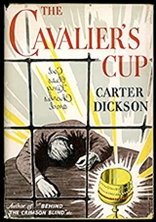
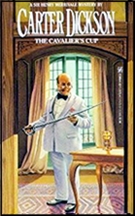
CARTER DICKSON – The Cavalier’s Cup. Sir Henry Merrivale #22. William Morrow & Co., hardcover, 1953. Zebra, paperback, 1987.

   Another book passed on to me by Dan and another re-read of one of the later Sir Henry Merrivale novels. It is also one that isn’t a murder mystery.

   Lady Brace, the American-born wife of Lord Brace and the daughter of a Congressman from Pennsylvania comes to Chief Inspector Humphrey Masters of Scotland Yard seeking his help to find an explanation for how her husband, having locked himself in the Oak Room of his home, Telford Old Hall, in order to guard the golden bejeweled Cavalier’s Cup, a family heirloom taken from the bank for a museum exhibition, awoke to find the cup on the table before him and no longer in the safe, which is open and the door and windows still locked as they had been when he had locked himself in the night before.

   Masters reluctantly goes along after being ordered to by his superiors, even though he thinks it’s a simple case of Lord Brace walking in his sleep, and even though he knows that Sir Henry Merrivale has been staying in nearby Cranleigh Court for the past six months. Masters is forced to spend a night locked in the Oak Room. where, in the middle of the night, he is knocked out and a sword displayed outside the room is found inside along with the opened safe and the Cavalier’s Cup again out in the open. So it’s up to Sir Henry to explain it all.

   This is a book I completely forgot and I think I know the reason why, since Carr was clearly tiring of the character. In a way this reminded me of The Maltese Falcon. (I’ll wait here while the laughter dies down.) One of the criticisms of that classic was that the murder of Miles Archer was pushed aside while the characters and story concentrated on the Black Bird: who has it and how to get it In response Hammett wrote The Glass Key in which “who killed Taylor Henry” was on everyone’s lips.

   Here, Carr sets up an intriguing locked-room puzzle but spends the whole middle of the book trying to write farce about Merrivale’s singing (with an Italian teacher named Ravioli yet who speaks ,n the sort of Italian accented English that should have the Italian-American Civil Rights League up in arms) and the Congressman’s love at first sight (and sex at second) with the local Labour M. P. Miss E. M. Cheeseman.

   Only then does he go back to the puzzle and Merrivale’s explanation (to the perpetrator who he decides to let get away with it). So let me remember Carr’s glory days and forget this as thoroughly as I did the first time I read it.

— Reprinted from The Hound of Dr. Johnson 53, September 2007.

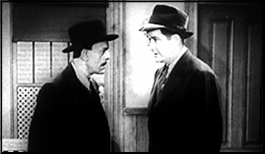
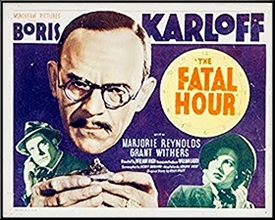
THE FATAL HOUR. Monogram Pictures, 1940. Mr. Wong #4. Boris Karloff (James Lee Wong), Marjorie Reynolds, Grant Withers, Charles Trowbridge, Frank Puglia, Craig Reynolds, Lita Chevret. Based on the “James Lee Wong” series in Collier’s Magazine written by Hugh Wiley. Director: William Nigh.

   When an undercover policeman and a good friend of Captain Bill Street of San Francisco Homicide is found murdered, it is his friend Mr. Wong who steps in and gives him all the help he needs to catch the killer. Spunky female reporter Bobbie Logan is also on hand, but she’s there mostly for eye appeal and doesn’t do much in the way of actual detective work.

   But since I’ve mentioned “detective work,” this is, I think, is one of the better B-movies in that regard that I’ve watched in a while. There are a lot of suspects crammed into a movie that is only about an hour long, and all of the plot points click off like clockwork. There is even a brand new invention involving a common home [Redacted] that’s part of the solution.

   To tell you the truth, Boris Karloff doesn’t look Chinese to me, but any movie that he appeared in was far better off than if he wasn’t, and The Fatal Hour is no exception. I haven’t seen one of these Mr. Wong movies since I was 15 or 16, and it’s only me who’s the worse for wear.


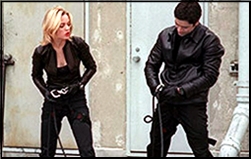
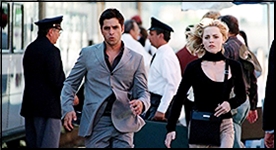
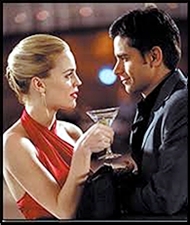
THIEVES. “Pilot.” ABC, 28 September 2001. John Stamos (as Johnny), Melissa George (as Rita), Robert Knepper, Tone Lōc. Written by Jim Leonard. Director: James Frawley.

  It’s so tempting to start this review by saying, “Stop me if you’ve heard this one before,” and guess what? I just did. Two young cat burglars, male and female, each successful on their own, are caught trying to steal the same set of diamonds, and given an ultimatum” Work for us (the government) or go to jail. By story’s end, they have (guess what) decided to work for the government.

  They of course bicker between each other a lot, but one can imagine that if the series had been allowed to continue (only eight of the ten films were aired before the plug was pulled), the sparks would have been romantic ones as well as those generated by their competitive natures. Both lead actors are extremely attractive (and the female partner of the two seems to dress in clothes that show as much bare skin as much as possible).

  There is an old adage in the television business (or if there isn’t, there should be), that you need a story, too, not bits of pieces of one that need as much padding as to make each episode fit comfortably in a 60 minute time slot, less commercials.

  Each of the two leads ha gone on to have had successful careers. This series wasn’t much of a step up along the way, however. It remains a relic only, of interest only to those of us who love digging up old relics such as this.


« Previous PageNext Page »