Reviews


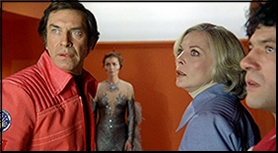
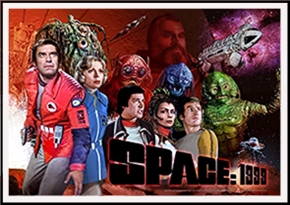
SPACE: 1999 “The Metamorph” ITC (UK); first run syndication (US). 04 September 1976 (Season 2, Episode 1).. Martin Landau (Commander John Koenig), Barbara Bain (Dr. Helena Russell), Tony Anholt, Nick Tate, Zienia Merton. Guest cast: Catherine Schell, Brian Blessed. Format creators: Gerry Anderson and Sylvia Anderson. Writer: Johnny Byrne. Director: Charles Crichton.

   The premise of this series was laughable at best if you were to look at scientifically: an explosion on the Moon would be sufficient to throw it out of its orbit and head it traveling at apparent light speed out into outer space. (In reality such an explosion would have the Moon come crashing down on Earth or blow it up entirely.)

   But given enough suspension of disbelief, which I could at the time, and I still can now, this mean that the 300 plus inhabitants on the Moonbase there would have the trip and adventures of their lives. The special effects were both top notch and spectacular. The stories? Not so much.

   But truth be told, I enjoyed Space: 1999 more than I did Star Trek, which I often found boring and preachy. If it hadn’t been for Spock’s ears, the show would have gone nowhere. But I digress. Suffice it to say that the stories in Space:1999 were probably not as good as those as Star Trek’s, but while people may disagree with me on this, I found them a lot more fun.
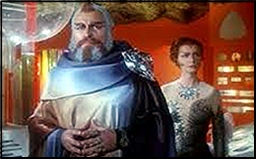
   Case in point. In “The Metamorph,” the folks on the space traveling Moon are running out of titanium (if I remember correctly), and a what they think is a barren planet looks like a promising place to find some. Not so. The ruler of the underground civilization named Mentor – the ruler, not the planet – takes a survey crew captive, and plans to do the same to the rest of the crew. The reason? To suck the energy from their brains to feed his biological computer, which he plans to use to replenish his planet.
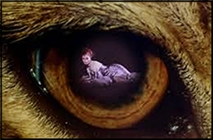
   It’s a close call, but everyone escapes, just in the nick of time, thanks to, .. Well, I guess I won’t tell you, but as a hint, one of the members of the guest cast above turns out to become a regular member of Moonbase Alpha for the rest of the second season. (There were only the two.)

   As I say, the story is weak. If you haven’t read and seen a version of it before, you probably haven’t read or watched a lot of sci-fi. But watching this last night brought a lot of good memories. All of a sudden I was a 30-something again.
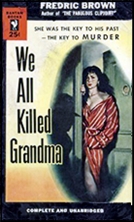
   

FREDRIC BROWN – We All Killed Grandma. E. P. Dutton, hardcover, 1952. Bantam #1176, paperback, December 1953.

   It’s possible that the amnesia victim has become a worn-out cliche in the mystery field, but I think that in We All Killed Grandma, Fredric Brown did about as well as possible with the idea 25 years ago, and perhaps all that can be done.

   Rod Britton’s mind blanks out just as he reports to the police after finding his grandmother’s body. He’s the same person, but with a memory that’s only a few days old. Why doesn’t his subconscious want him to remember? Is he the killer?

   What this is is a well-done character study: it’s all about Rod investigating and rediscovering himself. It’s the motivation behind it all that’s a little less sure.

Rating: B

–Slightly revised from The MYSTERY FANcier, Vol. 1, No. 2, March 1977.

THE ADVENTURES OF FATHER BROWN “The Three Tools of Death.” Mutual, 22 July, 1945. Karl Swenson (Father Brown), Bill Griffis (Flambeau), Gretchen Douglas (Nora, the rectory housekeeper). Based on characters created by G. K. Chesterton.

   Sherlock Holmes came first, and Father Brown may not be quite as famous, but he’s caught the fancy of reading, listening and viewing audiences almost contiguously since 1910, and that’s not a bad feat at all. He’s still read – and watched – even today.

   The radio this episode was part of was probably only a summer replacement show. Wikipedia says “The program was broadcast Sundays at 5 p.m. on Mutual from June 10, 1945, to July 29, 1945.” Not a lot more is known about it for sure – it’s always a challenge when only two episodes are known to exist, the other being “The Mystified Mind” (August 13, 1945).

   Based on this episode, however, the writers of the series had a good idea of what the appeal of Father Brown was, and it’s an excellent detective story too. Dead is a clergyman who had a very productive life bringing cheer and happiness to thousands as part of his public ministry. His death is no accident. At the scene of the crime – for that it what it is – are found a rope, a fragment still found around his leg; a gun that has been fired three times; and a bloody razor. His only visible wound, however, is an battered skull, incurred perhaps when he fell out of a second story window and down a steep embankment.

   Assisting Father Brown is Flambeau, a former criminal now a PI, but while he’s puzzling over the facts, Father Brown does the opposite and studies the inner nature of the people involved. This is rather a unique approach, I think, to the usual cops and robber programs on the air then, or programs with weird things happening only to explained safely away at the end.

   If the link continues to work, you can listen to this episode here.

COUNTERSTRIKE “Dealbreaker.” USA Network., 01 July 1990 (Season 1, Episode 1). Christopher Plummer, Simon MacCorkindale, Cyrielle Clair, Stephen Shellen, Laurence Ashley-Taboulet. Guest Cast: Susan George, Chuck Shamata. Director: Mario Azzopardi.

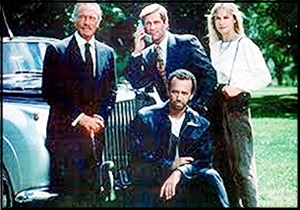
   Counterstrike was a Canadian-French TV series that was broadcast on USA here in the US for three seasons, beginning in 1990.  Christopher Plummer was the biggest name in the cast, playing ,Alexander Addington, the wealthy leader of a group of three counter-terrorism agents. Unfortunately in this, the first show of the series, there is nothing to show how the team was assembled or their motivations, if any. The viewer is expected to pick upon things as they go.


   And this is a state of affairs that applies to the story itself, I’m sorry to say A little bit of stick-to-it-iveness is a handy thing to have sometimes, and eventually the overall picture becomes clearer. To wit: A former girl friend of one of the team (Simon MacCorkindale) has been kidnapped. She’s now the wife of a former CIA agent who’s gone back on a deal with some terrorists involving some bomb detonators. It’s up to Peter to get her back, along with the help from Addington  and the other two members of the team. The husband he cares about not at all.

   There’s lots of spy stuff going on, but you needn’t bother paying too much attention to the details. There’s not a lot in this one you’ve haven’t seen before, and when you did, it was probably better told. Many of the episodes are playing now on YouTube, however, and maybe once you get to know the characters better, maybe the shows improve as well.


REVIEWED BY DAN STUMPF:


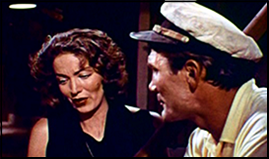
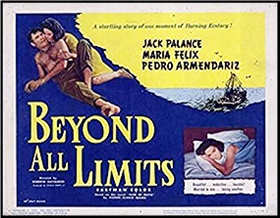
BEYOND ALL LIMITS. Cinematografica Latino Americana, Mexico, 1959. Original title: Flor de mayo. Maria Felix, Jack Palance, Pedro Armendariz, Juan Muzquiz, Carlos Montalban, and Paul Stewart. Screenplay by Libertad Blasco Ibanez, from the novel by Vicente Blasco Ibanez. Directed by Roberto Gavaldon.

   Just a Soap Opera, but like all good soaps it hovers at the edge of violence like a fly at a Venus Flytrap.

   Jack Palance (fittingly playing a character named Gatsby) returns to a Mexican fishing village where, six years earlier, he had an affair with the wife of a friend (Armendariz) doing a stretch in jail. To make a long flashback short: they got serious, he bailed, she had Jack’s kid and passed it off as Pedro’s.

   There’s a subplot about an illegal fishing venture that moves things along, but the story proper begins when Pedro stars counting the months and wonders if his boy is really his. We’re not supposed to wonder why it never occurred to him before, so I won’t. In fact, I didn’t want to, because Beyond All Limits accomplished that most essential function of fiction: the willing suspension of disbelief.

   Ibanez’ screenplay skillfully pivots between Palance, and Felix, filled with regret and longing; Armendariz, confused and compelled to reject the boy he loves as a son; and the boy (Muzquiz) convincing, not cloying, as he tries to figure out why the parents he loves seem so suddenly far away.

   Gavaldon’s direction lends an operatic air to the whole thing, backed by lush music (“And That Reminds Me”) that would have seemed silly in hands less deft. Here it swells under the simple passions of real-seeming people, and it works. There’s one small moment in particular when a minor character pleads with Armendariz to stand by his son. “I have no child. I never had a wife. My only family is yours and you are throwing it away.” Lines so simply and wrenchingly delivered that one feels a sense of what is really at the crux of this eternal triangle.


REVIEWED BY JONATHAN LEWIS:


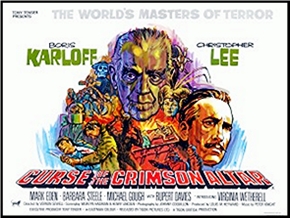
THE CURSE OF THE CRIMSON ALTAR. Tigon Pictures, UK, 1968. America International, US, 1970, as The Crimson Cult. Boris Karloff, Christopher Lee, Mark Eden, Barbara Steele, Michael Gough. Based on a story by Jerry Sohl and (uncredited) “The Dreams in the Witch House,” by H. P. Lovecraft. Director: Vernon Sewell.

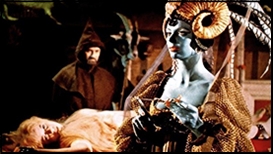
   The Curse of the Crimson Altar, a psychedelic gothic horror film which was released in the United States under the title The Crimson Cult opens with a shocking scene of violence. There’s a blue-faced witch (portrayed by the legendary horror queen Barbara Steele), a bunch of scary looking characters dressed in robes and black leather, and a woman being whipped. And it appears as if this motley crew is trying to force a rather mild-mannered Englishman to sign his name in a large book. What in blazes is going on, you ask yourself.

   Well, it turns out that there’s a cult at work. A cult which, based on the movie’s mise-en-scène, seems to really have a deep attachment to the color red. Crimson, to be specific. And as any savvy consumer of films dealing with the occult or “Satansploitation,” knows all too well, an innocent person is almost certainly going to be swept up in the cult’s unheavenly deeds!

   Enter Robert Manning (Mark Eden), an antiques dealer in London. His brother has gone missing and he’s determined to find out where his sibling has gone. What Manning doesn’t know is that his brother was the aforementioned mild-mannered Englishman swept up into the cult’s demonic grasp. So, much like in The Wicker Man (1973), which this horror film clearly presages, a man searches a small somewhat isolated village for a missing person, only to be the unwitting mark of a pagan cult. And much like in The Wicker Man, the cult’s leader is portrayed by the irreplaceable Christopher Lee. Seeing Lee’s entrance into the movie is a delight; you know at that point, that no matter how clunky or formulaic the movie might turn out to be, that you’re going to at least benefit from his singular theatrical presence.

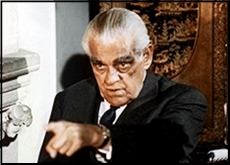
   But Lee is not the only famous horror actor to make an appearance. Boris Karloff, in one of his final roles, portrays Professor John Marsh, a leading scholar of witchcraft. Although Karloff was in the final years of his life, his speech and cadence were spot on. It’s pure unadulterated Karloff.

   As you may have surmised by my comments so far, it’s pretty clear that I thoroughly enjoyed The Crimson Cult. But it is a good film? Yes and no. It’s definitely a little predictable and Eden is not a particularly dynamic lead. As a Tigon production, it also doesn’t have the unique Hammer film aesthetic. But if you take it for what it is, you might have a little fun with it. There’s definitely a late 1960s psychedelic vibe to the whole affair – an attempt to capitalize on the counterculture era? – and the movie benefits from never taking itself too seriously. I read online that the script was inspired by H. P. Lovecraft’s “The Dreams in the Witch House” (1933). That may very well be the case, but it was not listed in the credits.


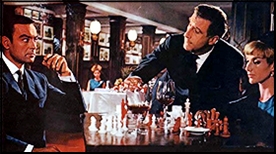
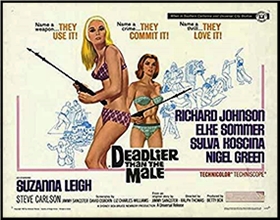
DEADLIER THAN THE MALE. Rank, UK, 1966. Universal, US, 1967. Richard Johnson (Hugh Drummond), Elke Sommer, Sylva Koscina, Nigel Green, Suzanna Leigh, Steve Carlson. Screenwriters: Jimmy Sangster, David Osborn) & Liz Charles-Williams, based on a original story by Jimmy Sangster and the character Bulldog Drummond created by Herman C. McNeile (as Sapper) & Gerard Fairlie. Directed by Ralph Thomas.

   If my count is correct, there were 22 films between 1922 and 1951 in which Bulldog Drmmond was the leading character. Various actors played the role, with John Howard getting the nod the most often. Others include Ronald Colman, Ray Milland, Tom Conway and Walter Pidgeon. Spurred on by the success of the James Bond films, Deadlier Than the Male was the first of two additional outings for the character in the late 60s; Some Girls Do (1969) was the second.

   By this time, though, I can easily imagine that audiences had more or less forgotten the character. The role played by Richard Johnson could easily have been any debonair insurance investigator. I may be mistaken, but in Deadlier than the Male, I do not believe he is even called “Bulldog” Drummond.

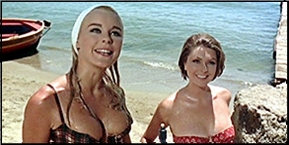
   He’s brought in on the case when a series of accidents have taken out some of the top level executives of various oil companies. Responsible, although he doesn’t know it at first, are two eye-catching female assassins (Elke Summer, she of the cantilevered bikini, and almost as luscious Sylvia Koscina). But even with such eye candy on hand, the story doesn’t really get into high gear until Drummond’s arch enemy Carl Peterson reveals himself as the man behind the killings.

   In spite of all the action that takes place in the last thirty minutes, I found the overall product only semi-satisfactory at best. As I mentioned earlier, there was a sequel, so this first of the two must have done all right, but unless someone can tell me otherwise, the adventures of Bulldog Drummond essentially ended with the second of the pair, content perhaps as being the model and/or inspiration for the many other characters of derrng-do who followed in his footsteps.


NOTE: For Dan Stumpf’s much more personal take on this film, posted on this blog almost nine years ago, go here.

REVIEWED BY BARRY GARDNER:


WILLIAM LASHNER – Hostile Witness. Victor Carl #1. HarperCollins, hardcover, 1995. Harper, paperback, 1996.

   Well, well – a book about a Philadelphia lawyer by a Philadelphia lawyer, and a first novel to boot. Be still, my fibrillating heart, HarperCollins thinks this is going to be a biggie.

   Victor Carl is six years out of law school and beginning to understand that he’s not going to make it big. Then one of the city’s most prestigious firms asks him to replace a lawyer who died as defense fir a politician’s right-hand man. Both are coming to trial on racketeering charges, but though the case against them looks strong, the high-powered firm isn’t worried, and just wants Victor to sit at the table and be quiet.

   He has qualms, but the lure of money and prestige is too much, and he accepts. It doesn’t take him too long to realize that the price he pays may be more that the price he gets.

   This isn’t a really bad book, though it’s far from a good one, and pre-Grishan I doubt that anyone would have thought it could be a hit. Victor Carl is decently-realized character, if not a particularly fine human being. The story is an adequate one, if nothing new, and Lashner’s pacing is good, as is his prose for the most part.

   Some of the characters are a bit on the exaggerated side, and you don’t have to worry about telling the good guys from the bad – though there are damned few of the former. There’s a good bit of steamy sex, a soupcon of violence, and some decent courtroom dramatics.

   If you like the type, you could do worse. You probably have.

— Reprinted from Ah Sweet Mysteries #19, May 1995.


      The Victor Carl series —

1. Hostile Witness (1995)
2. Bitter Truth (1997)
3. Fatal Flaw (2003)
4. Past Due (2004)
5. Falls the Shadow (2005)
6. Marked Man (2006)
7. A Killer’s Kiss (2007)
7.5 A Bite of Strawberry (novella, 2013)
8. Bagmen (2014)

REVIEWED BY DAN STUMPF:


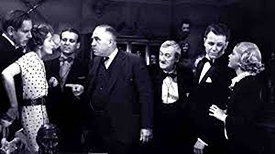
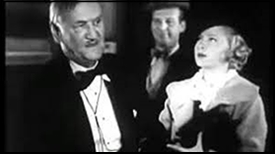
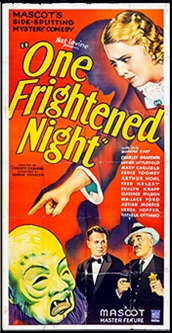
ONE FRIGHTENED NIGHT. Mascot, 1935. Charley Grapewin, Mary Carlisle, Arthur Hohl, Wally Ford, Lucian Littlefield, Regis Toomey, Hedda Hopper. Screenplay by Wellyn Totman, based on a story by Stuart Palmer. Director: Christy Cabanne.

   I don’t want to wax too passionate about the virtues of One Frightened Night, a cheap old-dark-house thing from a studio that died of penury, filled with bad dialogue, tired acting, and no pace whatsoever. And yet…


   Night starts off with imaginative title credits, worthy of Sam Bass (B-movie makers knew the value of wrapping even the direst offerings in fancy wrap) and proceeds to ring in some changes on the standard formula. Charles Grapewin (Uncle Henry in Wizard of Oz) stars as Jasper Whyte, a reclusive millionaire who kicks things off by announcing plans to distribute his wealth, Lear-like, before his death, to his greedy relatives gathered for the occasion in his creepy mansion on a dark/stormy etc. But there’s a hitch: he tells everyone they wouldn’t get any of it if he had only been able to find his long-lost grand-daughter.

   This is normally the sort of set-up that would put him dead on the library carpet late in the first reel, but writer Stuart Palmer throws things about a bit: just before Midnight (when the bequests were to be made) Jasper’s lawyer shows up with the missing heiress. Then “The Great Luvalle” a creaky vaudeville magician played by Wallace Ford, arrives with another woman claiming to be the missing grand-daughter. In short order one of them turns up dead, and Jasper, who started off the film looking like the most-likely victim is thrust into the role of amateur detective.

   I’d like to say the film lives up to this charming premise, but the fact is, it just sort of plods along, with tired dialogue, annoying complications, and humor that could set comedy back fifty years. On the other hand, Grapewin delights in playing a lead, Wallace Ford is suitably brassy as the obvious charlatan, and together they inject enough energy into things to make One Frightened Night worth sitting through. To me, anyway.

— Reprinted from The Hound of Dr. Johnson 53, September 2007.


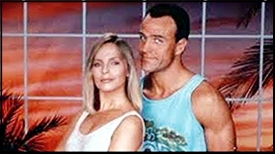
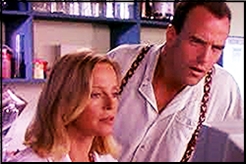
ONE WEST WAIKIKI “Along Came a Spider.” CBS, 01 September 1994 (Season 1, Episode 5). Cheryl Ladd (Dawn ‘Holli’ Holliday M.E.), Richard Burgi (Detective Mack Wolfe). Created by Glen A. Larson, who also wrote this episode. Director: Jerry Thorpe.

   One West Waikiki had a short six-episode first season run on CBS, followed by a second season of 13 episodes shown in syndication. Starring was Cheryl Ladd as a hands-on medical examiner newly arrived in Hawaii from California who helps the police solve murders.

   And there two of them in “Along Came a Spider.” Both victims appear to have been natural deaths until relatives start prodding the police (and Holli) into investigating further. The problem is, in both cases, is that the deceased have already been cremated. It is up to Holli and the police, in the form of detective Mack Wolfe, to find a way around this “small” problem. Complicating matters is that Hollli’s former mentor is called in, and in spite of his boasts ahead of time, he finds nothing either.

   In spite of the beautiful sun and other scenery, I’d have enjoyed this one more if we the viewers hadn’t been shown the murders taking place. I’m not a big fan of inverted murders, and not even the beautiful Cheryl Ladd in the leading role can make me change my mind about that. I didn’t dislike this one, mind you. If the entire series were available on DVD, I’d love to have it.

   One other thing, though. This was episode five of the CBS run, and not only are Holli and Mack apparently just getting to know each other, but much is made of the fact that Holli is still only in her second week on the job. I have a feeling that maybe the guys in suits decided to put this one out of order.


« Previous PageNext Page »