THOMAS B. DEWEY – The Brave, Bad Girls. Mac #5. Simon & Schuster, hardcover, 1956. Permabooks M-3089, paperback, 1957. Carroll & Graf, paperback, 1985.
If you like detective work along with your hard-boiled PI fiction, this may be the book for you. But as a all-out recommendation, this statement comes with a bit of a caveat. The plot is extremely complicated, and the fact that Mac, the only name that he goes by, doesn’t tell the reader everything he notices or is thinking, doesn’t help any.
The women in the case: (1) his client, Sherry, a young girl who is going out with a married musician against her father’s wishes; (2) Miss Colby, the principal of the school where one of her staff, Lorraine, is a teacher and whose past life is being looked into and she, Miss Colby, doesn’t like it; (3) Lorraine herself, who is married to but separated from the musician that Sherry is seeing; (4) Trudy, her young precocious daughter; (5) Esther, Lorraine’s sister, who has generally been in charge of bringing up Trudy; and (6) Georgiana, also a PI, who agrees to give Sherry shelter after Mac finds her with a dead man on her hands.
As I say, complicated. The best part of the book, though, is the extreme interrogation that Mac undergoes at the hands of the police which extends from page 150 to 190. That Mac stays faithful to his clients and his principles is an understatement.
There were 16 “Mac” novels in all, published between 1947 and 1970. I’ve enjoyed all of them that I’ve read, including this one. After reading this one, though, I realize that I haven’t read nearly enough of them.
LAIRD BARRON – Blood Standard. Isaiah Coleridge #1. G. P. Putnam’s Sons, hardcover, April 2018; premium paperback, April 2019.
To get the facts straight first, Isaiah Coleridge is not a private eye when Blood Standardbegins, far from it, and even when the book ends, it is doubtful that he will ever be more than an unlicensed PI. What he really is a retired hitman for the mob. An unfortunate incident at the beginning of the book, when he is living in Alaska, forces him to retreat to a recovery facility in New York State, somewhere near New Paltz.
While finding a new life mucking out stables and other farm work, he is asked to find the granddaughter, about 18 and somewhat wild, of his new hosts. She has gone missing, and while she has done so before, it has never been as long as it has this time.
Isaiah says he will see what he can do, but what he does not realize that by simply asking questions will stir up all kinds of trouble. You might not think that there could be trouble like this in such tranquil surroundings, but you would be dead wrong. There are rival gangs running all sorts of criminal activity in the area, and Isaiah finds himself right in the middle between them, along with a new ally named Lionel, a co-worker at the farm and a former Special Forces agent.
It takes a while to find a footing in this story, or at least it did me. Isaiah tells the story himself, and it is difficult to grasp the concept that a hit man for the Outfit could speak as eloquently, shall we say, as he does. It is also a long book, over 360 pages, and it is not always easy to remember all of the characters, many of whom appear only every so often and, I am sorry to say, are often little more than stereotypical and one-dimensional people.
But the forcefulness of the telling may get you over any rough spots you may find. This is a tough minded story, no doubt about it. There may be some resemblance between this book and the Spenser novels, but Spenser and Hawk are sheer pussycats in comparison to Isaiah and Lionel when the latter get into action, which is often and bloody. When it comes to the rough and tough streets of Boston as a center of underworld activity, it’s a mere walk in the park to what goes on in upstate New York.
Number two in the series will be Black Mountain, coming soon. I’m looking forward to it.
SUPERNATURAL “Roadkill.” The CW Television Network; 15 March 2007 (Season 2, episode 16. Jared Padalecki (Sam Winchester), Jensen Ackles (Dean Winchester). Guest star: Tricia Helfer. Series creator: Eric Kripke. Teleplay: Raelle Tucker.
This series seems to have sneaked up on a lot of people, having just finished its 14th season in April of this year. That’ a lot of monsters, ghosts and other supernatural beings for Sam and Dean Winchester to have chased down and eliminated from the Earth.
Although there have been several overall story arcs, none of which I’m really familiar with, “Roadkill” is a standalone episode, which was fine with me, this being the first one I’ve watched since perhaps the first one or two of the series.
It begins with Molly McNamara and her husband driving all but lost on an isolated highway and bickering at each other abut it when unable to avoid a figure in the road, they crash down a ditch and into a tree. When Molly wakes up, her husband is no longer in the car, and worse, he seems to have completely disappeared.
Luckily Sam and Dean are driving on the same road and come to her rescue. They are looking into stories that stretch of the road is haunted, and that the “man” Molly saw on the road may be looking for revenge for his death several years earlier.
Supernatural apparitions on the highway at night — a spooky premise for a ghost story if ever there was one, and this one’s no exception. There’s also a nice twist or two before Sam and Dean’s job is finally done, after pondering the question for which the two brothers have no answer: where do their adversaries go after they’ve been released from their terrestrial bonds?
Of the two brothers, Dean is the more hardnosed one, while Sam shows an occasional more sentimental side. There’s a good rapport between the two actors, as there’d have to have been from the beginning for the series to have lasted as long as it has. I kind of think of them as Frank and Joe Hardy some ten years later, after discovering where and what their father Fenton Hardy was doing on all those trips out of Bayport when they were younger.
BABYLON BERLIN. Sky 1, a German-language entertainment channel broadcast by Sky Deutschland, premiering on 13 October 2017. The first broadcast consisted of a continuous run of sixteen episodes, with the first eight officially known as Season 1, and the second eight known as Season 2. Volker Bruch, Liv Lisa Fries, Peter Kurth, Matthais Brandt. Teleplays by Henk Handolegten, Tom Tykwer, Achim Von Borries (series creators also directors of all sixteen episodes), and author Volker Kutscher.
Currently there seems to be a taste in Europe for noirish gritty cop dramas, and few of them are grittier or darker than Babylon Berlin (available on Netflix) set in a handsomely rendered Weimar Berlin circa 1929 as the leftover guilt and humiliation of the Great War, the rise of National Socialism, the decadence that inspired the Christopher Isherwood’s Goodbye Berlin and the musicalCabaret, and good and bad people caught up in events they can’t control combine with the inevitability of history.
Gereon Rath (Volker Bruch) is a policeman from Cologne, a troubled veteran of the war with PTSD (called here the trembles) and repressed memories. He has been assigned to Berlin on a mission to find a pornographic film the mayor of Cologne is being blackmailed over and assigned to Vice with fat, corrupt, but effective cop Chief Inspector Wolter (Peter Kurth).
The plot of this sixteen part series that ran two seasons spirals out from that basic situation. A train traveling from the Soviet Union is hijacked by Troskeyites smuggling a car carrying gold to Istanbul to be used against Stalin unaware the train also carries illegal phosgene gas the Soviets have sold to a secretive right wing military group (who Wolter, among others, belongs to) hoping to restore the Kaiser by bringing down the democratic government.
Meanwhile there is unrest between the police and communists in Berlin threatening to end in violence, Rath and Wolter are closing in on the pornography ring, and a powerful gangster the Armenian (Meisel Mateicvic) tied to the porn ring runs a decadent night club where the chief performer is a crossdressing singer Sevetlana (Severijia Janusauskaite) playing her Trotskeyite lover, the Soviets, and the industrialist importing the poison gas who is also her lover all against each other so she can get the gold.
Did I mention the May Day riots that kill two hundred communist protesters that the police are trying to cover up, or that Rath is having an affair with the wife of his brother missing since the war whose disappearance is tied to Rath’s illness, the Soviet Secret police, an assassination plot meant to trigger the overthrow of the Weimar government, or the mysterious scarred doctor (Jens Harzer) who has ties to the gangster and an unnatural interest in Rath including substituting his own drugs for the one Rath secretly takes?
There is also Charlotte Ritter (Fries), living in a hovel with her dying mother, two sisters, evil brother in law, and senile grandfather. Lotte is a party girl, dancing her nights away madly in the club owned by the Armenian and working part time as a prostitute in the basement while by day working for the police as a piece work secretary to keep a roof over her family. Lotte develops a crush on Rath and an ambition to become an assistant investigator under him even when Wolter blackmails her into spying on Rath.
Also involved in Commissioner Brenda (Brandt), a moral Jewish policeman who represents the best of Rath’s ambitions as the world around him and his own morality become ever more difficult to balance against the pressures of a city and nation in turmoil, both moral and political.
The cast is uniformly fine, playing believable wounded individuals whose innocence can be as damning as their sins. No one emerges unsullied by the world collapsing around them, and even victories are tinged with the viewers knowledge that history is going to test them far beyond the corruption of their modern Babylon.
Scenarist Volker Kutscher wrote a novel based on the series and since has written several novels based on the further adventures of Gereon Rath though whether any of them will be dramatized is uncertain. Babylon Berlin is an involving mystery, complex as a Chandler plot, morally questionable as Hammett’s world, and handsomely realized, perfectly designed for binging. For all its darkness it is a highly satisfying excursion into modern European noir.
THE WIDOW FROM MONTE CARLO. Warner Brothers, 1936. Warren William, Dolores del RÃo, Louise Fazenda, Colin Clive, Warren Hymer. Director: Arthur Greville Collins.
A better than average WB flick is The Widow from Monte Carlo. Good cast, with brightest performances by Hymer (Dopey Mullins) as an American crook “vacationing” in England and Fazenda as a socially ambitious American parvenue who’s not above blackmail to get Del Rio to attend her costume ball.
William is more interesting when he plays one of his cads, but he makes an amused foil for Hymer and an attentive suitor for Del Rio. A drawing-room comedy based on a play by F. Hugh Herbert (and others). Not memorable but polished and charming.
TERENCE KINGSLEY-SMITH – The Murder of an Old-Time Movie Star. PI Pete McCoy #1. Pinnacle, paperback original; 1st printing, August 1983. Cover art by Mark Watts.
Another one and done as far as Hollywood PI Pete McCoy is concerned, but when you look at where he is when the story’s done, it is not surprising. The tale in The Murder of an Old-Time Movie Star is told in alternating segments, the first taking place in 1935, the second in current day 1983, when the events of 1930s finally catch up with all who were involved, including Pete McCoy himself.
It begins when McCoy’s replacement cleaning woman, a lady newly arrived from Poland, asks him to find her husband, a man who abandoned her in the old country with her two children to come to America, and Hollywood in particular. It does not take Pete long to find him. He’s a well-known director now, married and living under a new name.
McCoy makes the mistake of confronting him with head of the studio in tow, however, without a back-up plan in mind. When the cleaning lady is found dead on the sidewalk outside the building where McCoy’s office is, he knows how bad a mistake he made. The year 1935 was part of a time when studio bosses had all the power in Hollywood, especially when it came to protecting the reputations of their stars and their highly-paid directors.
Terence Kingsley-Smith has a few credits on IMDb, and his mother was screenwriter Dorothy Kingsley, so he knew his way around Hollywood, both old and new, with an especial flair for knowing what was there then and what’s there now — or was in 1983.
Pete McCoy tells the story himself and does so walking an occasional fine line between being crass and being crude. It’s his style and he’s as non-PC as they come: female readers may find much to object to in this book. Although the jumping back and forth in time may do a lot to conceal it, the plot is a simple one, but anyone enjoying PI stories taking place in Hollywood against a movie-making background may find as much to like with this one as I did.
THIEF OF HEARTS. Paramount, 1984. Steven Bauer, Barbara Wiliams, John Getz, David Caruso, and George Wendt. Written & directed by Douglas Day Stewart.
A lush romantic fantasy dressed up as a crime film in the bright-pastel Miami Vice mode. So well done that you don’t mistake it for an actual crime film, it’s highly enjoyable on its own terms. And while I will discuss the plot in some detail here, I have to say I’m revealing no more than the original release trailer did.
Hunky Steven Bauer, he of the chiseled face and biceps, plays a cat burglar extraordinaire, grown rich from preying on the very wealthy. So rich that he can afford a mega-warehouse apartment in San Francisco, a boat at the marina, a fancy sports car…
You get the idea. This character is to be taken no more seriously than Raffles, Arsene Lupin, The Lone Wolf, or any of those International Jewel thieves who were once played by real luminaries like John Barrymore, Melvyn Douglas, or William Powell.
Getting back to Bauer, though, he starts the film with a raid on an ultra-chic condo owned by John Getz and Barbara Williams, best-selling children’s book author and trendy interior designer, respectively. Writer-Director Stewart generates a certain amount of suspense here, and then…
And then things take a turn for the Romantic. Amid the loot from the condo is a lock box containing Williams’ private journals, wherein she keeps her innermost thoughts and fantasies—for the millennials out there, that’s what folks used to do with their private thoughts and fantasies before there was Facebook.
Anyway, Bauer reads the journals, becomes intrigued by the inner woman and sets out to seduce the outer one – a task made easier because he knows which buttons to push, and because her husband is a self-absorbed dullard. Even his publisher (a nice character part by George Wendt) says so.
The seduction is carried out among the luxurious trappings one associates with old Ross Hunter films (All That Heaven Allows, Back Street, etc.) and if you can enjoy the long romantic scenes, the opulent music and gratuitous nudity (I could and did) time passes pleasantly till things come to a head.
Getz (If you remember the actor as the nice red-neck bartender inBlood Simple you won’t recognize him here.) awakens to his wife’s new obsession, senses that Bauer is a phony, and sets out to investigate. At the same time, Bauer falls deep in love with Williams but finds himself emotionally crippled because he can’t open up to her. And for her part, Williams becomes increasingly put off by this man with something to hide who has invaded her life by way of her dreams.
By now you may get the idea that this fantasy romance touches on some very real and complex emotions. It does, and it also works in some nice plot twists, as Bauer’s partner-in-crime (a very young, lean and repellant David Caruso) sees that it’s time to move on and wants to feather their retirement with one last big job: another raid on Getz and Williams’ condo.
Which leads to a scene that actually got me a little misty, and I won’t spoil it for you. And to a full-blooded romantic conclusion I enjoyed and didn’t buy for a minute.
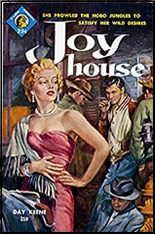
DAY KEENE – Joy House. Lion #210, paperback original, 1954. First published in much shorter form as “She Shall Make Murder,” Detective Tales, November 1949. Expanded manuscript, circa 1952. Revised/edited version published by Lion in 1954. Lancer 72-628, reprint paperback, 1962, published in a 2-in-1 edition with City of Sin by Milton K. Ozaki. Reprinted by Stark House Press, softcover, 2017, in a newly revised edition based on the 1952 manuscript by David Laurence Wilson. This is a 3-in-1 edition with Sleep with the Devil (Lion, 1954; reviewed here) andWake Up to Murder (Avon, 1952; reviewed here). Film: MGM, 1964; also released as The Love Cage.
If you ever have the urge to read a real down to earth noir novel, as solid as solid can be, and this one’s handy, look no further. You aren’t gong to find many books, nor authors, better than this one. If you have to go looking, though, you’ll probably need to pass on coming up with the Lion edition. I’ll get back to this, but I just looked, and there’s only one copy offered on abebooks.com right now, and that one has an asking price of $250.
The book opens with our protagonist — not hero — awakening in a Chicago flophouse following a weeks-long drunken binge. How he made it to Chicago from California Mark Harris does not know. At one time a top notch criminal lawyer, all he remembers now is killing his wife, faking an accident to put the authorities off the trail, and going on the run.
And here’s what every bum on skid row dreams of. A rich “crazy” lady whose support the mission depends on, sees him and he’s cleaned himself up, asks him if he’d like to be her chauffeur. A widow, Mrs. Hill is blonde, beautiful and still young. Would you say no? Mark Harris doesn’t either.
He also knows, or strongly senses, that she has an ulterior motive in mind. Alone in a boarded up relic of a house for ten years, with only a black maid for company, indeed she does. The maid knows full well what is going on, and she is quite correct.
All is well for a while. Mrs. Hill has a past, though, and when a man from that past makes his way into the house, he ends up dead, and it is up to Mark Harris (now Phil Thomas, an “accountant” from Atlanta) to dispose of the body. Even though it is May Hill’s plan for them to get married and escape to Rio, it is downhill all the way from here.
And if you can stop reading once you’ve gotten to this point, you’re a better person than I am. Keene’s prose may have been pulpish and not always polished, true. It is gritty and fatalistic but never quite salacious — you can use your imagination for that.
Every word pulls you on to the next, and not always gently. Entire pages will be swallowed up in a gulp, until you’ve reached the last one, when at last you can come up for air and let yourself savor the ending just a while longer.
If I’ve intrigued you at all, and I hope I have, my suggestion is to obtain a copy of the recent Stark House edition. With two other novels included, all three by Day Keene, it’s quite a bargain.
TOBRUK. Universal Pictures, 1967. Rock Hudson, George Peppard, Nigel Green, Guy Stockwell, Jack Watson. Screenwriter: Leo Gordon. Director: Arthur Hiller.
You have to review the movie that you watched, not the one you wished you’d seen. Such is the case with Arthur Hiller’s Tobruk, a war film helmed by a director best known for his cinematic adaptations of the works of Paddy Chayefsky and Neil Simon. While it’s a completely solid movie and adheres closes to the tropes of the “North African Second World War desert combat film†sub-genre (I made that up), the plot and dialogue never quite match the unique possibilities offered by the following premise. “A Canadian-British soldier who shuns heroism teams up with an idealistic German-Jewish commando to take destroy the Nazi oil depot in Tobruk, Libya.â€
Sounds like you’d have a good tale to tell, right? How two men from disparate backgrounds must find common ground in order to achieve a greater good that transcends their differences. How one man learns the value of sacrifice and heroism and finds, under the glare of the unforgiving desert sun, what it means to fight a cause worth fighting – and dying – for.
But no. That’s the film I wish I had seen. Now, there are indeed flashes of potential scattered throughout the movie. There’s a powerful exchange in which Bergman (George Peppard), the German-Jewish commando explains to his Canadian counterpart, Major Donald Craig (Rock Hudson) what the war effort means to the Jewish people.
And there’s the mention, too often forgotten today, of how Egyptian officers and the Grand Mufti of Jerusalem were scheming to team up with the Nazis against the British in Egypt and Palestine. But all of this great material is ultimately wasted as the film bogs itself down in mild, inoffensively didactic lessons about human prejudice.
Now, you may be asking yourself: why watch Tobruk after everything I just told you? Simple answer: the atmospherics and the combat scenes. Hiller does an exceptional job in staging the latter and gives the viewer a real powerful jolt to the senses.
There’s the obligatory scene in which our hero (Hudson) attacks Nazis with a flamethrower and there’s also a beautifully crafted scene in which the Allies scare away a band of Arab tribesmen looking to exchange two prisoners for guns. The soundtrack, by Polish composer Bronisław Kaper, who also scored Gaslight (1944) and Mutiny on the Bounty (1962), works seamlessly with this visual material and gives it a gritty, sweaty feeling.
HELL CANYON OUTLAWS. Jarod Zukor Productions/Republic, 1957. Dale Robertson, Brian Keith, Rossana Rory, Dick Kallman, Charles Fredericks, Buddy Baer and Don Megowan. Written by Allan Kaufman and Max Glandbard. Directed by Paul Landres.
I don’t know about you, but I can’t resist a movie called Hell Canyon Outlaws, and when it was over, I wasn’t even mildly disappointed upon reflecting that there was no actual Hell Canyon in the film itself. Call it Poetic License I guess, but director Paul Landres was doing some interesting movies about this time, and this is one of them.
It’s easy to look at Hell Canyon Outlaws and say Brian Keith carries it with his off-beat portrayal of Outlaw Leader “Happy†Waters: good-humored, lethal, and pitched on a collision course with steely lawman Caleb Wells (Dale Robertson — And get it? Wells? Waters?)
But the fact is, some intelligent writing and sure-handed direction went into making the character—and those around him—come alive.
Standard stuff so far, made even more ordinary by staid Alexander Lockwood as the “modern†replacement lawman, and noisy method-acting Dick Kallman as the local quick-draw kid trying to prove he’s a man. Add Rossana Rory (of Big Deal on Madonna Street) as Dale Robertson’s girlfriend who doesn’t see the need for violence, and you’ve got a pretty cold deck to try and deal a new hand from.
The wonder is that they do it, and do it rather well, too. Landres and the writers keep things poised on the edge of violence, so that whenever Keith and his overgrown goons (including Buddy Baer and Don Megowan) swagger into a saloon, bank or dry-goods store, they seem just about to take it apart by size alone.
Contrast this with Dale Robertson, waiting silent and tight-lipped on the sidelines, no longer a lawman, but always just about to spring into action, and you get a very involving movie indeed, particularly when he and Brian Keith circle about each other, talking quietly but both clearly looking for the right moment….
And when that moment comes, it doesn’t disappoint: An extended shoot-out in a darkened saloon, with Dale and his deputy jockeying for position against the bad guys, who make some smart moves themselves, ratcheting up the tension, even as shots blast and bodies fall all over the place.
Hell Canyon Outlaws is a low-budget affair, and the DVD I got at Cinevent is a thing of shreds and patches, but it has flair and to spare, plus a few surprises. Recommended.