Reviews


FIRST YOU READ, THEN YOU WRITE
by Francis M. Nevins


   My presentation on Cornell Woolrich at Columbia late in March went over, I think, quite well, but I’m the least objective judge in the world when it comes to my own material. For about six weeks it was accessible on the Web and YouTube so every reader of this column could check it out if they wished. But as I put the finishing touches to this column I discovered that apparently it has been removed. Drat!

***

   In the middle of my presentation there was a special guest appearance (in voice only) from none other than Basil Rathbone, now dead more than half a century. I incorporated this sound bite from the grave because Roy William Neill, who directed the Woolrich-based movie BLACK ANGEL (1946), is best known for having directed most of Universal’s Sherlock Holmes series (1941-46) starring Rathbone and Nigel Bruce.

   In an appearance before a Holmes group in New York in 1965, two years before his death, Rathbone talked about Neill’s sudden death at age 59, soon after completing BLACK ANGEL. You can’t listen to it on your computer any more, but you’ll find a transcript of the relevant parts in my March column and also on pages 463-464 of my FIRST YOU DREAM, THEN YOU DIE. Thirty-odd years ago, when I first transcribed the recording for FIRST YOU DREAM, I took Rathbone to say that Neill was known among the Holmes crew as Muggsy, but listening several more times I realized it should have been Mousie and changed it in my column.

***

   I was not present at Rathbone’s New York talk but I had heard him live about a year earlier, when I was a senior in undergraduate school and he gave a talk at a girls’ college in New Jersey. He had lost much of his hair but was still as imperially slim and commanding and his voice as hypnotically powerful as we all remember him and it from his Holmes years.

   About ten years ago, sifting through some stuff I had written in college, I learned that during that same senior year I had also heard — well, you’ll soon find out. Anyone remember THE DEPUTY? No, it wasn’t a Western but an extremely controversial drama by Rolf Hochhuth, dealing with Pope Pius XII, the Nazis and the Holocaust. The play was staged in every major European country and came to the United States in 1963. I saw the New York version — which, as almost everyone agreed, was a preposterous travesty of what Hochhuth had written — and wrote an article about it for my college newspaper.

   I hadn’t given the matter a thought for generations until about ten years ago when I found and reread a copy of the article in that box of college writings and discovered to my stupefaction and delight that the part of the heroic young Jesuit who defied the pope and went to Auschwitz to share the fate of the Jews was played by a then little-known actor by the name of Jeremy Brett. That’s right: during the same academic year I had heard and seen the Holmes of my generation and the Holmes of the next.

***

   Hochhuth was born in Germany in 1931, the year before a young Englishman named John Creasey published the first of what were to be more than 500 novels under his own name and at least fifteen pseudonyms. He created the byline of Gordon Ashe and a character named Patrick Dawlish back in the late Thirties. After finishing another novel in three days, he wrote less than a year before his death, “I plunged into a Bulldog Drummond type of book.”

   He quickly discovered that Dawlish simply “would not behave like Bulldog Drummond” but, despite this surprise, completed that book, published in England as THE SPEAKER (John Long, 1939), in three and a half days. A few years after the end of World War II, Creasey traveled to the U.S. on a mission to find out why virtually none of his more than two hundred novels had been accepted by American publishers.

   Joan Kahn, the iconic mystery editor at Harper, read some of his English books and faulted them for having protagonists readers couldn’t identify with and for lacking the emotional element that the American public demanded. Creasey listened to her and within a few years was established as a Harper author. In later years he prided himself on his stylistic evolution. “My books are read emotionally….I write subjectively, to the heart.”

   His Gordon Ashe byline and the Patrick Dawlish novels remained unknown in the States except for one, first published in England as THE LONG SEARCH (John Long, 1953), which came out here as a paperback original from Ace Books and garnered zero attention, not even a review in the NEW YORK TIMES by Anthony Boucher, who covered most softcover mysteries as a matter of course. DROP DEAD! (Ace pb #D-71, 1954) is light on plot but demonstrates beautifully what Creasey learned from Joan Kahn.

   Dawlish comes to Arizona looking for his wife Felicity, who was on a solo trip to the States when she vanished near the Grand Canyon just after her guide jumped or fell or was pushed to his death. A few hours after his arrival at the Canyon he finds himself followed. The next morning two men stop him near the spot when the guide went over the canyon rim and threaten to throw him over too unless he tells them why he came to Arizona. He saves himself by dropping over the edge of the canyon onto a rock ledge twenty feet below.

   This is the first of a huge number of tight spots he walks into and gets out of in his frantic search for his wife. The trail takes him from Arizona to an isolated Nevada cattle ranch, then to Las Vegas and the California desert near Death Valley before he finally gets the answers, which aren’t terribly interesting. Essentially this isn’t a mystery but a traditional Western novel updated to the early Fifties, complete with convertibles, fire engines and a helicopter.

   The local color is vivid and seems to ring true, suggesting that Creasey had spent some time in the West, as witness also the following year’s Dawlish novel, DEATH IN THE TREES (John Long, 1954), which is set in Washington State. Occasionally, as when cabins are referred to as huts or shacks and a Vegas casino as a gaming saloon, the narrative betrays Creasey’s English origins.

   But despite the moment when a bad guy tells Dawlish that someone has “put the black” on him (which in gringo lingo means he’s being blackmailed), by and large Creasey is head and shoulders above most English writers when it comes to keeping his American characters from talking like Brits. Although Dawlish sounds English as he should, in some respects he reminds me of the protagonist of an American noir novel, often in mortal danger and suffering like Job. Here are four examples in fewer than fifteen pages.

       Pain stabbed through [his legs], but not so badly as it had done through his arms. (106)

       As he asked [whether his wife is dead] it seemed as if steel bands were fastening round him, and even breathing was difficult…. (114)

       It was almost dark when they landed, and the bump on landing jolted Dawlish’s head into screaming agony. (119)

       …[H]is eyes [were] glassy and his cheeks livid with the pain. (119)

   Whether lines like these are also in the earlier English version THE LONG SEARCH remains unknown, but its U.S. counterpart makes it clear that one of the lessons Creasey had learned from Joan Kahn, perhaps too well, was to make his heroes vulnerable. His Scotland Yard sleuth Inspector Roger West exhibits the same kind of vulnerability in novels of the same period like THE BLIND SPOT (Harper, 1954).

***

   Some Web sources claim that the first Dawlish novel was DEATH ON DEMAND (John Long, 1939), but Creasey himself — and who should know better? — identified his character’s debut book as THE SPEAKER, published earlier the same year. It’s interesting to compare the later Dawlish with his first appearance, which Creasey revised shortly before his death, although he missed a few gaffes, leaving intact the plural noun “sneak-thiefs” (2) and the singular noun “collaboration” where he clearly meant “corroboration” (20).

   The much younger Dawlish, who’s described as “a blond Atlas…with a reputation at sport and big game” (10), and his three buddies, who are clearly modeled on the boon companions of Bulldog Drummond or the early Simon Templar, are pitted against an Edgar Wallace-style hidden mastermind originally known as the Speaker but in this revision by the more sinister name of THE CROAKER (Holt, Rinehart & Winston, 1973).

   In the U.S. version it’s the Croaker’s second-in-command who’s known as the Speaker, which leads me to wonder: If the boss toad was originally called the Speaker, what was the secondary toad’s moniker? Or could the 1939 version have been named for Number Two? Creasey offers full measure of action, punctuated with abundant exclamation points and italicized words as if the book were a novelization of the BATMAN TV series of a few years earlier. As usual in his pre-WWII novels, the hero and everyone else keep stiff upper lips and show zero vulnerability. It’s hard to believe that this Dawlish and the Dawlish of DROP DEAD! were meant to be the same character.

***

   For this column I can’t claim the virtue of unity, but I hope there have been compensations. Woolrich, Rathbone, Pius XII, plus Creasey and a Croaker and a Speaker — whatta cast!
         Tuesday, February 10.

DEATH SHIP. AVCO Embassy Pictures, 1980. George Kennedy, Richard Crenna, Nick Mancuso, Sally Ann Howes, Kate Reid. Director: Alvin Rakoff. [Watched on HBO.]

   I’m not too sure why I watched this. It’s not the sort of thing I am usually interested in at all. Maybe it’s because I like to warch George Kennedy in action as an actor.

   He’s in top form in this one. He plays a cruise ship capyain on his last voyage before being forcibly retired. He doesn’t get on at all well with either passengers or crew.

   But then the cruise liner is attacked and sunk by a huge hulk of a ship running circular patterns in the Atlantic totally unmanned — this is the “death ship.” Kennedy, plus his soon-to-be replacement (Richard Crenna) and a few others, including Crenna’s wife and two young children, are rescued, is that’s the word, by the killer ship.

   The movie is scary, all right, but it helps that the new passengers are dumber than you can possibly imagine. Even after two of the party have been killed off, in fairly gruesome fashion, they allow themselves to become separated and even easier prey.

   Eventually they discover that the boat had been a Nazi (of course) interrogation ship, and it is full of torture rooms, corpses, some complete, some not; only pieces of bodies, and lots and lots of cobwebs.

   Kennedy makes a fine Nazi. Why the ship turns against him and allows Crenna and his family to escape is not explained. For that matter, nothing is explained.

   Rated R, and if you don’t know why, you haven’t been paying attention. There is some nudity as well, but if you were to watch this movie and found it sexually stimulating, I would really prefer not to know you.

***

   Coming up on HBO this month are some more of the same: Humanoids from the Deep, The Legacy, Thirst (about vampires) and Silent Scream. I don’t plan on watching any of them [Nor did I.]


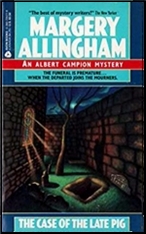
MARGERY ALLINGHAM – The Case of the Late Pig. Mr. Campion. Avon, paperback; July 1989. First published by Hodder, UK, paperback, 1937, and in Mr. Campion: Criminologist (Doubleday, US, hardcover, 1937).

   The three earlier Albert Campion books recently reprinted by Avon have all been mystery “thrillers,” without a lot of detection involved. This long novelette is the real thing, however, and what’s more, Campion, now a well-established character, tells it himself.

   The Pig in the title is an old boyhood friend who seems to have died twice, six months apart. The second time is definitely murder. While part of the solution is obvious, and another merely clumsy, it takes sharp eyes to figure out the rest before Campion does.

[FOOTNOTE.]   This book has only 140 pages of large print. Avon should be ashamed of themselves, charging the same $3.50 for this as for the other novels in the series. They could easily have included the short stories [that appeared in Mr Campion: Criminologist], couldn’t they?

–Reprinted in slightly revised form from Mystery*File #14, July 1989.

SPENSER: PALE KINGS AND PRINCES. Made for TV movie. Lifetime, 02 January 1994. Robert Urich (Spenser), Barbara Williams (Susan Silverman), Avery Brooks (Hawk), Sonja Smits, Ken James, Maurice Dean Wint, Alex Carter. Screenplay: Robert B. Parker and
Joan H. Parker, based on the former’s book of the same title. Director: Vic Sarin.

   The plot is a little thin in this one, but if you like the Spenser books, as I do in general, but as I know some of you don’t, this is about as close to one of the stories that a filmed version is going to get. I say that not because I’ve read the book as well as seen the movie. The truth is, I read the book so long ago I’m simply not able to compare the two.

   No, the reason for saying this is that Robert B. Parker and his wife Joan are the screenwriters, and she was one of several co-producers. If that doesn’t give you some sort of say in how a movie comes out, it’s difficult to say what does.

   One difference that I seem to remember from the book is that when Spenser makes a trip into the mid-central section of Massachusetts — a small hamlet named Wheaton, which probably doesn’t really exist — to look into the death of a investigate reporter who was killed there, in the movie Susan comes with him. In the book, she only commutes back and forth between Wheaton ad Boston. In the the movie, her motivation for staying close on the scene is that the reporter was one of her clients in psychotherapy.

   What this change does, though, is allow the two of them to work on the investigation together while staying in the same small motel room and eating together in the same dingy diner. This gives the a lot more time to indulge in witty banter together, and to give Susan the opportunity to see her man in action, up close and personal.

   And what action means to Spenser, of course, is barging right in, asking questions, and making a general nuisance of himself — and no small number of enemies, a term that applies to the local police force as well as possible local drug lords. Wheaton has a population that has been substantially bolstered in recent years by a influx of refugee Colombians, and when they have been unable to find work, they have turned to dope peddling, or so it has been rumored. This may be the reason behind the reporter’s death — or it may be his non-stop womanizing ways — or perhaps an even more deadly combo of the two.

   Hawk shows up to help the two of them out when things get a little too tight for them on their own. I can’t think of a better actor to play the part than Avery Brooks, but Robert Urich and Barbara Williams have quite a bit of chemistry together as well. I enjoyed this one.

REVIEWED BY DAN STUMPF:         


THE YIN AND THE YANG OF MR. GO. Ross Film Productions, UK, 1970. James Mason, Jeff Bridges, Jack McGowran, Irene Tsu, Peter Lind Hayes, Clarissa Kaye(-Mason), Broderick Crawford and Burgess Meredith, who also wrote & directed.

   People ask me why I spend time on bad movies. “Dan,” they ask me, “Why does a good-looking, intelligent man like you spend time on bad movies?”

   Funny you should ask that.

   Most bad films are simply bad, and you won’t read about them here. But now and again, a film is strikingly, memorably, bad, and these I think should be appreciated on their own terms. I mean, when you watch a good movie, or even a competently-made one, you and the filmmaker share common assumptions, and you have some idea what to expect. Here, I was on my own, adrift in a film that could go anywhere.

   I’d like to think this was not the film Burgess Meredith envisioned when he started making it. Word around the ’net is that it was plagued by financial problems, beset by internal strife, and some scenes were clearly added post-production. How else to explain scenes of Brod Crawford acting alone in a room, intercut with scenes of other actors supposedly conversing with him — and none of them even in the movie proper!

   But the fact is, the more I got into this cinematic fever swamp, the more I wondered how anyone could have thought any of it could have made a watchable movie. The cheap color, bad sound and choppy editing don’t help, but they can’t hide the fact that Mr. Go was misconceived and born to calamity.

   Needless to say, I was spellbound.

   For starters, this film is narrated by Buddha. Not some guy named Buddha, THE Buddha: Gautama. Siddhartha. Shakyamuni. The guy with all the statues sitting cross-legged. That’s the one, and every so often we cut to a picture of him and he fills in the narrative gaps in voice-over.

   Said narrative involves Yin Yang Go, a Chinese-German master criminal played by James Mason, in his usual Bored-British manner, headquartered in Macao or Hong Kong (the script is never sure which) and out to get the secret of a new advanced super-weapon from Scientist Pete Martin, played by Peter Lynd Hayes—who will always be Mr. Zabladowski to me.

   To this end, Mason recruits draft-dodger Jeff Bridges to exploit Martin’s weakness for the Rough Trade. Bridges doe his bit in a mildly shocking scene, Mason gets the secret plans, sells them to the bad guys (who are led by his wife, Clarissa Kaye-Mason) who kidnap Bridges’ girlfriend for some reason. Then Brod Crawford’s man (Jack McGowran) shows up and starts chasing everybody. Mason, Bridges and some of the bad guys escape on a helicopter while Clarissa Kaye-Mason tortures Jeff’s girlfriend on a boat, and then….

((!SPOILER ALERT!! MAJOR PLOT TURN REVEALED AHEAD! NOBODY WILL BELIEVE IT, BUT I’M WARNING YOU ANYWAY!))

    …and then Buddha shoots a magical ray from his forehead and turns James Mason into a Good Guy.

   You heard it here, folks. James Mason & Jeff Bridges, still being chased by McGowran, go after the bad guys. And then comes something else I’ve never seen before: Bridges overacts outrageously — in the fight scenes! No kidding, every time he bursts through a door, throws a punch or leaps off a balcony, he strikes a pose like Mighty Mouse.

   By this time I was thoroughly dazzled. And then….

   And then someone apparently took the trouble to tape over this commercial VHS copy, replacing the ending with one of those programs where an artist shows the viewer how to paint awful paintings. And it is a tribute of sorts to The Yin and the Yang of Mr. Go that it took me a minute or two to realize I was no longer watching it.

   I suppose I should seek out a complete DVD or VHS tape of Mr. Go and see how it ends, but I like to remember it like this: Disjointed, misbalanced, completely unpredictable and — and I haven’t even mentioned Director Meredith playing a Chinese herbalist Doctor, or the Loveboat music that jumps and prances in the background, whether it fits or not — no, I like to think that Mr. Go is supposed to end with everybody learning to paint badly.

   And even if that’s not the director’s cut, it’s the version I will cherish.


REVIEWED BY JONATHAN LEWIS:


WORKING GIRLS. Paramount Pictures, 1931. Judith Wood, Dorothy Hall, Charles ‘Buddy’ Rogers, Paul Lukas, Stuart Erwin, Frances Dee. Director: Dorothy Arzner.

   A thoroughly enjoyable pre-Code comedy/drama, Working Girls may not have all that much to say to contemporary audiences, but has a lot to say about the time and place in which it was filmed. Directed by Dorothy Arzner, the first woman to direct a talkie, this Paramount Pictures release tells the story of two sisters from small-town Indiana as they try to balance work and love in New York City.

   June (Judith Wood) and Mae (Dorothy Hall) Sharpe arrive in Manhattan and take up residence at a woman’s boarding house. Within the first day or so, they are out and about looking for employment and for men to date. June ends up working for a Western Union telegraph office and dating a saxophone player (Stuart Erwin).

   Mae, on the other hand, finds work as a secretary for Dr. Joseph Von Schrader (Paul Lukas), who proceeds to fall in love with his much younger employee. Mae, naturally, doesn’t reciprocate the affection. Instead, she’s got her eyes on Boyd Wheeler (Charles “Buddy” Rogers), a Harvard graduate working in a Manhattan law firm who seems to really care for her.

   Or does he? It would seem that he’s got a fiancée from the wealthy suburbs who he plans to marry soon and that he is just using Mae for a good time.

   While I won’t tell you how the story turns out, I will let you know that Working Girls is simply a fun movie to watch. It’s loaded with sexual innuendo, has some great comedic moments, and benefits greatly from Judith Wood’s hard-boiled, cynical character who has a quick wit as well as stunning looks.

   For contemporary audiences who are all too familiar with romantic comedy tropes, it may not seem like there’s much new under the sun here, but bear in mind this was filmed in 1931. And if you watch it with that fact very much in mind, you’ll surely find a lot to appreciate in this lesser known pre-Code film.


REVIEWED BY DAVID VINEYARD:


ALBERT DORRINGTON – The Radium Terrors. Eveleigh Nash, UK, hardcover, 1912. Doubleday Pagr, US, hardcover, 1912. W. R. Caldwell & Co., US, Hardcover, ca. 1912. Serialized in The Pall Mall Magazine, UK, January-June 1911, and in The Scrap Book, January-August 1911.

   Beatrice Messonier sat near the window dazed and mystified by her benefactor’s dazzling prophecies. Something in his manner suggested an approaching crisis in his own life and hers. What did his talk of princes and statesmen mean? She would have regarded such an outburst in another as the result of alcoholic excesses. But Teroni Tsarka was not given to the use of stimulants. He abhorred intemperance of mind and body. What he had spoken was the result of his structural philosophy, she felt certain. A tremendous crisis in medical research was at hand. And Teroni Tsarka was the man to sound the trumpet of science to an apathetic civilization.

   Beatrice Messonier is a brilliant oculist whose research was backed by the mysterious Dr. Tsarka, who has helped her learn the secrets of the Z Ray, the powerful result of radium research, and has set her up in a clinic, which has no patients thanks to his insistence on exorbitant fees.

   Just that night she broken her own heart having had to turn down the young detective Clifford Renwick, who was blinded with radium by Tsarka’s own assistant Horubi when Renwick tried to force an interview with Tsarka about the recently stolen Moritz Radium, Renwick being a youthful private investigator eager to make a name for himself.

   And of course we are off in the land of the Yellow Peril novel, serialized in Pall Mall, a popular British magazine on the lines of The Strand, and handsomely illustrated as well.

   Ironically Sax Rohmer had much the same idea in about the same year, with Dr. Fu Manchu making his debut, but even with Rohmer’s rather crude Edwardian style, his work is a far cry from the maudlin at times (the blinded Renwick has a touching moment with his old gray mother after escaping Tsarka — something you can hardly imagine Dr. Petrie or Nayland Smith bothering with) and painfully arch Dorrington.

   The formula here is much the same of the early Fu Manchu books, parry and thrust, chase, escape, and traps to capture Tsarka sharing about equal time with not particularly imaginative deadly traps for young Renwick.

   But the devil in these details is how dated Dorrington’s novel reads compared to Rohmer, who for all his melodrama and atmosphere is practically a minimalist in comparison.

   What with Beatrice Messonier (another difference is that in Rohmer, a Eurasian beauty wins Dr. Petrie’s heart, but in Dorrington, Renwick can’t be involved with a woman much more exotic than a Frenchwoman) unconvincingly posing as a much older woman and forced to seem heartless and cruel to young Renwick, and Tsarka being more interested in profit than world conquest, it is, for all its thrills, pretty pale stuff compared to Rohmer’s unknown poisons, Fu Manchu’s army of dacoit assassins, seductive Eurasian beauties under his spell, snakes, rats, weird poisonous bugs and the like.

   Tsarka, like Fu Manchu, has a daughter, but she is a far cry from Fu Manchu’s child. Rather she is a pale flower whose Japanese artist lover lives with she and her father (Tsarka uses an exhibition of the young man’s work to blind several prominent people who must then seek Madame Messonier’s clinic, the extent of his evil masterplan, a cheap cruel con game to make a few bucks). I suppose the attractive lovers are a step up from Fu Manchu’s evil daughter, but frankly they don’t bring much to the proceedings rather than a bit of humanization to the cruel and crafty Japanese scientist despite his penchant for experimenting on unwilling victims.

   “The scoundrel!” burst from Coleman. “He and his associates appear to have discovered a destroyer of human energy in radium. Personally, I fear that we shall find ourselves unable to cope with this new school of Asiatic criminals who regard the blinding of men and women as a pleasant pastime.”

   Reading this, it doesn’t take much imagination to see Rohmer’s entry in the Yellow Peril stakes for the startlingly new and modern work it must have seemed what with a thin patina of sex, relatively clipped dialogue, and straight forward telling wrapped in the opium fog laden atmosphere of Limehouse out of Thomas Burke and pure imagination. Rohmer’s “The Zayat Kiss” reads as if it might have been written in the early twenties, where Dorrington’s Radium Terrors reads as if it might have been written in the early eighteen nineties.

   The book has its thrills, and while dated, it isn’t badly written, but reading it you can understand what readers noted in better writers of the era, a voice, that beginning with Conan Doyle, was more modern and less given to maudlin sentiment and long winded prose. Reading Rohmer after Dorrington, or around the same time, must have been as refreshing as discovering Dashiell Hammett after a steady diet of Carolyn Wells.

   Reading this can give you a new appreciation for the relative modernity of the more vulgar, and certainly more gifted Sax Rohmer. Tsarka is a mean and constipated villain, vicious, petty, and ultimately ridiculous for all the Victorian language. Rohmer’s Fu Manchu is a Miltonian angel fallen to earth — some recent Asian literary scholars have suggested rehabilitating Fu Manchu for just that reason — because the character has, both in Rohmer’s work and the public imagination, transcended his racist origins becoming an archetype as much as a stereotype.

   Whether there proves to be anything to that view or not the inescapable fact of reading The Radium Terrors is that Rohmer and Fu Manchu ran literary rings around Dorrington and his Dr. Tsarka, and it may just be the difference, aside from Rohmer’s superior storytelling skills, is that Dorrington doesn’t believe in his Japanese pretender for a moment, and Rohmer embraces the his creation with full blooded zeal.

   Fu Manchu lived and breathed. Tsarka lingers like a bad taste.

AARON MARC STEIN – Moonmilk and Murder. Tim Mulligan & Elsie Mae Hunt #18. Doubleday Crime Club, hardcover, 1955. Curtis, paperback, 1968.

   Moonmilk consists of the cheesey calcium deposits the form on the surfaces of damp caves before it hardens into limestone, ad unlike archaeologists Tim Mulligan and Elsie Mae Hunt, I didn’t know that either. Here they’re in France, looking for caveman art.

   And they find murder as well. Ten years after the war, passions against collaborators still run high, setting off a complicated puzzle spoiled only slightly by the intrusive smell of coincidence. While the pieces fit nicely, the story doesn’t quite jell.

–Reprinted from Mystery*File #14, July 1989.


Bibliographic Note:   This was the last appearance of archaeological partners Tim Mullligan and Elsie Mae Hunt. Their first of eighteen mysteries was The Sun Is a Witness (1940). All eighteen were published under Doubledy’s Crime Club imprint.

REVIEWED BY DAN STUMPF:         


NORTHWEST RANGERS. MGM, 1942. James Craig, William Lundigan, Patricia Dane, John Carradine, Jack Holt, Keenan Wynn and Grant Withers. Screenplay by Gordon Kahn and David Lang, story by Arthur Caesar. Directed by Joseph M. Newman (as Joe Newman.)

   MGM’s notorious Manhattan Melodrama, re-made with Mounties.

   Yeah, well, okay so it’s Mounties. I mean if that’s what the kids are doing these days…

   Actually, Northwest Rangers ain’t all that bad except in comparison. It has all the gloss MGM lavished even on its B-pictures, John Carradine and Grant Withers make a fine pair of villains with plenty of screen time, Jack Holt is tough as ever, and Keenan Wynn does well with rather less as comic relief.

   If you’re not familiar with the story, you’ll recognize it right off: two pals, orphaned as boys, are adopted by doughty old Mountie Sergeant Jack Holt. One (William Lundigan) grows up to be a doughty young Mountie, the other (James Craig) makes his way as a gambler and general rakehell, and with all of Canada to bounce around in, they just naturally come into conflict with each other when Craig wins the local gambling hall from John Carradine, and his girl falls for Lundigan. Small world, ain’t it?

   Director Joseph M. Newman had his moments, and he handles this predestined obscurity with more class than it really deserves. The problem here is with the leads.

   In the 1950s, James Craig matured into a pretty good actor in bad-guy parts. But in the 40s he was MGM’s back-up for Clark Gable — or maybe for Gable’s 1st-string back-up — and all he does here is grin and try to look roguish, an effort clearly beyond him at this stage.

   As for William Lundigan, well, he was always William Lundigan.

   With these two carrying the story – unlike William Powell and Clark Gable in Manhattan Melodrama — it’s hard to give a damn, and about the nicest thing you can say about Northwest Rangers is that it passes the time easily and nobody famous got shot leaving the theater.


REVIEWED BY JONATHAN LEWIS:


TUMBLEWEED. Universal Pictures, 1953. Audie Murphy, Lori Nelson, Chill Wills, Roy Roberts, Russell Johnson, K.T. Stevens, Madge Meredith, Lee Van Cleef, I. Stanford Jolley. Director: Nathan Juran.

   Surprisingly stylish for an Audie Murphy oater, Tumbleweed isn’t a particularly well-known Western. Yet it’s a quite watchable movie and one that deserves wider recognition as well as an official stand-alone DVD release. Directed by Nathan Juran, whose significant work in art direction gave him a keen eye for staging scenes, this Universal-International release may not have anything in it that you probably haven’t seen before.

   But that doesn’t mean what it has isn’t solid. There are Indians on the warpath; a White man scheming with them (of course); a seemingly impossible love affair; a man wrongfully accused of a crime; and a sheriff who must face off against the town’s rabble who are determined to exact frontier justice.

   Murphy portrays Jim Harvey, a drifter who takes a job guiding a wagon trail through Yaqui Indian country. When the braves attack the caravan, killing the men, he gets blamed for their deaths. Some seem to think he ran away out of cowardice. Others seem to believe he may have been in cahoots with the Yaqui. After he’s sprung from the town’s jail by a friendly Indian tribesman, it’s up to Harvey to clear his name and find out the real reason the wagon trail was ambushed. Chill Wills and a youthful looking Lee Van Cleef, respectively, portray the town’s sheriff and his deputy. Van Cleef is very good here as the tougher and more brutal of the town’s lawmen.

   Now, I know what you may be thinking. It sounds like every other Western from this period. Well. Yes and No. Juran isn’t often thought of as a Western auteur the way in which someone like Budd Boetticher is. But he definitely has his own particular style, one that is highly notable in two scenes in particular: Harvey’s jailbreak and a fight scene in which our hero takes on the corrupt, greedy White man behind all the recent troubles. Well-staged and filmed with a sharp sense of what makes action scenes invigorating to an audience, they are but two standout moments in a film that punches well above its weight.


« Previous PageNext Page »