Reviews


MARLOWE. MGM, 1969. James Garner James Garner (Philip Marlowe), Gayle Hunnicutt, Carroll O’Connor, Rita Moreno, Sharon Farrell (Orfamay Quest), Kenneth Tobey, Bruce Lee. Screenplay by Stirling Silliphant, based on the novel The Little Sister by Raymond Chandler. Director: Paul Bogart.

   From beginning to end, the movie follows the book almost as closely as it could be done, starting with PI Philip Marlowe being hired by a young girl from Kansas to find her brother Orrin, who has come to L.A. to find work. But even though the story’s the same, and (so I’m told) some of the dialogue is the same, something’s missing. This is not the story Raymond Chandler wrote. Not the way I visualized it. It’s difficult to put into words, but if you watch the trailer below, I think you’ll see what I mean. (Hint: Bruce Lee.)

   What the movie is, to my way of thinking, more than anything else, is James Garner starring in an extended episode of The Rockford Files. It’s his story on the screen, not Chandler’s.

   The story does get darker and a lot more noirish as it nears the end, which is slightly different from the book, as I recall, but not so much as it makes any difference. Not that any of these observations make the movie bad, I hasten to add, and if you’re a Garner fan, I think you very well may love this movie. If you’re a Chandler fan, perhaps not as much.


JAMES T. DOYLE – Deadly Resurrection. Dan Cronyn #1. Walker & Co., hardcover, 1987. No paperback edition.

   Why is it, I wonder, that there are so few PIs working the Washington DC area? Besides Dan Cronyn, the hero of this book and his first adventure, I can think of only two or three others. The nation’s capital would seem to be fertile ground for a whole slew of cases for PIs to be swallowed up into.

   Cronyn, whose roots include an ex-radical past, is in trouble from the first line on, when he finds the body of the man blackmailing his female client. A better than average detective story follows, and luckily (though not perhaps for him) Cronyn is the best possible person to solve it.

–Reprinted in revised form from Mystery*File #16, October 1989.


Bibliographic Note:   James T. Doyle wrote one other mystery, that being Epitaph for a Loser (Walker, 1988), but alas, Dan Cronyn did not appear in it.

REVIEWED BY WALTER ALBERT:


SIMON HAWKE – The Dracula Caper. Timewars #8. Ace, paperback original, 1988.

   Monsters (werewolves and vampires) created genetically in the future begin turning up in Victorian England. Arthur Conan Doyle and H. G. Wells join with the time-traveling Time Commandos to eradicate the plague.

   The novel is prefaced by several pages of a Time Wars Chronology which I read with about as much interest as I read the potted summaries of fiction in standard literary histories.

   This will probably interest the science fiction fan more than the mystery fan, but the crossover fan (like me) may not find this well enough written to engage either side of his dual personality. Maybe if I had read the eight earlier volumes I would have appreciated this more, but dropping in on it, well along in the series, I found it something of a bore.

   Maybe it’s time to re-read Don Sturdy or Bomba the Jungle Boy.

— Reprinted from The French Connection #75, November 1989.

       The Time Wars series –

The Ivanhoe Gambit (1984)
The Timekeeper Conspiracy (1984)
The Pimpernel Plot (1984)
The Zenda Vendetta (1985)
The Nautilus Sanction (1985)
The Khyber Connection (1986)
The Argonaut Affair (1987)
The Dracula Caper (1988)
The Lilliput Legion (1989)
The Hellfire Rebellion (1990)
The Cleopatra Crisis (1990)
The Six-Gun Solution (1991)


EDITORIAL NOTE:   From Wikipedia: “TimeWars is a series of twelve science fiction paperback books created and written by author Simon Hawke beginning in 1984. The story involves the adventures of an organization tasked with protecting history from being changed by time travelers. In the world of the series, many people and events considered fictional are historical, and vice versa; the action of each book in the series weaves in and out of the events of a famous work of literature. For example, in the first book in the series, time travelers contesting the fate of Richard I of England become caught up in Walter Scott’s Ivanhoe.”

NGAIO MARSH – Enter a Murderer. Inspector Roderick Alleyn #2. Geoffrey Bles, UK, hardcover, 1935. Pocket Books #113, US, paperback, 1941. Reprinted many times in both hardcover and paperback.

   The second Roderick Alleyn detective novel, and the first of many subsequent Ngaio Marsh mysteries to take place in the world of the London theatre. I don’t know the history of such things, so I’m only suggesting this, but could this be the first detective novel in which the victim is killed on stage in front of a live audience by a gun which is supposed to have fake bullets — but doesn’t?

   If not, it has to be one of the first. And in the audience is none other than Inspector Alleyn himself, along with his friend Nigel Bathgate, a journalist whom he met in the first book in the series, A Man Lay Dead (1934). Bathgate has not only provided the tickets, but he stays close to Alleyn throughout the book as an unofficial Watson — until, that is, his friendship with the suspects makes him something of a liability, from Alleyn’s point of view.

   And there are a lot of suspects, and where each of them were when there was an opportunity to switch the bullets is obviously a prime factor in the investigation that follows.

   This early in Alleyn’s career, I don’t believe that Marsh had a very good handle on his character yet. I grant you that in large part we see him through Bathgate’s eyes, but the latter often seems genuinely surprised by some of Alleyn’s reactions to events, both major and minor, as they happen throughout the investigation. And in all honesty I was taken aback myself, just a bit, at a scene in which it seems he has fallen unduly under the spell of the play’s leading lady — and she still a suspect.

   And here’s a curiosity. On page 86 of the Berkley paperback reprint I happened to I read this time, after Alleyn has questioned most of the people on and behind the stage when the shooting took place, he asks one of them to wait a little longer in the wardrobe room. Nothing is heard of the latter from that point on until the inquest takes place several days later, and then never again.

   All in all, in spite of the lapse above, Enter a Murderer remains highly readable, but it’s also nowhere nearly as sharp or knock-your-socks-off clever at the game of fair play detection as Agatha Christie was, back in the mid-30s when the book was written. Of course, no one else was either, then or now.

THE MAN BEHIND THE GUN. Warner Brothers, 1953. Randolph Scott, Patrice Wymore, Dick Wesson, Philip Carey, Lina Romay, Roy Roberts, Morris Ankrum, Katharine Warren, Alan Hale Jr., Douglas Fowley, Robert Cabal. Screenplay: John Twist, based on a story by Robert Buckner. Director: Felix Feist.

   An unusual sort of western, one that place in the burgeoning small town of Los Angeles, circa 1850 or so. The town is a lot more elaborately laid out than most western towns that sit in the middle of a prairie for no great reason to be there. References to Santa Monica to the west, the La Brea tar pits, and the importance of water to the growing community all are intended to add to the historical authenticity, as are references to whether California should enter the Union as a slave state or not, along with the presence of a young bandit named Joaquin Murietta.

   The plot is too complicated to go into (I didn’t understand it) but boiled down to as small a nutshell as I can manage, Randolph Scott (Major Ransome Callicut) comes to town undercover disguised as a schoolteacher (the latter being the result of some quick thinking on his part) to root out a gang of secessionists who also want to control the area’s water supply.

   There are several other major threads to the plot, however, including killings, desperate ruses and several lengthy scenes of singing and dancing in the local saloon, not to mention some ineffectual efforts in the way of comedy by Dick Wesson and Alan Hale Jr.

   There too many twisted threads in this movie’s tale, in other words, taking place mostly in cramped indoor sets. This is made all the more noticeable when at last the director takes the movie outside, for a big shoot-em-up finale. Scott is stiffer than usual in this one, looking far too old (55) for young Patrice Wymore (26), the real new schoolmarm in town. (I forgot to mention the rolling on the floor catfight the latter has with songstress Lina Romay, who also has eyes on Scott).


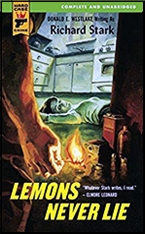
DONALD WESTLAKE writing as RICHARD STARK – Lemons Never Lie. Alan Grofield [solo] #4. World, hardcover, 1971. Countryman Press, softcover, 1990. Hard Case Crime #22, paperback, July 2006.

   I welcome being corrected if I’m wrong, but I believe that this is the last of four solo adventures of summer stock theatre owner-cum-heist man Alan Grofield. The other books that Richard Stark wrote that he appeared in he played second fiddle to the author’s other primary character, a really hard-boiled fellow by the name of Parker, whom you very well may have heard of before.

   And in Lemons Never Lie, we see that Grofield isn’t averse to a little violence himself, if (but only if) the situation calls for it. The only reason he pulls jobs, almost always in conjunction with others, is to finance his summer theatre, located somewhere in the middle of Indiana, which means of course that it needs a lot of outside financing.

   This one begins with Grofield arriving at the Las Vegas airport, trying a slot machine in the terminal after deplaning — and winning. Three lemons. He naturally takes this as a bad sign, and so right he is.

   He turns down the job he’s offered there, but the guy whose plan it is — a guy named Myers — does not take rejection kindly, and the two knock heads together for the entire rest of the book. It’s not much fun for Grofield, and in the end Myers ends up extremely badly, but it certainly is a lot of fun for the reader.

   Donald Westlake’s way of producing smooth, relaxed prose is on full display here. He was indeed a master of words. The plot doesn’t run all that deep, but I don’t know what kind of on-the-ground research Westlake ever did for the Stark books, but he sure makes it sound as though he’d been taken along on a few heists himself. He’ll probably convince you, too.

REVIEWED BY BARRY GARDNER:


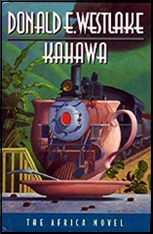
DONALD WESTLAKE – Kahawa. Viking, hardcover, 1982. Tor, paperback, 1984. Mysterious Press, hardcover reprint, 1995; paperback, 1996.

   This was originally published in the early 80s, as I’m sure most of you knew but I didn’t. Evidently it sank without a trace then, and now Mysterious is re-publishing it with a new introduction by Westlake.

   Lew Brady, a good, old-fashioned soldier-of-fortune, is stranded in Alaska, reduced to teaching truckers how to fend off union strong-arms. He’s only partly assuaged by the fact that he’s with his lover, a bush pilot.

   Then comes a call from an old mercenary friend who wants him to come to Africa and help steal a train. That’s right, a train. It belongs to Idi Amin, the Uganda strongman, and it’s full of some very pricey coffee. Brandy and his lady pilot hie themselves to the Dark Continent, where they find good and bad guys of all races, and enough excitement to banish boredom forever.

   There are few if any who do caper novels better than Westlake. All the old pro’s skills are in evidence here, if not in quite as polished form as they are today. He created a fascinating cat of characters, with the real-life portrait of Idi Amin hovering chillingly over them all.

   Uganda was a bad, bad place to be in those days, and Westlake brings it to life for you. It’s a thick book, 496 pages, and therein lay my only cavil — it’s hard to maintain the level of intensity a caper novel requires for that length, and I thought that Westlake occasionally failed to do so.

   But it’s still a decent book, by one of the best. If no one made a movie of this, they missed a damned good bet.

— Reprinted from Ah Sweet Mysteries #18, February-March 1995.

SECRET SERVICE OF THE AIR. Warner Brothers, 1939. Brass Bancroft #1. Ronald Reagan, John Litel, Ila Rhodes, James Stephenson, Eddie Foy Jr., Rosella Towne. Director: Noel M. Smith.

   I really can’t imagine that anyone who went to see this movie in 1939 could have possibly come away from it saying to his wife or her husband, as the case may be, that that guy’s got what it takes to be President someday! But what they definitely would have gotten was a good look at an amiable, good-looking actor with a lot of personal appeal if not necessarily a wide range of acting ability.

   Although only a small budget affair from Warners, the movie itself did so well that three more in a follow-up series were made. I’ve listed two women in the cast, but you can forget about them, even though one of them plays Brass’s fiancée, showing up only at the beginning and once again right at the end.

   In between this is a guys’ story only, one dealing with a tough gang of hoodlums actively smuggling people across the border by plane into California. (How tough are they? Watch this movie and you’ll find out.)

   As for Brass Bancroft, he’s a pilot recruited by the secret Service to go undercover and find out who he Big Boss is. To this end he is framed on a counterfeiting rap and sentenced to a term in prison. Our star of course does this standing on his head. Figuratively speaking, of course. And in spite of his longtime sidekick’s attempt to help (Eddie Foy, Jr.), he’s pretty good at catching bad guys, too.

   Don’t expect too much from this one, as it doesn’t have a lot to give, but you may find this one as much fun to watch as I did.


REVIEWED BY DAN STUMPF:         


RENEGADE TRAIL. Paramount, 1939. William Boyd, Russell Hayden, George Hayes, Charlotte Wynters, Russell Hopton, Roy Barcroft, John Merton, Bob Kortman, and Sonny Bupp. Screenplay by John Rathmell & Harrison Jacobs, based on characters created by Clarence E. Mulford. Directed by Lesley Selander.

   A landmark Western… of sorts.

   Even if it were no better than routine, Renegade Trail would be remembered by B-Western buffs for the last appearance in a Hoppy film by George Hayes, who had established himself as trusty-dusty side-kick Windy Halliday in George Sherman’s Hopalong Cassidy series since Bar 20 Rides Again in 1935.

   In the intervening four years, Hayes had worked his garrulous old-timer schtick into a smooth routine, replete with tall tales, amusing double-takes and toothless muttering asides. Small wonder then, that Hayes hit producer Sherman up for a substantial raise. Or that Sherman, running a successful but not hugely profitable enterprise, had Windy Halliday written out off the Bar 20 ranch, into a comfortable sinecure as a town marshal and out of the series.

   George Hayes moved to Republic, playing basically the same character, but since “Windy” was owned by Paramount, he changed the name to “Gabby,” and it stuck. Gabby Hayes. Thus are legends born.

   Getting back to the movie itself, Trail is a bit lacking in action, the plot needlessly complicated, but vigorously directed by Lesley Selander, and has a moment that would have been at home in an Anthony Mann movie:

   Hoppy’s pal Lucky, lying wounded in the back of a chuck wagon, trying to get his gun out as a bad guy walks from long-shot to medium range and murders the driver. The only problem is that Mann would have done it in a single shot, where Selander breaks it into 3 or 4 — which makes the difference between a great director and a talented one.

   But I said this was a landmark Western and it is. Renegade Trail is the only Western I’ve ever seen (and I’ve seen plenty) where the bad guy (Roy Barcroft) actually makes his entrance kicking a dog – an act which seems to have gone down in B-movie folklore. And it ties into a delicious ending, so I’ll insert here a SPOILER ALERT!

   Toward the end, the outlaw gang has the good guys pinned down, but Hoppy slips behind their lines, sneaks up close to Roy Barcroft and says. “Tell your men to drop their guns!” which he does and they do. Then in the post-game wrap-up, there’s a conversation I’ll paraphrase as:

   “Nice work, Hoppy. But how’d you know he’d give up?”

   And Hoppy replies, “No man that’d kick a dog would stand up to a fair fight!”

   They just don’t make ’em like that anymore.


REVIEWED BY DAVID VINEYARD:


FRANCIS BEEDING – The Seven Sleepers. Professor Kreutzemark #1. Hutchinson, UK, hardcover, 1925. Little Brown, US, hardcover, 1925.

    “I don’t like it, Tom,” she said. “All sorts of queer things are happening just now, and Geneva is always full of international agents of every kind.”

    “International agents!” I exclaimed. “But this is real life. I’ve got a British passport and I’m Thomas Preston of Jebbutt and Jebbutt.”

    “Don’t make any mistake,” said Beatrice. “My chief has told me a good deal about these things. He used to be in the French Intelligence Department.”

    “I don’t see how on earth it can possibly concern me,” I objected.

   Thomas Preston is a British traveling man in Post WWI Europe (a Europe that has just received the first awakening call of what is to come with Mussolini) who finds himself in Geneva, home of the League of Nations (which features prominently in most of Beeding’s thrillers since the two men who wrote under that name both worked there), when his luggage takes a side trip. Not that he is averse to visiting Geneva where the beautiful Beatrice Harvel is working for the League, and as it turns out, for Henri Laval who Preston knew from the war.

   Even before calling on Beatrice, Tom’s visit has been an interesting one, beginning with a strange little man approaching him as if he knew him, shoving a document in his hands, and then promptly being arrested, and then a letter from someone claiming to be Tom’s grandmother setting forth a meeting the next day. These are the things Beatrice doesn’t like and with good reason.

   But no Englishman in the fiction of the between-the-war period, and few since the days of Anthony Hope and the Play-Actor, ever manages to ignore such intriguing mysteries, and in the shadow of John Buchan and Richard Hannay, it would seem practically treasonous. Somehow even when the saner, less adventurous heroes of Eric Ambler and Graham Greene came along, they still somehow never quite managed to ignore that siren song no matter how hard they tried.

   Hero or feckless coward it seems impossible to avoid adventure in a British thriller.

   The Seven Sinners is the work of Francis Beeding (John Leslie Palmer and Hilary Aidan St. George Saunders), best remembered today for the novel The House of Dr. Edwardes, filmed as Alfred Hitchcock’s Spellbound, and a fine mystery suspense serial killer novel Death Walks in Eastrepps.

   In their lifetime, though, they were known as one of the most popular and purveyors of the novel of adventure and international intrigue. Along with the likes of Valentine Williams, they were authors of many stand alone novels (The Norwich Victims, The 2 Undertakers, Eleven Were Brave, The Five Flamboys, The Six Walkers, The Twelve Disguises, The Three Fishers, Nine Waxed Faces — if you note a theme here …) as well as the Colonel Alistair Granby series.

   This is the first novel in the shorter Professor Kreutzemark series, and a good introduction to the pleasures of Beeding in thriller mode. Like their rival Valentine Williams, the team has some decided skills as a writers of this sort of thing, an eye for drama (keep in mind the plot devices that seem so familiar now were still pretty fresh then), and they probably knew the European scene as well as any British writers until Eric Ambler, especially Switzerland and the international environs around Geneva.

   In short order Tom finds himself calling on his ‘grandmother’ who proves to be a a German Professor (He had a fine silky beard, neatly trimmed and of a bright gold, a broad forehead and well-set eyes, a straight nose, and a complexion almost feminine in its delicacy. At the first view he suggested an intelligent and sensitive philanthropist, reclusive in temperament.), and two other Germans (Uncle Ulrich and Uncle Fritz), and has killed a man in self defense.

   It’s clear the three have mistaken Tom for someone else, and equally clear they are up to something shady involving German resurgence after the war and with the mysterious Seven Sleepers of the title financing their scheme.

   Escapes and hurried journeys, near run things, dual identities, trusted allies (a refreshingly international lot in this case), betrayal, sudden set-backs, and a plot to attack London and Paris with the Professor’s nasty X-3 gas that could “…destroy all forms of vegetable or animal life within a radius of 400 square kilometres” are all the elements expertly handled by Beeding.

   (As Richard Usborne points out in his study of popular fiction between the wars The Clubland Heroes, a good paper could be written on the use of deadly gas in the post War era, so great were the memories of its horrors, Bulldog Drummond and the Saint both encountering the nasty stuff along with just about every other hero.)

   Old fashioned, true (…that fate should have permitted me to assist in foiling the powers of malice and disorder which in every age must be encountered and freshly overcome if men are to keep and to increase their inheritance), but half the fun lies in the familiar elements in these books and the skills with which the writer deploys them.

   Though hardly in a class with Buchan or Yates, Beeding is still an entertaining read with a moment or two of the kind of ‘fine writing’ John Buchan’s literate thrillers instilled in the genre, with only an occasional need to wince at attitudes of another age, and superior plot spinning and settings. The boys knew their Europe both geographically and politically.    (*)

   Professor Kreutzemark, the silky bearded one, of course lives to scheme another day, and indeed Thomas Preston and he cross swords again in The Hidden Kingdom for the last time. No really good villain should be expected to give up the ghost that easy, and there isn’t much doubt that Beeding had a success as great as Valentine Williams Adolph Von Grundt, Clubfoot, in mind even if it eluded him for the Professor, only to find it with the clever and heroic Colonel Granby. Too bad, because Kreutzemark had his moments as mad German professors go, and a bit of style is appreciated in any field, perhaps especially villainy.


   (*) One has to wonder that any reader of popular British thriller fiction was at all taken by surprise by the rise of Hitler and the rebirth of a dangerous Germany. The fiction of the era barely let the poison gas clear from the trenches before imagining fellows in Prussian haircuts, mad doctors, armaments dealers, and shady fellows in high finance plotting the next war, certainly after the mid twenties when Mussolini raised his ugly shaved head.

Granted, most writers were more subtle with Germany never quite spelled out, and Russia and the Reds came in for no small amount of plotting themselves (Sapper was about evenly divided between Germans and Russians sometimes rather remarkably managing to have both working together, but then politics was not his strong point), but it does seem at times as if anyone who bothered to crack a book would have been well advised to invest in a bomb shelter or leave the continent.
« Previous PageNext Page »