Reviews


KATHERINE HALL PAGE – Murder in the Belfry. Faith Fairchild #1. St. Martin’s, hardcover, 1990. Avon, paperback, 1991.

   Finding the body is [the former] Faith Sibley, displaced New Yorker and now the wife of a minister in a small New England town. The dead girl has been president of the Young People’s Club, but she was also a blackmailer, and worse — and somebody probably wanted her stopped.

   At first this is a “let’s solve a murder — it’ll be such fun” type of book, but when the dead girl’s innocent boy friend is suspected, a real reason for finding the killer emerges. Unfortunately Faith stumbles onto the truth almost by accident, spoiling the ending more than a little.

— Reprinted from Mystery*File #23,, July 1990. (very slightly revised).


[UPDATE.] Faith Sibley’s married name is Faith Fairchild, and this is how she is known throughout the rest of series. If you has asked me in 1990 when I wrote this review how many books would end up being in the series, I’m sure I’d have said three or four. I believe that was the standard publishers contract at the time for a new series. Unless the books and the leading characters caught on, and for Katherine Hall Page, I’m happy to say that they did. See for yourself:

      The Faith Fairchild series —

1. The Body in the Belfry (1990)
2. The Body in the Kelp (1990)
3. The Body in the Bouillon (1991)
4. The Body in the Vestibule (1992)
5. The Body in the Cast (1993)
6. The Body in the Basement (1994)
7. The Body in the Bog (1996; aka The Body in the Marsh)
8. The Body in the Fjord (1997)
9. The Body in the Bookcase (1998)
10. The Body in the Big Apple (1999)
11. The Body in the Moonlight (2001)
12. The Body In The Bonfire (2002)
13. The Body in the Lighthouse (2003)
14. The Body in the Attic (2004)
15. The Body in the Snowdrift (2005)
16. The Body in the Ivy (2006)
17. The Body in the Gallery (2008)
18. The Body in the Sleigh (2009)
19. The Body in the Gazebo (2011)
20. The Body in the Boudoir (2012)
21. The Body in the Piazza (2013)
22. The Body in the Birches (2015)
23. The Body in the Wardrobe (2016)
24. The Body in the Casket (2017)

IT IS PURELY MY OPINION
Reviews by L. J. Roberts


KRISTEN LEPIONKA – The Last Place You Look. Roxane Weary #1. Minotair Books, hardcover, June 2017.

First Sentence: “Matt said you find things. For a living,” the woman said on the phone.

   Roxane — one ‘n’ — has a reputation for being good at finding things. Danielle Stockton’s brother, Bradford, is two months away from his execution date after being convicted for murdering the parents of a girl no one has seen since the crime. Danielle believes she saw her recently, and she wants Roxane to find her and prove her brother’s innocence.

   What a pleasure to have a book whose story starts at the beginning and goes straight through to the end. What a pleasure to have a book you definitely don’t want to put down until the last page is done.

   Lepioinka has created a fascinating character in Roxane. She is a wonderful study in contrasts with a complicated personal life. A fair amount of time is spent focusing on her family and relationships which lays the foundation for our getting to know this well-drawn, fully-developed character. It creates a strong enough interest that one really wants to know what will happen to her, both in this book , and in the future. Yet, while Roxane takes center stage, those around her hold their own as well.

   With every setting, a strong sense of place is created— “The previous tenant had painted spirited colors in every room: a dark, shiny teal in the office, burnt orange in the bathroom, chocolate-brown walls and red cabinets in the kitchen, cornflower blue in the long hallway that ran the length of the apartment.” —which orients one to the character.

   Even better is the author’s well-done, unforced dialogue— “He slid one of the shot glasses to me and held his up. ‘Friends don’t let friends order cocktails invented by social-media interns.'”

   The suspense starts quietly, subtly, and builds at a good pace with red herrings along with way. The body count also increases and includes a good twist. The author is very good at having you follow the character down a path only to discover it’s the wrong path.

   The Last Place You Look has an excellent protagonist, and a breath-catching climax. It’s a book one wants to read in one sitting, and an author one may wish to follow.

— For more of LJ’s reviews, check out her blog at : https://booksaremagic.blogspot.com/.

REVIEWED BY BARRY GARDNER:


ROBERT B. PARKER – Walking Shadow. Spenser #21. G. P. Putnam’s Sons, hardcover, 1994. Berkley, paperback, 1995.

   What in the world is left for me or anyone to say about Parker, Spenser. Hawk, Susan and the whole menagerie? At his best Parker writes some of the smoothest prose the field has seen, and at his worst is so pretentious he’s embarrassing and devises plots you wouldn’t wish on Mack Bolan. I guess the suspense is in seeing which one you get this time out.

   Spenser is drawn into the world of theater when Susan, on the theater’s board, drags him to a small Massachusetts town to see an avant-garde play. It develops that the producer is being followed by a person unknown, feels threatened, and wants Spenser to find out why. For Susan’s sake he agrees, but before he can find out anything, a cast member is murdered.

   The town has a large Chinese population, and Spenser is visited by one of them and two Vietnamese gang members who encourage him to stay away. This is a signal to bring in Hawk and get serious about things.

   This could be sub-titled “Three Against the Tong,” and that should tell you all you need to know about what kind of story it is. Parker has created a fantasy-land here, his own little Oz, with a manly hero who knows T. S. Eliot and has not only stone killers (two of them this time) but every sort of cop at this beck and call when he needs aid, and an oh-so-understanding lady with a precious dog to boot.

   He’s only going through the motions now, though granted, they’re smooth motions. He writes effortless prose still, but it’s all moves and no punch. It’s slick, it’s superficial, it’s kind of silly, really, and it’s the literary equivalent of week-old stew. If this were a paperback original from a new author, I might be a little more tolerant — but it isn’t. I’m afraid Parker’s just about played out his string.

— Reprinted from Ah Sweet Mysteries #13, June 1994.


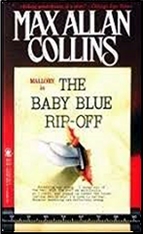
MAX ALLAN COLLINS – The Baby Blue Rip-Off. Mallory #1. Walker, hardcover, 1983. Tor, paperback, November 1987.

   It takes a while in this, Mallory’s first appearance, for details of who he is to be filled in. But as the story goes on, we learn that is is an ex-Viet Nam vet as well as a former cop, and is now beginning a career as a mystery writer. He’s also just moved back to the small home town of Port City, Iowa. (By the end of the book, though, his first name is still not known, at least by me.)

   The book begins as he describes how he’s been inveigled by a girl friend (who then almost immediately splits on him) into volunteering as a Meals on Wheels delivery person for the elderly. This may be a first (and only?) as an occupation for the leading character in a mystery novel.

   But what this does is to serve as a means for Mallory to get involved in his first case of actual murder. When he arrives at the home of one of the elderly women on his route, he finds a gang of thieves ransacking the place, and worse, he discovers the woman herself tied to a chair and very much dead.

   Besides taking her death as personal affront and deciding to find the ones responsible on his own, he also gets involved with an old flame from high school who now needs his help. One thing leads to another in that regard as well.

   Collins tells the story in a nice breezy tone that’s as comfortable as an old pair of shoes, with more than a bit of nostalgia mixed in. It’s also very well plotted — three solid reasons why I’m hooked and will go on to read the rest of series as soon as I can. There were four more. See below:

       The Mallory series —

1. The Baby Blue Rip-Off (1982)
2. No Cure for Death (1983)
3. Kill Your Darlings (1984)
4. A Shroud for Aquarius (1985)
5. Nice Weekend for a Murder (1986)

DEAD MEN DON’T WEAR PLAID. Universal Pictures, 1982. Steve Martin, Rachel Ward, Carl Reiner, Reni Santoni. In archival footage: Ingrid Bergman, Humphrey Bogart, James Cagney, Joan Crawford, Bette Davis, Brian Donlevy, Kirk Douglas, Ava Gardner, Cary Grant, Alan Ladd, Veronica Lake, Burt Lancaster, Charles Laughton, Fred MacMurray, Ray Milland, Edmond O’Brien, Vincent Price, Barbara Stanwyck, Lana Turner and more. Screenplay: Carl Reiner, George Gipe & Steve Martin. Director: Carl Reiner.

   Laughter is contagious. Watching a comedy film in a theater with a few hundred other people is one thing. Even if the comedy is not so hot, if one person starts laughing at a scene, no matter how lame it is, you may find yourself laughing too. You can’t help yourself.

   It’s why the TV networks came up with the idea of laugh tracks, and that was a long time ago.

   Dead Men Don’t Wear Plaid is another kettle of fish altogether. I watched this one on DVD with only one other person watching with me, and I found myself laughing out loud any number of times. I couldn’t help myself. This does not happen often.

   I can’t say that this would happen to everyone. Some people can’t watch black and white movies. I can understand that. It’s difficult for me to watch silent movies. Some people don’t care for noir movies from the 40s. That I don’t understand, but there’s no accounting for tastes.

   Steve Martin plays a 1940s Sam Spade kind of private eye in this one, a guy named Rigby Reardon, and he’s hired by a beautiful dame (Ranchel Ward) who hires him to investigate the reported death of her father in a car accident along a deserted mountain highway. From that point on, there’s no real need to explain what happens (because I can’t), but surprisingly enough, I’m willing to wager that it actually makes sense.

   For what is interspersed with the case that Rigby Reardon is working on are archival clips from maybe a dozen film noir movies from the 40s, sliced in perfectly to not only move the story along but to also fit in as smooth as silk with whatever comic antics Steve Martin is doing on screen, including voice-over narration.

   I’m sure all of you know this already, and each of you has your own personal favorite scenes. But speaking personally, if I may, I think this film is a work of genius, and if by chance you have never seen it but you have read this far into the review, you absolutely should. See it, that is. Don’t deprive yourself any longer.

RAH RAH RASPUTIN!
by Dan Stumpf


  RASPUTIN. (Dial Press, 1927) by Felix Yusupov.

  RASPUTIN AND THE EMPRESS MGM, 1932. John, Ethel and Lionel Barrymore, Ralph Morgan, Diana Wynyard and Edward Arnold. Written by Charles MacArthur. Directed by Richard Boleslavsky.

  THE NIGHT THEY KILLED RASPUTIN. Cino Del Duca, 1960. Also released as Nights of Rasputin. Edmond Purdom, Gianna Maria Canale and John Drew Barrymore. Written and directed by Pierre Chenal.

  RASPUTIN: THE MAD MONK. Hammer, 1966. Christopher Lee, Barbara Shelley and Richard Pascoe. Written by Anthony Hinds (as “John Elder”.) Directed by Don Sharp.

  RASPUTIN IN HOLLYWOOD (Weidenfeld & Nicolson, 1990) by Sir David Napley.

   Prince Felix Yusupov’s RASPUTIN (Dial Press, 1927) is something of a rarity: a biography written by the assassin of its subject. Indeed, the only antecedent I can recall is Pat Garrett’s AUTHENTIC LIFE OF BILLY THE KID, which was largely ghost-written. This may have been ghosted too, for all I know, but it reads with the self-serving simplicity of One Who Was There.

   Maybe some faint controversy still sputters over The Mad Monk, but there’s no denying his role as the 20th century equivalent of the Queen’s Necklace: the catalyst in the fall of a (tottering) monarchy that ushered in a whole new age — and did it with a tawdry stylishness that has all the elements (according to the old joke) of a great novel: Religion, Royalty, Sex and Mystery. No wonder he’s been the subject of a dozen books and movies.

   But this book, as I say, was written by the guy who killed him, and it has its moments. The background on Rasputin is sketchy and one-sided as one expects, but it’s interesting to read Prince Felix, writing ten years after the Russian Revolution, anticipating the imminent fall of the Communist government.

   His take on the Great War and the chaos of Imperial Russian politics is also fascinating, but the book really comes to life when Yusupov gets to his own encounters with Rasputin, and his growing resolve to kill him, then the bloody deed and its aftermath. These chapters have all the impact of a really fine crime story, and if it’s not told with quite the edgy panache of Charles Williams or Jim Thompson, it’s still a fine, riveting read and a fascinating reflection of an age gone by.

   The whole affair was done up with suitable splendor by MGM in 1932; RASPUTIN AND THE EMPRESS offers a stellar cast, crowds of extras, sumptuous sets and appropriate disregard for history. John Barrymore looks a bit ticked off at not getting to play Rasputin (his brother Lionel gets that plum part), but he puts commensurate enthusiasm into the scene where he poisons, shoots, clubs and drowns his sibling, and the rest of the cast handles things with equal enthusiasm.

   There is some interest in seeing Barrymore Jr in THE NIGHT THEY KILLED RASPUTIN essay the part his daddy had, but that’s the sole attraction of this effort, at least as released here in the US. It may have been more appealing in color, but it showed up here in badly-dubbed B&W. Hence. I cannot fairly judge the acting except to say it sounds like they had two or three voice-over artists doing all the parts, and it ends so abruptly I suspect someone just lost interest. I know I did.

   RASPUTIN: THE MAD MONK is rather more spirited but somewhat misses the high-water mark set by Hammer Studios at their best. Blame the by-the-numbers direction by Don Sharp, a confirmed second-stringer, or the penurious production from Hammer, who did this back-to-back with DRACULA, PRINCE OF DARKNESS, using the same sets and much of the cast. There’s a spirited performance from Christopher Lee, relishing a bravura speaking part for a change, but everyone else seems to act like they’re wasted in Nothing Parts — which they pretty much are.

   And then there’s the book RASPUTIN IN HOLLYWOOD, by noted British author/solicitor Sir David Napley, dealing primarily with the lawsuit Prince and Princess Yusupov brought in British courts against MGM for suggesting in their movie that the princess had an improper encounter with the mad monk.

   This is hardly the stuff of gripping drama, but Napley handles it (mostly) well. There’s some enjoyably concise background on the principals in the story: I never knew the Prince did a drag act in nightclubs, and he was about the least likely person to pick for the job of assassinating a bear of a man like Rasputin; in point of fact, the monk was finished off by others in the plot.

   Be that as it may, the Yusupovs escaped the Bolsheviks, spent all their money, and when the MGM film came out, either gasped in horror at seeing the princess’ name besmirched, or licked their chops seeing the chance for more lucre. Take your pick. Napley remains impartial as he goes on to describe the trial in detail, telling us about the opposing strategies, explaining the strengths and weaknesses and all the hits, runs and errors in a very expensive game.

   It ain’t exactly ANATOMY OF A MURDER, but he keeps it interesting and fun—which is more than I can say for some of those movies.
ASHLEY WEAVER – Death Wears a Mask. Amory Ames #2. Minotaur Books, hardcover, October 2015; trade paperback, September 2016.

   Although not intended, I imagine, for most readers of this blog, as a detective mystery novel, this is a book — as well as a series — that has a lot going for it. It has, first of all, a spunky heroine named Amory Ames, a young married woman who is quite at home in the wealthy upperclass set in England in the 1930s. She loves her husband, but he in turn seems to have a restless eye, a fact that causes a lot of heartache between the two of them.

   Lots of romantic conflict and stress, in other words, but what’s also of interest to modern day readers is that Amory has a growing reputation for solving mysteries. This, her second venture into solving a murder, starts slowly, though, as she is asked by a friend to find out who has been stealing some of her jewelry. A bracelet studded with fake sapphires is chosen as bait for the thief. And where? At as masquerade ball.

   Before the ball is over, however, a man is dead, but why? Did he confront the thief? He can’t have been the thief because he was in on the plan, and he knew the jewels were only paste. Surprisingly enough, the same policeman who was on the job in Amory’s first adventure, Murder at the Brightwell, manages to turn up again, but this time working for Scotland Yard.

   And since the world in which the murder takes place, that of the well-to-do and wealthy, does he ask Amory to snoop around and see what she can learn about all of the suspects, who are limited in number, but who live in a class that Inspector Jones can hardly expect to penetrate? In a word, yes.

   Overshadowing the case, however, is Amory’s problem with her husband Milo, who always has excuses for long stays away from home, and worse, has had his photo in the newspapers kissing a well-known French actress. Is a divorce in the works? On the other side of the coin is the attention that a certain Lord Dunmore is paying Amory.

   The mystery is complicated, but it’s nowhere near the level of that of an Agatha Christie novel, or even a Georgette Heyer mystery, both of whom are prominently referred to in the blurbs on the back cover. If you get the idea from the preceding paragraph that as much time is spent with Amory’s marital difficulties as with solving the mystery, I suspect that you may be correct.

   Personally, while I don’t know what’s going on with Milo — a theme that will assuredly be carried along in the next book — but I think he’s a dope to leave poor Amory twisting in the wind as he does.

The Amory Ames series —

1. Murder At the Brightwell (2014).     Edgar nominee for Best First Novel.

2. Death Wears a Mask (2015).
3. A Most Novel Revenge (2016).
4. The Essence of Malice (2017).
5. Intrigue in Capri (2017).

BILL PRONZINI – Quincannon. John Quincannon #1. Walker, hardcover, 1985. Berkley, paperback, September 2001.

   When readers of this blog see Bill Pronzini’s name, I’m sure that most of them will immediately think of his Nameless PI series, and rightfully so, since there are over 40 of them. A good percentage of these readers will also know him as the author of a large number of straight suspense novels. Relatively fewer will associate him with an additional 8 or 10 western novels, however, some published under other names.

   What you can count on with a Pronzini book, though, no matter what genre, is one that is is well-researched, will-plotted, and above all well-dialogued (if such is actually a word). Quincannon is actually a hybrid, a crossover between a western and a detective novel. The leading character is John Quincannon a longtime agent for the Secret Service in the 1890s, based in San Francisco. The case which he’s assigned to in this, his first recorded adventure, is finding out who’s flooding the West Coast with phony currency and counterfeit silver eagles and half-eagles.

   The trail leads him to a small mining town in Idaho, but unfortunately Quincannon is suffering from a bad case of the whiskey blues. If the word alcoholic was in use then, he would be one. His present is constantly clouded by the memory of the young pregnant woman he accidentally killed on on earlier assignment.

   But completely sober or not, in the guise of a patent medicine salesman, he’s still capable of doing the detective work needed to crack the case. Of even more importance, perhaps, is that in doing so, his path crosses that of a young independent woman named Sabina Carpenter, who has an uncanny resemblance to the woman whose death he was responsible for. And more, she also does not seem to be whom she claims to be.

   That they end up working together is a fact that followers of their combined careers already know. At the end of the book there is a strong hint that they will continue to be partners in a San Francisco-based private investigation business, which of course they did.

Bibliographic Notes:   Following this book, Quincannon next appeared in Beyond the Grave (1986), co-authored with Marcia Muller. Carpenter and Quincannon then appeared in a long list of short stories, some co-written by Myarcia Muller and most if not all collected in:

Carpenter & Quincannon, Professional Detective Services (1998).

Burgade’s Crossing (2003).
Quincannon’s Game (2005).

   Eventually the pair began appearing in book form, in the following list of novels, under the combined byline of Muller and Pronzini:

The Bughouse Affair (2013).

The Spook Lights Affair (2013).
The Body Snatchers Affair (2015).
The Plague of Thieves Affair (2016).
The Dangerous Ladies Affair (2017).

X. American International Pictures, 1963. Also released as X: The Man with the X-Ray Eyes. Ray Milland, Diana van der Vlis, Harold J. Stone, John Hoyt, Don Rickles, Dick Miller. Screenplay: Robert Dillon and Ray Russell, based on a story by the latter. Director: Roger Corman.

   Refused an extension of a medical grant for his research on enhancing human vision, a doctor (Ray Milland) decides to carry on on his own, using himself as the first subject. Things, of course, do not go well, as per the alternative title for this rather well-done sci-fi movie.

   If you had x-ray vision, what would use it for? Go to a party, of course, where you can see all of the dancers au naturel. Or if in your haste to continue your experiments, you accidentally push a colleague out of a window to his death, what would you do then?

   Become a blindfolded swami in a carnival act, one supposes. Or if your barker (Don Rickles) sees dollar signs, open a free clinic for people to have their ailments diagnosed. Or if still on the run, head for Nevada to make a real fortune (though I don’t understand the business with a slot machines, looking inside to see a big payoff coming in two more plays).

   Don’t get me wrong. The movie is well done, and everybody plays it straight, except for maybe a short bit between Don Rickles and a heckler (Dick Miller) while Dr. Xavier is doing his carney act. There’s no big message, except perhaps scientists ought be careful how far they go, and the 80 minutes of playing time go by very quickly.

ERIC JAMES STONE – Unforgettable. Baen, trade paperback; January 2016; mass market paperback, May 2017. Previously published in ebook form, December 2015.

   Not too many science fiction novels take place in the present, but as I far as I can tell, this one does. There is only one aspect of it that makes it sfnal, and that is the fact that, since birth, Nat Morgan has had a unique talent: once out of sight of anyone, that person will forget everything about him in exactly sixty seconds.

   The same goes for computers and digital cameras, too. Anything in writing, fine, and (if I understand it correctly) photographs, the old-fashioned kind, if they’ve been printed out on paper they will continue to exist. It’s a tenuous hold on life, and it takes a lot of effort on Nat’s part just to survive.

   But who do you think he works for? The CIA, of course.

   And during the course of this current assignment, he’s finally given an explanation. Quantum physics, in other words, and Stone, as the author of this high-tech lighthearted thriller, somehow manages to convince me that it’s possible as well or better than any author could. (Store the information away along with intergalactic wormholes , faster-than-light drives and transporter beams. All I need is the basic concept and I say yes, OK, that makes sense, and now tell me a story about it.)

   And in this case the problem that Nat finds himself working on is how to stop a madman from building a quantum supercomputer so powerful that is can cancel out probability itself, and therefore control the fate of the entire planet. Aiding him in this effort is a female Russian agent who, as things progress, becomes the only one who does not forget him as soon as he steps out of the room. (If captured, stopping in a bathroom stall is a good way to elude his enemies.)

   It’s a one-note story, to tell you the truth, but it’s also a lot of fun. I’m not sure that Stone has yet mastered all of the maneuvering you could do in life to both do good and to escape your would-be captors, but he’s thought of a lot of them. I enjoyed this one.

« Previous PageNext Page »