REX STOUT – Too Many Clients. Viking Press, hardcover, October 1960. Bantam, paperback; 1st printing, March 1962. Reprinted by Bantam many times. TV adaptation: Season 2, episodes 9 and 10, of A Nero Wolfe Mystery (A&E, June 2 and 9, 2002).
The title says it all. Nero Wolfe and Archie Goodwin go from a bank account that’s discouragingly low, with an IRS payment coming up soon, to a case that walks in the door and before it’s over, ends up with four different clients having paid Wolfe a retainer for his services.
It begins with an executive for a plastics company hiring Archie to see if he’s being followed when he visits a certain address, a task so simple that Wolfe need not be involved. Archie agrees, but the arrangement falls through when the client is a no-show. Then the client is found dead outside the building that was his destination, but the death occurred the day before, and it isn’t the man who hired Archie.
It also turns out that the dead man had an elaborate (and duly well-decorated) love nest in the apartment building he was found murdered outside of, and keeping the place a secret while solving the murder is the job Wolfe takes on, hoping that one of the clients will come through with a very large payment for the work he’s done.
Rex Stout was hitting on all cylinders when he wrote this one. Both the rapport and the repartee between Wolfe and Archie are terrific, the case is quirky enough to be interesting throughout, and all of the usual secondary characters in the Wolfe saga show up and have their individual roles to play. If I could complain about anything, it would be the fact that Stout doesn’t exactly play fair with the reader, in that a short time before the end of the book Wolfe gives Saul Panzer and Orrie Cather a job to do without telling Archie about it, nor us, therefore, the reader.
That small quibble aside, this one was a lot of fun to read.
FINAL EXAM. Motion Picture Marketing / Embassy Pictures, 1981. Cecile Bagdadi, Joel S. Rice, Ralph Brown, DeAnna Robbins, Sherry Willis-Burch, John Fallon. Written and directed by Jimmy Huston.
Odd. Amateurish. Creative. Atmospheric. These are just four ways to describe this low-budget “madman on the campus†thriller. Filmed on location in North Carolina, Final Exam features an extremely effective musical score and a cast replete with first-time actors and relative unknowns. All of them, despite their lack of on screen experience, do an admirable job in making this offbeat slasher film something far more memorable than it truthfully deserves to be.
The plot isn’t particularly difficult to follow. It’s finals week at a small liberal arts college somewhere in the US South and the remaining students on campus are involved in studying and partying. There’s also the jock-filled fraternity that decides it’s a good idea to pull a major prank on campus, one that involves a simulated terrorist attack. This naturally sets up one of the major characters, a nerdy fellow named Radish (Joel Rice) into believing the prank is real, leading him to phone the local sheriff who is less than pleased to learn that the whole thing was a false alarm.
But what happens next is no prank. Soon enough, a knife-wielding madman shows up on campus and begins his senseless murderous rampage. (I say “senseless†not just as a means of describing psychopathic murders, but also because the film controversially provides no motive for the killer. Whether that makes it more effective or less is up to the viewer to decide.) The main characters – from the jock to the blonde girl having an affair with the chemistry professor – come face to face with the lurking evil in their midst.
Typical for the genre, there is a studious, morally upright final girl who (spoiler alert) not only kills the killer, but also survives the ordeal. Courtney (Cecil Bagdadi) is filled with self-doubt and is insecure about her future. She doesn’t feel as if she has it easy either in terms of looks or marketable skills. But somehow she finds the internal strength to not only keep on living in the midst of the evil that overtakes the campus, but to also defeat it.
I’d be exaggerating if I said that there were any deep philosophical themes explored in Final Exam, a movie that’s far more grindhouse than art house. But there are several thematic elements that merit further exploration, such as the effect of fraternity pranks on college campuses, the psychological insecurity of college students soon to embark on their journey into the “real world,†and the randomness of life itself.
Indeed, Radish is constantly badgering Courtney with seemingly useless observations about how there are psychopaths out there in the world who would do innocent people harm. Taken as a metaphor for the difference between the relative security of a college campus and the dog-eat-dog reality of post-collegiate life, Final Exam deserves a far higher grade than many of the other derivative slasher films that were released in the wake of John Carpenter’s seminal Halloween (1978). And much like Halloween, this film eschews gore and relies more on atmosphere, suspense, and a haunting soundtrack to make an impact on the viewer.
PHOEBE ATWOOD TAYLOR – The Cape Cod Mystery. Bobbs-Merrill, hardcover, 1931. Paperback reprints include: Pyramid R-1124, Green Door Mystery, 1965; Foul Play Press, 1985.
The Cape Cod Mystery is the first book in a series of 22 Asey Mayo novels and two hardcover collections, each of the latter containing three novellas reprinted from The American Magazine. All of the stories take place in the quintessential area of New England called Cape Cod, and over the years Asey Mayo became the model for the typical New England Yankee handyman, whose knowledge of the world and the people in it made him a natural-born solver of mysteries as well.
In this first foray into detective work, Asey Mayo tackles the death at unknown hands of a well-known novelist who takes up residence in a small cottage behind the residence of Prudence “Snoodles” Whitsby, who accompanies Asey as he tries to prove the innocence of his employer, Bill Porter, heir to a prosperous automobile company.
As it turns out, as the pair of sleuths continue to ask questions, they quickly learn that the dead man was someone who had made more enemies than friends over the course of his life. There is, therefore, no shortage of suspects, and it takes quite a while to sort out which of them was where and when.
It is difficult to believe that Phoebe Atwood Taylor was only 22 years old when she wrote this book. Each and every character is distinctively drawn, even if only in broad strokes, but most impressively, Asey Mayo acts and talks exactly like a man who might not have a formal education but has a ton of both life experience and common sense to base his observations and deductions on.
The book does get a little talky in the middle, and the ending — following a gathering of all the important players in one room — might be overly dramatic, but it works well enough for me to suggest to you that if you’re a fan of Golden Age mysteries, this is a series you really ought to look into. If you haven’t already.
GEORGE C. CHESBRO – City of Whispering Stone. Simon & Schuster, hardcover, 1978. Signet, paperback, 1979.
Ladies and gentlemen, presenting Bob Frederickson, alias Mongo the Magnificent, former circus dwarf with a Ph.D. in criminology, now moonlighting as the world’s shortest private detective!
This case of the missing Iranian weight-lifter is actually Mongo’s second, and it takes him deep into the web of revolution threatening that ancient oil-rich kingdom as it struggles to make its way into this century. Plenty of bodies pile up, and lots of double (and redoubled) agents, but as in cheap carnival sideshows, the emphasis seems to be more on flash than substance.
Cotton candy also comes to mind.
— Reprinted from The MYSTERY FANcier, Vol. 3, No. 1, Jan-Feb 1979.
AARON ELKINS – Old Scores. Chris Norgren #3. Charles Scribner’s Sons, hardcover, 1993. Fawcett Gold Medal, paperback, 1994.
One thing about Elkins, he picks widely varying specialties for his series characters. Though he;s best known for his “bone doctor” series about Gideon Oliver, the Norgren books seem to be pucking up steam. Chris Norgren is curator at the Seattle Art Museum, and who’d have thought the world of acquisitions would be so hazardous?
A famous French collector wants to give the museum a Rembrandt — great, hein? Well, maybe. There are a couple of catches: the painting has no provenance, and no scientific tests will be allowed. Chris’s director wants him to go to France and make an accept/reject decision. Chris wants to reject it out of hand, but goes anyway, at the cost of some discombobulation to his already shaky love life. Things are even weirder than expected in France, the situation turns nasty, and murder is done. Well, hell, what did you expect?
I don’t believe for a minute that any museum would even consider accepting a master painting without provenance and/or testing, but what do I know about museums? Aside from that, this was the kind of entertaining tale I’ve come to expect from Elkins. I like Norgren as a character, and find the artistic background interesting and edifying. Elkins tells a good story, and creates a good set of supporting characters. His stories fall somewhere between cozy and hard-edged, and while I don’t think anyone would call them memorable, they provide an enjoyable read.
— Reprinted from Ah Sweet Mysteries #7, May 1993.
The Chris Norgren series —
1. A Deceptive Clarity (1987)
2. A Glancing Light (1991)
3. Old Scores (1993)
NORMAN BERROW – The Footprints of Satan. Ward Lock, UK, hardcover, 1950. Ramble House, US, softcover, April 2005.
One morning the inhabitants of the English village of Winchingham awaken to find a single line of hoofprints that begin in the middle of the road, in a carpeting of virgin snow, and then lead through gardens, over walls and hedges, through a locked summerhouse and pavilion, across a steep roof inaccessible to humans, to finally end by an old tree from which a man is hanging by the neck.
Superstitious terror grips the village: Many believe the devil is responsible. (There is actual historical precedent for such a belief: On the night of February 8, 1855, a similar trail of cloven hoofprints appeared in and around a number of towns in the south of Devon, and no earthly explanation for them was ever discovered.)
The trail and the dead man are not the work of Satan, of course, but that of a very clever murderer. Berrow’s development and unraveling of the apparently inexplicable is likewise ingenious, and he builds considerable suspense before his series sleuth, Detective Inspector Lancelot Carolus Smith, finally solves the mystery.
Only one of Berrow’s twenty novels — a revised and updated version of the 1940 book The Ghost House (1979) — was published in the United States, perhaps because of their numerous flaws: talkiness and overwriting, colorless characters, and some dubious use of English slang (Berrow was a New Zealander). The Footprints of Satan, however, his best and most baffling novel, deserves to have been reprinted here — and still should be for the amusement of contemporary readers.
Other of his books worth reading include The Three Tiers of Fantasy (1947) and The Bishop’s Sword (1948), each of which contains no fewer than three neatly worked out “impossible crimes”; and It Howls at Night (1937), a non-series book set in Spain, which has a werewolf theme.
UPDATE: Here is some good news, at least for fans of “impossible crime” mysteries. All twenty of Berrow’s mysteries have been reprinted by Ramble House, including this one.
THE DRIVER. EMI Films/20th Century Fox, 1978. Ryan O’Neal, Bruce Dern, Isabelle Adjani, Ronee Blakley. Written and directed by Walter Hill.
Ryan O’Neal plays it cool – really cool – as the eponymous Driver in Walter Hill’s genre bending contemporary Western/crime drama. Although on the surface, The Driver is just another action movie replete with urban car chases, the movie is a multi-layered, yet subtle, re-imagining of the Western film subgenre in which a renegade lawman becomes consumed with bringing an outlaw to justice.
Enter Bruce Dern, who is known for his seemingly effortless ability to portray unhinged characters. He portrays the Detective who relentlessly pursues the Driver, a skillful, ascetic getaway driver who has been involved in some high profile robberies in Los Angeles. Dern is actually quite effective in this role, and he chews the scenery throughout the film. There’s a goldmine of subtle dialogue sprinkled throughout the movie, much of it the Detective’s acerbic interactions with his colleagues and suspects alike.
That brings us to the Player (Isabelle Adjani), a gambler who the Detective suspects isn’t exactly truthful about what she witnesses during a casino robbery. Much like O’Neal, Adjani plays it cool with an understated performance that somehow makes the movie even stronger than it would have been had she showed more emotion. The Player is not afraid in getting caught up in the cat-and-mouse game between the Driver and the Detective. She may be mysterious and vulnerable, but she isn’t going to be so easily intimidated by either the cops or the criminals.
What the movie lacks in character development – seen most obviously in the lack of personal names for the main characters – it more than makes up for in skillfully filmed car chases, most of which take place without any music. Indeed, there is no fanfare to drown out the sounds of revving engines and squeaking tires. All of which serve to remind the viewer that, despite the fact that the narrative could just have easily been reworked for a gritty Western, that this is a car chase film par excellence.
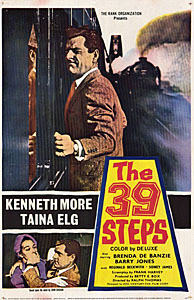
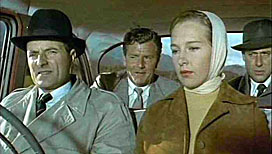
THE 39 STEPS. Rank Films, UK, 1959; 20th Century Fox, US, 1960. Kenneth More,Tania Elg, Barry Jones, Brenda de Banzie, Reginald Beckwith, James Hayter, Faith Brook, Dunacan Lamont, Jameson Clark, Sidney James. Screenplay by Frank Harvey, based on the novel by John Buchan. Directed by Ralph Thomas.
This color almost scene-for-scene remake of the 1936 Alfred Hitchcock classic has many things to recommend it, and had there been no film of the book by the master would stand as the best version of the story committed to film. Four films of the classic novel of escape and pursuit by John Buchan have been made including a slightly more faithful to the book version with Robert Powell and a version done for PBS. The Powell has things to recommend it, less so the PBS version. Not too long ago Jonathan Demme was thinking of doing yet another adaptation of the book.
Of course, Hitchcock himself remade it at least twice using the essential story from his own film, once as Saboteur with Robert Cummings and once more as North By Northwest with Cary Grant. For all the changes, both are variations on the same theme and plot. With the possible exception of “The Most Dangerous Game,†The 39 Steps may be the most borrowed plot in film and modern genre fiction. Even Bob Hope’s My Favorite Blonde owed much to it, including the presence of Madeline Carroll.
This version produced by Betty Box, opens with Richard Hannay (Kenneth More) footloose and at loose ends in London. In the park he encounters a Nanny (Faith Brook) and tries to return a rattle dropped on the ground only to be rebuffed. Still trying to return the rattle he saves her from nearly being run down by a car and ends up with the pram, which had no baby in it, and her purse with no identity but a gun and tickets to a music hall performance that night at the Palace (and that’s a fairly placed clue for the handful unfamiliar with the film versions).
The Nanny shows up, and promises to tell him the story behind the empty pram, but only after they watch Mr. Memory (James Hayter), a little man with a prodigious memory for facts. They go to Hannay’s flat, where she reveals she works for the government and is being hunted by a spy ring led by a man missing the top joint of his little finger. Something important about a military project is being smuggled out of England and it has to be stopped (the classic Hitchcockian definition of a McGuffin, that exists only to move the plot forward).
Hannay goes to make tea and while he is doing that, the two men (Duncan Lamont and Jameson Clark), who tried to run her down earlier and who have followed her to Hannay’s flat, kill her with a dagger Hannay brought back from his adventures (in the book he is an engineer from South Africa, in the Hitchcock he’s Canadian, and here he appears to have been connected with the Foreign Office though not as an agent).
He knows the police will never believe him and the two killers are waiting outside in case he tries to leave. His only hope is to follow the few clues Nanny gave him and go to Scotland and try to see the important man she named.
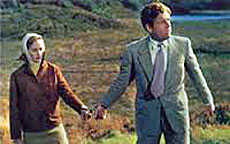
Aside from the color, what sets this apart from the Hitchcock classic is its on location filming. Some spectacular shots, narrow misses, and eccentric characters (shopworn medium Brenda de Banzie and her cuckold husband Reginald Beckwith), a few new bits including Hannay asked to speak at a girls school rather than a political meeting as in the book and first film (a scene ‘borrowed’ and set in a nudist meeting in the film of Irving Wallace’s The Prize, another Steps influenced thriller), all add to the mix that made the first film so charming and this one a worthwhile remake.
If nothing else, the location color shooting expands the films feel for Buchan country, something suggested by a few scenes in the original.
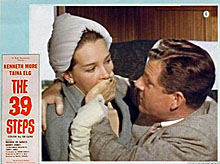
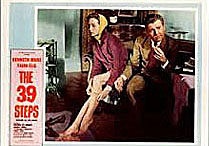
Along the way Hannay meets Miss Fisher (Tania Elg), who is traveling with a group of school girls, who doesn’t believe a word he says, but has seen and knows too much, ending up handcuffed to him as he tries to reach London and discover just where and what the 39 steps are (this version does restore the original meaning of the steps of the title even if we never see them).
The cast is first rate, but it is More’s film, and like Robert Donat before him, the success depends greatly on his charm and abilities as a light comedian as much as a dramatic actor. Elg does quite well, but lacks the cool Hitchcock blonde demeanor of Madeline Carroll. It isn’t her fault, even Deborah Kerr had trouble recreating icy Carroll’s beauty in The Prisoner of Zenda scene-for-scene remake. Barry Jones (Brigadoon, Seven Days to Noon) is especially sinister as Professor Logan who exudes charm and threat with the same soft tones.
Sidney James, Reginald Beckwith, and James Hayter all bring their usual skills to bits in the film, as does Brenda de Banzie as a phony medium half convinced of her own con and attracted to all the wrong men. Ralph Thomas was always a competent director and often more, and screenwriter Frank Harvey not only wrote or co-wrote some of the best films of the period but was a first class novelist as well (The Mercenary).
Hitchcock’s film is the classic, and there is no suggestion this is anything but a shadow of that, but it is a strong and quite entertaining shadow, and as the first version of the story I saw, it has some pride of place for me. It served as my introduction to the works of John Buchan and to Kenneth More, and both have served me well in terms of entertainment over the years.
The 39 Steps has been adapted to four films, radio, the stage (a major hit on Broadway and London’s West End), comic books, appeared as a serial in Argosy, and audiobooks. The book is a recognized minor classic (major in the mystery genre), and Alfred Hitchcock’s film a classic in itself.
This version may not reach that high bar, but it does have charm, excitement, wit, and attractive leads in an entertaining film, and that’s not such a low bar to achieve for any film, especially a remake.
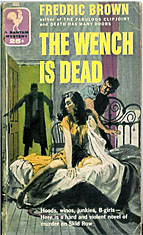
FREDRIC BROWN – The Wench Is Dead. E. P. Dutton, hardcover, 1953. Bantam #1565, paperback, 1957.
This finds Brown in David Goodis territory at his smooth, shattering best.
Howard (“Howieâ€) Perry is a High School sociology teacher studying the denizens of Los Angeles’ skid row by living as one of them as he angles for a master’s degree and a better teaching position. As the story opens he’s staying in a flophouse, washing dishes for a living, and spending most nights on the street, drinking himself comatose among the other winos, all in the name of Research.
He’s also carrying on a relationship of sorts with Billie, a good-natured B-Girl who likes him for his sensitive nature, and expresses her affection in a very physical way. There’s a murder early on, and the cops don’t know whodunit, but we’re not far into the book before we realize that this is not so much a mystery as it is an observation of Howard losing control and in danger of becoming one of the derelicts he’s supposed to be studying.
Brown keeps his story light, moving the plot along with telling details about Howie and his chums as they instinctively duck the police, desperately try to make up the price of a bottle, and stake out a safe place to drink themselves unconscious. Like David Goodis, Brown never looks down on his bums and winos, nor does he seek to make them noble savages; they’re just guys getting along their own way, with their own norms and goals in life, and in Brown as well as Goodis, these are the heroes of pulp fiction.
In fact, Howie does eventually solve the murder and see the killer brought to justice, but (again like Goodis) any sense of accomplishment is illusory. Howard Perry spends a whole murder mystery treading water, and if we see the ending coming a long way off, Fredric Brown still delivers it with a punch.
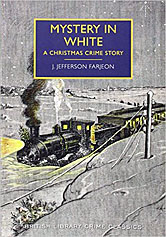
J. JEFFERSON FARJEON – Mystery in White. British Library, UK, softcover, 2014. Introduction by Martin Edwards. First published by Collins Crime Club, UK, hardcover, 1937. Bobbs-Merrill, US, hardcover, 1938.
There were some “lost classics” published during the Golden Age of Detection, I am sure, and this is almost — but not quite — one of them. The good news, though, is that as a puzzle story there are parts of Mystery in White that are absolutely terrific. If actual detective work in the crime fiction you read is your meat, this is definitely one you should not miss. The original edition is difficult, if not impossible, to find, but the recent reprint illustrated here is easy to obtain, and happily so.
This one starts out on a train stranded in a sudden blizzard that has blown up just before Christmas, and the passengers in one compartment decide as a group to hoof it through the snow to the next station. Not a good idea, as it turns out, since if trains can’t get through, then how can people on foot?
Suddenly a haven appears. A house with the lights on, the door unlocked, a blazing fire in the fireplace, and the table set for tea. But — and it’s a huge but — the house is otherwise empty. What should they do? Take advantage of the shelter, they decide, and repay their unseen host later, when they can.
But wait, there’s more. Apparently a murder was committed on the train, and a killer is on the loose. Strange noises are heard in the house, which also seems to have ghostly emanations throughout. And more: footprints in the snow are found coming and going all night long. There is also more than one murder committed, perhaps as many as three.
Doing an excellent job of deduction, at least in the first two-thirds of the book is the “old man” his fellow passengers first met on the train, or that is to say, Mr Edward Maltby of the Royal Psychical Society, and for a change, he allows his deductions to be challenged by the others — an absolute breath of fresh air from the infallible detectives of other books, those who hold back their thoughts and conclusions until the book is almost over and they’re finally ready to point their finger at the guilty party or parties.
It is too much too hope for, then, with such a buildup of atmosphere, clues and various cries for help and other mysterious events in the night, that the ending — and a final explanation — can live up to what precedes. Alas, it doesn’t, and nothing probably could. Anything less than pure legerdemain would be a letdown, and there’s too much tramping around in blizzard conditions and waist-high snow to be realistic. This is a book that’s still a lot of fun to read, but as I said in the first paragraph above, a lost classic? No, far from it, but it’s good enough that I wish I could say otherwise!