Reviews


JANET DAWSON – Kindred Crimes. St. Martin’s Press, hardcover, 1990. Fawcett Crest, paperback, May 1992.

   This is the first of fifteen recorded cases tackled and solved by Oakland-based PI Jeri Howard, including four novellas, and it’s a good one. I’m not alone in holding that opinion. Kindred Crimes won the St. Martin’s Press/PWA contest for best first private eye novel. It was also nominated in the best first novel category for the Shamus, the Macavity and the Anthony.

   In this novel Jeri is hired by a forlorn husband whose wife left their baby son with his grandparents, cleaned out their joint checking account and completely disappeared. Using nothing more than feet and wheels on the ground, Jeri discovers that the missing woman had married him under a phony name, and that her brother had been convicted of killing their parents when they were still children.

   This is a tough-minded detective story. Hints of child abuse immediately come to Jeri’s mind. If you don’t care for detective stories in which the detective gets too emotionally involved with the case she is working on, this may not be the book for you.

   Dawson is a smooth but not overly slick writer, and the puzzle aspect is as well done as the characters. If you decide that this is the kind of book you’d like to read, I think you’ll see why Jeri Howard has managed to hang around for quite a while now.

       The Jeri Howard series —

1. Kindred Crimes (1990)
2. Till the Old Men Die (1993)

3. Take a Number (1993)
4. Don’t Turn Your Back On the Ocean (1994)
5. Nobody’s Child (1995)

6. A Credible Threat (1996)
7. Witness to Evil (1997)
8. Where the Bodies Are Buried (1998)
9. A Killing at the Track (2000)

10. Bit Player (2011)
11. Jeri Howard Casebook: 4 Stories (2011)
12. Cold Trail (2015)

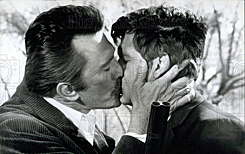
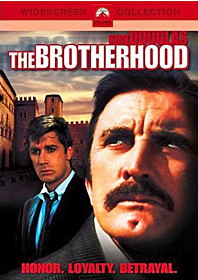
THE BROTHERHOOD. Paramount Pictures, 1968. Kirk Douglas, Alex Cord, Irene Papas, Luther Adler, Susan Strasberg, Murray Hamilton, Eduardo Ciannelli. Music: Lalo Schifrin. Producer: Kirk Douglas. Director: Martin Ritt.

   I don’t know where this movie fits precisely into the chronology of Mafia-based crime films, but while there were certainly gangster movies before The Brotherhood was filmed, in terms of realism, none were quite like this one. It was also four years before The Godfather showed up and finally convinced everyone how they were supposed to be done.

   The story has it that when this one bombed so badly at the box office, it took quite a while to convince the people at Paramount to do another one, which of course was The Godfather.

   The reason I bring this up is that, well, first of all, the movie is actually quite good, but if you can’t place it properly in the evolution of Mafia movies, it can be viewed as a whole series of clichés. Kirk Douglas plays Frank Ginetta, an old-fashioned Mafia don based in New York City; Alex Cord is his (much) younger Vince, who’s gone to college, is home from Viet Nam, has just gotten married, and wants to join the “firm.” Big brother Frank is elated.

   But Vince and the other members of the council want to abandon the old ways and start finding new ways to invest their money and talents. This causes all kinds of problems, as you can imagine. Frank also finds out who provided the tip-off that happened many years ago that resulted in the massacre of over 40 members of the Mafia at the time, including Frank’s father.

   Frank does not take this very well, and his actions leave Vince squarely in the middle. Kirk Douglas takes this role and makes it entirely his own. He is an ebullient lover of his family, good food and happy times, and yet he casually and reminiscently tells someone about the first hit he ever made — when he was eighteen years old.

   Alex Cord, in contrast, and perhaps deliberately so, downplays his role so low that you barely know he’s in the film. He’s grim and dour while his brother’s innate nature is cheerful and charming. The ending is perhaps inevitable, but the getting there is not only absorbing, but a lot of fun to watch.

   If the movie didn’t do well financially, perhaps the movie audiences of the day were simply not ready for it. Another possibility, of course, is that I’m the only one in the world who has ever enjoyed it, but I’m fairly sure that that’s not so.

REVIEWED BY BARRY GARDNER:


SUE GRAFTON – “I” is for Innocent. Kinsey Millhone #9. Henry Holt, hardcover, 1992. Fawcett, paperback, 1993.

   I like the way Sue Grafton writes. Depending on the day and the book, she is quite often my favorite writer of female PI stories, and Kinsey Millhone my favorite female PI; both are always high on the list regardless of sex. Not surprisingly, I enjoyed the ninth Kinsey.

   Kinsey has lost her office and sinecure with California Fidelity, and is now freelancing with a Santa Teresa law firm. One of the partners is handling a civil suit involving a murder; the defendant has been acquitted of criminal charges in the murder of his wife, but her family hasn’t given up.

   The private detective who has been working on the case for the firm has died of a heart attack, and the lawyer wants Kinsey to take over. She does, and finds there are a lot more loose ends to tie up than she had thought. Even worse, key witnesses begin to lose credibility and the possibility of the defendant’s innocence looms large; not what Kinsey is supposed to be proving.

   The plot is twisty and well handled, though once again there is the obligatory shootout at the end; these have become so prevalent that they have begun to annoy me even when justified. Kinsey is her usual very human, appealing self — which is to say that I like the voice Grafton gives her. The book is written in her straightforward narrative style, refreshingly free from angst and unfocused anger. She writes a detective story rather than a polemic, and by now you’ve probably figured out that I prefer the former. A good book in a good series — what more do you want?

— Reprinted from Fireman, Fireman, Save My Books #5, January 1993.

ERLE STANLEY GARDNER – The Case of the Sun Bather’s Diary. William Morrow & Co., hardcover, 1955. Serialized in The Saturday Evening Post from March 5 to April 23, 1955. Reprinted many times in paperback, including Cardinal C268, February 1958; Pocket 4514, 1963; Ballantine, July 1982.

   You have to hand it to Erle Stanley Gardner for consistently coming up with openings that are sure to attract the reader’s attention, and this is certainly one of them. Della Street answers the telephone in the very first paragraph and calling is a young woman in quite a predicament. (Della’s very words.) She’s been robbed of absolutely everything, including every stitch of clothing.

   It seems as though she’s a “nature girl” who lives in a secluded trailer and likes to wander around nude but hidden from view in the California sun. When she returns to the trailer containing all her belongings, she finds it gone.

   Now this aspect of the story has little to do with the rest of the case, but you have to admit, it makes the reader sit up and take notice. As it turns out, the case involves her father who is in prison for having stolen a payroll of nearly $400,000 from an armored car. How it was done is unknown, since the money was under watch at both ends of the delivery route, as well as during.

   Also unknown is where the money is, which is why Perry’s client is under such strict scrutiny. Perry is one of those hands-on kind of attorneys, and in this one, as it so happens, if his client didn’t commit the murder that happens about halfway through, then Perry is the only other one who could have done it.

   Well, we know he didn’t, and we doubt that his client did, but how on earth could anyone else have done it? In spite of thinly written characters and his usual only utilitarian prose, Gardner as always has several tricks up his sleeve, and Perry utterly flummoxes D.A. Hamilton Burger once again, who is convinced that this time he has Perry dead to rights.

   I defy anyone to figure this one out in advance. I sure didn’t.

Reviewed by JONATHAN LEWIS:


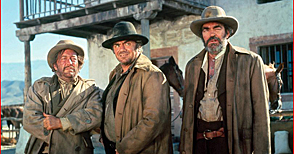
HANNIE CAULDER. Tigon British Film Productions, UK, 1971. Paramount Pictures, US, 1972. Raquel Welch, Robert Culp, Ernest Borgnine, Jack Elam, Strother Martin, Christopher Lee, Diana Dors. Director: Burt Kennedy.

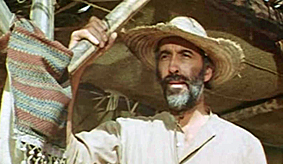
   Hannie Caulder is the type of movie that could only have been made in the 1970s, a time of comparably anarchic freedom for directors, producers, and screenwriters. Take a few well known characters actors and cast them as buffoonish rapists, add a strong willed feminist protagonist to be portrayed by a leading sex symbol, and then cast Robert Culp and Christopher Lee as a bounty hunter and a gunsmith, respectively, and you’ve got yourself a Western cult classic in the making.

   But wait, there’s more. While a Spaghetti Western aesthetic, replete with notably fake red blood, gives the film a gritty edge, a mysterious character, a gunslinger dressed from head to toe in black, adds a quasi-mystical element to the proceedings.

   Raquel Welch stars as the film’s title character, a woman who is savagely raped and beaten by three outlaw brothers portrayed by Ernest Borgnine, Jack Elam, and Strother Martin. After that experience, Hannie Caulder sets out on a course of revenge against the men who attacked her and murdered her husband.

   Soon enough, she comes under the tutelage of bounty hunter Thomas Luther Price (Culp), a solitary man who – not surprisingly – begins to develop romantic feelings toward Hannie. Price is a man torn. On the one hand, he’s willing to teach Hannie the art of gun fighting; on the other, he doesn’t want Hannie to become a killer like he is.

   All told, Hannie Caulder is a solid revenge Western. Look for Christopher Lee in his portrayal of Bailey, a boutique gunsmith camped out in Mexico. The interactions between his character and Price and Hannie Caulder are among the best in this truly unique Burt Kennedy film. It may not be among the best Westerns ever filmed, but it’s certainly a spunky little 1970s meditation on violence that isn’t easily forgotten.

THE BACKWARD REVIEWER
William F. Deeck


THE GORDONS – Campaign Train. Doubleday Crime Club, hardcover, 1952. Bantam 1475, paperback, 1956; Popular Library, paperback, no date stated, both as Murder Rides the Campaign Train.

   A hopeful assassin rides the campaign train of Gov. Wallace X. Martin, candidate for the presidency. Worse, Martin’s No. 2 secretary, 19-year-old Jackie Moxas, whom he has rescued from a correctional institution, is looking for the assassin in order to lend him (or her) her support. No good deed goes unpunished, someone has rightly contended.

   Moxas despises the governor for what he once did and is now doing to her. all of which is imaginary. When she discovers who the assassin is, her views begin to change.

   Not a sympathetic character, Moxas, but convincingly drawn by The Gordons are the political background and the campaign.

— Reprinted from MYSTERY READERS JOURNAL, Vol. 6, No. 3, Fall 1990, “Political Mysteries.”

EARL DERR BIGGERS – Behind That Curtain. Bobbs-Merrill, hardcover, 1928. Serialized in The Saturday Evening Post between March 31 and May 5, 1928. Paperback reprints include: Pocket #191, 1942; Paperback Library 52-296, June 1964; Pyramid, 1969; Bantam, 1974; Mysterious Press, 1987.

   A Charlie Chan mystery, of course, the third of six, and one I first read some 60 odd years ago. I found that I didn’t remember the mystery at all. Only two things came back to me as I was reading. First, the frustration Charlie felt in not being able to return his treasured home town of Honolulu from the mainland (San Francisco) in order to meet his new born son, his eleventh child. The demands of the current case he is working on require him to stay. No loose ends for the noted Detective-Sergeant Chan!

   The second aspect of the tale that I dimly recalled was the romantic elements, the witty courtship between Charlie’s host, wealthy Barry Kirk, and June Morrow, the young female deputy district attorney who is assigned the case. When I read this back sometime in the 1950s, I thought this part of the story was boring, if not out-and-out boring. I was wrong. This time around I found it charming, as in the best of black-and-white light-hearted romantic films made a little later, once movie-makers learned how to make the best use of the new sound techniques available to them.

   Dead is a retired Scotland Yard detective who obsession with two unsolved cases, possibly related, has brought him all the way from England to California. All his notes are also stolen, indicating that he was closing in on bringing one to a conclusion, that of a young 18-year-old girl, a new bride who disappeared without a trace in Peshawar, India, fifteen years ago.

   The case is extremely complicated. There are plenty of suspects and lots of clues, many of them relevant, but equally many that are not, and all of them have to be checked out, as well as alibis. Adding to the pleasure of the reading this old-fashioned traditional mystery is Biggers’ dialogue and prose, which simply flows.

   I don’t know that this is exactly a fair play mystery, but the solution to the crime is very clever, and the romance? Well, all’s well that ends well, and this one does.

Reviewed by DAVID VINEYARD:


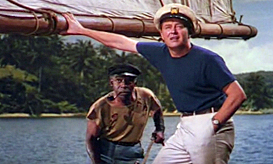
JAMAICA RUN. Paramount Pictures, 1953, Ray Milland, Arlene Dahl, Wendell Corey, Patric Knowles, Carroll McComas, Bill Walker, Laura Elliot (Kasey Rogers), Murray Matheson, Clarence Muse, Michael Moore, Robert Warwick, Lester Matthews. Based on the novel A Neat Little Corpse by Max Murray. Director: Lewis R. Foster.

   â€œGreat House, piracy, war, slavery, and murder, everything in Comeback Bay has grown out of violence.”        — Mrs. Dacey (Carroll McComas)

   We are in Gothic country à la Rebecca in this attractive film adaptation of mystery novelist Max Murray’s novel A Neat Little Corpse. Ray Milland is Captain Patrick Fairlie, returning to Comeback Bay in Jamaica on a mission after the war; first, to establish his old business running the islands in his boat, and second, to reclaim his one time wife, Ena Dacey (Arlene Dahl) held captive by the neediness of her sodden mother (Carroll McComas) and brother Todd (Wendell Corey) who drove a younger Fairlie away before the war.

   Fairlie soon learns things aren’t any better. Mrs. McComas hates him for threatening to take Ena away, Todd is still arrogant and short tempered, and Human (Bill Walker) the butler and houseman still runs the house and the natives with Obeah powers in one hand and Dacey influence in the other.

   A new element though is William Montagu (Patric Knowles) looking to buy the beach front property, and interested in an old legend that the house was sold to another Dacey whose boat went down in a great storm with the evidence. He has found the heirs to that Dacey, Janice and Robert Clayton (Laura Elliot and Michael Moore), and wants Fairlie to dive on the old wreck to look for evidence of the sale.

   Things are tense enough before Robert is found at the bottom of the ocean with his skull caved in, murdered.

   Montague: One doesn’t lose a brother every day.

   Todd: One couldn’t unless one had an awful lot of brothers.

   Fairlie finds the chest with the papers, but not before he is nearly murdered by another diver and Janice Clayton nearly suffers a fatal riding accident.

   Meanwhile things are getting more complicated with Todd finally coming around as he and Janice seem to fall for each other — or is he merely scheming to keep Great House, and Obeah man Human is casting spells and determined that the Dacey’s will never leave Great House no matter what the cost.

   Ena: Human has cast a spell. The rolling calf is loose and someone must die.

   Save for some rather unconvincing underwater scenes, and perhaps a too obvious villain (the book was a little better in that regard), there is some decent suspense generated and some good detective work including a well handled hearing where the truth is revealed, thanks to Fairlie’s detective work and help from the local police (Murray Matheson). The ending is nicely ironic and exciting giving the grand old place a proper Gothic send-off, since as someone once put it, Gothic fiction of the modern kind is about women getting a house, and often losing it and getting a man instead.

   Though no auteur, Lewis R. Foster (who started as a writer on films like Mr. Smith Goes to Washington, It Happened Tomorrow, and The Farmer’s Daughter) was a capable director whose work in the late forties and fifties include some of my favorite minor A films of the era including Armored Car, The Lucky Stiff, Manhandled, Captain China, and Those Redheads From Seattle before moving primarily to television where he directed numerous series ranging from Four Star Playhouse to Zorro, Tales of Wells Fargo, and Walt Disney’s Wonderful World of Color along with a few films like Dakota Incident and Tonka.

   Jamaica Run won’t top anyone’s list, but it is an attractive and involving mystery, well acted, tightly directed, and with more than enough to keep most mystery fans involved.

Reviewed by JONATHAN LEWIS:


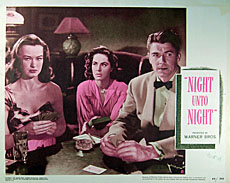
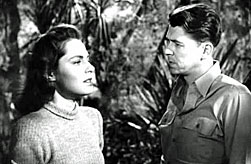
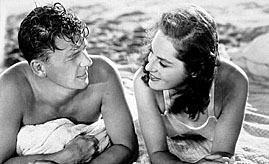
NIGHT UNTO NIGHT. Warner Brothers, 1949. Ronald Reagan, Viveca Lindfors, Broderick Crawford, Rosemary DeCamp, Osa Massen, Art Baker, Craig Stevens. Based on the novel by Philip Wylie. Director: Don Siegel.

   Years before he directed Clint Eastwood, Don Siegel worked with Ronald Reagan in Night Unto Night, a romantic melodrama with a tinge of sunshine noir. Set on Florida’s alternatingly sunny and stormy East coast, this early film by Siegel is overall a highly uneven feature, but is nonetheless an immensely watchable postwar psychological thriller that defies easy categorization. Consider it a Gothic romance crossed with a ghost tale, or as a crime film without really any significant criminal act. It’s not great, but it’s good.

   Reagan and Viveca Lindfors portray star-crossed lovers, each living in the shadow of death. Reagan’s character, John Galen, is a scientist in the business of developing medicine to save lives. In one of life’s dark ironies, he learns that he is slowly beginning to develop epilepsy. His response to this is to flee from his native Chicago and rent a house on the Florida coast. Most importantly, he wants to be alone and to shut out the world.

   That’s easier said than done, however, as he slowly becomes entangled with two European sisters, Ann Gracy (Lindfors) and her highly seductive sister, Lisa (Osa Massen). After Lisa fails to seduce Galen, she becomes enraged when it’s revealed that Galen and Ann have fallen in love.

   If things weren’t complicated enough for our physically declining protagonist, he soon learns how psychologically scarred Ann is from the death of her first husband. So devastatingly broken in fact, that she hears his voice speaking to her from beyond the grave. Unfortunately, Lindsfors tends to overact these scenes, making them more maudlin than terrifying.

   Siegel’s use of atmosphere in cinematic storytelling, on the other hand, can’t be beat. Add in a dark and stormy night battering the windows of an old house, a gun collection, and you’ve got yourself one overwrought post-war melodrama that tries, even if not all that successfully, to say something about love conquering death. Still, for Reagan fans and those interested in seeing what Siegel’s early output was like, Night Unto Night, at a running time of less than ninety minutes, is well worth the effort.

REVIEWED BY BARRY GARDNER:


SARAH DUNANT – Birth Marks. Hannah Wolfe #1. Doubleday, hardcover, 1992. First published in the UK: Michael Joseph, hardcover, 1991.

   This is Sarah Dunant’s second mystery, but the first (I believe) featuring London-based private detective Hannah Wolfe.’ I believe we have a winner here.

   Hannah accepts a job that’s basically a missing persons case — young ballet dancer hasn’t send her more-or-less adopted mother a card when she should have, and the woman is concerned. Though Hannah first believes that the young woman simply wanted not to be found, she takes the case because she needs the money. After the investigation has begun, but before anything substantive has been learned, the missing dancer is fished out of the Thames, dead, an apparent suicide, eight months pregnant.

   Based on what she’s learned, Hannah doesn’t believe it,`nor does someone else: she is retained by an anonymous client to investigate further. The` trail leads to Paris, and leads Hannah into an ever-deepening questioning of her own feelings about motherhood.

   Hannah Wolfe was not only believable, but appealing, and altogether the best feminine PI I’ve met in a long while. The character was beautifully developed, as were those of her sister, her ex-boss and “mentor,” and several others. Dunant’s prose style is literate and understated, and the narrative flow was very good.

   This was an excellent book. There were no unbelievable characters, the plot made sense, the writing was fine, and it didn’t end in an orgy of violence. I don’t want to go overboard, but I liked this better than any first book (for me) I’ve read in a while. You need to give this lady a try.

— Reprinted from Fireman, Fireman, Save My Books #5, January 1993.


       The Hannah Wolfe series —

Birth Marks. Joseph, 1991.
Fatlands. H. Hamilton, 1993.
Under My Skin. H. Hamilton, 1995.

« Previous PageNext Page »