Reviews


Reviewed by DAVID VINEYARD:         


THE YELLOW ONE. CCC Filmkunst, Germany, 1964. Originally released in West Germany as Der Schut; also released in the US as The Shoot and Yellow Devil. Lex Barker, Maria Versini, Rolf Wolter, Rik Battlaglia, Marianne Hold, Friedrich von Ledebur, Pierre Fromont, Dusan Janicijevic, Dieter Borsche, Chris Howland. Screenplay Georg Marischka and (uncredited) Robert Siodmak, based on the novel by Karl May. Directed by Robert Siodmak.

   If you ever wondered what a Lone Ranger movie set in the Balkans would be like this Old Eastern is your movie. Lex Barker, who played beloved German author Karl May’s hero, Old Surehand, in a series of Westerns about Apache chief Winnetou with Pierre Brice, sails for the old world and the Balkans here as Old Surehand’s Middle Eastern incarnation (it’s the same character) Kara Ben Nemsi (variously Karl the German or Karl Blackbeard) author May’s stand in.

   Based on the last of a five novel sequence that began with In The Desert and known as the Oriental Odyssey (yes, I know it isn’t what we mean by the Orient and the term Oriental is considered derogatory today), Der Schut or The Shoot and sometimes The Yellow One, brings to a close Kara Ben Nemsi’s sojourn through the Ottoman Empire with an action-packed fight to the death with a master criminal known as der Shut who he has seen traces of throughout his Mid East adventures.

   Nirwan (Rik Battaglia) a wealthy merchant approaches Sir David Lindsey (Dieter Borsche) and his man Archie (Chris Howland) on Sir David’s yacht when he makes port in Albania to ask his help to rescue journalist Henri Galingre (Pierre Fromont) held captive by der Schut and help the interior region of the Skipetars, Albanian Muslims, escape the oppressive reign of terror of the mysterious kidnaper der Schut, and naturally Sir David turns to his friend Kara Ben Nemsi and hadji Halef (Lex Barker and Rolf Wolter), his servant, to join the quest.

   The comical Sir David and his servant are recurring characters in the novels who at various times either complicate the action or inadvertently help things along depending on their level of incompetence.

   Karl May was a beloved German storyteller who survived tragedy and a criminal past to write uplifting books that became beloved young adult literature. His Winnetou and Old Surehand books inspired Indian Clubs like the Boy Scouts that popped up all over Europe, and his admirers include as diverse a readership as Albert Einstein, Albert Schweitzer, Herman Hesse, Henrik Siekiewicz (the great Polish national novelist, author of Quo Vadis and his own attempt at a Karl May book Into The Desert) and Adolph Hitler.

   May’s philosophy can be found in his autobiography and in his allegorical novel Ardijistan and Djistan but shines through in his avatar, the moral and stalwart Kara Ben Nemsi/Old Surehand who can best be described as a cross between Superman, James Bond, Indiana Jones, the Lone Ranger, Davy Crockett, and Jesus Christ.

   Kara Ben Nemsi first appeared in German cinema in the silent era then again in the late thirties and the nineteen fifties, and again in the sixties with two outings starring Lex Barker and Rolf Wolter, this and Durch Wilde der Kurdistan. There was also a serialized German television series adapting the Kara Ben Nemsi novels, some episodes of which can be seen in German on YouTube. May’s books certainly contributed to the popularity of Eastern themes in German popular literature and cinema that includes the original Kismet, Joe May’s serial The Indian Tomb, and Fritz Lang’s dyptich remaking the serial in 1958.

   Wolter also appeared with Barker in two non Winnetou Westerns based on May’s works (and reviewed here) all directed by Robert Siodmak (Phantom Lady, The Spiral Staircase) brother of writer Curt Siodmak (Donovan’s Brain and the screenplay for The Wolfman) who, like Fritz Lang, returned to his homeland late in his career. Wolter was a popular character actor perhaps best known here for his role in Cabaret as Lisa Minneli and Michael York’s clueless fellow boarder who represented the German’s people failure to comprehend what was happening in their country.

   Kara Ben Nemsi and Halef are joined by Omar (Dusan Janicijevc) whose wife Tschita (Maria Versini) has been kidnaped by der Schut and by the wife of kidnaped Henri Galigre, Annette (Marianne Hold) in their quest, hampered by the fact der Schut knows they are coming and has laid traps for them along the way.

   Kara and Halef free a village from the heavy hand of der Schut’s man the Mubarek (Friedrich von Neidbhur, Queequeg in John Huston’s Moby Dick, a nobleman who liked to dabble in acting), and in typical Karl May plotting style, just about all of the heroes are captured and escape multiple times learning a bit here and there as they go and trimming down the numbers of the opposition. Whatever aspirations the books may have the plotting is pure pulp adventure revealing their origins as serialized novels.

   Like the Winnetou films these are handsome productions shot on location in gorgeous widescreen color with large casts and numerous well done set pieces that here vary from being ambushed from above on a barge, an attack by an escaped bear, being dragged behind a fleeing wagon, trapped in a burning house surrounded by the enemy, hand to hand combat, daring escapes, speeding horses, the cavalry coming to the rescue, well at least the Turkish cavalry, and Kara Ben Nemsi and Halef’s deadly marksmanship, though you might question why the film needs quite so much comic relief (Halef, Sir David, and the servant Archie) and notice almost exactly the same actors are in all the Barker films (Battaglia must have tired of being killed by Barker after four outings) and Old Albania looks a lot like the Old West.

   Barker, not the most expressive of actors, even gets a dramatic scene where he weeps when his beloved horse is killed before he walks off into the sunset, I suppose to return to the Old West and Winnetou (though the latter is killed in the books). At least some of the books carry Kara/Old Surehand around the world in adventures though those were never filmed. Anyway it is one of the few times you will see Barker exhibit any emotion in a film other than stalwart heroics are mild bemusement save for his outing as Q Patrick’s Peter Duluth in The Female Fiends.

   This one does exist in a dubbed English version though the German version available on YouTube is free and a fine handsome print. Once you know the plot you won’t miss a lot since the story is pretty straight forward right down to der Schut’s jealous wife who helps Tschita escape. My German is atrocious and it has been years since I read the book, but I had no problem following the plot or what was being said.

   This is old-fashioned movie making, a Western with burnooses instead of war feathers and turbans and fez rather than buckskins and ten gallon hats. The cast is competent, the action well choreographed, cinematography and direction both well above the average, and the Saturday matinee style plot well executed. It’s actually quite a bit of fun, though I still haven’t quite figured out what the Lone Ranger and Tonto were in Albania for in the first place.
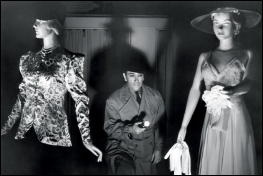
Reviewed by JONATHAN LEWIS:


HERO AND THE TERROR. Golan-Globus Productions/Cannon Films, 1988. Chuck Norris, Brynn Thayer, Steve James, Jack O’Halloran, Jeffrey Kramer, Ron O’Neal. Based on the novel by Michael Blodgett. Director: William Tannen.

   Chuck Norris shows his sensitive side in this somewhat effective, although hardly outstanding, Cannon Films thriller. Indeed, there’s enough suspense in Hero and The Terror to keep the viewer engaged with what turns out to be a rather formulaic story about a cop determined to stop a deranged serial killer.

   Norris portrays Danny O’Brien, a Los Angeles cop nicknamed “Hero.” O’Brien, who is as much a brooder as a fighter, is haunted by nightmares stemming from the time in which he successfully apprehended a notorious serial killer named Sam Moon (Jack O’Halloran). Moon, who doesn’t speak a word in the entire movie, is known as “The Terror.” And it’s not difficult to understand why. He’s less of a serial killer in the cop drama sense than some sort of hulking, supernatural evil. What are his motivations? We never learn.

   Time has passed and O’Brien is now in a relationship with his therapist, Kay (Brynn Thayer) and trying to move on with his life. But reality intrudes and intrudes hard. Turns out that The Terror might have successfully escaped from a mental institution and resumed his nefarious activities. So it’s up to O’Brien to once and for all exercise his demons and to stop The Terror. There aren’t too many surprises in this story, but it’s kind of mindless fun to see Norris shed his ultra tough guy persona for a little while.

THE BACKWARD REVIEWER
William F. Deeck


REX STOUT – The Broken Vase. Farrar & Rinehart, hardcover, 1941. Paperback reprints include: Dell #115, ca.1946; Pyramid R-1149, “A Green Door Mystery,” 1965; Bantam Crimeline, 1995.

   At a friend’s behest, Tecumseh Fox contributed $2,000 to the purchase of a Stradivarius violin for “the next Sarasate.” Attending the premier performance of the violinist at Carnegie Hall, Fox finds it mildly enjoyable, but the music lovers are aghast at the performance. So, too, is the violinist, who, in front of witnesses, kills himself during the intermission.

   The violin is stolen and then returned. Fox is asked to investigate the circumstances by the violinist’s rich patron and later is hired to find out who committed a murder.

   On the cover of the [Pyramid] paperback the publisher says, “As great as Nero Wolfe.” Well, publishers will have their little drolleries. Nonetheless, while a Fox is not a Wolfe, this is a good, fair-play novel that should make the reader want to find the earlier Fox novels to find out more about this detective.

— Reprinted from MYSTERY READERS JOURNAL, Vol. 6, No. 1, Spring 1990, “Musical Mysteries.”


      The Tecumseh Fox series —

Double for Death. Farrar & Rinehart, 1939.
Bad for Business. Farrar & Rinehart, 1940.
The Broken Vase. Farrar & Rinehart, 1941.

GHOST STORY “The New House.” NBC. Pilot episode, 60m, 17 March 1972. Sebastian Cabot (host), David Birney, Barbara Parkins, Sam Jaffe, Jeanette Nolan, Caitlin Wyles. Written by Richard Matheson. Producer: William Castle. Director: John Llewellyn Moxey.

   As the pilot film for a proposed series, Ghost Story: The New House was aired in the spring of 1972, paired up, I am told, with the pilot for another series, the name of which I do not know, nor of course do I know whether the other would-be series was successful or not. [LATER: But see the first comment!] Ghost Story was picked up, however, with the first episode of its first and only season airing on 15 September 1972.

   There were in total 23 episodes in this anthology series with a supernatural slant, including the pilot, but it ran into difficulty 13 shows into the run. The series went off the air briefly on 22 December 1972, and when it came back on 5 January 1973 under the title Circle of Fear. Sebastian Cabot as the host was dropped, and the emphasis was no longer on ghost stories.

   Ghost Story came along a year before Thriller, a somewhat similar series created by Brian Clemens appeared in the UK, and even though the shows I’ve seen so far from the latter have been uneven in quality, unfortunately I think the worst has been better than “The New House.”

   What it is is the story of a young couple, the wife pregnant, who move into a new house, only to find that it was built on the land where a young girl in the 18th century was hanged for stealing a loaf of bread. Soon the wife begins to hear strange noises at night, with no apparent cause, even though she wakes her husband up to go check. He is very exasperated by this, since he hears nothing.

   There was one short scene that made me jump, close to the end with the power off (in the story) and a thunderstorm crashing all around the house, the wife alone with the newly born baby.

   Other than that, I was not convinced. Neither star seemed to really get into the spirit of things, nor — even though I am sure this was done deliberately — do I believe that newly built homes in the US with dishwashers and modern two-car garages are conducive to ghostly hauntings. They seem to do this kind of story a whole lot better in England.

   I also think that once you accept the premise that ghosts can exist, and that they are not necessarily friendly, that they ought to act logically, not bang around and make nuisances of themselves when they really have evil intent in mind.

Reviewed by JONATHAN LEWIS:


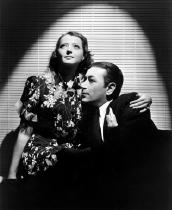
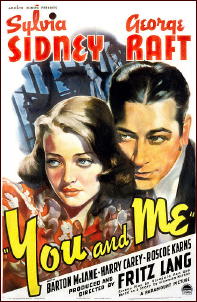
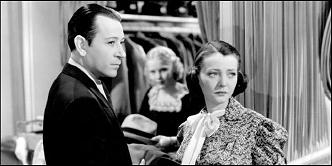
YOU AND ME. Paramount Pictures, 1938. Sylvia Sidney, George Raft, Robert Cummings, Barton MacLane, Roscoe Karns, Harry Carey. Director: Fritz Lang.

   “Genuinely odd but likable film.” That’s how Leonard Maltin described Fritz Lang’s decidedly uneven, but eminently watchable, gangster film/romantic comedy mash-up starring George Raft and Sylvia Sidney as two former jailbirds turned lovebirds. Both work in a department store run by a man who wants nothing more than to give parolees a second chance at building an upstanding life.

   Sounds typical enough, right?

   The thing is: Maltin’s correct.

   You and Me is nothing if not “genuinely odd.” With an Old World comedic sensibility with more than a dash of Yiddishkeit, an armed standoff in the children’s section of an Art Deco department store, and some captivating dreamlike montage sequences, this relatively obscure crime melodrama didn’t fare well at the box office.

   That’s not surprising, given how much of the movie feels as if it were almost an experimental film, a cult classic before there were cult classics.

   When looked at as a whole, the final product actually seems like a thought experiment in which Lang, either consciously or subconsciously, explored the possibilities of bringing both the aesthetic and thematic elements of German expressionism into the American crime film genre.

   Skillful use of light and shadow to convey meaning (check); a prominent spiral staircase (check); a subterranean meeting of criminals operating according to their own code with camera shots that look straight out of M (check).

   Some scenes, such as when a group of gangsters remember their time in the slammer, work extraordinarily well; others, such as when Sidney’s character instructs a coterie of criminals in basic math to demonstrate why crime (literally) doesn’t pay, fall flat. Yet, it’s difficult not to find some things to genuinely admire in this quirky film, one that surely left most audiences slightly baffled when first released in the late 1930s.

REVIEWED BY WALTER ALBERT:         


SHARON FIFFER – Dead Guy’s Stuff. St. Martin’s, hardcover, 2002; paperback, 2003.

   Jane Wheel is an antiques “picker” (similar to a book scout who finds books for dealers, Jane has a gift for spotting treasures among other people’s trash, which she then sells to e dealer who’s “sponsoring” her). Jane is not only a scout for other people, she’s also a collector of Bakelite. (Even after reading the book, I was a bit unclear about this product, but wife volunteered the information that she remembered it as plastics used in the manufacture of dinnerware. She then made a quick web search courtesy of Google and found that its use dates back to at least the 1930s and includes the manufacture of appliances and jewelry, among other products.)

   This unfortunately reminded me of shows I go to where glassware predominates with books and magazine relegated to also-ran status. Still, the obsession in itself is still recognizable to any collector and who am I to look down on any knowledgeable collector, whatever the field?

   Anyhow, Jane has found a collection of tavern memorabilia, which resonates with her tavern-owning parents who are renovating their bar and grill in Kankakee, Illinois.

   To my mind, the whole subject is somewhat cluttered, and the novel is, too, with gangsters and long-buried family secrets in the mix. In addition, her marriage is shaky and and she and her husband are only maintaining a relationship for their teen-age son.

      The Jane Wheel series —

1. Killer Stuff (2001)

2. Dead Guy’s Stuff (2002)
3. The Wrong Stuff (2003)
4. Buried Stuff (2004)

5. Hollywood Stuff (2006)
6. Scary Stuff (2009)
7. Backstage Stuff (2011)

8. Lucky Stuff (2012)

REVIEWED BY BARRY GARDNER:


RANDY WAYNE WHITE – The Heat Islands. St. Martin’s, hardcover, 1992; paperback, February 1993.

   I’d been unaware of White’s books until the ladies at The Mystery Bookstore here very kindly loaned me the advance proofs of the current offering. The first in the series, Sanibel Flats, evidently didn’t make it to my local library branch, and I somehow missed seeing it reviewed.

   Ford is a marine biologist with his own small biological supply company, operated out of a stilt house on Sanibel Island, Florida, that is both home and laboratory. All told, it’s the laid-back good life.

   As we begin, the most hated man on the barrier islands is found floating face down in Dinkin‘s Bay. He was the owner/operator of the local marina, and had alienated enough people that suspects were in plentiful supply. One of Doc’s friends, a fishing guide, quickly becomes the prime suspect, but Doc doesn’t believe it, and begins his own investigation. An oddball relationship with a lady tennis pro enlivens things somewhat.

   You know, I just can’t think of a whole lot to say about this one. I enjoyed reading it, in a mild sort of way; White writes adequately enough; Old Doc is a decent enough leading man; there really wasn’t anything to gripe about, so why aren’t I more positive? I don’t know, but I’m not.

   Good enough for checking out of the library, but I’m glad I didn’t buy it.

— Reprinted from Fireman, Fireman, Save My Books #3, September 1992.


IAN ALEXANDER – The Disappearance of Archibald Forsyth. Hutchinson & Co., UK, no date stated [1933].

   Back in the printed version of Mystery*File, issue #46, one of the items in Al Hubin’s “Addenda to Crime Fiction IV” columns revealed that Ian Alexander was a previously unknown pen name of Alexander Knox.

   In the very same issue, and totally unconnected with the Hubin entry, Charlie Shibuk mentioned Alexander Knox as one of the actors who appeared in Andre DeToth’s film None Shall Escape. This very remarkable coincidence went unnoticed by me, but naturally Charlie spotted it right away. He added the following information, which appeared in the letter column of M*F 47: “Knox was born in Canada in 1907 and appeared on stage and screen in England and America. He portrayed the title role in Wilson (1944).”

   Not only that, but he was nominated for an Oscar for his performance in that film.

   As for his crime-writing career, this book at hand is the only one Knox wrote as Ian Alexander. In the 70s he wrote two novels included in Hubin’s Crime Fiction IV, both historical adventure novels based on the Canadian wilderness of the late 18th century. As Leonard Blackledge, he wrote one crime novel entitled Behind the Evidence (Hutchinson, 1935), and as John Crozier, he wrote two others: Murder in Public (Hutchinson, 1934) and Kidnapped Again (Hutchinson, 1935)

   Both of the latter two novels featured a character called “Falcon,” who doubtlessly was not the Falcon of movie and radio fame, and created in book form by Drexel Drake in 1936. (Or was it Michael Arlen, in a 1940 short story called “Gay Falcon”? The radio series always credited Drake as creator of the character, who was called Michael Waring; Arlen was always the one stated as creating the fellow in the 1940s movie series: either Gay Lawrence (George Sanders) or Tom Lawrence (Tom Conway).)

   No more digressions, however. The sleuth in The Disappearance of Archibald Forsyth is a very interesting fellow, indeed, and it’s a shame that this was apparently his only case on record. His name is Eagels, he works and has a growing reputation as a private investigator in London, at least with Scotland Yard. He’s also, well, I’m going to do some extensive quoting here, if you don’t object too loudly. From pages 12-13:

   Eagels was a man whom it was impossible to pump. Most people have their little weaknesses, their penetrable moments, but Conway [from Scotland Yard] has never seen this tall figure when it was not utterly self-possessed, the features composed and unmoving, the dark eyes caves above the high cheek-bones, caves with fire in their depths. Eagles was a North American Indian. His father has been a chief of the Iroquois, has done well in Canada and given his son an excellent education along the lines of the white man he saw about him, but he had not neglected to give him the keys to the great storehouse of the knowledge of his own race.

   Eagels never had a Christian name that anybody knew. His skin was remarkably fair for an Indian, and he had served seven years with the Royal Canadian Mounted Police before he was connected with the bootlegging case that made his name in America. He had come to England shortly after, a strange man, gaunt and somewhat uncanny. Already his unusual facilities were being noticed by Scotland Yard. He had worked with the Yard on several cases while he was still connected with the R.C.M.P., and there was a mutual respect between them which the passing months did nothing to diminish.

   Eagels’ secretary and trusted assistant is Millicent Doe, who also deserves a mention. They make an unusual couple working together. From pages 20-21:

   They were working late. Eagels had dinner sent in at about eight-thirty, and for half an hour they left their desks and ate a strange, silent meal by the fire. They were odd companions. The perky, rather hard American girl, bred on the Broadway booze racket, efficient, capable, terse, emotionless, and the Indian, inheritor of a vanishing race. When they talked it was as if what went between the lines was more important than what was said.

   Question: Is this the first appearance of an American Indian as a detective? How many others are there?

   Here is something else equally striking. Read this, taken from page 72, as Eagels is thinking over the case so far (and yes, I promise to tell you something about that sometime soon as well):

   Conway might go to the house if he liked with a preconceived theory, but he wouldn’t. With this fact fixed in his mind, the complete refusal to theorize in advance which he had learned from Holmes himself the only time he had met him, Eagels listened to the conversation of the others.

   On page 97, Eagels considers what to do about a butler with an unfortunate habit of listening at doors:

   â€œI suppose,” he said, half aloud, half to himself, “that a bribe to keep his mouth shut would only open it wider. Old proverb: ‘Mouth shut with wampum will open with more.’”

   From pages 102-103 we find a tidbit of understanding about Eagels’ philosophy of human nature:

   Eagels could not help throwing a backward glance at the gloomy house as he left it, and thinking of the tortured hours the two children were going through [it is their father who has disappeared, probably murdered], hours that would probably echo all through their lives with recurring misery. He wondered if the influence which was behind it all had ever thought of the effect his actions would have on the happiness of the people he touched. Even the most callous, ordinary person, he thought, would have some consideration for other people’s feelings. This seemed to him sufficient distinction between the ordinary person and the person who is capable of murder.

   Crimes of sudden passion excepted, Eagels worked on the theory that a murderer is never a perfectly ordinary being. He is lacking in some quality, some essential element of humanity. He was quite convinced that a normal person is as incapable of murder as he is incapable of building a sky-scraper single-handed.

   I have been thinking about the next quote, whether to include it or not, and I’ve decided, what the hey, let’s go all the way. From pages 126-127:

   â€œAnyway,” said Conway, suddenly heaving a sigh, “this proves one thing that we’ve been thinking. It’s a gang that’s at the bottom of the whole business. If it is a murder, there must have been at least two people to get the body away from the church, and if it was enforced disappearance, they must have had more. If he disappeared himself, there are strange goings on which I can only explain by bringing in a gang. I can’t see the motive, though, that’s the worrying part.”

   â€œYes,” said Eagels, “I’d thought of that. A gang seems the only solution. At least it seems the only solution at present. I don’t like it. If it was murder, it was too clever for a gang. The best murders are done by specialists – no accomplices. If it wasn’t murder, I don’t understand what has happened since. What about the will? Have you looked into Forsyth’s financial position?”

   â€œHe’s not as rich as he was five years ago, but then, who is?” [Remember that is was 1933.]

   â€œHe’s quite sound? No wriggling out of debts or anything?”

   â€œNo debts that I can see. He was a careful old miser.”

   â€œWhat do you think of the note he left?”

   â€œThe one you pinched from me, you mean?”

   â€œThe one we made the little mistake about.”

   â€œMistake my eye.” Conway grinned. “I don’t see why you wanted to have it; it was obviously a forgery.”

   â€œToo damned obviously.”

   â€œWhat do you mean?”

   â€œWell, I haven’t examined it yet, but it looks to me as if Forsyth was disguising his own hand.”

   Conway whistled.

   Luckily Miss Doe is a forgery expert, among other skills, but Eagels’ outwardly competent and calm facade does not reveal the torment roiling up inside. From pages 230-231:

   If he had been resolved before, Eagels was filled now with a determination that comes to few men. Down somewhere deep within him there was smouldering a terrible hatred. He admitted to himself that he had muddled the case horribly. The detectives of fiction that never make a mistake never occurred to him. He remembered the great detectives of reality – Sherlock Holmes himself – had sometimes been saved from grave errors by luck, and luck alone, but could he expect luck now? Holmes had never depended on luck. “Get your man.” The catchword was still branded on his brain. “Get your man.”

   â€œI’ll free Donald,” he swore to Joan. “Please, please trust me.”

   There is more. On page 233 Eagels is confronted with an important document that has disappeared from a locked safe:

   Could Feeny have taken the paper away with him? No. Eagels had read it after he left. Conway? No, he didn’t even know of its existence, and the porter had said no one climbed the stair after he went out. Therefore nobody entered the office at all. But the paper was gone!

   Nobody entered the office.

   Eagles thought carefully, remembering that if there was a contradiction in facts, it did not mean the facts were definitely wrong. It meant that his connection or interpretation was wrong.

   There is a lot of confusion that occurs just before the end. A lot of action that goes on that doesn’t seem to have nay meaning – until at length, in Chapter Sixteen, beginning with page 278, all is revealed. That it takes most of ten pages is quite telling. If this is your kind of detective fiction, as it is mine, usually, and yes, it’s probably an acquired taste today, you’re going to wish that this was not the only recorded appearance of detective Eagels.

— April 2015.


[UPDATE] 12-28-15.   I didn’t realize how long this review, was. I hope you made it here all the way through to the bottom, but I suppose that on occasion the scroll bar on the right side of your screen does have its uses. If by chance I happen to have intrigued you a little about this book, I regret to tell you that a search online two minutes ago turned up exactly no copies.

   More importantly, however, after writing this review I attempted to answer my own question and started putting together a checklist of Native American detectives in mystery fiction. I haven’t worked on it in ten years, but at the time I think w=it was fairly complete. Take a look, should you be so inclined.

   Please also read the comments. The first is from Jamie Sturgeon, who had some interesting information to report on the two books Knox wrote as John Crozier.

Reviewed by JONATHAN LEWIS:


JOHN PAUL JONES. Warner Brothers, 1959. Robert Stack, Marisa Pavan, Charles Coburn (Benjamin Franklin), Erin O’Brien, Bette Davis (Empress Catherine the Great), Macdonald Carey (Patrick Henry), Jean Pierre Aumont (King Louis XVI), David Farrar, Peter Cushing. Director: John Farrow.

   Aside from an exciting naval battle sequence toward the end of the film in which the title character, portrayed by Robert Stack, faces off with Sir Richard Pearson (Peter Cushing) and shouts that he has yet to begun to fight, John Paul Jones is an epic bore. It’s not so much that it’s a poorly constructed film or without a talented coterie of actors as it is that the script is remarkably, almost painfully, lifeless.

   In many ways, the movie, at a running time just over two hours, plods along from scene to scene, many of which are exceptionally abbreviated in nature. Sad to say, but at times this Technicolor film plays less like a fictionalized historical drama than as an educational biopic classroom film. That’s not to say that John Farrow wasn’t a talented director or that he wasn’t capable of creating solid movies worth watching. Unfortunately, John Paul Jones simply isn’t one of his more durable works.

   As far as Robert Stack, he may very well have been perfectly adequate in his portrayal of the Scottish-born Revolutionary War hero, but that just wasn’t enough. There’s something a little too stiff, almost genteel in the manner in which Stack portrays Jones. One could imagine other actors with a little more grit and subdued rage – Kirk Douglas and Jeff Chandler come to mind – in his stead.

   But then again, with a script that plays it safe and never once allows the title character to lose his cool or show some warm-blooded passion, it’s difficult to imagine John Paul Jones as any anything but a meandering daytime cruise to nowhere particularly exciting.

Reviewed by DAVID VINEYARD:          

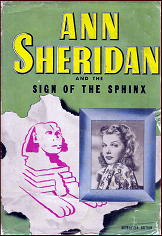
KATHRYN HEISENFELT – Ann Sheridan and the Secret of the Sphinx. Whitman, hardcover, 1943. Illustrated by Henry E. Vallely.

   If it were dark and the lights were on, the neon display would be much more effective. But even now, swaying from the suspended black bar, it did have the look of an old sampler. Since she turned the last corner, Ann Sheridan had kept her eyes on it, eagerly, expectantly. She thought to herself, “Tess has come up another notch in the world. And I’m glad — glad!”

   Again, braving the ferocity of the wind, she was forced to bend her head, to put her free hand to the small blue hat atop the gold-spun hair that fell almost to her shoulders. In her left hand, her spacious bag was cradled against her side. The gold tweed suit, with its short fitted jacket and wide striped scarf, was intended for lamb-like weather. But March in Coreyville, Ann decided emphatically, was on the lion side.

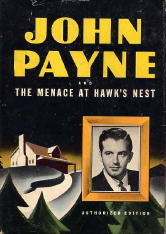
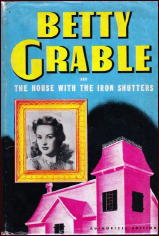
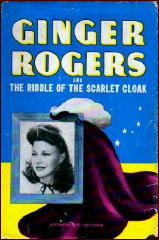
   In this age of the celebrity, we think we have seen everything, but truth is there is nothing new under the celebrity sun when it comes to exploiting fame. Whitman, the people behind the Big Little Book, came up with a series of books for older readers in the 1940‘s, and beyond the usual cowboy stars, and comic strip heroes they carried it one step farther with adventures of Hollywood stars like Shirley Temple, Ginger Rogers, Deanna Durbin, John Payne, and others.

   This one features the Ooompf Girl from Denton, Texas, red-haired Ann Sheridan, who visits her friend Tess Whitehouse at her new beauty salon and soon finds herself up to her pretty neck in a mystery involving a mysterious Egyptian Sphinx cult:

   She saw now that the man’s face was a deep reddish tan. Black hair grew back from a high forehead. He was facing the light from a wall lamp, and his cheek bones seemed to jut out in a sunken face. His eyes were snapping black and mercilessly intent. Ann pulled her gaze from those eyes and in a brief moment studied the unusual clothing, the long-sleeved, black embroidered coat that hung loosely, the baggy dark trousers, gathered tight at the ankles. Around the man’s waist was a wide, red sash. Tucked in the sash was a curved knife, sharp and shining.

   Without knowing it, Ann’s hand that held the key came up to her mouth. She felt her heart mounting in her throat, almost exploding with her terror. She heard a strange, strangled cry and knew it was her own voice.

   With a leap like a panther’s, the man was at her side. Fingers of steel closed over her mouth. Wings seemed to beat over her head, faster, faster, the whirl of sound growing so that all thought, all fear was drowned out.

   Of course Ann solves the mystery with help of an attractive young man named Crunch, without the slightest hint of romance, but well within the B movie mystery formula the book falls into.

   The best part of the book are the attractive illustrations by Henry Vallely, the king of the Big Little Book illustrators whose work graced the adventures of the Lone Ranger, Tom Mix, the Green Hornet, and the Big Little Books own superhero, Maximo. His illustrations are outstanding examples of the art, more than can be said of the story.

   Other adventures in this series include Betty Grable and The House With The Iron Shutters, John Payne and the Menace at Hawk’s Nest, Jane Withers and the Phantom Violin, Judy Garland and the Hoodoo Costume, Ann Rutherford and the Key to Nightmare Hall, Ginger Rogers and the Riddle of the Scarlet Cloak, and Deanna Durbin and the Feather of Flame.

   It may strike you almost all of these titles fall into the mystery genre in one way or another. If most are like this they are simple low level reads for slightly older children — eight and up — along the line of Nancy Drew or the Hardy Boys or the Rover Boys and Frank Merriwell before them.

   There is a little mystery, a few minor scares, and a bit of action. I grant this one is more collectable than readable, but its worth the effort if only for the handsome Vallely illustrations.

   Looking at Harry Potter, Anthony Horowitz’s Alex Rider, and the Hunger Games we can at least note how young adult literature has improved. We can consider ourselves lucky we don’t have to deal with Justin Beiber and the Jailer’s Daughter or Myley Cyrus and the Obscene Gesture.

« Previous PageNext Page »